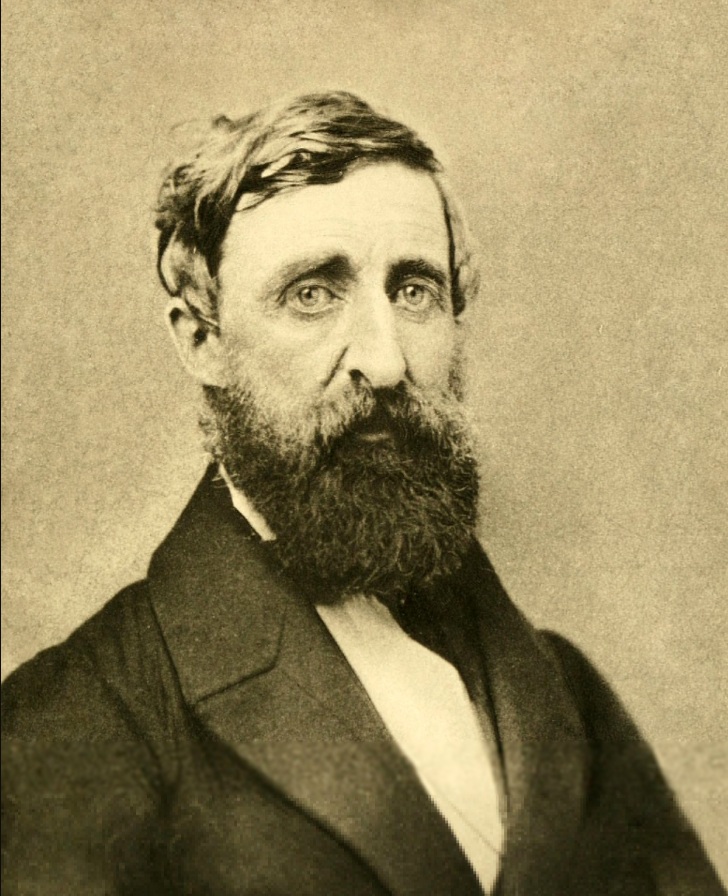
This essay was derived from the lecture "What Shall It Profit?",
which Thoreau first
delivered on 6 December 1854, at Railroad Hall in Providence Rhode Island.
He delivered
it several times over the next two years, and edited it for publication
before he died in
1862. It was first published in the October 1863 issue of The Atlantic Monthly ( Volume
12, Issue 71, pp. 484--495.) where it was given its modern title.
AT a lyceum, not long since, I felt that the lecturer had chosen a theme too foreign to
himself, and so failed to interest me as much as he might have done. He
described things
not in or near to his heart, but toward his extremities and superficies. There was, in this
sense, no truly central or centralizing thought in the lecture. I would
have had him deal
with his privatest experience, as the poet does. The greatest compliment that was ever
paid me was when one asked me what I thought, and attended to my answer. I am surprised,
as well as delighted, when this happens, it is such a rare use he would
make of me, as if
he were acquainted with the tool. Commonly, if men want anything of me, it is only to know
how many acres I make of their land,—since I am a surveyor,—or, at most, what trivial news
I have burdened myself with. They never will go to law for my meat; they prefer the shell.
A man once came a considerable distance to ask me to lecture on Slavery;
but on conver-
sing with him, I found that he and his clique expected seven-eighths of
the lecture to be
theirs, and only one-eighth mine; so I declined. I take it for granted,
when I am invited to
lecture anywhere,—for I have had a little experience in that business,—that there is a desire
to hear what I think on some subject, though I may be the greatest fool
in the country,—and
not that I should say pleasant things merely, or such as the audience will
assent to; and I
resolve, accordingly, that I will give them a strong dose of myself. They have sent for me,
and engaged to pay for me, and I am determined that they shall have me,
though I bore them
beyond all precedent.
So now I would say something similar to you, my readers. Since you are my readers, and I
have not been much of a traveller, I will not talk about people a thousand miles off, but
come as near home as I can. As the time is short, I will leave out all
the flattery, and retain
all the criticism.
Let us consider the way in which we spend our lives.
This world is a place of business. What an infinite bustle! I am awaked almost every
night
by the panting of the locomotive. It interrupts my dreams. There is no sabbath. It would be
glorious to see mankind at leisure for once. It is nothing but work, work, work. I cannot ea-
sily buy a blank-book to write thoughts in; they are commonly ruled for
dollars and cents.
An Irishman, seeing me making a minute in the fields, took it for granted
that I was calcula-
ting my wages. If a man was tossed out of a window when an infant, and so made a cripple
for life, or scared out of his wits by the Indians, it is regretted chiefly
because he was thus
incapacitated for—business! I think that there is nothing, not even crime, more opposed to
poetry, to philosophy, ay, to life itself, than this incessant business.
There is a coarse and boisterous money-making fellow in the outskirts of our town, who is
going to build a bank-wall under the hill along the edge of his meadow.
The powers have put
this into his head to keep him out of mischief, and he wishes me to spend three weeks dig-
ging there with him. The result will be that he will perhaps get some more
money to hoard,
and leave for his heirs to spend foolishly. If I do this, most will commend
me as an indus-
trious and hard-working man; but if I choose to devote myself to certain labors which yield
more real profit, though but little money, they may be inclined to look
on me as an idler.
Nevertheless, as I do not need the police of meaningless labor to regulate me, and do not
see anything absolutely praiseworthy in this fellow's undertaking, any more than in many
an enterprise of our own or foreign governments, however amusing it may
be to him or
them, I prefer to finish my education at a different school.
If a man walk in the woods for love of them half of each day, he is in danger of being re-
garded as a loafer; but if he spends his whole day as a speculator, shearing
off those woods
and making earth bald before her time, he is esteemed an industrious and enterprising citi-
zen. As if a town had no interest in its forests but to cut them down!
Most men would feel insulted, if it were proposed to employ them in throwing
stones over
a wall, and then in throwing them back, merely that they might earn their
wages. But many
are no more worthily employed now. For instance: just after sunrise, one summer morning, I
noticed one of my neighbors walking beside his team, which was slowly drawing a heavy
hewn stone swung under the axle, surrounded by an atmosphere of industry,—his day's
work
begun,—his brow commenced to sweat,—a reproach to all sluggards and idlers,—pausing
a-
breast the shoulders of his oxen, and half turning round with a flourish
of his merciful whip,
while they gained their length on him. And I thought, Such is the labor which the American
Congress exists to protect,—honest, manly toil,—honest as the day is long,—that makes his
bread taste sweet, and keeps society sweet,—which all men respect and have
consecrated:
one of the sacred band, doing the needful, but irksome drudgery. Indeed, I felt a slight re-
proach, because I observed this from the window, and was not abroad and
stirring about a
similar business. The day went by, and at evening I passed the yard of another neighbor,
who keeps many servants, and spends much money foolishly, while he adds
nothing to the
common stock, and there I saw the stone of the morning lying beside a whimsical structure
intended to adorn this Lord Timothy Dexter's premises, and the dignity
forthwith departed
from the teamster's labor, in my eyes. In my opinion, the sun was made
to light worthier toil
than this. I may add, that his employer has since run off, in debt to a good part of the town,
and, after passing through Chancery, has settled somewhere else, there
to become once
more a patron of the arts.
The ways by which you may get money almost without exception lead downward.
To have
done anything by which you earned money merely is to have been truly idle or worse. If the
laborer gets no more than the wages which his employer pays him, he is
cheated, he cheats
himself. If you would get money as a writer or lecturer, you must be popular,
which is to go
down perpendicularly. Those services which the community will most readily pay for it is
most disagreeable to render. You are paid for being something less than a man. The State
does not commonly reward a genius any more wisely. Even the poet-laureate
would rather
not have to celebrate the accidents of royalty. He must be bribed with a pipe of wine; and
perhaps another poet is called away from his muse to gauge that very pipe.
As for my own
business, even that kind of surveying which I could do with most satisfaction
my employers
do not want. They would prefer that I should do my work coarsely and not too well, ay, not
well enough. When I observe that there are different ways of surveying,
my employer com-
monly asks which will give him the most land, not which is most correct. I once invented a
rule for measuring cord-wood, and tried to introduce it in Boston; but
the measurer there
told me that the sellers did not wish to have their wood measured correctly,—that
he was
already too accurate for them, and therefore they commonly got their wood measured in
Charlestown before crossing the bridge.
The aim of the laborer should be, not to get his living, to get "a good job," but to perform
well a certain work; and, even in a pecuniary sense, it would be economy
for a town to pay
its laborers so well that they would not feel that they were working for low ends, as for a
livelihood merely, but for scientific, or even moral ends. Do not hire
a man who does your
work for money, but him who does it for love of it.
It is remarkable that there are few men so well employed, so much to their
minds, but that
a little money or fame would commonly buy them off from their present pursuit. I see ad-
vertisements for active young men, as if activity were the whole of a young
man's capital.
Yet I have been surprised when one has with confidence proposed to me,
a grown man, to
embark in some enterprise of his, as if I had absolutely nothing to do, my life having been
a complete failure hitherto. What a doubtful compliment this is to pay
me! As if he had met
me half-way across the ocean beating up against the wind, but bound nowhere, and pro-
posed to me to go along with him! If I did, what do you think the underwriters would say?
No, no! I am not without employment at this stage of the voyage. To tell
the truth, I saw
an advertisement for able-bodied seamen, when I was a boy, sauntering in my native port,
and as soon as I came of age I embarked.
The community has no bribe that will tempt a wise man. You may raise money
enough to
tunnel a mountain, but you cannot raise money enough to hire a man who
is minding his
own business. An efficient and valuable man does what he can, whether the community
pay him for it or not. The inefficient offer their inefficiency to the
highest bidder, and are
forever expecting to be put into office. One would suppose that they were rarely disap-
pointed.
Perhaps I am more than usually jealous with respect to my freedom. I feel that my con-
nection with and obligation to society are still very slight and transient.
Those slight labors
which afford me a livelihood, and by which it is allowed that I am to some
extent service-
able to my contemporaries, are as yet commonly a pleasure to me, and I
am not often
reminded that they are a necessity. So far I am successful. But I foresee, that, if my
wants should be much increased, the labor required to supply them would
become a drudg-
ery. If I should sell both my forenoons and afternoons to society, as most appear to do, I
am sure, that, for me, there would be nothing left worth living for. I trust that I shall nev-
er thus sell my birthright for a mess of pottage. I wish to suggest that a man may be very
industrious, and yet not spend his time well. There is no more fatal blunderer than he who
consumes the greater part of his life getting his living. All great enterprises are self-sup-
porting. The poet, for instance, must sustain his body by his poetry, as
a steam planing-
mill feeds its boilers with the shavings it makes. You must get your living by loving. But
as it is said of the merchants that ninety-seven in a hundred fail, so
the life of men gen-
erally, tried by this standard, is a failure, and bankruptcy may be surely
prophesied.
Merely to come into the world the heir of a fortune is not to be born,
but to be still-
born, rather. To be supported by the charity of friends, or a government-pension,—pro-
vided you continue to breathe,—by whatever fine synonymes you describe these rela-
tions, is to go into the almshouse. On Sundays the poor debtor goes to
church to take
an account of stock, and finds, of course, that his outgoes have been greater
than his
income. In the Catholic Church, especially, they go into Chancery, make a clean con-
fession, give up all, and think to start again. Thus men will lie on their backs, talking a-
bout the fall of man, and never make an effort to get up.
As for the comparative demand which men make on life, it is an important
difference
between two, that the one is satisfied with a level success, that his marks can all be
hit by point-blank shots, but the other, however low and unsuccessful his life may be,
constantly elevates his aim, though at a very slight angle to the horizon.
I should much
rather be the last man,—though, as the Orientals say, "Greatness doth
not approach
him who is forever looking down; and all those who are looking high are
growing poor."
It is remarkable that there is little or nothing to be remembered written on the subject
of getting a living: how to make getting a living not merely honest and honorable, but
altogether inviting and glorious; for if getting a living is not so, then living is not. One
would think, from looking at literature, that this question had never disturbed a solitary
individual's musings. Is it that men are too much disgusted with their
experience to
speak of it? The lesson of value which money teaches, which the Author of the Uni-
verse has taken so much pains to teach us, we are inclined to skip altogether.
As for
the means of living, it is wonderful how indifferent men of all classes are about it, e-
ven reformers, so called,—whether they inherit, or earn, or steal it. I
think that society
has done nothing for us in this respect, or at least has undone what she
has done.
Cold and hunger seem more friendly to my nature than those methods which men have
adopted and advise to ward them off.
The title wise is, for the most part, falsely applied. How can one be a wise man, if he
does not know any better how to live than other men?—if he is only more cunning and
intellectually subtle? Does Wisdom work in a tread-mill? or does she teach how to suc-
ceed by her example? Is there any such thing as wisdom not applied to life? Is she
merely the miller who grinds the finest logic? It is pertinent to ask if Plato got his
living in a better way or more successfully than his contemporaries,—or
did he suc-
cumb to the difficulties of life like other men? Did he seem to prevail over some of
them merely by indifference, or by assuming grand airs? or find it easier to live, be-
cause his aunt remembered him in her will? The ways in which most men get their
living, that is, live, are mere make-shifts, and a shirking of the real
business of life,
—chiefly because they do not know, but partly because they do not mean,
any better.
The rush to California, for instance, and the attitude, not merely of merchants, but of
philosophers and prophets, so called, in relation to it, reflect the greatest disgrace on
mankind. That so many are ready to live by luck, and so get the means of commanding
the labor of others less lucky, without contributing any value to society! And that is
called enterprise! I know of no more startling development of the immorality of trade,
and all the common modes of getting a living. The philosophy and poetry and religion
of such a mankind are not worth the dust of a puff-ball. The hog that gets
his living
by rooting, stirring up the soil so, would be ashamed of such company. If I could com-
mand the wealth of all the worlds by lifting my finger, I would not pay
such a price for
it. Even Mahomet knew that God did not make this world in jest. It makes God to be a
moneyed gentleman who scatters a handful of pennies in order to see mankind scramble
for them. The world's raffle! A subsistence in the domains of Nature a
thing to be raf-
fled for! What a comment, what a satire on our institutions! The conclusion will be,
that mankind will hang itself upon a tree. And have all the precepts in
all the Bibles
taught men only this? and is the last and most admirable invention of the
human race
only an improved muck-rake? Is this the ground on which Orientals and Occidentals
meet? Did God direct us so to get our living, digging where we never planted,—and
He
would, perchance, reward us with lumps of gold?
God gave the righteous man a certificate entitling him to food and raiment,
but the
unrighteous man found a facsimile of the same in God's coffers, and appropriated it,
and obtained food and raiment like the former. It is one of the most extensive
sys-
tems of counterfeiting that the world has seen. I did not know that mankind were
suffering for want of gold. I have seen a little of it. I know that it
is very malleable,
but not so malleable as wit. A grain of gold will gild a great surface,
but not so much
as a grain of wisdom.
The gold-digger in the ravines of the mountains is as much a gambler as his fellow
in the saloons of San Francisco. What difference does it make, whether
you shake
dirt or shake dice? If you win, society is the loser. The gold-digger is
the enemy of
the honest laborer, whatever checks and compensations there may be. It is not e-
nough to tell me that you worked hard to get your gold. So does the Devil
work hard.
The way of transgressors may be hard in many respects. The humblest observer who
goes to the mines sees and says that gold-digging is of the character of
a lottery;
the gold thus obtained is not the same thing with the wages of honest toil. But, prac-
tically, he forgets what he has seen, for he has seen only the fact, not
the principle,
and goes into trade there, that is, buys a ticket in what commonly proves
another lot-
tery, where the fact is not so obvious.
After reading Howitt's account of the Australian gold-diggings one evening,
I had in
my mind's eye, all night, the numerous valleys, with their streams, all cut up with foul
pits, from ten to one hundred feet deep, and half a dozen feet across,
as close as
they can be dug, and partly filled with water,—the locality to which men
furiously rush
to probe for their fortunes,—uncertain where they shall break ground,—not knowing
but the gold is under their camp itself;—sometimes digging one hundred
and sixty feet
before they strike the vein, or then missing it by a foot,—turned into demons, and re-
gardless of each other's rights, in their thirst for riches,—whole valleys,
for thirty
miles, suddenly honey-combed by the pits of the miners, so that even hundreds
are
drowned in them,—standing in water, and covered with mud and clay, they work night
and day, dying of exposure and disease. Having read this, and partly forgotten it, I was
thinking, accidentally, of my own unsatisfactory life, doing as others
do; and with that
vision of the diggings still before me, I asked myself, why I might not be washing some
gold daily, though it were only the finest particles,—why I might not sink
a shaft down
to the gold within me, and work that mine. There is a Ballarat, a Bendigo for you,—what
though it were a sulky-gully? At any rate, I might pursue some path, however solitary
and narrow and crooked, in which I could walk with love and reverence. Wherever a
man separates from the multitude, and goes his own way in this mood, there
indeed is
a fork in the road, though ordinary travellers may see only a gap in the
paling. His sol-
itary path across-lots will turn out the higher way of the two.
Men rush to California and Australia as if the true gold were to be found
in that direct-
ion; but that is to go to the very opposite extreme to where it lies. They go prospect-
ing farther and farther away from the true lead, and are most unfortunate
when they
think themselves most successful. Is not our native soil auriferous? Does not a stream
from the golden mountains flow through our native valley? and has not this
for more
than geologic ages been bringing down the shining particles and forming
the nuggets
for us? Yet, strange to tell, if a digger steal away, prospecting for this true
gold, into
the unexplored solitudes around us, there is no danger that any will dog
his steps, and
endeavor to supplant him. He may claim and undermine the whole valley even,
both the
cultivated and the uncultivated portions, his whole life long in peace, for no one will
ever dispute his claim. They will not mind his cradles or his toms. He is not confined
to a claim twelve feet square, as at Ballarat, but may mine anywhere, and wash the
whole wide world in his tom.
Howitt says of the man who found the great nugget which weighed twenty-eight pounds,
at the Bendigo diggings in Australia:—"He soon began to drink; got
a horse, and rode all
about, generally at full gallop, and, when he met people, called out to
inquire if they
knew who he was, and then kindly informed them that he was 'the bloody wretch that
had found the nugget.' At last he rode full speed against a tree, and nearly
knocked his
brains out." I think, however, there was no danger of that, for he
had already knocked
his brains out against the nugget. Howitt adds, "He is a hopelessly ruined man." But he
is a type of the class. They are all fast men. Hear some of the names of
the places
where they dig:—"Jackass Flat,"—"Sheep's-Head Gully,"—"Murderer's
Bar," etc. Is there
no satire in these names? Let them carry their ill-gotten wealth where they will, I am
thinking it will still be "Jackass Flat," if not "Murderer's Bar," where they live.
The last resource of our energy has been the robbing of graveyards on the
Isthmus of
Darien, an enterprise which appears to be but in its infancy; for, according to late ac-
counts, an act has passed its second reading in the legislature of New
Granada, regula-
ting this kind of mining: and a correspondent of the Tribune writes:—"In the dry sea-
son, when the weather will permit of the country being properly prospected,
no doubt
other rich guacas [that is, graveyards] will be found." To emigrants he says:—"Do not
come before December; take the Isthmus route in preference to the Boca
del Toro
one; bring no useless baggage, and do not cumber yourself with a tent;
but a good pair
of blankets will be necessary; a pick, shovel, and axe of good material
will be almost all
that is required": advice which might have been taken from the "Burker's
Guide." And
he concludes with this line in Italics and small capitals: "If you are doing well at home,
STAY THERE," which may fairly be interpreted to mean, "If you
are getting a good living
by robbing graveyards at home, stay there."
But why go to California for a text? She is the child of New England, bred
at her own
school and church.
It is remarkable that among all the preachers there are so few moral teachers.
The pro-
phets are employed in excusing the ways of men. Most reverend seniors, the illuminati
of the age, tell me, with a gracious, reminiscent smile, betwixt an aspiration
and a shud-
der, not to be too tender about these things,—to lump all that, that is,
make a lump of
gold of it. The highest advice I have heard on these subjects was grovelling. The bur-
den of it was,—It is not worth your while to undertake to reform the world in this par-
ticular. Do not ask how your bread is buttered; it will make you sick,
if you do,—and the
like. A man had better starve at once than lose his innocence in the process
of getting
his bread. If within the sophisticated man there is not an unsophisticated one, then he
is but one of the Devil's angels. As we grow old, we live more coarsely, we relax a little
in our disciplines, and, to some extent, cease to obey our finest instincts.
But we
should be fastidious to the extreme of sanity, disregarding the gibes of those who are
more unfortunate than ourselves.
In our science and philosophy, even, there is commonly no true and absolute
account
of things. The spirit of sect and bigotry has planted its hoof amid the stars. You have
only to discuss the problem, whether the stars are inhabited or not, in
order to disco-
ver it. Why must we daub the heavens as well as the earth? It was an unfortunate dis-
covery that Dr. Kane was a Mason, and that Sir John Franklin was another.
But it was
a more cruel suggestion that possibly that was the reason why the former
went in
search of the latter. There is not a popular magazine in this country that would dare
to print a child's thought on important subjects without comment. It must be submit-
ted to the D. D.s. I would it were the chickadee-dees.
You come from attending the funeral of mankind to attend to a natural phenomenon.
A little thought is sexton to all the world.
I hardly know an intellectual man, even, who is so broad and truly liberal that you can
think aloud in his society. Most with whom you endeavor to talk soon come
to a stand
against some institution in which they appear to hold stock,—that is, some particular,
not universal, way of viewing things. They will continually thrust their own low roof,
with its narrow skylight, between you and the sky, when it is the unobstructed hea-
vens you would view. Get out of the way with your cobwebs, wash your windows,
I
say! In some lyceums they tell me that they have voted to exclude the subject
of
religion. But how do I know what their religion is, and when I am near to or far from
it? I have walked into such an arena and done my best to make a clean breast
of
what religion I have experienced, and the audience never suspected what
I was about.
The lecture was as harmless as moonshine to them. Whereas, if I had read to them
the biography of the greatest scamps in history, they might have thought
that I had
written the lives of the deacons of their church. Ordinarily, the inquiry is, Where did
you come from? or, Where are you going? That was a more pertinent question which
I overheard one of my auditors put to another once,—"What does he
lecture for?"
It made me quake in my shoes.
To speak impartially, the best men that I know are not serene, a world in themselves.
For the most part, they dwell in forms, and flatter and study effect only
more finely
than the rest. We select granite for the underpinning of our houses and barns; we
build fences of stone; but we do not ourselves rest on an underpinning of granitic
truth, the lowest primitive rock. Our sills are rotten. What stuff is the man made of
who is not coexistent in our thought with the purest and subtilest truth? I often ac-
cuse my finest acquaintances of an immense frivolity; for, while there
are manners
and compliments we do not meet, we do not teach one another the lessons of hon-
esty and sincerity that the brutes do, or of steadiness and solidity that
the rocks do.
The fault is commonly mutual, however; for we do not habitually demand
any more
of each other.
That excitement about Kossuth, consider how characteristic, but superficial, it was!—
only another kind of politics or dancing. Men were making speeches to him all over
the country, but each expressed only the thought, or the want of thought, of the
multitude. No man stood on truth. They were merely banded together, as usual, lean-
ing on another, and all together on nothing; as the Hindoos made the world rest on
an elephant, the elephant on a tortoise, and the tortoise on a serpent,
and had no-
thing to put under the serpent. For all fruit of that stir we have the Kossuth hat.
Just so hollow and ineffectual, for the most part, is our ordinary conversation. Sur-
face meets surface. When our life ceases to be inward and private, conversation
degenerates into mere gossip. We rarely meet a man who can tell us any news
which he has not read in a newspaper, or been told by his neighbor; and, for the
most part, the only difference between us and our fellow is, that he has seen the
newspaper, or been out to tea, and we have not. In proportion as our inward life
fails, we go more constantly and desperately to the post-office. You may depend
on it, that the poor fellow who walks away with the greatest number of letters,
proud of his extensive correspondence, has not heard from himself this long while.
I do not know but it is too much to read one newspaper a week. I have tried
it
recently, and for so long it seems to me that I have not dwelt in my native region.
The sun, the clouds, the snow, the trees say not so much to me. You cannot
serve two masters. It requires more than a day's devotion to know and to pos-
sess the wealth of a day.
We may well be ashamed to tell what things we have read or heard in our
day. I
do not know why my news should be so trivial,—considering what one's dreams
and expectations are, why the developments should be so paltry.
The news we hear, for the most part, is not news to our genius. It is the
stal-
est repetition. You are often tempted to ask, why such stress is laid on a par-
ticular experience which you have had,—that, after twenty-five years, you
should
meet Hobbins, Registrar of Deeds, again on the sidewalk. Have you not budged
an inch, then? Such is the daily news. Its facts appear to float in the atmosphere,
insignificant as the sporules of fungi, and impinge on some neglected thallus, or
surface of our minds, which affords a basis for them, and hence a parasitic
growth. We should wash ourselves clean of such news. Of what consequence,
though our planet explode, if there is no character involved in the explosion?
In health we have not the least curiosity about such events. We do not
live for
idle amusement. I would not run round a corner to see the world blow up.
All summer, and far into the autumn, perchance, you unconsciously went by the
newspapers and the news, and now you find it was because the morning and
the
evening were full of news to you. Your walks were full of incidents. You
attend-
ed, not to the affairs of Europe, but to your own affairs in Massachusetts
fields.
If you chance to live and move and have your being in that thin stratum in which
the events that make the news transpire,—thinner than the paper on which
it is
printed,—then these things will fill the world for you; but if you soar
above or dive
below that plane, you cannot remember nor be reminded of them. Really to see
the sun rise or go down every day, so to relate ourselves to a universal
fact,
would preserve us sane forever. Nations! What are nations? Tartars, and
Huns,
and Chinamen! Like insects, they swarm. The historian strives in vain to make
them memorable. It is for want of a man that there are so many men. It
is indivi-
duals that populate the world. Any man thinking may say with the Spirit
of Lodin,—
"I look down from my height on nations,
And they become ashes before me;—
Calm is my dwelling in the clouds;
Pleasant are the great fields of my rest."
Pray, let us live without being drawn by dogs, Esquimaux-fashion, tearing over hill
and dale, and biting each other's ears.
Not without a slight shudder at the danger, I often perceive how near I
had come
to admitting into my mind the details of some trivial affair,—the news
of the street;
and I am astonished to observe how willing men are to lumber their minds with
such rubbish,—to permit idle rumors and incidents of the most insignificant
kind to
intrude on ground which should be sacred to thought. Shall the mind be a public
arena, where the affairs of the street and the gossip of the tea-table chiefly
are
discussed? Or shall it be a quarter of heaven itself,—an hypæthral temple, conse-
crated to the service of the gods? I find it so difficult to dispose of the few facts
which to me are significant, that I hesitate to burden my attention with
those
which are insignificant, which only a divine mind could illustrate. Such is, for the
most part, the news in newspapers and conversation. It is important to
preserve
the mind's chastity in this respect. Think of admitting the details of
a single case
of the criminal court into our thoughts, to stalk profanely through their
very san-
ctum sanctorum for an hour, ay, for many hours! to make a very bar-room of the
mind's inmost apartment, as if for so long the dust of the street had occupied us,
—the very street itself, with all its travel, its bustle, and filth had
passed through
our thoughts' shrine! Would it not be an intellectual and moral suicide?
When I
have been compelled to sit spectator and auditor in a court-room for some hours,
and have seen my neighbors, who were not compelled, stealing in from time
to time,
and tiptoeing about with washed hands and faces, it has appeared to my
mind's eye,
that, when they took off their hats, their ears suddenly expanded into vast hoppers
for sound, between which even their narrow heads were crowded. Like the
vanes
of windmills, they caught the broad, but shallow stream of sound, which,
after a
few titillating gyrations in their coggy brains, passed out the other side. I wonder-
ed if, when they got home, they were as careful to wash their ears as before their
hands and faces. It has seemed to me, at such a time, that the auditors and the
witnesses, the jury and the counsel, the judge and the criminal at the
bar,—if I may
presume him guilty before he is convicted,—were all equally criminal, and
a thunder-
bolt might be expected to descend and consume them all together.
By all kinds of traps and sign-boards, threatening the extreme penalty
of the divine
law, exclude such trespassers from the only ground which can be sacred to you. It
is so hard to forget what it is worse than useless to remember! If I am
to be a tho-
roughfare, I prefer that it be of the mountain-brooks, the Parnassian streams, and
not the town-sewers. There is inspiration, that gossip which comes to the ear of
the attentive mind from the courts of heaven. There is the profane and stale reve-
lation of the bar-room and the police court. The same ear is fitted to
receive both
communications. Only the character of the hearer determines to which it
shall be
open, and to which closed. I believe that the mind can be permanently profaned by
the habit of attending to trivial things, so that all our thoughts shall be tinged with
triviality. Our very intellect shall be macadamized, as it were,—its foundation broken
into fragments for the wheels of travel to roll over; and if you would know what will
make the most durable pavement, surpassing rolled stones, spruce blocks,
and as-
phaltum, you have only to look into some of our minds which have been subjected
to this treatment so long.
If we have thus desecrated ourselves,—as who has not?—the remedy will be
by war-
iness and devotion to reconsecrate ourselves, and make once more a fane of the
mind. We should treat our minds, that is, ourselves, as innocent and ingenuous chil-
dren, whose guardians we are, and be careful what objects and what subjects we
thrust on their attention. Read not the Times. Read the Eternities. Conventionalities
are at length as bad as impurities. Even the facts of science may dust
the mind by
their dryness, unless they are in a sense effaced each morning, or rather rendered
fertile by the dews of fresh and living truth. Knowledge does not come
to us by de-
tails, but in flashes of light from heaven. Yes, every thought that passes through
the mind helps to wear and tear it, and to deepen the ruts, which, as in
the streets
of Pompeii, evince how much it has been used. How many things there are con-
cerning which we might well deliberate, whether we had better know them,—had
better let their peddling-carts be driven, even at the slowest trot or
walk, over
that bridge of glorious span by which we trust to pass at last from the
farthest
brink of time to the nearest shore of eternity! Have we no culture, no
refinement,
—but skill only to live coarsely and serve the Devil?—to acquire a little worldly
wealth, or fame, or liberty, and make a false show with it, as if we were
all husk
and shell, with no tender and living kernel to us? Shall our institutions
be like
those chestnut-burs which contain abortive nuts, perfect only to prick
the fing-
ers?
America is said to be the arena on which the battle of freedom is to be fought;
but surely it cannot be freedom in a merely political sense that is meant.
Even if
we grant that the American has freed himself from a political tyrant, he
is still the
slave of an economical and moral tyrant. Now that the republic—the res-publica—
has been settled, it is time to look after the res-privata,—the private state,—to see,
as the Roman senate charged its consuls, "ne quid res-PRIVATA detrimenti cape-
ret," that the private state receive no detriment.
Do we call this the land of the free? What is it to be free from King George
and
continue the slaves of King Prejudice? What is it to be born free and not to live
free? What is the value of any political freedom, but as a means to moral
free-
dom? Is it a freedom to be slaves, or a freedom to be free, of which we
boast?
We are a nation of politicians, concerned about the outmost defences only
of
freedom. It is our children's children who may perchance be really free.
We tax
ourselves unjustly. There is a part of us which is not represented. It is taxation
without representation. We quarter troops, we quarter fools and cattle of all sorts
upon ourselves. We quarter our gross bodies on our poor souls, till the former
eat up all the latter's substance.
With respect to a true culture and manhood, we are essentially provincial
still,
not metropolitan,—mere Jonathans. We are provincial, because we do not find
at home our standards,—because we do not worship truth, but the reflection
of
truth,—because we are warped and narrowed by an exclusive devotion to trade
and commerce and manufactures and agriculture and the like, which are but
means, and not the end.
So is the English Parliament provincial. Mere country-bumpkins, they betray
themselves, when any more important question arises for them to settle,
the
Irish question, for instance,—the English question why did I not say? Their
natures are subdued to what they work in. Their "good breeding" respects
only secondary objects. The finest manners in the world are awkwardness
and fatuity, when contrasted with a finer intelligence. They appear but as the
fashions of past days,—mere courtliness, knee-buckles and small-clothes,
out of date. It is the vice, but not the excellence of manners, that they
are
continually being deserted by the character; they are cast-off clothes or
shells, claiming the respect which belonged to the living creature. You are
presented with the shells instead of the meat, and it is no excuse generally,
that, in the case of some fishes, the shells are of more worth than the meat.
The man who thrusts his manners upon me does as if he were to insist on
introducing me to his cabinet of curiosities, when I wished to see himself. It
was not in this sense that the poet Decker called Christ "the first
true gen-
tleman that ever breathed." I repeat that in this sense the most splendid
court in Christendom is provincial, having authority to consult about Trans-
alpine interests only, and not the affairs of Rome. A prætor or proconsul
would suffice to settle the questions which absorb the attention of the
English Parliament and the American Congress.
Government and legislation! these I thought were respectable professions.
We have heard of heaven-born Numas, Lycurguses, and Solons, in the his-
tory of the world, whose names at least may stand for ideal legislators; but
think of legislating to regulate the breeding of slaves, or the exportation of
tobacco! What have divine legislators to do with the exportation or the
im-
portation of tobacco? what humane ones with the breeding of slaves? Sup-
pose you were to submit the question to any son of God,—and has He no
children in the nineteenth century? is it a family which is extinct?—in
what
condition would you get it again? What shall a State like Virginia say for it-
self at the last day, in which these have been the principal, the staple
pro-
ductions? What ground is there for patriotism in such a State? I derive my
facts from statistical tables which the States themselves have published.
A commerce that whitens every sea in quest of nuts and raisins, and makes
slaves of its sailors for this purpose! I saw, the other day, a vessel which
had been wrecked, and many lives lost, and her cargo of rags, juniper-ber-
ries, and bitter almonds were strewn along the shore. It seemed hardly
worth the while to tempt the dangers of the sea between Leghorn and New
York for the sake of a cargo of juniper-berries and bitter almonds. America
sending to the Old World for her bitters! Is not the seabrine, is not ship-
wreck, bitter enough to make the cup of life go down here? Yet such, to
a great extent, is our boasted commerce; and there are those who style
themselves statesmen and philosophers who are so blind as to think that
progress and civilization depend on precisely this kind of interchange and
activity,—the activity of flies about a molasses-hogshead. Very well, ob-
serves one, if men were oysters. And very well, answer I, if men were
mosquitoes.
Lieutenant Herndon, whom our Government sent to explore the Amazon,
and, it is said, to extend the area of Slavery, observed that there was
wanting there "an industrious and active population, who know what the
comforts of life are, and who have artificial wants to draw out the great
resources of the country." But what are the "artificial wants"
to be en-
couraged? Not the love of luxuries, like the tobacco and slaves of, I be-
lieve, his native Virginia, nor the ice and granite and other material
wealth
of our native New England; nor are "the great resources of a country"
that fertility or barrenness of soil which produces these. The chief want,
in every State that I have been into, was a high and earnest purpose in
its inhabitants. This alone draws out "the great resources" of
Nature, and
at last taxes her beyond her resources; for man naturally dies out of her.
When we want culture more than potatoes, and illumination more than
sugar-plums, then the great resources of a world are taxed and drawn
out, and the result, or staple production, is, not slaves, nor operatives,
but men,—those rare fruits called heroes, saints, poets, philosophers,
and
redeemers.
In short, as a snow-drift is formed where there is a lull in the wind,
so,
one would say, where there is a lull of truth, an institution springs up.
But the truth blows right on over it, nevertheless, and at length blows
it down.
What is called politics is comparatively something so superficial and in-
human, that, practically, I have never fairly recognized that it concerns
me at all. The newspapers, I perceive, devote some of their columns
specially to politics or government without charge; and this, one would
say, is all that saves it; but, as I love literature, and, to some extent,
the truth also, I never read those columns at any rate. I do not wish to
blunt my sense of right so much. I have not got to answer for having
read a single President's Message. A strange age of the world this, when
empires, kingdoms, and republics come a-begging to a private man's door,
and utter their complaints at his elbow! I cannot take up a newspaper
but I find that some wretched government or other, hard pushed, and on
its last legs, is interceding with me, the reader, to vote for it,—more im-
portunate than an Italian beggar; and if I have a mind to look at its certi-
ficate, made, perchance, by some benevolent merchant's clerk, or the
skipper that brought it over, for it cannot speak a word of English itself,
I shall probably read of the eruption of some Vesuvius, or the overflow-
ing of some Po, true or forged, which brought it into this condition. I do
not hesitate, in such a case, to suggest work, or the almshouse; or why
not keep its castle in silence, as I do commonly? The poor President,
what with preserving his popularity and doing his duty, is completely be-
wildered. The newspapers are the ruling power. Any other government is
reduced to a few marines at Fort Independence. If a man neglects to
read the Daily Times, Government will go down on its knees to him, for
this is the only treason in these days.
Those things which now most engage the attention of men, as politics
and the daily routine, are, it is true, vital functions of human society, but
should be unconsciously performed, like the corresponding functions of
the physical body. They are infra-human, a kind of vegetation. I some-
times awake to a half-consciousness of them going on about me, as a
man may become conscious of some of the processes of digestion in a
morbid state, and so have the dyspepsia, as it is called. It is as if a
think-
er submitted himself to be rasped by the great gizzard of creation. Poli-
tics is, as it were, the gizzard of society, full of grit and gravel, and
the
two political parties are its two opposite halves,—sometimes split into
quarters, it may be, which grind on each other. Not only individuals, but
States, have thus a confirmed dyspepsia, which expresses itself, you can
imagine by what sort of eloquence. Thus our life is not altogether a for-
getting, but also, alas! to a great extent, a remembering of that which
we
should never have been conscious of, certainly not in our waking hours.
Why should we not meet, not always as dyspeptics, to tell our bad dreams,
but sometimes as eupeptics, to congratulate each other on the ever glor-
ious morning? I do not make an exorbitant demand, surely.
.