CHAPTER L.
THE JOURNEY TO LIVERPOOL.
Marie Melmotte, as she had promised, sat up all night, as did also
the faithful Didon. I think that to Marie the night was full of
pleasure,--or at any rate of pleasurable excitement. With her door
locked, she packed and unpacked and repacked her treasures,--having
more than once laid out on the bed the dress in which she purposed
to be married. She asked Didon her opinion whether that American
clergyman of whom they had heard would marry them on board, and
whether in that event the dress would be fit for the occasion. Didon
thought that the man, if sufficiently paid, would marry them, and
that the dress would not much signify. She scolded her young mistress
very often during the night for what she called nonsense; but was
true to her, and worked hard for her. They determined to go without
food in the morning, so that no suspicion should be raised by
the use of cups and plates. They could get refreshment at the
railway-station.
At six they started. Robert went first with the big boxes, having his
ten pounds already in his pocket,--and Marie and Didon with smaller
luggage followed in a second cab. No one interfered with them and
nothing went wrong. The very civil man at Euston Square gave them
their tickets, and even attempted to speak to them in French. They
had quite determined that not a word of English was to be spoken by
Marie till the ship was out at sea. At the station they got some very
bad tea and almost uneatable food,--but Marie's restrained excitement
was so great that food was almost unnecessary to her. They took their
seats without any impediment,--and then they were off.
During a great part of the journey they were alone, and then Marie
gabbled to Didon about her hopes and her future career, and all the
things she would do;--how she had hated Lord Nidderdale;--especially
when, after she had been awed into accepting him, he had given her no
token of love;--"pas un baiser!" Didon suggested that such was the
way with English lords. She herself had preferred Lord Nidderdale,
but had been willing to join in the present plan,--as she said, from
devoted affection to Marie. Marie went on to say that Nidderdale was
ugly, and that Sir Felix was as beautiful as the morning. "Bah!"
exclaimed Didon, who was really disgusted that such considerations
should prevail. Didon had learned in some indistinct way that Lord
Nidderdale would be a marquis and would have a castle, whereas Sir
Felix would never be more than Sir Felix, and, of his own, would
never have anything at all. She had striven with her mistress, but
her mistress liked to have a will of her own. Didon no doubt had
thought that New York, with £50 and other perquisites in hand, might
offer her a new career. She had therefore yielded, but even now could
hardly forbear from expressing disgust at the folly of her mistress.
Marie bore it with imperturbable good humour. She was running
away,--and was running to a distant continent,--and her lover would
be with her! She gave Didon to understand that she cared nothing for
marquises.
As they drew near to Liverpool Didon explained that they must still
be very careful. It would not do for them to declare at once their
destination on the platform,--so that every one about the station
should know that they were going on board the packet for New York.
They had time enough. They must leisurely look for the big boxes and
other things, and need say nothing about the steam packet till they
were in a cab. Marie's big box was directed simply "Madame Racine,
Passenger to Liverpool;"--so also was directed a second box, nearly
as big, which was Didon's property. Didon declared that her anxiety
would not be over till she found the ship moving under her. Marie was
sure that all their dangers were over,--if only Sir Felix was safe
on board. Poor Marie! Sir Felix was at this moment in Welbeck Street,
striving to find temporary oblivion for his distressing situation and
loss of money, and some alleviation for his racking temples, beneath
the bedclothes.
When the train ran into the station at Liverpool the two women sat
for a few moments quite quiet. They would not seek remark by any
hurry or noise. The door was opened, and a well-mannered porter
offered to take their luggage. Didon handed out the various packages,
keeping however the jewel-case in her own hands. She left the
carriage first, and then Marie. But Marie had hardly put her foot
on the platform, before a gentleman addressed her, touching his hat,
"You, I think, are Miss Melmotte." Marie was struck dumb, but said
nothing. Didon immediately became voluble in French. No; the young
lady was not Miss Melmotte; the young lady was Mademoiselle Racine,
her niece. She was Madame Racine. Melmotte! What was Melmotte? They
knew nothing about Melmottes. Would the gentleman kindly allow them
to pass on to their cab?
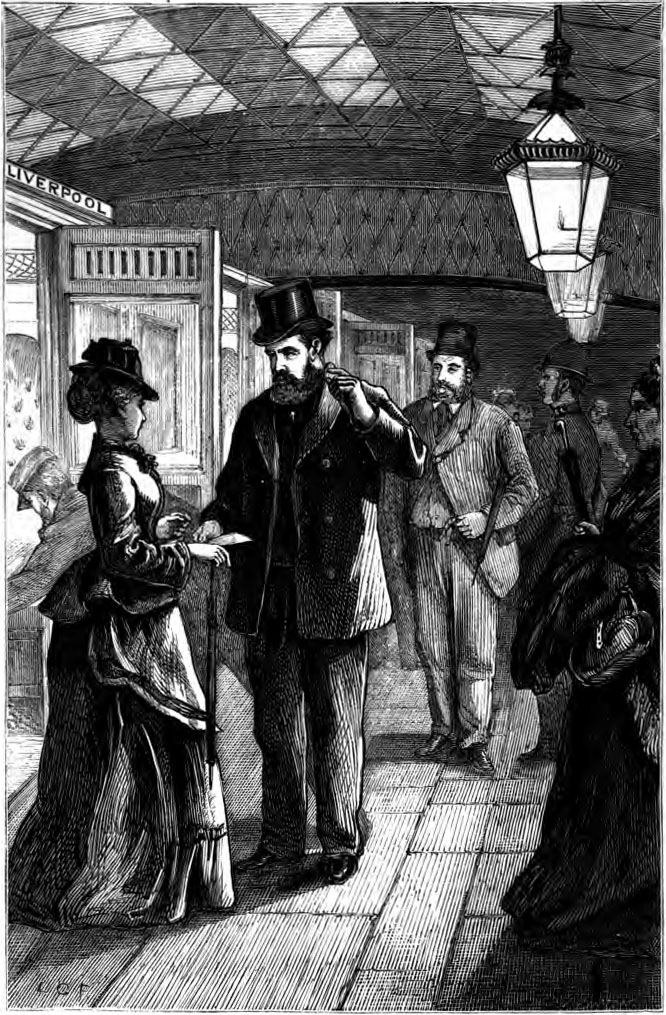
But the gentleman would by no means kindly allow them to pass on to
their cab. With the gentleman was another gentleman,--who did not
seem to be quite so much of a gentleman;--and again, not far in the
distance Didon quickly espied a policeman, who did not at present
connect himself with the affair, but who seemed to have his time very
much at command, and to be quite ready if he were wanted. Didon at
once gave up the game,--as regarded her mistress.
"I am afraid I must persist in asserting that you are Miss Melmotte,"
said the gentleman, "and that this other--person is your servant,
Elise Didon. You speak English, Miss Melmotte." Marie declared that
she spoke French. "And English too," said the gentleman. "I think you
had better make up your minds to go back to London. I will accompany
you."
"Ah, Didon, nous sommes perdues!" exclaimed Marie. Didon, plucking up
her courage for the moment, asserted the legality of her own position
and of that of her mistress. They had both a right to come to
Liverpool. They had both a right to get into the cab with their
luggage. Nobody had a right to stop them. They had done nothing
against the laws. Why were they to be stopped in this way? What was
it to anybody whether they called themselves Melmotte or Racine?
The gentleman understood the French oratory, but did not commit
himself to reply in the same language. "You had better trust yourself
to me; you had indeed," said the gentleman.
"But why?" demanded Marie.
Then the gentleman spoke in a very low voice. "A cheque has been
changed which you took from your father's house. No doubt your father
will pardon that when you are once with him. But in order that we
may bring you back safely we can arrest you on the score of the
cheque,--if you force us to do so. We certainly shall not let you go
on board. If you will travel back to London with me, you shall be
subjected to no inconvenience which can be avoided."
There was certainly no help to be found anywhere. It may be well
doubted whether upon the whole the telegraph has not added more
to the annoyances than to the comforts of life, and whether the
gentlemen who spent all the public money without authority ought not
to have been punished with special severity in that they had injured
humanity, rather than pardoned because of the good they had produced.
Who is benefited by telegrams? The newspapers are robbed of all their
old interest, and the very soul of intrigue is destroyed. Poor Marie,
when she heard her fate, would certainly have gladly hanged Mr.
Scudamore.
When the gentleman had made his speech, she offered no further
opposition. Looking into Didon's face and bursting into tears, she
sat down on one of the boxes. But Didon became very clamorous on her
own behalf,--and her clamour was successful. "Who was going to stop
her? What had she done? Why should not she go where she pleased? Did
anybody mean to take her up for stealing anybody's money? If anybody
did, that person had better look to himself. She knew the law. She
would go where she pleased." So saying she began to tug the rope of
her box as though she intended to drag it by her own force out of the
station. The gentleman looked at his telegram,--looked at another
document which he now held in his hand, ready prepared, should it
be wanted. Elise Didon had been accused of nothing that brought her
within the law. The gentleman in imperfect French suggested that
Didon had better return with her mistress. But Didon clamoured only
the more. No; she would go to New York. She would go wherever she
pleased,--all the world over. Nobody should stop her. Then she
addressed herself in what little English she could command to
half-a-dozen cabmen who were standing round and enjoying the scene.
They were to take her trunk at once. She had money and she could pay.
She started off to the nearest cab, and no one stopped her. "But the
box in her hand is mine," said Marie, not forgetting her trinkets in
her misery. Didon surrendered the jewel-case, and ensconced herself
in the cab without a word of farewell; and her trunk was hoisted on
to the roof. Then she was driven away out of the station,--and out of
our story. She had a first-class cabin all to herself as far as New
York, but what may have been her fate after that it matters not to us
to enquire.
Poor Marie! We who know how recreant a knight Sir Felix had proved
himself, who are aware that had Miss Melmotte succeeded in getting on
board the ship she would have passed an hour of miserable suspense,
looking everywhere for her lover, and would then at last have been
carried to New York without him, may congratulate her on her escape.
And, indeed, we who know his character better than she did, may still
hope in her behalf that she may be ultimately saved from so wretched
a marriage. But to her her present position was truly miserable. She
would have to encounter an enraged father; and when,--when should she
see her lover again? Poor, poor Felix! What would be his feelings
when he should find himself on his way to New York without his love!
But in one matter she made up her mind steadfastly. She would be true
to him! They might chop her in pieces! Yes;--she had said it before,
and she would say it again. There was, however, doubt on her mind
from time to time, whether one course might not be better even than
constancy. If she could contrive to throw herself out of the carriage
and to be killed,--would not that be the best termination to her
present disappointment? Would not that be the best punishment for her
father? But how then would it be with poor Felix? "After all I don't
know that he cares for me," she said to herself, thinking over it
all.
The gentleman was very kind to her, not treating her at all as though
she were disgraced. As they got near town he ventured to give her a
little advice. "Put a good face on it," he said, "and don't be cast
down."
"Oh, I won't," she answered. "I don't mean."
"Your mother will be delighted to have you back again."
"I don't think that mamma cares. It's papa. I'd do it again to-morrow
if I had the chance." The gentleman looked at her, not having
expected so much determination. "I would. Why is a girl to be made
to marry to please any one but herself? I won't. And it's very mean
saying that I stole the money. I always take what I want, and papa
never says anything about it."
"Two hundred and fifty pounds is a large sum, Miss Melmotte."
"It is nothing in our house. It isn't about the money. It's because
papa wants me to marry another man;--and I won't. It was downright
mean to send and have me taken up before all the people."
"You wouldn't have come back if he hadn't done that."
"Of course I wouldn't," said Marie.
The gentleman had telegraphed up to Grosvenor Square while on the
journey, and at Euston Square they were met by one of the Melmotte
carriages. Marie was to be taken home in the carriage, and the box
was to follow in a cab;--to follow at some interval so that Grosvenor
Square might not be aware of what had taken place. Grosvenor Square,
of course, very soon knew all about it. "And are you to come?" Marie
asked, speaking to the gentleman. The gentleman replied that he had
been requested to see Miss Melmotte home. "All the people will wonder
who you are," said Marie laughing. Then the gentleman thought that
Miss Melmotte would be able to get through her troubles without much
suffering.
When she got home she was hurried up at once to her mother's
room,--and there she found her father, alone. "This is your game, is
it?" said he, looking down at her.
"Well, papa;--yes. You made me do it."
"You fool you! You were going to New York,--were you?" To this she
vouchsafed no reply. "As if I hadn't found out all about it. Who was
going with you?"
"If you have found out all about it, you know, papa."
"Of course I know;--but you don't know all about it, you little
idiot."
"No doubt I'm a fool and an idiot. You always say so."
"Where do you suppose Sir Felix Carbury is now?" Then she opened her
eyes and looked at him. "An hour ago he was in bed at his mother's
house in Welbeck Street."
"I don't believe it, papa."
"You don't, don't you? You'll find it true. If you had gone to New
York, you'd have gone alone. If I'd known at first that he had stayed
behind, I think I'd have let you go."
"I'm sure he didn't stay behind."
"If you contradict me, I'll box your ears, you jade. He is in London
at this moment. What has become of the woman that went with you?"
"She's gone on board the ship."
"And where is the money you took from your mother?" Marie was silent.
"Who got the cheque changed?"
"Didon did."
"And has she got the money?"
"No, papa."
"Have you got it?"
"No, papa."
"Did you give it to Sir Felix Carbury?"
"Yes, papa."
"Then I'll be hanged if I don't prosecute him for stealing it."
"Oh, papa, don't do that;--pray don't do that. He didn't steal it.
I only gave it him to take care of for us. He'll give it you back
again."
"I shouldn't wonder if he lost it at cards, and therefore didn't go
to Liverpool. Will you give me your word that you'll never attempt to
marry him again if I don't prosecute him?" Marie considered. "Unless
you do that I shall go to a magistrate at once."
"I don't believe you can do anything to him. He didn't steal it. I
gave it to him."
"Will you promise me?"
"No, papa, I won't. What's the good of promising when I should only
break it. Why can't you let me have the man I love? What's the good
of all the money if people don't have what they like?"
"All the money!--What do you know about the money? Look here," and
he took her by the arm. "I've been very good to you. You've had
your share of everything that has been going;--carriages and horses,
bracelets and brooches, silks and gloves, and every thing else." He
held her very hard and shook her as he spoke.
"Let me go, papa; you hurt me. I never asked for such things. I don't
care a straw about bracelets and brooches."
"What do you care for?"
"Only for somebody to love me," said Marie, looking down.
"You'll soon have nobody to love you, if you go on this fashion.
You've had everything done for you, and if you don't do something
for me in return, by G---- you shall have a hard time of it. If you
weren't such a fool you'd believe me when I say that I know more than
you do."
"You can't know better than me what'll make me happy."
"Do you think only of yourself? If you'll marry Lord Nidderdale
you'll have a position in the world which nothing can take from you."
"Then I won't," said Marie firmly. Upon this he shook her till she
cried, and calling for Madame Melmotte desired his wife not to let
the girl for one minute out of her presence.
The condition of Sir Felix was I think worse than that of the lady
with whom he was to have run away. He had played at the Bear-
garden till four in the morning and had then left the club, on the
breaking-up of the card-table, intoxicated and almost penniless.
During the last half hour he had made himself very unpleasant at the
club, saying all manner of harsh things of Miles Grendall;--of whom,
indeed, it was almost impossible to say things too hard, had they
been said in a proper form and at a proper time. He declared that
Grendall would not pay his debts, that he had cheated when playing
loo,--as to which Sir Felix appealed to Dolly Longestaffe; and he
ended by asserting that Grendall ought to be turned out of the club.
They had a desperate row. Dolly of course had said that he knew
nothing about it, and Lord Grasslough had expressed an opinion that
perhaps more than one person ought to be turned out. At four o'clock
the party was broken up and Sir Felix wandered forth into the
streets, with nothing more than the change of a ten pound note in his
pocket. All his luggage was lying in the hall of the club, and there
he left it.
There could hardly have been a more miserable wretch than Sir Felix
wandering about the streets of London that night. Though he was
nearly drunk, he was not drunk enough to forget the condition of his
affairs. There is an intoxication that makes merry in the midst of
affliction;--and there is an intoxication that banishes affliction
by producing oblivion. But again there is an intoxication which is
conscious of itself though it makes the feet unsteady, and the voice
thick, and the brain foolish; and which brings neither mirth nor
oblivion. Sir Felix trying to make his way to Welbeck Street and
losing it at every turn, feeling himself to be an object of ridicule
to every wanderer, and of dangerous suspicion to every policeman,
got no good at all out of his intoxication. What had he better do
with himself? He fumbled in his pocket, and managed to get hold of
his ticket for New York. Should he still make the journey? Then he
thought of his luggage, and could not remember where it was. At last,
as he steadied himself against a letter-post, he was able to call
to mind that his portmanteaus were at the club. By this time he had
wandered into Marylebone Lane, but did not in the least know where
he was. But he made an attempt to get back to his club, and stumbled
half down Bond Street. Then a policeman enquired into his purposes,
and when he said that he lived in Welbeck Street, walked back with
him as far as Oxford Street. Having once mentioned the place where he
lived, he had not strength of will left to go back to his purpose of
getting his luggage and starting for Liverpool.
Between six and seven he was knocking at the door in Welbeck Street.
He had tried his latch-key, but had found it inefficient. As he was
supposed to be at Liverpool, the door had in fact been locked. At
last it was opened by Lady Carbury herself. He had fallen more than
once, and was soiled with the gutter. Most of my readers will not
probably know how a man looks when he comes home drunk at six in
the morning; but they who have seen the thing will acknowledge that a
sorrier sight can not meet a mother's eye than that of a son in such
a condition. "Oh, Felix!" she exclaimed.
"It'sh all up," he said, stumbling in.
"What has happened, Felix?"
"Discovered, and be d---- to it! The old shap'sh stopped ush." Drunk
as he was, he was able to lie. At that moment the "old shap" was fast
asleep in Grosvenor Square, altogether ignorant of the plot; and
Marie, joyful with excitement, was getting into the cab in the mews.
"Bettersh go to bed." And so he stumbled up-stairs by daylight, the
wretched mother helping him. She took off his clothes for him and his
boots, and having left him already asleep, she went down to her own
room, a miserable woman.
CHAPTER LI.
WHICH SHALL IT BE?
Paul Montague reached London on his return from Suffolk early on the
Monday morning, and on the following day he wrote to Mrs. Hurtle. As
he sat in his lodgings, thinking of his condition, he almost wished
that he had taken Melmotte's offer and gone to Mexico. He might at
any rate have endeavoured to promote the railway earnestly, and then
have abandoned it if he found the whole thing false. In such case of
course he would never have seen Hetta Carbury again; but, as things
were, of what use to him was his love,--of what use to him or to her?
The kind of life of which he dreamed, such a life in England as was
that of Roger Carbury, or, as such life would be, if Roger had a wife
whom he loved, seemed to be far beyond his reach. Nobody was like
Roger Carbury! Would it not be well that he should go away, and, as
he went, write to Hetta and bid her marry the best man that ever
lived in the world?
But the journey to Mexico was no longer open to him. He had
repudiated the proposition and had quarrelled with Melmotte. It was
necessary that he should immediately take some further step in regard
to Mrs. Hurtle. Twice lately he had gone to Islington determined that
he would see that lady for the last time. Then he had taken her to
Lowestoft, and had been equally firm in his resolution that he would
there put an end to his present bonds. Now he had promised to go
again to Islington;--and was aware that if he failed to keep his
promise, she would come to him. In this way there would never be an
end to it.
He would certainly go again, as he had promised,--if she should still
require it; but he would first try what a letter would do,--a plain
unvarnished tale. Might it still be possible that a plain tale sent
by post should have sufficient efficacy? This was his plain tale as
he now told it.
Tuesday, 2nd July, 1873.
MY DEAR MRS. HURTLE,--
I promised that I would go to you again in Islington, and
so I will, if you still require it. But I think that such
a meeting can be of no service to either of us. What is to
be gained? I do not for a moment mean to justify my own
conduct. It is not to be justified. When I met you on our
journey hither from San Francisco, I was charmed with your
genius, your beauty, and your character. They are now what
I found them to be then. But circumstances have made our
lives and temperaments so far different, that I am certain
that, were we married, we should not make each other
happy. Of course the fault was mine; but it is better to
own that fault, and to take all the blame,--and the evil
consequences, let them be what they may,--[to be shot, f
or instance, like the gentleman in Oregon,--] than to be
married with the consciousness that even at the very
moment of the ceremony, such marriage will be a matter
of sorrow and repentance. As soon as my mind was made
up on this I wrote to you. I can not,--I dare not,--blame
you for the step you have since taken. But I can only ad-
here to the resolution I then expressed.
The first day I saw you here in London you asked me
whether I was attached to another woman. I could answer
you only by the truth. But I should not of my own accord
have spoken to you of altered affections. It was after I
had resolved to break my engagement with you that I first
knew this girl. It was not because I had come to love her
that I broke it. I have no grounds whatever for hoping
that my love will lead to any results.
I have now told you as exactly as I can the condition
of my mind. If it were possible for me in any way to
compensate the injury I have done you,--or even to undergo
retribution for it,--I would do so. But what compensation
can be given, or what retribution can you exact? I think
that our further meeting can avail nothing. But if, after
this, you wish me to come again, I will come for the last
time,--because I have promised.
Your most sincere friend,
PAUL MONTAGUE.
Mrs. Hurtle, as she read this, was torn in two ways. All that Paul
had written was in accordance with the words written by herself on a
scrap of paper which she still kept in her own pocket. Those words,
fairly transcribed on a sheet of note-paper, would be the most
generous and the fittest answer she could give. And she longed to be
generous. She had all a woman's natural desire to sacrifice herself.
But the sacrifice which would have been most to her taste would have
been of another kind. Had she found him ruined and penniless she
would have delighted to share with him all that she possessed. Had
she found him a cripple, or blind, or miserably struck with some
disease, she would have stayed by him and have nursed him and given
him comfort. Even had he been disgraced she would have fled with him
to some far country and have pardoned all his faults. No sacrifice
would have been too much for her that would have been accompanied
by a feeling that he appreciated all that she was doing for him, and
that she was loved in return. But to sacrifice herself by going away
and never more being heard of, was too much for her! What woman can
endure such sacrifice as that? To give up not only her love, but her
wrath also;--that was too much for her! The idea of being tame was
terrible to her. Her life had not been very prosperous, but she was
what she was because she had dared to protect herself by her own
spirit. Now, at last, should she succumb and be trodden on like a
worm? Should she be weaker even than an English girl? Should she
allow him to have amused himself with her love, to have had "a good
time," and then to roam away like a bee, while she was so dreadfully
scorched, so mutilated and punished! Had not her whole life been
opposed to the theory of such passive endurance? She took out the
scrap of paper and read it; and, in spite of all, she felt that there
was a feminine softness in it that gratified her.
But no;--she could not send it. She could not even copy the words.
And so she gave play to all her strongest feelings on the other
side,--being in truth torn in two directions. Then she sat herself
down to her desk, and with rapid words, and flashing thoughts, wrote
as follows:--
PAUL MONTAGUE,--
I have suffered many injuries, but of all injuries this
is the worst and most unpardonable,--and the most unmanly.
Surely there never was such a coward, never so false a
liar. The poor wretch that I destroyed was mad with liquor
and was only acting after his kind. Even Caradoc Hurtle
never premeditated such wrong as this. What;--you are to
bind yourself to me by the most solemn obligation that can
join a man and a woman together, and then tell me,--when
they have affected my whole life,--that they are to go for
nothing, because they do not suit your view of things? On
thinking over it, you find that an American wife would
not make you so comfortable as some English girl;--and
therefore it is all to go for nothing! I have no brother,
no man near me;--or you would not dare to do this. You can
not but be a coward.
You talk of compensation! Do you mean money? You do not
dare to say so, but you must mean it. It is an insult
the more. But as to retribution; yes. You shall suffer
retribution. I desire you to come to me,--according to
your promise,--and you will find me with a horsewhip in my
hand. I will whip you till I have not a breath in my body.
And then I will see what you will dare to do;--whether you
will drag me into a court of law for the assault.
Yes; come. You shall come. And now you know the welcome
you shall find. I will buy the whip while this is reaching
you, and you shall find that I know how to choose such a
weapon. I call upon you to come. But should you be afraid
and break your promise, I will come to you. I will make
London too hot to hold you;--and if I do not find you I
will go with my story to every friend you have.
I have now told you as exactly as I can the condition of
my mind.
WINIFRID HURTLE.
Having written this she again read the short note, and again gave
way to violent tears. But on that day she sent no letter. On the
following morning she wrote a third, and sent that. This was the
third letter:--
Yes. Come.
W. H.
This letter duly reached Paul Montague at his lodgings. He started
immediately for Islington. He had now no desire to delay the meeting.
He had at any rate taught her that his gentleness towards her,
his going to the play with her, and drinking tea with her at Mrs.
Pipkin's, and his journey with her to the sea, were not to be taken
as evidence that he was gradually being conquered. He had declared
his purpose plainly enough at Lowestoft,--and plainly enough in his
last letter. She had told him down at the hotel, that had she by
chance have been armed at the moment, she would have shot him. She
could arm herself now if she pleased;--but his real fear had not lain
in that direction. The pang consisted in having to assure her that he
was resolved to do her wrong. The worst of that was now over.
The door was opened for him by Ruby, who by no means greeted him with
a happy countenance. It was the second morning after the night of her
imprisonment; and nothing had occurred to alleviate her woe. At this
very moment her lover should have been in Liverpool, but he was, in
fact, abed in Welbeck Street. "Yes, sir; she's at home," said Ruby,
with a baby in her arms and a little child hanging on to her dress.
"Don't pull so, Sally. Please, sir, is Sir Felix still in London?"
Ruby had written to Sir Felix the very night of her imprisonment, but
had not as yet received any reply. Paul, whose mind was altogether
intent on his own troubles, declared that at present he knew nothing
about Sir Felix, and was then shown into Mrs. Hurtle's room.
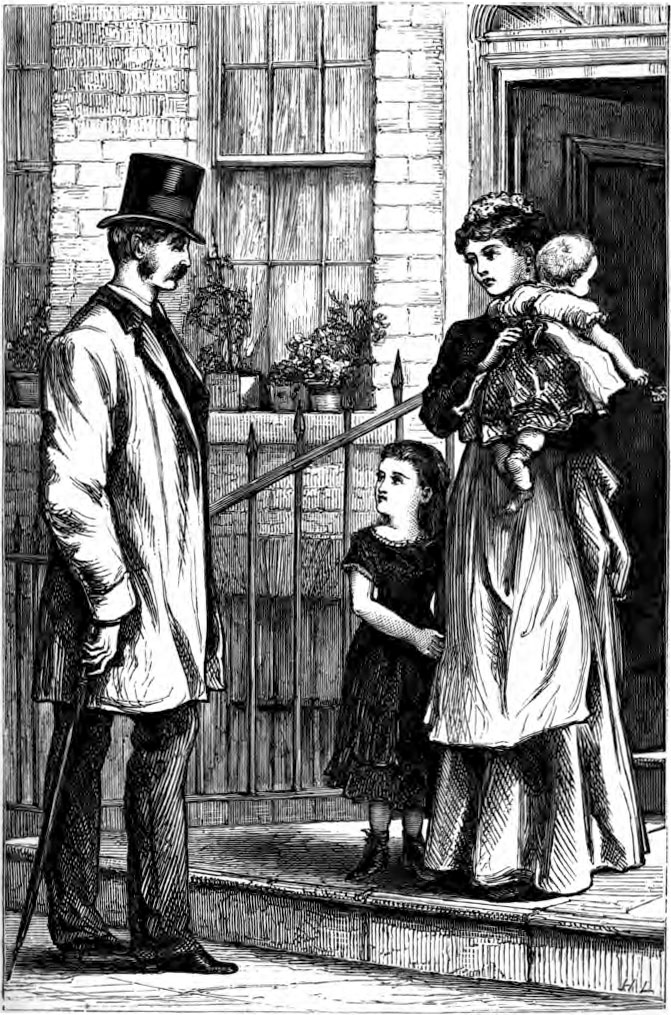
"So you have come," she said, without rising from her chair.
"Of course I came, when you desired it."
"I don't know why you should. My wishes do not seem to affect you
much. Will you sit down there," she said, pointing to a seat at some
distance from herself. "So you think it would be best that you and I
should never see each other again?" She was very calm; but it seemed
to him that the quietness was assumed, and that at any moment it
might be converted into violence. He thought that there was that in
her eye which seemed to foretell the spring of the wild-cat.
"I did think so certainly. What more can I say?"
"Oh, nothing; clearly nothing." Her voice was very low. "Why should a
gentleman trouble himself to say any more,--than that he has changed
his mind? Why make a fuss about such little things as a woman's
life, or a woman's heart?" Then she paused. "And having come,
in
consequence of my unreasonable request, of course you are wise to
hold your peace."
"I came because I promised."
"But you did not promise to speak;--did you?"
"What would you have me say?"
"Ah what! Am I to be so weak as to tell you now what I would have
you say? Suppose you were to say, 'I am a gentleman, and a man of my
word, and I repent me of my intended perfidy,' do you not think you
might get your release that way? Might it not be possible that I
should reply that as your heart was gone from me, your hand might
go after it;--that I scorned to be the wife of a man who did not
want me?" As she asked this she gradually raised her voice, and half
lifted herself in her seat, stretching herself towards him.
"You might indeed," he replied, not well knowing what to say.
"But I should not. I at least will be true. I should take you,
Paul,--still take you; with a confidence that I should yet win you
to me by my devotion. I have still some kindness of feeling towards
you,--none to that woman who is I suppose younger than I, and
gentler, and a maid." She still looked as though she expected a
reply, but there was nothing to be said in answer to this. "Now that
you are going to leave me, Paul, is there any advice you can give me,
as to what I shall do next? I have given up every friend in the world
for you. I have no home. Mrs. Pipkin's room here is more my home than
any other spot on the earth. I have all the world to choose from, but
no reason whatever for a choice. I have my property. What shall I do
with it, Paul? If I could die and be no more heard of, you should
be welcome to it." There was no answer possible to all this. The
questions were asked because there was no answer possible. "You might
at any rate advise me. Paul, you are in some degree responsible,--are
you not,--for my loneliness?"
"I am. But you know that I cannot answer your questions."
"You cannot wonder that I should be somewhat in doubt as to my future
life. As far as I can see, I had better remain here. I do good at any
rate to Mrs. Pipkin. She went into hysterics yesterday when I spoke
of leaving her. That woman, Paul, would starve in our country, and I
shall be desolate in this." Then she paused, and there was absolute
silence for a minute. "You thought my letter very short; did you
not?"
"It said, I suppose, all you had to say."
"No, indeed. I did have much more to say. That was the third letter
I wrote. Now you shall see the other two. I wrote three, and had to
choose which I would send you. I fancy that yours to me was easier
written than either one of mine. You had no doubts, you know. I had
many doubts. I could not send them all by post, together. But you may
see them all now. There is one. You may read that first. While I was
writing it, I was determined that that should go." Then she handed
him the sheet of paper which contained the threat of the horsewhip.
"I am glad you did not send that," he said.
"I meant it."
"But you have changed your mind?"
"Is there anything in it that seems to you to be unreasonable? Speak
out and tell me."
"I am thinking of you, not of myself."
"Think of me, then. Is there anything said there which the usage to
which I have been subjected does not justify?"
"You ask me questions which I cannot answer. I do not think that
under any provocation a woman should use a horsewhip."
"It is certainly more comfortable for gentlemen,--who amuse
themselves,--that women should have that opinion. But, upon my word,
I don't know what to say about that. As long as there are men to
fight for women, it may be well to leave the fighting to the men.
But when a woman has no one to help her, is she to bear everything
without turning upon those who ill-use her? Shall a woman be flayed
alive because it is unfeminine in her to fight for her own skin?
What is the good of being--feminine, as you call it? Have you asked
yourself that? That men may be attracted, I should say. But if a
woman finds that men only take advantage of her assumed weakness,
shall she not throw it off? If she be treated as prey, shall she not
fight as a beast of prey? Oh, no;--it is so unfeminine! I also, Paul,
had thought of that. The charm of womanly weakness presented itself
to my mind in a soft moment,--and then I wrote this other letter. You
may as well see them all." And so she handed him the scrap which had
been written at Lowestoft, and he read that also.
He could hardly finish it, because of the tears which filled his
eyes. But, having mastered its contents, he came across the room and
threw himself on his knees at her feet, sobbing. "I have not sent it,
you know," she said. "I only show it you that you may see how my mind
has been at work."
"It hurts me more than the other," he replied.
"Nay, I would not hurt you,--not at this moment. Sometimes I feel
that I could tear you limb from limb, so great is my disappointment,
so ungovernable my rage! Why,--why should I be such a victim? Why
should life be an utter blank to me, while you have everything before
you? There, you have seen them all. Which will you have?"
"I cannot now take that other as the expression of your mind."
"But it will be when you have left me;--and was when you were with
me at the sea-side. And it was so I felt when I got your first letter in
San Francisco. Why should you kneel there? You do not love me. A man
should kneel to a woman for love, not for pardon." But though she
spoke thus, she put her hand upon his forehead, and pushed back his
hair, and looked into his face. "I wonder whether that other woman
loves you. I do not want an answer, Paul. I suppose you had better
go." She took his hand and pressed it to her breast. "Tell me one
thing. When you spoke of--compensation, did you mean--money?"
"No; indeed no."
"I hope not;--I hope not that. Well, there;--go. You shall be
troubled no more with Winifrid Hurtle." She took the sheet of paper
which contained the threat of the horsewhip and tore it into scraps.
"And am I to keep the other?" he asked.
"No. For what purpose would you have it? To prove my weakness? That
also shall be destroyed." But she took it and restored it to her
pocket-book.
"Good-bye, my friend," he said.
"Nay! This parting will not bear a farewell. Go, and let there be no
other word spoken." And so he went.
As soon as the front door was closed behind him she rang the bell and
begged Ruby to ask Mrs. Pipkin to come to her. "Mrs. Pipkin," she
said, as soon as the woman had entered the room; "everything is over
between me and Mr. Montague." She was standing upright in the middle
of the room, and as she spoke there was a smile on her face.
"Lord a' mercy," said Mrs. Pipkin, holding up both her hands.
"As I have told you that I was to be married to him, I think it right
now to tell you that I'm not going to be married to him."
"And why not?--and he such a nice young man,--and quiet too."
"As to the why not, I don't know that I am prepared to speak about
that. But it is so. I was engaged to him."
"I'm well sure of that, Mrs. Hurtle."
"And now I'm no longer engaged to him. That's all."
"Dearie me! and you going down to Lowestoft with him, and all." Mrs.
Pipkin could not bear to think that she should hear no more of such
an interesting story.
"We did go down to Lowestoft together, and we both came back,--not
together. And there's an end of it."
"I'm sure it's not your fault, Mrs. Hurtle. When a marriage is to be,
and doesn't come off, it never is the lady's fault."
"There's an end of it, Mrs. Pipkin. If you please, we won't say
anything more about it."
"And are you going to leave, ma'am?" said Mrs. Pipkin, prepared to
have her apron up to her eyes at a moment's notice. Where should she
get such another lodger as Mrs. Hurtle,--a lady who not only did
not inquire about victuals, but who was always suggesting that the
children should eat this pudding or finish that pie, and who had
never questioned an item in a bill since she had been in the house!
"We'll say nothing about that yet, Mrs. Pipkin." Then Mrs. Pipkin
gave utterance to so many assurances of sympathy and help that it
almost seemed that she was prepared to guarantee to her lodger
another lover in lieu of the one who was now dismissed.
CHAPTER LII.
THE RESULTS OF LOVE AND WINE.
Two, three, four, and even five o'clock still found Sir Felix Carbury
in bed on that fatal Thursday. More than once or twice his mother
crept up to his room, but on each occasion he feigned to be fast
asleep and made no reply to her gentle words. But his condition was
one which only admits of short snatches of uneasy slumber. From
head to foot, he was sick and ill and sore, and could find no comfort
anywhere. To lie where he was, trying by absolute quiescence to
soothe the agony of his brows and to remember that as long as he lay
there he would be safe from attack by the outer world, was all the
solace within his reach. Lady Carbury sent the page up to him, and to
the page he was awake. The boy brought him tea. He asked for soda and
brandy; but there was none to be had, and in his present condition he
did not dare to hector about it till it was procured for him.
The world surely was now all over to him. He had made arrange-
ments for running away with the great heiress of the day, and had
absolutely allowed the young lady to run away without him. The
details of their arrangement had been such that she absolutely would
start upon her long journey across the ocean before she could find
out that he had failed to keep his appointment. Melmotte's hostility
would be incurred by the attempt, and hers by the failure. Then he
had lost all his money,--and hers. He had induced his poor mother to
assist in raising a fund for him,--and even that was gone. He was so
cowed that he was afraid even of his mother. And he could remember
something, but no details, of some row at the club,--but still with a
conviction on his mind that he had made the row. Ah,--when would he
summon courage to enter the club again? When could he show himself
again anywhere? All the world would know that Marie Melmotte had
attempted to run off with him, and that at the last moment he had
failed her. What lie could he invent to cover his disgrace? And his
clothes! All his things were at the club;--or he thought that they
were, not being quite certain whether he had not made some attempt
to carry them off to the Railway Station. He had heard of suicide. If
ever it could be well that a man should cut his own throat, surely
the time had come for him now. But as this idea presented itself to
him he simply gathered the clothes around him and tried to sleep.
The death of Cato would hardly have for him persuasive charms.
Between five and six his mother again came up to him, and when he
appeared to sleep, stood with her hand upon his shoulder. There
must be some end to this. He must at any rate be fed. She, wretched
woman, had been sitting all day,--thinking of it. As regarded her son
himself, his condition told his story with sufficient accuracy. What
might be the fate of the girl she could not stop to enquire. She had
not heard all the details of the proposed scheme; but she had known
that Felix had proposed to be at Liverpool on the Wednesday night,
and to start on Thursday for New York with the young lady; and with
the view of aiding him in his object she had helped him with money.
She had bought clothes for him, and had been busy with Hetta for two
days preparing for his long journey,--having told some lie to her own
daughter as to the cause of her brother's intended journey. He had
not gone, but had come, drunk and degraded, back to the house. She
had searched his pockets with less scruple than she had ever before
felt, and had found his ticket for the vessel and the few sovereigns
which were left to him. About him she could read the riddle plainly.
He had stayed at his club till he was drunk, and had gambled away all
his money. When she had first seen him she had asked herself what
further lie she should now tell to her daughter. At breakfast there
was instant need for some story. "Mary says that Felix came back this
morning, and that he has not gone at all," Hetta exclaimed. The poor
woman could not bring herself to expose the vices of the son to her
daughter. She could not say that he had stumbled into the house drunk
at six o'clock. Hetta no doubt had her own suspicions. "Yes; he has
come back," said Lady Carbury, broken-hearted by her troubles. "It
was some plan about the Mexican railway I believe, and has broken
through. He is very unhappy and not well. I will see to him." After
that Hetta had said nothing during the whole day. And now, about an
hour before dinner, Lady Carbury was standing by her son's bedside,
determined that he should speak to her.
"Felix," she said,--"speak to me, Felix.--I know that you are awake."
He groaned, and turned himself away from her, burying himself,
further under the bedclothes. "You must get up for your dinner. It is
near six o'clock."
"All right," he said at last.
"What is the meaning of this, Felix? You must tell me. It must be
told sooner or later. I know you are unhappy. You had better trust
your mother."
"I am so sick, mother."
"You will be better up. What were you doing last night? What has come
of it all? Where are your things?"
"At the club.--You had better leave me now, and let Sam come up to
me." Sam was the page.
"I will leave you presently; but, Felix, you must tell me about this.
What has been done?"
"It hasn't come off."
"But how has it not come off?"
"I didn't get away. What's the good of asking?"
"You said this morning when you came in, that Mr. Melmotte had
discovered it."
"Did I? Then I suppose he has. Oh, mother, I wish I could die. I
don't see what's the use of anything. I won't get up to dinner. I'd
rather stay here."
"You must have something to eat, Felix."
"Sam can bring it me. Do let him get me some brandy and water. I'm
so faint and sick with all this that I can hardly bear myself. I can't
talk now. If he'll get me a bottle of soda water and some brandy,
I'll tell you all about it then."
"Where is the money, Felix?"
"I paid it for the ticket," said he, with both his hands up to his
head.
Then his mother again left him with the understanding that he was to
be allowed to remain in bed till the next morning; but that he was
to give her some further explanation when he had been refreshed and
invigorated after his own prescription. The boy went out and got him
soda water and brandy, and meat was carried up to him, and then he
did succeed for a while in finding oblivion from his misery in sleep.
"Is he ill, mamma?" Hetta asked.
"Yes, my dear."
"Had you not better send for a doctor?"
"No, my dear. He will be better to-morrow."
"Mamma, I think you would be happier if you would tell me everything."
"I can't," said Lady Carbury, bursting out into tears. "Don't ask.
What's the good of asking? It is all misery and wretchedness. There
is nothing to tell,--except that I am ruined."
"Has he done anything, mamma?"
"No. What should he have done? How am I to know what he does? He
tells me nothing. Don't talk about it any more. Oh, God,--how much
better it would be to be childless!"
"Oh, mamma, do you mean me?" said Hetta, rushing across the room, and
throwing herself close to her mother's side on the sofa. "Mamma, say
that you do not mean me."
"It concerns you as well as me and him. I wish I were childless."
"Oh, mamma, do not be cruel to me! Am I not good to you? Do I not try
to be a comfort to you?"
"Then marry your cousin, Roger Carbury, who is a good man, and who
can protect you. You can, at any rate, find a home for yourself, and
a friend for us. You are not like Felix. You do not get drunk and
gamble,--because you are a woman. But you are stiff-necked, and will
not help me in my trouble."
"Shall I marry him, mamma, without loving him?"
"Love! Have I been able to love? Do you see much of what you call
love around you? Why should you not love him? He is a gentleman, and
a good man,--soft-hearted, of a sweet nature, whose life would be one
effort to make yours happy. You think that Felix is very bad."
"I have never said so."
"But ask yourself whether you do not give as much pain, seeing what
you could do for us if you would. But it never occurs to you to
sacrifice even a fantasy for the advantage of others."
Hetta retired from her seat on the sofa, and when her mother again
went up-stairs she turned it all over in her mind. Could it be right
that she should marry one man when she loved another? Could it be
right that she should marry at all, for the sake of doing good to
her family? This man, whom she might marry if she would,--who did
in truth worship the ground on which she trod,--was, she well knew,
all that her mother had said. And he was more than that. Her mother
had spoken of his soft heart, and his sweet nature. But Hetta knew
also that he was a man of high honour and a noble courage. In such
a condition as was hers now he was the very friend whose advice she
could have asked,--had he not been the very lover who was desirous
of making her his wife. Hetta felt that she could sacrifice much for
her mother. Money, if she had it, she could have given, though she
left herself penniless. Her time, her inclinations, her very heart's
treasure, and, as she thought, her life, she could give. She could
doom herself to poverty, and loneliness, and heart-rending regrets
for her mother's sake. But she did not know how she could give
herself into the arms of a man she did not love.
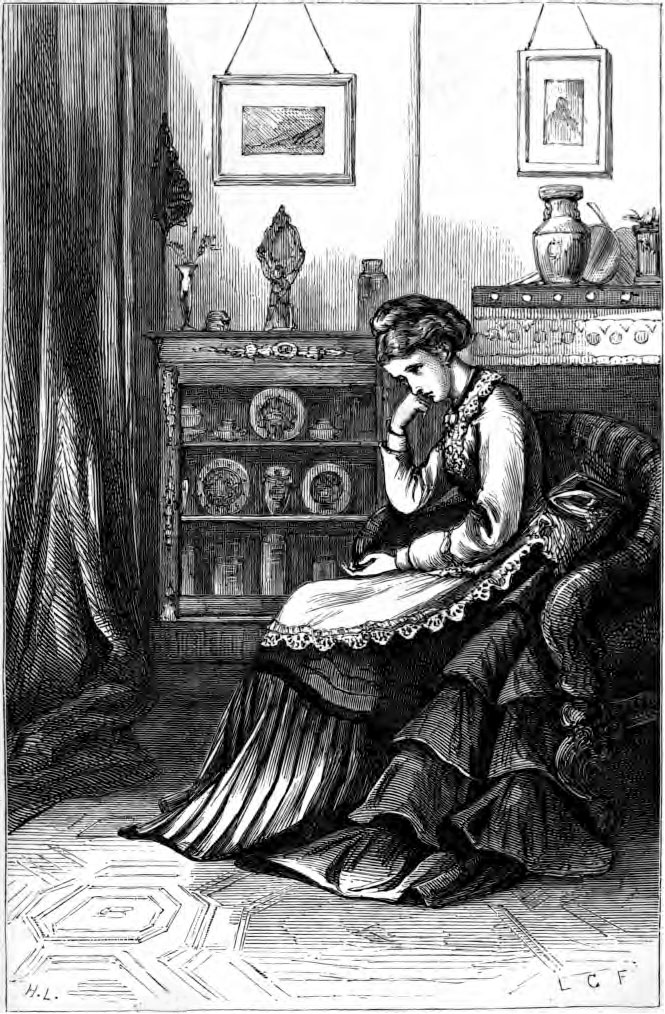
"I don't know what there is to explain," said Felix to his mother.
She had asked him why he had not gone to Liverpool, whether he had
been interrupted by Melmotte himself, whether news had reached him
from Marie that she had been stopped, or whether,--as might have been
possible,--Marie had changed her own mind. But he could not bring
himself to tell the truth, or any story bordering on the truth. "It
didn't come off," he said, "and of course that knocked me off my
legs. Well; yes. I did take some champagne when I found how it was.
A fellow does get cut up by that kind of thing. Oh, I heard it at the
club,--that the whole thing was off. I can't explain anything more.
And then I was so mad, I can't tell what I was after. I did get the
ticket. There it is. That shows I was in earnest. I spent the £30
in getting it. I suppose the change is there. Don't take it, for I
haven't another shilling in the world." Of course he said nothing
of Marie's money, or of that which he had himself received from
Melmotte. And as his mother had heard nothing of these sums she could
not contradict what he said. She got from him no further statement,
but she was sure that there was a story to be told which would reach
her ears sooner or later.
That evening, about nine o'clock, Mr. Broune called in Welbeck
Street. He very often did call now, coming up in a cab, staying for
a cup of tea, and going back in the same cab to the office of his
newspaper. Since Lady Carbury had, so devotedly, abstained from
accepting his offer, Mr. Broune had become almost sincerely attached
to her. There was certainly between them now more of the intimacy of
real friendship than had ever existed in earlier days. He spoke to
her more freely about his own affairs, and even she would speak to
him with some attempt at truth. There was never between them now
even a shade of love-making. She did not look into his eyes, nor did he
hold her hand. As for kissing her,--he thought no more of it than
of kissing the maid-servant. But he spoke to her of the things that
worried him,--the unreasonable exactions of proprietors, and the
perilous inaccuracy of contributors. He told her of the exceeding
weight upon his shoulders, under which an Atlas would have succumbed.
And he told her something too of his triumphs;--how he had had this
fellow bowled over in punishment for some contradiction, and that man
snuffed out for daring to be an enemy. And he expatiated on his own
virtues, his justice and clemency. Ah,--if men and women only knew
his good nature and his patriotism;--how he had spared the rod here,
how he had made the fortune of a man there, how he had saved the
country millions by the steadiness of his adherence to some grand
truth! Lady Carbury delighted in all this and repaid him by flattery,
and little confidences of her own. Under his teaching she had almost
made up her mind to give up Mr. Alf. Of nothing was Mr. Broune more
certain than that Mr. Alf was making a fool of himself in regard to
the Westminster election and those attacks on Melmotte. "The world of
London generally knows what it is about," said Mr. Broune, "and the
London world believes Mr. Melmotte to be sound. I don't pretend to
say that he has never done anything that he ought not to do. I am not
going into his antecedents. But he is a man of wealth, power, and
genius, and Alf will get the worst of it." Under such teaching as
this, Lady Carbury was almost obliged to give up Mr. Alf.
Sometimes they would sit in the front room with Hetta, to whom also
Mr. Broune had become attached; but sometimes Lady Carbury would be
in her own sanctum. On this evening she received him there, and at
once poured forth all her troubles about Felix. On this occasion she
told him everything, and almost told him everything truly. He had
already heard the story. "The young lady went down to Liverpool, and
Sir Felix was not there."
"He could not have been there. He has been in bed in this house all
day. Did she go?"
"So I am told;--and was met at the station by the senior officer
of the police at Liverpool, who brought her back to London without
letting her go down to the ship at all. She must have thought that
her lover was on board;--probably thinks so now. I pity her."
"How much worse it would have been, had she been allowed to start,"
said Lady Carbury.
"Yes; that would have been bad. She would have had a sad journey to
New York, and a sadder journey back. Has your son told you anything
about money?"
"What money?"
"They say that the girl entrusted him with a large sum which she had
taken from her father. If that be so he certainly ought to lose no
time in restoring it. It might be done through some friend. I would
do it for that matter. If it be so,--to avoid unpleasantness,--it
should be sent back at once. It will be for his credit." This Mr.
Broune said with a clear intimation of the importance of his advice.
It was dreadful to Lady Carbury. She had no money to give back, nor,
as she was well aware, had her son. She had heard nothing of any
money. What did Mr. Broune mean by a large sum? "That would be
dreadful," she said.
"Had you not better ask him about it?"
Lady Carbury was again in tears. She knew that she could not hope to
get a word of truth from her son. "What do you mean by a large sum?"
"Two or three hundred pounds, perhaps."
"I have not a shilling in the world, Mr. Broune." Then it all came
out,--the whole story of her poverty, as it had been brought about by
her son's misconduct. She told him every detail of her money affairs
from the death of her husband, and his will, up to the present
moment.
"He is eating you up, Lady Carbury." Lady Carbury thought that she
was nearly eaten up already, but she said nothing. "You must put a
stop to this."
"But how?"
"You must rid yourself of him. It is dreadful to say so, but it must
be done. You must not see your daughter ruined. Find out what money
he got from Miss Melmotte and I will see that it is repaid. That
must be done;--and we will then try to get him to go abroad. No;--do
not contradict me. We can talk of the money another time. I must be
off now, as I have stayed too long. Do as I bid you. Make him tell
you, and send me word down to the office. If you could do it early
to-morrow, that would be best. God bless you." And so he hurried off.
Early on the following morning a letter from Lady Carbury was put
into Mr. Broune's hands, giving the story of the money as far as she
had been able to extract it from Sir Felix. Sir Felix declared that
Mr. Melmotte had owed him £600, and that he had received £250 out
of this from Miss Melmotte,--so that there was still a large balance
due to him. Lady Carbury went on to say that her son had at last
confessed that he had lost this money at play. The story was fairly
true; but Lady Carbury in her letter acknowledged that she was not
justified in believing it because it was told to her by her son.
CHAPTER LIII.
A DAY IN THE CITY.
Melmotte had got back his daughter, and was half inclined to let the
matter rest there. He would probably have done so had he not known
that all his own household were aware that she had gone off to meet
Sir Felix Carbury, and had he not also received the condolence of
certain friends in the city. It seemed that about two o'clock in the
day the matter was known to everybody. Of course Lord Nidderdale
would hear of it, and if so all the trouble that he had taken in
that direction would have been taken in vain. Stupid fool of a girl
to throw away her chance,--nay, to throw away the certainty of a
brilliant career, in that way! But his anger against Sir Felix was
infinitely more bitter than his anger against his daughter. The man
had pledged himself to abstain from any step of this kind,--had
given a written pledge,--had renounced under his own signature his
intention of marrying Marie! Melmotte had of course learned all the
details of the cheque for £250,--how the money had been paid at the
bank to Didon, and how Didon had given it to Sir Felix. Marie herself
acknowledged that Sir Felix had received the money. If possible he
would prosecute the baronet for stealing his money.
Had Melmotte been altogether a prudent man he would probably have
been satisfied with getting back his daughter and would have allowed
the money to go without further trouble. At this especial point in
his career ready money was very valuable to him, but his concerns
were of such magnitude that £250 could make but little difference.
But there had grown upon the man during the last few months an
arrogance, a self-confidence inspired in him by the worship of other
men, which clouded his intellect, and robbed him of much of that
power of calculation which undoubtedly he naturally possessed. He
remembered perfectly his various little transactions with Sir Felix.
Indeed it was one of his gifts to remember with accuracy all money
transactions, whether great or small, and to keep an account book in
his head, which was always totted up and balanced with accuracy. He
knew exactly how he stood, even with the crossing-sweeper to whom
he had given a penny last Tuesday, as with the Longestaffes, father
and son, to whom he had not as yet made any payment on behalf of the
purchase of Pickering. But Sir Felix's money had been consigned into
his hands for the purchase of shares,--and that consignment did not
justify Sir Felix in taking another sum of money from his daughter.
In such a matter he thought that an English magistrate, and an
English jury, would all be on his side,--especially as he was August-
us Melmotte, the man about to be chosen for Westminster, the man
about to entertain the Emperor of China!
The next day was Friday,--the day of the Railway Board. Early in the
morning he sent a note to Lord Nidderdale.
MY DEAR NIDDERDALE,--
Pray come to the Board to-day;--or at any rate come to me
in the city. I specially want to speak to you.
Yours,
A. M.
This he wrote, having made up his mind that it would be wise to make
a clear breast of it with his hoped-for son-in-law. If there was
still a chance of keeping the young lord to his guns that chance
would be best supported by perfect openness on his part. The young
lord would of course know what Marie had done. But the young lord had
for some weeks past been aware that there had been a difficulty in
regard to Sir Felix Carbury, and had not on that account relaxed his
suit. It might be possible to persuade the young lord that as the
young lady had now tried to elope and tried in vain, his own chance
might on the whole be rather improved than injured.
Mr. Melmotte on that morning had many visitors, among whom one of the
earliest and most unfortunate was Mr. Longestaffe. At that time there
had been arranged at the offices in Abchurch Lane a mode of double
ingress and egress,--a front stairs and a back stairs approach and
exit, as is always necessary with very great men,--in reference
to which arrangement the honour and dignity attached to each is
exactly contrary to that which generally prevails in the world; the
front stairs being intended for everybody, and being both slow and
uncertain, whereas the back stairs are quick and sure, and are used
only for those who are favoured. Miles Grendall had the command of
the stairs, and found that he had plenty to do in keeping people
in their right courses. Mr. Longestaffe reached Abchurch Lane
before one,--having altogether failed in getting a moment's private
conversation with the big man on that other Friday, when he had come
later. He fell at once into Miles's hands, and was ushered through
the front stairs passage and into the front stairs waiting-room,
with much external courtesy. Miles Grendall was very voluble. Did
Mr. Longestaffe want to see Mr. Melmotte? Oh;--Mr. Longestaffe wanted
to see Mr. Melmotte as soon as possible! Of course Mr. Longestaffe
should see Mr. Melmotte. He, Miles, knew that Mr. Melmotte was
particularly desirous of seeing Mr. Longestaffe. Mr. Melmotte had
mentioned Mr. Longestaffe's name twice during the last three days.
Would Mr. Longestaffe sit down for a few minutes? Had Mr. Longestaffe
seen the "Morning Breakfast Table"? Mr. Melmotte undoubtedly was
very much engaged. At this moment a deputation from the Canadian
Government was with him;--and Sir Gregory Gribe was in the office
waiting for a few words. But Miles thought that the Canadian
Government would not be long,--and as for Sir Gregory, perhaps his
business might be postponed. Miles would do his very best to get an
interview for Mr. Longestaffe,--more especially as Mr. Melmotte was
so very desirous himself of seeing his friend. It was astonishing
that such a one as Miles Grendall should have learned his business
so well and should have made himself so handy! We will leave Mr.
Longestaffe with the "Morning Breakfast Table" in his hands, in the
front waiting-room, merely notifying the fact that there he remained
for something over two hours.
In the mean time both Mr. Broune and Lord Nidderdale came to the
office, and both were received without delay. Mr. Broune was the
first. Miles knew who he was, and made no attempt to seat him in the
same room with Mr. Longestaffe. "I'll just send him a note," said
Mr. Broune, and he scrawled a few words at the office counter. "I'm
commissioned to pay you some money on behalf of Miss Melmotte."
Those were the words, and they at once procured him admission to
the sanctum. The Canadian Deputation must have taken its leave, and
Sir Gregory could hardly have as yet arrived. Lord Nidderdale, who
had presented himself almost at the same moment with the Editor,
was shown into a little private room,--which was, indeed, Miles
Grendall's own retreat. "What's up with the Governor?" asked the
young lord.
"Anything particular do you mean?" said Miles. "There are always so
many things up here."
"He has sent for me."
"Yes,--you'll go in directly. There's that fellow who does the
'Breakfast Table' in with him. I don't know what he's come about. You
know what he has sent for you for?"
Lord Nidderdale answered this question by another. "I suppose all
this about Miss Melmotte is true?"
"She did go off yesterday morning," said Miles, in a whisper.
"But Carbury wasn't with her."
"Well, no;--I suppose not. He seems to have mulled it. He's such a
d---- brute, he'd be sure to go wrong whatever he had in hand."
"You don't like him, of course, Miles. For that matter I've no reason
to love him. He couldn't have gone. He staggered out of the club
yesterday morning at four o'clock as drunk as Cloe. He'd lost a pot
of money, and had been kicking up a row about you for the last hour."
"Brute!" exclaimed Miles, with honest indignation.
"I dare say. But though he was able to make a row, I'm sure he
couldn't get himself down to Liverpool. And I saw all his things
lying about the club hall late last night;--no end of portmanteaux
and bags; just what a fellow would take to New York. By George! Fancy
taking a girl to New York! It was plucky."
"It was all her doing," said Miles, who was of course intimate with
Mr. Melmotte's whole establishment, and had had means therefore of
hearing the true story.
"What a fiasco!" said the young lord, "I wonder what the old boy
means to say to me about it." Then there was heard the clear tingle
of a little silver bell, and Miles told Lord Nidderdale that his time
had come.
Mr. Broune had of late been very serviceable to Mr. Melmotte, and
Melmotte was correspondingly gracious. On seeing the Editor he
immediately began to make a speech of thanks in respect of the
support given by the "Breakfast Table" to his candidature. But Mr.
Broune cut him short. "I never talk about the 'Breakfast Table,'"
said he. "We endeavour to get along as right as we can, and the less
said the soonest mended." Melmotte bowed. "I have come now about
quite another matter, and perhaps, the less said the sooner mended
about that also. Sir Felix Carbury on a late occasion received a sum
of money in trust from your daughter. Circumstances have prevented
its use in the intended manner, and, therefore, as Sir Felix's
friend, I have called to return the money to you." Mr. Broune did not
like calling himself the friend of Sir Felix, but he did even that
for the lady who had been good enough to him not to marry him.
"Oh, indeed," said Mr. Melmotte, with a scowl on his face, which he
would have repressed if he could.
"No doubt you understand all about it."
"Yes;--I understand. D---- scoundrel!"
"We won't discuss that, Mr. Melmotte. I've drawn a cheque myself,
payable to your order,--to make the matter all straight. The sum was
£250, I think." And Mr. Broune put a cheque for that amount down upon
the table.
"I dare say it's all right," said Mr. Melmotte. "But, remember, I
don't think that this absolves him. He has been a scoundrel."
"At any rate he has paid back the money, which chance put into his
hands, to the only person entitled to receive it on the young lady's
behalf. Good morning." Mr. Melmotte did put out his hand in token of
amity. Then Mr. Broune departed and Melmotte tinkled his bell. As
Nidderdale was shown in he crumpled up the cheque, and put it into
his pocket. He was at once clever enough to perceive that any idea
which he might have had of prosecuting Sir Felix must be abandoned.
"Well, my Lord, and how are you?" said he with his pleasantest smile.
Nidderdale declared himself to be as fresh as paint. "You don't look
down in the mouth, my Lord."
Then Lord Nidderdale,--who no doubt felt that it behoved him to show
a good face before his late intended father-in-law,--sang the refrain
of an old song, which it is trusted my readers may remember.
"Cheer up, Sam;
Don't let your spirits go down.
There's many a girl that I know well,
Is waiting for you in the town."
"Ha, ha, ha," laughed Melmotte, "very good. I've no doubt there
is,--many a one. But you won't let this stupid nonsense stand in your
way with Marie."
"Upon my word, sir, I don't know about that. Miss Melmotte has given
the most convincing proof of her partiality for another gentleman,
and of her indifference to me."
"A foolish baggage! A silly little romantic baggage! She's been
reading novels till she has learned to think she couldn't settle down
quietly till she had run off with somebody."
"She doesn't seem to have succeeded on this occasion, Mr. Melmotte."
"No;--of course we had her back again from Liverpool."
"But they say that she got further than the gentleman."
"He is a dishonest, drunken scoundrel. My girl knows very well what
he is now. She'll never try that game again. Of course, my Lord, I'm
very sorry. You know that I've been on the square with you always.
She's my only child, and sooner or later she must have all that I
possess. What she will have at once will make any man wealthy,--that
is, if she marries with my sanction; and in a year or two I expect
that I shall be able to double what I give her now, without touching
my capital. Of course you understand that I desire to see her
occupying high rank. I think that, in this country, that is a noble
object of ambition. Had she married that sweep I should have broken
my heart. Now, my Lord, I want you to say that this shall make no
difference to you. I am very honest with you. I do not try to hide
anything. The thing of course has been a misfortune. Girls will be
romantic. But you may be sure that this little accident will assist
rather than impede your views. After this she will not be very fond
of Sir Felix Carbury."
"I dare say not. Though, by Jove, girls will forgive anything."
"She won't forgive him. By George, she shan't. She shall hear the
whole story. You'll come and see her just the same as ever!"
"I don't know about that, Mr. Melmotte."
"Why not? You're not so weak as to surrender all your settled
projects for such a piece of folly as that! He didn't even see her
all the time."
"That wasn't her fault."
"The money will all be there, Lord Nidderdale."
"The money's all right, I've no doubt. And there isn't a man in all
London would be better pleased to settle down with a good income
than I would. But, by Jove, it's a rather strong order when a girl has
just run away with another man. Everybody knows it."
"In three months' time everybody will have forgotten it."
"To tell you the truth, sir, I think Miss Melmotte has got a will of
her own stronger than you give her credit for. She has never given me
the slightest encouragement. Ever so long ago, about Christmas, she
did once say that she would do as you bade her. But she is very much
changed since then. The thing was off."
"She had nothing to do with that."
"No;--but she has taken advantage of it, and I have no right to
complain."
"You just come to the house, and ask her again to-morrow. Or
come on Sunday morning. Don't let us be done out of all our settled
arrangements by the folly of an idle girl. Will you come on Sunday
morning about noon?" Lord Nidderdale thought of his position for
a few moments and then said that perhaps he would come on Sunday
morning. After that Melmotte proposed that they two should go
and "get a bit of lunch" at a certain Conservative club in the
City. There would be time before the meeting of the Railway Board.
Nidderdale had no objection to the lunch, but expressed a strong
opinion that the Board was "rot." "That's all very well for you,
young man," said the chairman, "but I must go there in order that you
may be able to enjoy a splendid fortune." Then he touched the young
man on the shoulder and drew him back as he was passing out by the
front stairs. "Come this way, Nidderdale;--come this way. I must get
out without being seen. There are people waiting for me there who
think that a man can attend to business from morning to night without
ever having a bit in his mouth." And so they escaped by the back
stairs.
At the club, the City Conservative world,--which always lunches
well,--welcomed Mr. Melmotte very warmly. The election was coming on,
and there was much to be said. He played the part of the big City man
to perfection, standing about the room with his hat on, and talking
loudly to a dozen men at once. And he was glad to show the club
that Lord Nidderdale had come there with him. The club of course
knew that Lord Nidderdale was the accepted suitor of the rich man's
daughter,--accepted, that is, by the rich man himself,--and the
club knew also that the rich man's daughter had tried,--but had
failed,--to run away with Sir Felix Carbury. There is nothing like
wiping out a misfortune and having done with it. The presence of Lord
Nidderdale was almost an assurance to the club that the misfortune
had been wiped out, and, as it were, abolished. A little before three
Mr. Melmotte returned to Abchurch Lane, intending to regain his room
by the back way; while Lord Nidderdale went westward, considering
within his own mind whether it was expedient that he should continue
to show himself as a suitor for Miss Melmotte's hand. He had an idea
that a few years ago a man could not have done such a thing--that
he would be held to show a poor spirit should he attempt it; but
that now it did not much matter what a man did,--if only he were
successful. "After all it's only an affair of money," he said to
himself.
Mr. Longestaffe in the meantime had progressed from weariness to
impatience, from impatience to ill-humour, and from ill-humour to
indignation. More than once he saw Miles Grendall, but Miles Grendall
was always ready with an answer. That Canadian Deputation was
determined to settle the whole business this morning, and would not
take itself away. And Sir Gregory Gribe had been obstinate, beyond
the ordinary obstinacy of a bank director. The rate of discount at
the bank could not be settled for to-morrow without communication
with Mr. Melmotte, and that was a matter on which the details were
always most oppressive. At first Mr. Longestaffe was somewhat stunned
by the Deputation and Sir Gregory Gribe; but as he waxed wroth
the potency of those institutions dwindled away, and as, at last,
he waxed hungry, they became as nothing to him. Was he not Mr.
Longestaffe of Caversham, a Deputy-Lieutenant of his County, and
accustomed to lunch punctually at two o'clock? When he had been in
that waiting-room for two hours, it occurred to him that he only
wanted his own, and that he would not remain there to be starved for
any Mr. Melmotte in Europe. It occurred to him also that that thorn
in his side, Squercum, would certainly get a finger into the pie to
his infinite annoyance. Then he walked forth, and attempted to see
Grendall for the fourth time. But Miles Grendall also liked his
lunch, and was therefore declared by one of the junior clerks to be
engaged at that moment on most important business with Mr. Melmotte.
"Then say that I can't wait any longer," said Mr. Longestaffe,
stamping out of the room with angry feet.
At the very door he met Mr. Melmotte. "Ah, Mr. Longestaffe," said the
great financier, seizing him by the hand, "you are the very man I am
desirous of seeing."
"I have been waiting two hours up in your place," said the Squire of
Caversham.
"Tut, tut, tut;--and they never told me!"
"I spoke to Mr. Grendall half a dozen times."
"Yes,--yes. And he did put a slip with your name on it on my desk.
I do remember. My dear sir, I have so many things on my brain, that
I hardly know how to get along with them. You are coming to the
Board? It's just the time now."
"No;"--said Mr. Longestaffe. "I can stay no longer in the
City." It
was cruel that a man so hungry should be asked to go to a Board by a
chairman who had just lunched at his club.
"I was carried away to the Bank of England and could not help
myself," said Melmotte. "And when they get me there I can never get
away again."
"My son is very anxious to have the payments made about Pickering,"
said Mr. Longestaffe, absolutely holding Melmotte by the collar of
his coat.
"Payments for Pickering!" said Melmotte, assuming an air of
unimportant doubt,--of doubt as though the thing were of no real
moment. "Haven't they been made?"
"Certainly not," said Mr. Longestaffe, "unless made this morning."
"There was something about it, but I cannot just remember what. My
second cashier, Mr. Smith, manages all my private affairs, and they
go clean out of my head. I'm afraid he's in Grosvenor Square at this
moment. Let me see;--Pickering! Wasn't there some question of a
mortgage? I'm sure there was something about a mortgage."
"There was a mortgage, of course;--but that only made three payments
necessary instead of two."
"But there was some unavoidable delay about the papers;--something
occasioned by the mortgagee. I know there was. But you shan't be
inconvenienced, Mr. Longestaffe."
"It's my son, Mr. Melmotte. He's got a lawyer of his own."
"I never knew a young man that wasn't in a hurry for his money," said
Melmotte laughing. "Oh, yes;--there were three payments to be made;
one to you, one to your son, and one to the mortgagee. I will speak
to Mr. Smith myself to-morrow--and you may tell your son that he
really need not trouble his lawyer. He will only be losing his money,
for lawyers are expensive. What; you won't come to the Board? I am
sorry for that." Mr. Longestaffe, having after a fashion said what he
had to say, declined to go to the Board. A painful rumour had reached
him the day before, which had been communicated to him in a very
quiet way by a very old friend,--by a member of a private firm of
bankers whom he was accustomed to regard as the wisest and most
eminent man of his acquaintance,--that Pickering had been already
mortgaged to its full value by its new owner. "Mind, I know nothing,"
said the banker. "The report has reached me, and if it be true, it
shows that Mr. Melmotte must be much pressed for money. It does
not concern you at all if you have got your price. But it seems to
be rather a quick transaction. I suppose you have, or he wouldn't
have the title-deeds." Mr. Longestaffe thanked his friend, and
acknowledged that there had been something remiss on his part.
Therefore, as he went westward, he was low in spirits. But
nevertheless he had been reassured by Melmotte's manner.
Sir Felix Carbury of course did not attend the Board; nor did Paul
Montague, for reasons with which the reader has been made acquainted.
Lord Nidderdale had declined, having had enough of the City for that
day, and Mr. Longestaffe had been banished by hunger. The chairman
was therefore supported only by Lord Alfred and Mr. Cohenlupe. But
they were such excellent colleagues that the work was got through as
well as though those absentees had all attended. When the Board was
over Mr. Melmotte and Mr. Cohenlupe retired together.
"I must get that money for Longestaffe," said Melmotte to his friend.
"What, eighty thousand pounds! You can't do it this week,--nor yet
before this day week."
"It isn't eighty thousand pounds. I've renewed the mortgage, and that
makes it only fifty. If I can manage the half of that which goes to
the son, I can put the father off."
"You must raise what you can on the whole property."
"I've done that already," said Melmotte hoarsely.
"And where's the money gone?"
"Brehgert has had £40,000. I was obliged to keep it up with them.
You can manage £25,000 for me by Monday?" Mr. Cohenlupe said that he
would try, but intimated his opinion that there would be considerable
difficulty in the operation.
CHAPTER LIV.
THE INDIA OFFICE.
The Conservative party at this particular period was putting its
shoulder to the wheel,--not to push the coach up any hill, but
to prevent its being hurried along at a pace which was not only
dangerous, but manifestly destructive. The Conservative party now and
then does put its shoulder to the wheel, ostensibly with the great
national object above named; but also actuated by a natural desire to
keep its own head well above water and be generally doing something,
so that other parties may not suppose that it is moribund. There are,
no doubt, members of it who really think that when some object has
been achieved,--when, for instance, a good old Tory has been squeezed
into Parliament for the borough of Porcorum, which for the last three
parliaments has been represented by a Liberal,--the coach has been
really stopped. To them, in their delightful faith, there comes at
these triumphant moments a conviction that after all the people as
a people have not been really in earnest in their efforts to take
something from the greatness of the great, and to add something to
the lowliness of the lowly. The handle of the windlass has been
broken, the wheel is turning fast the reverse way, and the rope
of Radical progress is running back. Who knows what may not be
regained if the Conservative party will only put its shoulder to the
wheel and take care that the handle of the windlass be not mended!
Sticinthemud, which has ever been a doubtful little borough, has
just been carried by a majority of fifteen! A long pull, a strong
pull, and a pull altogether,--and the old day will come back again.
Venerable patriarchs think of Lord Liverpool and other heroes, and
dream dreams of Conservative bishops, Conservative lord-lieutenants,
and of a Conservative ministry that shall remain in for a generation.
Such a time was now present. Porcorum and Sticinthemud had done
their duty valiantly,--with much management. But Westminster! If this
special seat for Westminster could be carried, the country then could
hardly any longer have a doubt on the matter. If only Mr. Melmotte
could be got in for Westminster, it would be manifest that the people
were sound at heart, and that all the great changes which had been
effected during the last forty years,--from the first reform in
Parliament down to the Ballot,--had been managed by the cunning and
treachery of a few ambitious men. Not, however, that the Ballot was
just now regarded by the party as an unmitigated evil, though it
was the last triumph of Radical wickedness. The Ballot was on the
whole popular with the party. A short time since, no doubt it was
regarded by the party as being one and the same as national ruin and
national disgrace. But it had answered well at Porcorum, and with due
manipulation had been found to be favourable at Sticinthemud. The
Ballot might perhaps help the long pull and the strong pull,--and, in
spite of the ruin and disgrace, was thought by some just now to be a
highly Conservative measure. It was considered that the Ballot might
assist Melmotte at Westminster very materially.
Any one reading the Conservative papers of the time, and hearing the
Conservative speeches in the borough,--any one at least who lived so
remote as not to have learned what these things really mean,--would
have thought that England's welfare depended on Melmotte's return.
In the enthusiasm of the moment, the attacks made on his character
were answered by eulogy as loud as the censure was bitter. The chief
crime laid to his charge was connected with the ruin of some great
continental assurance company, as to which it was said that he had
so managed it as to leave it utterly stranded, with an enormous
fortune of his own. It was declared that every shilling which he had
brought to England with him had consisted of plunder stolen from
the shareholders in the company. Now the "Evening Pulpit," in its
endeavour to make the facts of this transaction known, had placed
what it called the domicile of this company in Paris, whereas it was
ascertained that its official head-quarters had in truth been placed
at Vienna. Was not such a blunder as this sufficient to show that no
merchant of higher honour than Mr. Melmotte had ever adorned the
Exchanges of modern capitals? And then two different newspapers of
the time, both of them antagonistic to Melmotte, failed to be in
accord on a material point. One declared that Mr. Melmotte was not in
truth possessed of any wealth. The other said that he had derived his
wealth from those unfortunate shareholders. Could anything betray
so bad a cause as contradictions such as these? Could anything
be so false, so weak, so malignant, so useless, so wicked, so
self-condemned,--in fact, so "Liberal" as a course of action such
as this? The belief naturally to be deduced from such statements,
nay, the unavoidable conviction on the minds--of, at any rate, the
Conservative newspapers--was that Mr. Melmotte had accumulated an
immense fortune, and that he had never robbed any shareholder of a
shilling.
The friends of Melmotte had moreover a basis of hope, and were
enabled to sound premonitory notes of triumph, arising from causes
quite external to their party. The "Breakfast Table" supported
Melmotte, but the "Breakfast Table" was not a Conservative organ.
This support was given, not to the great man's political opinions, as
to which a well-known writer in that paper suggested that the great
man had probably not as yet given very much attention to the party
questions which divided the country,--but to his commercial position.
It was generally acknowledged that few men living,--perhaps no man
alive,--had so acute an insight into the great commercial questions
of the age as Mr. Augustus Melmotte. In whatever part of the world he
might have acquired his commercial experience,--for it had been said
repeatedly that Melmotte was not an Englishman,--he now made London
his home and Great Britain his country, and it would be for the
welfare of the country that such a man should sit in the British
Parliament. Such were the arguments used by the "Breakfast Table" in
supporting Mr. Melmotte. This was, of course, an assistance;--and not
the less so because it was asserted in other papers that the country
would be absolutely disgraced by his presence in Parliament. The
hotter the opposition the keener will be the support. Honest good
men, men who really loved their country, fine gentlemen, who had
received unsullied names from great ancestors, shed their money right
and left, and grew hot in personally energetic struggles to have this
man returned to Parliament as the head of the great Conservative
mercantile interests of Great Britain!
There was one man who thoroughly believed that the thing at the
present moment most essentially necessary to England's glory was the
return of Mr. Melmotte for Westminster. This man was undoubtedly a
very ignorant man. He knew nothing of any one political question
which had vexed England for the last half century,--nothing whatever
of the political history which had made England what it was at the
beginning of that half century. Of such names as Hampden, Somers, and
Pitt he had hardly ever heard. He had probably never read a book in
his life. He knew nothing of the working of parliament, nothing of
nationality,--had no preference whatever for one form of government
over another, never having given his mind a moment's trouble on
the subject. He had not even reflected how a despotic monarch or
a federal republic might affect himself, and possibly did not com-
prehend the meaning of those terms. But yet he was fully confident
that England did demand and ought to demand that Mr. Melmotte should
be returned for Westminster. This man was Mr. Melmotte himself.
In this conjunction of his affairs Mr. Melmotte certainly lost his
head. He had audacity almost sufficient for the very dangerous game
which he was playing; but, as crisis heaped itself upon crisis, he
became deficient in prudence. He did not hesitate to speak of himself
as the man who ought to represent Westminster, and of those who
opposed him as little malignant beings who had mean interests of
their own to serve. He went about in his open carriage, with Lord
Alfred at his left hand, with a look on his face which seemed to
imply that Westminster was not good enough for him. He even hinted
to certain political friends that at the next general election he
should try the City. Six months since he had been a humble man to a
Lord,--but now he scolded Earls and snubbed Dukes, and yet did it in
a manner which showed how proud he was of connecting himself with
their social pre-eminence, and how ignorant of the manner in which
such pre-eminence affects English gentlemen generally. The more
arrogant he became the more vulgar he was, till even Lord Alfred
would almost be tempted to rush away to impecuniosity and freedom.
Perhaps there were some with whom this conduct had a salutary effect.
No doubt arrogance will produce submission; and there are men who
take other men at the price those other men put upon themselves. Such
persons could not refrain from thinking Melmotte to be mighty because
he swaggered; and gave their hinder parts to be kicked merely because
he put up his toe. We all know men of this calibre,--and how they
seem to grow in number. But the net result of his personal demeanour
was injurious; and it was debated among some of the warmest of his
supporters whether a hint should not be given him. "Couldn't Lord
Alfred say a word to him?" said the Honourable Beauchamp Beauclerk,
who, himself in Parliament, a leading man in his party, thoroughly
well acquainted with the borough, wealthy and connected by blood with
half the great Conservative families in the kingdom, had been moving
heaven and earth on behalf of the great financial king, and working
like a slave for his success.
"Alfred's more than half afraid of him," said Lionel Lupton, a young
aristocrat, also in Parliament, who had been inoculated with the
idea that the interests of the party demanded Melmotte in Parliament,
but who would have given up his Scotch shooting rather than have
undergone Melmotte's company for a day.
"Something really must be done, Mr. Beauclerk," said Mr. Jones, who
was the leading member of a very wealthy firm of builders in the
borough, who had become a Conservative politician, who had thoughts
of the House for himself, but who never forgot his own position. "He
is making a great many personal enemies."
"He's the finest old turkey cock out," said Lionel Lupton.
Then it was decided that Mr. Beauclerk should speak a word to Lord
Alfred. The rich man and the poor man were cousins, and had always
been intimate. "Alfred," said the chosen mentor at the club one
afternoon, "I wonder whether you couldn't say something to Melmotte
about his manner." Lord Alfred turned sharp round and looked into his
companion's face. "They tell me he is giving offence. Of course he
doesn't mean it. Couldn't he draw it a little milder?"
Lord Alfred made his reply almost in a whisper. "If you ask me, I
don't think he could. If you got him down and trampled on him, you
might make him mild. I don't think there's any other way."
"You couldn't speak to him, then?"
"Not unless I did it with a horsewhip."
This, coming from Lord Alfred, who was absolutely dependent on the
man, was very strong. Lord Alfred had been much afflicted that
morning. He had spent some hours with his friend, either going about
the borough in the open carriage, or standing just behind him at
meetings, or sitting close to him in committee-rooms,--and had been
nauseated with Melmotte. When spoken to about his friend he could not
restrain himself. Lord Alfred had been born and bred a gentleman, and
found the position in which he was now earning his bread to be almost
insupportable. It had gone against the grain with him at first, when
he was called Alfred; but now that he was told "just to open the
door," and "just to give that message," he almost meditated revenge.
Lord Nidderdale, who was quick at observation, had seen something of
this in Grosvenor Square, and declared that Lord Alfred had invested
part of his recent savings in a cutting whip. Mr. Beauclerk, when he
had got his answer, whistled and withdrew. But he was true to his
party. Melmotte was not the first vulgar man whom the Conservatives
had taken by the hand, and patted on the back, and told that he was a
god.
The Emperor of China was now in England, and was to be entertained
one night at the India Office. The Secretary of State for the second
great Asiatic Empire was to entertain the ruler of the first. This
was on Saturday the 6th of July, and Melmotte's dinner was to take
place on the following Monday. Very great interest was made by the
London world generally to obtain admission to the India Office,--the
making of such interest consisting in the most abject begging for
tickets of admission, addressed to the Secretary of State, to all
the under secretaries, to assistant secretaries, secretaries of
departments, chief clerks, and to head-messengers and their wives.
If a petitioner could not be admitted as a guest into the splendour
of the reception rooms, might not he,--or she,--be allowed to stand
in some passage whence the Emperor's back might perhaps be seen,--
so that, if possible, the petitioner's name might be printed in the
list of guests which would be published on the next morning? Now Mr.
Melmotte with his family was, of course, supplied with tickets. He,
who was to spend a fortune in giving the Emperor a dinner, was of
course entitled to be present at other places to which the Emperor
would be brought to be shown. Melmotte had already seen the Emperor
at a breakfast in Windsor Park, and at a ball in royal halls. But hith-
erto he had not been presented to the Emperor. Presentations have
to be restricted,--if only on the score of time; and it had been
thought that as Mr. Melmotte would of course have some communication
with the hardworked Emperor at his own house, that would suffice. But
he had felt himself to be ill-used and was offended. He spoke with
bitterness to some of his supporters of the Royal Family generally,
because he had not been brought to the front rank either at the
breakfast or at the ball,--and now, at the India Office, was deter-
mined to have his due. But he was not on the list of those whom
the Secretary of State intended on this occasion to present to the
Brother of the Sun.
He had dined freely. At this period of his career he had taken to
dining freely,--which was in itself imprudent, as he had need at all
hours of his best intelligence. Let it not be understood that he
was tipsy. He was a man whom wine did not often affect after that
fashion. But it made him, who was arrogant before, tower in his
arrogance till he was almost sure to totter. It was probably at some
moment after dinner that Lord Alfred decided upon buying the cutting
whip of which he had spoken. Melmotte went with his wife and daughter
to the India Office, and soon left them far in the background with a
request,--we may say an order,--to Lord Alfred to take care of them.
It may be observed here that Marie Melmotte was almost as great a
curiosity as the Emperor himself, and was much noticed as the girl
who had attempted to run away to New York, but had gone without
her lover. Melmotte entertained some foolish idea that as the India
Office was in Westminster, he had a peculiar right to demand an
introduction on this occasion because of his candidature. He did
succeed in getting hold of an unfortunate under secretary of state, a
studious and invaluable young peer, known as Earl De Griffin. He was
a shy man, of enormous wealth, of mediocre intellect, and no great
physical ability, who never amused himself; but worked hard night and
day, and read everything that anybody could write, and more than any
other person could read, about India. Had Mr. Melmotte wanted to know
the exact dietary of the peasants in Orissa, or the revenue of the
Punjaub, or the amount of crime in Bombay, Lord De Griffin would have
informed him without a pause. But in this matter of managing the
Emperor, the under secretary had nothing to do, and would have been
the last man to be engaged in such a service. He was, however, second
in command at the India Office, and of his official rank Melmotte was
unfortunately made aware. "My Lord," said he, by no means hiding
his demand in a whisper, "I am desirous of being presented to his
Imperial Majesty." Lord De Griffin looked at him in despair, not know-
ing the great man,--being one of the few men in that room who did
not know him.
"This is Mr. Melmotte," said Lord Alfred, who had deserted the ladies
and still stuck to his master. "Lord De Griffin, let me introduce you
to Mr. Melmotte."
"Oh--oh--oh," said Lord De Griffin, just putting out his hand. "I am
delighted;--ah, yes," and pretending to see somebody, he made a weak
and quite ineffectual attempt to escape.
Melmotte stood directly in his way, and with unabashed audacity
repeated his demand. "I am desirous of being presented to his
Imperial Majesty. Will you do me the honour of making my request
known to Mr. Wilson?" Mr. Wilson was the Secretary of State, who was
as busy as a Secretary of State is sure to be on such an occasion.
"I hardly know," said Lord De Griffin. "I'm afraid it's all arranged.
I don't know anything about it myself."
"You can introduce me to Mr. Wilson."
"He's up there, Mr. Melmotte; and I couldn't get at him. Really you
must excuse me. I'm very sorry. If I see him I'll tell him." And the
poor under secretary again endeavoured to escape.
Mr. Melmotte put up his hand and stopped him. "I'm not going to stand
this kind of thing," he said. The old Marquis of Auld Reekie was
close at hand, the father of Lord Nidderdale, and therefore the
proposed father-in-law of Melmotte's daughter, and he poked his
thumb heavily into Lord Alfred's ribs. "It is generally understood,
I believe," continued Melmotte, "that the Emperor is to do me the
honour of dining at my poor house on Monday. He don't dine there
unless I'm made acquainted with him before he comes. I mean what
I say. I ain't going to entertain even an Emperor unless I'm good
enough to be presented to him. Perhaps you'd better let Mr. Wilson
know, as a good many people intend to come."
"Here's a row," said the old Marquis. "I wish he'd be as good as his
word."
"He has taken a little wine," whispered Lord Alfred. "Melmotte," he
said, still whispering; "upon my word it isn't the thing. They're
only Indian chaps and Eastern swells who are presented here,--not a
fellow among 'em all who hasn't been in India or China, or isn't a
Secretary of State, or something of that kind."
"Then they should have done it at Windsor, or at the ball," said
Melmotte, pulling down his waistcoat. "By George, Alfred! I'm in
earnest, and somebody had better look to it. If I'm not presented to
his Imperial Majesty to-night, by G----, there shall be no dinner
in Grosvenor Square on Monday. I'm master enough of my own house,
I suppose, to be able to manage that."
Here was a row, as the Marquis had said! Lord De Griffin was
frightened, and Lord Alfred felt that something ought to be done.
"There's no knowing how far the pig-headed brute may go in his
obstinacy," Lord Alfred said to Mr. Lupton, who was there. It no
doubt might have been wise to have allowed the merchant prince to
return home with the resolution that his dinner should be abandoned.
He would have repented probably before the next morning; and had
he continued obdurate it would not have been difficult to explain
to Celestial Majesty that something preferable had been found for
that particular evening even to a banquet at the house of British
commerce. The Government would probably have gained the seat for
Westminster, as Melmotte would at once have become very unpopular
with the great body of his supporters. But Lord De Griffin was not
the man to see this. He did make his way up to Mr. Wilson, and
explained to the Amphytrion of the night the demand which was made
on his hospitality. A thoroughly well-established and experienced
political Minister of State always feels that if he can make a friend
or appease an enemy without paying a heavy price he will be doing a
good stroke of business. "Bring him up," said Mr. Wilson. "He's going
to do something out in the East, isn't he?" "Nothing in India," said
Lord De Griffin. "The submarine telegraph is quite impossible." Mr.
Wilson, instructing some satellite to find out in what way he might
properly connect Mr. Melmotte with China, sent Lord De Griffin away
with his commission.
"My dear Alfred, just allow me to manage these things myself," Mr.
Melmotte was saying when the under secretary returned. "I know my
own position and how to keep it. There shall be no dinner. I'll be d----
if any of the lot shall dine in Grosvenor Square on Monday." Lord
Alfred was so astounded that he was thinking of making his way to
the Prime Minister, a man whom he abhorred and didn't know, and of
acquainting him with the terrible calamity which was threatened. But
the arrival of the under secretary saved him the trouble.
"If you will come with me," whispered Lord De Griffin, "it shall be
managed. It isn't just the thing, but as you wish it, it shall be
done."
"I do wish it," said Melmotte aloud. He was one of those men whom
success never mollified, whose enjoyment of a point gained always
demanded some hoarse note of triumph from his own trumpet.
"If you will be so kind as to follow me," said Lord De Griffin. And
so the thing was done. Melmotte, as he was taken up to the imperial
footstool, was resolved upon making a little speech, forgetful at
the moment of interpreters,--of the double interpreters whom the
Majesty of China required; but the awful, quiescent solemnity of the
celestial one quelled even him, and he shuffled by without saying a
word even of his own banquet.
But he had gained his point, and, as he was taken home to poor Mr.
Longestaffe's house in Bruton Street, was intolerable. Lord Alfred
tried to escape after putting Madame Melmotte and her daughter into
the carriage, but Melmotte insisted on his presence. "You might as
well come, Alfred;--there are two or three things I must settle
before I go to bed."
"I'm about knocked up," said the unfortunate man.
"Knocked up, nonsense! Think what I've been through. I've been all
day at the hardest work a man can do." Had he as usual got in first,
leaving his man-of-all-work to follow, the man-of-all-work would
have escaped. Melmotte, fearing such defection, put his hand on Lord
Alfred's shoulder, and the poor fellow was beaten. As they were taken
home a continual sound of cock-crowing was audible, but as the words
were not distinguished they required no painful attention; but when
the soda water and brandy and cigars made their appearance in Mr.
Longestaffe's own back room, then the trumpet was sounded with a full
blast. "I mean to let the fellows know what's what," said Melmotte,
walking about the room. Lord Alfred had thrown himself into an
arm-chair, and was consoling himself as best he might with tobacco.
"Give and take is a very good motto. If I scratch their back, I mean
them to scratch mine. They won't find many people to spend ten
thousand pounds in entertaining a guest of the country's as a private
enterprise. I don't know of any other man of business who could
do it, or would do it. It's not much any of them can do for me.
Thank God, I don't want 'em. But if consideration is to be shown
to anybody, I intend to be considered. The Prince treated me very
scurvily, Alfred, and I shall take an opportunity of telling him
so on Monday. I suppose a man may be allowed to speak to his own
guests."
"You might turn the election against you if you said anything the
Prince didn't like."
"D---- the election, sir. I stand before the electors of Westminster
as a man of business, not as a courtier,--as a man who understands
commercial enterprise, not as one of the Prince's toadies. Some of
you fellows in England don't realise the matter yet; but I can tell
you that I think myself quite as great a man as any Prince." Lord
Alfred looked at him, with strong reminiscences of the old ducal
home, and shuddered. "I'll teach them a lesson before long. Didn't I
teach 'em a lesson to-night,--eh? They tell me that Lord De Griffin
has sixty thousand a-year to spend. What's sixty thousand a year?
Didn't I make him go on my business? And didn't I make 'em do as I
chose? You want to tell me this and that, but I can tell you that I
know more of men and women than some of you fellows do, who think
you know a great deal."
This went on through the whole of a long cigar; and afterwards,
as Lord Alfred slowly paced his way back to his lodgings in Mount
Street, he thought deeply whether there might not be means of
escaping from his present servitude. "Beast! Brute! Pig!" he said to
himself over and over again as he slowly went to Mount Street.
CHAPTER LV.
CLERICAL CHARITIES.
Melmotte's success, and Melmotte's wealth, and Melmotte's antecedents
were much discussed down in Suffolk at this time. He had been seen
there in the flesh, and there is no believing like that which comes
from sight. He had been staying at Caversham, and many in those parts
knew that Miss Longestaffe was now living in his house in London.
The purchase of the Pickering estate had also been noticed in all
the Suffolk and Norfolk newspapers. Rumours, therefore, of his past
frauds, rumour also as to the instability of his presumed fortune,
were as current as those which declared him to be by far the richest
man in England. Miss Melmotte's little attempt had also been
communicated in the papers; and Sir Felix, though he was not
recognised as being "real Suffolk" himself, was so far connected
with Suffolk by name as to add something to this feeling of reality
respecting the Melmottes generally. Suffolk is very old-fashioned.
Suffolk, taken as a whole, did not like the Melmotte fashion.
Suffolk, which is, I fear, persistently and irrecoverably Conserv-
ative, did not believe in Melmotte as a Conservative Member
of Parliament. Suffolk on this occasion was rather ashamed of the
Longestaffes, and took occasion to remember that it was barely the
other day, as Suffolk counts days, since the original Longestaffe was
in trade. This selling of Pickering, and especially the selling of
it to Melmotte, was a mean thing. Suffolk, as a whole, thoroughly
believed that Melmotte had picked the very bones of every shareholder
in that Franco-Austrian Assurance Company.
Mr. Hepworth was over with Roger one morning, and they were talking
about him,--or talking rather of the attempted elopement. "I know
nothing about it," said Roger, "and I do not intend to ask. Of course
I did know when they were down here that he hoped to marry her, and I
did believe that she was willing to marry him. But whether the father
had consented or not I never enquired."
"It seems he did not consent."
"Nothing could have been more unfortunate for either of them than
such a marriage. Melmotte will probably be in the 'Gazette' before
long, and my cousin not only has not a shilling, but could not keep
one if he had it."
"You think Melmotte will turn out a failure."
"A failure! Of course he's a failure, whether rich or poor;--a
miserable imposition, a hollow vulgar fraud from beginning to
end,--too insignificant for you and me to talk of, were it not that
his position is a sign of the degeneracy of the age. What are we
coming to when such as he is an honoured guest at our tables?"
"At just a table here and there," suggested his friend.
"No;--it is not that. You can keep your house free from him, and so
can I mine. But we set no example to the nation at large. They who do
set the example go to his feasts, and of course he is seen at theirs
in return. And yet these leaders of the fashion know,--at any rate
they believe,--that he is what he is because he has been a swindler
greater than other swindlers. What follows as a natural consequence?
Men reconcile themselves to swindling. Though they themselves mean
to be honest, dishonesty of itself is no longer odious to them. Then
there comes the jealousy that others should be growing rich with the
approval of all the world,--and the natural aptitude to do what all
the world approves. It seems to me that the existence of a Melmotte
is not compatible with a wholesome state of things in general."
Roger dined with the Bishop of Elmham that evening, and the same hero
was discussed under a different heading. "He has given £200," said
the Bishop, "to the Curates' Aid Society. I don't know that a man
could spend his money much better than that."
"Clap-trap!" said Roger, who in his present mood was very bitter.
"The money is not clap-trap, my friend. I presume that the money is
really paid."
"I don't feel at all sure of that."
"Our collectors for clerical charities are usually stern men,--very
ready to make known defalcations on the part of promising
subscribers. I think they would take care to get the money during the
election."
"And you think that money got in that way redounds to his credit?"
"Such a gift shows him to be a useful member of society,--and I am
always for encouraging useful men."
"Even though their own objects may be vile and pernicious?"
"There you beg ever so many questions, Mr. Carbury. Mr. Melmotte
wishes to get into Parliament, and if there would vote on the side
which you at any rate approve. I do not know that his object in that
respect is pernicious. And as a seat in Parliament has been a matter
of ambition to the best of our countrymen for centuries, I do not
know why we should say that it is vile in this man." Roger frowned
and shook his head. "Of course Mr. Melmotte is not the sort of
gentleman whom you have been accustomed to regard as a fitting
member for a Conservative constituency. But the country is chang-
ing."
"It's going to the dogs, I think;--about as fast as it can go."
"We build churches much faster than we used to do."
"Do we say our prayers in them when we have built them?" asked the
Squire.
"It is very hard to see into the minds of men," said the Bishop;
"but we can see the results of their minds' work. I think that men
on the whole do live better lives than they did a hundred years ago.
There is a wider spirit of justice abroad, more of mercy from one to
another, a more lively charity, and if less of religious enthusiasm,
less also of superstition. Men will hardly go to heaven, Mr. Carbury,
by following forms only because their fathers followed the same forms
before them."
"I suppose men will go to heaven, my Lord, by doing as they would be
done by."
"There can be no safer lesson. But we must hope that some may
be saved even if they have not practised at all times that grand
self-denial. Who comes up to that teaching? Do you not wish for,
nay, almost demand, instant pardon for any trespass that you may
commit,--of temper, or manner, for instance? and are you always ready
to forgive in that way yourself? Do you not writhe with indignation
at being wrongly judged by others who condemn you without knowing
your actions or the causes of them; and do you never judge others
after that fashion?"
"I do not put myself forward as an example."
"I apologise for the personal form of my appeal. A clergyman is apt
to forget that he is not in the pulpit. Of course I speak of men in
general. Taking society as a whole, the big and the little, the rich
and the poor, I think that it grows better from year to year, and not
worse. I think, too, that they who grumble at the times, as Horace
did, and declare that each age is worse than its forerunner, look
only at the small things beneath their eyes, and ignore the course of
the world at large."
"But Roman freedom and Roman manners were going to the dogs when
Horace wrote."
"But Christ was about to be born, and men were already being made fit
by wider intelligence for Christ's teaching. And as for freedom, has
not freedom grown, almost every year, from that to this?"
"In Rome they were worshipping just such men as this Melmotte. Do you
remember the man who sat upon the seats of the knights and scoured
the Via Sacra with his toga, though he had been scourged from pillar
to post for his villainies? I always think of that man when I hear
Melmotte's name mentioned. Hoc, hoc tribuno militum! Is this the man
to be Conservative member for Westminster?"
"Do you know of the scourges, as a fact?"
"I think I know that they are deserved."
"That is hardly doing to others as you would be done by. If the man
is what you say, he will surely be found out at last, and the day of
his punishment will come. Your friend in the ode probably had a bad
time of it, in spite of his farms and his horses. The world perhaps
is managed more justly than you think, Mr. Carbury."
"My Lord, I believe you're a Radical at heart," said Roger, as he
took his leave.
"Very likely,--very likely. Only don't say so to the Prime Minister,
or I shall never get any of the better things which may be going."
The Bishop was not hopelessly in love with a young lady, and was
therefore less inclined to take a melancholy view of things in
general than Roger Carbury. To Roger everything seemed to be out
of joint. He had that morning received a letter from Lady Carbury,
reminding him of the promise of a loan, should a time come to her
of great need. It had come very quickly. Roger Carbury did not in
the least begrudge the hundred pounds which he had already sent to
his cousin; but he did begrudge any furtherance afforded to the
iniquitous schemes of Sir Felix. He felt all but sure that the
foolish mother had given her son money for his abortive attempt, and
that therefore this appeal had been made to him. He alluded to no
such fear in his letter. He simply enclosed the cheque, and expressed
a hope that the amount might suffice for the present emergency. But
he was disheartened and disgusted by all the circumstances of the
Carbury family. There was Paul Montague, bringing a woman such as
Mrs. Hurtle down to Lowestoft, declaring his purpose of continuing
his visits to her, and, as Roger thought, utterly unable to free
himself from his toils,--and yet, on this man's account, Hetta was
cold and hard to him. He was conscious of the honesty of his own
love, sure that he could make her happy,--confident, not in himself,
but in the fashion and ways of his own life. What would be Hetta's
lot if her heart was really given to Paul Montague?
When he got home, he found Father Barham sitting in his library. An
accident had lately happened at Father Barham's own establishment.
The wind had blown the roof off his cottage; and Roger Carbury,
though his affection for the priest was waning, had offered him
shelter while the damage was being repaired. Shelter at Carbury Manor
was very much more comfortable than the priest's own establishment,
even with the roof on, and Father Barham was in clover. Father Barham
was reading his own favourite newspaper, "The Surplice," when Roger
entered the room. "Have you seen this, Mr. Carbury?" he said.
"What's this? I am not likely to have seen anything that belongs
peculiarly to 'The Surplice.'"
"That's the prejudice of what you are pleased to call the Anglican
Church. Mr. Melmotte is a convert to our faith. He is a great man,
and will perhaps be one of the greatest known on the face of the
globe."
"Melmotte a convert to Romanism! I'll make you a present of him, and
thank you to take him; but I don't believe that we've any such good
riddance."
Then Father Barham read a paragraph out of "The Surplice." "Mr.
Augustus Melmotte, the great financier and capitalist, has presented
a hundred guineas towards the erection of an altar for the new church
of St. Fabricius, in Tothill Fields. The donation was accompanied
by a letter from Mr. Melmotte's secretary, which leaves but little
doubt that the new member for Westminster will be a member, and no
inconsiderable member, of the Catholic party in the House, during the
next session."
"That's another dodge, is it?" said Carbury.
"What do you mean by a dodge, Mr. Carbury? Because money is given for
a pious object of which you do not happen to approve, must it be a
dodge?"
"But, my dear Father Barham, the day before the same great man gave
£200 to the Protestant Curates' Aid Society. I have just left the
Bishop exulting in this great act of charity."
"I don't believe a word of it;--or it may be a parting gift to the
Church to which he belonged in his darkness."
"And you would be really proud of Mr. Melmotte as a convert?"
"I would be proud of the lowest human being that has a soul," said
the priest; "but of course we are glad to welcome the wealthy and the
great."
"The great! oh dear!"
"A man is great who has made for himself such a position as that of
Mr. Melmotte. And when such a one leaves your Church and joins our
own, it is a great sign to us that the Truth is prevailing." Roger
Carbury, without another word, took his candle and went to bed.
CHAPTER LVI.
FATHER BARHAM VISITS LONDON.
It was considered to be a great thing to catch the Roman Catholic
vote in Westminster. For many years it has been considered a great
thing both in the House and out of the House to "catch" Roman
Catholic votes. There are two modes of catching these votes. This or
that individual Roman Catholic may be promoted to place, so that he
personally may be made secure; or the right hand of fellowship may
be extended to the people of the Pope generally, so that the people
of the Pope may be taught to think that a general step is being
made towards the reconversion of the nation. The first measure is
the easier, but the effect is but slight and soon passes away. The
promoted one, though as far as his prayers go he may remain as
good a Catholic as ever, soon ceases to be one of the party to be
conciliated, and is apt after a while to be regarded by them as an
enemy. But the other mode, if a step be well taken, may be very
efficacious. It has now and then occurred that every Roman Catholic
in Ireland and England has been brought to believe that the nation
is coming round to them;--and in this or that borough the same
conviction has been made to grow. To catch the Protestant,--that is
the peculiarly Protestant,--vote and the Roman Catholic vote at the
same instant is a feat difficult of accomplishment; but it has been
attempted before, and was attempted now by Mr. Melmotte and his
friends. It was perhaps thought by his friends that the Protestants
would not notice the £100 given for the altar to St. Fabricius; but
Mr. Alf was wide awake, and took care that Mr. Melmotte's religious
opinions should be a matter of interest to the world at large. During
all that period of newspaper excitement there was perhaps no article
that created so much general interest as that which appeared in the
"Evening Pulpit," with a special question asked at the head of it,
"For Priest or Parson?" In this article, which was more than usually
delightful as being pungent from the beginning to the end and as
being unalloyed with any dry didactic wisdom, Mr. Alf's man, who did
that business, declared that it was really important that the nation
at large and especially the electors of Westminster should know what
was the nature of Mr. Melmotte's faith. That he was a man of a highly
religious temperament was most certain by his munificent charities
on behalf of religion. Two noble donations, which by chance had been
made just at this crisis, were doubtless no more than the regular
continuation of his ordinary flow of Christian benevolence. The
"Evening Pulpit" by no means insinuated that the gifts were intended
to have any reference to the approaching election. Far be it from
the "Evening Pulpit" to imagine that so great a man as Mr. Melmotte
looked for any return in this world from his charitable generosity.
But still, as Protestants naturally desired to be represented
in Parliament by a Protestant member, and as Roman Catholics as
naturally desired to be represented by a Roman Catholic, perhaps Mr.
Melmotte would not object to declare his creed.
This was biting, and of course did mischief; but Mr. Melmotte and his
manager were not foolish enough to allow it to actuate them in any
way. He had thrown his bread upon the waters, assisting St. Fabricius
with one hand and the Protestant curates with the other, and must
leave the results to take care of themselves. If the Protestants
chose to believe that he was hyper-protestant, and the Catholics
that he was tending towards papacy, so much the better for him. Any
enthusiastic religionists wishing to enjoy such conviction's would
not allow themselves to be enlightened by the manifestly interested
malignity of Mr. Alf's newspaper.
It may be doubted whether the donation to the Curates' Aid Society
did have much effect. It may perhaps have induced a resolution in
some few to go to the poll whose minds were active in regard to
religion and torpid as to politics. But the donation to St. Fabricius
certainly had results. It was taken up and made much of by the Roman
Catholic party generally, till a report got itself spread abroad and
almost believed that Mr. Melmotte was going to join the Church of
Rome. These manoeuvres require most delicate handling, or evil may
follow instead of good. On the second afternoon after the question
had been asked in the "Evening Pulpit," an answer to it appeared,
"For Priest and not for Parson." Therein various assertions made by
Roman Catholic organs and repeated in Roman Catholic speeches were
brought together, so as to show that Mr. Melmotte really had at last
made up his mind on this important question. All the world knew
now, said Mr. Alf's writer, that with that keen sense of honesty
which was the Great Financier's peculiar characteristic,--the Great
Financier was the name which Mr. Alf had specially invented for Mr.
Melmotte,--he had doubted, till the truth was absolutely borne in
upon him, whether he could serve the nation best as a Liberal or as
a Conservative. He had solved that doubt with wisdom. And now this
other doubt had passed through the crucible, and by the aid of fire a
golden certainty had been produced. The world of Westminster at last
knew that Mr. Melmotte was a Roman Catholic. Now nothing was clearer
than this,--that though catching the Catholic vote would greatly help
a candidate, no real Roman Catholic could hope to be returned. This
last article vexed Mr. Melmotte, and he proposed to his friends to
send a letter to the "Breakfast Table" asserting that he adhered
to the Protestant faith of his ancestors. But, as it was suspected
by many, and was now being whispered to the world at large, that
Melmotte had been born a Jew, this assurance would perhaps have been
too strong. "Do nothing of the kind," said Mr. Beauchamp Beauclerk.
"If any one asks you a question at any meeting, say that you are a
Protestant. But it isn't likely, as we have none but our own people.
Don't go writing letters."
But unfortunately the gift of an altar to St. Fabricius was such
a godsend that sundry priests about the country were determined
to cling to the good man who had bestowed his money so well. I
think that many of them did believe that this was a great sign of a
beauteous stirring of people's minds in favour of Rome. The fervent
Romanists have always this point in their favour, that they are ready
to believe. And they have a desire for the conversion of men which
is honest in an exactly inverse ratio to the dishonesty of the means
which they employ to produce it. Father Barham was ready to sacri-
fice anything personal to himself in the good cause,--his time, his
health, his money when he had any, and his life. Much as he liked the
comfort of Carbury Hall, he would never for a moment condescend to
ensure its continued enjoyment by reticence as to his religion. Roger
Carbury was hard of heart. He could see that. But the dropping of
water might hollow the stone. If the dropping should be put an end
to by outward circumstances before the stone had been impressed
that would not be his fault. He at any rate would do his duty. In that
fixed resolution Father Barham was admirable. But he had no scruple
whatsoever as to the nature of the arguments he would use,--or as
to the facts which he would proclaim. With the mingled ignorance of
his life and the positiveness of his faith he had at once made up
his mind that Melmotte was a great man, and that he might be made a
great instrument on behalf of the Pope. He believed in the enormous
proportions of the man's wealth,--believed that he was powerful in
all quarters of the globe,--and believed, because he was so told by
"The Surplice," that the man was at heart a Catholic. That a man
should be at heart a Catholic, and live in the world professing the
Protestant religion, was not to Father Barham either improbable or
distressing. Kings who had done so were to him objects of veneration.
By such subterfuges and falsehood of life had they been best able
to keep alive the spark of heavenly fire. There was a mystery and
religious intrigue in this which recommended itself to the young
priest's mind. But it was clear to him that this was a peculiar
time,--in which it behoved an earnest man to be doing something. He
had for some weeks been preparing himself for a trip to London in
order that he might spend a week in retreat with kindred souls who
from time to time betook themselves to the cells of St. Fabricius.
And so, just at this season of the Westminster election, Father
Barham made a journey to London.
He had conceived the great idea of having a word or two with Mr.
Melmotte himself. He thought that he might be convinced by a word or
two as to the man's faith. And he thought, also, that it might be a
happiness to him hereafter to have had intercourse with a man who
was perhaps destined to be the means of restoring the true faith to
his country. On Saturday night,--that Saturday night on which Mr.
Melmotte had so successfully exercised his greatness at the India
Office,--he took up his quarters in the cloisters of St. Fabricius;
he spent a goodly festive Sunday among the various Romanist church
services of the metropolis; and on the Monday morning he sallied
forth in quest of Mr. Melmotte. Having obtained that address from
some circular, he went first to Abchurch Lane. But on this day, and
on the next, which would be the day of the election, Mr. Melmotte was
not expected in the City, and the priest was referred to his present
private residence in Bruton Street. There he was told that the great
man might probably be found in Grosvenor Square, and at the house in
the square Father Barham was at last successful. Mr. Melmotte was
there superintending the arrangements for the entertainment of the
Emperor.
The servants, or more probably the workmen, must have been at fault
in giving the priest admittance. But in truth the house was in
great confusion. The wreaths of flowers and green boughs were being
suspended, last daubs of heavy gilding were being given to the wooden
capitals of mock pilasters, incense was being burned to kill the
smell of the paint, tables were being fixed and chairs were being
moved; and an enormous set of open presses were being nailed together
for the accommodation of hats and cloaks. The hall was chaos, and
poor Father Barham, who had heard a good deal of the Westminster
election, but not a word of the intended entertainment of the
Emperor, was at a loss to conceive for what purpose these operations
were carried on. But through the chaos he made his way, and did soon
find himself in the presence of Mr. Melmotte in the banqueting hall.
Mr. Melmotte was attended both by Lord Alfred and his son. He was
standing in front of the chair which had been arranged for the
Emperor, with his hat on one side of his head, and he was very angry
indeed. He had been given to understand when the dinner was first
planned, that he was to sit opposite to his august guest;--by which
he had conceived that he was to have a seat immediately in face of
the Emperor of Emperors, of the Brother of the Sun, of the Celestial
One himself. It was now explained to him that this could not be
done. In face of the Emperor there must be a wide space, so that his
Majesty might be able to look down the hall; and the royal princesses
who sat next to the Emperor, and the royal princes who sat next
to the princesses, must also be so indulged. And in this way Mr.
Melmotte's own seat became really quite obscure. Lord Alfred was
having a very bad time of it. "It's that fellow from 'The Herald'
office did it, not me," he said, almost in a passion. "I don't know
how people ought to sit. But that's the reason."
"I'm d---- if I'm going to be treated in this way in my own house,"
were the first words which the priest heard. And as Father Barham
walked up the room and came close to the scene of action, unperceived
by either of the Grendalls, Mr. Melmotte was trying, but trying in
vain, to move his own seat nearer to Imperial Majesty. A bar had been
put up of such a nature that Melmotte, sitting in the seat prepared
for him, would absolutely be barred out from the centre of his own
hall. "Who the d---- are you?" he asked, when the priest appeared
close before his eyes on the inner or more imperial side of the bar.
It was not the habit of Father Barham's life to appear in sleek
apparel. He was ever clothed in the very rustiest brown black that
age can produce. In Beccles where he was known it signified little,
but in the halls of the great one in Grosvenor Square, perhaps the
stranger's welcome was cut to the measure of his outer man. A comely
priest in glossy black might have been received with better grace.
Father Barham stood humbly with his hat off. He was a man of infinite
pluck; but outward humility--at any rate at the commencement of an
enterprise,--was the rule of his life. "I am the Rev. Mr. Barham,"
said the visitor. "I am the priest of Beccles in Suffolk. I believe I
am speaking to Mr. Melmotte."
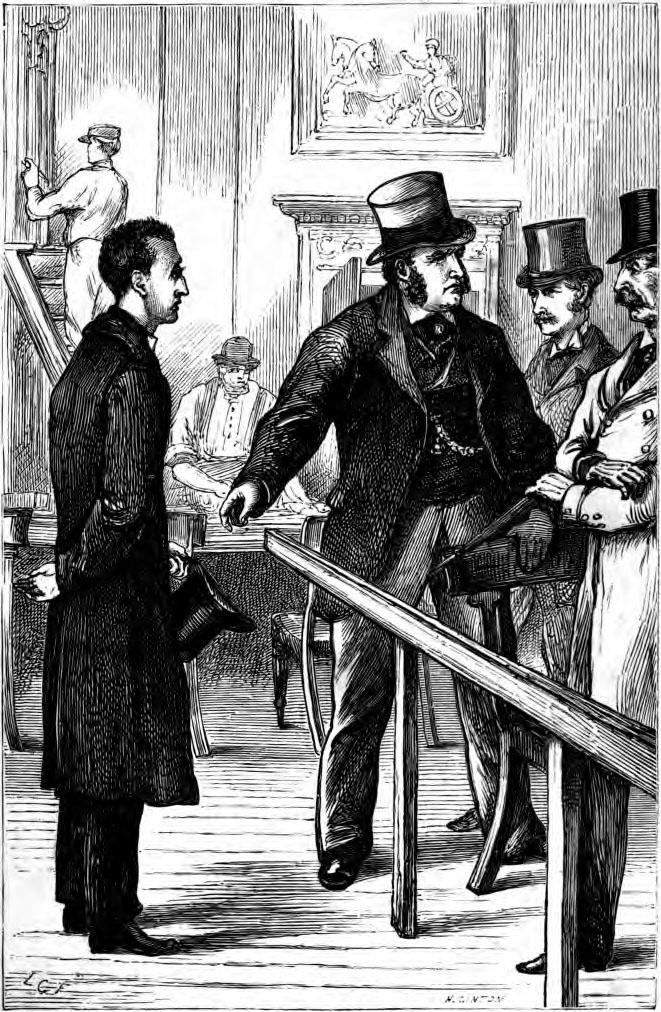
"That's my name, sir. And what may you want? I don't know whether you
are aware that you have found your way into my private dining-room
without any introduction. Where the mischief are the fellows, Alfred,
who ought to have seen about this? I wish you'd look to it, Miles.
Can anybody who pleases walk into my hall?"
"I came on a mission which I hope may be pleaded as my excuse," said
the priest. Although he was bold, he found it difficult to explain
his mission. Had not Lord Alfred been there he could have done it
better, in spite of the very repulsive manner of the great man
himself.
"Is it business?" asked Lord Alfred.
"Certainly it is business," said Father Barham with a smile.
"Then you had better call at the office in Abchurch Lane,--in the
City," said his lordship.
"My business is not of that nature. I am a poor servant of the Cross,
who is anxious to know from the lips of Mr. Melmotte himself that his
heart is inclined to the true Faith."
"Some lunatic," said Melmotte. "See that there ain't any knives
about, Alfred."
"No otherwise mad, sir, than they have ever been accounted mad who
are enthusiastic in their desire for the souls of others."
"Just get a policeman, Alfred. Or send somebody; you'd better not go
away."
"You will hardly need a policeman, Mr. Melmotte," continued the
priest. "If I might speak to you alone for a few minutes--"
"Certainly not;--certainly not. I am very busy, and if you will not
go away you'll have to be taken away. I wonder whether anybody knows
him."
"Mr. Carbury, of Carbury Hall, is my friend."
"Carbury! D---- the Carburys! Did any of the Carburys send you here?
A set of beggars! Why don't you do something, Alfred, to get rid of
him?"
"You'd better go," said Lord Alfred. "Don't make a rumpus, there's a
good fellow;--but just go."
"There shall be no rumpus," said the priest, waxing wrathful. "I
asked for you at the door, and was told to come in by your own
servants. Have I been uncivil that you should treat me in this
fashion?"
"You're in the way," said Lord Alfred.
"It's a piece of gross impertinence," said Melmotte. "Go away."
"Will you not tell me before I go whether I shall pray for you as one
whose steps in the right path should be made sure and firm; or as one
still in error and in darkness?"
"What the mischief does he mean?" asked Melmotte.
"He wants to know whether you're a papist," said Lord Alfred.
"What the deuce is it to him?" almost screamed Melmotte;--whereupon
Father Barham bowed and took his leave.
"That's a remarkable thing," said Melmotte,--"very remarkable."
Even
this poor priest's mad visit added to his inflation. "I suppose he
was in earnest."
"Mad as a hatter," said Lord Alfred.
"But why did he come to me in his madness--to me especially? That's
what I want to know. I'll tell you what it is. There isn't a man
in all England at this moment thought of so much as--your humble
servant. I wonder whether the 'Morning Pulpit' people sent him here
now to find out really what is my religion."
"Mad as a hatter," said Lord Alfred again;--"just that and no more."
"My dear fellow, I don't think you've the gift of seeing very far.
The truth is they don't know what to make of me;--and I don't intend
that they shall. I'm playing my game, and there isn't one of 'em
understands it except myself. It's no good my sitting here, you know.
I shan't be able to move. How am I to get at you if I want anything?"
"What can you want? There'll be lots of servants about."
"I'll have this bar down, at any rate." And he did succeed in having
removed the bar which had been specially put up to prevent his
intrusion on his own guests in his own house. "I look upon that
fellow's coming here as a very singular sign of the times," he went
on to say. "They'll want before long to know where I have my clothes
made, and who measures me for my boots!" Perhaps the most remarkable
circumstance in the career of this remarkable man was the fact that
he came almost to believe in himself.
Father Barham went away certainly disgusted; and yet not altogether
disheartened. The man had not declared that he was not a Roman
Catholic. He had shown himself to be a brute. He had blasphemed
and cursed. He had been outrageously uncivil to a man whom he must
have known to be a minister of God. He had manifested himself to
this priest, who had been born an English gentleman, as being no
gentleman. But, not the less might he be a good Catholic,--or good
enough at any rate to be influential on the right side. To his eyes
Melmotte, with all his insolent vulgarity, was infinitely a more
hopeful man than Roger Carbury. "He insulted me," said Father Barham
to a brother religionist that evening within the cloisters of St.
Fabricius.
"Did he intend to insult you?"
"Certainly he did. But what of that? It is not by the hands of
polished men, nor even of the courteous, that this work has to be
done. He was preparing for some great festival, and his mind was
intent upon that."
"He entertains the Emperor of China this very day," said the brother
priest, who, as a resident in London, heard from time to time what
was being done.
"The Emperor of China! Ah, that accounts for it. I do think that he
is on our side, even though he gave me but little encouragement for
saying so. Will they vote for him, here at Westminster?"
"Our people will. They think that he is rich and can help them."
"There is no doubt of his wealth, I suppose," said Father Barham.
"Some people do doubt;--but others say he is the richest man in the
world."
"He looked like it,--and spoke like it," said Father Barham. "Think
what such a man might do, if he be really the wealthiest man in the
world! And if he had been against us would he not have said so?
Though he was uncivil, I am glad that I saw him." Father Barham, with
a simplicity that was singularly mingled with his religious cunning,
made himself believe before he returned to Beccles that Mr. Melmotte
was certainly a Roman Catholic.
CHAPTER LVII.
LORD NIDDERDALE TRIES HIS HAND AGAIN.
Lord Nidderdale had half consented to renew his suit to Marie
Melmotte. He had at any rate half promised to call at Melmotte's
house on the Sunday with the object of so doing. As far as that
promise had been given it was broken, for on the Sunday he was not
seen in Bruton Street. Though not much given to severe thinking,
he did feel that on this occasion there was need for thought. His
father's property was not very large. His father and his grandfather
had both been extravagant men, and he himself had done something
towards adding to the family embarrassments. It had been an
understood thing, since he had commenced life, that he was to marry
an heiress. In such families as his, when such results have been
achieved, it is generally understood that matters shall be put right
by an heiress. It has become an institution, like primogeniture, and
is almost as serviceable for maintaining the proper order of things.
Rank squanders money; trade makes it;--and then trade purchases
rank by re-gilding its splendour. The arrangement, as it affects the
aristocracy generally, is well understood, and was quite approved of
by the old marquis--so that he had felt himself to be justified in
eating up the property, which his son's future marriage would renew
as a matter of course. Nidderdale himself had never dissented, had
entertained no fanciful theory opposed to this view, had never
alarmed his father by any liaison tending towards matrimony with any
undowered beauty;--but had claimed his right to "have his fling"
before he devoted himself to the redintegration of the family
property. His father had felt that it would be wrong and might
probably be foolish to oppose so natural a desire. He had regarded
all the circumstances of "the fling" with indulgent eyes. But there
arose some little difference as to the duration of the fling, and
the father had at last found himself compelled to inform his son
that if the fling were carried on much longer it must be done with
internecine war between himself and his heir. Nidderdale, whose sense
and temper were alike good, saw the thing quite in the proper light.
He assured his father that he had no intention of "cutting up rough,"
declared that he was ready for the heiress as soon as the heiress
should be put in his way, and set himself honestly about the task
imposed on him. This had all been arranged at Auld Reekie Castle
during the last winter, and the reader knows the result.
But the affair had assumed abnormal difficulties. Perhaps the Marquis
had been wrong in flying at wealth which was reputed to be almost
unlimited, but which was not absolutely fixed. A couple of hundred
thousand pounds down might have been secured with greater ease. But
here there had been a prospect of endless money,--of an inheritance
which might not improbably make the Auld Reekie family conspicuous
for its wealth even among the most wealthy of the nobility. The
old man had fallen into the temptation, and abnormal difficulties
had been the result. Some of these the reader knows. Latterly
two difficulties had culminated above the others. The young lady
preferred another gentleman, and disagreeable stories were afloat,
not only as to the way in which the money had been made, but even as
to its very existence.
The Marquis, however, was a man who hated to be beaten. As far as he
could learn from inquiry, the money would be there,--or, at least, so
much money as had been promised. A considerable sum, sufficient to
secure the bridegroom from absolute shipwreck,--though by no means
enough to make a brilliant marriage,--had in truth been already
settled on Marie, and was, indeed, in her possession. As to that, her
father had armed himself with a power of attorney for drawing the
income,--but had made over the property to his daughter, so that
in the event of unforeseen accidents on 'Change, he might retire
to obscure comfort, and have the means perhaps of beginning again
with whitewashed cleanliness. When doing this, he had doubtless not
anticipated the grandeur to which he would soon rise, or the fact
that he was about to embark on seas so dangerous that this little
harbour of refuge would hardly offer security to his vessel. Marie
had been quite correct in her story to her favoured lover. And the
Marquis's lawyer had ascertained that if Marie ever married before
she herself had restored this money to her father, her husband would
be so far safe,--with this as a certainty and the immense remainder
in prospect. The Marquis had determined to persevere. Pickering was
to be added. Mr. Melmotte had been asked to depone the title-deeds,
and had promised to do so as soon as the day of the wedding should
have been fixed with the consent of all the parties. The Marquis's
lawyer had ventured to express a doubt; but the Marquis had
determined to persevere. The reader will, I trust, remember that
those dreadful misgivings, which are I trust agitating his own mind,
have been borne in upon him by information which had not as yet
reached the Marquis in all its details.
But Nidderdale had his doubts. That absurd elopement, which Melmotte
declared really to mean nothing,--the romance of a girl who wanted
to have one little fling of her own before she settled down for
life,--was perhaps his strongest objection. Sir Felix, no doubt, had
not gone with her; but then one doesn't wish to have one's intended
wife even attempt to run off with any one but oneself. "She'll be
sick of him by this time, I should say," his father said to him.
"What does it matter, if the money's there?" The Marquis seemed to
think that the escapade had simply been the girl's revenge against
his son for having made his arrangements so exclusively with
Melmotte, instead of devoting himself to her. Nidderdale acknowledged
to himself that he had been remiss. He told himself that she was
possessed of more spirit than he had thought. By the Sunday evening
he had determined that he would try again. He had expected that the
plum would fall into his mouth. He would now stretch out his hand to
pick it.
On the Monday he went to the house in Bruton Street, at lunch time.
Melmotte and the two Grendalls had just come over from their work
in the square, and the financier was full of the priest's visit to
him. Madame Melmotte was there, and Miss Longestaffe, who was to be
sent for by her friend Lady Monogram that afternoon,--and, after
they had sat down, Marie came in. Nidderdale got up and shook hands
with her,--of course as though nothing had happened. Marie, putting
a brave face upon it, struggling hard in the midst of very real
difficulties, succeeded in saying an ordinary word or two. Her
position was uncomfortable. A girl who has run away with her lover
and has been brought back again by her friends, must for a time find
it difficult to appear in society with ease. But when a girl has run
away without her lover,--has run away expecting her lover to go with
her, and has then been brought back, her lover not having stirred,
her state of mind must be peculiarly harassing. But Marie's courage
was good, and she ate her lunch even though she sat next to Lord
Nidderdale.
Melmotte was very gracious to the young lord. "Did you ever hear
anything like that, Nidderdale?" he said, speaking of the priest's
visit.
"Mad as a hatter," said Lord Alfred.
"I don't know much about his madness. I shouldn't wonder if he had
been sent by the Archbishop of Westminster. Why don't we have an
Archbishop of Westminster when they've got one? I shall have to see
to that when I'm in the House. I suppose there is a bishop, isn't
there, Alfred?" Alfred shook his head. "There's a Dean, I know, for
I called on him. He told me flat he wouldn't vote for me. I thought
all those parsons were Conservatives. It didn't occur to me that the
fellow had come from the Archbishop, or I would have been more civil
to him."
"Mad as a hatter;--nothing else," said Lord Alfred.
"You should have seen him, Nidderdale. It would have been as good as
a play to you."
"I suppose you didn't ask him to the dinner, sir."
"D---- the dinner, I'm sick of it," said Melmotte, frowning. "We must
go back again, Alfred. Those fellows will never get along if they are
not looked after. Come, Miles. Ladies, I shall expect you to be ready
at exactly a quarter before eight. His Imperial Majesty is to arrive
at eight precisely, and I must be there to receive him. You, Madame,
will have to receive your guests in the drawing-room." The ladies
went up-stairs, and Lord Nidderdale followed them. Miss Longestaffe
soon took her departure, alleging that she couldn't keep her dear
friend Lady Monogram waiting for her. Then there fell upon Madame
Melmotte the duty of leaving the young people together, a duty which
she found a great difficulty in performing. After all that had happen-
ed, she did not know how to get up and go out of the room. As re-
garded herself, the troubles of these troublous times were becoming
almost too much for her. She had no pleasure from her grandeur,--and
probably no belief in her husband's achievements. It was her present
duty to assist in getting Marie married to this young man, and that
duty she could only do by going away. But she did not know how to
get out of her chair. She expressed in fluent French her abhorrence
of the Emperor, and her wish that she might be allowed to remain in
bed during the whole evening. She liked Nidderdale better than any
one else who came there, and wondered at Marie's preference for Sir
Felix. Lord Nidderdale assured her that nothing was so easy as kings
and emperors, because no one was expected to say anything. She sighed
and shook her head, and wished again that she might be allowed to go
to bed. Marie, who was by degrees plucking up her courage, declared
that though kings and emperors were horrors as a rule, she thought an
Emperor of China would be good fun. Then Madame Melmotte also
plucked up her courage, rose from her chair, and made straight for the
door. "Mamma, where are you going?" said Marie, also rising. Madame
Melmotte, putting her handkerchief up to her face, declared that she
was being absolutely destroyed by a toothache. "I must see if I can't
do something for her," said Marie, hurrying to the door. But Lord
Nidderdale was too quick for her, and stood with his back to it.
"That's a shame," said Marie.
"Your mother has gone on purpose that I may speak to you," said his
lordship. "Why should you grudge me the opportunity?"
Marie returned to her chair and again seated herself. She also had
thought much of her own position since her return from Liverpool. Why
had Sir Felix not been there? Why had he not come since her return,
and, at any rate, endeavoured to see her? Why had he made no attempt
to write to her? Had it been her part to do so, she would have found
a hundred ways of getting at him. She absolutely had walked inside
the garden of the square on Sunday morning, and had contrived to
leave a gate open on each side. But he had made no sign. Her father
had told her that he had not gone to Liverpool--and had assured her
that he had never intended to go. Melmotte had been very savage with
her about the money, and had loudly accused Sir Felix of stealing it.
The repayment he never mentioned,--a piece of honesty, indeed, which
had showed no virtue on the part of Sir Felix. But even if he had
spent the money, why was he not man enough to come and say so?
Marie could have forgiven that fault,--could have forgiven even the
gambling and the drunkenness which had caused the failure of the
enterprise on his side, if he had had the courage to come and confess
to her. What she could not forgive was continued indifference,--or
the cowardice which forbade him to show himself. She had more than
once almost doubted his love, though as a lover he had been better
than Nidderdale. But now, as far as she could see, he was ready to
consent that the thing should be considered as over between them.
No doubt she could write to him. She had more than once almost
determined to do so. But then she had reflected that if he really
loved her he would come to her. She was quite ready to run away with
a lover, if her lover loved her; but she would not fling herself at
a man's head. Therefore she had done nothing,--beyond leaving the
garden gates open on the Sunday morning.
But what was she to do with herself? She also felt, she knew not why,
that the present turmoil of her father's life might be brought to an
end by some dreadful convulsion. No girl could be more anxious to be
married and taken away from her home. If Sir Felix did not appear
again, what should she do? She had seen enough of life to be aware
that suitors would come,--would come as long as that convulsion was
staved off. She did not suppose that her journey to Liverpool would
frighten all the men away. But she had thought that it would put an
end to Lord Nidderdale's courtship; and when her father had commanded
her, shaking her by the shoulders, to accept Lord Nidderdale when he
should come on Sunday, she had replied by expressing her assurance
that Lord Nidderdale would never be seen at that house any more. On
the Sunday he had not come; but here he was now, standing with his
back to the drawing-room door, and cutting off her retreat with the
evident intention of renewing his suit. She was determined at any
rate that she would speak up. "I don't know what you should have to
say to me, Lord Nidderdale."
"Why shouldn't I have something to say to you?"
"Because--. Oh, you know why. Besides, I've told you ever so often,
my lord. I thought a gentleman would never go on with a lady when the
lady has told him that she liked somebody else better."
"Perhaps I don't believe you when you tell me."
"Well; that is impudent! You may believe it then. I think I've given
you reason to believe it, at any rate."
"You can't be very fond of him now, I should think."
"That's all you know about it, my lord. Why shouldn't I be fond of
him? Accidents will happen, you know."
"I don't want to make any allusion to anything that's unpleasant,
Miss Melmotte."
"You may say just what you please. All the world knows about it. Of
course I went to Liverpool, and of course papa had me brought back
again."
"Why did not Sir Felix go?"
"I don't think, my lord, that that can be any business of yours."
"But I think that it is, and I'll tell you why. You might as well let
me say what I've got to say,--out at once."
"You may say what you like, but it can't make any difference."
"You knew me before you knew him, you know."
"What does that matter? If it comes to that, I knew ever so many
people before I knew you."
"And you were engaged to me."
"You broke it off."
"Listen to me for a moment or two. I know I did. Or, rather, your
father and my father broke it off for us."
"If we had cared for each other they couldn't have broken it off.
Nobody in the world could break me off as long as I felt that he
really loved me;--not if they were to cut me in pieces. But you
didn't care, not a bit. You did it just because your father told you.
And so did I. But I know better than that now. You never cared for
me a bit more than for the old woman at the crossing. You thought
I didn't understand;--but I did. And now you've come again;--be-
cause your father has told you again. And you'd better go away."
"There's a great deal of truth in what you say."
"It's all true, my lord. Every word of it."
"I wish you wouldn't call me my lord."
"I suppose you are a lord, and therefore I shall call you so. I never
called you anything else when they pretended that we were to be
married, and you never asked me. I never even knew what your name
was till I looked it out in the book after I had consented."
"There is truth in what you say;--but it isn't true now. How was I to
love you when I had seen so little of you? I do love you now."
"Then you needn't;--for it isn't any good."
"I do love you now, and I think you'd find that I should be truer
to you than that fellow who wouldn't take the trouble to go down to
Liverpool with you."
"You don't know why he didn't go."
"Well;--perhaps I do. But I did not come here to say anything about
that."
"Why didn't he go, Lord Nidderdale?" She asked the question with an
altered tone and an altered face. "If you really know, you might as
well tell me."
"No, Marie;--that's just what I ought not to do. But he ought to tell
you. Do you really in your heart believe that he means to come back
to you?"
"I don't know," she said, sobbing. "I do love him;--I do indeed. I
know that you are good-natured. You are more good-natured than
he is. But he did like me. You never did;--no; not a bit. It isn't true.
I ain't a fool. I know. No;--go away. I won't let you now. I don't
care what he is; I'll be true to him. Go away, Lord Nidderdale. You
oughtn't to go on like that because papa and mamma let you come
here. I didn't let you come. I don't want you to come. No;--I won't say
any kind word to you. I love Sir Felix Carbury better--than any
person--in all the world. There! I don't know whether you call that
kind, but it's true."
"Say good-bye to me, Marie."
"Oh, I don't mind saying good-bye. Good-bye, my lord; and don't come
any more."
"Yes, I shall. Good-bye, Marie. You'll find the difference between
me and him yet." So he took his leave, and as he sauntered away he
thought that upon the whole he had prospered, considering the extreme
difficulties under which he had laboured in carrying on his suit.
"She's quite a different sort of girl from what I took her to be," he
said to himself. "Upon my word, she's awfully jolly."
Marie, when the interview was over, walked about the room almost in
dismay. It was borne in upon her by degrees that Sir Felix Carbury
was not at all points quite as nice as she had thought him. Of his
beauty there was no doubt; but then she could trust him for no other
good quality. Why did he not come to her? Why did he not show some
pluck? Why did he not tell her the truth? She had quite believed Lord
Nidderdale when he said that he knew the cause that had kept Sir
Felix from going to Liverpool. And she had believed him, too, when
he said that it was not his business to tell her. But the reason,
let it be what it might, must, if known, be prejudicial to her love.
Lord Nidderdale was, she thought, not at all beautiful. He had a
common-place, rough face, with a turn-up nose, high cheek bones, no
especial complexion, sandy-coloured whiskers, and bright laughing
eyes,--not at all an Adonis such as her imagination had painted. But
if he had only made love at first as he had attempted to do it now,
she thought that she would have submitted herself to be cut in pieces
for him.
CHAPTER LVIII.
MR. SQUERCUM IS EMPLOYED.
While these things were being done in Bruton Street and Grosvenor
Square horrid rumours were prevailing in the City and spreading from
the City westwards to the House of Commons, which was sitting this
Monday afternoon with a prospect of an adjournment at seven o'clock
in consequence of the banquet to be given to the Emperor. It is
difficult to explain the exact nature of this rumour, as it was not
thoroughly understood by those who propagated it. But it is certainly
the case that the word forgery was whispered by more than one pair of
lips.
Many of Melmotte's staunchest supporters thought that he was very
wrong not to show himself that day in the City. What good could he do
pottering about among the chairs and benches in the banqueting room?
There were people to manage that kind of thing. In such an affair it
was his business to do simply as he was told, and to pay the bill. It
was not as though he were giving a little dinner to a friend, and had
to see himself that the wine was brought up in good order. His work
was in the City; and at such a time as this and in such a crisis
as this, he should have been in the City. Men will whisper forgery
behind a man's back who would not dare even to think it before his
face.
Of this particular rumour our young friend Dolly Longestaffe was the
parent. With unhesitating resolution, nothing awed by his father,
Dolly had gone to his attorney, Mr. Squercum, immediately after that
Friday on which Mr. Longestaffe first took his seat at the Railway
Board. Dolly was possessed of fine qualities, but it must be owned
that veneration was not one of them. "I don't know why Mr. Melmotte
is to be different from anybody else," he had said to his father.
"When I buy a thing and don't pay for it, it is because I haven't got
the tin, and I suppose it's about the same with him. It's all right,
no doubt, but I don't see why he should have got hold of the place
till the money was paid down."
"Of course it's all right," said the father. "You think you
understand everything, when you really understand nothing at all."
"Of course I'm slow," said Dolly. "I don't comprehend these things.
But then Squercum does. When a fellow is stupid himself, he ought to
have a sharp fellow to look after his business."
"You'll ruin me and yourself too, if you go to such a man as that.
Why can't you trust Mr. Bideawhile? Slow and Bideawhile have been
the family lawyers for a century." Dolly made some remark as to the
old family advisers which was by no means pleasing to the father's
ears, and went his way. The father knew his boy, and knew that his
boy would go to Squercum. All he could himself do was to press Mr.
Melmotte for the money with what importunity he could assume. He
wrote a timid letter to Mr. Melmotte, which had no result; and then,
on the next Friday, again went into the City and there encountered
perturbation of spirit and sheer loss of time,--as the reader has
already learned.
Squercum was a thorn in the side of all the Bideawhiles. Mr. Slow had
been gathered to his fathers, but of the Bideawhiles there were three
in the business, a father and two sons, to whom Squercum was a pest
and a musquito, a running sore and a skeleton in the cupboard. It
was not only in reference to Mr. Longestaffe's affairs that they
knew Squercum. The Bideawhiles piqued themselves on the decorous
and orderly transaction of their business. It had grown to be a rule in
the house that anything done quickly must be done badly. They never
were in a hurry for money, and they expected their clients never to
be in a hurry for work. Squercum was the very opposite to this. He
had established himself, without predecessors and without a partner,
and we may add without capital, at a little office in Fetter Lane,
and had there made a character for getting things done after a
marvellous and new fashion. And it was said of him that he was fairly
honest, though it must be owned that among the Bideawhiles of the
profession this was not the character which he bore. He did sharp
things no doubt, and had no hesitation in supporting the interests
of sons against those of their fathers. In more than one case he had
computed for a young heir the exact value of his share in a property
as compared to that of his father, and had come into hostile contact
with many family Bideawhiles. He had been closely watched. There were
some who, no doubt, would have liked to crush a man who was at once
so clever, and so pestilential. But he had not as yet been crushed,
and had become quite in vogue with elder sons. Some three years since
his name had been mentioned to Dolly by a friend who had for years
been at war with his father, and Squercum had been quite a comfort to
Dolly.
He was a mean-looking little man, not yet above forty, who always
wore a stiff light-coloured cotton cravat, an old dress coat, a
coloured dingy waistcoat, and light trousers of some hue different
from his waistcoat. He generally had on dirty shoes and gaiters. He
was light haired, with light whiskers, with putty-formed features, a
squat nose, a large mouth, and very bright blue eyes. He looked as
unlike the normal Bideawhile of the profession as a man could be; and
it must be owned, though an attorney, would hardly have been taken
for a gentleman from his personal appearance. He was very quick,
and active in his motions, absolutely doing his law work himself,
and trusting to his three or four juvenile clerks for little more
than scrivener's labour. He seldom or never came to his office on a
Saturday, and many among his enemies said that he was a Jew. What
evil will not a rival say to stop the flow of grist to the mill of
the hated one? But this report Squercum rather liked, and assisted.
They who knew the inner life of the little man declared that he
kept a horse and hunted down in Essex on Saturday, doing a bit of
gardening in the summer months;--and they said also that he made up
for this by working hard all Sunday. Such was Mr. Squercum,--a sign,
in his way, that the old things are being changed.
Squercum sat at a desk, covered with papers in chaotic confusion, on
a chair which moved on a pivot. His desk was against the wall, and
when clients came to him, he turned himself sharp round, sticking out
his dirty shoes, throwing himself back till his body was an inclined
plane, with his hands thrust into his pockets. In this attitude he
would listen to his client's story, and would himself speak as little
as possible. It was by his instructions that Dolly had insisted on
getting his share of the purchase money for Pickering into his own
hands, so that the incumbrance on his own property might be paid
off. He now listened as Dolly told him of the delay in the payment.
"Melmotte's at Pickering?" asked the attorney. Then Dolly informed
him how the tradesmen of the great financier had already half knocked
down the house. Squercum still listened, and promised to look to it.
He did ask what authority Dolly had given for the surrender of the
title-deeds. Dolly declared that he had given authority for the sale,
but none for the surrender. His father, some time since, had put
before him, for his signature, a letter, prepared in Mr. Bideawhile's
office, which Dolly said that he had refused even to read, and
certainly had not signed. Squercum again said that he'd look to it,
and bowed Dolly out of his room. "They've got him to sign something
when he was tight," said Squercum to himself, knowing something of
the habits of his client. "I wonder whether his father did it, or old
Bideawhile, or Melmotte himself?" Mr. Squercum was inclined to think
that Bideawhile would not have done it, that Melmotte could have had
no opportunity, and that the father must have been the practitioner.
"It's not the trick of a pompous old fool either," said Mr. Squercum,
in his soliloquy. He went to work, however, making himself detestably
odious among the very respectable clerks in Mr. Bideawhile's
office,--men who considered themselves to be altogether superior to
Squercum himself in professional standing.
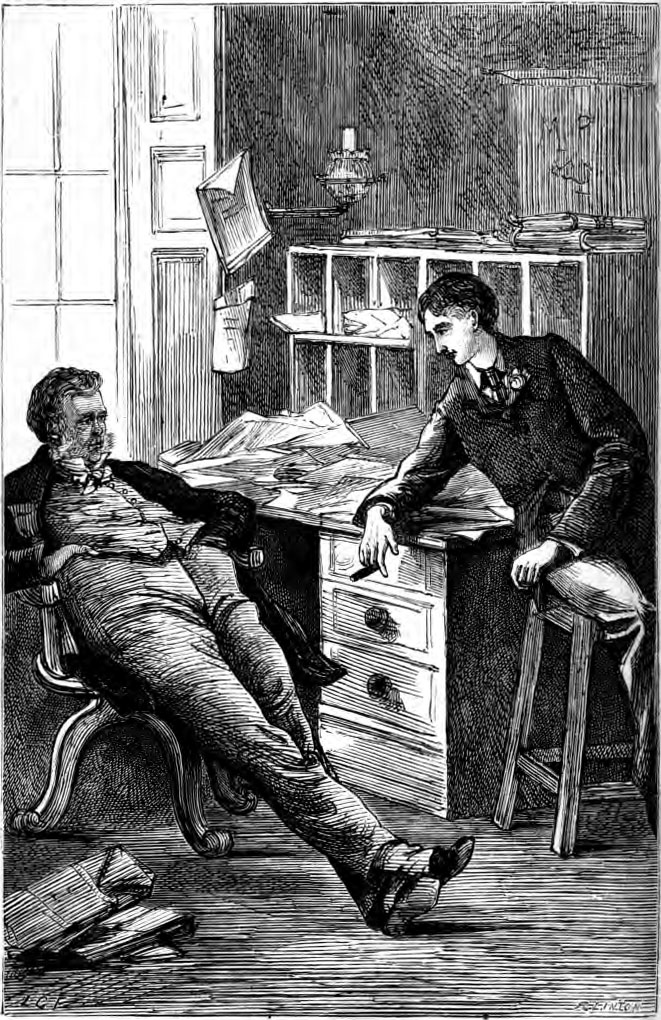
And now there came this rumour which was so far particular in
its details that it inferred the forgery, of which it accused Mr.
Melmotte, to his mode of acquiring the Pickering property. The
nature of the forgery was of course described in various ways,--as
was also the signature said to have been forged. But there were
many who believed, or almost believed, that something wrong had
been done,--that some great fraud had been committed; and in
connection with this it was ascertained,--by some as a matter of
certainty,--that the Pickering estate had been already mortgaged
by Melmotte to its full value at an assurance office. In such a
transaction there would be nothing dishonest; but as this place
had been bought for the great man's own family use, and not as a
speculation, even this report of the mortgage tended to injure his
credit. And then, as the day went on, other tidings were told as to
other properties. Houses in the East-end of London were said to have
been bought and sold, without payment of the purchase money as to
the buying, and with receipt of the purchase money as to the selling.
It was certainly true that Squercum himself had seen the letter in
Mr. Bideawhile's office which conveyed to the father's lawyer the
son's sanction for the surrender of the title-deeds, and that that
letter, prepared in Mr. Bideawhile's office, purported to have
Dolly's signature. Squercum said but little, remembering that his
client was not always clear in the morning as to anything he had done
on the preceding evening. But the signature, though it was scrawled
as Dolly always scrawled it, was not like the scrawl of a drunken
man.
The letter was said to have been sent to Mr. Bideawhile's office with
other letters and papers, direct from old Mr. Longestaffe. Such was
the statement made at first to Mr. Squercum by the Bideawhile party,
who at that moment had no doubt of the genuineness of the letter or
of the accuracy of their statement. Then Squercum saw his client
again, and returned to the charge at Bideawhile's office, with the
positive assurance that the signature was a forgery. Dolly, when
questioned by Squercum, quite admitted his propensity to be "tight."
He had no reticence, no feeling of disgrace on such matters. But he
had signed no letter when he was tight. "Never did such a thing in my
life, and nothing could make me," said Dolly. "I'm never tight except
at the club, and the letter couldn't have been there. I'll be drawn
and quartered if I ever signed it. That's flat." Dolly was intent on
going to his father at once, on going to Melmotte at once, on going
to Bideawhile's at once, and making there "no end of a row,"--but
Squercum stopped him. "We'll just ferret this thing out quietly,"
said Squercum, who perhaps thought that there would be high honour
in discovering the peccadillos of so great a man as Mr. Melmotte. Mr.
Longestaffe, the father, had heard nothing of the matter till the
Saturday after his last interview with Melmotte in the City. He had
then called at Bideawhile's office in Lincoln's Inn Fields, and had
been shown the letter. He declared at once that he had never sent
the letter to Mr. Bideawhile. He had begged his son to sign the
letter and his son had refused. He did not at that moment distinctly
remember what he had done with the letter unsigned. He believed he
had left it with the other papers; but it was possible that his son
might have taken it away. He acknowledged that at the time he had
been both angry and unhappy. He didn't think that he could have sent
the letter back unsigned,--but he was not sure. He had more than
once been in his own study in Bruton Street since Mr. Melmotte had
occupied the house,--by that gentleman's leave,--having left various
papers there under his own lock and key. Indeed it had been matter
of agreement that he should have access to his own study when he let
the house. He thought it probable that he would have kept back the
unsigned letter, and have kept it under lock and key, when he sent
away the other papers. Then reference was made to Mr. Longestaffe's
own letter to the lawyer, and it was found that he had not even
alluded to that which his son had been asked to sign; but that he had
said, in his own usually pompous style, that Mr. Longestaffe, junior,
was still prone to create unsubstantial difficulties. Mr. Bideawhile
was obliged to confess that there had been a want of caution among
his own people. This allusion to the creation of difficulties by
Dolly, accompanied, as it was supposed to have been, by Dolly's
letter doing away with all difficulties, should have attracted
notice. Dolly's letter must have come in a separate envelope; but
such envelope could not be found, and the circumstance was not
remembered by the clerk. The clerk who had prepared the letter for
Dolly's signature represented himself as having been quite satisfied
when the letter came again beneath his notice with Dolly's well-known
signature.
Such were the facts as far as they were known at Messrs. Slow and
Bideawhile's office,--from whom no slightest rumour emanated; and as
they had been in part collected by Squercum, who was probably less
prudent. The Bideawhiles were still perfectly sure that Dolly had
signed the letter, believing the young man to be quite incapable of
knowing on any day what he had done on the day before.
Squercum was quite sure that his client had not signed it. And it
must be owned on Dolly's behalf that his manner on this occasion was
qualified to convince. "Yes," he said to Squercum; "it's easy saying
that I'm lack-a-daisical. But I know when I'm lack-a-daisical and
when I'm not. Awake or asleep, drunk or sober, I never signed that
letter." And Mr. Squercum believed him.
It would be hard to say how the rumour first got into the City on
this Monday morning. Though the elder Longestaffe had first heard
of the matter only on the previous Saturday, Mr. Squercum had been
at work for above a week. Mr. Squercum's little matter alone might
hardly have attracted the attention which certainly was given on this
day to Mr. Melmotte's private affairs;--but other facts coming to
light assisted Squercum's views. A great many shares of the South
Central Pacific and Mexican Railway had been thrown upon the market,
all of which had passed through the hands of Mr. Cohenlupe;--and Mr.
Cohenlupe in the City had been all to Mr. Melmotte as Lord Alfred had
been at the West End. Then there was the mortgage of this Pickering
property, for which the money certainly had not been paid; and there
was the traffic with half a street of houses near the Commercial
Road, by which a large sum of money had come into Mr. Melmotte's
hands. It might, no doubt, all be right. There were many who thought
that it would all be right. There were not a few who expressed the
most thorough contempt for these rumours. But it was felt to be a
pity that Mr. Melmotte was not in the City.
This was the day of the dinner. The Lord Mayor had even made up his
mind that he would not go to the dinner. What one of his brother
aldermen said to him about leaving others in the lurch might be quite
true; but, as his lordship remarked, Melmotte was a commercial man,
and as these were commercial transactions it behoved the Lord Mayor
of London to be more careful than other men. He had always had his
doubts, and he would not go. Others of the chosen few of the City
who had been honoured with commands to meet the Emperor resolved
upon absenting themselves unless the Lord Mayor went. The affair was
very much discussed, and there were no less than six declared City
defaulters. At the last moment a seventh was taken ill and sent a
note to Miles Grendall excusing himself, which was thrust into the
secretary's hands just as the Emperor arrived.
But a reverse worse than this took place;--a defalcation more
injurious to the Melmotte interests generally even than that which
was caused either by the prudence or by the cowardice of the City
Magnates. The House of Commons, at its meeting, had heard the tidings
in an exaggerated form. It was whispered about that Melmotte had
been detected in forging the deed of conveyance of a large property,
and that he had already been visited by policemen. By some it was
believed that the Great Financier would lie in the hands of the
Philistines while the Emperor of China was being fed at his house.
In the third edition of the "Evening Pulpit" came out a mysterious
paragraph which nobody could understand but they who had known all
about it before. "A rumour is prevalent that frauds to an enormous
extent have been committed by a gentleman whose name we are
particularly unwilling to mention. If it be so it is indeed remark-
able that they should have come to light at the present moment.
We cannot trust ourselves to say more than this." No one wishes
to dine with a swindler. No one likes even to have dined with a
swindler,--especially to have dined with him at a time when his
swindling was known or suspected. The Emperor of China no doubt was
going to dine with this man. The motions of Emperors are managed with
such ponderous care that it was held to be impossible now to save
the country from what would doubtless be felt to be a disgrace if
it should hereafter turn out that a forger had been solicited to
entertain the imperial guest of the country. Nor was the thing as yet
so far certain as to justify such a charge, were it possible. But
many men were unhappy in their minds. How would the story be told
hereafter if Melmotte should be allowed to play out his game of host
to the Emperor, and be arrested for forgery as soon as the Eastern
Monarch should have left his house? How would the brother of the Sun
like the remembrance of the banquet which he had been instructed
to honour with his presence? How would it tell in all the foreign
newspapers, in New York, in Paris, and Vienna, that this man who
had been cast forth from the United States, from France, and from
Austria had been selected as the great and honourable type of British
Commerce? There were those in the House who thought that the absolute
consummation of the disgrace might yet be avoided, and who were of
opinion that the dinner should be "postponed." The leader of the
Opposition had a few words on the subject with the Prime Minister.
"It is the merest rumour," said the Prime Minister. "I have inquired,
and there is nothing to justify me in thinking that the charges can
be substantiated."
"They say that the story is believed in the City."
"I should not feel myself justified in acting upon such a report. The
Prince might probably find it impossible not to go. Where should we
be if Mr. Melmotte to-morrow were able to prove the whole to be a
calumny, and to show that the thing had been got up with a view of
influencing the election at Westminster? The dinner must certainly go
on."
"And you will go yourself?"
"Most assuredly," said the Prime Minister. "And I hope that you will
keep me in countenance." His political antagonist declared with
a smile that at such a crisis he would not desert his honourable
friend;--but he could not answer for his followers. There was, he
admitted, a strong feeling among the leaders of the Conservative
party of distrust in Melmotte. He considered it probable that among
his friends who had been invited there would be some who would be
unwilling to meet even the Emperor of China on the existing terms.
"They should remember," said the Prime Minister, "that they are also
to meet their own Prince, and that empty seats on such an occasion
will be a dishonour to him."
"Just at present I can only answer for myself," said the leader of
the Opposition.--At that moment even the Prime Minister was much
disturbed in his mind; but in such emergencies a Prime Minister can
only choose the least of two evils. To have taken the Emperor to dine
with a swindler would be very bad; but to desert him, and to stop the
coming of the Emperor and all the Princes on a false rumour, would be
worse.
CHAPTER LIX.
THE DINNER.
It does sometimes occur in life that an unambitious man, who is in no
degree given to enterprises, who would fain be safe, is driven by the
cruelty of circumstances into a position in which he must choose a
side, and in which, though he has no certain guide as to which side
he should choose, he is aware that he will be disgraced if he should
take the wrong side. This was felt as a hardship by many who were
quite suddenly forced to make up their mind whether they would go to
Melmotte's dinner, or join themselves to the faction of those who had
determined to stay away although they had accepted invitations. Some
there were not without a suspicion that the story against Melmotte
had been got up simply as an electioneering trick,--so that Mr. Alf
might carry the borough on the next day. As a dodge for an election
this might be very well, but any who might be deterred by such
a manoeuvre from meeting the Emperor and supporting the Prince
would surely be marked men. And none of the wives, when they were
consulted, seemed to care a straw whether Melmotte was a swindler or
not. Would the Emperor and the Princes and Princesses be there? This
was the only question which concerned them. They did not care whether
Melmotte was arrested at the dinner or after the dinner, so long
as they, with others, could show their diamonds in the presence of
eastern and western royalty. But yet,--what a fiasco would it be,
if at this very instant of time the host should be apprehended for
common forgery! The great thing was to ascertain whether others were
going. If a hundred or more out of the two hundred were to be absent
how dreadful would be the position of those who were present! And how
would the thing go if at the last moment the Emperor should be kept
away? The Prime Minister had decided that the Emperor and the Prince
should remain altogether in ignorance of the charges which were
preferred against the man; but of that these doubters were unaware.
There was but little time for a man to go about town and pick up the
truth from those who were really informed; and questions were asked
in an uncomfortable and restless manner. "Is your Grace going?" said
Lionel Lupton to the Duchess of Stevenage,--having left the House
and gone into the park between six and seven to pick up some hints
among those who were known to have been invited. The Duchess was
Lord Alfred's sister, and of course she was going. "I usually keep
engagements when I make them, Mr. Lupton," said the Duchess. She
had been assured by Lord Alfred not a quarter of an hour before that
everything was as straight as a die. Lord Alfred had not then even
heard of the rumour. But ultimately both Lionel Lupton and Beauchamp
Beauclerk attended the dinner. They had received special tickets as
supporters of Mr. Melmotte at the election,--out of the scanty number
allotted to that gentleman himself,--and they thought themselves
bound in honour to be there. But they, with their leader, and one
other influential member of the party, were all who at last came as
the political friends of the candidate for Westminster. The existing
ministers were bound to attend to the Emperor and the Prince. But
members of the Opposition, by their presence, would support the man
and the politician, and both as a man and as a politician they were
ashamed of him.
When Melmotte arrived at his own door with his wife and daughter he
had heard nothing of the matter. That a man so vexed with affairs of
money, so laden with cares, encompassed by such dangers, should be
free from suspicion and fear it is impossible to imagine. That such
burdens should be borne at all is a wonder to those whose shoulders
have never been broadened for such work;--as is the strength of the
blacksmith's arm to men who have never wielded a hammer. Surely his
whole life must have been a life of terrors! But of any special peril
to which he was at that moment subject, or of any embarrassment which
might affect the work of the evening, he knew nothing. He placed his
wife in the drawing-room and himself in the hall, and arranged his
immediate satellites around him,--among whom were included the two
Grendalls, young Nidderdale, and Mr. Cohenlupe,--with a feeling of
gratified glory. Nidderdale down at the House had heard the rumour,
but had determined that he would not as yet fly from his colours.
Cohenlupe had also come up from the House, where no one had spoken
to him. Though grievously frightened during the last fortnight, he had
not dared to be on the wing as yet. And, indeed, to what clime could
such a bird as he fly in safety? He had not only heard,--but also
knew very much, and was not prepared to enjoy the feast. Since they
had been in the hall Miles had spoken dreadful words to his father.
"You've heard about it; haven't you?" whispered Miles. Lord Alfred,
remembering his sister's question, became almost pale, but declared
that he had heard nothing. "They're saying all manner of things in
the City;--forgery and heaven knows what. The Lord Mayor is not
coming." Lord Alfred made no reply. It was the philosophy of his
life that misfortunes when they came should be allowed to settle
themselves. But he was unhappy.
The grand arrivals were fairly punctual, and the very grand people
all came. The unfortunate Emperor,--we must consider a man to be
unfortunate who is compelled to go through such work as this,--with
impassible and awful dignity, was marshalled into the room on the
ground floor, whence he and other royalties were to be marshalled
back into the banqueting hall. Melmotte, bowing to the ground, walked
backwards before him, and was probably taken by the Emperor for some
Court Master of the Ceremonies especially selected to walk backwards
on this occasion. The Princes had all shaken hands with their host,
and the Princesses had bowed graciously. Nothing of the rumour had
as yet been whispered in royal palaces. Besides royalty the company
allowed to enter the room downstairs was very select. The Prime
Minister, one archbishop, two duchesses, and an ex-governor of
India with whose features the Emperor was supposed to be peculiarly
familiar, were alone there. The remainder of the company, under the
superintendence of Lord Alfred, were received in the drawing-room
above. Everything was going on well, and they who had come and had
thought of not coming were proud of their wisdom.
But when the company was seated at dinner the deficiencies were
visible enough, and were unfortunate. Who does not know the effect
made by the absence of one or two from a table intended for ten
or twelve,--how grievous are the empty places, how destructive of
the outward harmony and grace which the hostess has endeavoured to
preserve are these interstices, how the lady in her wrath declares to
herself that those guilty ones shall never have another opportunity
of filling a seat at her table? Some twenty, most of whom had been
asked to bring their wives, had slunk from their engagements, and
the empty spaces were sufficient to declare a united purpose. A week
since it had been understood that admission for the evening could not
be had for love or money, and that a seat at the dinner-table was as
a seat at some banquet of the gods! Now it looked as though the room
were but half-filled. There were six absences from the City. Another
six of Mr. Melmotte's own political party were away. The archbishops
and the bishop were there, because bishops never hear worldly tidings
till after other people;--but that very Master of the Buckhounds for
whom so much pressure had been made did not come. Two or three
peers were absent, and so also was that editor who had been chosen
to fill Mr. Alf's place. One poet, two painters, and a philosopher had
received timely notice at their clubs, and had gone home. The three
independent members of the House of Commons for once agreed in their
policy, and would not lend the encouragement of their presence to a
man suspected of forgery. Nearly forty places were vacant when the
business of the dinner commenced.
Melmotte had insisted that Lord Alfred should sit next to himself at
the big table, and having had the objectionable bar removed, and
his own chair shoved one step nearer to the centre, had carried his.
point. With the anxiety natural to such an occasion, he glanced
repeatedly round the hall, and of course became aware that many were
absent. "How is it that there are so many places empty?" he said to
his faithful Achates.
"Don't know," said Achates, shaking his head, steadfastly refusing to
look round upon the hall.
Melmotte waited awhile, then looked round again, and asked the
question in another shape: "Hasn't there been some mistake about the
numbers? There's room for ever so many more."
"Don't know," said Lord Alfred, who was unhappy in his mind, and
repenting himself that he had ever seen Mr. Melmotte.
"What the deuce do you mean?" whispered Melmotte. "You've been at it
from the beginning and ought to know. When I wanted to ask Brehgert,
you swore that you couldn't squeeze a place."
"Can't say anything about it," said Lord Alfred, with his eyes fixed
upon his plate.
"I'll be d---- if I don't find out," said Melmotte. "There's either
some horrible blunder, or else there's been imposition. I don't see
quite clearly. Where's Sir Gregory Gribe?"
"Hasn't come, I suppose."
"And where's the Lord Mayor?" Melmotte, in spite of royalty, was now
sitting with his face turned round upon the hall. "I know all their
places, and I know where they were put. Have you seen the Lord
Mayor?"
"No; I haven't seen him at all."
"But he was to come. What's the meaning of it, Alfred?"
"Don't know anything about it." He shook his head but would not, for
even a moment, look round upon the room.
"And where's Mr. Killegrew,--and Sir David Boss?" Mr. Killegrew and
Sir David were gentlemen of high standing, and destined for important
offices in the Conservative party. "There are ever so many people not
here. Why, there's not above half of them down the room. What's up,
Alfred? I must know."
"I tell you I know nothing. I could not make them come." Lord
Alfred's answers were made not only with a surly voice, but also with
a surly heart. He was keenly alive to the failure, and alive also to
the feeling that the failure would partly be attached to himself.
At the present moment he was anxious to avoid observation, and it
seemed to him that Melmotte, by the frequency and impetuosity of his
questions, was drawing special attention to him. "If you go on making
a row," he said, "I shall go away." Melmotte looked at him with all
his eyes. "Just sit quiet and let the thing go on. You'll know all
about it soon enough." This was hardly the way to give Mr. Melmotte
peace of mind. For a few minutes he did sit quiet. Then he got up and
moved down the hall behind the guests.
In the meantime, Imperial Majesty and Royalties of various
denominations ate their dinner, without probably observing those
Banquo's seats. As the Emperor talked Manchoo only, and as there was
no one present who could even interpret Manchoo into English,--the
imperial interpreter condescending only to interpret Manchoo into
ordinary Chinese which had to be reinterpreted,--it was not within
his Imperial Majesty's power to have much conversation with his
neighbours. And as his neighbours on each side of him were all
cousins and husbands, and brothers and wives, who saw each constantly
under, let us presume, more comfortable circumstances, they had not
very much to say to each other. Like most of us, they had their
duties to do, and, like most of us, probably found their duties
irksome. The brothers and sisters and cousins were used to it; but
that awful Emperor, solid, solemn, and silent, must, if the spirit of
an Eastern Emperor be at all like that of a Western man, have had a
weary time of it. He sat there for more than two hours, awful, solid,
solemn, and silent, not eating very much,--for this was not his
manner of eating; nor drinking very much,--for this was not his
manner of drinking; but wondering, no doubt, within his own awful
bosom, at the changes which were coming when an Emperor of China was
forced, by outward circumstances, to sit and hear this buzz of voices
and this clatter of knives and forks. "And this," he must have said
to himself, "is what they call royalty in the West!" If a prince of
our own was forced, for the good of the country, to go among some
far distant outlandish people, and there to be poked in the ribs, and
slapped on the back all round, the change to him could hardly be so
great.
"Where's Sir Gregory?" said Melmotte, in a hoarse whisper, bending
over the chair of a City friend. It was old Todd, the senior partner
of Todd, Brehgert, and Goldsheiner. Mr. Todd was a very wealthy man,
and had a considerable following in the City.
"Ain't he here?" said Todd,--knowing very well who had come from the
City and who had declined.
"No;--and the Lord Mayor's not come;--nor Postlethwaite, nor Bunter.
What's the meaning of it?"
Todd looked first at one neighbour and then at another before he
answered. "I'm here, that's all I can say, Mr. Melmotte; and I've
had a very good dinner. They who haven't come, have lost a very good
dinner."
There was a weight upon Melmotte's mind of which he could not rid
himself. He knew from the old man's manner, and he knew also from
Lord Alfred's manner, that there was something which each of them
could tell him if he would. But he was unable to make the men open
their mouths. And yet it might be so important to him that he should
know! "It's very odd," he said, "that gentlemen should promise to
come and then stay away. There were hundreds anxious to be present
whom I should have been glad to welcome, if I had known that there
would be room. I think it is very odd."
"It is odd," said Mr. Todd, turning his attention to the plate before
him.
Melmotte had lately seen much of Beauchamp Beauclerk, in reference
to the coming election. Passing back up the table, he found the
gentleman with a vacant seat on one side of him. There were many
vacant seats in this part of the room, as the places for the
Conservative gentlemen had been set apart together. There Mr.
Melmotte seated himself for a minute, thinking that he might get the
truth from his new ally. Prudence should have kept him silent. Let
the cause of these desertions have been what it might, it ought to
have been clear to him that he could apply no remedy to it now. But
he was bewildered and dismayed, and his mind within him was changing
at every moment. He was now striving to trust to his arrogance and
declaring that nothing should cow him. And then again he was so cowed
that he was ready to creep to any one for assistance. Personally,
Mr. Beauclerk had disliked the man greatly. Among the vulgar, loud
upstarts whom he had known, Melmotte was the vulgarest, the loudest,
and the most arrogant. But he had taken the business of Melmotte's
election in hand, and considered himself bound to stand by Melmotte
till that was over; and he was now the guest of the man in his own
house, and was therefore constrained to courtesy. His wife was
sitting by him, and he at once introduced her to Mr. Melmotte. "You
have a wonderful assemblage here, Mr. Melmotte," said the lady,
looking up at the royal table.
"Yes, ma'am, yes. His Majesty the Emperor has been pleased to
intimate that he has been much gratified."--Had the Emperor in truth
said so, no one who looked at him could have believed his imperial
word.--"Can you tell me, Mr. Beauclerk, why those other gentlemen are
not here? It looks very odd; does it not?"
"Ah; you mean Killegrew."
"Yes; Mr. Killegrew and Sir David Boss, and the whole lot. I made a
particular point of their coming. I said I wouldn't have the dinner
at all unless they were to be asked. They were going to make it a
Government thing; but I said no. I insisted on the leaders of our own
party; and now they're not here. I know the cards were sent;--and, by
George, I have their answers, saying they'd come."
"I suppose some of them are engaged," said Mr. Beauclerk.
"Engaged! What business has a man to accept one engagement and
then take another? And, if so, why shouldn't he write and make his
excuses? No, Mr. Beauclerk, that won't go down."
"I'm here, at any rate," said Beauclerk, making the very answer that
had occurred to Mr. Todd.
"Oh, yes, you're here. You're all right. But what is it, Mr.
Beauclerk? There's something up, and you must have heard." And so
it was clear to Mr. Beauclerk that the man knew nothing about it
himself. If there was anything wrong, Melmotte was not aware that
the wrong had been discovered. "Is it anything about the election
to-morrow?"
"One never can tell what is actuating people," said Mr. Beauclerk.
"If you know anything about the matter I think you ought to tell me."
"I know nothing except that the ballot will be taken to-morrow. You
and I have got nothing more to do in the matter except to wait the
result."
"Well; I suppose it's all right," said Melmotte, rising and going
back to his seat. But he knew that things were not all right. Had his
political friends only been absent, he might have attributed their
absence to some political cause which would not have touched him
deeply. But the treachery of the Lord Mayor and of Sir Gregory Gribe
was a blow. For another hour after he had returned to his place, the
Emperor sat solemn in his chair; and then, at some signal given by
some one, he was withdrawn. The ladies had already left the room
about half an hour. According to the programme arranged for the
evening, the royal guests were to return to the smaller room for
a cup of coffee, and were then to be paraded upstairs before the
multitude who would by that time have arrived, and to remain there
long enough to justify the invited ones in saying that they had spent
the evening with the Emperor and the Princes and the Princesses. The
plan was carried out perfectly. At half-past ten the Emperor was made
to walk upstairs, and for half an hour sat awful and composed in an
arm-chair that had been prepared for him. How one would wish to see
the inside of the mind of the Emperor as it worked on that occasion!
Melmotte, when his guests ascended his stairs, went back into the
banqueting-room and through to the hall, and wandered about till he
found Miles Grendall. "Miles," he said, "tell me what the row is."
"How row?" asked Miles.
"There's something wrong, and you know all about it. Why didn't the
people come?" Miles, looking guilty, did not even attempt to deny his
knowledge. "Come; what is it? We might as well know all about it at
once." Miles looked down on the ground, and grunted something. "Is it
about the election?"
"No, it's not that," said Miles.
"Then what is it?"
"They got hold of something to-day in the City--about Pickering."
"They did, did they? And what were they saying about Pickering? Come;
you might as well out with it. You don't suppose that I care what
lies they tell."
"They say there's been something--forged. Title-deeds, I think they
say."
"Title-deeds! that I have forged title-deeds. Well; that's beginning
well. And his lordship has stayed away from my house after accepting
my invitation because he has heard that story! All right, Miles;
that will do." And the Great Financier went upstairs into his own
drawing-room.
CHAPTER LX.
MISS LONGESTAFFE'S LOVER.
A few days before that period in our story which we have now reached,
Miss Longestaffe was seated in Lady Monogram's back drawing-room,
discussing the terms on which the two tickets for Madame Melmotte's
grand reception had been transferred to Lady Monogram,--the place on
the cards for the names of the friends whom Madame Melmotte had the
honour of inviting to meet the Emperor and the Princes, having been
left blank; and the terms also on which Miss Longestaffe had been
asked to spend two or three days with her dear friend Lady Monogram.
Each lady was disposed to get as much and to give as little as
possible,--in which desire the ladies carried out the ordinary
practice of all parties to a bargain. It had of course been settled
that Lady Monogram was to have the two tickets,--for herself and
her husband,--such tickets at that moment standing very high in the
market. In payment for these valuable considerations, Lady Monogram
was to undertake to chaperon Miss Longestaffe at the entertainment,
to take Miss Longestaffe as a visitor for three days, and to have one
party at her own house during the time, so that it might be seen that
Miss Longestaffe had other friends in London besides the Melmotte's
on whom to depend for her London gaieties. At this moment Miss
Longestaffe felt herself justified in treating the matter as though
she were hardly receiving a fair equivalent. The Melmotte tickets
were certainly ruling very high. They had just culminated. They
fell a little soon afterwards, and at ten P.M. on the night of the
entertainment were hardly worth anything. At the moment which we have
now in hand, there was a rush for them. Lady Monogram had already
secured the tickets. They were in her desk. But, as will sometimes
be the case in a bargain, the seller was complaining that as she had
parted with her goods too cheap, some make-weight should be added to
the stipulated price.
"As for that, my dear," said Miss Longestaffe, who, since the rise in
Melmotte stock generally, had endeavoured to resume something of her
old manners, "I don't see what you mean at all. You meet Lady Julia
Goldsheiner everywhere, and her father-in-law is Mr. Brehgert's
junior partner."
"Lady Julia is Lady Julia, my dear, and young Mr. Goldsheiner has,
in some sort of way, got himself in. He hunts, and Damask says
that he is one of the best shots at Hurlingham. I never met old Mr.
Goldsheiner anywhere."
"I have."
"Oh, yes, I dare say. Mr. Melmotte, of course, entertains all the
City people. I don't think Sir Damask would like me to ask Mr. Breh-
gert to dine here." Lady Monogram managed everything herself with
reference to her own parties; invited all her own guests, and never
troubled Sir Damask,--who, again, on his side, had his own set of
friends; but she was very clever in the use which she made of her
husband. There were some aspirants who really were taught to think
that Sir Damask was very particular as to the guests whom he welcomed
to his own house.
"May I speak to Sir Damask about it?" asked Miss Longestaffe, who was
very urgent on the occasion.
"Well, my dear, I really don't think you ought to do that. There are
little things which a man and his wife must manage together without
interference."
"Nobody can ever say that I interfered in any family. But really,
Julia, when you tell me that Sir Damask cannot receive Mr. Brehgert,
it does sound odd. As for City people, you know as well as I do, that
that kind of thing is all over now. City people are just as good as
West-end people."
"A great deal better, I dare say. I'm not arguing about that. I don't
make the lines; but there they are; and one gets to know in a sort
of way what they are. I don't pretend to be a bit better than my
neighbours. I like to see people come here whom other people who come
here will like to meet. I'm big enough to hold my own, and so is Sir
Damask. But we ain't big enough to introduce new-comers. I don't
suppose there's anybody in London understands it better than you do,
Georgiana, and therefore it's absurd my pretending to teach you. I
go pretty well everywhere, as you are aware; and I shouldn't know Mr.
Brehgert if I were to see him."
"You'll meet him at the Melmottes', and, in spite of all you said
once, you're glad enough to go there."
"Quite true, my dear. I don't think that you are just the person to
throw that in my teeth; but never mind that. There's the butcher
round the corner in Bond Street, or the man who comes to do my hair.
I don't at all think of asking them to my house. But if they were
suddenly to turn out wonderful men, and go everywhere, no doubt I
should be glad to have them here. That's the way we live, and you are
as well used to it as I am. Mr. Brehgert at present to me is like the
butcher round the corner." Lady Monogram had the tickets safe under
lock and key, or I think she would hardly have said this.
"He is not a bit like a butcher," said Miss Longestaffe, blazing up
in real wrath.
"I did not say that he was."
"Yes, you did; and it was the unkindest thing you could possibly say.
It was meant to be unkind. It was monstrous. How would you like it if
I said that Sir Damask was like a hair-dresser?"
"You can say so if you please. Sir Damask drives four in hand, rides
as though he meant to break his neck every winter, is one of the best
shots going, and is supposed to understand a yacht as well as any
other gentleman out. And I'm rather afraid that before he was married
he used to box with all the prize-fighters, and to be a little too
free behind the scenes. If that makes a man like a hair-dresser,
well, there he is."
"How proud you are of his vices."
"He's very good-natured, my dear, and as he does not interfere with
me, I don't interfere with him. I hope you'll do as well. I dare say
Mr. Brehgert is good-natured."
"He's an excellent man of business, and is making a very large
fortune."
"And has five or six grown-up children, who, no doubt, will be a
comfort."
"If I don't mind them, why need you? You have none at all, and you
find it lonely enough."
"Not at all lonely. I have everything that I desire. How hard you are
trying to be ill-natured, Georgiana."
"Why did you say that he was a--butcher?"
"I said nothing of the kind. I didn't even say that he was like a
butcher. What I did say was this,--that I don't feel inclined to risk
my own reputation on the appearance of new people at my table. Of
course, I go in for what you call fashion. Some people can dare to
ask anybody they meet in the streets. I can't. I've my own line, and
I mean to follow it. It's hard work, I can tell you; and it would
be harder still if I wasn't particular. If you like Mr. Brehgert to
come here on Tuesday evening, when the rooms will be full, you can
ask him; but as for having him to dinner, I--won't--do--it." So the
matter was at last settled. Miss Longestaffe did ask Mr. Brehgert for
the Tuesday evening, and the two ladies were again friends.
Perhaps Lady Monogram, when she illustrated her position by an
allusion to a butcher and a hair-dresser, had been unaware that Mr.
Brehgert had some resemblance to the form which men in that trade
are supposed to bear. Let us at least hope that she was so. He was a
fat, greasy man, good-looking in a certain degree, about fifty, with
hair dyed black, and beard and moustache dyed a dark purple colour.
The charm of his face consisted in a pair of very bright black eyes,
which were, however, set too near together in his face for the
general delight of Christians. He was stout;--fat all over rather
than corpulent,--and had that look of command in his face which has
become common to master-butchers, probably by long intercourse with
sheep and oxen. But Mr. Brehgert was considered to be a very good man
of business, and was now regarded as being, in a commercial point of
view, the leading member of the great financial firm of which he was
the second partner. Mr. Todd's day was nearly done. He walked about
constantly between Lombard Street, the Exchange, and the Bank,
and talked much to merchants; he had an opinion too of his own on
particular cases; but the business had almost got beyond him, and Mr.
Brehgert was now supposed to be the moving spirit of the firm. He
was a widower, living in a luxurious villa at Fulham with a family,
not indeed grown up, as Lady Monogram had ill-naturedly said, but
which would be grown up before long, varying from an eldest son of
eighteen, who had just been placed at a desk in the office, to the
youngest girl of twelve, who was at school at Brighton. He was a man
who always asked for what he wanted; and having made up his mind that
he wanted a second wife, had asked Miss Georgiana Longestaffe to fill
that situation. He had met her at the Melmottes', had entertained
her, with Madame Melmotte and Marie, at Beaudesert, as he called
his villa, had then proposed in the square, and two days after had
received an assenting answer in Bruton Street.
Poor Miss Longestaffe! Although she had acknowledged the fact to Lady
Monogram in her desire to pave the way for the reception of herself
into society as a married woman, she had not as yet found courage to
tell her family. The man was absolutely a Jew;--not a Jew that had
been, as to whom there might possibly be a doubt whether he or his
father or his grandfather had been the last Jew of the family; but
a Jew that was. So was Goldsheiner a Jew, whom Lady Julia Start had
married,--or at any rate had been one a very short time before he ran
away with that lady. She counted up ever so many instances on her
fingers of "decent people" who had married Jews or Jewesses. Lord
Frederic Framlinghame had married a girl of the Berrenhoffers; and
Mr. Hart had married a Miss Chute. She did not know much of Miss
Chute, but was certain that she was a Christian. Lord Frederic's wife
and Lady Julia Goldsheiner were seen everywhere. Though she hardly
knew how to explain the matter even to herself, she was sure that
there was at present a general heaving-up of society on this matter,
and a change in progress which would soon make it a matter of
indifference whether anybody was Jew or Christian. For herself she
regarded the matter not at all, except as far as it might be regarded
by the world in which she wished to live. She was herself above
all personal prejudices of that kind. Jew, Turk, or infidel was
nothing to her. She had seen enough of the world to be aware that
her happiness did not lie in that direction, and could not depend in
the least on the religion of her husband. Of course she would go to
church herself. She always went to church. It was the proper thing to
do. As to her husband, though she did not suppose that she could ever
get him to church,--nor perhaps would it be desirable,--she thought
that she might induce him to go nowhere, so that she might be able to
pass him off as a Christian. She knew that such was the Christianity
of young Goldsheiner, of which the Starts were now boasting.
Had she been alone in the world she thought that she could have
looked forward to her destiny with complacency; but she was afraid of
her father and mother. Lady Pomona was distressingly old-fashioned,
and had so often spoken with horror even of the approach of a
Jew,--and had been so loud in denouncing the iniquity of Christians
who allowed such people into their houses! Unfortunately, too,
Georgiana in her earlier days had re-echoed all her mother's
sentiments. And then her father,--if he had ever earned for himself
the right to be called a Conservative politician by holding a real
opinion of his own,--it had been on that matter of admitting the Jews
into parliament. When that had been done he was certain that the
glory of England was sunk for ever. And since that time, whenever
creditors were more than ordinarily importunate, when Slow and
Bideawhile could do nothing for him, he would refer to that fatal
measure as though it was the cause of every embarrassment which had
harassed him. How could she tell parents such as these that she was
engaged to marry a man who at the present moment went to synagogue
on a Saturday and carried out every other filthy abomination common to
the despised people?
That Mr. Brehgert was a fat, greasy man of fifty, conspicuous for
hair-dye, was in itself distressing:--but this minor distress
was swallowed up in the greater. Miss Longestaffe was a girl
possessing considerable discrimination, and was able to weigh her
own possessions in just scales. She had begun life with very high
aspirations, believing in her own beauty, in her mother's fashion,
and her father's fortune. She had now been ten years at the work, and
was aware that she had always flown a little too high for her mark at
the time. At nineteen and twenty and twenty-one she had thought that
all the world was before her. With her commanding figure, regular
long features, and bright complexion, she had regarded herself as
one of the beauties of the day, and had considered herself entitled
to demand wealth and a coronet. At twenty-two, twenty-three, and
twenty-four any young peer, or peer's eldest son, with a house in
town and in the country, might have sufficed. Twenty-five and six
had been the years for baronets and squires; and even a leading
fashionable lawyer or two had been marked by her as sufficient
since that time. But now she was aware that hitherto she had always
fixed her price a little too high. On three things she was still
determined,--that she would not be poor, that she would not be
banished from London, and that she would not be an old maid. "Mamma,"
she had often said, "there's one thing certain. I shall never do to
be poor." Lady Pomona had expressed full concurrence with her child.
"And, mamma, to do as Sophia is doing would kill me. Fancy having to
live at Toodlam all one's life with George Whitstable!" Lady Pomona
had agreed to this also, though she thought that Toodlam Hall was a
very nice home for her elder daughter. "And, mamma, I should drive
you and papa mad if I were to stay at home always. And what would
become of me when Dolly was master of everything?" Lady Pomona,
looking forward as well as she was able to the time at which she
should herself have departed, when her dower and dower-house would
have reverted to Dolly, acknowledged that Georgiana should provide
herself with a home of her own before that time.
And how was this to be done? Lovers with all the glories and all
the graces are supposed to be plentiful as blackberries by girls of
nineteen, but have been proved to be rare hothouse fruits by girls
of twenty-nine. Brehgert was rich, would live in London, and would
be a husband. People did such odd things now and "lived them down,"
that she could see no reason why she should not do this and live this
down. Courage was the one thing necessary,--that and perseverance.
She must teach herself to talk about Brehgert as Lady Monogram did
of Sir Damask. She had plucked up so much courage as had enabled her
to declare her fate to her old friend,--remembering as she did so
how in days long past she and her friend Julia Triplex had scattered
their scorn upon some poor girl who had married a man with a Jewish
name,--whose grandfather had possibly been a Jew. "Dear me," said
Lady Monogram. "Todd, Brehgert, and Goldsheiner! Mr. Todd is--one of
us, I suppose."
"Yes," said Georgiana boldly, "and Mr. Brehgert is a Jew. His name is
Ezekiel Brehgert, and he is a Jew. You can say what you like about
it."
"I don't say anything about it, my dear."
"And you can think anything you like. Things are changed since you
and I were younger."
"Very much changed, it appears," said Lady Monogram. Sir Damask's
religion had never been doubted, though except on the occasion of his
marriage no acquaintance of his had probably ever seen him in church.
But to tell her father and mother required a higher spirit than
she had shown even in her communication to Lady Monogram, and that
spirit had not as yet come to her. On the morning before she left
the Melmottes in Bruton Street, her lover had been with her. The
Melmottes of course knew of the engagement and quite approved of it.
Madame Melmotte rather aspired to credit for having had so happy
an affair arranged under her auspices. It was some set-off against
Marie's unfortunate escapade. Mr. Brehgert, therefore, had been
allowed to come and go as he pleased, and on that morning he had
pleased to come. They were sitting alone in some back room, and
Brehgert was pressing for an early day. "I don't think we need talk
of that yet, Mr. Brehgert," she said.
"You might as well get over the difficulty and call me Ezekiel at
once," he remarked. Georgiana frowned, and made no soft little
attempt at the name as ladies in such circumstances are wont to
do. "Mrs. Brehgert"--he alluded of course to the mother of his
children--"used to call me Ezzy."
"Perhaps I shall do so some day," said Miss Longestaffe, looking at
her lover, and asking herself why she should not have been able to
have the house and the money and the name of the wife without the
troubles appertaining. She did not think it possible that she should
ever call him Ezzy.
"And ven shall it be? I should say as early in August as possible."
"In August!" she almost screamed. It was already July.
"Vy not, my dear? Ve would have our little holiday in Germany,--at
Vienna. I have business there, and know many friends." Then he
pressed her hard to fix some day in the next month. It would be
expedient that they should be married from the Melmottes' house, and
the Melmottes would leave town some time in August. There was truth
in this. Unless married from the Melmottes' house, she must go down
to Caversham for the occasion,--which would be intolerable. No;--she
must separate herself altogether from father and mother, and become
one with the Melmottes and the Brehgerts,--till she could live it
down and make a position for herself. If the spending of money could
do it, it should be done.
"I must at any rate ask mamma about it," said Georgiana. Mr.
Breh-
gert, with the customary good-humour of his people, was satisfied
with the answer, and went away promising that he would meet his love
at the great Melmotte reception. Then she sat silent, thinking how
she should declare the matter to her family. Would it not be better
for her to say to them at once that there must be a division among
them,--an absolute breaking off of all old ties, so that it should be
tacitly acknowledged that she, Georgiana, had gone out from among
the Longestaffes altogether, and had become one with the Melmottes,
Brehgerts, and Goldsheiners?
CHAPTER LXI.
LADY MONOGRAM PREPARES FOR THE PARTY.
When the little conversation took place between Lady Monogram and
Miss Longestaffe, as recorded in the last chapter, Mr. Melmotte
was in all his glory, and tickets for the entertainment were very
precious. Gradually their value subsided. Lady Monogram had paid very
dear for hers,--especially as the reception of Mr. Brehgert must be
considered. But high prices were then being paid. A lady offered to
take Marie Melmotte into the country with her for a week; but this
was before the elopement. Mr. Cohenlupe was asked out to dinner to
meet two peers and a countess. Lord Alfred received various presents.
A young lady gave a lock of her hair to Lord Nidderdale, although it
was known that he was to marry Marie Melmotte. And Miles Grendall got
back an I. O. U. of considerable nominal value from Lord Grasslough,
who was anxious to accommodate two country cousins who were in
London. Gradually the prices fell;--not at first from any doubt in
Melmotte, but through that customary reaction which may be expected
on such occasions. But at eight or nine o'clock on the evening of
the party the tickets were worth nothing. The rumour had then spread
itself through the whole town from Pimlico to Marylebone. Men coming
home from clubs had told their wives. Ladies who had been in the park
had heard it. Even the hairdressers had it, and ladies' maids had been
instructed by the footmen and grooms who had been holding horses
and seated on the coach-boxes. It had got into the air, and had
floated round dining-rooms and over toilet-tables.
I doubt whether Sir Damask would have said a word about it to his
wife as he was dressing for dinner, had he calculated what might
be the result to himself. But he came home open-mouthed, and made
no calculation. "Have you heard what's up, Ju?" he said, rushing
half-dressed into his wife's room.
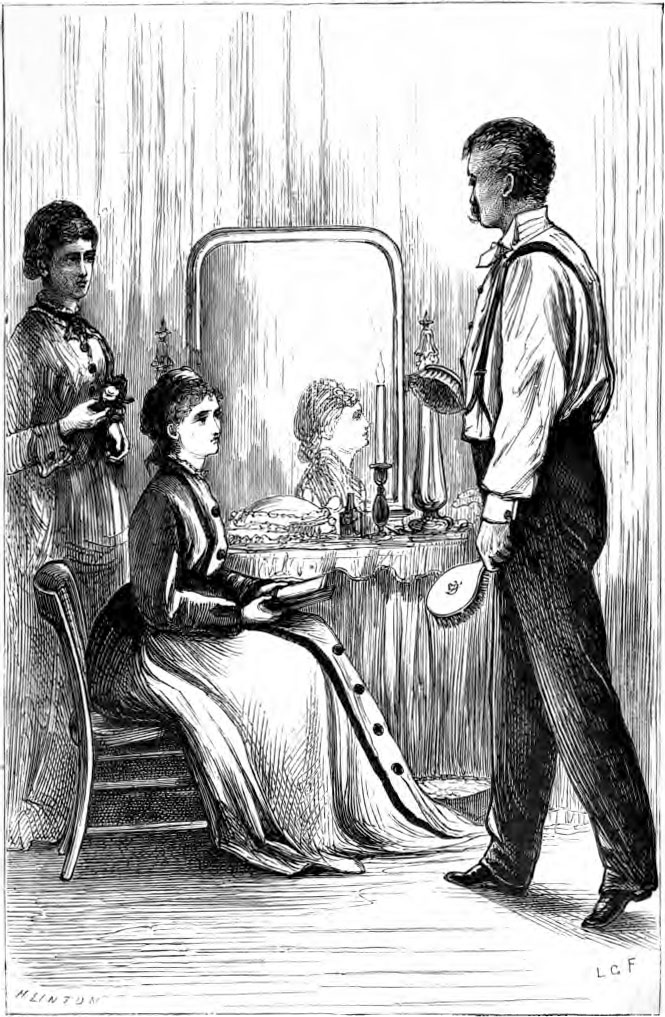
"What is up?"
"Haven't you been out?"
"I was shopping, and that kind of thing. I don't want to take that
girl into the Park. I've made a mistake in having her here, but I
mean to be seen with her as little as I can."
"Be good-natured, Ju, whatever you are."
"Oh, bother! I know what I'm about. What is it you mean?"
"They say Melmotte's been found out."
"Found out!" exclaimed Lady Monogram, stopping her maid in some
arrangement which would not need to be continued in the event of her
not going to the reception. "What do you mean by found out?"
"I don't know exactly. There are a dozen stories told. It's something
about that place he bought of old Longestaffe."
"Are the Longestaffes mixed up in it? I won't have her here a day
longer if there is anything against them."
"Don't be an ass, Ju. There's nothing against him except that the
poor old fellow hasn't got a shilling of his money."
"Then he's ruined,--and there's an end of them."
"Perhaps he will get it now. Some say that Melmotte has forged a
receipt, others a letter. Some declare that he has manufactured a
whole set of title-deeds. You remember Dolly?"
"Of course I know Dolly Longestaffe," said Lady Monogram, who had
thought at one time that an alliance with Dolly might be convenient.
"They say he has found it all out. There was always something about
Dolly more than fellows gave him credit for. At any rate, everybody
says that Melmotte will be in quod before long."
"Not to-night, Damask!"
"Nobody seems to know. Lupton was saying that the policemen would
wait about in the room like servants till the Emperor and the Princes
had gone away."
"Is Mr. Lupton going?"
"He was to have been at the dinner, but hadn't made up his mind
whether he'd go or not when I saw him. Nobody seems to be quite
certain whether the Emperor will go. Somebody said that a Cabinet
Council was to be called to know what to do."
"A Cabinet Council!"
"Why, you see it's rather an awkward thing, letting the Prince go to
dine with a man who perhaps may have been arrested and taken to gaol
before dinner-time. That's the worst part of it. Nobody knows."
Lady Monogram waved her attendant away. She piqued herself upon
having a French maid who could not speak a word of English, and was
therefore quite careless what she said in the woman's presence. But,
of course, everything she did say was repeated down-stairs in some
language that had become intelligible to the servants generally. Lady
Monogram sat motionless for some time, while her husband, retreating
to his own domain, finished his operations. "Damask," she said, when
he reappeared, "one thing is certain;--we can't go."
"After you've made such a fuss about it!"
"It is a pity,--having that girl here in the house. You know, don't
you, she's going to marry one of these people?"
"I heard about her marriage yesterday. But Brehgert isn't one of
Melmotte's set. They tell me that Brehgert isn't a bad fellow. A
vulgar cad, and all that, but nothing wrong about him."
"He's a Jew,--and he's seventy years old, and makes up horribly."
"What does it matter to you if he's eighty? You are determined, then,
you won't go?"
But Lady Monogram had by no means determined that she wouldn't go.
She had paid her price, and with that economy which sticks to a woman
always in the midst of her extravagances, she could not bear to lose
the thing that she had bought. She cared nothing for Melmotte's
villainy, as regarded herself. That he was enriching himself by the
daily plunder of the innocent she had taken for granted since she had
first heard of him. She had but a confused idea of any difference
between commerce and fraud. But it would grieve her greatly to
become known as one of an awkward squad of people who had driven to
the door, and perhaps been admitted to some wretched gathering of
wretched people,--and not, after all, to have met the Emperor and
the Prince. But then, should she hear on the next morning that the
Emperor and the Princes, that the Princesses, and the Duchesses,
with the Ambassadors, Cabinet Ministers, and proper sort of world
generally, had all been there,--that the world, in short, had ignored
Melmotte's villainy,--then would her grief be still greater. She sat
down to dinner with her husband and Miss Longestaffe, and could not
talk freely on the matter. Miss Longestaffe was still a guest of the
Melmottes, although she had transferred herself to the Monograms
for a day or two. And a horrible idea crossed Lady Monogram's mind.
What should she do with her friend Georgiana if the whole Melmotte
establishment were suddenly broken up? Of course, Madame Melmotte
would refuse to take the girl back if her husband were sent to gaol.
"I suppose you'll go," said Sir Damask as the ladies left the room.
"Of course we shall,--in about an hour," said Lady Monogram as
she left the room, looking round at him and rebuking him for his
imprudence.
"Because, you know--" and then he called her back. "If you want me
I'll stay, of course; but if you don't, I'll go down to the club."
"How can I say, yet? You needn't mind the club to-night."
"All right;--only it's a bore being here alone."
Then Miss Longestaffe asked what "was up." "Is there any doubt about
our going to-night?"
"I can't say. I'm so harassed that I don't know what I'm about. There
seems to be a report that the Emperor won't be there."
"Impossible!"
"It's all very well to say impossible, my dear," said Lady Monogram;
"but still that's what people are saying. You see Mr. Melmotte is a
very great man, but perhaps--something else has turned up, so that
he may be thrown over. Things of that kind do happen. You had better
finish dressing. I shall. But I shan't make sure of going till I hear
that the Emperor is there." Then she descended to her husband, whom
she found forlornly consoling himself with a cigar. "Damask," she
said, "you must find out."
"Find out what?"
"Whether the Prince and the Emperor are there."
"Send John to ask," suggested the husband.
"He would be sure to make a blunder about it. If you'd go yourself
you'd learn the truth in a minute. Have a cab,--just go into the hall
and you'll soon know how it all is;--I'd do it in a minute if I were
you." Sir Damask was the most good-natured man in the world, but he
did not like the job. "What can be the objection?" asked his wife.
"Go to a man's house and find out whether a man's guests are come
before you go yourself! I don't just see it, Ju."
"Guests! What nonsense! The Emperor and all the Royal Family! As if
it were like any other party. Such a thing, probably, never happened
before, and never will happen again. If you don't go, Damask, I
must; and I will." Sir Damask, after groaning and smoking for half
a minute, said that he would go. He made many remonstrances. It was
a confounded bore. He hated emperors and he hated princes. He hated
the whole box and dice of that sort of thing! He "wished to goodness"
that he had dined at his club and sent word up home that the affair
was to be off. But at last he submitted, and allowed his wife to
leave the room with the intention of sending for a cab. The cab was
sent for and announced, but Sir Damask would not stir till he had
finished his big cigar.
It was past ten when he left his own house. On arriving in Grosvenor
Square he could at once see that the party was going on. The house
was illuminated. There was a concourse of servants round the door,
and half the square was already blocked up with carriages. It was
not without delay that he got to the door, and when there he saw the
royal liveries. There was no doubt about the party. The Emperor and
the Princes and the Princesses were all there. As far as Sir Damask
could then perceive, the dinner had been quite a success. But again
there was a delay in getting away, and it was nearly eleven before
he could reach home. "It's all right," said he to his wife. "They're
there, safe enough."
"You are sure that the Emperor is there."
"As sure as a man can be without having seen him."
Miss Longestaffe was present at this moment, and could not but resent
what appeared to be a most unseemly slur cast upon her friends. "I
don't understand it at all," she said. "Of course the Emperor is
there. Everybody has known for the last month that he was coming.
What is the meaning of it, Julia?"
"My dear, you must allow me to manage my own little affairs my own
way. I dare say I am absurd. But I have my reason. Now, Damask, if
the carriage is there we had better start." The carriage was there,
and they did start, and with a delay which seemed unprecedented, even
to Lady Monogram, who was accustomed to these things, they reached
the door. There was a great crush in the hall, and people were coming
down-stairs. But at last they made their way into the room above,
and found that the Emperor of China and all the Royalties had been
there,--but had taken their departure.
Sir Damask put the ladies into the carriage and went at once to his
club.
CHAPTER LXII.
THE PARTY.
Lady Monogram retired from Mr. Melmotte's house in disgust as soon
as she was able to escape; but we must return to it for a short time.
When the guests were once in the drawing-room the immediate sense
of failure passed away. The crowd never became so thick as had been
anticipated. They who were knowing in such matters had declared that
the people would not be able to get themselves out of the room till
three or four o'clock in the morning, and that the carriages would
not get themselves out of the Square till breakfast time. With a view
to this kind of thing Mr. Melmotte had been told that he must provide
a private means of escape for his illustrious guests, and with a
considerable sacrifice of walls and general house arrangements this
had been done. No such gathering as was expected took place; but
still the rooms became fairly full, and Mr. Melmotte was able to
console himself with the feeling that nothing certainly fatal had as
yet occurred.
There can be no doubt that the greater part of the people assembled
did believe that their host had committed some great fraud which
might probably bring him under the arm of the law. When such rumours
are spread abroad, they are always believed. There is an excitement
and a pleasure in believing them. Reasonable hesitation at such a
moment is dull and phlegmatic. If the accused one be near enough to
ourselves to make the accusation a matter of personal pain, of course
we disbelieve. But, if the distance be beyond this, we are almost
ready to think that anything may be true of anybody. In this case
nobody really loved Melmotte and everybody did believe. It was so
probable that such a man should have done something horrible! It was
only hoped that the fraud might be great and horrible enough.
Melmotte himself during that part of the evening which was passed
up-stairs kept himself in the close vicinity of royalty. He behaved
certainly very much better than he would have done had he had
no weight at his heart. He made few attempts at beginning any
conversation, and answered, at any rate with brevity, when he was
addressed. With scrupulous care he ticked off on his memory the names
of those who had come and whom he knew, thinking that their presence
indicated a verdict of acquittal from them on the evidence already
before them. Seeing the members of the Government all there, he
wished that he had come forward in Westminster as a Liberal. And he
freely forgave those omissions of Royalty as to which he had been so
angry at the India Office, seeing that not a Prince or Princess was
lacking of those who were expected. He could turn his mind to all
this, although he knew how great was his danger. Many things occurred
to him as he stood, striving to smile as a host should smile. It
might be the case that half-a-dozen detectives were already stationed
in his own hall,--perhaps one or two, well dressed, in the very
presence of royalty,--ready to arrest him as soon as the guests
were gone, watching him now lest he should escape. But he bore the
burden,--and smiled. He had always lived with the consciousness that
such a burden was on him and might crush him at any time. He had
known that he had to run these risks. He had told himself a thousand
times that when the dangers came, dangers alone should never cow
him. He had always endeavoured to go as near the wind as he could,
to avoid the heavy hand of the criminal law of whatever country he
inhabited. He had studied the criminal laws, so that he might be sure
in his reckonings; but he had always felt that he might be carried by
circumstances into deeper waters than he intended to enter. As the
soldier who leads a forlorn hope, or as the diver who goes down for
pearls, or as the searcher for wealth on fever-breeding coasts, knows
that as his gains may be great, so are his perils, Melmotte had been
aware that in his life, as it opened itself out to him, he might come
to terrible destruction. He had not always thought, or even hoped,
that he would be as he was now, so exalted as to be allowed to
entertain the very biggest ones of the earth; but the greatness had
grown upon him,--and so had the danger. He could not now be as exact
as he had been. He was prepared himself to bear all mere ignominy
with a tranquil mind,--to disregard any shouts of reprobation which
might be uttered, and to console himself when the bad quarter of an
hour should come with the remembrance that he had garnered up a store
sufficient for future wants and placed it beyond the reach of his
enemies. But as his intellect opened up to him new schemes, and as
his ambition got the better of his prudence, he gradually fell from
the security which he had preconceived, and became aware that he
might have to bear worse than ignominy.
Perhaps never in his life had he studied his own character and his
own conduct more accurately, or made sterner resolves, than he did
as he stood there smiling, bowing, and acting without impropriety
the part of host to an Emperor. No;--he could not run away. He soon
made himself sure of that. He had risen too high to be a successful
fugitive, even should he succeed in getting off before hands were
laid upon him. He must bide his ground, if only that he might not
at once confess his own guilt by flight; and he would do so with
courage. Looking back at the hour or two that had just passed he was
aware that he had allowed himself not only to be frightened in the
dinner-room,--but also to seem to be frightened. The thing had come
upon him unawares and he had been untrue to himself. He acknowledged
that. He should not have asked those questions of Mr. Todd and Mr.
Beauclerk, and should have been more good-humoured than usual with
Lord Alfred in discussing those empty seats. But for spilt milk there
is no remedy. The blow had come upon him too suddenly, and he had
faltered. But he would not falter again. Nothing should cow him,--no
touch from a policeman, no warrant from a magistrate, no defalcation
of friends, no scorn in the City, no solitude in the West End. He
would go down among the electors to-morrow and would stand his
ground, as though all with him were right. Men should know at any
rate that he had a heart within his bosom. And he confessed also to
himself that he had sinned in that matter of arrogance. He could see
it now,--as so many of us do see the faults which we have committed,
which we strive, but in vain, to discontinue, and which we never
confess except to our own bosoms. The task which he had imposed on
himself, and to which circumstances had added weight, had been very
hard to bear. He should have been good-humoured to these great ones
whose society he had gained. He should have bound these people to him
by a feeling of kindness as well as by his money. He could see it all
now. And he could see too that there was no help for spilt milk. I
think he took some pride in his own confidence as to his own courage,
as he stood there turning it all over in his mind. Very much might be
suspected. Something might be found out. But the task of unravelling
it all would not be easy. It is the small vermin and the little birds
that are trapped at once. But wolves and vultures can fight hard
before they are caught. With the means which would still be at his
command, let the worst come to the worst, he could make a strong
fight. When a man's frauds have been enormous there is a certain
safety in their very diversity and proportions. Might it not be that
the fact that these great ones of the earth had been his guests
should speak in his favour? A man who had in very truth had the real
brother of the Sun dining at his table could hardly be sent into the
dock and then sent out of it like a common felon.
Madame Melmotte during the evening stood at the top of her own stairs
with a chair behind her on which she could rest herself for a moment
when any pause took place in the arrivals. She had of course dined
at the table,--or rather sat there;--but had been so placed that no
duty had devolved upon her. She had heard no word of the rumours,
and would probably be the last person in that house to hear them. It
never occurred to her to see whether the places down the table were
full or empty. She sat with her large eyes fixed on the Majesty of
China and must have wondered at her own destiny at finding herself
with an Emperor and Princes to look at. From the dining-room she had
gone when she was told to go, up to the drawing-room, and had there
performed her task, longing only for the comfort of her bedroom. She,
I think, had but small sympathy with her husband in all his work,
and but little understanding of the position in which she had been
placed. Money she liked, and comfort, and perhaps diamonds and fine
dresses, but she can hardly have taken pleasure in duchesses or
have enjoyed the company of the Emperor. From the beginning of the
Melmotte era it had been an understood thing that no one spoke to
Madame Melmotte.
Marie Melmotte had declined a seat at the dinner-table. This at first
had been cause of quarrel between her and her father, as he desired
to have seen her next to young Lord Nidderdale as being acknowledged
to be betrothed to him. But since the journey to Liverpool he had
said nothing on the subject. He still pressed the engagement, but
thought now that less publicity might be expedient. She was, however,
in the drawing-room standing at first by Madame Melmotte, and
afterwards retreating among the crowd. To some ladies she was a
person of interest as the young woman who had lately run away under
such strange circumstances; but no one spoke to her till she saw a
girl whom she herself knew, and whom she addressed, plucking up all
her courage for the occasion. This was Hetta Carbury who had been
brought hither by her mother.
The tickets for Lady Carbury and Hetta had of course been sent before
the elopement;--and also, as a matter of course, no reference had
been made to them by the Melmotte family after the elopement. Lady
Carbury herself was anxious that that affair should not be considered
as having given cause for any personal quarrel between herself
and Mr. Melmotte, and in her difficulty had consulted Mr. Broune.
Mr. Broune was the staff on which she leant at present in all her
difficulties. Mr. Broune was going to the dinner. All this of course
took place while Melmotte's name was as yet unsullied as snow. Mr.
Broune saw no reason why Lady Carbury should not take advantage of
her tickets. These invitations were simply tickets to see the Emperor
surrounded by the Princes. The young lady's elopement is "no affair
of yours," Mr. Broune had said. "I should go, if it were only for the
sake of showing that you did not consider yourself to be implicated
in the matter." Lady Carbury did as she was advised, and took her
daughter with her. "Nonsense," said the mother, when Hetta objected;
"Mr. Broune sees it quite in the right light. This is a grand
demonstration in honour of the Emperor, rather than a private
party;--and we have done nothing to offend the Melmottes. You know
you wish to see the Emperor." A few minutes before they started
from Welbeck Street a note came from Mr. Broune, written in pencil
and sent from Melmotte's house by a Commissioner. "Don't mind what
you hear; but come. I am here and as far as I can see it is all
right. The E. is beautiful, and P.'s are as thick as blackberries."
Lady Carbury, who had not been in the way of hearing the reports,
understood nothing of this; but of course she went. And Hetta went
with her.
Hetta was standing alone in a corner, near to her mother, who was
talking to Mr. Booker, with her eyes fixed on the awful tranquillity
of the Emperor's countenance, when Marie Melmotte timidly crept up to
her and asked her how she was. Hetta, probably, was not very cordial
to the poor girl, being afraid of her, partly as the daughter of
the great Melmotte and partly as the girl with whom her brother
had failed to run away; but Marie was not rebuked by this. "I hope
you won't be angry with me for speaking to you." Hetta smiled more
graciously. She could not be angry with the girl for speaking to her,
feeling that she was there as the guest of the girl's mother. "I
suppose you know about your brother," said Marie, whispering with her
eyes turned to the ground.
"I have heard about it," said Hetta. "He never told me himself."
"Oh, I do so wish that I knew the truth. I know nothing. Of course,
Miss Carbury, I love him. I do love him so dearly! I hope you don't
think I would have done it if I hadn't loved him better than anybody
in the world. Don't you think that if a girl loves a man,--really
loves him,--that ought to go before everything?"
This was a question that Hetta was hardly prepared to answer. She
felt quite certain that under no circumstances would she run away
with a man. "I don't quite know. It is so hard to say," she replied.
"I do. What's the good of anything if you're to be broken-hearted?
I don't care what they say of me, or what they do to me, if he would
only be true to me. Why doesn't he--let me know--something about it?"
This also was a question difficult to be answered. Since that horrid
morning on which Sir Felix had stumbled home drunk,--which was now
four days since,--he had not left the house in Welbeck Street till
this evening. He had gone out a few minutes before Lady Carbury had
started, but up to that time he had almost kept his bed. He would
not get up till dinner-time, would come down after some half-dressed
fashion, and then get back to his bedroom, where he would smoke and
drink brandy-and-water and complain of headache. The theory was that
he was ill;--but he was in fact utterly cowed and did not dare to
show himself at his usual haunts. He was aware that he had quarrelled
at the club, aware that all the world knew of his intended journey to
Liverpool, aware that he had tumbled about the streets intoxicated.
He had not dared to show himself, and the feeling had grown upon
him from day to day. Now, fairly worn out by his confinement, he
had crept out intending, if possible, to find consolation with Ruby
Ruggles. "Do tell me. Where is he?" pleaded Marie.
"He has not been very well lately."
"Is he ill? Oh, Miss Carbury, do tell me. You can understand what it
is to love him as I do;--can't you?"
"He has been ill. I think he is better now."
"Why does he not come to me, or send to me; or let me know something?
It is cruel, is it not? Tell me,--you must know,--does he really care
for me?"
Hetta was exceedingly perplexed. The real feeling betrayed by the
girl recommended her. Hetta could not but sympathize with the
affection manifested for her own brother, though she could hardly
understand the want of reticence displayed by Marie in thus speaking
of her love to one who was almost a stranger. "Felix hardly ever
talks about himself to me," she said.
"If he doesn't care for me, there shall be an end of it," Marie said
very gravely. "If I only knew! If I thought that he loved me, I'd go
through,--oh,--all the world for him. Nothing that papa could say
should stop me. That's my feeling about it. I have never talked to
any one but you about it. Isn't that strange? I haven't a person to
talk to. That's my feeling, and I'm not a bit ashamed of it. There's
no disgrace in being in love. But it's very bad to get married
without being in love. That's what I think."
"It is bad," said Hetta, thinking of Roger Carbury.
"But if Felix doesn't care for me!" continued Marie, sinking her
voice to a low whisper, but still making her words quite audible to
her companion. Now Hetta was strongly of opinion that her brother
did not in the least "care for" Marie Melmotte, and that it would be
very much for the best that Marie Melmotte should know the truth. But
she had not that sort of strength which would have enabled her to
tell it. "Tell me just what you think," said Marie. Hetta was still
silent. "Ah,--I see. Then I must give him up? Eh?"
"What can I say, Miss Melmotte? Felix never tells me. He is my
brother,--and of course I love you for loving him." This was almost
more than Hetta meant; but she felt herself constrained to say some
gracious word.
"Do you? Oh! I wish you did. I should so like to be loved by you.
Nobody loves me, I think. That man there wants to marry me. Do you
know him? He is Lord Nidderdale. He is very nice; but he does not
love me any more than he loves you. That's the way with men. It isn't
the way with me. I would go with Felix and slave for him if he were
poor. Is it all to be over then? You will give him a message from
me?" Hetta, doubting as to the propriety of the promise, promised
that she would. "Just tell him I want to know; that's all. I want to
know. You'll understand. I want to know the real truth. I suppose I
do know it now. Then I shall not care what happens to me. It will be
all the same. I suppose I shall marry that young man, though it will
be very bad. I shall just be as if I hadn't any self of my own at
all. But he ought to send me word after all that has passed. Do not
you think he ought to send me word?"
"Yes, indeed."
"You tell him, then," said Marie, nodding her head as she crept away.
Nidderdale had been observing her while she had been talking to Miss
Carbury. He had heard the rumour, and of course felt that it behoved
him to be on his guard more specially than any one else. But he
had not believed what he had heard. That men should be thoroughly
immoral, that they should gamble, get drunk, run into debt, and make
love to other men's wives, was to him a matter of every-day life.
Nothing of that kind shocked him at all. But he was not as yet
quite old enough to believe in swindling. It had been impossible to
convince him that Miles Grendall had cheated at cards, and the idea
that Mr. Melmotte had forged was as improbable and shocking to him
as that an officer should run away in battle. Common soldiers, he
thought, might do that sort of thing. He had almost fallen in love
with Marie when he saw her last, and was inclined to feel the more
kindly to her now because of the hard things that were being said
about her father. And yet he knew that he must be careful. If "he
came a cropper" in this matter, it would be such an awful cropper!
"How do you like the party?" he said to Marie.
"I don't like it at all, my lord. How do you like it?"
"Very much, indeed. I think the Emperor is the greatest fun I ever
saw. Prince Frederic,"--one of the German princes who was staying at
the time among his English cousins,--"Prince Frederic says that he's
stuffed with hay, and that he's made up fresh every morning at a shop
in the Haymarket."
"I've seen him talk."
"He opens his mouth, of course. There is machinery as well as hay.
I think he's the grandest old buffer out, and I'm awfully glad that
I've dined with him. I couldn't make out whether he really put
anything to eat into his jolly old mouth."
"Of course he did."
"Have you been thinking about what we were talking about the other
day?"
"No, my lord,--I haven't thought about it since. Why should I?"
"Well;--it's a sort of thing that people do think about, you know."
"You don't think about it."
"Don't I? I've been thinking about nothing else the last three
months."
"You've been thinking whether you'd get married or not."
"That's what I mean," said Lord Nidderdale.
"It isn't what I mean, then."
"I'll be shot if I can understand you."
"Perhaps not. And you never will understand me. Oh, goodness;
--they're all going, and we must get out of the way. Is that
Prince Frederic, who told you about the hay? He is handsome; isn't
he? And who is that in the violet dress;--with all the pearls?"
"That's the Princess Dwarza."
"Dear me;--isn't it odd, having a lot of people in one's own house,
and not being able to speak a word to them? I don't think it's at all
nice. Good night, my lord. I'm glad you like the Emperor."
And then the people went, and when they had all gone Melmotte put
his wife and daughter into his own carriage, telling them that he
would follow them on foot to Bruton Street when he had given some
last directions to the people who were putting out the lights, and
extinguishing generally the embers of the entertainment. He had
looked round for Lord Alfred, taking care to avoid the appearance of
searching; but Lord Alfred had gone. Lord Alfred was one of those who
knew when to leave a falling house. Melmotte at the moment thought
of all that he had done for Lord Alfred, and it was something of the
real venom of ingratitude that stung him at the moment rather than
this additional sign of coming evil. He was more than ordinarily
gracious as he put his wife into the carriage, and remarked that,
considering all things, the party had gone off very well. "I only
wish it could have been done a little cheaper," he said laughing.
Then he went back into the house, and up into the drawing-rooms which
were now utterly deserted. Some of the lights had been put out, but
the men were busy in the rooms below, and he threw himself into the
chair in which the Emperor had sat. It was wonderful that he should
come to such a fate as this;--that he, the boy out of the gutter,
should entertain at his own house, in London, a Chinese Emperor and
English and German Royalty,--and that he should do so almost with a
rope round his neck. Even if this were to be the end of it all, men
would at any rate remember him. The grand dinner which he had given
before he was put into prison would live in history. And it would be
remembered, too, that he had been the Conservative candidate for the
great borough of Westminster,--perhaps, even, the elected member. He,
too, in his manner, assured himself that a great part of him would
escape Oblivion. "Non omnis moriar," in some language of his own, was
chanted by him within his own breast, as he sat there looking out on
his own magnificent suite of rooms from the arm-chair which had been
consecrated by the use of an Emperor.
No policemen had come to trouble him yet. No hint that he would
be "wanted" had been made to him. There was no tangible sign that
things were not to go on as they went before. Things would be exactly
as they were before, but for the absence of those guests from the
dinner-table, and for the words which Miles Grendall had spoken. Had
he not allowed himself to be terrified by shadows? Of course he had
known that there must be such shadows. His life had been made dark by
similar clouds before now, and he had lived through the storms which
had followed them. He was thoroughly ashamed of the weakness which
had overcome him at the dinner-table, and of that palsy of fear which
he had allowed himself to exhibit. There should be no more shrinking
such as that. When people talked of him they should say that he was
at least a man.
As this was passing through his mind a head was pushed in through one
of the doors, and immediately withdrawn. It was his Secretary. "Is
that you, Miles?" he said. "Come in. I'm just going home, and came up
here to see how the empty rooms would look after they were all gone.
What became of your father?"
"I suppose he went away."
"I suppose he did," said Melmotte, unable to hinder himself from
throwing a certain tone of scorn into his voice,--as though pro-
claiming the fate of his own house and the consequent running away
of the rat. "It went off very well, I think."
"Very well," said Miles, still standing at the door. There had been
a few words of consultation between him and his father,--only a
very few words. "You'd better see it out to-night, as you've had a
regular salary, and all that. I shall hook it. I sha'n't go near him
to-morrow till I find out how things are going. By G----, I've had
about enough of him." But hardly enough of his money,--or it may
be presumed that Lord Alfred would have "hooked it" sooner.
"Why don't you come in, and not stand there?" said Melmotte. "There's
no Emperor here now for you to be afraid of."
"I'm afraid of nobody," said Miles, walking into the middle of the
room.
"Nor am I. What's one man that another man should be afraid of him?
We've got to die, and there'll be an end of it, I suppose."
"That's about it," said Miles, hardly following the working of his
master's mind.
"I shouldn't care how soon. When a man has worked as I have done,
he gets about tired at my age. I suppose I'd better be down at the
committee-room about ten to-morrow?"
"That's the best, I should say."
"You'll be there by that time?" Miles Grendall assented slowly, and
with imperfect assent. "And tell your father he might as well be
there as early as convenient."
"All right," said Miles as he took his departure.
"Curs!" said Melmotte almost aloud. "They neither of them will be
there. If any evil can be done to me by treachery and desertion, they
will do it." Then it occurred to him to think whether the Grendall
article had been worth all the money that he had paid for it.
"Curs!" he said again. He walked down into the hall, and through the
banqueting-room, and stood at the place where he himself had sat.
What a scene it had been, and how frightfully low his heart had sunk
within him! It had been the defection of the Lord Mayor that had hit
him hardest. "What cowards they are!" The men went on with their
work, not noticing him, and probably not knowing him. The dinner had
been done by contract, and the contractor's foreman was there. The
care of the house and the alterations had been confided to another
contractor, and his foreman was waiting to see the place locked up.
A confidential clerk, who had been with Melmotte for years, and who
knew his ways, was there also to guard the property. "Good night,
Croll," he said to the man in German. Croll touched his hat and bade
him good night. Melmotte listened anxiously to the tone of the man's
voice, trying to catch from it some indication of the mind within.
Did Croll know of these rumours, and if so, what did he think of
them? Croll had known him in some perilous circumstances before, and
had helped him through them. He paused a moment as though he would
ask a question, but resolved at last that silence would be safest.
"You'll see everything safe, eh, Croll?" Croll said that he would see
everything safe, and Melmotte passed out into the Square.
He had not far to go, round through Berkeley Square into Bruton
Street, but he stood for a few moments looking up at the bright
stars. If he could be there, in one of those unknown distant worlds,
with all his present intellect and none of his present burdens, he
would, he thought, do better than he had done here on earth. If he
could even now put himself down nameless, fameless, and without
possessions in some distant corner of the world, he could, he
thought, do better. But he was Augustus Melmotte, and he must bear
his burdens, whatever they were, to the end. He could reach no place
so distant but that he would be known and traced.
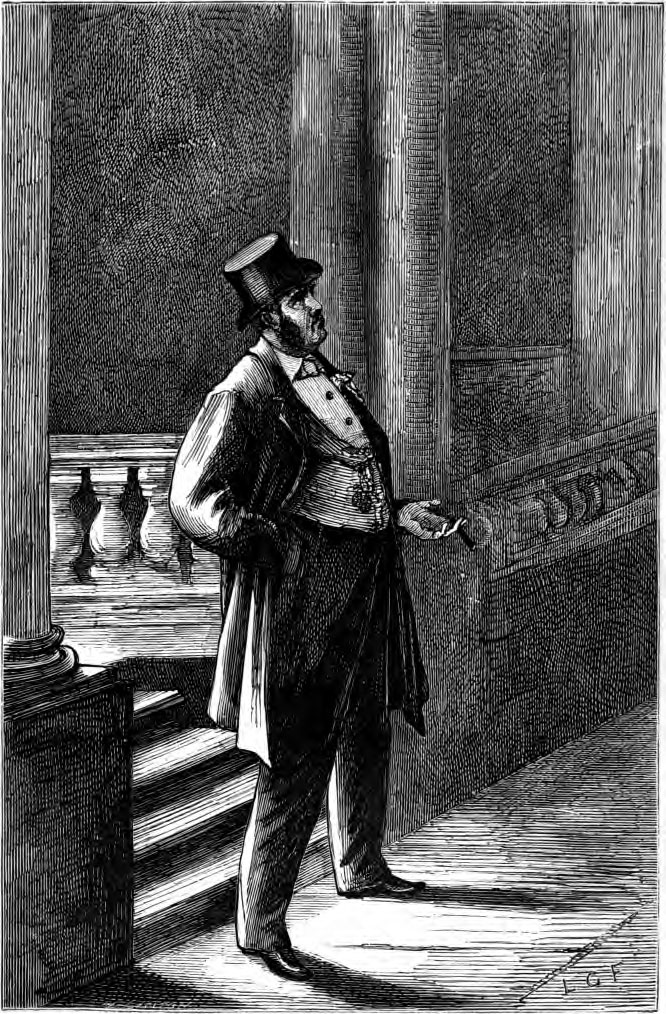
CHAPTER LXIII.
MR. MELMOTTE ON THE DAY OF THE ELECTION.
No election of a Member of Parliament by ballot in a borough so large
as that of Westminster had as yet been achieved in England since the
ballot had been established by law. Men who heretofore had known,
or thought that they knew, how elections would go, who counted up
promises, told off professed enemies, and weighed the doubtful ones,
now confessed themselves to be in the dark. Three days since the odds
had been considerably in Melmotte's favour; but this had come from
the reputation attached to his name, rather than from any calculation
as to the politics of the voters. Then Sunday had intervened. On
the Monday Melmotte's name had continued to go down in the betting
from morning to evening. Early in the day his supporters had thought
little of this, attributing the fall to that vacillation which
is customary in such matters; but towards the latter part of the
afternoon the tidings from the City had been in everybody's mouth,
and Melmotte's committee-room had been almost deserted. At six
o'clock there were some who suggested that his name should be
withdrawn. No such suggestion, however, was made to him,--perhaps
because no one dared to make it. On the Monday evening all work and
strategy for the election, as regarded Melmotte and his party, died
away; and the interest of the hour was turned to the dinner.
But Mr. Alf's supporters were very busy. There had been a close
consultation among a few of them as to what should be done by their
Committee as to these charges against the opposite candidate. In the
"Pulpit" of that evening an allusion had been made to the affair,
which was of course sufficiently intelligible to those who were
immediately concerned in the matter, but which had given no name and
mentioned no details. Mr. Alf explained that this had been put in by
the sub-editor, and that it only afforded such news as the paper was
bound to give to the public. He himself pointed out the fact that no
note of triumph had been sounded, and that the rumour had not been
connected with the election.
One old gentleman was of opinion that they were bound to make the
most of it. "It's no more than we've all believed all along," said
the old gentleman, "and why are we to let a fellow like that get
the seat if we can keep him out?" He was of opinion that everything
should be done to make the rumour with all its exaggerations as
public as possible,--so that there should be no opening for an
indictment for libel; and the clever old gentleman was full of
devices by which this might be effected. But the Committee generally
was averse to fight in this manner. Public opinion has its Bar as
well as the Law Courts. If, after all, Melmotte had committed no
fraud,--or, as was much more probable, should not be convicted of
fraud,--then it would be said that the accusation had been forged for
purely electioneering purposes, and there might be a rebound which
would pretty well crush all those who had been concerned. Individual
gentlemen could, of course, say what they pleased to individual
voters; but it was agreed at last that no overt use should be made of
the rumours by Mr. Alf's Committee. In regard to other matters, they
who worked under the Committee were busy enough. The dinner to the
Emperor was turned into ridicule, and the electors were asked whether
they felt themselves bound to return a gentleman out of the City to
Parliament because he had offered to spend a fortune on entertaining
all the royalties then assembled in London. There was very much said
on placards and published in newspapers to the discredit of Melmotte,
but nothing was so printed which would not have appeared with equal
venom had the recent rumours never been sent out from the City. At
twelve o'clock at night, when Mr. Alf's committee-room was being
closed, and when Melmotte was walking home to bed, the general
opinion at the clubs was very much in favour of Mr. Alf.
On the next morning Melmotte was up before eight. As yet no police-
man had called for him, nor had any official intimation reached him that
an accusation was to be brought against him. On coming down from his
bedroom he at once went into the back-parlour on the ground floor,
which Mr. Longestaffe called his study, and which Mr. Melmotte had
used since he had been in Mr. Longestaffe's house for the work which
he did at home. He would be there often early in the morning, and
often late at night after Lord Alfred had left him. There were two
heavy desk-tables in the room, furnished with drawers down to the
ground. One of these the owner of the house had kept locked for his
own purposes. When the bargain for the temporary letting of the house
had been made, Mr. Melmotte and Mr. Longestaffe were close friends.
Terms for the purchase of Pickering had just been made, and no
cause for suspicion had as yet arisen. Everything between the two
gentlemen had been managed with the greatest ease. Oh dear, yes! Mr.
Longestaffe could come whenever he pleased. He, Melmotte, always left
the house at ten and never returned till six. The ladies would never
enter that room. The servants were to regard Mr. Longestaffe quite
as master of the house as far as that room was concerned. If Mr.
Longestaffe could spare it, Mr. Melmotte would take the key of one of
the tables. The matter was arranged very pleasantly.
Mr. Melmotte, on entering the room bolted the door, and then, sitting
at his own table, took certain papers out of the drawers,--a bundle
of letters and another of small documents. From these, with very
little examination, he took three or four,--two or three perhaps
from each. These he tore into very small fragments and burned the
bits,--holding them over a gas-burner and letting the ashes fall into
a large china plate. Then he blew the ashes into the yard through the
open window. This he did to all these documents but one. This one he
put bit by bit into his mouth, chewing the paper into a pulp till
he swallowed it. When he had done this, and had re-locked his own
drawers, he walked across to the other table, Mr. Longestaffe's
table, and pulled the handle of one of the drawers. It opened;--and
then, without touching the contents, he again closed it. He then
knelt down and examined the lock, and the hole above into which the
bolt of the lock ran. Having done this he again closed the drawer,
drew back the bolt of the door, and, seating himself at his own desk,
rang the bell which was close to hand. The servant found him writing
letters after his usual hurried fashion, and was told that he was
ready for breakfast. He always breakfasted alone with a heap of
newspapers around him, and so he did on this day. He soon found the
paragraph alluding to himself in the "Pulpit," and read it without a
quiver in his face or the slightest change in his colour. There was
no one to see him now,--but he was acting under a resolve that at no
moment, either when alone, or in a crowd, or when suddenly called
upon for words,--not even when the policemen with their first hints
of arrest should come upon him,--would he betray himself by the
working of a single muscle, or the loss of a drop of blood from
his heart. He would go through it, always armed, without a sign of
shrinking. It had to be done, and he would do it.
At ten he walked down to the central committee-room at Whitehall
Place. He thought that he would face the world better by walking
than if he were taken in his own brougham. He gave orders that the
carriage should be at the committee-room at eleven, and wait an
hour for him if he was not there. He went along Bond Street and
Piccadilly, Regent Street and through Pall Mall to Charing Cross,
with the blandly triumphant smile of a man who had successfully
entertained the great guest of the day. As he got near the club he
met two or three men whom he knew, and bowed to them. They returned
his bow graciously enough, but not one of them stopped to speak to
him. Of one he knew that he would have stopped, had it not been for
the rumour. Even after the man had passed on he was careful to show
no displeasure on his face. He would take it all as it would come
and still be the blandly triumphant Merchant Prince,--as long as the
police would allow him. He probably was not aware how very different
was the part he was now playing from that which he had assumed at the
India Office.
At the committee-room he only found a few understrappers, and was
informed that everything was going on regularly. The electors
were balloting; but with the ballot,--so said the leader of the
understrappers,--there never was any excitement. The men looked
half-frightened,--as though they did not quite know whether they
ought to seize their candidate, and hold him till the constable came.
They certainly had not expected to see him there. "Has Lord Alfred
been here?" Melmotte asked, standing in the inner room with his
back to the empty grate. No,--Lord Alfred had not been there. "Nor
Mr. Grendall?" The senior understrapper knew that Melmotte would
have asked for "his Secretary," and not for Mr. Grendall, but for
the rumours. It is so hard not to tumble into Scylla when you are
avoiding Charybdis. Mr. Grendall had not been there. Indeed, nobody
had been there. "In fact, there is nothing more to be done, I
suppose?" said Mr. Melmotte. The senior understrapper thought that
there was nothing more to be done. He left word that his brougham
should be sent away, and strolled out again on foot.
He went up into Covent Garden, where there was a polling booth. The
place seemed to him, as one of the chief centres for a contested
election, to be wonderfully quiet. He was determined to face
everybody and everything, and he went close up to the booth. Here he
was recognised by various men, mechanics chiefly, who came forward
and shook hands with him. He remained there for an hour conversing
with people, and at last made a speech to a little knot around him.
He did not allude to the rumour of yesterday, nor to the paragraph
in the "Pulpit" to which his name had not been attached; but he
spoke freely enough of the general accusations that had been brought
against him previously. He wished the electors to understand that
nothing which had been said against him made him ashamed to meet them
here or elsewhere. He was proud of his position, and proud that the
electors of Westminster should recognise it. He did not, he was glad
to say, know much of the law, but he was told that the law would
protect him from such aspersions as had been unfairly thrown upon
him. He flattered himself that he was too good an Englishman to
regard the ordinary political attacks to which candidates were, as
a matter of course, subject at elections;--and he could stretch his
back to bear perhaps a little more than these, particularly as he
looked forward to a triumphant return. But things had been said, and
published, which the excitement of an election could not justify,
and as to these things he must have recourse to the law. Then he
made some allusion to the Princes and the Emperor, and concluded
by observing that it was the proudest boast of his life to be an
Englishman and a Londoner.
It was asserted afterwards that this was the only good speech he had
ever been known to make; and it was certainly successful, as he was
applauded throughout Covent Garden. A reporter for the "Breakfast
Table" who was on duty at the place, looking for paragraphs as to
the conduct of electors, gave an account of the speech in that paper,
and made more of it, perhaps, than it deserved. It was asserted
afterwards, and given as a great proof of Melmotte's cleverness,
that he had planned the thing and gone to Covent Garden all alone
having considered that in that way could he best regain a step in
reputation; but in truth the affair had not been preconcerted. It was
while in Whitehall Place that he had first thought of going to Covent
Garden, and he had had no idea of making a speech till the people had
gathered round him.
It was then noon, and he had to determine what he should do next. He
was half inclined to go round to all the booths and make speeches.
His success at Covent Garden had been very pleasant to him. But he
feared that he might not be so successful elsewhere. He had shown
that he was not afraid of the electors. Then an idea struck him that
he would go boldly into the City,--to his own offices in Abchurch
Lane. He had determined to be absent on this day, and would not be
expected. But his appearance there could not on that account be taken
amiss. Whatever enmities there might be, or whatever perils, he would
face them. He got a cab therefore and had himself driven to Abchurch
Lane.
The clerks were hanging about doing nothing, as though it were a
holiday. The dinner, the election, and the rumour together had
altogether demoralized them. But some of them at least were there,
and they showed no signs of absolute insubordination. "Mr. Grendall
has not been here?" he asked. No; Mr. Grendall had not been there;
but Mr. Cohenlupe was in Mr. Grendall's room. At this moment he
hardly desired to see Mr. Cohenlupe. That gentleman was privy to
many of his transactions, but was by no means privy to them all.
Mr. Cohenlupe knew that the estate at Pickering had been purchased,
and knew that it had been mortgaged. He knew also what had become
of the money which had so been raised. But he knew nothing of the
circumstances of the purchase, although he probably surmised that
Melmotte had succeeded in getting the title-deeds on credit, without
paying the money. He was afraid that he could hardly see Cohenlupe
and hold his tongue, and that he could not speak to him without
danger. He and Cohenlupe might have to stand in a dock together;
and Cohenlupe had none of his spirit. But the clerks would think,
and would talk, were he to leave the office without seeing his old
friend. He went therefore into his own room, and called to Cohenlupe
as he did so.
"Ve didn't expect you here to-day," said the member for Staines.
"Nor did I expect to come. But there isn't much to do at Westminster
while the ballot is going on; so I came up, just to look at the
letters. The dinner went off pretty well yesterday, eh?"
"Uncommon;--nothing better. Vy did the Lord Mayor stay away,
Melmotte?"
"Because he's an ass and a cur," said Mr. Melmotte with an assumed
air of indignation. "Alf and his people had got hold of him. There
was ever so much fuss about it at first,--whether he would accept the
invitation. I say it was an insult to the City to take it and not to
come. I shall be even with him some of these days."
"Things will go on just the same as usual, Melmotte?"
"Go on. Of course they'll go. What's to hinder them?"
"There's ever so much been said," whispered Cohenlupe.
"Said;--yes," ejaculated Melmotte very loudly. "You're not such a
fool, I hope, as to believe every word you hear. You'll have enough
to believe, if you do."
"There's no knowing vat anybody does know, and vat anybody does not
know," said Cohenlupe.
"Look you here, Cohenlupe,"--and now Melmotte also sank his voice to
a whisper,--"keep your tongue in your mouth; go about just as usual,
and say nothing. It's all right. There has been some heavy pulls upon
us."
"Oh dear, there has indeed!"
"But any paper with my name to it will come right."
"That's nothing;--nothing at all," said Cohenlupe.
"And there is nothing;--nothing at all! I've bought some property and
have paid for it; and I have bought some, and have not yet paid for
it. There's no fraud in that."
"No, no,--nothing in that."
"You hold your tongue, and go about your business. I'm going to the
bank now." Cohenlupe had been very low in spirits, and was still low
in spirits; but he was somewhat better after the visit of the great
man to the City.
Mr. Melmotte was as good as his word and walked straight to the bank.
He kept two accounts at different banks, one for his business, and
one for his private affairs. The one he now entered was that which
kept what we may call his domestic account. He walked straight
through, after his old fashion, to the room behind the bank in which
sat the manager and the manager's one clerk, and stood upon the rug
before the fire-place just as though nothing had happened,--or as
nearly as though nothing had happened as was within the compass of
his powers. He could not quite do it. In keeping up an appearance
intended to be natural he was obliged to be somewhat milder than his
wont. The manager did not behave nearly as well as he did, and the
clerks manifestly betrayed their emotion. Melmotte saw that it was
so;--but he had expected it, and had come there on purpose to "put it
down."
"We hardly expected to see you in the City to-day, Mr. Melmotte."
"And I didn't expect to see myself here. But it always happens that
when one expects that there's most to be done, there's nothing to
be done at all. They're all at work down at Westminster, balloting;
but as I can't go on voting for myself, I'm of no use. I've been at
Covent Garden this morning, making a stump speech, and if all that
they say there is true, I haven't much to be afraid of."
"And the dinner went off pretty well?" asked the manager.
"Very well, indeed. They say the Emperor liked it better than
anything that has been done for him yet." This was a brilliant flash
of imagination. "For a friend to dine with me every day, you know,
I should prefer somebody who had a little more to say for himself.
But then, perhaps, you know, if you or I were in China we shouldn't
have much to say for ourselves;--eh?" The manager acceded to this
proposition. "We had one awful disappointment. His lordship from over
the way didn't come."
"The Lord Mayor, you mean."
"The Lord Mayor didn't come! He was frightened at the last
moment;--took it into his head that his authority in the City was
somehow compromised. But the wonder was that the dinner went on
without him." Then Melmotte referred to the purport of his call there
that day. He would have to draw large cheques for his private wants.
"You don't give a dinner to an Emperor of China for nothing, you
know." He had been in the habit of over-drawing on his private
account,--making arrangements with the manager. But now, in the
manager's presence, he drew a regular cheque on his business account
for a large sum, and then, as a sort of afterthought, paid in the
£250 which he had received from Mr. Broune on account of the money
which Sir Felix had taken from Marie.
"There don't seem much the matter with him," said the manager, when
Melmotte had left the room.
"He brazens it out, don't he?" said the senior clerk. But the feeling
of the room after full discussion inclined to the opinion that the
rumours had been a political manoeuvre. Nevertheless, Mr. Melmotte
would not now have been allowed to overdraw at the present moment.
CHAPTER LXIV.
THE ELECTION.
Mr. Alf's central committee-room was in Great George Street, and
there the battle was kept alive all the day. It had been decided, as
the reader has been told, that no direct advantage should be taken
of that loud blast of accusation which had been heard throughout the
town on the previous afternoon. There had not been sufficient time
for inquiry as to the truth of that blast. If there were just ground
for the things that had been said, Mr. Melmotte would no doubt soon
be in gaol, or would be--wanted. Many had thought that he would
escape as soon as the dinner was over, and had been disappointed
when they heard that he had been seen walking down towards his own
committee-room on the following morning. Others had been told that at
the last moment his name would be withdrawn,--and a question arose
as to whether he had the legal power to withdraw his name after a
certain hour on the day before the ballot. An effort was made to
convince a portion of the electors that he had withdrawn, or would
have withdrawn, or should have withdrawn. When Melmotte was at Covent
Garden, a large throng of men went to Whitehall Place with the view
of ascertaining the truth. He certainly had made no attempt at
withdrawal. They who propagated this report certainly damaged Mr.
Alf's cause. A second reaction set in, and there grew a feeling that
Mr. Melmotte was being ill-used. Those evil things had been said
of him,--many at least so declared,--not from any true motive, but
simply to secure Mr. Alf's return. Tidings of the speech in Covent
Garden were spread about at the various polling places, and did
good service to the so-called Conservative cause. Mr. Alf's friends,
hearing all this, instigated him also to make a speech. Something
should be said, if only that it might be reported in the newspapers,
to show that they had behaved with generosity, instead of having
injured their enemy by false attacks. Whatever Mr. Alf might say, he
might at any rate be sure of a favourable reporter.
About two o'clock in the day, Mr. Alf did make a speech,--and a very
good speech it was, if correctly reported in the "Evening Pulpit."
Mr. Alf was a clever man, ready at all points, with all his powers
immediately at command, and, no doubt, he did make a good speech.
But in this speech, in which we may presume that it would be his
intention to convince the electors that they ought to return him to
Parliament, because, of the two candidates, he was the fittest to
represent their views, he did not say a word as to his own political
ideas, not, indeed, a word that could be accepted as manifesting
his own fitness for the place which it was his ambition to fill. He
contented himself with endeavouring to show that the other man was
not fit;--and that he and his friends, though solicitous of proving
to the electors that Mr. Melmotte was about the most unfit man in the
world, had been guilty of nothing shabby in their manner of doing so.
"Mr. Melmotte," he said, "comes before you as a Conservative,
and
has told us, by the mouths of his friends,--for he has not favoured
us with many words of his own,--that he is supported by the whole
Conservative party. That party is not my party, but I respect it.
Where, however, are these Conservative supporters? We have heard,
till we are sick of it, of the banquet which Mr. Melmotte gave
yesterday. I am told that very few of those whom he calls his
Conservative friends could be induced to attend that banquet. It is
equally notorious that the leading merchants of the City refused
to grace the table of this great commercial prince. I say that the
leaders of the Conservative party have at last found their candidate
out, have repudiated him;--and are seeking now to free themselves
from the individual shame of having supported the candidature of such
a man by remaining in their own houses instead of clustering round
the polling booths. Go to Mr. Melmotte's committee-room and inquire
if those leading Conservatives be there. Look about, and see whether
they are walking with him in the streets, or standing with him in
public places, or taking the air with him in the parks. I respect
the leaders of the Conservative party; but they have made a mistake
in this matter, and they know it." Then he ended by alluding to the
rumours of yesterday. "I scorn," said he, "to say anything against
the personal character of a political opponent, which I am not in
a position to prove. I make no allusion, and have made no allusion,
to reports which were circulated yesterday about him, and which I
believe were originated in the City. They may be false or they may
be true. As I know nothing of the matter, I prefer to regard them as
false, and I recommend you to do the same. But I declared to you long
before these reports were in men's mouths, that Mr. Melmotte was
not entitled by his character to represent you in parliament, and I
repeat that assertion. A great British merchant, indeed! How long, do
you think, should a man be known in this city before that title be
accorded to him? Who knew aught of this man two years since,--unless,
indeed, it be some one who had burnt his wings in trafficking with
him in some continental city? Ask the character of this great British
merchant in Hamburg and Vienna; ask it in Paris;--ask those whose
business here has connected them with the assurance companies of
foreign countries, and you will be told whether this is a fit man to
represent Westminster in the British parliament!" There was much more
yet; but such was the tone of the speech which Mr. Alf made with the
object of inducing the electors to vote for himself.
At two or three o'clock in the day, nobody knew how the matter was
going. It was supposed that the working-classes were in favour of
Melmotte, partly from their love of a man who spends a great deal of
money, partly from the belief that he was being ill-used,--partly, no
doubt, from that occult sympathy which is felt for crime, when the
crime committed is injurious to the upper classes. Masses of men will
almost feel that a certain amount of injustice ought to be inflicted
on their betters, so as to make things even, and will persuade
themselves that a criminal should be declared to be innocent, because
the crime committed has had a tendency to oppress the rich and pull
down the mighty from their seats. Some few years since, the basest
calumnies that were ever published in this country, uttered by one
of the basest men that ever disgraced the country, levelled, for the
most part, at men of whose characters and services the country was
proud, were received with a certain amount of sympathy by men not
themselves dishonest, because they who were thus slandered had
received so many good things from Fortune, that a few evil things
were thought to be due to them. There had not as yet been time
for the formation of such a feeling generally, in respect of Mr.
Melmotte. But there was a commencement of it. It had been asserted
that Melmotte was a public robber. Whom had he robbed? Not the poor.
There was not a man in London who caused the payment of a larger sum
in weekly wages than Mr. Melmotte.
About three o'clock, the editor of the "Morning Breakfast Table"
called on Lady Carbury. "What is it all about?" she asked, as soon
as her friend was seated. There had been no time for him to explain
anything at Madame Melmotte's reception, and Lady Carbury had as yet
failed in learning any certain news of what was going on.
"I don't know what to make of it," said Mr. Broune. "There is a story
abroad that Mr. Melmotte has forged some document with reference to
a purchase he made,--and hanging on to that story are other stories
as to moneys that he has raised. I should say that it was simply an
electioneering trick, and a very unfair trick, were it not that all
his own side seem to believe it."
"Do you believe it?"
"Ah,--I could answer almost any question sooner than that."
"Then he can't be rich at all."
"Even that would not follow. He has such large concerns in hand that
he might be very much pressed for funds, and yet be possessed of
immense wealth. Everybody says that he pays all his bills."
"Will he be returned?" she asked.
"From what we hear, we think not. I shall know more about it in an
hour or two. At present I should not like to have to publish an
opinion; but were I forced to bet, I would bet against him. Nobody is
doing anything for him. There can be no doubt that his own party are
ashamed of him. As things used to be, this would have been fatal to
him at the day of election; but now, with the ballot, it won't matter
so much. If I were a candidate, at present, I think I would go to bed
on the last day, and beg all my committee to do the same as soon as
they had put in their voting papers."
"I am glad Felix did not go to Liverpool," said Lady Carbury.
"It would not have made much difference. She would have been brought
back all the same. They say Lord Nidderdale still means to marry
her."
"I saw him talking to her last night."
"There must be an immense amount of property somewhere. No one
doubts that he was rich when he came to England two years ago, and
they say everything has prospered that he has put his hand to since. The
Mexican Railway shares had fallen this morning, but they were at £15
premium yesterday morning. He must have made an enormous deal out
of that." But Mr. Broune's eloquence on this occasion was chiefly
displayed in regard to the presumption of Mr. Alf. "I shouldn't think
him such a fool if he had announced his resignation of the editorship
when he came before the world as a candidate for parliament. But a
man must be mad who imagines that he can sit for Westminster and edit
a London daily paper at the same time."
"Has it never been done?"
"Never, I think;--that is, by the editor of such a paper as the
'Pulpit.' How is a man who sits in parliament himself ever to pretend
to discuss the doings of parliament with impartiality? But Alf
believes that he can do more than anybody else ever did, and he'll
come to the ground. Where's Felix now?"
"Do not ask me," said the poor mother.
"Is he doing anything?"
"He lies in bed all day, and is out all night."
"But that wants money." She only shook her head. "You do not give him
any?"
"I have none to give."
"I should simply take the key of the house from him,--or bolt the
door if he will not give it up."
"And be in bed, and listen while he knocks,--knowing that he must
wander in the streets if I refuse to let him in? A mother cannot do
that, Mr. Broune. A child has such a hold upon his mother. When her
reason has bade her to condemn him, her heart will not let her carry
out the sentence." Mr. Broune never now thought of kissing Lady
Carbury; but when she spoke thus, he got up and took her hand, and
she, as she pressed his hand, had no fear that she would be kissed.
The feeling between them was changed.
Melmotte dined at home that evening with no company but that of his
wife and daughter. Latterly one of the Grendalls had almost always
joined their party when they did not dine out. Indeed, it was an
understood thing, that Miles Grendall should dine there always,
unless he explained his absence by some engagement,--so that his
presence there had come to be considered as a part of his duty.
Not unfrequently "Alfred" and Miles would both come, as Melmotte's
dinners and wines were good, and occasionally the father would take
the son's place,--but on this day they were both absent. Madame
Melmotte had not as yet said a word to any one indicating her own
apprehension of any evil. But not a person had called to-day,--the
day after the great party,--and even she, though she was naturally
callous in such matters, had begun to think that she was deserted.
She had, too, become so used to the presence of the Grendalls, that
she now missed their company. She thought that on this day, of all
days, when the world was balloting for her husband at Westminster,
they would both have been with him to discuss the work of the day.
"Is not Mr. Grendall coming?" she asked, as she took her seat at the
table.
"No, he is not," said Melmotte.
"Nor Lord Alfred?"
"Nor Lord Alfred." Melmotte had returned home much comforted by the
day's proceedings. No one had dared to say a harsh word to his face.
Nothing further had reached his ears. After leaving the bank he had
gone back to his office, and had written letters,--just as if nothing
had happened; and, as far as he could judge, his clerks had plucked
up courage. One of them, about five o'clock, came into him with news
from the west, and with second editions of the evening papers. The
clerk expressed his opinion that the election was going well. Mr.
Melmotte, judging from the papers, one of which was supposed to be
on his side and the other of course against him, thought that his
affairs altogether were looking well. The Westminster election had
not the foremost place in his thoughts; but he took what was said on
that subject as indicating the minds of men upon the other matter. He
read Alf's speech, and consoled himself with thinking that Mr. Alf
had not dared to make new accusations against him. All that about
Hamburgh and Vienna and Paris was as old as the hills, and availed
nothing. His whole candidature had been carried in the face of that.
"I think we shall do pretty well," he said to the clerk. His very
presence in Abchurch Lane of course gave confidence. And thus, when
he came home, something of the old arrogance had come back upon him,
and he could swagger at any rate before his wife and servants. "Nor
Lord Alfred," he said with scorn. Then he added more. "The father and
son are two d---- curs." This of course frightened Madame Melmotte,
and she joined this desertion of the Grendalls to her own solitude
all the day.
"Is there anything wrong, Melmotte?" she said afterwards, creeping up
to him in the back parlour, and speaking in French.
"What do you call wrong?"
"I don't know;--but I seem to be afraid of something."
"I should have thought you were used to that kind of feeling by this
time."
"Then there is something."
"Don't be a fool. There is always something. There is always much.
You don't suppose that this kind of thing can be carried on as
smoothly as the life of an old maid with £400 a year paid quarterly
in advance."
"Shall we have to--move again?" she asked.
"How am I to tell? You haven't much to do when we move, and may get
plenty to eat and drink wherever you go. Does that girl mean to
marry Lord Nidderdale?" Madame Melmotte shook her head. "What a poor
creature you must be when you can't talk her out of a fancy for such
a reprobate as young Carbury. If she throws me over, I'll throw her
over. I'll flog her within an inch of her life if she disobeys me.
You tell her that I say so."
"Then he may flog me," said Marie, when so much of the conversation
was repeated to her that evening. "Papa does not know me if he thinks
that I'm to be made to marry a man by flogging." No such attempt was
at any rate made that night, for the father and husband did not again
see his wife or daughter.
Early the next day a report was current that Mr. Alf had been
returned. The numbers had not as yet been counted, or the books made
up;--but that was the opinion expressed. All the morning newspapers,
including the "Breakfast Table," repeated this report,--but each gave
it as the general opinion on the matter. The truth would not be known
till seven or eight o'clock in the evening. The Conservative papers
did not scruple to say that the presumed election of Mr. Alf was
owing to a sudden declension in the confidence originally felt in Mr.
Melmotte. The "Breakfast Table," which had supported Mr. Melmotte's
candidature, gave no reason, and expressed more doubt on the result
than the other papers. "We know not how such an opinion forms
itself," the writer said;--"but it seems to have been formed.
As
nothing as yet is really known, or can be known, we express no
opinion of our own upon the matter."
Mr. Melmotte again went into the City, and found that things seemed
to have returned very much into their usual grooves. The Mexican
Railway shares were low, and Mr. Cohenlupe was depressed in spirits
and unhappy;--but nothing dreadful had occurred or seemed to be
threatened. If nothing dreadful did occur, the railway shares would
probably recover, or nearly recover, their position. In the course of
the day, Melmotte received a letter from Messrs. Slow and Bideawhile,
which, of itself, certainly contained no comfort;--but there was
comfort to be drawn even from that letter, by reason of what it did
not contain. The letter was unfriendly in its tone and peremptory. It
had come evidently from a hostile party. It had none of the feeling
which had hitherto prevailed in the intercourse between these two
well-known Conservative gentlemen, Mr. Adolphus Longestaffe and Mr.
Augustus Melmotte. But there was no allusion in it to forgery; no
question of criminal proceedings; no hint at aught beyond the not
unnatural desire of Mr. Longestaffe and Mr. Longestaffe's son to be
paid for the property at Pickering which Mr. Melmotte had purchased.
"We have to remind you," said the letter, in continuation of
paragraphs which had contained simply demands for the money, "that
the title-deeds were delivered to you on receipt by us of authority
to that effect from the Messrs. Longestaffe, father and son, on the
understanding that the purchase-money was to be at once paid to us
by you. We are informed that the property has been since mortgaged
by you. We do not state this as a fact. But the information, whether
true or untrue, forces upon us the necessity of demanding that you
should at once pay to us the purchase-money,--£80,000,--or else
return to us the title-deeds of the estate."
This letter, which was signed Slow and Bideawhile, declared
positively that the title-deeds had been given up on authority
received by them from both the Longestaffes,--father and son. Now
the accusation brought against Melmotte, as far as he could as yet
understand it, was that he had forged the signature to the young Mr.
Longestaffe's letter. Messrs. Slow and Bideawhile were therefore on
his side. As to the simple debt, he cared little comparatively about
that. Many fine men were walking about London who owed large sums of
money which they could not pay.
As he was sitting at his solitary dinner this evening,--for both his
wife and daughter had declined to join him, saying that they had
dined early,--news was brought to him that he had been elected for
Westminster. He had beaten Mr. Alf by something not much less than a
thousand votes.
It was very much to be member for Westminster. So much had at any
rate been achieved by him who had begun the world without a shilling
and without a friend,--almost without education! Much as he loved
money, and much as he loved the spending of money, and much as he
had made and much as he had spent, no triumph of his life had been
so great to him as this. Brought into the world in a gutter, without
father or mother, with no good thing ever done for him, he was now
a member of the British Parliament, and member for one of the first
cities in the empire. Ignorant as he was he understood the magnitude
of the achievement, and dismayed as he was as to his present
position, still at this moment he enjoyed keenly a certain amount
of elation. Of course he had committed forgery;--of course he had
committed robbery. That, indeed, was nothing, for he had been
cheating and forging and stealing all his life. Of course he was in
danger of almost immediate detection and punishment. He hardly hoped
that the evil day would be very much longer protracted, and yet he
enjoyed his triumph. Whatever they might do, quick as they might
be, they could hardly prevent his taking his seat in the House
of Commons. Then if they sent him to penal servitude for life,
they would have to say that they had so treated the member for
Westminster!
He drank a bottle of claret, and then got some brandy-and-water.
In such troubles as were coming upon him now, he would hardly
get sufficient support from wine. He knew that he had better not
drink;--that is, he had better not drink, supposing the world to
be free to him for his own work and his own enjoyment. But if the
world were no longer free to him, if he were really coming to penal
servitude and annihilation,--then why should he not drink while the
time lasted? An hour of triumphant joy might be an eternity to a man,
if the man's imagination were strong enough to make him so regard his
hour. He therefore took his brandy-and-water freely, and as he took
it he was able to throw his fears behind him, and to assure himself
that, after all, he might even yet escape from his bondages. No;--he
would drink no more. This he said to himself as he filled another
beaker. He would work instead. He would put his shoulder to the
wheel, and would yet conquer his enemies. It would not be so easy to
convict a member for Westminster,--especially if money were spent
freely. Was he not the man who, at his own cost, had entertained the
Emperor of China? Would not that be remembered in his favour? Would
not men be unwilling to punish the man who had received at his own
table all the Princes of the land, and the Prime Minister, and all
the Ministers? To convict him would be a national disgrace. He fully
realised all this as he lifted the glass to his mouth, and puffed out
the smoke in large volumes through his lips. But money must be spent!
Yes;--money must be had! Cohenlupe certainly had money. Though he
squeezed it out of the coward's veins he would have it. At any rate,
he would not despair. There was a fight to be fought yet, and he
would fight it to the end. Then he took a deep drink, and slowly,
with careful and almost solemn steps, he made his way up to his bed.
CHAPTER LXV.
MISS LONGESTAFFE WRITES HOME.
Lady Monogram, when she left Madame Melmotte's house after that
entertainment of Imperial Majesty which had been to her of so very
little avail, was not in a good humour. Sir Damask, who had himself
affected to laugh at the whole thing, but who had been in truth as
anxious as his wife to see the Emperor in private society, put her
ladyship and Miss Longestaffe into the carriage without a word, and
rushed off to his club in disgust. The affair from beginning to end,
including the final failure, had been his wife's doing. He had been
made to work like a slave, and had been taken against his will to
Melmotte's house, and had seen no Emperor and shaken hands with no
Prince! "They may fight it out between them now like the Kilkenny
cats." That was his idea as he closed the carriage-door on the two
ladies,--thinking that if a larger remnant were left of one cat than
of the other that larger remnant would belong to his wife.
"What a horrid affair!" said Lady Monogram. "Did anybody ever see
anything so vulgar?" This was at any rate unreasonable, for whatever
vulgarity there may have been, Lady Monogram had seen none of it.
"I don't know why you were so late," said Georgiana.
"Late! Why it's not yet twelve. I don't suppose it was eleven when we
got into the Square. Anywhere else it would have been early."
"You knew they did not mean to stay long. It was particularly said
so. I really think it was your own fault."
"My own fault. Yes;--I don't doubt that. I know it was my own fault,
my dear, to have had anything to do with it. And now I have got to
pay for it."
"What do you mean by paying for it, Julia?"
"You know what I mean very well. Is your friend going to do us the
honour of coming to us to-morrow night?" She could not have declared
in plainer language how very high she thought the price to be which
she had consented to give for those ineffective tickets.
"If you mean Mr. Brehgert, he is coming. You desired me to ask him,
and I did so."
"Desired you! The truth is, Georgiana, when people get into different
sets, they'd better stay where they are. It's no good trying to mix
things." Lady Monogram was so angry that she could not control her
tongue.
Miss Longestaffe was ready to tear herself with indignation. That she
should have been brought to hear insolence such as this from Julia
Triplex,--she, the daughter of Adolphus Longestaffe of Caversham and
Lady Pomona; she, who was considered to have lived in quite the first
London circle! But she could hardly get hold of fit words for a
reply. She was almost in tears, and was yet anxious to fight rather
than weep. But she was in her friend's carriage, and was being taken
to her friend's house, was to be entertained by her friend all the
next day, and was to see her lover among her friend's guests. "I
wonder what has made you so ill-natured," she said at last. "You
didn't use to be like that."
"It's no good abusing me," said Lady Monogram. "Here we are, and
I suppose we had better get out,--unless you want the carriage to
take you anywhere else." Then Lady Monogram got out and marched into
the house, and taking a candle went direct to her own room. Miss
Longestaffe followed slowly to her own chamber, and having half
undressed herself, dismissed her maid and prepared to write to her
mother.
The letter to her mother must be written. Mr. Brehgert had twice
proposed that he should, in the usual way, go to Mr. Longestaffe,
who had been backwards and forwards in London, and was there at the
present moment. Of course it was proper that Mr. Brehgert should see
her father,--but, as she had told him, she preferred that he should
postpone his visit for a day or two. She was now agonized by many
doubts. Those few words about "various sets" and the "mixing of
things" had stabbed her to the very heart,--as had been intended. Mr.
Brehgert was rich. That was a certainty. But she already repented of
what she had done. If it were necessary that she should really go
down into another and a much lower world, a world composed altogether
of Brehgerts, Melmottes, and Cohenlupes, would it avail her much to
be the mistress of a gorgeous house? She had known, and understood,
and had revelled in the exclusiveness of county position. Caversham
had been dull, and there had always been there a dearth of young
men of the proper sort; but it had been a place to talk of, and to
feel satisfied with as a home to be acknowledged before the world.
Her mother was dull, and her father pompous and often cross; but
they were in the right set,--miles removed from the Brehgerts and
Melmottes,--until her father himself had suggested to her that she
should go to the house in Grosvenor Square. She would write one
letter to-night; but there was a question in her mind whether the
letter should be written to her mother telling her the horrid
truth,--or to Mr. Brehgert begging that the match should be broken
off. I think she would have decided on the latter had it not been
that so many people had already heard of the match. The Monograms
knew it, and had of course talked far and wide. The Melmottes knew
it, and she was aware that Lord Nidderdale had heard it. It was
already so far known that it was sure to be public before the end of
the season. Each morning lately she had feared that a letter from
home would call upon her to explain the meaning of some frightful
rumours reaching Caversham, or that her father would come to her and
with horror on his face demand to know whether it was indeed true
that she had given her sanction to so abominable a report.
And there were other troubles. She had just spoken to Madame Mel-
motte this evening, having met her late hostess as she entered the
drawing-room, and had felt from the manner of her reception that
she was not wanted back again. She had told her father that she was
going to transfer herself to the Monograms for a time, not mention-
ing the proposed duration of her visit, and Mr. Longestaffe, in his
ambiguous way, had expressed himself glad that she was leaving the
Melmottes. She did not think that she could go back to Grosvenor
Square, although Mr. Brehgert desired it. Since the expression of
Mr. Brehgert's wishes she had perceived that ill-will had grown up
between her father and Mr. Melmotte. She must return to Caversham.
They could not refuse to take her in, though she had betrothed
herself to a Jew!
If she decided that the story should be told to her mother it would
be easier to tell it by letter than by spoken words, face to face.
But then if she wrote the letter there would be no retreat,--and how
should she face her family after such a declaration? She had always
given herself credit for courage, and now she wondered at her own
cowardice. Even Lady Monogram, her old friend Julia Triplex, had
trampled upon her. Was it not the business of her life, in these
days, to do the best she could for herself, and would she allow
paltry considerations as to the feelings of others to stand in her
way and become bugbears to affright her? Who sent her to Melmotte's
house? Was it not her own father? Then she sat herself square at the
table, and wrote to her mother,--as follows,--dating her letter for
the following morning:--
Hill Street,
9th July, 187--.
MY DEAR MAMMA,
I am afraid you will be very much astonished by this
letter, and perhaps disappointed. I have engaged myself to
Mr. Brehgert, a member of a very wealthy firm in the City,
called Todd, Brehgert, and Goldsheiner. I may as well tell
you the worst at once. Mr. Brehgert is a Jew.
This last word she wrote very rapidly, but largely, determined that
there should be no lack of courage apparent in the letter.
He is a very wealthy man, and his business is about
banking and what he calls finance. I understand they are
among the most leading people in the City. He lives at
present at a very handsome house at Fulham. I don't know
that I ever saw a place more beautifully fitted up. I have
said nothing to papa, nor has he; but he says he will be
willing to satisfy papa perfectly as to settlements. He
has offered to have a house in London if I like,--and
also to keep the villa at Fulham or else to have a place
somewhere in the country. Or I may have the villa at
Fulham and a house in the country. No man can be more
generous than he is. He has been married before, and has a
family, and now I think I have told you all.
I suppose you and papa will be very much dissatisfied. I
hope papa won't refuse his consent. It can do no good. I
am not going to remain as I am now all my life, and there
is no use waiting any longer. It was papa who made me go
to the Melmottes, who are not nearly so well placed as
Mr. Brehgert. Everybody knows that Madame Melmotte is a
Jewess, and nobody knows what Mr. Melmotte is. It is no
good going on with the old thing when everything seems to
be upset and at sixes and sevens. If papa has got to be so
poor that he is obliged to let the house in town, one must
of course expect to be different from what we were.
I hope you won't mind having me back the day after
to-morrow,--that is to-morrow, Wednesday. There is a party
here to-night, and Mr. Brehgert is coming. But I can't
stay longer with Julia, who doesn't make herself nice,
and I do not at all want to go back to the Melmottes. I
fancy that there is something wrong between papa and Mr.
Melmotte.
Send the carriage to meet me by the 2.30 train from
London,--and pray, mamma, don't scold when you see me, or
have hysterics, or anything of that sort. Of course it
isn't all nice, but things have got so that they never
will be nice again. I shall tell Mr. Brehgert to go to
papa on Wednesday.
Your affectionate daughter,
G.
When the morning came she desired the servant to take the letter away
and have it posted, so that the temptation to stop it might no longer
be in her way.
About one o'clock on that day Mr. Longestaffe called at Lady
Monogram's. The two ladies had breakfasted up-stairs, and had only
just met in the drawing-room when he came in. Georgiana trembled at
first, but soon perceived that her father had as yet heard nothing of
Mr. Brehgert. She immediately told him that she proposed returning
home on the following day. "I am sick of the Melmottes," she said.
"And so am I," said Mr. Longestaffe, with a serious countenance.
"We should have been delighted to have had Georgiana to stay with
us a little longer," said Lady Monogram; "but we have but the one
spare bedroom, and another friend is coming." Georgiana, who knew
both these statements to be false, declared that she wouldn't
think of such a thing. "We have a few friends coming to-night, Mr.
Longestaffe, and I hope you'll come in and see Georgiana." Mr.
Longestaffe hummed and hawed and muttered something, as old gentlemen
always do when they are asked to go out to parties after dinner.
"Mr. Brehgert will be here," continued Lady Monogram with a peculiar
smile.
"Mr. who?" The name was not at first familiar to Mr. Longestaffe.
"Mr. Brehgert." Lady Monogram looked at her friend. "I hope I'm not
revealing any secret."
"I don't understand anything about it," said Mr. Longestaffe.
"Georgiana, who is Mr. Brehgert?" He had understood very much. He
had been quite certain from Lady Monogram's manner and words, and
also from his daughter's face, that Mr. Brehgert was mentioned as an
accepted lover. Lady Monogram had meant that it should be so, and
any father would have understood her tone. As she said afterwards to
Sir Damask, she was not going to have that Jew there at her house
as Georgiana Longestaffe's accepted lover without Mr. Longestaffe's
knowledge.
"My dear Georgiana," she said, "I supposed your father knew all about
it."
"I know nothing. Georgiana, I hate a mystery. I insist upon knowing.
Who is Mr. Brehgert, Lady Monogram?"
"Mr. Brehgert is a--very wealthy gentleman. That is all I know of
him. Perhaps, Georgiana, you will be glad to be alone with your
father." And Lady Monogram left the room.
Was there ever cruelty equal to this! But now the poor girl was
forced to speak,--though she could not speak as boldly as she had
written. "Papa, I wrote to mamma this morning, and Mr. Brehgert was
to come to you to-morrow."
"Do you mean that you are engaged to marry him?"
"Yes, papa."
"What Mr. Brehgert is he?"
"He is a merchant."
"You can't mean the fat Jew whom I've met with Mr. Melmotte;--a man
old enough to be your father!" The poor girl's condition now was
certainly lamentable. The fat Jew, old enough to be her father, was
the very man she did mean. She thought that she would try to brazen
it out with her father. But at the present moment she had been so
cowed by the manner in which the subject had been introduced that
she did not know how to begin to be bold. She only looked at him as
though imploring him to spare her. "Is the man a Jew?" demanded Mr.
Longestaffe, with as much thunder as he knew how to throw into his
voice.
"Yes, papa," she said.
"He is that fat man?"
"Yes, papa."
"And nearly as old as I am?"
"No, papa,--not nearly as old as you are. He is fifty."
"And a Jew?" He again asked the horrid question, and again threw in
the thunder. On this occasion she condescended to make no further
reply. "If you do, you shall do it as an alien from my house. I
certainly will never see him. Tell him not to come to me, for I
certainly will not speak to him. You are degraded and disgraced; but
you shall not degrade and disgrace me and your mother and sister."
"It was you, papa, who told me to go to the Melmottes."
"That is not true. I wanted you to stay at Caversham. A Jew! an old
fat Jew! Heavens and earth! that it should be possible that you
should think of it! You;--my daughter,--that used to take such pride
in yourself! Have you written to your mother?"
"I have."
"It will kill her. It will simply kill her. And you are going home
to-morrow?"
"I wrote to say so."
"And there you must remain. I suppose I had better see the man and
explain to him that it is utterly impossible. Heavens on earth;--a
Jew! An old fat Jew! My daughter! I will take you down home myself
to-morrow. What have I done that I should be punished by my children
in this way?" The poor man had had rather a stormy interview with
Dolly that morning. "You had better leave this house to-day, and come
to my hotel in Jermyn Street."
"Oh, papa, I can't do that."
"Why can't you do it? You can do it, and you shall do it. I will not
have you see him again. I will see him. If you do not promise me to
come, I will send for Lady Monogram and tell her that I will not
permit you to meet Mr. Brehgert at her house. I do wonder at her. A
Jew! An old fat Jew!" Mr. Longestaffe, putting up both his hands,
walked about the room in despair.
She did consent, knowing that her father and Lady Monogram between
them would be too strong for her. She had her things packed up, and
in the course of the afternoon allowed herself to be carried away.
She said one word to Lady Monogram before she went. "Tell him that I
was called away suddenly."
"I will, my dear. I thought your papa would not like it." The poor
girl had not spirit sufficient to upbraid her friend; nor did it suit
her now to acerbate an enemy. For the moment, at least, she must
yield to everybody and everything. DFDFD, hardly speaking or
spoken to, and the following day she was taken down to Caversham. She
believed that her father had seen Mr. Brehgert on the morning of that
day;--but he said no word to her, nor did she ask him any question.
That was on the day after Lady Monogram's party. Early in the
evening, just as the gentlemen were coming up from the dining-room,
Mr. Brehgert, apparelled with much elegance, made his appearance.
Lady Monogram received him with a sweet smile. "Miss Longestaffe,"
she said, "has left me and gone to her father."
"Oh, indeed."
"Yes," said Lady Monogram, bowing her head, and then attending to
other persons as they arrived. Nor did she condescend to speak
another word to Mr. Brehgert, or to introduce him even to her
husband. He stood for about ten minutes inside the drawing-room,
leaning against the wall, and then he departed. No one had spoken a
word to him. But he was an even-tempered, good-humoured man. When
Miss Longestaffe was his wife things would no doubt be different;--or
else she would probably change her acquaintance.
CHAPTER LXVI.
"SO SHALL BE MY ENMITY."
"You shall be troubled no more with Winifrid Hurtle." So Mrs. Hurtle
had said, speaking in perfect good faith to the man whom she had
come to England with the view of marrying. And then when he had said
good-bye to her, putting out his hand to take hers for the last time,
she declined that. "Nay," she had said; "this parting will bear no
farewell."
Having left her after that fashion Paul Montague could not return
home with very high spirits. Had she insisted on his taking that
letter with the threat of the horsewhip as the letter which she
intended to write to him,--that letter which she had shown him,
owning it to be the ebullition of her uncontrolled passion, and
had then destroyed,--he might at any rate have consoled himself
with thinking that, however badly he might have behaved, her
conduct had been worse than his. He could have made himself warm and
comfortable with anger, and could have assured himself that under any
circumstances he must be right to escape from the clutches of a wild
cat such as that. But at the last moment she had shown that she was
no wild cat to him. She had melted, and become soft and womanly. In
her softness she had been exquisitely beautiful; and as he returned
home he was sad and dissatisfied with himself. He had destroyed
her life for her,--or, at least, had created a miserable episode
in it which could hardly be obliterated. She had said that she was
all alone, and had given up everything to follow him,--and he had
believed her. Was he to do nothing for her now? She had allowed him
to go, and after her fashion had pardoned him the wrong he had done
her. But was that to be sufficient for him,--so that he might now
feel inwardly satisfied at leaving her, and make no further inquiry
as to her fate? Could he pass on and let her be as the wine that has
been drunk,--as the hour that has been enjoyed,--as the day that is
past?
But what could he do? He had made good his own escape. He had
resolved that, let her be woman or wild cat, he would not marry
her, and in that he knew he had been right. Her antecedents, as now
declared by herself, unfitted her for such a marriage. Were he to
return to her he would be again thrusting his hand into the fire.
But his own selfish coldness was hateful to him when he thought that
there was nothing to be done but to leave her desolate and lonely in
Mrs. Pipkin's lodgings.
During the next three or four days, while the preparations for the
dinner and the election were going on, he was busy in respect to
the American railway. He again went down to Liverpool, and at Mr.
Ramsbottom's advice prepared a letter to the board of directors, in
which he resigned his seat, and gave his reasons for resigning it;
adding that he should reserve to himself the liberty of publishing
his letter, should at any time the circumstances of the railway com-
pany seem to him to make such a course desirable. He also wrote a
letter to Mr. Fisker, begging that gentleman to come to England, and
expressing his own wish to retire altogether from the firm of Fisker,
Montague, and Montague upon receiving the balance of money due to
him,--a payment which must, he said, be a matter of small moment to
his two partners, if, as he had been informed, they had enriched
themselves by the success of the railway company in San Francisco.
When he wrote these letters at Liverpool the great rumour about
Melmotte had not yet sprung up. He returned to London on the day
of the festival, and first heard of the report at the Beargarden.
There he found that the old set had for the moment broken itself up.
Sir Felix Carbury had not been heard of for the last four or five
days,--and then the whole story of Miss Melmotte's journey, of which
he had read something in the newspapers, was told to him. "We think
that Carbury has drowned himself," said Lord Grasslough, "and I
haven't heard of anybody being heartbroken about it." Lord Nidderdale
had hardly been seen at the club. "He's taken up the running with the
girl," said Lord Grasslough. "What he'll do now, nobody knows. If I
was at it, I'd have the money down in hard cash before I went into
the church. He was there at the party yesterday, talking to the girl
all the night;--a sort of thing he never did before. Nidderdale is
the best fellow going, but he was always an ass." Nor had Miles
Grendall been seen in the club for three days. "We've got into a way
of play the poor fellow doesn't like," said Lord Grasslough; "and
then Melmotte won't let him out of his sight. He has taken to dine
there every day." This was said during the election,--on the very day
on which Miles deserted his patron; and on that evening he did dine
at the club. Paul Montague also dined there, and would fain have
heard something from Grendall as to Melmotte's condition; but the
secretary, if not faithful in all things, was faithful at any rate in his
silence. Though Grasslough talked openly enough about Melmotte in
the smoking-room Miles Grendall said never a word.
On the next day, early in the afternoon, almost without a fixed
purpose, Montague strolled up to Welbeck Street, and found Hetta
alone. "Mamma has gone to her publisher's," she said. "She is writing
so much now that she is always going there. Who has been elected,
Mr. Montague?" Paul knew nothing about the election, and cared very
little. At that time, however, the election had not been decided. "I
suppose it will make no difference to you whether your chairman be in
Parliament or not?" Paul said that Melmotte was no longer a chairman
of his. "Are you out of it altogether, Mr. Montague?" Yes;--as far as
it lay within his power to be out of it, he was out of it. He did not
like Mr. Melmotte, nor believe in him. Then with considerable warmth
he repudiated all connection with the Melmotte party, expressing
deep regret that circumstances had driven him for a time into that
alliance. "Then you think that Mr. Melmotte is--?"
"Just a scoundrel;--that's all."
"You heard about Felix?"
"Of course I heard that he was to marry the girl, and that he tried
to run off with her. I don't know much about it. They say that Lord
Nidderdale is to marry her now."
"I think not, Mr. Montague."
"I hope not, for his sake. At any rate, your brother is well out of
it."
"Do you know that she loves Felix? There is no pretence about that. I
do think she is good. The other night at the party she spoke to me."
"You went to the party, then?"
"Yes;--I could not refuse to go when mamma chose to take me. And when
I was there she spoke to me about Felix. I don't think she will marry
Lord Nidderdale. Poor girl;--I do pity her. Think what a downfall it
will be if anything happens."
But Paul Montague had certainly not come there with the intention
of discussing Melmotte's affairs, nor could he afford to lose the
opportunity which chance had given him. He was off with one love, and
now he thought that he might be on with the other. "Hetta," he said,
"I am thinking more of myself than of her,--or even of Felix."
"I suppose we all do think more of ourselves than of other people,"
said Hetta, who knew from his voice at once what it was in his mind
to do.
"Yes;--but I am not thinking of myself only. I am thinking of myself,
and you. In all my thoughts of myself I am thinking of you too."
"I do not know why you should do that."
"Hetta, you must know that I love you."
"Do you?" she said. Of course she knew it. And of course she thought
that he was equally sure of her love. Had he chosen to read signs
that ought to have been plain enough to him, could he have doubted
her love after the few words that had been spoken on that night
when Lady Carbury had come in with Roger and interrupted them? She
could not remember exactly what had been said; but she did remember
that he had spoken of leaving England for ever in a certain event,
and that she had not rebuked him;--and she remembered also how she
had confessed her own love to her mother. He, of course, had known
nothing of that confession; but he must have known that he had her
heart! So at least she thought. She had been working some morsel of
lace, as ladies do when ladies wish to be not quite doing nothing.
She had endeavoured to ply her needle, very idly, while he was
speaking to her, but now she allowed her hands to fall into her lap.
She would have continued to work at the lace had she been able, but
there are times when the eyes will not see clearly, and when the
hands will hardly act mechanically.
"Yes,--I do. Hetta, say a word to me. Can it be so? Look at me for
one moment so as to let me know." Her eyes had turned downwards after
her work. "If Roger is dearer to you than I am, I will go at once."
"Roger is very dear to me."
"Do you love him as I would have you love me?"
She paused for a time, knowing that his eyes were fixed upon her,
and then she answered the question in a low voice, but very clearly.
"No," she said;--"not like that."
"Can you love me like that?" He put out both his arms as though to
take her to his breast should the answer be such as he longed to
hear. She raised her hand towards him, as if to keep him back, and
left it with him when he seized it. "Is it mine?" he said.
"If you want it."
Then he was at her feet in a moment, kissing her hands and her dress,
looking up into her face with his eyes full of tears, ecstatic with
joy as though he had really never ventured to hope for such success.
"Want it!" he said. "Hetta, I have never wanted anything but that
with real desire. Oh, Hetta, my own. Since I first saw you this has
been my only dream of happiness. And now it is my own."
She was very quiet, but full of joy. Now that she had told him the
truth she did not coy her love. Having once spoken the word she did
not care how often she repeated it. She did not think that she could
ever have loved anybody but him,--even if he had not been fond of
her. As to Roger,--dear Roger, dearest Roger,--no; it was not the
same thing. "He is as good as gold," she said,--"ever so much better
than you are, Paul," stroking his hair with her hand and looking into
his eyes.
"Better than anybody I have ever known," said Montague with all his
energy.
"I think he is;--but, ah, that is not everything. I suppose we ought
to love the best people best; but I don't, Paul."
"I do," said he.
"No,--you don't. You must love me best, but I won't be called good.
I do not know why it has been so. Do you know, Paul, I have sometimes
thought I would do as he would have me, out of sheer gratitude. I did
not know how to refuse such a trifling thing to one who ought to have
everything that he wants."
"Where should I have been?"
"Oh, you! Somebody else would have made you happy. But do you know,
Paul, I think he will never love any one else. I ought not to say so,
because it seems to be making so much of myself. But I feel it. He is
not so young a man, and yet I think that he never was in love before.
He almost told me so once, and what he says is true. There is an
unchanging way with him that is awful to think of. He said that he
never could be happy unless I would do as he would have me,--and he
made me almost believe even that. He speaks as though every word he
says must come true in the end. Oh, Paul, I love you so dearly,--but
I almost think that I ought to have obeyed him." Paul Montague of
course had very much to say in answer to this. Among the holy things
which did exist to gild this every-day unholy world, love was the
holiest. It should be soiled by no falsehood, should know nothing of
compromises, should admit no excuses, should make itself subject to
no external circumstances. If Fortune had been so kind to him as to
give him her heart, poor as his claim might be, she could have no
right to refuse him the assurance of her love. And though his rival
were an angel, he could have no shadow of a claim upon her,--seeing
that he had failed to win her heart. It was very well said,--at least
so Hetta thought,--and she made no attempt at argument against him.
But what was to be done in reference to poor Roger? She had spoken
the word now, and, whether for good or bad, she had given herself to
Paul Montague. Even though Roger should have to walk disconsolate
to the grave, it could not now be helped. But would it not be right
that it should be told? "Do you know I almost feel that he is like a
father to me," said Hetta, leaning on her lover's shoulder.
Paul thought it over for a few minutes, and then said that he would
himself write to Roger. "Hetta, do you know, I doubt whether he will
ever speak to me again."
"I cannot believe that."
"There is a sternness about him which it is very hard to understand.
He has taught himself to think that as I met you in his house, and as
he then wished you to be his wife, I should not have ventured to love
you. How could I have known?"
"That would be unreasonable."
"He is unreasonable--about that. It is not reason with him. He always
goes by his feelings. Had you been engaged to him--"
"Oh, then, you never could have spoken to me like this."
"But he will never look at it in that way;--and he will tell me that
I have been untrue to him and ungrateful."
"If you think, Paul--"
"Nay; listen to me. If it be so I must bear it. It will be a great
sorrow, but it will be as nothing to that other sorrow, had that come
upon me. I will write to him, and his answer will be all scorn and
wrath. Then you must write to him afterwards. I think he will forgive
you, but he will never forgive me." Then they parted, she having
promised that she would tell her mother directly Lady Carbury came
home, and Paul undertaking to write to Roger that evening.
And he did, with infinite difficulty, and much trembling of the
spirit. Here is his letter:--
MY DEAR ROGER,--
I think it right to tell you at once what has occurred
to-day. I have proposed to Miss Carbury and she has
accepted me. You have long known what my feelings were,
and I have also known yours. I have known, too, that Miss
Carbury has more than once declined to take your offer.
Under these circumstances I cannot think that I have been
untrue to friendship in what I have done, or that I have
proved myself ungrateful for the affectionate kindness
which you have always shown me. I am authorised by Hetta
to say that, had I never spoken to her, it must have been
the same to you.
[This was hardly a fair representation of what had been said, but the
writer, looking back upon his interview with the lady, thought that
it had been implied.]
I should not say so much by way of excusing myself, but
that you once said, that should such a thing occur there
must be a division between us ever after. If I thought
that you would adhere to that threat, I should be very
unhappy and Hetta would be miserable. Surely, if a man
love she is bound to tell his love, and to take the
chance. You would hardly have thought it manly in me if I
had abstained. Dear friend, take a day or two before you
answer this, and do not banish us from your heart if you
can help it.
Your affectionate friend,
PAUL MONTAGUE.
Roger Carbury did not take a single day,--or a single hour to answer
the letter. He received it at breakfast, and after rushing out on the
terrace and walking there for a few minutes, he hurried to his desk
and wrote his reply. As he did so, his whole face was red with wrath,
and his eyes were glowing with indignation.
There is an old French saying that he who makes excuses
is his own accuser. You would not have written as you
have done, had you not felt yourself to be false and
ungrateful. You knew where my heart was, and there you
went and undermined my treasure, and stole it away. You
have destroyed my life, and I will never forgive you.
You tell me not to banish you both from my heart. How dare
you join yourself with her in speaking of my feelings! She
will never be banished from my heart. She will be there
morning, noon, and night, and as is and will be my love to
her, so shall be my enmity to you.
ROGER CARBURY.
It was hardly a letter for a Christian to write; and, yet, in those
parts Roger Carbury had the reputation of being a good Christian.
Henrietta told her mother that morning, immediately on her return.
"Mamma, Mr. Paul Montague has been here."
"He always comes here when I am away," said Lady Carbury.
"That has been an accident. He could not have known that you were
going to Messrs. Leadham and Loiter's."
"I'm not so sure of that, Hetta."
"Then, mamma, you must have told him yourself, and I don't think
you knew till just before you were going. But, mamma, what does it
matter? He has been here, and I have told him--"
"You have not accepted him?"
"Yes, mamma."
"Without even asking me?"
"Mamma, you knew. I will not marry him without asking you. How was I
not to tell him when he asked me whether I--loved him?"
"Marry him! How is it possible you should marry him? Whatever he had
got was in that affair of Melmotte's, and that has gone to the dogs.
He is a ruined man, and for aught I know may be compromised in all
Melmotte's wickedness."
"Oh, mamma, do not say that!"
"But I do say it. It is hard upon me. I did think that you would try
to comfort me after all this trouble with Felix. But you are as bad
as he is;--or worse, for you have not been thrown into temptation
like that poor boy! And you will break your cousin's heart. Poor
Roger! I feel for him;--he that has been so true to us! But you think
nothing of that."
"I think very much of my cousin Roger."
"And how do you show it;--or your love for me? There would have been
a home for us all. Now we must starve, I suppose. Hetta, you have
been worse to me even than Felix." Then Lady Carbury, in her passion,
burst out of the room, and took herself to her own chamber.
CHAPTER LXVII.
SIR FELIX PROTECTS HIS SISTER.
Up to this period of his life Sir Felix Carbury had probably felt but
little of the punishment due to his very numerous shortcomings. He
had spent all his fortune; he had lost his commission in the army;
he had incurred the contempt of everybody that had known him; he had
forfeited the friendship of those who were his natural friends, and
had attached to him none others in their place; he had pretty nearly
ruined his mother and sister; but, to use his own language, he had
always contrived "to carry on the game." He had eaten and drunk, had
gambled, hunted, and diverted himself generally after the fashion
considered to be appropriate to young men about town. He had kept
up till now. But now there seemed to him to have come an end to all
things. When he was lying in bed in his mother's house he counted up
all his wealth. He had a few pounds in ready money, he still had a
little roll of Mr. Miles Grendall's notes of hand, amounting perhaps
to a couple of hundred pounds,--and Mr. Melmotte owed him £600. But
where was he to turn, and what was he to do with himself? Gradually
he learned the whole story of the journey to Liverpool,--how Marie
had gone there and had been sent back by the police, how Marie's
money had been repaid to Mr. Melmotte by Mr. Broune, and how his
failure to make the journey to Liverpool had become known. He was
ashamed to go to his club. He could not go to Melmotte's house.
He was ashamed even to show himself in the streets by day. He was
becoming almost afraid even of his mother. Now that the brilliant
marriage had broken down, and seemed to be altogether beyond hope,
now that he had to depend on her household for all his comforts, he
was no longer able to treat her with absolute scorn,--nor was she
willing to yield as she had yielded.
One thing only was clear to him. He must realise his possessions.
With this view he wrote both to Miles Grendall and to Melmotte. To
the former he said he was going out of town,--probably for some time,
and he must really ask for a cheque for the amount due. He went on
to remark that he could hardly suppose that a nephew of the Duke of
Albury was unable to pay debts of honour to the amount of £200;--but
that if such was the case he would have no alternative but to apply
to the Duke himself. The reader need hardly be told that to this
letter Mr. Grendall vouchsafed no answer whatever. In his letter to
Mr. Melmotte he confined himself to one matter of business in hand.
He made no allusion whatever to Marie, or to the great man's anger,
or to his seat at the board. He simply reminded Mr. Melmotte that
there was a sum of £600 still due to him, and requested that a cheque
might be sent to him for that amount. Melmotte's answer to this was
not altogether unsatisfactory, though it was not exactly what Sir
Felix had wished. A clerk from Mr. Melmotte's office called at the
house in Welbeck Street, and handed to Felix railway scrip in the
South Central Pacific and Mexican Railway to the amount of the sum
claimed,--insisting on a full receipt for the money before he parted
with the scrip. The clerk went on to explain, on behalf of his
employer, that the money had been left in Mr. Melmotte's hands for
the purpose of buying these shares. Sir Felix, who was glad to get
anything, signed the receipt and took the scrip. This took place on
the day after the balloting at Westminster, when the result was not
yet known,--and when the shares in the railway were very low in-
deed. Sir Felix had asked as to the value of the shares at the time.
The clerk professed himself unable to quote the price,--but there
were the shares if Sir Felix liked to take them. Of course he took
them;--and hurrying off into the City found that they might perhaps
be worth about half the money due to him. The broker to whom he
showed them could not quite answer for anything. Yes;--the scrip
had been very high; but there was a panic. They might recover,--or,
more probably, they might go to nothing. Sir Felix cursed the Great
Financier aloud, and left the scrip for sale. That was the first
time that he had been out of the house before dark since his little
accident.
But he was chiefly tormented in these days by the want of amusement.
He had so spent his life hitherto that he did not know how to get
through a day in which no excitement was provided for him. He never
read. Thinking was altogether beyond him. And he had never done a
day's work in his life. He could lie in bed. He could eat and drink.
He could smoke and sit idle. He could play cards; and could amuse
himself with women,--the lower the culture of the women, the better
the amusement. Beyond these things the world had nothing for him.
Therefore he again took himself to the pursuit of Ruby Ruggles.
Poor Ruby had endured a very painful incarceration at her aunt's
house. She had been wrathful and had stormed, swearing that she would
be free to come and go as she pleased. Free to go, Mrs. Pipkin told
her that she was;--but not free to return if she went out otherwise
than as she, Mrs. Pipkin, chose. "Am I to be a slave?" Ruby asked,
and almost upset the perambulator which she had just dragged in at
the hall door. Then Mrs. Hurtle had taken upon herself to talk to
her, and poor Ruby had been quelled by the superior strength of the
American lady. But she was very unhappy, finding that it did not suit
her to be nursemaid to her aunt. After all John Crumb couldn't have
cared for her a bit, or he would have come to look after her. While
she was in this condition Sir Felix came to Mrs. Pipkin's house, and
asked for her at the door. It happened that Mrs. Pipkin herself had
opened the door,--and, in her fright and dismay at the presence of so
pernicious a young man in her own passage, had denied that Ruby was
in the house. But Ruby had heard her lover's voice, and had rushed up
and thrown herself into his arms. Then there had been a great scene.
Ruby had sworn that she didn't care for her aunt, didn't care for
her grandfather, or for Mrs. Hurtle, or for John Crumb,--or for any
person or anything. She cared only for her lover. Then Mrs. Hurtle
had asked the young man his intentions. Did he mean to marry Ruby?
Sir Felix had said that he "supposed he might as well some day."
"There," said Ruby, "there!"--shouting in triumph as though an offer
had been made to her with the completest ceremony of which such an
event admits. Mrs. Pipkin had been very weak. Instead of calling
in the assistance of her strong-minded lodger, she had allowed the
lovers to remain together for half-an-hour in the dining-room. I do
not know that Sir Felix in any way repeated his promise during that
time, but Ruby was probably too blessed with the word that had been
spoken to ask for such renewal. "There must be an end of this," said
Mrs. Pipkin, coming in when the half-hour was over. Then Sir Felix
had gone, promising to come again on the following evening. "You
must not come here, Sir Felix," said Mrs. Pipkin, "unless you puts
it in writing." To this, of course, Sir Felix made no answer. As he
went home he congratulated himself on the success of his adventure.
Perhaps the best thing he could do when he had realised the money for
the shares would be to take Ruby for a tour abroad. The money would
last for three or four months,--and three or four months ahead was
almost an eternity.
That afternoon before dinner he found his sister alone in the
drawing-room. Lady Carbury had gone to her own room after hearing
the distressing story of Paul Montague's love, and had not seen
Hetta since. Hetta was melancholy, thinking of her mother's hard
words,--thinking perhaps of Paul's poverty as declared by her mother,
and of the ages which might have to wear themselves out before she
could become his wife; but still tinting all her thoughts with a rosy
hue because of the love which had been declared to her. She could
not but be happy if he really loved her. And she,--as she had told him
that she loved him,--would be true to him through everything! In her
present mood she could not speak of herself to her brother, but she
took the opportunity of making good the promise which Marie Melmotte
had extracted from her. She gave him some short account of the party,
and told him that she had talked with Marie. "I promised to give you
a message," she said.
"It's all of no use now," said Felix.
"But I must tell you what she said. I think, you know, that she
really loves you."
"But what's the good of it? A man can't marry a girl when all the
policemen in the country are dodging her."
"She wants you to let her know what,--what you intend to do. If you
mean to give her up, I think you should tell her."
"How can I tell her? I don't suppose they would let her receive a
letter."
"Shall I write to her;--or shall I see her?"
"Just as you like. I don't care."
"Felix, you are very heartless."
"I don't suppose I'm much worse than other men;--or for the matter of
that, worse than a great many women either. You all of you here put
me up to marry her."
"I never put you up to it."
"Mother did. And now because it did not go off all serene, I am to
hear nothing but reproaches. Of course I never cared so very much
about her."
"Oh, Felix, that is so shocking!"
"Awfully shocking I dare say. You think I am as black as the very
mischief, and that sugar wouldn't melt in other men's mouths. Other
men are just as bad as I am,--and a good deal worse too. You believe
that there is nobody on earth like Paul Montague." Hetta blushed, but
said nothing. She was not yet in a condition to boast of her lover
before her brother, but she did, in very truth, believe that but few
young men were as true-hearted as Paul Montague. "I suppose you'd be
surprised to hear that Master Paul is engaged to marry an American
widow living at Islington."
"Mr. Montague--engaged--to marry--an American widow! I don't believe
it."
"You'd better believe it if it's any concern of yours, for it's true.
And it's true too that he travelled about with her for ever so long
in the United States, and that he had her down with him at the hotel
at Lowestoft about a fortnight ago. There's no mistake about it."
"I don't believe it," repeated Hetta, feeling that to say even as
much as that was some relief to her. It could not be true. It was
impossible that the man should have come to her with such a lie in
his mouth as that. Though the words astounded her, though she felt
faint, almost as though she would fall in a swoon, yet in her heart
of hearts she did not believe it. Surely it was some horrid joke,--or
perhaps some trick to divide her from the man she loved. "Felix, how
dare you say things so wicked as that to me?"
"What is there wicked in it? If you have been fool enough to become
fond of the man, it is only right you should be told. He is engaged
to marry Mrs. Hurtle, and she is lodging with one Mrs. Pipkin in
Islington. I know the house, and could take you there to-morrow, and
show you the woman. There," said he, "that's where she is;"--and he
wrote Mrs. Hurtle's name down on a scrap of paper.
"It is not true," said Hetta, rising from her seat, and standing
upright. "I am engaged to Mr. Montague, and I am sure he would not
treat me in that way."
"Then, by heaven, he shall answer it to me," said Felix, jumping up.
"If he has done that, it is time that I should interfere. As true as
I stand here, he is engaged to marry a woman called Mrs. Hurtle whom
he constantly visits at that place in Islington."
"I do not believe it," said Hetta, repeating the only defence for her
lover which was applicable at the moment.
"By George, this is beyond a joke. Will you believe it if Roger
Carbury says it's true? I know you'd believe anything fast enough
against me, if he told you."
"Roger Carbury will not say so?"
"Have you the courage to ask him? I say he will say so. He knows all
about it,--and has seen the woman."
"How can you know? Has Roger told you?"
"I do know, and that's enough. I will make this square with Master
Paul. By heaven, yes! He shall answer to me. But my mother must
manage you. She will not scruple to ask Roger, and she will believe
what Roger tells her."
"I do not believe a word of it," said Hetta, leaving the room.
But when she was alone she was very wretched. There must be some
foundation for such a tale. Why should Felix have referred to Roger
Carbury? And she did feel that there was something in her brother's
manner which forbade her to reject the whole story as being
altogether baseless. So she sat upon her bed and cried, and thought
of all the tales she had heard of faithless lovers. And yet why
should the man have come to her, not only with soft words of love,
but asking her hand in marriage, if it really were true that he was
in daily communication with another woman whom he had promised to
make his wife?
Nothing on the subject was said at dinner. Hetta with difficulty to
herself sat at the table, and did not speak. Lady Carbury and her son
were nearly as silent. Soon after dinner Felix slunk away to some
music hall or theatre in quest probably of some other Ruby Ruggles.
Then Lady Carbury, who had now been told as much as her son knew,
again attacked her daughter. Very much of the story Felix had learned
from Ruby. Ruby had of course learned that Paul was engaged to Mrs.
Hurtle. Mrs. Hurtle had at once declared the fact to Mrs. Pipkin, and
Mrs. Pipkin had been proud of the position of her lodger. Ruby had
herself seen Paul Montague at the house, and had known that he had
taken Mrs. Hurtle to Lowestoft. And it had also become known to the
two women, the aunt and her niece, that Mrs. Hurtle had seen Roger
Carbury on the sands at Lowestoft. Thus the whole story with most of
its details,--not quite with all,--had come round to Lady Carbury's
ears. "What he has told you, my dear, is true. Much as I disapprove
of Mr. Montague, you do not suppose that I would deceive you."
"How can he know, mamma?"
"He does know. I cannot explain to you how. He has been at the same
house."
"Has he seen her?"
"I do not know that he has, but Roger Carbury has seen her. If I
write to him you will believe what he says?"
"Don't do that, mamma. Don't write to him."
"But I shall. Why should I not write if he can tell me? If this other
man is a villain am I not bound to protect you? Of course Felix is
not steady. If it came only from him you might not credit it. And
he has not seen her. If your cousin Roger tells you that it is true,
--tells me that he knows the man is engaged to marry this woman,
then I suppose you will be contented."
"Contented, mamma!"
"Satisfied that what we tell you is true."
"I shall never be contented again. If that is true, I will never
believe anything. It can't be true. I suppose there is something, but
it can't be that."
The story was not altogether displeasing to Lady Carbury, though it
pained her to see the agony which her daughter suffered. But she had
no wish that Paul Montague should be her son-in-law, and she still
thought that if Roger would persevere he might succeed. On that very
night before she went to bed she wrote to Roger, and told him the
whole story. "If," she said, "you know that there is such a person as
Mrs. Hurtle, and if you know also that Mr. Montague has promised to
make her his wife, of course you will tell me." Then she declared her
own wishes, thinking that by doing so she could induce Roger Carbury
to give such real assistance in this matter that Paul Montague
would certainly be driven away. Who could feel so much interest
in doing this as Roger, or who be so closely acquainted with all
the circumstances of Montague's life? "You know," she said, "what
my wishes are about Hetta, and how utterly opposed I am to Mr.
Montague's interference. If it is true, as Felix says, that he is
at the present moment entangled with another woman, he is guilty of
gross insolence; and if you know all the circumstances you can surely
protect us,--and also yourself."
CHAPTER LXVIII.
MISS MELMOTTE DECLARES HER PURPOSE.
Poor Hetta passed a very bad night. The story she had heard seemed to
be almost too awful to be true,--even about any one else. The man had
come to her, and had asked her to be his wife,--and yet at that very
moment was living in habits of daily intercourse with another woman
whom he had promised to marry! And then, too, his courtship with her
had been so graceful, so soft, so modest, and yet so long continued!
Though he had been slow in speech, she had known since their first
meeting how he regarded her! The whole state of his mind had, she
had thought, been visible to her,--had been intelligible, gentle, and
affectionate. He had been aware of her friends' feeling, and had
therefore hesitated. He had kept himself from her because he had owed
so much to friendship. And yet his love had not been the less true,
and had not been less dear to poor Hetta. She had waited, sure that
it would come,--having absolute confidence in his honour and love.
And now she was told that this man had been playing a game so base,
and at the same time so foolish, that she could find not only no
excuse but no possible cause for it. It was not like any story she
had heard before of man's faithlessness. Though she was wretched and
sore at heart she swore to herself that she would not believe it.
She knew that her mother would write to Roger Carbury,--but she knew
also that nothing more would be said about the letter till the answer
should come. Nor could she turn anywhere else for comfort. She did
not dare to appeal to Paul himself. As regarded him, for the present
she could only rely on the assurance, which she continued to give
herself, that she would not believe a word of the story that had been
told her.
But there was other wretchedness besides her own. She had undertaken
to give Marie Melmotte's message to her brother. She had done so, and
she must now let Marie have her brother's reply. That might be told
in a very few words--"Everything is over!" But it had to be told.
"I want to call upon Miss Melmotte, if you'll let me," she said to
her mother at breakfast.
"Why should you want to see Miss Melmotte? I thought you hated the
Melmottes?"
"I don't hate them, mamma. I certainly don't hate her. I have a
message to take to her,--from Felix."
"A message--from Felix."
"It is an answer from him. She wanted to know if all that was over.
Of course it is over. Whether he said so or not, it would be so. They
could never be married now;--could they, mamma?"
The marriage, in Lady Carbury's mind, was no longer even desirable.
She, too, was beginning to disbelieve in the Melmotte wealth, and did
quite disbelieve that that wealth would come to her son, even should
he succeed in marrying the daughter. It was impossible that Melmotte
should forgive such offence as had now been committed. "It is out of
the question," she said. "That, like everything else with us, has
been a wretched failure. You can go, if you please. Felix is under no
obligation to them, and has taken nothing from them. I should much
doubt whether the girl will get anybody to take her now. You can't go
alone, you know," Lady Carbury added. But Hetta said that she did not
at all object to going alone as far as that. It was only just over
Oxford Street.
So she went out and made her way into Grosvenor Square. She had
heard, but at the time remembered nothing, of the temporary migration
of the Melmottes to Bruton Street. Seeing, as she approached the
house, that there was a confusion there of carts and workmen, she
hesitated. But she went on, and rang the bell at the door, which was
wide open. Within the hall the pilasters and trophies, the wreaths
and the banners, which three or four days since had been built up
with so much trouble, were now being pulled down and hauled away. And
amidst the ruins Melmotte himself was standing. He was now a member
of Parliament, and was to take his place that night in the House.
Nothing, at any rate, should prevent that. It might be but for a
short time;--but it should be written in the history of his life that
he had sat in the British House of Commons as member for Westminster.
At the present moment he was careful to show himself everywhere.
It was now noon, and he had already been into the City. At this
moment he was talking to the contractor for the work,--having just
propitiated that man by a payment which would hardly have been made
so soon but for the necessity which these wretched stories had
entailed upon him of keeping up his credit for the possession of
money. Hetta timidly asked one of the workmen whether Miss Melmotte
was there. "Do you want my daughter?" said Melmotte coming forward,
and just touching his hat. "She is not living here at present."
"Oh,--I remember now," said Hetta.
"May I be allowed to tell her who was asking after her?" At the
present moment Melmotte was not unreasonably suspicious about his
daughter.
"I am Miss Carbury," said Hetta in a very low voice.
"Oh, indeed;--Miss Carbury!--the sister of Sir Felix Carbury?"
There
was something in the tone of the man's voice which grated painfully
on Hetta's ears,--but she answered the question. "Oh;--Sir Felix's
sister! May I be permitted to ask whether--you have any business with
my daughter?" The story was a hard one to tell, with all the workmen
around her, in the midst of the lumber, with the coarse face of
the suspicious man looking down upon her; but she did tell it very
simply. She had come with a message from her brother. There had been
something between her brother and Miss Melmotte, and her brother had
felt that it would be best that he should acknowledge that it must
be all over. "I wonder whether that is true," said Melmotte, looking
at her out of his great coarse eyes, with his eyebrows knit, with
his hat on his head and his hands in his pockets. Hetta, not knowing
how, at the moment, to repudiate the suspicion expressed, was
silent. "Because, you know, there has been a deal of falsehood and
double dealing. Sir Felix has behaved infamously; yes,--by G----,
infamously. A day or two before my daughter started, he gave me a
written assurance that the whole thing was over, and now he sends you
here. How am I to know what you are really after?"
"I have come because I thought I could do some good," she said,
trembling with anger and fear. "I was speaking to your daughter at
your party."
"Oh, you were there;--were you? It may be as you say, but how is
one to tell? When one has been deceived like that, one is apt to be
suspicious, Miss Carbury." Here was one who had spent his life in
lying to the world, and who was in his very heart shocked at the
atrocity of a man who had lied to him! "You are not plotting another
journey to Liverpool;--are you?" To this Hetta could make no answer.
The insult was too much, but alone, unsupported, she did not know how
to give him back scorn for scorn. At last he proposed to take her
across to Bruton Street himself, and at his bidding she walked by his
side. "May I hear what you say to her?" he asked.
"If you suspect me, Mr. Melmotte, I had better not see her at all. It
is only that there may no longer be any doubt."
"You can say it all before me."
"No;--I could not do that. But I have told you, and you can say it
for me. If you please, I think I will go home now."
But Melmotte knew that his daughter would not believe him on such a
subject. This girl she probably would believe. And though Melmotte
himself found it difficult to trust anybody, he thought that there
was more possible good than evil to be expected from the proposed
interview. "Oh, you shall see her," he said. "I don't suppose she's
such a fool as to try that kind of thing again." Then the door in
Bruton Street was opened, and Hetta, repenting her mission, found
herself almost pushed into the hall. She was bidden to follow
Melmotte up-stairs, and was left alone in the drawing-room, as she
thought, for a long time. Then the door was slowly opened and Marie
crept into the room. "Miss Carbury," she said, "this is so good of
you,--so good of you! I do so love you for coming to me! You said you
would love me. You will; will you not?" and Marie, sitting down by
the stranger, took her hand and encircled her waist.
"Mr. Melmotte has told you why I have come."
"Yes;--that is, I don't know. I never believe what papa says to me."
To poor Hetta such an announcement as this was horrible. "We are at
daggers drawn. He thinks I ought to do just what he tells me, as
though my very soul were not my own. I won't agree to that;--would
you?" Hetta had not come there to preach disobedience, but could not
fail to remember at the moment that she was not disposed to obey her
mother in an affair of the same kind. "What does he say, dear?"
Hetta's message was to be conveyed in three words, and when those
were told, there was nothing more to be said. "It must all be over,
Miss Melmotte."
"Is that his message, Miss Carbury?" Hetta nodded her head. "Is that
all?"
"What more can I say? The other night you told me to bid him send you
word. And I thought he ought to do so. I gave him your message, and I
have brought back the answer. My brother, you know, has no income of
his own;--nothing at all."
"But I have," said Marie with eagerness.
"But your father--"
"It does not depend upon papa. If papa treats me badly, I can give it
to my husband. I know I can. If I can venture, cannot he?" "I think
it is impossible."
"Impossible! Nothing should be impossible. All the people that one
hears of that are really true to their loves never find anything
impossible. Does he love me, Miss Carbury? It all depends on that.
That's what I want to know." She paused, but Hetta could not answer
the question. "You must know about your brother. Don't you know
whether he does love me? If you know I think you ought to tell me."
Hetta was still silent. "Have you nothing to say?"
"Miss Melmotte--" began poor Hetta very slowly.
"Call me Marie. You said you would love me;--did you not? I don't
even know what your name is."
"My name is--Hetta."
"Hetta;--that's short for something. But it's very pretty. I have
no brother, no sister. And I'll tell you, though you must not tell
anybody again;--I have no real mother. Madame Melmotte is not my
mamma, though papa chooses that it should be thought so." All this
she whispered, with rapid words, almost into Hetta's ear. "And papa
is so cruel to me! He beats me sometimes." The new friend, round
whom Marie still had her arm, shuddered as she heard this. "But I
never will yield a bit for that. When he boxes and thumps me I always
turn and gnash my teeth at him. Can you wonder that I want to have a
friend? Can you be surprised that I should be always thinking of my
lover? But,--if he doesn't love me, what am I to do then?"
"I don't know what I am to say," ejaculated Hetta amidst her sobs.
Whether the girl was good or bad, to be sought or to be avoided,
there was so much tragedy in her position that Hetta's heart was
melted with sympathy.
"I wonder whether you love anybody, and whether he loves you," said
Marie. Hetta certainly had not come there to talk of her own affairs,
and made no reply to this. "I suppose you won't tell me about
yourself."
"I wish I could tell you something for your own comfort."
"He will not try again, you think?"
"I am sure he will not."
"I wonder what he fears. I should fear nothing,--nothing. Why should
not we walk out of the house, and be married any way? Nobody has a
right to stop me. Papa could only turn me out of his house. I will
venture if he will."
It seemed to Hetta that even listening to such a proposition amounted
to falsehood,--to that guilt of which Mr. Melmotte had dared to
suppose that she could be capable. "I cannot listen to it. Indeed I
cannot listen to it. My brother is sure that he cannot--cannot--"
"Cannot love me, Hetta! Say it out, if it is true."
"It is true," said Hetta. There came over the face of the other girl
a stern hard look, as though she had resolved at the moment to throw
away from her all soft womanly things. And she relaxed her hold on
Hetta's waist. "Oh, my dear, I do not mean to be cruel, but you ask
me for the truth."
"Yes; I did."
"Men are not, I think, like girls."
"I suppose not," said Marie slowly. "What liars they are, what
brutes;--what wretches! Why should he tell me lies like that? Why
should he break my heart? That other man never said that he loved me.
Did he never love me,--once?"
Hetta could hardly say that her brother was incapable of such love as
Marie expected, but she knew that it was so. "It is better that you
should think of him no more."
"Are you like that? If you had loved a man and told him of it, and
agreed to be his wife and done as I have, could you bear to be told
to think of him no more,--just as though you had got rid of a servant
or a horse? I won't love him. No;--I'll hate him. But I must think of
him. I'll marry that other man to spite him, and then, when he finds
that we are rich, he'll be broken-hearted."
"You should try to forgive him, Marie."
"Never. Do not tell him that I forgive him. I command you not to tell
him that. Tell him,--tell him, that I hate him, and that if I ever
meet him, I will look at him so that he shall never forget it. I
could,--oh!--you do not know what I could do. Tell me;--did he tell
you to say that he did not love me?"
"I wish I had not come," said Hetta.
"I am glad you have come. It was very kind. I don't hate you. Of
course I ought to know. But did he say that I was to be told that he
did not love me?"
"No;--he did not say that."
"Then how do you know? What did he say?"
"That it was all over."
"Because he is afraid of papa. Are you sure he does not love me?"
"I am sure."
"Then he is a brute. Tell him that I say that he is a false-hearted
liar, and that I trample him under my foot." Marie as she said this
thrust her foot upon the ground as though that false one were in
truth beneath it,--and spoke aloud, as though regardless who might
hear her. "I despise him;--despise him. They are all bad, but he is
the worst of all. Papa beats me, but I can bear that. Mamma reviles
me and I can bear that. He might have beaten me and reviled me,
and I could have borne it. But to think that he was a liar all the
time;--that I can't bear." Then she burst into tears. Hetta kissed
her, tried to comfort her, and left her sobbing on the sofa.
Later in the day, two or three hours after Miss Carbury had gone,
Marie Melmotte, who had not shown herself at luncheon, walked into
Madame Melmotte's room, and thus declared her purpose. "You can tell
papa that I will marry Lord Nidderdale whenever he pleases." She
spoke in French and very rapidly.
On hearing this Madame Melmotte expressed herself to be delighted.
"Your papa," said she, "will be very glad to hear that you have
thought better of this at last. Lord Nidderdale is, I am sure, a very
good young man."
"Yes," continued Marie, boiling over with passion as she spoke. "I'll
marry Lord Nidderdale, or that horrid Mr. Grendall who is worse than
all the others, or his old fool of a father,--or the sweeper at the
crossing,--or the black man that waits at table, or anybody else that
he chooses to pick up. I don't care who it is the least in the world.
But I'll lead him such a life afterwards! I'll make Lord Nidderdale
repent the hour he saw me! You may tell papa." And then, having thus
entrusted her message to Madame Melmotte, Marie left the room.
CHAPTER LXIX.
MELMOTTE IN PARLIAMENT.
Melmotte did not return home in time to hear the good news that
day,--good news as he would regard it, even though, when told to him
it should be accompanied by all the extraneous additions with which
Marie had communicated her purpose to Madame Melmotte. It was nothing
to him what the girl thought of the marriage,--if the marriage could
now be brought about. He, too, had cause for vexation, if not for
anger. If Marie had consented a fortnight since he might have so
hurried affairs that Lord Nidderdale might by this time have been
secured. Now there might be,--must be, doubt, through the folly
of his girl and the villany of Sir Felix Carbury. Were he once
the father-in-law of the eldest son of a marquis, he thought he
might almost be safe. Even though something might be all but proved
against him,--which might come to certain proof in less august
circumstances,--matters would hardly be pressed against a Member for
Westminster whose daughter was married to the heir of the Marquis of
Auld Reekie! So many persons would then be concerned! Of course his
vexation with Marie had been great. Of course his wrath against Sir
Felix was unbounded. The seat for Westminster was his. He was to be
seen to occupy it before all the world on this very day. But he had
not as yet heard that his daughter had yielded in reference to Lord
Nidderdale.
There was considerable uneasiness felt in some circles as to the
manner in which Melmotte should take his seat. When he was put
forward as the Conservative candidate for the borough a good deal of
fuss had been made with him by certain leading politicians. It had
been the manifest intention of the party that his return, if he were
returned, should be hailed as a great Conservative triumph, and be
made much of through the length and the breadth of the land. He was
returned,--but the trumpets had not as yet been sounded loudly. On a
sudden, within the space of forty-eight hours, the party had become
ashamed of their man. And, now, who was to introduce him to the
House? But with this feeling of shame on one side, there was already
springing up an idea among another class that Melmotte might become
as it were a Conservative tribune of the people,--that he might be
the realization of that hitherto hazy mixture of Radicalism and
old-fogyism, of which we have lately heard from a political master,
whose eloquence has been employed in teaching us that progress can
only be expected from those whose declared purpose is to stand still.
The new farthing newspaper, "The Mob," was already putting Melmotte
forward as a political hero, preaching with reference to his com-
mercial transactions the grand doctrine that magnitude in affairs
is a valid defence for certain irregularities. A Napoleon, though he
may exterminate tribes in carrying out his projects, cannot be judged
by the same law as a young lieutenant who may be punished for cruelty
to a few negroes. "The Mob" thought that a good deal should be
overlooked in a Melmotte, and that the philanthropy of his great
designs should be allowed to cover a multitude of sins. I do not know
that the theory was ever so plainly put forward as it was done by the
ingenious and courageous writer in "The Mob;" but in practice it has
commanded the assent of many intelligent minds.
Mr. Melmotte, therefore, though he was not where he had been before
that wretched Squercum had set afloat the rumours as to the purchase
of Pickering, was able to hold his head much higher than on the
unfortunate night of the great banquet. He had replied to the letter
from Messrs. Slow and Bideawhile, by a note written in the ordinary
way in the office, and only signed by himself. In this he merely said
that he would lose no time in settling matters as to the purchase of
Pickering. Slow and Bideawhile were of course anxious that things
should be settled. They wanted no prosecution for forgery. To make
themselves clear in the matter, and their client,--and if possible
to take some wind out of the sails of the odious Squercum;--this
would suit them best. They were prone to hope that for his own sake
Melmotte would raise the money. If it were raised there would be
no reason why that note purporting to have been signed by Dolly
Longestaffe should ever leave their office. They still protested
their belief that it did bear Dolly's signature. They had various
excuses for themselves. It would have been useless for them to
summon Dolly to their office, as they knew from long experience that
Dolly would not come. The very letter written by themselves,--as a
suggestion,--and given to Dolly's father, had come back to them with
Dolly's ordinary signature, sent to them,--as they believed,--with
other papers by Dolly's father. What justification could be clearer?
But still the money had not been paid. That was the fault of
Longestaffe senior. But if the money could be paid, that would set
everything right. Squercum evidently thought that the money would
not be paid, and was ceaseless in his intercourse with Bideawhile's
people. He charged Slow and Bideawhile with having delivered up the
title-deeds on the authority of a mere note, and that a note with
a forged signature. He demanded that the note should be impounded.
On the receipt by Mr. Bideawhile of Melmotte's rather curt reply Mr.
Squercum was informed that Mr. Melmotte had promised to pay the money
at once, but that a day or two must be allowed. Mr. Squercum replied
that on his client's behalf he should open the matter before the Lord
Mayor.
But in this way two or three days had passed without any renewal
of the accusation before the public, and Melmotte had in a certain
degree recovered his position. The Beauclerks and the Luptons
disliked and feared him as much as ever, but they did not quite dare
to be so loud and confident in condemnation as they had been. It
was pretty well known that Mr. Longestaffe had not received his
money,--and that was a condition of things tending greatly to shake
the credit of a man living after Melmotte's fashion. But there was
no crime in that. No forgery was implied by the publication of any
statement to that effect. The Longestaffes, father and son, might
probably have been very foolish. Whoever expected anything but folly
from either? And Slow and Bideawhile might have been very remiss
in their duty. It was astonishing, some people said, what things
attorneys would do in these days! But they who had expected to see
Melmotte behind the bars of a prison before this, and had regulated
their conduct accordingly, now imagined that they had been deceived.
Had the Westminster triumph been altogether a triumph it would have
become the pleasant duty of some popular Conservative to express to
Melmotte the pleasure he would have in introducing his new political
ally to the House. In such case Melmotte himself would have been
walked up the chamber with a pleasurable ovation and the thing would
have been done without trouble to him. But now this was not the
position of affairs. Though the matter was debated at the Carlton,
no such popular Conservative offered his services. "I don't think we
ought to throw him over," Mr. Beauclerk said. Sir Orlando Drought,
quite a leading Conservative, suggested that as Lord Nidderdale was
very intimate with Mr. Melmotte he might do it. But Nidderdale was
not the man for such a performance. He was a very good fellow and
everybody liked him. He belonged to the House because his father had
territorial influence in a Scotch county;--but he never did anything
there, and his selection for such a duty would be a declaration
to the world that nobody else would do it. "It wouldn't hurt you,
Lupton," said Mr. Beauclerk. "Not at all," said Lupton; "but I also,
like Nidderdale, am a young man and of no use,--and a great deal too
bashful." Melmotte, who knew but little about it, went down to the
House at four o'clock, somewhat cowed by want of companionship, but
carrying out his resolution that he would be stopped by no phantom
fears,--that he would lose nothing by want of personal pluck. He knew
that he was a Member, and concluded that if he presented himself
he would be able to make his way in and assume his right. But here
again fortune befriended him. The very leader of the party, the very
founder of that new doctrine of which it was thought that Melmotte
might become an apostle and an expounder,--who, as the reader may
remember, had undertaken to be present at the banquet when his
colleagues were dismayed and untrue to him, and who kept his promise
and sat there almost in solitude,--he happened to be entering the
House, as his late host was claiming from the door-keeper the
fruition of his privilege. "You had better let me accompany you,"
said the Conservative leader, with something of chivalry in his
heart. And so Mr. Melmotte was introduced to the House by the head
of his party! When this was seen many men supposed that the ru-
mours had been proved to be altogether false. Was not this a guar-
antee sufficient to guarantee any man's respectability?
Lord Nidderdale saw his father in the lobby of the House of Lords
that afternoon and told him what had occurred. The old man had been
in a state of great doubt since the day of the dinner party. He
was aware of the ruin that would be incurred by a marriage with
Melmotte's daughter, if the things which had been said of Melmotte
should be proved to be true. But he knew also that if his son should
now recede, there must be an end of the match altogether;--and he
did not believe the rumours. He was fully determined that the money
should be paid down before the marriage was celebrated; but if his
son were to secede now, of course no money would be forthcoming.
He was prepared to recommend his son to go on with the affair still a
little longer. "Old Cure tells me he doesn't believe a word of it,"
said the father. Cure was the family lawyer of the Marquises of Auld
Reekie.
"There's some hitch about Dolly Longestaffe's money, sir," said the
son.
"What's that to us if he has our money ready? I suppose it isn't
always easy even for a man like that to get a couple of hundred
thousand together. I know I've never found it easy to get a thousand.
If he has borrowed a trifle from Longestaffe to make up the girl's
money, I shan't complain. You stand to your guns. There's no harm
done till the parson has said the word."
"You couldn't let me have a couple of hundred;--could you, sir?"
suggested the son.
"No, I couldn't," replied the father with a very determined aspect.
"I'm awfully hard up."
"So am I." Then the old man toddled into his own chamber, and after
sitting there ten minutes went away home.
Lord Nidderdale also got quickly through his legislative duties and
went to the Beargarden. There he found Grasslough and Miles Grendall
dining together, and seated himself at the next table. They were full
of news. "You've heard it, I suppose," said Miles in an awful
whisper.
"Heard what?"
"I believe he doesn't know!" said Lord Grasslough. "By Jove,
Nidderdale, you're in a mess like some others."
"What's up now?"
"Only fancy that they shouldn't have known down at the House! Vossner
has bolted!"
"Bolted!" exclaimed Nidderdale, dropping the spoon with which he was
just going to eat his soup.
"Bolted," repeated Grasslough. Lord Nidderdale looked round the
room
and became aware of the awful expression of dismay which hung upon
the features of all the dining members. "Bolted by George! He has
sold all our acceptances to a fellow in Great Marlbro' that's called
'Flatfleece.'"
"I know him," said Nidderdale shaking his head.
"I should think so," said Miles ruefully.
"A bottle of champagne!" said Nidderdale, appealing to the waiter
in almost a humble voice, feeling that he wanted sustenance in this
new trouble that had befallen him. The waiter, beaten almost to the
ground by an awful sense of the condition of the club, whispered
to him the terrible announcement that there was not a bottle of
champagne in the house. "Good G----," exclaimed the unfortunate
nobleman. Miles Grendall shook his head. Grasslough shook his head.
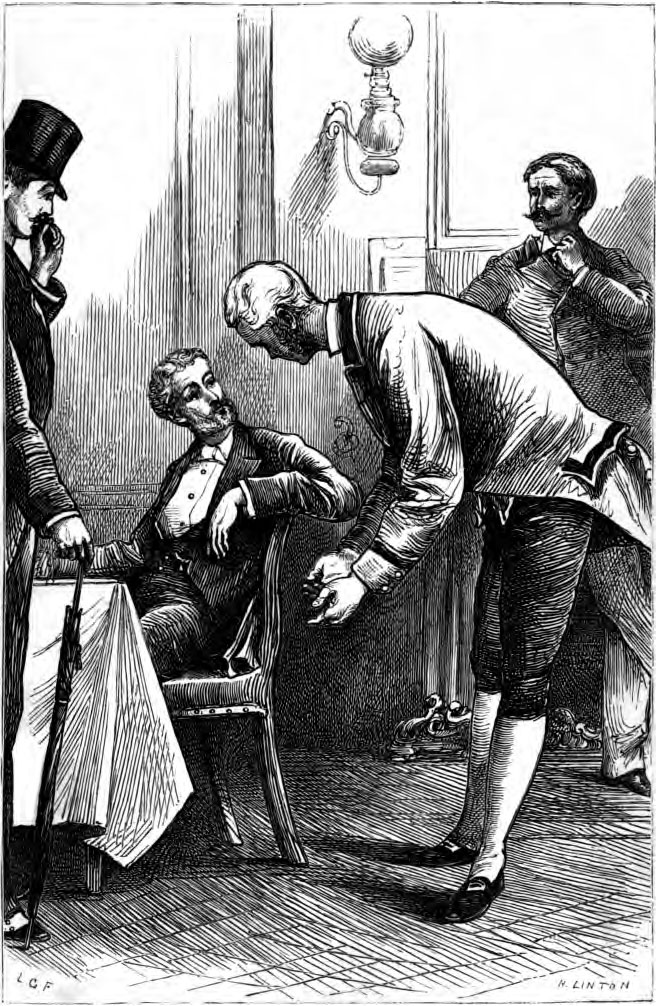
"It's true," said another young lord from the table on the other
side. Then the waiter, still speaking with suppressed and melancholy
voice, suggested that there was some port left. It was now the middle
of July.
"Brandy?" suggested Nidderdale. There had been a few bottles of
brandy, but they had been already consumed. "Send out and get some
brandy," said Nidderdale with rapid impetuosity. But the club was so
reduced in circumstances that he was obliged to take silver out of
his pocket before he could get even such humble comfort as he now
demanded.
Then Lord Grasslough told the whole story as far as it was known.
Herr Vossner had not been seen since nine o'clock on the preceding
evening. The head waiter had known for some weeks that heavy bills
were due. It was supposed that three or four thousand pounds were
owing to tradesmen, who now professed that the credit had been given,
not to Herr Vossner but to the club. And the numerous acceptances
for large sums which the accommodating purveyor held from many of
the members had all been sold to Mr. Flatfleece. Mr. Flatfleece had
spent a considerable portion of the day at the club, and it was now
suggested that he and Herr Vossner were in partnership. At this
moment Dolly Longestaffe came in. Dolly had been at the club before
and had heard the story,--but had gone at once to another club for
his dinner when he found that there was not even a bottle of wine
to be had. "Here's a go," said Dolly. "One thing atop of another!
There'll be nothing left for anybody soon. Is that brandy you're
drinking, Nidderdale? There was none here when I left."
"Had to send round the corner for it, to the public."
"We shall be sending round the corner for a good many things now.
Does anybody know anything of that fellow Melmotte?"
"He's down in the House, as big as life," said Nidderdale. "He's all
right I think."
"I wish he'd pay me my money then. That fellow Flatfleece was here,
and he showed me notes of mine for about £1,500! I write such a
beastly hand that I never know whether I've written it or not. But,
by George, a fellow can't eat and drink £1,500 in less than six
months!"
"There's no knowing what you can do, Dolly," said Lord Grasslough.
"He's paid some of your card money, perhaps," said Nidderdale.
"I don't think he ever did. Carbury had a lot of my I. O. U.'s while
that was going on, but I got the money for that from old Melmotte.
How is a fellow to know? If any fellow writes D. Longestaffe, am I
obliged to pay it? Everybody is writing my name! How is any fellow
to stand that kind of thing? Do you think Melmotte's all right?"
Nidderdale said that he did think so. "I wish he wouldn't go and
write my name then. That's a sort of thing that a man should be left
to do for himself. I suppose Vossner is a swindler; but, by Jove,
I know a worse than Vossner." With that he turned on his heels and
went into the smoking-room. And, after he was gone, there was silence
at the table, for it was known that Lord Nidderdale was to marry
Melmotte's daughter.
In the meantime a scene of a different kind was going on in the House
of Commons. Melmotte had been seated on one of the back Conservative
benches, and there he remained for a considerable time unnoticed and
forgotten. The little emotion that had attended his entrance had
passed away, and Melmotte was now no more than any one else. At
first he had taken his hat off, but, as soon as he observed that the
majority of members were covered, he put it on again. Then he sat
motionless for an hour, looking round him and wondering. He had never
hitherto been even in the gallery of the House. The place was very
much smaller than he had thought, and much less tremendous. The
Speaker did not strike him with the awe which he had expected, and it
seemed to him that they who spoke were talking much like other people
in other places. For the first hour he hardly caught the meaning of a
sentence that was said, nor did he try to do so. One man got up very
quickly after another, some of them barely rising on their legs to
say the few words that they uttered. It seemed to him to be a very
common-place affair,--not half so awful as those festive occasions on
which he had occasionally been called upon to propose a toast or to
return thanks. Then suddenly the manner of the thing was changed, and
one gentleman made a long speech. Melmotte by this time, weary of
observing, had begun to listen, and words which were familiar to him
reached his ears. The gentleman was proposing some little addition
to a commercial treaty and was expounding in very strong language
the ruinous injustice to which England was exposed by being tempted
to use gloves made in a country in which no income tax was levied.
Melmotte listened to his eloquence caring nothing about gloves,
and very little about England's ruin. But in the course of the
debate which followed, a question arose about the value of money, of
exchange, and of the conversion of shillings into francs and dollars.
About this Melmotte really did know something and he pricked up his
ears. It seemed to him that a gentleman whom he knew very well in the
city,--and who had maliciously stayed away from his dinner,--one Mr.
Brown, who sat just before him on the same side of the House, and who
was plodding wearily and slowly along with some pet fiscal theory of
his own, understood nothing at all of what he was saying. Here was an
opportunity for himself! Here was at his hand the means of revenging
himself for the injury done him, and of showing to the world at the
same time that he was not afraid of his city enemies! It required
some courage certainly,--this attempt that suggested itself to him of
getting upon his legs a couple of hours after his first introduction
to parliamentary life. But he was full of the lesson which he was now
ever teaching himself. Nothing should cow him. Whatever was to be
done by brazen-faced audacity he would do. It seemed to be very easy,
and he saw no reason why he should not put that old fool right. He
knew nothing of the forms of the House;--was more ignorant of them
than an ordinary schoolboy;--but on that very account felt less
trepidation than might another parliamentary novice. Mr. Brown was
tedious and prolix; and Melmotte, though he thought much of his
project and had almost told himself that he would do the thing,
was still doubting, when, suddenly, Mr. Brown sat down. There did
not seem to be any particular end to the speech, nor had Melmotte
followed any general thread of argument. But a statement had been
made and repeated, containing, as Melmotte thought, a fundamental
error in finance; and he longed to set the matter right. At any rate
he desired to show the House that Mr. Brown did not know what he
was talking about,--because Mr. Brown had not come to his dinner.
When Mr. Brown was seated, nobody at once rose. The subject was not
popular, and they who understood the business of the House were well
aware that the occasion had simply been one on which two or three
commercial gentlemen, having crazes of their own, should be allowed
to ventilate them. The subject would have dropped;--but on a sudden
the new member was on his legs.
Now it was probably not in the remembrance of any gentleman there
that a member had got up to make a speech within two or three hours
of his first entry into the House. And this gentleman was one
whose recent election had been of a very peculiar kind. It had
been considered by many of his supporters that his name should be
withdrawn just before the ballot; by others that he would be deterred
by shame from showing himself even if he were elected; and again by
another party that his appearance in Parliament would be prevented by
his disappearance within the walls of Newgate. But here he was, not
only in his seat, but on his legs! The favourable grace, the air of
courteous attention, which is always shown to a new member when he
first speaks, was extended also to Melmotte. There was an excitement
in the thing which made gentlemen willing to listen, and a consequent
hum, almost of approbation.
As soon as Melmotte was on his legs, and, looking round, found that
everybody was silent with the intent of listening to him, a good deal
of his courage oozed out of his fingers' ends. The House, which, to
his thinking, had by no means been august while Mr. Brown had been
toddling through his speech, now became awful. He caught the eyes of
great men fixed upon him,--of men who had not seemed to him to be
at all great as he had watched them a few minutes before, yawning
beneath their hats. Mr. Brown, poor as his speech had been, had, no
doubt, prepared it,--and had perhaps made three or four such speeches
every year for the last fifteen years. Melmotte had not dreamed of
putting two words together. He had thought, as far as he had thought
at all, that he could rattle off what he had to say just as he might
do it when seated in his chair at the Mexican Railway Board. But
there was the Speaker, and those three clerks in their wigs, and the
mace,--and worse than all, the eyes of that long row of statesmen
opposite to him! His position was felt by him to be dreadful. He had
forgotten even the very point on which he had intended to crush Mr.
Brown.
But the courage of the man was too high to allow him to be altogether
quelled at once. The hum was prolonged; and though he was red in the
face, perspiring, and utterly confused, he was determined to make
a dash at the matter with the first words which would occur to him.
"Mr. Brown is all wrong," he said. He had not even taken off his hat
as he rose. Mr. Brown turned slowly round and looked up at him. Some
one, whom he could not exactly hear, touching him behind, suggested
that he should take off his hat. There was a cry of order, which of
course he did not understand. "Yes, you are," said Melmotte, nodding
his head, and frowning angrily at poor Mr. Brown.
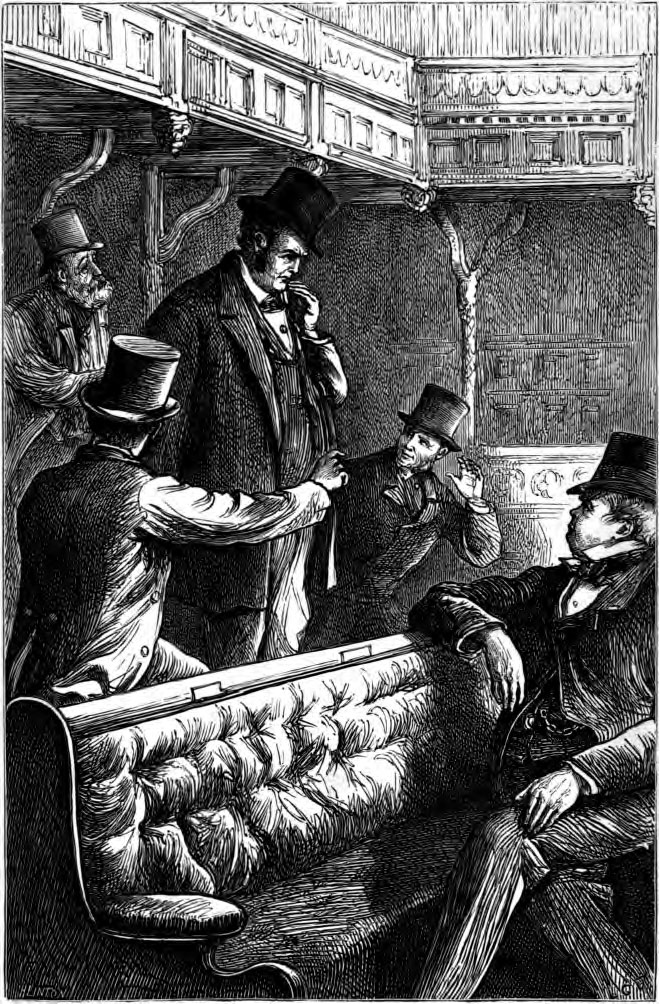
"The honourable member," said the Speaker, with the most good-na-
tured voice which he could assume, "is not perhaps as yet aware that
he should not call another member by his name. He should speak
of the gentleman to whom he alluded as the honourable member
for Whitechapel. And in speaking he should address, not another
honourable member, but the chair."
"You should take your hat off," said the good-natured gentleman
behind.
In such a position how should any man understand so many and such
complicated instructions at once, and at the same time remember the
gist of the argument to be produced? He did take off his hat, and was
of course made hotter and more confused by doing so. "What he said
was all wrong," continued Melmotte; "and I should have thought a man
out of the City, like Mr. Brown, ought to have known better." Then
there were repeated calls of order, and a violent ebullition of
laughter from both sides of the House. The man stood for a while
glaring around him, summoning his own pluck for a renewal of his
attack on Mr. Brown, determined that he would be appalled and put
down neither by the ridicule of those around him, nor by his want of
familiarity with the place; but still utterly unable to find words
with which to carry on the combat. "I ought to know something about
it," said Melmotte sitting down and hiding his indignation and his
shame under his hat.
"We are sure that the honourable member for Westminster does
understand the subject," said the leader of the House, "and we shall
be very glad to hear his remarks. The House I am sure will pardon
ignorance of its rules in so young a member."
But Mr. Melmotte would not rise again. He had made a great effort,
and had at any rate exhibited his courage. Though they might all say
that he had not displayed much eloquence, they would be driven to
admit that he had not been ashamed to show himself. He kept his seat
till the regular stampede was made for dinner, and then walked out
with as stately a demeanour as he could assume.
"Well, that was plucky!" said Cohenlupe, taking his friend's arm in
the lobby.
"I don't see any pluck in it. That old fool Brown didn't know what he
was talking about, and I wanted to tell them so. They wouldn't let me
do it, and there's an end of it. It seems to me to be a stupid sort
of a place."
"Has Longestaffe's money been paid?" said Cohenlupe opening his black
eyes while he looked up into his friend's face.
"Don't you trouble your head about Longestaffe, or his money
either," said Melmotte, getting into his brougham; "do you leave Mr.
Longestaffe and his money to me. I hope you are not such a fool as
to be scared by what the other fools say. When men play such a game
as you and I are concerned in, they ought to know better than to be
afraid of every word that is spoken."
"Oh, dear; yes;" said Cohenlupe apologetically. "You don't suppose
that I am afraid of anything." But at that moment Mr. Cohenlupe was
meditating his own escape from the dangerous shores of England, and
was trying to remember what happy country still was left in which an
order from the British police would have no power to interfere with
the comfort of a retired gentleman such as himself.
That evening Madame Melmotte told her husband that Marie was now
willing to marry Lord Nidderdale;--but she did not say anything as
to the crossing-sweeper or the black footman, nor did she allude to
Marie's threat of the sort of life she would lead her husband.
CHAPTER LXX.
SIR FELIX MEDDLES WITH MANY MATTERS.
There is no duty more certain or fixed in the world than that which
calls upon a brother to defend his sister from ill-usage; but, at the
same time, in the way we live now, no duty is more difficult, and
we may say generally more indistinct. The ill-usage to which men's
sisters are most generally exposed is one which hardly admits of
either protection or vengeance,--although the duty of protecting
and avenging is felt and acknowledged. We are not allowed to fight
duels, and that banging about of another man with a stick is always
disagreeable and seldom successful. A John Crumb can do it, perhaps,
and come out of the affair exulting; but not a Sir Felix Carbury,
even if the Sir Felix of the occasion have the requisite courage.
There is a feeling, too, when a girl has been jilted,--thrown over,
perhaps, is the proper term,--after the gentleman has had the fun of
making love to her for an entire season, and has perhaps even been
allowed privileges as her promised husband, that the less said the
better. The girl does not mean to break her heart for love of the
false one, and become the tragic heroine of a tale for three months.
It is her purpose again to
--trick her beams, and with new-spangled ore
Flame in the forehead of the morning sky.
Though this one has been false, as were perhaps two or three before,
still the road to success is open. Uno avulso non deficit alter. But
if all the notoriety of cudgels and cutting whips be given to the
late unfortunate affair, the difficulty of finding a substitute will
be greatly increased. The brother recognises his duty, and prepares
for vengeance. The injured one probably desires that she may be left
to fight her own little battles alone.
"Then, by heaven, he shall answer it to me," Sir Felix had said very
grandly, when his sister had told him that she was engaged to a man
who was, as he thought he knew, engaged also to marry another woman.
Here, no doubt, was gross ill-usage, and opportunity at any rate for
threats. No money was required and no immediate action,--and Sir
Felix could act the fine gentleman and the dictatorial brother at
very little present expense. But Hetta, who ought perhaps to have
known her brother more thoroughly, was fool enough to believe him.
On the day but one following, no answer had as yet come from Roger
Carbury,--nor could as yet have come. But Hetta's mind was full of
her trouble, and she remembered her brother's threat. Felix had
forgotten that he had made a threat,--and, indeed, had thought no
more of the matter since his interview with his sister.
"Felix," she said, "you won't mention that to Mr. Montague!"
"Mention what? Oh! about that woman, Mrs. Hurtle? Indeed I shall.
A man who does that kind of thing ought to be crushed;--and, by
heavens, if he does it to you, he shall be crushed."
"I want to tell you, Felix. If it is so, I will see him no more."
"If it is so! I tell you I know it."
"Mamma has written to Roger. At least I feel sure she has."
"What has she written to him for? What has Roger Carbury to do with
our affairs?"
"Only you said he knew! If he says so, that is, if you and he both
say that he is to marry that woman,--I will not see Mr. Montague
again. Pray do not go to him. If such a misfortune does come, it is
better to bear it and to be silent. What good can be done?"
"Leave that to me," said Sir Felix, walking out of the room with much
fraternal bluster. Then he went forth, and at once had himself driven
to Paul Montague's lodgings. Had Hetta not been foolish enough to
remind him of his duty, he would not now have undertaken the task.
He too, no doubt, remembered as he went that duels were things of
the past, and that even fists and sticks are considered to be out of
fashion. "Montague," he said, assuming all the dignity of demeanour
that his late sorrows had left to him, "I believe I am right in
saying that you are engaged to marry that American lady, Mrs.
Hurtle."
"Then let me tell you that you were never more wrong in your life.
What business have you with Mrs. Hurtle?"
"When a man proposes to my sister, I think I've a great deal of
business," said Sir Felix.
"Well;--yes; I admit that fully. If I answered you roughly, I beg
your pardon. Now as to the facts. I am not going to marry Mrs.
Hurtle. I suppose I know how you have heard her name;--but as you
have heard it, I have no hesitation in telling you so much. As you
know where she is to be found you can go and ask her if you please.
On the other hand, it is the dearest wish of my heart to marry your
sister. I trust that will be enough for you."
"You were engaged to Mrs. Hurtle?"
"My dear Carbury, I don't think I'm bound to tell you all the details
of my past life. At any rate, I don't feel inclined to do so in
answer to hostile questions. I dare say you have heard enough of Mrs.
Hurtle to justify you, as your sister's brother, in asking me whether
I am in any way entangled by a connection with her. I tell you that
I am not. If you still doubt, I refer you to the lady herself. Beyond
that, I do not think I am called on to go; and beyond that I won't
go,--at any rate, at present." Sir Felix still blustered, and made
what capital he could out of his position as a brother; but he took
no steps towards positive revenge. "Of course, Carbury," said the
other, "I wish to regard you as a brother; and if I am rough to you,
it is only because you are rough to me."
Sir Felix was now in that part of town which he had been accustomed
to haunt,--for the first time since his misadventure,--and, plucking
up his courage, resolved that he would turn into the Beargarden. He
would have a glass of sherry, and face the one or two men who would
as yet be there, and in this way gradually creep back to his old
habits. But when he arrived there, the club was shut up. "What the
deuce is Vossner about?" said he, pulling out his watch. It was
nearly five o'clock. He rang the bell, and knocked at the door,
feeling that this was an occasion for courage. One of the servants,
in what we may call private clothes, after some delay, drew back the
bolts, and told him the astounding news;--The club was shut up! "Do
you mean to say I can't come in?" said Sir Felix. The man certainly
did mean to tell him so, for he opened the door no more than a foot,
and stood in that narrow aperture. Mr. Vossner had gone away. There
had been a meeting of the Committee, and the club was shut up.
Whatever further information rested in the waiter's bosom he declined
to communicate to Sir Felix Carbury.
"By George!" The wrong that was done him filled the young baronet's
bosom with indignation. He had intended, he assured himself, to dine
at his club, to spend the evening there sportively, to be pleasant
among his chosen companions. And now the club was shut up, and
Vossner had gone away! What business had the club to be shut up? What
right had Vossner to go away? Had he not paid his subscription in
advance? Throughout the world, the more wrong a man does, the more
indignant is he at wrong done to him. Sir Felix almost thought that
he could recover damages from the whole Committee.
He went direct to Mrs. Pipkin's house. When he made that half promise
of marriage in Mrs. Pipkin's hearing, he had said that he would come
again on the morrow. This he had not done; but of that he thought
nothing. Such breaches of faith, when committed by a young man in
his position, require not even an apology. He was admitted by Ruby
herself, who was of course delighted to see him. "Who do you think
is in town?" she said. "John Crumb; but though he came here ever so
smart, I wouldn't so much as speak to him, except to tell him to
go away." Sir Felix, when he heard the name, felt an uncomfortable
sensation creep over him. "I don't know I'm sure what he should come
after me for, and me telling him as plain as the nose on his face
that I never want to see him again."
"He's not of much account," said the baronet.
"He would marry me out and out immediately, if I'd have him,"
continued Ruby, who perhaps thought that her honest old lover should
not be spoken of as being altogether of no account. "And he has
everything comfortable in the way of furniture, and all that. And
they do say he's ever so much money in the bank. But I detest him,"
said Ruby, shaking her pretty head, and inclining herself towards her
aristocratic lover's shoulder.
This took place in the back parlour, before Mrs. Pipkin had ascended
from the kitchen prepared to disturb so much romantic bliss with
wretched references to the cold outer world. "Well, now, Sir Felix,"
she began, "if things is square, of course you're welcome to see my
niece."
"And what if they're round, Mrs. Pipkin?" said the gallant, careless,
sparkling Lothario.
"Well, or round either, so long as they're honest."
"Ruby and I are both honest;--ain't we, Ruby? I want to take her out
to dinner, Mrs. Pipkin. She shall be back before late;--before ten;
she shall indeed." Ruby inclined herself still more closely towards
his shoulder. "Come, Ruby, get your hat and change your dress, and
we'll be off. I've ever so many things to tell you."
Ever so many things to tell her! They must be to fix a day for the
marriage, and to let her know where they were to live, and to settle
what dress she should wear,--and perhaps to give her the money to go
and buy it! Ever so many things to tell her! She looked up into Mrs.
Pipkin's face with imploring eyes. Surely on such an occasion as this
an aunt would not expect that her niece should be a prisoner and a
slave. "Have it been put in writing, Sir Felix Carbury?" demanded
Mrs. Pipkin with cruel gravity. Mrs. Hurtle had given it as her
decided opinion that Sir Felix would not really mean to marry Ruby
Ruggles unless he showed himself willing to do so with all the
formality of a written contract.
"Writing be bothered," said Sir Felix.
"That's all very well, Sir Felix. Writing do bother, very often. But
when a gentleman has intentions, a bit of writing shows it plainer
nor words. Ruby don't go no where to dine unless you puts it into
writing."
"Aunt Pipkin!" exclaimed the wretched Ruby. "What do you think I'm
going to do with her?" asked Sir Felix.
"If you want to make her your wife, put it in writing. And if it be
as you don't, just say so, and walk away,--free."
"I shall go," said Ruby. "I'm not going to be kept here a prisoner
for any one. I can go when I please. You wait, Felix, and I'll be
down in a minute." The girl, with a nimble spring, ran upstairs,
and began to change her dress without giving herself a moment for
thought.
"She don't come back no more here, Sir Felix," said Mrs. Pipkin, in
her most solemn tones. "She ain't nothing to me, no more than she was
my poor dear husband's sister's child. There ain't no blood between
us, and won't be no disgrace. But I'd be loth to see her on the
streets."
"Then why won't you let me bring her back again?"
"'Cause that'd be the way to send her there. You don't mean to marry
her." To this Sir Felix said nothing. "You're not thinking of that.
It's just a bit of sport,--and then there she is, an old shoe to
be chucked away, just a rag to be swept into the dust-bin. I've
seen scores of 'em, and I'd sooner a child of mine should die in a
workus', or be starved to death. But it's all nothing to the likes o'
you."
"I haven't done her any harm," said Sir Felix, almost frightened.
"Then go away, and don't do her any. That's Mrs. Hurtle's door open.
You go and speak to her. She can talk a deal better nor me."
"Mrs. Hurtle hasn't been able to manage her own affairs very well."
"Mrs. Hurtle's a lady, Sir Felix, and a widow, and one as has seen
the world." As she spoke, Mrs. Hurtle came downstairs, and an
introduction, after some rude fashion, was effected between her and
Sir Felix. Mrs. Hurtle had heard often of Sir Felix Carbury, and was
quite as certain as Mrs. Pipkin that he did not mean to marry Ruby
Ruggles. In a few minutes Felix found himself alone with Mrs. Hurtle
in her own room. He had been anxious to see the woman since he had
heard of her engagement with Paul Montague, and doubly anxious since
he had also heard of Paul's engagement with his sister. It was not an
hour since Paul himself had referred him to her for corroboration of
his own statement.
"Sir Felix Carbury," she said, "I am afraid you are doing that poor
girl no good, and are intending to do her none." It did occur to him
very strongly that this could be no affair of Mrs. Hurtle's, and that
he, as a man of position in society, was being interfered with in an
unjustifiable manner. Aunt Pipkin wasn't even an aunt; but who was
Mrs. Hurtle? "Would it not be better that you should leave her to
become the wife of a man who is really fond of her?"
He could already see something in Mrs. Hurtle's eye which prevented
his at once bursting into wrath;--but who was Mrs. Hurtle, that she
should interfere with him? "Upon my word, ma'am," he said, "I'm very
much obliged to you, but I don't quite know to what I owe the honour
of your--your--"
"Interference you mean."
"I didn't say so, but perhaps that's about it."
"I'd interfere to save any woman that God ever made," said Mrs.
Hurtle with energy. "We're all apt to wait a little too long, because
we're ashamed to do any little good that chance puts in our way. You
must go and leave her, Sir Felix."
"I suppose she may do as she pleases about that."
"Do you mean to make her your wife?" asked Mrs. Hurtle sternly.
"Does Mr. Paul Montague mean to make you his wife?" rejoined Sir
Felix with an impudent swagger. He had struck the blow certainly
hard enough, and it had gone all the way home. She had not surmised
that he would have heard aught of her own concerns. She only barely
connected him with that Roger Carbury who, she knew, was Paul's great
friend, and she had as yet never heard that Hetta Carbury was the
girl whom Paul loved. Had Paul so talked about her that this young
scamp should know all her story?
She thought awhile,--she had to think for a moment,--before she
could answer him. "I do not see," she said, with a faint attempt at a
smile, "that there is any parallel between the two cases. I, at any
rate, am old enough to take care of myself. Should he not marry me,
I am as I was before. Will it be so with that poor girl if she allows
herself to be taken about the town by you at night?" She had desired
in what she said to protect Ruby rather than herself. What could it
matter whether this young man was left in a belief that she was, or
that she was not, about to be married?
"If you'll answer me, I'll answer you," said Sir Felix. "Does Mr.
Montague mean to make you his wife?"
"It does not concern you to know," said she, flashing upon him. "The
question is insolent."
"It does concern me,--a great deal more than anything about Ruby can
concern you. And as you won't answer me, I won't answer you."
"Then, sir, that girl's fate will be upon your head."
"I know all about that," said the baronet.
"And the young man who has followed her up to town will probably know
where to find you," added Mrs. Hurtle.
To such a threat as this, no answer could be made, and Sir Felix
left the room. At any rate, John Crumb was not there at present. And
were there not policemen in London? And what additional harm would
be done to John Crumb, or what increase of anger engendered in that
true lover's breast, by one additional evening's amusement? Ruby had
danced with him so often at the Music Hall that John Crumb could
hardly be made more bellicose by the fact of her dining with him
on this evening. When he descended, he found Ruby in the hall, all
arrayed. "You don't come in here again to-night," said Mrs. Pipkin,
thumping the little table which stood in the passage, "if you goes
out of that there door with that there young man."
"Then I shall," said Ruby linking herself on to her lover's arm.
"Baggage! Slut!" said Mrs. Pipkin; "after all I've done for you, just
as one as though you were my own flesh and blood."
"I've worked for it, I suppose;--haven't I?" rejoined Ruby.
"You send for your things to-morrow, for you don't come in here no
more. You ain't nothing to me no more nor no other girl. But I'd 've
saved you, if you'd but a' let me. As for you,"--and she looked at
Sir Felix,--"only because I've lodgings to let, and because of the
lady upstairs, I'd shake you that well, you'd never come here no
more after poor girls." I do not think that she need have feared
any remonstrance from Mrs. Hurtle, even had she put her threat into
execution.
Sir Felix, thinking that he had had enough of Mrs. Pipkin and her
lodger, left the house with Ruby on his arm. For the moment, Ruby had
been triumphant, and was happy. She did not stop to consider whether
her aunt would or would not open her door when she should return
tired, and perhaps repentant. She was on her lover's arm, in her
best clothes, and going to have a dinner given to her. And her
lover had told her that he had ever so many things,--ever so many
things to say to her! But she would ask no impertinent questions
in the first hour of her bliss. It was so pleasant to walk with
him up to Pentonville;--so joyous to turn into a gay enclosure,
half public-house and half tea-garden; so pleasant to hear him order
the good things, which in his company would be so nice! Who cannot
understand that even an urban Rosherville must be an Elysium to those
who have lately been eating their meals in all the gloom of a small
London underground kitchen? There we will leave Ruby in her bliss.
At about nine that evening John Crumb called at Mrs. Pipkin's, and
was told that Ruby had gone out with Sir Felix Carbury. He hit his
leg a blow with his fist, and glared out of his eyes. "He'll have it
hot some day," said John Crumb. He was allowed to remain waiting for
Ruby till midnight, and then, with a sorrowful heart, he took his
departure.
CHAPTER LXXI.
JOHN CRUMB FALLS INTO TROUBLE.
It was on a Friday evening, an inauspicious Friday, that poor Ruby
Ruggles had insisted on leaving the security of her Aunt Pipkin's
house with her aristocratic and vicious lover, in spite of the
positive assurance made to her by Mrs. Pipkin that if she went forth
in such company she should not be allowed to return. "Of course
you must let her in," Mrs. Hurtle had said soon after the girl's de-
parture. Whereupon Mrs. Pipkin had cried. She knew her own softness
too well to suppose it to be possible that she could keep the girl
out in the streets all night; but yet it was hard upon her, very
hard, that she should be so troubled. "We usen't to have our ways
like that when I was young," she said, sobbing. What was to be the
end of it? Was she to be forced by circumstances to keep the girl
always there, let the girl's conduct be what it might? Nevertheless
she acknowledged that Ruby must be let in when she came back. Then,
about nine o'clock, John Crumb came; and the latter part of the
evening was more melancholy even than the first. It was impossible to
conceal the truth from John Crumb. Mrs. Hurtle saw the poor man and
told the story in Mrs. Pipkin's presence.
"She's headstrong, Mr. Crumb," said Mrs. Hurtle.
"She is that, ma'am. And it was along wi' the baro-nite she went?"
"It was so, Mr. Crumb."
"Baro-nite! Well;--perhaps I shall catch him some of these
days;--went to dinner wi' him, did she? Didn't she have no dinner
here?"
Then Mrs. Pipkin spoke up with a keen sense of offence. Ruby Ruggles
had had as wholesome a dinner as any young woman in London,--a
bullock's heart and potatoes,--just as much as ever she had pleased
to eat of it. Mrs. Pipkin could tell Mr. Crumb that there was "no
starvation nor yet no stint in her house." John Crumb immediately
produced a very thick and admirably useful blue cloth cloak, which
he had brought up with him to London from Bungay, as a present to
the woman who had been good to his Ruby. He assured her that he did
not doubt that her victuals were good and plentiful, and went on to
say that he had made bold to bring her a trifle out of respect. It
was some little time before Mrs. Pipkin would allow herself to be
appeased;--but at last she permitted the garment to be placed on her
shoulders. But it was done after a melancholy fashion. There was no
smiling consciousness of the bestowal of joy on the countenance of
the donor as he gave it, no exuberance of thanks from the recipient
as she received it. Mrs. Hurtle, standing by, declared it to be
perfect;--but the occasion was one which admitted of no delight.
"It's very good of you, Mr. Crumb, to think of an old woman like
me,--particularly when you've such a deal of trouble with a young
'un."
"It's like the smut in the wheat, Mrs. Pipkin, or the d'sease in the
'tatoes;--it has to be put up with, I suppose. Is she very partial,
ma'am, to that young baro-nite?" This question was asked of Mrs.
Hurtle.
"Just a fancy for the time, Mr. Crumb," said the lady.
"They never thinks as how their fancies may well-nigh half kill a
man!" Then he was silent for awhile, sitting back in his chair, not
moving a limb, with his eyes fastened on Mrs. Pipkin's ceiling.
Mrs. Hurtle had some work in her hand, and sat watching him. The
man was to her an extraordinary being,--so constant, so slow, so
unexpressive, so unlike her own countrymen,--willing to endure so
much, and at the same time so warm in his affections! "Sir Felix
Carbury!" he said. "I'll Sir Felix him some of these days. If it was
only dinner, wouldn't she be back afore this, ma'am?"
"I suppose they've gone to some place of amusement," said Mrs.
Hurtle.
"Like enough," said John Crumb in a low voice.
"She's that mad after dancing as never was," said Mrs. Pipkin.
"And where is it as 'em dances?" asked Crumb, getting up from his
chair, and stretching himself. It was evident to both the ladies that
he was beginning to think that he would follow Ruby to the music
hall. Neither of them answered him, however, and then he sat down
again. "Does 'em dance all night at them places, Mrs. Pipkin?"
"They do pretty nearly all that they oughtn't to do," said Mrs.
Pipkin. John Crumb raised one of his fists, brought it down heavily
on the palm of his other hand, and then again sat silent for awhile.
"I never knowed as she was fond o' dancing," he said. "I'd a had
dancing for her down at Bungay,--just as ready as anything. D'ye
think, ma'am, it's the dancing she's after, or the baro-nite?" This
was another appeal to Mrs. Hurtle.
"I suppose they go together," said the lady.
Then there was another long pause, at the end of which poor John
Crumb burst out with some violence. "Domn him! Domn him! What 'ad
I ever dun to him? Nothing! Did I ever interfere wi' him? Never! But
I wull. I wull. I wouldn't wonder but I'll swing for this at Bury!"
"Oh, Mr. Crumb, don't talk like that," said Mrs. Pipkin.
"Mr. Crumb is a little disturbed, but he'll get over it presently,"
said Mrs. Hurtle.
"She's a nasty slut to go and treat a young man as she's treating
you," said Mrs. Pipkin.
"No, ma'am;--she ain't nasty," said the lover. "But she's
crou'll--horrid crou'll. It's no more use my going down about meal
and pollard, nor business, and she up here with that baro-nite,--no,
no more nor nothin'! When I handles it I don't know whether its
middlings nor nothin' else. If I was to twist his neck, ma'am, would
you take it on yourself to say as I was wrong?"
"I'd sooner hear that you had taken the girl away from him," said
Mrs. Hurtle.
"I could pretty well eat him,--that's what I could. Half past eleven;
is it? She must come some time, mustn't she?" Mrs. Pipkin, who did
not want to burn candles all night long, declared that she could give
no assurance on that head. If Ruby did come, she should, on that
night, be admitted. But Mrs. Pipkin thought that it would be better
to get up and let her in than to sit up for her. Poor Mr. Crumb did
not at once take the hint, and remained there for another half-hour,
saying little, but waiting with the hope that Ruby might come. But
when the clock struck twelve he was told that he must go. Then he
slowly collected his limbs and dragged them out of the house.
"That young man is a good fellow," said Mrs. Hurtle as soon as the
door was closed.
"A deal too good for Ruby Ruggles," said Mrs. Pipkin. "And he can
maintain a wife. Mr. Carbury says as he's as well to do as any
tradesman down in them parts."
Mrs. Hurtle disliked the name of Mr. Carbury, and took this last
statement as no evidence in John Crumb's favour. "I don't know that
I think better of the man for having Mr. Carbury's friendship," she
said.
"Mr. Carbury ain't any way like his cousin, Mrs. Hurtle."
"I don't think much of any of the Carburys, Mrs. Pipkin. It seems
to me that everybody here is either too humble or too overbearing.
Nobody seems content to stand firm on his own footing and interfere
with nobody else." This was all Greek to poor Mrs. Pipkin. "I suppose
we may as well go to bed now. When that girl comes and knocks, of
course we must let her in. If I hear her, I'll go down and open the
door for her."
Mrs. Pipkin made very many apologies to her lodger for the condition
of her household. She would remain up herself to answer the door at
the first sound, so that Mrs. Hurtle should not be disturbed. She
would do her best to prevent any further annoyance. She trusted Mrs.
Hurtle would see that she was endeavouring to do her duty by the
naughty wicked girl. And then she came round to the point of her
discourse. She hoped that Mrs. Hurtle would not be induced to quit
the rooms by these disagreeable occurrences. "I don't mind saying it
now, Mrs. Hurtle, but your being here is ever so much to me. I ain't
nothing to depend on,--only lodgers, and them as is any good is so
hard to get!" The poor woman hardly understood Mrs. Hurtle, who, as
a lodger, was certainly peculiar. She cared nothing for disturbances,
and rather liked than otherwise the task of endeavouring to assist
in the salvation of Ruby. Mrs. Hurtle begged that Mrs. Pipkin would
go to bed. She would not be in the least annoyed by the knocking.
Another half-hour had thus been passed by the two ladies in the
parlour after Crumb's departure. Then Mrs. Hurtle took her candle and
had ascended the stairs half way to her own sitting-room, when a loud
double knock was heard. She immediately joined Mrs. Pipkin in the
passage. The door was opened, and there stood Ruby Ruggles, John
Crumb, and two policemen! Ruby rushed in, and casting herself on
to one of the stairs began to throw her hands about, and to howl
piteously. "Laws a mercy; what is it?" asked Mrs. Pipkin.
"He's been and murdered him!" screamed Ruby. "He has! He's been and
murdered him!"
"This young woman is living here;--is she?" asked one of the
policemen.
"She is living here," said Mrs. Hurtle. But now we must go back to
the adventures of John Crumb after he had left the house.
He had taken a bedroom at a small inn close to the Eastern Counties
Railway Station which he was accustomed to frequent when business
brought him up to London, and thither he proposed to himself to
return. At one time there had come upon him an idea that he would
endeavour to seek Ruby and his enemy among the dancing saloons of
the metropolis; and he had asked a question with that view. But no
answer had been given which seemed to aid him in his project, and his
purpose had been abandoned as being too complex and requiring more
intelligence than he gave himself credit for possessing. So he had
turned down a street with which he was so far acquainted as to know
that it would take him to the Islington Angel,--where various roads
meet, and whence he would know his way eastwards. He had just passed
the Angel, and the end of Goswell Road, and was standing with his
mouth open, looking about, trying to make certain of himself that he
would not go wrong, thinking that he would ask a policeman whom he
saw, and hesitating because he feared that the man would want to know
his business. Then, of a sudden, he heard a woman scream, and knew
that it was Ruby's voice. The sound was very near him, but in the
glimmer of the gaslight he could not quite see whence it came. He
stood still, putting his hand up to scratch his head under his
hat,--trying to think what, in such an emergency, it would be well
that he should do. Then he heard the voice distinctly, "I won't;--I
won't," and after that a scream. Then there were further words. "It's
no good--I won't." At last he was able to make up his mind. He rushed
after the sound, and turning down a passage to the right which led
back into Goswell Road, saw Ruby struggling in a man's arms. She had
left the dancing establishment with her lover; and when they had come
to the turn of the passage, there had arisen a question as to her
further destiny for the night. Ruby, though she well remembered Mrs.
Pipkin's threats, was minded to try her chance at her aunt's door.
Sir Felix was of opinion that he could make a preferable arrangement
for her; and as Ruby was not at once amenable to his arguments he
had thought that a little gentle force might avail him. He had therefore
dragged Ruby into the passage. The unfortunate one! That so ill a
chance should have come upon him in the midst of his diversion! He
had swallowed several tumblers of brandy and water, and was therefore
brave with reference to that interference of the police, the fear
of which might otherwise have induced him to relinquish his hold of
Ruby's arm when she first raised her voice. But what amount of brandy
and water would have enabled him to persevere, could he have dreamed
that John Crumb was near him? On a sudden he found a hand on his
coat, and he was swung violently away, and brought with his back
against the railings so forcibly as to have the breath almost knocked
out of his body. But he could hear Ruby's exclamation, "If it isn't
John Crumb!" Then there came upon him a sense of coming destruction,
as though the world for him were all over; and, collapsing throughout
his limbs, he slunk down upon the ground.
"Get up, you wiper," said John Crumb. But the baronet thought it
better to cling to the ground. "You sholl get up," said John, taking
him by the collar of his coat and lifting him. "Now, Ruby, he's
a-going to have it," said John. Whereupon Ruby screamed at the top
of her voice, with a shriek very much louder than that which had at
first attracted John Crumb's notice.
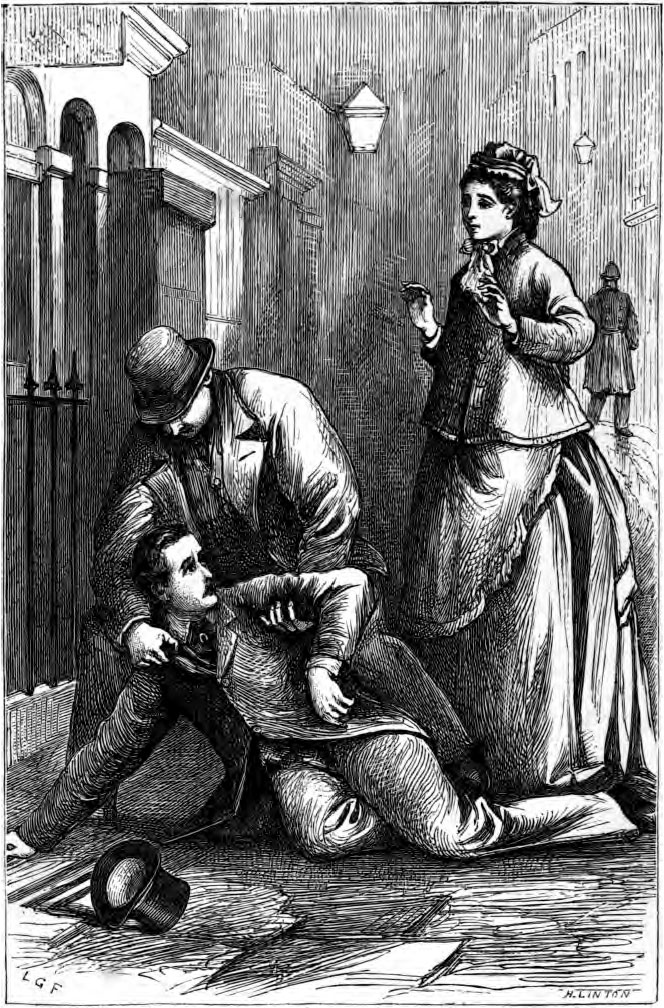
"Don't hit a man when he's down," said the baronet, pleading as
though for his life.
"I wunt," said John;--"but I'll hit a fellow when 'un's up."
Sir Felix was little more than a child in the man's arms. John
Crumb raised him, and catching him round the neck with his left
arm,--getting his head into chancery as we used to say when we fought
at school,--struck the poor wretch some half-dozen times violently
in the face, not knowing or caring exactly where he hit him, but at
every blow obliterating a feature. And he would have continued had
not Ruby flown at him and rescued Sir Felix from his arms. "He's
about got enough of it," said John Crumb as he gave over his work.
Then Sir Felix fell again to the ground, moaning fearfully. "I know'd
he'd have to have it," said John Crumb.
Ruby's screams of course brought the police, one arriving from each
end of the passage on the scene of action at the same time. And now
the cruellest thing of all was that Ruby in the complaints which she
made to the policemen said not a word against Sir Felix, but was
as bitter as she knew how to be in her denunciations of John Crumb.
It was in vain that John endeavoured to make the man understand
that the young woman had been crying out for protection when he had
interfered. Ruby was very quick of speech and John Crumb was very
slow. Ruby swore that nothing so horrible, so cruel, so bloodthirsty
had ever been done before. Sir Felix himself when appealed to could
say nothing. He could only moan and make futile efforts to wipe away
the stream of blood from his face when the men stood him up leaning
against the railings. And John, though he endeavoured to make the
policemen comprehend the extent of the wickedness of the young
baronet, would not say a word against Ruby. He was not even in the
least angered by her denunciations of himself. As he himself said
sometimes afterwards, he had "dropped into the baro-nite" just in
time, and, having been successful in this, felt no wrath against Ruby
for having made such an operation necessary.
There was soon a third policeman on the spot, and a dozen other
persons,--cab-drivers, haunters of the street by night, and houseless
wanderers, casuals who at this season of the year preferred the
pavements to the poor-house wards. They all took part against John
Crumb. Why had the big man interfered between the young woman and
her young man? Two or three of them wiped Sir Felix's face, and dabbed
his eyes, and proposed this and the other remedy. Some thought that
he had better be taken straight to an hospital. One lady remarked
that he was "so mashed and mauled" that she was sure he would never
"come to" again. A precocious youth remarked that he was "all one
as a dead 'un." A cabman observed that he had "'ad it awful 'eavy."
To all these criticisms on his condition Sir Felix himself made
no direct reply, but he intimated his desire to be carried away
somewhere, though he did not much care whither.
At last the policemen among them decided upon a course of action.
They had learned by the united testimony of Ruby and Crumb that Sir
Felix was Sir Felix. He was to be carried in a cab by one constable
to Bartholomew Hospital, who would then take his address so that he
might be produced and bound over to prosecute. Ruby should be even
conducted to the address she gave,--not half a mile from the spot
on which they now stood,--and be left there or not according to the
account which might be given of her. John Crumb must be undoubtedly
locked up in the station-house. He was the offender;--for aught that
any of them yet knew, the murderer. No one said a good word for
him. He hardly said a good word for himself, and certainly made no
objection to the treatment that had been proposed for him. But,
no doubt, he was buoyed up inwardly by the conviction that he had
thoroughly thrashed his enemy.
Thus it came to pass that the two policemen with John Crumb and
Ruby came together to Mrs. Pipkin's door. Ruby was still loud with
complaints against the ruffian who had beaten her lover,--who,
perhaps, had killed her loved one. She threatened the gallows, and
handcuffs, and perpetual imprisonment, and an action for damages
amidst her lamentations. But from Mrs. Hurtle the policemen did
manage to learn something of the truth. Oh yes;--the girl lived
there and was--respectable. This man whom they had arrested was
respectable also, and was the girl's proper lover. The other man who
had been beaten was undoubtedly the owner of a title; but he was not
respectable, and was only the girl's improper lover. And John Crumb's
name was given. "I'm John Crumb of Bungay," said he, "and
I ain't
afeared of nothin' nor nobody. And I ain't a been a drinking; no, I
ain't. Mauled 'un! In course I've mauled 'un. And I meaned it. That
ere young woman is engaged to be my wife."
"No, I ain't," shouted Ruby.
"But she is," persisted John Crumb.
"Well then, I never will," rejoined Ruby.
John Crumb turned upon her a look of love, and put his hand on his
heart. Whereupon the senior policeman said that he saw at a glance
how it all was, but that Mr. Crumb had better come along with
him,--just for the present. To this arrangement the unfortunate hero
from Bungay made not the slightest objection.
"Miss Ruggles," said Mrs. Hurtle, "if that young man doesn't conquer
you at last you can't have a heart in your bosom."
"Indeed and I have then, and I don't mean to give it him if it's ever
so. He's been and killed Sir Felix." Mrs. Hurtle in a whisper to Mrs.
Pipkin expressed a wicked wish that it might be so. After that the
three women all went to bed.
CHAPTER LXXII.
"ASK HIMSELF."
Roger Carbury when he received the letter from Hetta's mother
desiring him to tell her all that he knew of Paul Montague's
connection with Mrs. Hurtle found himself quite unable to write a
reply. He endeavoured to ask himself what he would do in such a case
if he himself were not personally concerned. What advice in this
emergency would he give to the mother and what to the daughter, were
he himself uninterested? He was sure that, as Hetta's cousin and
acting as though he were Hetta's brother, he would tell her that
Paul Montague's entanglement with that American woman should have
forbidden him at any rate for the present to offer his hand to any
other lady. He thought that he knew enough of all the circumstances
to be sure that such would be his decision. He had seen Mrs. Hurtle
with Montague at Lowestoft, and had known that they were staying
together as friends at the same hotel. He knew that she had come
to England with the express purpose of enforcing the fulfilment of
an engagement which Montague had often acknowledged. He knew that
Montague made frequent visits to her in London. He had, indeed, been
told by Montague himself that, let the cost be what it might, the
engagement should be and in fact had been broken off. He thoroughly
believed the man's word, but put no trust whatever in his firmness.
And, hitherto, he had no reason whatever for supposing that Mrs.
Hurtle had consented to be abandoned. What father, what elder brother
would allow a daughter or a sister to become engaged to a man
embarrassed by such difficulties? He certainly had counselled
Montague to rid himself of the trammels by which he had surrounded
himself;--but not on that account could he think that the man in his
present condition was fit to engage himself to another woman.
All this was clear to Roger Carbury. But then it had been equally
clear to him that he could not, as a man of honour, assist his own
cause by telling a tale,--which tale had become known to him as the
friend of the man against whom it would have to be told. He had
resolved upon that as he left Montague and Mrs. Hurtle together upon
the sands at Lowestoft. But what was he to do now? The girl whom he
loved had confessed her love for the other man,--that man, who in
seeking the girl's love, had been as he thought so foul a traitor
to himself! That he would hold himself as divided from the man by a
perpetual and undying hostility he had determined. That his love for
the woman would be equally perpetual he was quite sure. Already there
were floating across his brain ideas of perpetuating his name in the
person of some child of Hetta's,--but with the distinct understanding
that he and the child's father should never see each other. No more
than twenty-four hours had intervened between the receipt of Paul's
letter and that from Lady Carbury,--but during those four-and-twenty
hours he had almost forgotten Mrs. Hurtle. The girl was gone from
him, and he thought only of his own loss and of Paul's perfidy. Then
came the direct question as to which he was called upon for a direct
answer. Did he know anything of facts relating to the presence of
a certain Mrs. Hurtle in London which were of a nature to make it
inexpedient that Hetta should accept Paul Montague as her betrothed
lover? Of course he did. The facts were all familiar to him. But
how was he to tell the facts? In what words was he to answer such
a letter? If he told the truth as he knew it how was he to secure
himself against the suspicion of telling a story against his rival in
order that he might assist himself, or at any rate, punish the rival?
As he could not trust himself to write an answer to Lady Carbury's
letter he determined that he would go to London. If he must tell the
story he could tell it better face to face than by any written words.
So he made the journey, arrived in town late in the evening, and
knocked at the door in Welbeck Street between ten and eleven on the
morning after the unfortunate meeting which took place between Sir
Felix and John Crumb. The page when he opened the door looked as a
page should look when the family to which he is attached is suffering
from some terrible calamity. "My lady" had been summoned to the
hospital to see Sir Felix who was,--as the page reported,--in a very
bad way indeed. The page did not exactly know what had happened, but
supposed that Sir Felix had lost most of his limbs by this time. Yes;
Miss Carbury was up-stairs; and would no doubt see her cousin, though
she, too, was in a very bad condition; and dreadfully put about. That
poor Hetta should be "put about" with her brother in the hospital and
her lover in the toils of an abominable American woman was natural
enough.
"What's this about Felix?" asked Roger. The new trouble always has
precedence over those which are of earlier date.
"Oh Roger, I am so glad to see you. Felix did not come home last
night, and this morning there came a man from the hospital in the
city to say that he is there."
"What has happened to him?"
"Somebody,--somebody has,--beaten him," said Hetta whimpering. Then
she told the story as far as she knew it. The messenger from the
hospital had declared that the young man was in no danger and that
none of his bones were broken, but that he was terribly bruised about
the face, that his eyes were in a frightful condition, sundry of his
teeth knocked out, and his lips cut open. But, the messenger had
gone on to say, the house surgeon had seen no reason why the young
gentleman should not be taken home. "And mamma has gone to fetch
him," said Hetta.
"That's John Crumb," said Roger. Hetta had never heard of John Crumb,
and simply stared into her cousin's face. "You have not been told
about John Crumb? No;--you would not hear of him."
"Why should John Crumb beat Felix like that?"
"They say, Hetta, that women are the cause of most troubles that
occur in the world." The girl blushed up to her eyes, as though the
whole story of Felix's sin and folly had been told to her. "If it be
as I suppose," continued Roger, "John Crumb has considered himself to
be aggrieved and has thus avenged himself."
"Did you--know of him before?"
"Yes indeed;--very well. He is a neighbour of mine and was in love
with a girl, with all his heart; and he would have made her his wife
and have been good to her. He had a home to offer her, and is an
honest man with whom she would have been safe and respected and
happy. Your brother saw her and, though he knew the story, though
he had been told by myself that this honest fellow had placed his
happiness on the girl's love, he thought,--well, I suppose he thought
that such a pretty thing as this girl was too good for John Crumb."
"But Felix has been going to marry Miss Melmotte!"
"You're old-fashioned, Hetta. It used to be the way,--to be off with
the old love before you are on with the new; but that seems to be all
changed now. Such fine young fellows as there are now can be in love
with two at once. That I fear is what Felix has thought;--and now he
has been punished."
"You know all about it then?"
"No;--I don't know. But I think it has been so. I do know that John
Crumb had threatened to do this thing, and I felt sure that sooner or
later he would be as good as his word. If it has been so, who is to
blame him?"
Hetta as she heard the story hardly knew whether her cousin, in his
manner of telling the story, was speaking of that other man, of that
stranger of whom she had never heard, or of himself. He would have
made her his wife and have been good to her. He had a home to offer
her. He was an honest man with whom she would have been safe and
respected and happy! He had looked at her while speaking as though it
were her own case of which he spoke. And then, when he talked of the
old-fashioned way, of being off with the old love before you are on
with the new, had he not alluded to Paul Montague and this story of
the American woman? But, if so, it was not for Hetta to notice it
by words. He must speak more plainly than that before she could be
supposed to know that he alluded to her own condition. "It is very
shocking," she said.
"Shocking;--yes. One is shocked at it all. I pity your mother, and I
pity you."
"It seems to me that nothing ever will be happy for us," said Hetta.
She was longing to be told something of Mrs. Hurtle, but she did not
as yet dare to ask the question.
"I do not know whether to wait for your mother or not," said he after
a short pause.
"Pray wait for her if you are not very busy."
"I came up only to see her, but perhaps she would not wish me to be
here when she brings Felix back to the house."
"Indeed she will. She would like you always to be here when there are
troubles. Oh, Roger, I wish you could tell me."
"Tell you what?"
"She has written to you;--has she not?"
"Yes; she has written to me."
"And about me?"
"Yes;--about you, Hetta. And, Hetta, Mr. Montague has written to me
also."
"He told me that he would," whispered Hetta.
"Did he tell you of my answer?"
"No;--he has told me of no answer. I have not seen him since."
"You do not think that it can have been very kind, do you? I also
have something of the feeling of John Crumb, though I shall not
attempt to show it after the same fashion."
"Did you not say the girl had promised to love that man?"
"I did not say so;--but she had promised. Yes, Hetta; there is a
difference. The girl then was fickle and went back from her word.
You never have done that. I am not justified in thinking even a hard
thought of you. I have never harboured a hard thought of you. It is
not you that I reproach. But he,--he has been if possible more false
than Felix."
"Oh, Roger, how has he been false?"
Still he was not wishful to tell her the story of Mrs. Hurtle. The
treachery of which he was speaking was that which he had thought had
been committed by his friend towards himself. "He should have left
the place and never have come near you," said Roger, "when he found
how it was likely to be with him. He owed it to me not to take the
cup of water from my lips."
How was she to tell him that the cup of water never could have
touched his lips? And yet if this were the only falsehood of which
he had to tell, she was bound to let him know that it was so. That
horrid story of Mrs. Hurtle;--she would listen to that if she could
hear it. She would be all ears for that. But she could not admit that
her lover had sinned in loving her. "But, Roger," she said--"it would
have been the same."
"You may think so. You may feel it. You may know it. I at any rate
will not contradict you when you say that it must have been so. But
he didn't feel it. He didn't know it. He was to me as a younger
brother,--and he has robbed me of everything. I understand, Hetta,
what you mean. I should never have succeeded! My happiness would have
been impossible if Paul had never come home from America. I have told
myself so a hundred times, but I cannot therefore forgive him. And I
won't forgive him, Hetta. Whether you are his wife, or another man's,
or whether you are Hetta Carbury on to the end, my feeling to you
will be the same. While we both live, you must be to me the dearest
creature living. My hatred to him--"
"Oh, Roger, do not say hatred."
"My hostility to him can make no difference in my feeling to you. I
tell you that should you become his wife you will still be my love.
As to not coveting,--how is a man to cease to covet that which he has
always coveted? But I shall be separated from you. Should I be dying,
then I should send for you. You are the very essence of my life. I
have no dream of happiness otherwise than as connected with you. He
might have my whole property and I would work for my bread, if I
could only have a chance of winning you to share my toils with me."
But still there was no word of Mrs. Hurtle. "Roger," she said, "I
have given it all away now. It cannot be given twice."
"If he were unworthy would your heart never change?"
"I think--never. Roger, is he unworthy?"
"How can you trust me to answer such a question? He is my enemy. He
has been ungrateful to me as one man hardly ever is to another. He
has turned all my sweetness to gall, all my flowers to bitter weeds;
he has choked up all my paths. And now you ask me whether he is
unworthy! I cannot tell you."
"If you thought him worthy you would tell me," she said, getting up
and taking him by the arm.
"No;--I will tell you nothing. Go to some one else, not to me;" and
he tried with gentleness but tried ineffectually to disengage himself
from her hold.
"Roger, if you knew him to be good you would tell me,--because you
yourself are so good. Even though you hated him you would say so.
It would not be you to leave a false impression even against your
enemies. I ask you because, however it may be with you, I know I can
trust you. I can be nothing else to you, Roger; but I love you as a
sister loves, and I come to you as a sister comes to a brother. He
has my heart. Tell me;--is there any reason why he should not also
have my hand?"
"Ask himself, Hetta."
"And you will tell me nothing? You will not try to save me though you
know that I am in danger? Who is--Mrs. Hurtle?"
"Have you asked him?"
"I had not heard her name when he parted from me. I did not even know
that such a woman lived. Is it true that he has promised to marry
her? Felix told me of her, and told me also that you knew. But I
cannot trust Felix as I would trust you. And mamma says that it is
so;--but mamma also bids me ask you. There is such a woman?"
"There is such a woman certainly."
"And she has been,--a friend of Paul's?"
"Whatever be the story, Hetta, you shall not hear it from me. I will
say neither evil nor good of the man except in regard to his conduct
to myself. Send for him and ask him to tell you the story of Mrs.
Hurtle as it concerns himself. I do not think he will lie, but if he
lies you will know that he is lying."
"And that is all?"
"All that I can say, Hetta. You ask me to be your brother; but I
cannot put myself in the place of your brother. I tell you plainly
that I am your lover, and shall remain so. Your brother would
welcome the man whom you would choose as your husband. I can never
welcome any husband of yours. I think if twenty years were to pass
over us, and you were still Hetta Carbury, I should still be your
lover,--though an old one. What is now to be done about Felix,
Hetta?"
"Ah,--what can be done? I think sometimes that it will break mamma's
heart."
"Your mother makes me angry by her continual indulgence."
"But what can she do? You would not have her turn him into the
street?"
"I do not know that I would not. For a time it might serve him
perhaps. Here is the cab. Here they are. Yes; you had better go down
and let your mother know that I am here. They will perhaps take him
up to bed, so that I need not see him."
Hetta did as she was bid, and met her mother and her brother in the
hall. Felix having the full use of his arms and legs was able to
descend from the cab, and hurry across the pavement into the house,
and then, without speaking a word to his sister, hid himself in the
dining-room. His face was strapped up with plaister so that not a
feature was visible; and both his eyes were swollen and blue; part of
his beard had been cut away, and his physiognomy had altogether been
so treated that even the page would hardly have known him. "Roger is
up-stairs, mamma," said Hetta in the hall.
"Has he heard about Felix;--has he come about that?"
"He has heard only what I have told him. He has come because of your
letter. He says that a man named Crumb did it."
"Then he does know. Who can have told him? He always knows
everything. Oh, Hetta, what am I to do? Where shall I go with this
wretched boy?"
"Is he hurt, mamma?"
"Hurt;--of course he is hurt; horribly hurt. The brute tried to kill
him. They say that he will be dreadfully scarred for ever. But oh,
Hetta;--what am I to do with him? What am I to do with myself and
you?"
On this occasion Roger was saved from the annoyance of any personal
intercourse with his cousin Felix. The unfortunate one was made as
comfortable as circumstances would permit in the parlour, and Lady
Carbury then went up to her cousin in the drawing-room. She had
learned the truth with some fair approach to accuracy, though Sir
Felix himself had of course lied as to every detail. There are some
circumstances so distressing in themselves as to make lying almost
a necessity. When a young man has behaved badly about a woman, when
a young man has been beaten without returning a blow, when a young
man's pleasant vices are brought directly under a mother's eyes, what
can he do but lie? How could Sir Felix tell the truth about that rash
encounter? But the policeman who had brought him to the hospital had
told all that he knew. The man who had thrashed the baronet had been
called Crumb, and the thrashing had been given on the score of a
young woman called Ruggles. So much was known at the hospital, and so
much could not be hidden by any lies which Sir Felix might tell. And
when Sir Felix swore that a policeman was holding him while Crumb
was beating him, no one believed him. In such cases the liar does
not expect to be believed. He knows that his disgrace will be made
public, and only hopes to be saved from the ignominy of declaring it
with his own words.
"What am I to do with him?" Lady Carbury said to her cousin. "It is
no use telling me to leave him. I can't do that. I know he is bad.
I know that I have done much to make him what he is." As she said
this the tears were running down her poor worn cheeks. "But he is my
child. What am I to do with him now?"
This was a question which Roger found it almost impossible to answer.
If he had spoken his thoughts he would have declared that Sir
Felix had reached an age at which, if a man will go headlong to
destruction, he must go headlong to destruction. Thinking as he did
of his cousin he could see no possible salvation for him. "Perhaps I
should take him abroad," he said.
"Would he be better abroad than here?"
"He would have less opportunity for vice, and fewer means of running
you into debt."
Lady Carbury, as she turned this counsel in her mind, thought of all
the hopes which she had indulged,--her literary aspirations, her
Tuesday evenings, her desire for society, her Brounes, her Alfs, and
her Bookers, her pleasant drawing-room, and the determination which
she had made that now in the afternoon of her days she would become
somebody in the world. Must she give it all up and retire to the
dreariness of some French town because it was no longer possible that
she should live in London with such a son as hers? There seemed to be
a cruelty in this beyond all cruelties that she had hitherto endured.
This was harder even than those lies which had been told of her when
almost in fear of her life she had run from her husband's house. But
yet she must do even this if in no other way she and her son could
be together. "Yes," she said, "I suppose it would be so. I only wish
that I might die, so that were an end of it."
"He might go out to one of the Colonies," said Roger.
"Yes;--be sent away that he might kill himself with drink in the
bush, and so be got rid of. I have heard of that before. Wherever he
goes I shall go."
As the reader knows, Roger Carbury had not latterly held this cousin
of his in much esteem. He knew her to be worldly and he thought her
to be unprincipled. But now, at this moment, her exceeding love for
the son whom she could no longer pretend to defend, wiped out all her
sins. He forgot the visit made to Carbury under false pretences, and
the Melmottes, and all the little tricks which he had detected, in
his appreciation of an affection which was pure and beautiful. "If
you like to let your house for a period," he said, "mine is open to
you."
"But, Felix?"
"You shall take him there. I am all alone in the world. I can make a
home for myself at the cottage. It is empty now. If you think that
would save you you can try it for six months."
"And turn you out of your own house? No, Roger. I cannot do that.
And, Roger;--what is to be done about Hetta?" Hetta herself had
retreated, leaving Roger and her mother alone together, feeling sure
that there would be questions asked and answered in her absence
respecting Mrs. Hurtle, which her presence would prevent. She wished
it could have been otherwise--that she might have been allowed to
hear it all herself--as she was sure that the story coming through
her mother would not savour so completely of unalloyed truth as if
told to her by her cousin Roger.
"Hetta can be trusted to judge for herself," he said.
"How can you say that when she has just accepted this young man? Is
it not true that he is even now living with an American woman whom he
has promised to marry?"
"No;--that is not true."
"What is true, then? Is he not engaged to the woman?"
Roger hesitated a moment. "I do not know that even that is true. When
last he spoke to me about it he declared that the engagement was at
an end. I have told Hetta to ask himself. Let her tell him that she
has heard of this woman from you, and that it behoves her to know the
truth. I do not love him, Lady Carbury. He has no longer any place
in my friendship. But I think that if Hetta asks him simply what is
the nature of his connexion with Mrs. Hurtle, he will tell her the
truth."
Roger did not again see Hetta before he left the house, nor did
he see his cousin Felix at all. He had now done all that he could
do by his journey up to London, and he returned on that day back
to Carbury. Would it not be better for him, in spite of the
protestations which he had made, to dismiss the whole family from
his mind? There could be no other love for him. He must be desolate
and alone. But he might then save himself from a world of cares,
and might gradually teach himself to live as though there were no
such woman as Hetta Carbury in the world. But no! He would not
allow himself to believe that this could be right. The very fact of
his love made it a duty to him,--made it almost the first of his
duties,--to watch over the interests of her he loved and of those who
belonged to her.
But among those so belonging he did not recognise Paul Montague.
CHAPTER LXXIII.
MARIE'S FORTUNE.
When Marie Melmotte assured Sir Felix Carbury that her father had
already endowed her with a large fortune which could not be taken
from her without her own consent, she spoke no more than the truth.
She knew of the matter almost as little as it was possible that she
should know. As far as reticence on the subject was compatible with
the object he had in view Melmotte had kept from her all knowledge
of the details of the arrangement. But it had been necessary when
the thing was done to explain, or to pretend to explain, much; and
Marie's memory and also her intelligence had been strong beyond her
father's anticipation. He was deriving a very considerable income
from a large sum of money which he had invested in foreign funds in
her name, and had got her to execute a power of attorney enabling
him to draw this income on her behalf. This he had done fearing
shipwreck in the course which he meant to run, and resolved that, let
circumstances go as they might, there should still be left enough
to him of the money which he had realised to enable him to live
in comfort and luxury, should he be doomed to live in obscurity,
or even in infamy. He had sworn to himself solemnly that under no
circumstances would he allow this money to go back into the vortex of
his speculations, and hitherto he had been true to his oath. Though
bankruptcy and apparent ruin might be imminent he would not bolster
up his credit by the use of this money even though it might appear
at the moment that the money would be sufficient for the purpose. If
such a day should come, then, with that certain income, he would make
himself happy, if possible, or at any rate luxurious, in whatever
city of the world might know least of his antecedents, and give him
the warmest welcome on behalf of his wealth. Such had been his scheme
of life. But he had failed to consider various circumstances. His
daughter might be untrue to him, or in the event of her marriage
might fail to release his property,--or it might be that the very
money should be required to dower his daughter. Or there might come
troubles on him so great that even the certainty of a future income
would not enable him to bear them. Now, at this present moment,
his mind was tortured by great anxiety. Were he to resume this
property it would more than enable him to pay all that was due to
the Longestaffes. It would do that and tide him for a time over some
other difficulties. Now in regard to the Longestaffes themselves, he
certainly had no desire to depart from the rule which he had made
for himself, on their behalf. Were it necessary that a crash should
come they would be as good creditors as any other. But then he was
painfully alive to the fact that something beyond simple indebtedness
was involved in that transaction. He had with his own hand traced
Dolly Longestaffe's signature on the letter which he had found in old
Mr. Longestaffe's drawer. He had found it in an envelope, addressed
by the elder Mr. Longestaffe to Messrs. Slow and Bideawhile, and
he had himself posted this letter in a pillar-box near to his own
house. In the execution of this manoeuvre, circumstances had greatly
befriended him. He had become the tenant of Mr. Longestaffe's
house, and at the same time had only been the joint tenant of Mr.
Longestaffe's study,--so that Mr. Longestaffe's papers were almost in
his very hands. To pick a lock was with him an accomplishment long
since learned. But his science in that line did not go so far as
to enable him to replace the bolt in its receptacle. He had picked
a lock, had found the letter prepared by Mr. Bideawhile with its
accompanying envelope, and had then already learned enough of the
domestic circumstances of the Longestaffe family to feel assured that
unless he could assist the expedition of this hitherto uncompleted
letter by his own skill, the letter would never reach its intended
destination. In all this fortune had in some degree befriended him.
The circumstances being as they were it was hardly possible that the
forgery should be discovered. Even though the young man were to swear
that the signature was not his, even though the old man were to swear
that he had left that drawer properly locked with the unsigned letter
in it, still there could be no evidence. People might think. People
might speak. People might feel sure. And then a crash would come. But
there would still be that ample fortune on which to retire and eat
and drink and make merry for the rest of his days.
Then there came annoying complications in his affairs. What had
been so easy in reference to that letter which Dolly Longestaffe
never would have signed, was less easy but still feasible in another
matter. Under the joint pressure of immediate need, growing ambition,
and increasing audacity it had been done. Then the rumours that
were spread abroad,--which to Melmotte were serious indeed,--they
named, at any rate in reference to Dolly Longestaffe, the very thing
that had been done. Now if that, or the like of that, were brought
actually home to him, if twelve jurymen could be got to say that he
had done that thing, of what use then would be all that money? When
that fear arose, then there arose also the question whether it might
not be well to use the money to save him from such ruin, if it might
be so used. No doubt all danger in that Longestaffe affair might
be bought off by payment of the price stipulated for the Pickering
property. Neither would Dolly Longestaffe nor Squercum, of whom Mr.
Melmotte had already heard, concern himself in this matter if the
money claimed were paid. But then the money would be as good as
wasted by such a payment, if, as he firmly believed, no sufficient
evidence could be produced to prove the thing which he had done.
But the complications were so many! Perhaps in his admiration for the
country of his adoption Mr. Melmotte had allowed himself to attach
higher privileges to the British aristocracy than do in truth belong
to them. He did in his heart believe that could he be known to all
the world as the father-in-law of the eldest son of the Marquis of
Auld Reekie he would become, not really free of the law, but almost
safe from its fangs in regard to such an affair as this. He thought
he could so use the family with which he would be connected as to
force from it that protection which he would need. And then again, if
he could tide over this bad time, how glorious would it be to have a
British Marquis for his son-in-law! Like many others he had failed
altogether to enquire when the pleasure to himself would come, or
what would be its nature. But he did believe that such a marriage
would add a charm to his life. Now he knew that Lord Nidderdale could
not be got to marry his daughter without the positive assurance of
absolute property, but he did think that the income which might thus
be transferred with Marie, though it fell short of that which had
been promised, might suffice for the time; and he had already given
proof to the Marquis's lawyer that his daughter was possessed of the
property in question.
And indeed, there was another complication which had arisen within
the last few days and which had startled Mr. Melmotte very much
indeed. On a certain morning he had sent for Marie to the study and
had told her that he should require her signature in reference to a
deed. She had asked him what deed. He had replied that it would be a
document regarding money and reminded her that she had signed such
a deed once before, telling her that it was all in the way of business.
It was not necessary that she should ask any more questions as she
would be wanted only to sign the paper. Then Marie astounded him, not
merely by showing him that she understood a great deal more of the
transaction than he had thought,--but also by a positive refusal to
sign anything at all. The reader may understand that there had been
many words between them. "I know, papa. It is that you may have the
money to do what you like with. You have been so unkind to me about
Sir Felix Carbury that I won't do it. If I ever marry the money will
belong to my husband!" His breath almost failed him as he listened
to these words. He did not know whether to approach her with threats,
with entreaties, or with blows. Before the interview was over he had
tried all three. He had told her that he could and would put her in
prison for conduct so fraudulent. He besought her not to ruin her
parent by such monstrous perversity. And at last he took her by both
arms and shook her violently. But Marie was quite firm. He might cut
her to pieces; but she would sign nothing. "I suppose you thought Sir
Felix would have had the entire sum," said the father with deriding
scorn.
"And he would;--if he had the spirit to take it," answered Marie.
This was another reason for sticking to the Nidderdale plan. He
would no doubt lose the immediate income, but in doing so he would
secure the Marquis. He was therefore induced, on weighing in his
nicest-balanced scales the advantages and disadvantages, to leave the
Longestaffes unpaid and to let Nidderdale have the money. Not that he
could make up his mind to such a course with any conviction that he
was doing the best for himself. The dangers on all sides were very
great! But at the present moment audacity recommended itself to him,
and this was the boldest stroke. Marie had now said that she would
accept Nidderdale,--or the sweep at the crossing.
On Monday morning,--it was on the preceding Thursday that he had made
his famous speech in Parliament,--one of the Bideawhiles had come
to him in the City. He had told Mr. Bideawhile that all the world
knew that just at the present moment money was very "tight" in the
City. "We are not asking for payment of a commercial debt," said Mr.
Bideawhile, "but for the price of a considerable property which you
have purchased." Mr. Melmotte had suggested that the characteristics
of the money were the same, let the sum in question have become due
how it might. Then he offered to make the payment in two bills at
three and six months' date, with proper interest allowed. But this
offer Mr. Bideawhile scouted with indignation, demanding that the
title-deeds might be restored to them.
"You have no right whatever to demand the title-deeds," said
Melmotte. "You can only claim the sum due, and I have already told
you how I propose to pay it."
Mr. Bideawhile was nearly beside himself with dismay. In the whole
course of his business, in all the records of the very respectable
firm to which he belonged, there had never been such a thing as this.
Of course Mr. Longestaffe had been the person to blame,--so at least
all the Bideawhiles declared among themselves. He had been so anxious
to have dealings with the man of money that he had insisted that the
title-deeds should be given up. But then the title-deeds had not been
his to surrender. The Pickering estate had been the joint property of
him and his son. The house had been already pulled down, and now the
purchaser offered bills in lieu of the purchase money! "Do you mean
to tell me, Mr. Melmotte, that you have not got the money to pay for
what you have bought, and that nevertheless the title-deeds have
already gone out of your hands?"
"I have property to ten times the value, twenty times the value,
thirty times the value," said Melmotte proudly; "but you must know
I should think by this time that a man engaged in large affairs
cannot always realise such a sum as eighty thousand pounds at a day's
notice." Mr. Bideawhile without using language that was absolutely
vituperative gave Mr. Melmotte to understand that he thought that
he and his client had been robbed, and that he should at once take
whatever severest steps the law put in his power. As Mr. Melmotte
shrugged his shoulders and made no further reply, Mr. Bideawhile
could only take his departure.
The attorney, although he was bound to be staunch to his own client,
and to his own house in opposition to Mr. Squercum, nevertheless was
becoming doubtful in his own mind as to the genuineness of the letter
which Dolly was so persistent in declaring that he had not signed.
Mr. Longestaffe himself, who was at any rate an honest man, had given
it as his opinion that Dolly had not signed the letter. His son had
certainly refused to sign it once, and as far as he knew could have
had no opportunity of signing it since. He was all but sure that he
had left the letter under lock and key in his own drawer in the room
which had latterly become Melmotte's study as well as his own. Then,
on entering the room in Melmotte's presence,--their friendship at the
time having already ceased,--he found that his drawer was open. This
same Mr. Bideawhile was with him at the time. "Do you mean to say
that I have opened your drawer?" said Mr. Melmotte. Mr. Longestaffe
had become very red in the face and had replied by saying that he
certainly made no such accusation, but as certainly he had not left
the drawer unlocked. He knew his own habits and was sure that he had
never left that drawer open in his life. "Then you must have changed
the habits of your life on this occasion," said Mr. Melmotte with
spirit. Mr. Longestaffe would trust himself to no other word within
the house, but, when they were out in the street together, he assured
the lawyer that certainly that drawer had been left locked, and that
to the best of his belief the letter unsigned had been left within
the drawer. Mr. Bideawhile could only remark that it was the most
unfortunate circumstance with which he had ever been concerned.
The marriage with Nidderdale would upon the whole be the best thing,
if it could only be accomplished. The reader must understand that
though Mr. Melmotte had allowed himself considerable poetical licence
in that statement as to property thirty times as great as the price
which he ought to have paid for Pickering, still there was property.
The man's speculations had been so great and so wide that he did not
really know what he owned, or what he owed. But he did know that at
the present moment he was driven very hard for large sums. His chief
trust for immediate money was in Cohenlupe, in whose hands had really
been the manipulation of the shares of the Mexican railway. He had
trusted much to Cohenlupe,--more than it had been customary with him
to trust to any man. Cohenlupe assured him that nothing could be done
with the railway shares at the present moment. They had fallen under
the panic almost to nothing. Now in the time of his trouble Melmotte
wanted money from the great railway, but just because he wanted money
the great railway was worth nothing. Cohenlupe told him that he must
tide over the evil hour,--or rather over an evil month. It was at
Cohenlupe's instigation that he had offered the two bills to Mr.
Bideawhile. "Offer 'em again," said Cohenlupe. "He must take the
bills sooner or later."
On the Monday afternoon Melmotte met Lord Nidderdale in the lobby
of the House. "Have you seen Marie lately?" he said. Nidderdale had
been assured that morning, by his father's lawyer, in his father's
presence, that if he married Miss Melmotte at present he would
undoubtedly become possessed of an income amounting to something over
£5,000 a year. He had intended to get more than that,--and was hardly
prepared to accept Marie at such a price; but then there probably
would be more. No doubt there was a difficulty about Pickering.
Melmotte certainly had been raising money. But this might probably be
an affair of a few weeks. Melmotte had declared that Pickering should
be made over to the young people at the marriage. His father had
recommended him to get the girl to name a day. The marriage could be
broken off at the last day if the property were not forthcoming.
"I'm going up to your house almost immediately," said Nidderdale.
"You'll find the women at tea to a certainty between five and six,"
said Melmotte.
CHAPTER LXXIV.
MELMOTTE MAKES A FRIEND.
"Have you been thinking any more about it?" Lord Nidderdale said to
the girl as soon as Madame Melmotte had succeeded in leaving them
alone together.
"I have thought ever so much more about it," said Marie.
"And what's the result?"
"Oh,--I'll have you."
"That's right," said Nidderdale, throwing himself on the sofa close
to her, so that he might put his arm round her waist.
"Wait a moment, Lord Nidderdale," she said.
"You might as well call me John."
"Then wait a moment,--John. You think you might as well marry me,
though you don't love me a bit."
"That's not true, Marie."
"Yes it is;--it's quite true. And I think just the same,--that I
might as well marry you, though I don't love you a bit."
"But you will."
"I don't know. I don't feel like it just at present. You had better
know the exact truth, you know. I have told my father that I did not
think you'd ever come again, but that if you did I would accept you.
But I'm not going to tell any stories about it. You know who I've
been in love with."
"But you can't be in love with him now."
"Why not? I can't marry him. I know that. And if he were to come to
me, I don't think that I would. He has behaved bad."
"Have I behaved bad?"
"Not like him. You never did care, and you never said you cared."
"Oh yes,--I have."
"Not at first. You say it now because you think that I shall like it.
But it makes no difference now. I don't mind about your arm being
there if we are to be married, only it's just as well for both of us
to look on it as business."
"How very hard you are, Marie."
"No, I ain't. I wasn't hard to Sir Felix Carbury, and so I tell you.
I did love him."
"Surely you have found him out now."
"Yes, I have," said Marie. "He's a poor creature."
"He has just been thrashed, you know, in the streets,--most
horribly." Marie had not been told of this, and started back from her
lover's arms. "You hadn't heard it?"
"Who has thrashed him?"
"I don't want to tell the story against him, but they say he has been
cut about in a terrible manner."
"Why should anybody beat him? Did he do anything?"
"There was a young lady in the question, Marie."
"A young lady! What young lady? I don't believe it. But it's nothing
to me. I don't care about anything, Lord Nidderdale;--not a bit. I
suppose you've made up all that out of your own head."
"Indeed, no. I believe he was beaten, and I believe it was about a
young woman. But it signifies nothing to me, and I don't suppose it
signifies much to you. Don't you think we might fix a day, Marie?"
"I don't care the least," said Marie. "The longer it's put off the
better I shall like it;--that's all."
"Because I'm so detestable?"
"No,--you ain't detestable. I think you are a very good fellow; only
you don't care for me. But it is detestable not being able to do what
one wants. It's detestable having to quarrel with everybody and never
to be good friends with anybody. And it's horribly detestable having
nothing on earth to give one any interest."
"You couldn't take any interest in me?"
"Not the least."
"Suppose you try. Wouldn't you like to know anything about the place
where we live?"
"It's a castle, I know."
"Yes;--Castle Reekie; ever so many hundred years old."
"I hate old places. I should like a new house, and a new dress, and
a new horse every week,--and a new lover. Your father lives at the
castle. I don't suppose we are to go and live there too."
"We shall be there sometimes. When shall it be?"
"The year after next."
"Nonsense, Marie."
"To-morrow."
"You wouldn't be ready."
"You may manage it all just as you like with papa. Oh, yes,--kiss
me; of course you may. If I'm to belong to you what does it matter?
No;--I won't say that I love you. But if ever I do say it, you
may be sure it will be true. That's more than you can say of
yourself,--John."
So the interview was over and Nidderdale walked back to the house
thinking of his lady love, as far as he was able to bring his mind to
any operation of thinking. He was fully determined to go on with it.
As far as the girl herself was concerned, she had, in these latter
days, become much more attractive to him than when he had first known
her. She certainly was not a fool. And, though he could not tell
himself that she was altogether like a lady, still she had a manner
of her own which made him think that she would be able to live with
ladies. And he did think that, in spite of all she said to the
contrary, she was becoming fond of him,--as he certainly had become
fond of her. "Have you been up with the ladies?" Melmotte asked him.
"Oh yes."
"And what does Marie say?"
"That you must fix the day."
"We'll have it very soon then;--some time next month. You'll want to
get away in August. And to tell the truth so shall I. I never was
worked so hard in my life as I've been this summer. The election and
that horrid dinner had something to do with it. And I don't mind
telling you that I've had a fearful weight on my mind in reference to
money. I never had to find so many large sums in so short a time! And
I'm not quite through it yet."
"I wonder why you gave the dinner then."
"My dear boy,"--it was very pleasant to him to call the son of a
marquis his dear boy,--"as regards expenditure that was a flea-bite.
Nothing that I could spend myself would have the slightest effect
upon my condition,--one way or the other."
"I wish it could be the same way with me," said Nidderdale.
"If you chose to go into business with me instead of taking Marie's
money out, it very soon would be so with you. But the burden is very
great. I never know whence these panics arise, or why they come, or
whither they go. But when they do come, they are like a storm at sea.
It is only the strong ships that can stand the fury of the winds and
waves. And then the buffeting which a man gets leaves him only half
the man he was. I've had it very hard this time."
"I suppose you are getting right now."
"Yes;--I am getting right. I am not in any fear if you mean that. I
don't mind telling you everything as it is settled now that you are
to be Marie's husband. I know that you are honest, and that if you
could hurt me by repeating what I say you wouldn't do it."
"Certainly I would not."
"You see I've no partner,--nobody that is bound to know my affairs.
My wife is the best woman in the world, but is utterly unable to
understand anything about it. Of course I can't talk freely to Marie.
Cohenlupe whom you see so much with me is all very well,--in his way,
but I never talk over my affairs with him. He is concerned with me in
one or two things,--our American railway for instance, but he has no
interest generally in my house. It is all on my own shoulders, and
I can tell you the weight is a little heavy. It will be the greatest
comfort to me in the world if I can get you to have an interest in
the matter."
"I don't suppose I could ever really be any good at business," said
the modest young lord.
"You wouldn't come and work, I suppose. I shouldn't expect that. But
I should be glad to think that I could tell you how things are going
on. Of course you heard all that was said just before the election.
For forty-eight hours I had a very bad time of it then. The fact
was that Alf and they who were supporting him thought that they
could carry the election by running me down. They were at it for
a fortnight,--perfectly unscrupulous as to what they said or what
harm they might do me and others. I thought that very cruel. They
couldn't get their man in, but they could and did have the effect of
depreciating my property suddenly by nearly half a million of money.
Think what that is!"
"I don't understand how it could be done."
"Because you don't understand how delicate a thing is credit. They
persuaded a lot of men to stay away from that infernal dinner, and
consequently it was spread about the town that I was ruined. The
effect upon shares which I held was instantaneous and tremendous. The
Mexican railway were at 117, and they fell from that in two days to
something quite nominal,--so that selling was out of the question.
Cohenlupe and I between us had about 8,000 of these shares. Think
what that comes to!" Nidderdale tried to calculate what it did come
to, but failed altogether. "That's what I call a blow;--a terrible
blow. When a man is concerned as I am with money interests, and
concerned largely with them all, he is of course exchanging one
property for another every day of his life,--according as the markets
go. I don't keep such a sum as that in one concern as an investment.
Nobody does. Then when a panic comes, don't you see how it hits?"
"Will they never go up again?"
"Oh yes;--perhaps higher than ever. But it will take time. And in the
meantime I am driven to fall back upon property intended for other
purposes. That's the meaning of what you hear about that place down
in Sussex which I bought for Marie. I was so driven that I was
obliged to raise forty or fifty thousand wherever I could. But that
will be all right in a week or two. And as for Marie's money,--that,
you know, is settled."
He quite succeeded in making Nidderdale believe every word that he
spoke, and he produced also a friendly feeling in the young man's
bosom, with something approaching to a desire that he might be of
service to his future father-in-law. Hazily, as through a thick fog,
Lord Nidderdale thought that he did see something of the troubles, as
he had long seen something of the glories, of commerce on an extended
scale, and an idea occurred to him that it might be almost more
exciting than whist or unlimited loo. He resolved too that whatever
the man might tell him should never be divulged. He was on this
occasion somewhat captivated by Melmotte, and went away from the
interview with a conviction that the financier was a big man;--one
with whom he could sympathise, and to whom in a certain way he could
become attached.
And Melmotte himself had derived positive pleasure even from a
simulated confidence in his son-in-law. It had been pleasant to
him to talk as though he were talking to a young friend whom he
trusted. It was impossible that he could really admit any one to a
participation in his secrets. It was out of the question that he
should ever allow himself to be betrayed into speaking the truth of
his own affairs. Of course every word he had said to Nidderdale had
been a lie, or intended to corroborate lies. But it had not been
only on behalf of the lies that he had talked after this fashion.
Even though his friendship with the young man were but a mock
friendship,--though it would too probably be turned into bitter
enmity before three months had passed by,--still there was a pleasure
in it. The Grendalls had left him since the day of the dinner,--Miles
having sent him a letter up from the country complaining of severe
illness. It was a comfort to him to have someone to whom he could
speak, and he much preferred Nidderdale to Miles Grendall.
This conversation took place in the smoking-room. When it was over
Melmotte went into the House, and Nidderdale strolled away to
the Beargarden. The Beargarden had been opened again though with
difficulty, and with diminished luxury. Nor could even this be done
without rigid laws as to the payment of ready money. Herr Vossner had
never more been heard of, but the bills which Vossner had left unpaid
were held to be good against the club, whereas every note of hand
which he had taken from the members was left in the possession of Mr.
Flatfleece. Of course there was sorrow and trouble at the Beargarden;
but still the institution had become so absolutely necessary to its
members that it had been reopened under a new management. No one had
felt this need more strongly during every hour of the day,--of the
day as he counted his days, rising as he did about an hour after noon
and going to bed three or four hours after midnight,--than did Dolly
Longestaffe. The Beargarden had become so much to him that he had
begun to doubt whether life would be even possible without such a
resort for his hours. But now the club was again open, and Dolly
could have his dinner and his bottle of wine with the luxury to which
he was accustomed.
But at this time he was almost mad with the sense of injury.
Circumstances had held out to him a prospect of almost unlimited ease
and indulgence. The arrangement made as to the Pickering estate would
pay all his debts, would disembarrass his own property, and would
still leave him a comfortable sum in hand. Squercum had told him that
if he would stick to his terms he would surely get them. He had stuck
to his terms and he had got them. And now the property was sold, and
the title-deeds gone,--and he had not received a penny! He did not
know whom to be loudest in abusing,--his father, the Bideawhiles, or
Mr. Melmotte. And then it was said that he had signed that letter! He
was very open in his manner of talking about his misfortune at the
club. His father was the most obstinate old fool that ever lived. As
for the Bideawhiles,--he would bring an action against them. Squercum
had explained all that to him. But Melmotte was the biggest rogue
the world had ever produced. "By George! the world," he said, "must
be coming to an end. There's that infernal scoundrel sitting in
Parliament just as if he had not robbed me of my property, and forged
my name, and--and--by George! he ought to be hung. If any man ever
deserved to be hung, that man deserves to be hung." This he spoke
openly in the coffee-room of the club, and was still speaking as
Nidderdale was taking his seat at one of the tables. Dolly had been
dining, and had turned round upon his chair so as to face some
half-dozen men whom he was addressing.
Nidderdale leaving his chair walked up to him very gently. "Dolly,"
said he, "do not go on in that way about Melmotte when I am in the
room. I have no doubt you are mistaken, and so you'll find out in a
day or two. You don't know Melmotte."
"Mistaken!" Dolly still continued to exclaim with a loud voice. "Am
I mistaken in supposing that I haven't been paid my money?"
"I don't believe it has been owing very long."
"Am I mistaken in supposing that my name has been forged to a
letter?"
"I am sure you are mistaken if you think that Melmotte had anything
to do with it."
"Squercum says--"
"Never mind Squercum. We all know what are the suspicions of a fellow
of that kind."
"I'd believe Squercum a deuced sight sooner than Melmotte."
"Look here, Dolly. I know more probably of Melmotte's affairs than
you do or perhaps than anybody else. If it will induce you to remain
quiet for a few days and to hold your tongue here,--I'll make myself
responsible for the entire sum he owes you."
"The devil you will."
"I will indeed."
Nidderdale was endeavouring to speak so that only Dolly should hear
him, and probably nobody else did hear him; but Dolly would not lower
his voice. "That's out of the question, you know," he said. "How
could I take your money? The truth is, Nidderdale, the man is a
thief, and so you'll find out, sooner or later. He has broken open a
drawer in my father's room and forged my name to a letter. Everybody
knows it. Even my governor knows it now,--and Bideawhile. Before many
days are over you'll find that he will be in gaol for forgery."
This was very unpleasant, as every one knew that Nidderdale was
either engaged or becoming engaged to Melmotte's daughter. "Since you
will speak about it in this public way--" began Nidderdale.
"I think it ought to be spoken about in a public way," said Dolly.
"I deny it as publicly. I can't say anything about the letter except
that I am sure Mr. Melmotte did not put your name to it. From what I
understand there seems to have been some blunder between your father
and his lawyer."
"That's true enough," said Dolly; "but it doesn't excuse Melmotte."
"As to the money, there can be no more doubt that it will be paid
than that I stand here. What is it?--twenty-five thousand, isn't it?"
"Eighty thousand, the whole."
"Well,--eighty thousand. It's impossible to suppose that such a man
as Melmotte shouldn't be able to raise eighty thousand pounds."
"Why don't he do it then?" asked Dolly.
All this was very unpleasant and made the club less social than
it used to be in old days. There was an attempt that night to get
up a game of cards; but Nidderdale would not play because he was
offended with Dolly Longestaffe; and Miles Grendall was away in the
country,--a fugitive from the face of Melmotte, and Carbury was in
hiding at home with his countenance from top to bottom supported
by plasters, and Montague in these days never went to the club. At
the present moment he was again in Liverpool, having been summoned
thither by Mr. Ramsbottom. "By George," said Dolly, as he filled
another pipe and ordered more brandy and water, "I think everything
is going to come to an end. I do indeed. I never heard of such a
thing before as a man being done in this way. And then Vossner has
gone off, and it seems everybody is to pay just what he says they
owed him. And now one can't even get up a game of cards. I feel as
though there were no good in hoping that things would ever come right
again."
The opinion of the club was a good deal divided as to the matter
in dispute between Lord Nidderdale and Dolly Longestaffe. It was
admitted by some to be "very fishy." If Melmotte were so great a man
why didn't he pay the money, and why should he have mortgaged the
property before it was really his own? But the majority of the men
thought that Dolly was wrong. As to the signature of the letter,
Dolly was a man who would naturally be quite unable to say what he
had and what he had not signed. And then, even into the Beargarden
there had filtered, through the outer world, a feeling that people
were not now bound to be so punctilious in the paying of money as
they were a few years since. No doubt it suited Melmotte to make use
of the money, and therefore,--as he had succeeded in getting the
property into his hands,--he did make use of it. But it would be
forthcoming sooner or later! In this way of looking at the matter the
Beargarden followed the world at large. The world at large, in spite
of the terrible falling-off at the Emperor of China's dinner, in
spite of all the rumours, in spite of the ruinous depreciation of
the Mexican Railway stock, and of the undoubted fact that Dolly
Longestaffe had not received his money, was inclined to think that
Melmotte would "pull through."
(Continue Reading)