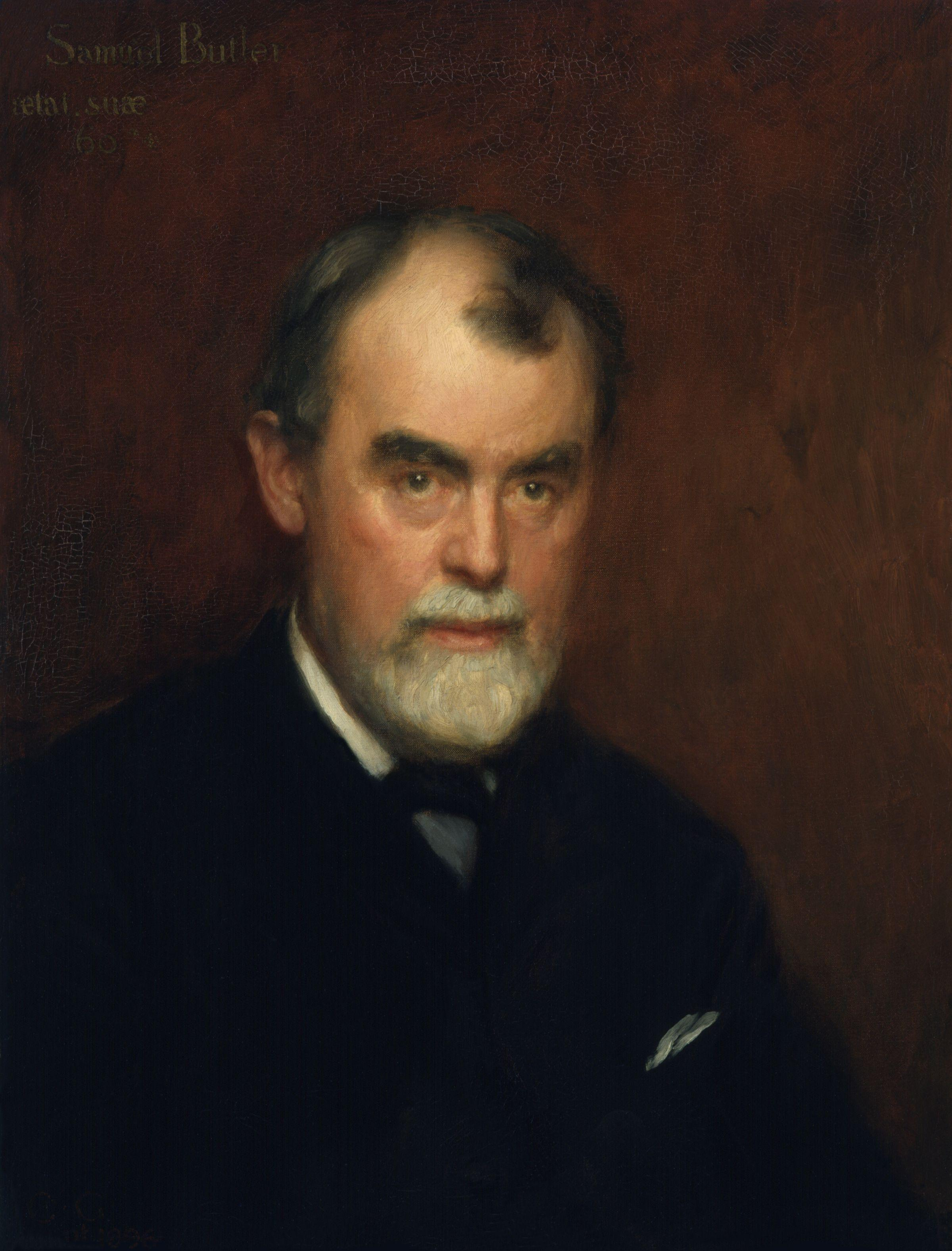
(1884)

| Characters | |
| Ernest Pontifex | The main character; his delayed appearance in the novel emphasizes the importance of the conflicting traits of his inheritance and upbringing on his character and development. Modest, gentle, and shy by nature, Ernest is severely handicapped by a compulsive devotion to overbearing parents bent on teaching him all the wrong things. By virtue of his essential goodness and his adult experiences, however, he survives a series of incredible follies to reclaim his identity, a triumph crowned by his Aunt Alethea's legacy. |
| Edward Overton | Ernest's godfather and fictional biographer who initially acts as a detached and ironic observer and recorder of Ernest's Pontifex antecedents and his early years of development; later in the novel, he becomes an active force in promoting Ernest's maturation. One of the few idealized characters, Overton is essentially a mouthpiece of the author in his older and more mature years. |
| Theobald Pontifex | The father of the main character and the principal target of the author's most ironic and biting satire. Bullied by his father and forced to become a clergyman against his own wishes, Theobald seeks to gain revenge on life by bullying his own children. To his wife and parishioners, however, he seems to be an exemplary man of the cloth. |
| Christina Pontifex | Ernest's mother, a comically deluded dreamer and a source of both comfort and anxiety to her son. Although Ernest is her favorite child, she inevitably loses his affection from betraying him too many times to her husband, Theobald, to whose shortcomings she remains oblivious. |
| Alethea Pontifex | An idealized conception of what Ernest would like his mother to be, she provides her nephew with nearly the only pleasure he experiences in his early years at home and at school. Her bequeathing a delayed inheritance later allows Ernest a life of financial security and independence of action. |
| Mrs. Jupp | One of the most brilliantly realized bawds in all literature, Mrs. Jupp, Ernest's landlady, supports Overton's observations about his godson's foolish aspirations to bring spiritual reform to the lower classes of London society. Her malapropisms and earthy humor provide hilarious comic relief. |
| Towneley | A college friend of Ernest's who, in his unconscious but perfect adaptation to life, acts as a foil to Ernest and his bumbling efforts to find his personal identity and role in society. More a type than a fully developed character, Towneley yet shows admirable loyalty in helping Ernest during his most troubled moments. |
| Pryer | The cunning and corrupt senior curate in the London parish in which Ernest is junior curate. He easily convinces Ernest of the need to establish a "College of Spiritual Pathology," then he absconds with the money Ernest entrusts him with for its founding. |
| John Pontifex | The unassuming founder of the modern Pontifex line. A skilled craftsman, accomplished musician, and talented artist, he represents the highest stage of evolutionary development in his unconscious perfection and closeness to nature. |
| Ruth Pontifex | Old John's wife; she gives birth to George at an advanced age for childbearing. Humorless, domineering, and obstinate, she introduces undesirable traits into the Pontifex lineage. |
| George Pontifex | Following an apprenticeship, he assumes control of his uncle's publishing house in London, which caters to conventionally pious tastes. His early zeal for book learning indicates an unfavorable characteristic, that of conscious knowledge; his miserliness and tyrannical treatment of his children also sharply distinguish him from his father, Old John. |
| Mr. Allaby | The rector of Crampsford and the father of seven children, notably Christina, the second of five unmarried daughters. When he tires of her prolonged engagement, he gently prods Theobald into honoring his commitment. |
| Mrs. Allaby | An outwardly good woman who adroitly schemes to marry off her daughters;
her powers are no better demonstrated than in her promoting the match between
Christina and Theobald. |
| Mrs. Cowey | A friend of Mrs. Allaby who, having succeeded in finding husbands for her
own daughters, delights in lending her talents to the cause of Mrs. Allaby. |
| Mrs. Thompson | A dying parishioner at Battersby who desperately seeks the comforts of
religion which Theobald is unable to provide. |
| Gelstrap | George Pontifex's butler; he is blamed for spilling the bottle of Jordan
River water reserved for Ernest's christening. Actually, George is to blame
and Gelstrap's quick thinking enables most of the water to be saved. |
| Joseph (Joey) Pontifex | Ernest's younger brother and eventual curate to Theobald. He is too compliant
as a son but, finally, hates his father more than does Ernest. |
| Charlotte Pontifex | Ernest's sister, the embodiment of the worst Pontifex traits. She counters her father's will only in conniving to introduce higher ritualism into the Anglican church service. |
| Dr. Skinner | A famous headmaster of Roughborough whose liberalism and learning seem a sham to Ernest, his reluctant pupil. |
| Ellen | The unusually attractive and generally capable former domestic servant at Battersby whom Ernest marries. After Ellen's hopeless addiction to alcohol severely tests Ernest's powers of endurance, the discovery that their marriage is bigamous enables Ernest to regain his freedom. She is probably the least successfully portrayed character of prominence in the novel. |
| John, the Coachman | He threatens Theobald with bodily harm when Ernest is discovered to have given Ellen a silver watch. His confession of earlier marrying Ellen releases Ernest from his supposed marital obligations. |
| Mrs. Cross | A small shopkeeper at Roughborough, Mrs. Jones being another, who provides refreshments on credit to schoolboys with voracious appetites. |
| Badcock | A sleazy sizar at Cambridge and leader of the Simeonites, a small group of religious zealots who live in extreme poverty. |
| Mr. Hawke | A fervent and skillful evangelist whose passionate oratory moves Ernest to become a religious activist. |
| Holt | A drunken and brutal wife-beater living at Mrs. Jupp's; Ernest quickly dismisses him as a likely prospect for conversion. |
| Emily Snow | A pretty young girl of easy virtue who lives at Mrs. Jupp's. Ernest's attempt to convert her is futile. |
| Miss Maitland | Another pretty young girl who lives at Mrs. Jupp's, but, unlike Miss Snow, her virtue is intact. She has Ernest arrested on a charge of assault. |
| Dawson | A Cambridge friend to whom Ernest addresses several patronizing letters which outline his plans to found a College of Spiritual Pathology. |
| Mr. and Mrs. Baxter | A married couple living at Mrs. Jupp's whom Ernest attempts to convert, but who nearly succeed in converting him to Methodism. |
| Mr. Shaw | A lowly tinker whose knowledge of the Bible astonishes Ernest; he plants the seeds of skepticism in the porous soul of Ernest. |
| Mr. Ottery | Overton's attorney; he advises Ernest to throw himself on the mercy of the court; later, he manages the weekly payments to Ellen after she agrees to a separation from Ernest. |
| The Magistrate | He pronounces sentence on Ernest after delivering the most comically ironical speech in the novel. |
| Mr. Hughes | Ernest's chaplain at Coldbath Fields Prison and the only clergyman to give Ernest sound and practical advice. |
| Mr. Larkin | Overton's tailor; he sensibly shows why Ernest is unemployable as a tailor
in a London shop. |
| "An Eminent London Doctor" | He prescribes therapy for Ernest which is in accord with Butler's own views on the desirability of living in harmony with nature |
| Georgie and Alice Pontifex | Ernest's two children by Ellen; they prosper as foster children of a simple bargeman and represent the racial "memory" of old John Pontifex's unconscious perfection. |
| Mr. Rollings | A robust and friendly owner and operator of barges who provides Ernest's children with a suitable home. |
CONTENTS
Chapter I
Chapter II
Chapter III
Chapter IV
Chapter V
Chapter VI
Chapter VII
Chapter VIII
Chapter IX
Chapter X
Chapter XI
Chapter XII
Chapter XIII
Chapter XIV
Chapter XV
Chapter XVI
Chapter XVII
Chapter XVIII
Chapter XIX
Chapter XX
Chapter XXI
Chapter XXII
Chapter XXIII
Chapter XXIV
Chapter XXV
Chapter XXVI
Chapter XXVII
Chapter XXVIII
Chapter XXIX
Chapter XXX
Chapter XXXI
Chapter XXXII
Chapter XXXIII
Chapter XXXIV
Chapter XXXV
Chapter XXXVI
Chapter XXXVII
Chapter XXXVIII
Chapter XXXIX
Chapter XL
Chapter XLI
Chapter XLII
Chapter XLIII
Chapter XLIV
Chapter XLV
Chapter XLVI
Chapter XLVII
Chapter XLVIII
Chapter XLIX
Chapter L
Chapter LI
Chapter LII
Chapter LIII
Chapter LIV
Chapter LV
Chapter LVI
Chapter LVII
Chapter LVIII
Chapter LIX
Chapter LX
Chapter LXI
Chapter LXII
Chapter LXIII
Chapter LXIV
Chapter LXV
Chapter LXVI
Chapter LXVII
Chapter LXVIII
Chapter LXIX
Chapter LXX
Chapter LXXI
Chapter LXXII
Chapter LXXIII
Chapter LXXIV
Chapter LXXV
Chapter LXXVI
Chapter LXXVII
Chapter LXXVIII
Chapter LXXIX
Chapter LXXX
Chapter LXXXI
Chapter LXXXII
Chapter LXXXIII
Chapter LXXXIV
Chapter LXXXV
Chapter LXXXVI
CHAPTER I
When I was a small boy at the beginning of the century I remember an
old man who wore knee-breeches and worsted stockings, and who used to
hobble about the street of our village with the help of a stick. He
must have been getting on for eighty in the year 1807, earlier than
which date I suppose I can hardly remember him, for I was born in 1802.
A few white locks hung about his ears, his shoulders were bent and his
knees feeble, but he was still hale, and was much respected in our
little world of Paleham. His name was Pontifex.
His wife was said to be his master; I have been told she brought him a
little money, but it cannot have been much. She was a tall,
square-shouldered person (I have heard my father call her a Gothic
woman) who had insisted on being married to Mr Pontifex when he was
young and too good-natured to say nay to any woman who wooed him. The
pair had lived not unhappily together, for Mr Pontifex’s temper was
easy and he soon learned to bow before his wife’s more stormy moods.
Mr Pontifex was a carpenter by trade; he was also at one time parish
clerk; when I remember him, however, he had so far risen in life as to
be no longer compelled to work with his own hands. In his earlier days
he had taught himself to draw. I do not say he drew well, but it was
surprising he should draw as well as he did. My father, who took the
living of Paleham about the year 1797, became possessed of a good many
of old Mr Pontifex’s drawings, which were always of local subjects, and
so unaffectedly painstaking that they might have passed for the work of
some good early master. I remember them as hanging up framed and glazed
in the study at the Rectory, and tinted, as all else in the room was
tinted, with the green reflected from the fringe of ivy leaves that
grew around the windows. I wonder how they will actually cease and come
to an end as drawings, and into what new phases of being they will then
enter.
Not content with being an artist, Mr Pontifex must needs also be a
musician. He built the organ in the church with his own hands, and made
a smaller one which he kept in his own house. He could play as much as
he could draw, not very well according to professional standards, but
much better than could have been expected. I myself showed a taste for
music at an early age, and old Mr Pontifex on finding it out, as he
soon did, became partial to me in consequence.
It may be thought that with so many irons in the fire he could hardly
be a very thriving man, but this was not the case. His father had been
a day labourer, and he had himself begun life with no other capital
than his good sense and good constitution; now, however, there was a
goodly show of timber about his yard, and a look of solid comfort over
his whole establishment. Towards the close of the eighteenth century
and not long before my father came to Paleham, he had taken a farm of
about ninety acres, thus making a considerable rise in life. Along with
the farm there went an old-fashioned but comfortable house with a
charming garden and an orchard. The carpenter’s business was now
carried on in one of the outhouses that had once been part of some
conventual buildings, the remains of which could be seen in what was
called the Abbey Close. The house itself, embosomed in honeysuckles
and creeping roses, was an ornament to the whole village, nor were its
internal arrangements less exemplary than its outside was ornamental.
Report said that Mrs Pontifex starched the sheets for her best bed, and
I can well believe it.
How well do I remember her parlour half filled with the organ which her
husband had built, and scented with a withered apple or two from the
pyrus japonica that grew outside the house; the picture of the prize
ox over the chimney-piece, which Mr Pontifex himself had painted; the
transparency of the man coming to show light to a coach upon a snowy
night, also by Mr Pontifex; the little old man and little old woman who
told the weather; the china shepherd and shepherdess; the jars of
feathery flowering grasses with a peacock’s feather or two among them
to set them off, and the china bowls full of dead rose leaves dried
with bay salt. All has long since vanished and become a memory, faded
but still fragrant to myself.
Nay, but her kitchen—and the glimpses into a cavernous cellar beyond
it, wherefrom came gleams from the pale surfaces of milk cans, or it
may be of the arms and face of a milkmaid skimming the cream; or again
her storeroom, where among other treasures she kept the famous lipsalve
which was one of her especial glories, and of which she would present a
shape yearly to those whom she delighted to honour. She wrote out the
recipe for this and gave it to my mother a year or two before she died,
but we could never make it as she did. When we were children she used
sometimes to send her respects to my mother, and ask leave for us to
come and take tea with her. Right well she used to ply us. As for her
temper, we never met such a delightful old lady in our lives; whatever
Mr Pontifex may have had to put up with, we had no cause for complaint,
and then Mr Pontifex would play to us upon the organ, and we would
stand round him open-mouthed and think him the most wonderfully clever
man that ever was born, except of course our papa.
Mrs Pontifex had no sense of humour, at least I can call to mind no
signs of this, but her husband had plenty of fun in him, though few
would have guessed it from his appearance. I remember my father once
sent me down to his workship to get some glue, and I happened to come
when old Pontifex was in the act of scolding his boy. He had got the
lad—a pudding-headed fellow—by the ear and was saying, “What? Lost
again—smothered o’ wit.” (I believe it was the boy who was himself
supposed to be a wandering soul, and who was thus addressed as lost.)
“Now, look here, my lad,” he continued, “some boys are born stupid,
and thou art one of them; some achieve stupidity—that’s thee again,
Jim—thou wast both born stupid and hast greatly increased thy
birthright—and some” (and here came a climax during which the boy’s
head and ear were swayed from side to side) “have stupidity thrust upon
them, which, if it please the Lord, shall not be thy case, my lad, for
I will thrust stupidity from thee, though I have to box thine ears in
doing so,” but I did not see that the old man really did box Jim’s
ears, or do more than pretend to frighten him, for the two understood
one another perfectly well. Another time I remember hearing him call
the village rat-catcher by saying, “Come hither, thou three-days-
and-three-nights, thou,” alluding, as I afterwards learned, to the rat-
catcher’s periods of intoxication; but I will tell no more of such
trifles. My father’s face would always brighten when old Pontifex’s
name was mentioned. “I tell you, Edward,” he would say to me, “old
Pontifex was not only an able man, but he was one of the very
ablest men that ever I knew.”
This was more than I as a young man was prepared to stand. “My dear
father,” I answered, “what did he do? He could draw a little, but could
he to save his life have got a picture into the Royal Academy
exhibition? He built two organs and could play the Minuet in Samson
on one and the March in Scipio on the other; he was a good carpenter
and a bit of a wag; he was a good old fellow enough, but why make him
out so much abler than he was?”
“My boy,” returned my father, “you must not judge by the work, but by
the work in connection with the surroundings. Could Giotto or Filippo
Lippi, think you, have got a picture into the Exhibition? Would a
single one of those frescoes we went to see when we were at Padua have
the remotest chance of being hung, if it were sent in for exhibition
now? Why, the Academy people would be so outraged that they would not
even write to poor Giotto to tell him to come and take his fresco away.
Phew!” continued he, waxing warm, “if old Pontifex had had Cromwell’s
chances he would have done all that Cromwell did, and have done it
better; if he had had Giotto’s chances he would have done all that
Giotto did, and done it no worse; as it was, he was a village
carpenter, and I will undertake to say he never scamped a job in the
whole course of his life.”
“But,” said I, “we cannot judge people with so many ‘ifs.’ If old
Pontifex had lived in Giotto’s time he might have been another Giotto,
but he did not live in Giotto’s time.”
“I tell you, Edward,” said my father with some severity, “we must judge
men not so much by what they do, as by what they make us feel that they
have it in them to do. If a man has done enough either in painting,
music or the affairs of life, to make me feel that I might trust him in
an emergency he has done enough. It is not by what a man has actually
put upon his canvas, nor yet by the acts which he has set down, so to
speak, upon the canvas of his life that I will judge him, but by what
he makes me feel that he felt and aimed at. If he has made me feel that
he felt those things to be loveable which I hold loveable myself I ask
no more; his grammar may have been imperfect, but still I have
understood him; he and I are en rapport; and I say again, Edward,
that old Pontifex was not only an able man, but one of the very ablest
men I ever knew.”
Against this there was no more to be said, and my sisters eyed me to
silence. Somehow or other my sisters always did eye me to silence when
I differed from my father.
“Talk of his successful son,” snorted my father, whom I had fairly
roused. “He is not fit to black his father’s boots. He has his
thousands of pounds a year, while his father had perhaps three thousand
shillings a year towards the end of his life. He is a successful man;
but his father, hobbling about Paleham Street in his grey worsted
stockings, broad brimmed hat and brown swallow-tailed coat was worth a
hundred of George Pontifexes, for all his carriages and horses and the
airs he gives himself.”
“But yet,” he added, “George Pontifex is no fool either.” And this
brings us to the second generation of the Pontifex family with whom we
need concern ourselves.
CHAPTER II
Old Mr Pontifex had married in the year 1750, but for fifteen years his
wife bore no children. At the end of that time Mrs Pontifex astonished
the whole village by showing unmistakable signs of a disposition to
present her husband with an heir or heiress. Hers had long ago been
considered a hopeless case, and when on consulting the doctor
concerning the meaning of certain symptoms she was informed of their
significance, she became very angry and abused the doctor roundly for
talking nonsense. She refused to put so much as a piece of thread into
a needle in anticipation of her confinement and would have been
absolutely unprepared, if her neighbours had not been better judges of
her condition than she was, and got things ready without telling her
anything about it. Perhaps she feared Nemesis, though assuredly she
knew not who or what Nemesis was; perhaps she feared the doctor had
made a mistake and she should be laughed at; from whatever cause,
however, her refusal to recognise the obvious arose, she certainly
refused to recognise it, until one snowy night in January the doctor
was sent for with all urgent speed across the rough country roads. When
he arrived he found two patients, not one, in need of his assistance,
for a boy had been born who was in due time christened George, in
honour of his then reigning majesty.
To the best of my belief George Pontifex got the greater part of his
nature from this obstinate old lady, his mother—a mother who though she
loved no one else in the world except her husband (and him only after a
fashion) was most tenderly attached to the unexpected child of her old
age; nevertheless she showed it little.
The boy grew up into a sturdy bright-eyed little fellow, with plenty of
intelligence, and perhaps a trifle too great readiness at book
learning. Being kindly treated at home, he was as fond of his father
and mother as it was in his nature to be of anyone, but he was fond of
no one else. He had a good healthy sense of meum, and as little of
tuum as he could help. Brought up much in the open air in one of the
best situated and healthiest villages in England, his little limbs had
fair play, and in those days children’s brains were not overtasked as
they now are; perhaps it was for this very reason that the boy showed
an avidity to learn. At seven or eight years old he could read, write
and sum better than any other boy of his age in the village. My father
was not yet rector of Paleham, and did not remember George Pontifex’s
childhood, but I have heard neighbours tell him that the boy was looked
upon as unusually quick and forward. His father and mother were
naturally proud of their offspring, and his mother was determined that
he should one day become one of the kings and councillors of the earth.
It is one thing however to resolve that one’s son shall win some of
life’s larger prizes, and another to square matters with fortune in
this respect. George Pontifex might have been brought up as a carpenter
and succeeded in no other way than as succeeding his father as one of
the minor magnates of Paleham, and yet have been a more truly
successful man than he actually was—for I take it there is not much
more solid success in this world than what fell to the lot of old Mr
and Mrs Pontifex; it happened, however, that about the year 1780, when
George was a boy of fifteen, a sister of Mrs Pontifex’s, who had
married a Mr Fairlie, came to pay a few days’ visit at Paleham. Mr
Fairlie was a publisher, chiefly of religious works, and had an
establishment in Paternoster Row; he had risen in life, and his wife
had risen with him. No very close relations had been maintained between
the sisters for some years, and I forget exactly how it came about that
Mr and Mrs Fairlie were guests in the quiet but exceedingly comfortable
house of their sister and brother-in-law; but for some reason or other
the visit was paid, and little George soon succeeded in making his way
into his uncle and aunt’s good graces. A quick, intelligent boy with a
good address, a sound constitution, and coming of respectable parents,
has a potential value which a practised business man who has need of
many subordinates is little likely to overlook. Before his visit was
over Mr Fairlie proposed to the lad’s father and mother that he should
put him into his own business, at the same time promising that if the
boy did well he should not want some one to bring him forward. Mrs
Pontifex had her son’s interest too much at heart to refuse such an
offer, so the matter was soon arranged, and about a fortnight after the
Fairlies had left, George was sent up by coach to London, where he was
met by his uncle and aunt, with whom it was arranged that he should
live.
This was George’s great start in life. He now wore more fashionable
clothes than he had yet been accustomed to, and any little rusticity of
gait or pronunciation which he had brought from Paleham, was so quickly
and completely lost that it was ere long impossible to detect that he
had not been born and bred among people of what is commonly called
education. The boy paid great attention to his work, and more than
justified the favourable opinion which Mr Fairlie had formed concerning
him. Sometimes Mr Fairlie would send him down to Paleham for a few
days’ holiday, and ere long his parents perceived that he had acquired
an air and manner of talking different from any that he had taken with
him from Paleham. They were proud of him, and soon fell into their
proper places, resigning all appearance of a parental control, for
which indeed there was no kind of necessity. In return, George was
always kindly to them, and to the end of his life retained a more
affectionate feeling towards his father and mother than I imagine him
ever to have felt again for man, woman, or child.
George’s visits to Paleham were never long, for the distance from
London was under fifty miles and there was a direct coach, so that the
journey was easy; there was not time, therefore, for the novelty to
wear off either on the part of the young man or of his parents. George
liked the fresh country air and green fields after the darkness to which
he had been so long accustomed in Paternoster Row, which then, as
now, was a narrow gloomy lane rather than a street. Independently of
the pleasure of seeing the familiar faces of the farmers and villagers,
he liked also being seen and being congratulated on growing up such a
fine-looking and fortunate young fellow, for he was not the youth to
hide his light under a bushel. His uncle had had him taught Latin and
Greek of an evening; he had taken kindly to these languages and had
rapidly and easily mastered what many boys take years in acquiring. I
suppose his knowledge gave him a self-confidence which made itself
felt whether he intended it or not; at any rate, he soon began to
pose as a judge of literature, and from this to being a judge of art,
architecture, music and everything else, the path was easy. Like his
father, he knew the value of money, but he was at once more os-
tentatious and less liberal than his father; while yet a boy he was a
thorough little man of the world, and did well rather upon principles
which he had tested by personal experiment, and recognised as
principles, than from those profounder convictions which in his father
were so instinctive that he could give no account concerning them.
His father, as I have said, wondered at him and let him alone. His son
had fairly distanced him, and in an inarticulate way the father knew it
perfectly well. After a few years he took to wearing his best clothes
whenever his son came to stay with him, nor would he discard them for
his ordinary ones till the young man had returned to London. I believe
old Mr Pontifex, along with his pride and affection, felt also a
certain fear of his son, as though of something which he could not
thoroughly understand, and whose ways, notwithstanding outward
agreement, were nevertheless not as his ways. Mrs Pontifex felt nothing
of this; to her George was pure and absolute perfection, and she saw,
or thought she saw, with pleasure, that he resembled her and her family
in feature as well as in disposition rather than her husband and his.
When George was about twenty-five years old his uncle took him into
partnership on very liberal terms. He had little cause to regret this
step. The young man infused fresh vigour into a concern that was
already vigorous, and by the time he was thirty found himself in the
receipt of not less than £1500 a year as his share of the profits. Two
years later he married a lady about seven years younger than himself,
who brought him a handsome dowry. She died in 1805, when her young-
est child Alethea was born, and her husband did not marry again.
CHAPTER III
In the early years of the century five little children and a couple of
nurses began to make periodical visits to Paleham. It is needless to
say they were a rising generation of Pontifexes, towards whom the old
couple, their grandparents, were as tenderly deferential as they would
have been to the children of the Lord Lieutenant of the County. Their
names were Eliza, Maria, John, Theobald (who like myself was born in
1802), and Alethea. Mr Pontifex always put the prefix “master” or
“miss” before the names of his grandchildren, except in the case of
Alethea, who was his favourite. To have resisted his grandchildren
would have been as impossible for him as to have resisted his wife;
even old Mrs Pontifex yielded before her son’s children, and gave them
all manner of licence which she would never have allowed even to my
sisters and myself, who stood next in her regard. Two regulations only
they must attend to; they must wipe their shoes well on coming into the
house, and they must not overfeed Mr Pontifex’s organ with wind, nor
take the pipes out.
By us at the Rectory there was no time so much looked forward to as
the annual visit of the little Pontifexes to Paleham. We came in for some
of the prevailing licence; we went to tea with Mrs Pontifex to meet her
grandchildren, and then our young friends were asked to the Rectory to
have tea with us, and we had what we considered great times. I fell
desperately in love with Alethea, indeed we all fell in love with each
other, plurality and exchange whether of wives or husbands being openly
and unblushingly advocated in the very presence of our nurses. We
were very merry, but it is so long ago that I have forgotten nearly
everything save that we _were_ very merry. Almost the only thing that
remains with me as a permanent impression was the fact that Theobald
one day beat his nurse and teased her, and when she said she should go
away cried out, “You shan’t go away—I’ll keep you on purpose to torment
you.”
One winter’s morning, however, in the year 1811, we heard the church
bell tolling while we were dressing in the back nursery and were told
it was for old Mrs Pontifex. Our man-servant John told us and added
with grim levity that they were ringing the bell to come and take her
away. She had had a fit of paralysis which had carried her off quite
suddenly. It was very shocking, the more so because our nurse assured
us that if God chose we might all have fits of paralysis ourselves that
very day and be taken straight off to the Day of Judgement. The Day of
Judgement indeed, according to the opinion of those who were most
likely to know, would not under any circumstances be delayed more than
a few years longer, and then the whole world would be burned, and we
ourselves be consigned to an eternity of torture, unless we mended our
ways more than we at present seemed at all likely to do. All this was
so alarming that we fell to screaming and made such a hullabaloo that
the nurse was obliged for her own peace to reassure us. Then we wept,
but more composedly, as we remembered that there would be no more tea
and cakes for us now at old Mrs Pontifex’s.
On the day of the funeral, however, we had a great excitement; old Mr
Pontifex sent round a penny loaf to every inhabitant of the village
according to a custom still not uncommon at the beginning of the
century; the loaf was called a dole. We had never heard of this custom
before, besides, though we had often heard of penny loaves, we had
never before seen one; moreover, they were presents to us as
inhabitants of the village, and we were treated as grown up people, for
our father and mother and the servants had each one loaf sent them, but
only one. We had never yet suspected that we were inhabitants at all;
finally, the little loaves were new, and we were passionately fond of
new bread, which we were seldom or never allowed to have, as it was
supposed not to be good for us. Our affection, therefore, for our old
friend had to stand against the combined attacks of archæological
interest, the rights of citizenship and property, the pleasantness to
the eye and goodness for food of the little loaves themselves, and the
sense of importance which was given us by our having been intimate with
someone who had actually died. It seemed upon further inquiry that
there was little reason to anticipate an early death for anyone of
ourselves, and this being so, we rather liked the idea of someone
else’s being put away into the churchyard; we passed, therefore, in a
short time from extreme depression to a no less extreme exultation; a
new heaven and a new earth had been revealed to us in our perception
of the possibility of benefiting by the death of our friends, and I fear
that for some time we took an interest in the health of everyone in the
village whose position rendered a repetition of the dole in the least
likely.
Those were the days in which all great things seemed far off, and we
were astonished to find that Napoleon Buonaparte was an actually living
person. We had thought such a great man could only have lived a very
long time ago, and here he was after all almost as it were at our own
doors. This lent colour to the view that the Day of Judgement might
indeed be nearer than we had thought, but nurse said that was all right
now, and she knew. In those days the snow lay longer and drifted deeper
in the lanes than it does now, and the milk was sometimes brought in
frozen in winter, and we were taken down into the back kitchen to see
it. I suppose there are rectories up and down the country now where the
milk comes in frozen sometimes in winter, and the children go down to
wonder at it, but I never see any frozen milk in London, so I suppose
the winters are warmer than they used to be.
About one year after his wife’s death Mr Pontifex also was gathered to
his fathers. My father saw him the day before he died. The old man had
a theory about sunsets, and had had two steps built up against a wall
in the kitchen garden on which he used to stand and watch the sun go
down whenever it was clear. My father came on him in the afternoon,
just as the sun was setting, and saw him with his arms resting on the
top of the wall looking towards the sun over a field through which
there was a path on which my father was. My father heard him say
“Good-bye, sun; good-bye, sun,” as the sun sank, and saw by his tone
and manner that he was feeling very feeble. Before the next sunset he
was gone.
There was no dole. Some of his grandchildren were brought to the
funeral and we remonstrated with them, but did not take much by doing
so. John Pontifex, who was a year older than I was, sneered at penny
loaves, and intimated that if I wanted one it must be because my papa
and mamma could not afford to buy me one, whereon I believe we did
something like fighting, and I rather think John Pontifex got the worst
of it, but it may have been the other way. I remember my sister’s
nurse, for I was just outgrowing nurses myself, reported the matter to
higher quarters, and we were all of us put to some ignominy, but we had
been thoroughly awakened from our dream, and it was long enough before
we could hear the words “penny loaf” mentioned without our ears
tingling with shame. If there had been a dozen doles afterwards we
should not have deigned to touch one of them.
George Pontifex put up a monument to his parents, a plain slab in
Paleham church, inscribed with the following epitaph:—
SACRED TO THE MEMORY
OF
JOHN PONTIFEX
WHO WAS BORN AUGUST 16TH,
1727, AND DIED FEBRUARY 8, 1812,
IN HIS 85TH YEAR,
AND OF
RUTH PONTIFEX, HIS WIFE,
WHO WAS BORN OCTOBER 13, 1727, AND DIED JANUARY 10, 1811,
IN HER 84TH YEAR.
THEY WERE UNOSTENTATIOUS BUT EXEMPLARY
IN THE DISCHARGE OF THEIR
RELIGIOUS, MORAL, AND SOCIAL DUTIES.
THIS MONUMENT WAS PLACED
BY THEIR ONLY SON.
CHAPTER IV
In a year or two more came Waterloo and the European peace. Then Mr
George Pontifex went abroad more than once. I remember seeing at
Battersby in after years the diary which he kept on the first of these
occasions. It is a characteristic document. I felt as I read it that
the author before starting had made up his mind to admire only what he
thought it would be creditable in him to admire, to look at nature and
art only through the spectacles that had been handed down to him by
generation after generation of prigs and impostors. The first glimpse
of Mont Blanc threw Mr Pontifex into a conventional ecstasy. “My
feelings I cannot express. I gasped, yet hardly dared to breathe, as I
viewed for the first time the monarch of the mountains. I seemed to
fancy the genius seated on his stupendous throne far above his aspir-
ing brethren and in his solitary might defying the universe. I was so
overcome by my feelings that I was almost bereft of my faculties, and
would not for worlds have spoken after my first exclamation till I
found some relief in a gush of tears. With pain I tore myself from
contemplating for the first time ‘at distance dimly seen’ (though I
felt as if I had sent my soul and eyes after it), this sublime spect-
acle.” After a nearer view of the Alps from above Geneva he walked
nine out of the twelve miles of the descent: “My mind and heart
were too full to sit still, and I found some relief by exhausting my
feelings through exercise.” In the course of time he reached Chamonix
and went on a Sunday to the Montanvert to see the Mer de Glace.
There he wrote the following verses for the visitors’ book, which he
considered, so he says, “suitable to the day and scene”:—
Lord, while these wonders of thy hand I see,
My soul in holy reverence bends to thee.
These awful solitudes, this dread repose,
Yon pyramid sublime of spotless snows,
These spiry pinnacles, those smiling plains,
This sea where one eternal winter reigns,
These are thy works, and while on them I gaze
I hear a silent tongue that speaks thy praise.
Some poets always begin to get groggy about the knees after running
for seven or eight lines. Mr Pontifex’s last couplet gave him a lot of
trouble, and nearly every word has been erased and rewritten once at
least. In the visitors’ book at the Montanvert, however, he must have
been obliged to commit himself definitely to one reading or another.
Taking the verses all round, I should say that Mr Pontifex was right in
considering them suitable to the day; I don’t like being too hard even
on the Mer de Glace, so will give no opinion as to whether they are
suitable to the scene also.
Mr Pontifex went on to the Great St Bernard and there he wrote some
more verses, this time I am afraid in Latin. He also took good care to
be properly impressed by the Hospice and its situation. “The whole of
this most extraordinary journey seemed like a dream, its conclusion
especially, in gentlemanly society, with every comfort and accom-
modation amidst the rudest rocks and in the region of perpetual snow.
The thought that I was sleeping in a convent and occupied the bed
of no less a person than Napoleon, that I was in the highest inhabited
spot in the old world and in a place celebrated in every part of it,
kept me awake some time.” As a contrast to this, I may quote here an
extract from a letter written to me last year by his grandson Ernest,
of whom the reader will hear more presently. The passage runs: “I went
up to the Great St Bernard and saw the dogs.” In due course Mr Pont-
ifex found his way into Italy, where the pictures and other works of
art—those, at least, which were fashionable at that time—threw him into
genteel paroxysms of admiration. Of the Uffizi Gallery at Florence he
writes: “I have spent three hours this morning in the gallery and I
have made up my mind that if of all the treasures I have seen in Italy
I were to choose one room it would be the Tribune of this gallery. It
contains the Venus de’ Medici, the Explorator, the Pancratist, the
Dancing Faun and a fine Apollo. These more than outweigh the Laocoon
and the Belvedere Apollo at Rome. It contains, besides, the St John of
Raphael and many other chefs-d’œuvre of the greatest masters in the
world.” It is interesting to compare Mr Pontifex’s effusions with the
rhapsodies of critics in our own times. Not long ago a much esteemed
writer informed the world that he felt “disposed to cry out with de-
light” before a figure by Michael Angelo. I wonder whether he would
feel disposed to cry out before a real Michael Angelo, if the critics
had decided that it was not genuine, or before a reputed Michael Angelo
which was really by someone else. But I suppose that a prig with more
money than brains was much the same sixty or seventy years ago as he
is now.
Look at Mendelssohn again about this same Tribune on which Mr Ponti-
fex felt so safe in staking his reputation as a man of taste and culture.
He feels no less safe and writes, “I then went to the Tribune. This
room is so delightfully small you can traverse it in fifteen paces, yet
it contains a world of art. I again sought out my favourite arm chair
which stands under the statue of the ‘Slave whetting his knife’
(L’Arrotino), and taking possession of it I enjoyed myself for a couple
of hours; for here at one glance I had the ‘Madonna del Cardellino,’
Pope Julius II., a female portrait by Raphael, and above it a lovely
Holy Family by Perugino; and so close to me that I could have touched
it with my hand the Venus de’ Medici; beyond, that of Titian . . . The
space between is occupied by other pictures of Raphael’s, a portrait by
Titian, a Domenichino, etc., etc., all these within the circumference
of a small semi-circle no larger than one of your own rooms. This is a
spot where a man feels his own insignificance and may well learn to be
humble.” The Tribune is a slippery place for people like Mendelssohn to
study humility in. They generally take two steps away from it for one
they take towards it. I wonder how many chalks Mendelssohn gave himself
for having sat two hours on that chair. I wonder how often he looked at
his watch to see if his two hours were up. I wonder how often he told
himself that he was quite as big a gun, if the truth were known, as any
of the men whose works he saw before him, how often he wondered whe-
ther any of the visitors were recognizing him and admiring him for sitting
such a long time in the same chair, and how often he was vexed at
seeing them pass him by and take no notice of him. But perhaps if the
truth were known his two hours was not quite two hours.
Returning to Mr Pontifex, whether he liked what he believed to be the
masterpieces of Greek and Italian art or no he brought back some copies
by Italian artists, which I have no doubt he satisfied himself would
bear the strictest examination with the originals. Two of these copies
fell to Theobald’s share on the division of his father’s furniture, and
I have often seen them at Battersby on my visits to Theobald and his
wife. The one was a Madonna by Sassoferrato with a blue hood over her
head which threw it half into shadow. The other was a Magdalen by Carlo
Dolci with a very fine head of hair and a marble vase in her hands.
When I was a young man I used to think these pictures were beautiful,
but with each successive visit to Battersby I got to dislike them more
and more and to see “George Pontifex” written all over both of them. In
the end I ventured after a tentative fashion to blow on them a little,
but Theobald and his wife were up in arms at once. They did not like
their father and father-in-law, but there could be no question about
his power and general ability, nor about his having been a man of
consummate taste both in literature and art—indeed the diary he kept
during his foreign tour was enough to prove this. With one more short
extract I will leave this diary and proceed with my story. During his
stay in Florence Mr Pontifex wrote: “I have just seen the Grand Duke
and his family pass by in two carriages and six, but little more notice
is taken of them than if I, who am utterly unknown here, were to pass
by.” I don’t think that he half believed in his being utterly unknown
in Florence or anywhere else!
CHAPTER V
Fortune, we are told, is a blind and fickle foster-mother, who showers
her gifts at random upon her nurslings. But we do her a grave injustice
if we believe such an accusation. Trace a man’s career from his cradle
to his grave and mark how Fortune has treated him. You will find that
when he is once dead she can for the most part be vindicated from the
charge of any but very superficial fickleness. Her blindness is the
merest fable; she can espy her favourites long before they are born. We
are as days and have had our parents for our yesterdays, but through
all the fair weather of a clear parental sky the eye of Fortune can
discern the coming storm, and she laughs as she places her favourites
it may be in a London alley or those whom she is resolved to ruin in
kings’ palaces. Seldom does she relent towards those whom she has
suckled unkindly and seldom does she completely fail a favoured
nursling.
Was George Pontifex one of Fortune’s favoured nurslings or not? On
the whole I should say that he was not, for he did not consider himself
so; he was too religious to consider Fortune a deity at all; he took
whatever she gave and never thanked her, being firmly convinced that
whatever he got to his own advantage was of his own getting. And so it
was, after Fortune had made him able to get it.
“Nos te, nos facimus, Fortuna, deam,” exclaimed the poet. “It is we who
make thee, Fortune, a goddess”; and so it is, after Fortune has made us
able to make her. The poet says nothing as to the making of the “nos.”
Perhaps some men are independent of antecedents and surroundings
and have an initial force within themselves which is in no way due to
causation; but this is supposed to be a difficult question and it may
be as well to avoid it. Let it suffice that George Pontifex did not
consider himself fortunate, and he who does not consider himself
fortunate is unfortunate.
True, he was rich, universally respected and of an excellent natural
constitution. If he had eaten and drunk less he would never have known
a day’s indisposition. Perhaps his main strength lay in the fact that
though his capacity was a little above the average, it was not too much
so. It is on this rock that so many clever people split. The successful
man will see just so much more than his neighbours as they will be able
to see too when it is shown them, but not enough to puzzle them. It is
far safer to know too little than too much. People will condemn the
one, though they will resent being called upon to exert themselves to
follow the other.
The best example of Mr Pontifex’s good sense in matters connected
with his business which I can think of at this moment is the revolution
which he effected in the style of advertising works published by the
firm. When he first became a partner one of the firm’s advertisements
ran thus:—
“Books proper to be given away at this Season.—
“The Pious Country Parishioner, being directions how a Christian may
manage every day in the course of his whole life with safety and
success; how to spend the Sabbath Day; what books of the Holy Scripture
ought to be read first; the whole method of education; collects for the
most important virtues that adorn the soul; a discourse on the Lord’s
Supper; rules to set the soul right in sickness; so that in this
treatise are contained all the rules requisite for salvation. The 8th
edition with additions. Price 10d.
*** An allowance will be made to those who give them away.”
Before he had been many years a partner the advertisement stood as
follows:—
“The Pious Country Parishioner. A complete manual of Christian
Devotion. Price 10d.
A reduction will be made to purchasers for gratuitous distribution.”
What a stride is made in the foregoing towards the modern standard, and
what intelligence is involved in the perception of the unseemliness of
the old style, when others did not perceive it!
Where then was the weak place in George Pontifex’s armour? I suppose
in the fact that he had risen too rapidly. It would almost seem as if a
transmitted education of some generations is necessary for the due
enjoyment of great wealth. Adversity, if a man is set down to it by
degrees, is more supportable with equanimity by most people than
any great prosperity arrived at in a single lifetime. Nevertheless a
certain kind of good fortune generally attends self-made men to the
last. It is their children of the first, or first and second, generation
who are in greater danger, for the race can no more repeat its most
successful performances suddenly and without its ebbings and
flowings of success than the individual can do so, and the more
brilliant the success in any one generation, the greater as a general
rule the subsequent exhaustion until time has been allowed for reco-
very. Hence it oftens happens that the grandson of a successful man
will be more successful than the son—the spirit that actuated the
grandfather having lain fallow in the son and being refreshed by repose
so as to be ready for fresh exertion in the grandson. A very successful
man, moreover, has something of the hybrid in him; he is a new animal,
arising from the coming together of many unfamiliar elements and it is
well known that the reproduction of abnormal growths, whether animal or
vegetable, is irregular and not to be depended upon, even when they are
not absolutely sterile.
And certainly Mr Pontifex’s success was exceedingly rapid. Only a few
years after he had become a partner his uncle and aunt both died within
a few months of one another. It was then found that they had made him
their heir. He was thus not only sole partner in the business but found
himself with a fortune of some £30,000 into the bargain, and this was a
large sum in those days. Money came pouring in upon him, and the faster
it came the fonder he became of it, though, as he frequently said, he
valued it not for its own sake, but only as a means of providing for
his dear children.
Yet when a man is very fond of his money it is not easy for him at all
times to be very fond of his children also. The two are like God and
Mammon. Lord Macaulay has a passage in which he contrasts the pleasures
which a man may derive from books with the inconveniences to which he
may be put by his acquaintances. “Plato,” he says, “is never sullen.
Cervantes is never petulant. Demosthenes never comes unseasonably.
Dante never stays too long. No difference of political opinion can
alienate Cicero. No heresy can excite the horror of Bossuet.” I dare
say I might differ from Lord Macaulay in my estimate of some of the
writers he has named, but there can be no disputing his main propo-
sition, namely, that we need have no more trouble from any of them
than we have a mind to, whereas our friends are not always so easily
disposed of. George Pontifex felt this as regards his children and his
money. His money was never naughty; his money never made noise
or litter, and did not spill things on the tablecloth at meal times, or
leave the door open when it went out. His dividends did not quarrel
among themselves, nor was he under any uneasiness lest his mortgages
should become extravagant on reaching manhood and run him up debts
which sooner or later he should have to pay. There were tendencies in
John which made him very uneasy, and Theobald, his second son, was
idle and at times far from truthful. His children might, perhaps, have
answered, had they known what was in their father’s mind, that he did
not knock his money about as he not infrequently knocked his children.
He never dealt hastily or pettishly with his money, and that was
perhaps why he and it got on so well together.
It must be remembered that at the beginning of the nineteenth cen-
tury the relations between parents and children were still far from
satisfactory. The violent type of father, as described by Fielding,
Richardson, Smollett and Sheridan, is now hardly more likely to find a
place in literature than the original advertisement of Messrs. Fairlie
& Pontifex’s “Pious Country Parishioner,” but the type was much too
persistent not to have been drawn from nature closely. The parents in
Miss Austen’s novels are less like savage wild beasts than those of her
predecessors, but she evidently looks upon them with suspicion, and an
uneasy feeling that le père de famille est capable de tout makes
itself sufficiently apparent throughout the greater part of her
writings. In the Elizabethan time the relations between parents and
children seem on the whole to have been more kindly. The fathers and
the sons are for the most part friends in Shakespeare, nor does the
evil appear to have reached its full abomination till a long course of
Puritanism had familiarised men’s minds with Jewish ideals as those
which we should endeavour to reproduce in our everyday life. What
precedents did not Abraham, Jephthah and Jonadab the son of Rechab
offer? How easy was it to quote and follow them in an age when few
reasonable men or women doubted that every syllable of the Old
Testament was taken down verbatim from the mouth of God. Moreover,
Puritanism restricted natural pleasures; it substituted the Jeremiad
for the Pæan, and it forgot that the poor abuses of all times want
countenance.
Mr Pontifex may have been a little sterner with his children than some
of his neighbours, but not much. He thrashed his boys two or three
times a week and some weeks a good deal oftener, but in those days
fathers were always thrashing their boys. It is easy to have juster
views when everyone else has them, but fortunately or unfortunately
results have nothing whatever to do with the moral guilt or blameless-
ness of him who brings them about; they depend solely upon the
thing done, whatever it may happen to be. The moral guilt or blame-
lessness in like manner has nothing to do with the result; it turns
upon the question whether a sufficient number of reasonable people
placed as the actor was placed would have done as the actor has
done. At that time it was universally admitted that to spare the rod
was to spoil the child, and St Paul had placed disobedience to parents
in very ugly company. If his children did anything which Mr Pontifex
disliked they were clearly disobedient to their father. In this case
there was obviously only one course for a sensible man to take. It
consisted in checking the first signs of self-will while his children
were too young to offer serious resistance. If their wills were “well
broken” in childhood, to use an expression then much in vogue, they
would acquire habits of obedience which they would not venture to break
through till they were over twenty-one years old. Then they might
please themselves; he should know how to protect himself; till then he
and his money were more at their mercy than he liked.
How little do we know our thoughts—our reflex actions indeed, yes;
but our reflex reflections! Man, forsooth, prides himself on his con-
sciousness! We boast that we differ from the winds and waves and
falling stones and plants, which grow they know not why, and from the
wandering creatures which go up and down after their prey, as we are
pleased to say without the help of reason. We know so well what we are
doing ourselves and why we do it, do we not? I fancy that there is some
truth in the view which is being put forward nowadays, that it is our
less conscious thoughts and our less conscious actions which mainly
mould our lives and the lives of those who spring from us.
CHAPTER VI
Mr Pontifex was not the man to trouble himself much about his motives.
People were not so introspective then as we are now; they lived more
according to a rule of thumb. Dr Arnold had not yet sown that crop of
earnest thinkers which we are now harvesting, and men did not see
why they should not have their own way if no evil consequences to
themselves seemed likely to follow upon their doing so. Then as now,
however, they sometimes let themselves in for more evil consequences
than they had bargained for.
Like other rich men at the beginning of this century he ate and drank
a good deal more than was enough to keep him in health. Even his
excellent constitution was not proof against a prolonged course of
overfeeding and what we should now consider overdrinking. His liver
would not unfrequently get out of order, and he would come down to
breakfast looking yellow about the eyes. Then the young people knew
that they had better look out. It is not as a general rule the eating
of sour grapes that causes the children’s teeth to be set on edge.
Well-to-do parents seldom eat many sour grapes; the danger to the
children lies in the parents eating too many sweet ones.
I grant that at first sight it seems very unjust, that the parents
should have the fun and the children be punished for it, but young
people should remember that for many years they were part and parcel of
their parents and therefore had a good deal of the fun in the person of
their parents. If they have forgotten the fun now, that is no more than
people do who have a headache after having been tipsy overnight. The
man with a headache does not pretend to be a different person from the
man who got drunk, and claim that it is his self of the preceding night
and not his self of this morning who should be punished; no more should
offspring complain of the headache which it has earned when in the
person of its parents, for the continuation of identity, though not so
immediately apparent, is just as real in one case as in the other. What
is really hard is when the parents have the fun after the children have
been born, and the children are punished for this.
On these, his black days, he would take very gloomy views of things and
say to himself that in spite of all his goodness to them his children
did not love him. But who can love any man whose liver is out of order?
How base, he would exclaim to himself, was such ingratitude! How
especially hard upon himself, who had been such a model son, and always
honoured and obeyed his parents though they had not spent one hundredth
part of the money upon him which he had lavished upon his own children.
“It is always the same story,” he would say to himself, “the more young
people have the more they want, and the less thanks one gets; I have
made a great mistake; I have been far too lenient with my children;
never mind, I have done my duty by them, and more; if they fail in
theirs to me it is a matter between God and them. I, at any rate, am
guiltless. Why, I might have married again and become the father of a
second and perhaps more affectionate family, etc., etc.” He pitied
himself for the expensive education which he was giving his children;
he did not see that the education cost the children far more than it
cost him, inasmuch as it cost them the power of earning their living
easily rather than helped them towards it, and ensured their being at
the mercy of their father for years after they had come to an age when
they should be independent. A public school education cuts off a boy’s
retreat; he can no longer become a labourer or a mechanic, and these
are the only people whose tenure of independence is not precarious—with
the exception of course of those who are born inheritors of money or
who are placed young in some safe and deep groove. Mr Pontifex saw
nothing of this; all he saw was that he was spending much more money
upon his children than the law would have compelled him to do, and what
more could you have? Might he not have apprenticed both his sons to
greengrocers? Might he not even yet do so to-morrow morning if he were
so minded? The possibility of this course being adopted was a favourite
topic with him when he was out of temper; true, he never did apprentice
either of his sons to greengrocers, but his boys comparing notes
together had sometimes come to the conclusion that they wished he
would.
At other times when not quite well he would have them in for the fun
of shaking his will at them. He would in his imagination cut them all out
one after another and leave his money to found almshouses, till at last
he was obliged to put them back, so that he might have the pleasure of
cutting them out again the next time he was in a passion.
Of course if young people allow their conduct to be in any way
influenced by regard to the wills of living persons they are doing very
wrong and must expect to be sufferers in the end, nevertheless the
powers of will-dangling and will-shaking are so liable to abuse and are
continually made so great an engine of torture that I would pass a law,
if I could, to incapacitate any man from making a will for three months
from the date of each offence in either of the above respects and let
the bench of magistrates or judge, before whom he has been convicted,
dispose of his property as they shall think right and reasonable if he
dies during the time that his will-making power is suspended.
Mr Pontifex would have the boys into the dining-room. “My dear John,
my dear Theobald,” he would say, “look at me. I began life with nothing
but the clothes with which my father and mother sent me up to London.
My father gave me ten shillings and my mother five for pocket money and
I thought them munificent. I never asked my father for a shilling in
the whole course of my life, nor took aught from him beyond the small
sum he used to allow me monthly till I was in receipt of a salary. I
made my own way and I shall expect my sons to do the same. Pray
don’t take it into your heads that I am going to wear my life out making
money that my sons may spend it for me. If you want money you must
make it for yourselves as I did, for I give you my word I will not leave
a
penny to either of you unless you show that you deserve it. Young
people seem nowadays to expect all kinds of luxuries and indulgences
which were never heard of when I was a boy. Why, my father was a com-
mon carpenter, and here you are both of you at public schools, costing
me ever so many hundreds a year, while I at your age was plodding away
behind a desk in my Uncle Fairlie’s counting house. What should I not
have done if I had had one half of your advantages? You should become
dukes or found new empires in undiscovered countries, and even then I
doubt whether you would have done proportionately so much as I have
done. No, no, I shall see you through school and college and then, if
you please, you will make your own way in the world.”
In this manner he would work himself up into such a state of virtuous
indignation that he would sometimes thrash the boys then and there upon
some pretext invented at the moment.
And yet, as children went, the young Pontifexes were fortunate; there
would be ten families of young people worse off for one better; they
ate and drank good wholesome food, slept in comfortable beds, had the
best doctors to attend them when they were ill and the best education
that could be had for money. The want of fresh air does not seem much
to affect the happiness of children in a London alley: the greater part
of them sing and play as though they were on a moor in Scotland. So the
absence of a genial mental atmosphere is not commonly recognised by
children who have never known it. Young people have a marvellous
faculty of either dying or adapting themselves to circumstances. Even
if they are unhappy—very unhappy—it is astonishing how easily they can
be prevented from finding it out, or at any rate from attributing it to
any other cause than their own sinfulness.
To parents who wish to lead a quiet life I would say: Tell your child-
ren that they are very naughty—much naughtier than most children.
Point to the young people of some acquaintances as models of perfect-
ion and impress your own children with a deep sense of their own
inferiority. You carry so many more guns than they do that they cann-
ot fight you. This is called moral influence, and it will enable you to
bounce them as much as you please. They think you know and they will
not have yet caught you lying often enough to suspect that you are not
the unworldly and scrupulously truthful person which you represent
yourself to be; nor yet will they know how great a coward you are, nor
how soon you will run away, if they fight you with persistency and
judgement. You keep the dice and throw them both for your children
and yourself. Load them then, for you can easily manage to stop your
children from examining them. Tell them how singularly indulgent you
are; insist on the incalculable benefit you conferred upon them,
firstly in bringing them into the world at all, but more particularly
in bringing them into it as your own children rather than anyone
else’s. Say that you have their highest interests at stake whenever you
are out of temper and wish to make yourself unpleasant by way of balm
to your soul. Harp much upon these highest interests. Feed them
spiritually upon such brimstone and treacle as the late Bishop of
Winchester’s Sunday stories. You hold all the trump cards, or if you do
not you can filch them; if you play them with anything like judgement
you will find yourselves heads of happy, united, God-fearing families,
even as did my old friend Mr Pontifex. True, your children will
probably find out all about it some day, but not until too late to be
of much service to them or inconvenience to yourself.
Some satirists have complained of life inasmuch as all the pleasures
belong to the fore part of it and we must see them dwindle till we are
left, it may be, with the miseries of a decrepit old age.
To me it seems that youth is like spring, an overpraised season—
delightful if it happen to be a favoured one, but in practice very
rarely favoured and more remarkable, as a general rule, for biting east
winds than genial breezes. Autumn is the mellower season, and what
we lose in flowers we more than gain in fruits. Fontenelle at the age
of ninety, being asked what was the happiest time of his life, said he
did not know that he had ever been much happier than he then was, but
that perhaps his best years had been those when he was between
fifty-five and seventy-five, and Dr Johnson placed the pleasures of old
age far higher than those of youth. True, in old age we live under the
shadow of Death, which, like a sword of Damocles, may descend at any
moment, but we have so long found life to be an affair of being rather
frightened than hurt that we have become like the people who live under
Vesuvius, and chance it without much misgiving.
CHAPTER VII
A few words may suffice for the greater number of the young people
to whom I have been alluding in the foregoing chapter. Eliza and Maria,
the two elder girls, were neither exactly pretty nor exactly plain, and
were in all respects model young ladies, but Alethea was exceedingly
pretty and of a lively, affectionate disposition, which was in sharp
contrast with those of her brothers and sisters. There was a trace of
her grandfather, not only in her face, but in her love of fun, of which
her father had none, though not without a certain boisterous and rather
coarse quasi-humour which passed for wit with many.
John grew up to be a good-looking, gentlemanly fellow, with features a
trifle too regular and finely chiselled. He dressed himself so nicely,
had such good address, and stuck so steadily to his books that he
became a favourite with his masters; he had, however, an instinct for
diplomacy, and was less popular with the boys. His father, in spite of
the lectures he would at times read him, was in a way proud of him as
he grew older; he saw in him, moreover, one who would probably develop
into a good man of business, and in whose hands the prospects of his
house would not be likely to decline. John knew how to humour his
father, and was at a comparatively early age admitted to as much of his
confidence as it was in his nature to bestow on anyone.
His brother Theobald was no match for him, knew it, and accepted his
fate. He was not so good-looking as his brother, nor was his address so
good; as a child he had been violently passionate; now, however, he was
reserved and shy, and, I should say, indolent in mind and body. He was
less tidy than John, less well able to assert himself, and less skilful
in humouring the caprices of his father. I do not think he could have
loved anyone heartily, but there was no one in his family circle who
did not repress, rather than invite his affection, with the exception
of his sister Alethea, and she was too quick and lively for his
somewhat morose temper. He was always the scapegoat, and I have
sometimes thought he had two fathers to contend against—his father
and his brother John; a third and fourth also might almost be added
in his sisters Eliza and Maria. Perhaps if he had felt his bondage very
acutely he would not have put up with it, but he was constitutionally
timid, and the strong hand of his father knitted him into the closest
outward harmony with his brother and sisters.
The boys were of use to their father in one respect. I mean that he
played them off against each other. He kept them but poorly supplied
with pocket money, and to Theobald would urge that the claims of his
elder brother were naturally paramount, while he insisted to John upon
the fact that he had a numerous family, and would affirm solemnly that
his expenses were so heavy that at his death there would be very little
to divide. He did not care whether they compared notes or no, provided
they did not do so in his presence. Theobald did not complain even
behind his father’s back. I knew him as intimately as anyone was likely
to know him as a child, at school, and again at Cambridge, but he very
rarely mentioned his father’s name even while his father was alive, and
never once in my hearing afterwards. At school he was not actively
disliked as his brother was, but he was too dull and deficient in
animal spirits to be popular.
Before he was well out of his frocks it was settled that he was to be a
clergyman. It was seemly that Mr Pontifex, the well-known publisher of
religious books, should devote at least one of his sons to the Church;
this might tend to bring business, or at any rate to keep it in the
firm; besides, Mr Pontifex had more or less interest with bishops and
Church dignitaries and might hope that some preferment would be offered
to his son through his influence. The boy’s future destiny was kept
well before his eyes from his earliest childhood and was treated as a
matter which he had already virtually settled by his acquiescence.
Nevertheless a certain show of freedom was allowed him. Mr Pontifex
would say it was only right to give a boy his option, and was much too
equitable to grudge his son whatever benefit he could derive from this.
He had the greatest horror, he would exclaim, of driving any young man
into a profession which he did not like. Far be it from him to put pres-
sure upon a son of his as regards any profession and much less when
so sacred a calling as the ministry was concerned. He would talk in
this way when there were visitors in the house and when his son was
in the room. He spoke so wisely and so well that his listening guests
considered him a paragon of right-mindedness. He spoke, too, with such
emphasis and his rosy gills and bald head looked so benevolent that it
was difficult not to be carried away by his discourse. I believe two or
three heads of families in the neighbourhood gave their sons absolute
liberty of choice in the matter of their professions—and am not sure
that they had not afterwards considerable cause to regret having done
so. The visitors, seeing Theobald look shy and wholly unmoved by the
exhibition of so much consideration for his wishes, would remark to
themselves that the boy seemed hardly likely to be equal to his father
and would set him down as an unenthusiastic youth, who ought to have
more life in him and be more sensible of his advantages than he
appeared to be.
No one believed in the righteousness of the whole transaction more
firmly than the boy himself; a sense of being ill at ease kept him
silent, but it was too profound and too much without break for him to
become fully alive to it, and come to an understanding with himself. He
feared the dark scowl which would come over his father’s face upon the
slightest opposition. His father’s violent threats, or coarse sneers,
would not have been taken au sérieux by a stronger boy, but Theobald
was not a strong boy, and rightly or wrongly, gave his father credit
for being quite ready to carry his threats into execution. Opposition
had never got him anything he wanted yet, nor indeed had yielding, for
the matter of that, unless he happened to want exactly what his father
wanted for him. If he had ever entertained thoughts of resistance, he
had none now, and the power to oppose was so completely lost for want
of exercise that hardly did the wish remain; there was nothing left
save dull acquiescence as of an ass crouched between two burdens. He
may have had an ill-defined sense of ideals that were not his actuals;
he might occasionally dream of himself as a soldier or a sailor far
away in foreign lands, or even as a farmer’s boy upon the wolds, but
there was not enough in him for there to be any chance of his turning
his dreams into realities, and he drifted on with his stream, which was
a slow, and, I am afraid, a muddy one.
I think the Church Catechism has a good deal to do with the unhappy
relations which commonly even now exist between parents and children.
That work was written too exclusively from the parental point of view;
the person who composed it did not get a few children to come in and
help him; he was clearly not young himself, nor should I say it was the
work of one who liked children—in spite of the words “my good child”
which, if I remember rightly, are once put into the mouth of the
catechist and, after all, carry a harsh sound with them. The general
impression it leaves upon the mind of the young is that their
wickedness at birth was but very imperfectly wiped out at baptism, and
that the mere fact of being young at all has something with it that
savours more or less distinctly of the nature of sin.
If a new edition of the work is ever required I should like to
introduce a few words insisting on the duty of seeking all reasonable
pleasure and avoiding all pain that can be honourably avoided. I should
like to see children taught that they should not say they like things
which they do not like, merely because certain other people say they
like them, and how foolish it is to say they believe this or that when
they understand nothing about it. If it be urged that these additions
would make the Catechism too long I would curtail the remarks upon our
duty towards our neighbour and upon the sacraments. In the place of the
paragraph beginning “I desire my Lord God our Heavenly Father” I
would—but perhaps I had better return to Theobald, and leave the
recasting of the Catechism to abler hands.
CHAPTER VIII
Mr Pontifex had set his heart on his son’s becoming a fellow of a
college before he became a clergyman. This would provide for him at
once and would ensure his getting a living if none of his father’s
ecclesiastical friends gave him one. The boy had done just well enough
at school to render this possible, so he was sent to one of the smaller
colleges at Cambridge and was at once set to read with the best private
tutors that could be found. A system of examination had been adopted a
year or so before Theobald took his degree which had improved his
chances of a fellowship, for whatever ability he had was classical
rather than mathematical, and this system gave more encouragement to
classical studies than had been given hitherto.
Theobald had the sense to see that he had a chance of independence
if he worked hard, and he liked the notion of becoming a fellow. He
therefore applied himself, and in the end took a degree which made his
getting a fellowship in all probability a mere question of time. For a
while Mr Pontifex senior was really pleased, and told his son he would
present him with the works of any standard writer whom he might select.
The young man chose the works of Bacon, and Bacon accordingly made
his appearance in ten nicely bound volumes. A little inspection, however,
showed that the copy was a second hand one.
Now that he had taken his degree the next thing to look forward to was
ordination—about which Theobald had thought little hitherto beyond
acquiescing in it as something that would come as a matter of course
some day. Now, however, it had actually come and was asserting itself
as a thing which should be only a few months off, and this rather
frightened him inasmuch as there would be no way out of it when he
was once in it. He did not like the near view of ordination as well as
the
distant one, and even made some feeble efforts to escape, as may be
perceived by the following correspondence which his son Ernest found
among his father’s papers written on gilt-edged paper, in faded ink and
tied neatly round with a piece of tape, but without any note or
comment. I have altered nothing. The letters are as follows:—
“My dear Father,—I do not like opening up a question which has been
considered settled, but as the time approaches I begin to be very
doubtful how far I am fitted to be a clergyman. Not, I am thankful to
say, that I have the faintest doubts about the Church of England, and I
could subscribe cordially to every one of the thirty-nine articles
which do indeed appear to me to be the ne plus ultra of human wisdom,
and Paley, too, leaves no loop-hole for an opponent; but I am sure I
should be running counter to your wishes if I were to conceal from you
that I do not feel the inward call to be a minister of the gospel that
I shall have to say I have felt when the Bishop ordains me. I try to
get this feeling, I pray for it earnestly, and sometimes half think
that I have got it, but in a little time it wears off, and though I have
no absolute repugnance to being a clergyman and trust that if I am
one I shall endeavour to live to the Glory of God and to advance His
interests upon earth, yet I feel that something more than this is
wanted before I am fully justified in going into the Church. I am aware
that I have been a great expense to you in spite of my scholarships,
but you have ever taught me that I should obey my conscience, and my
conscience tells me I should do wrong if I became a clergyman. God
may yet give me the spirit for which I assure you I have been and am
continually praying, but He may not, and in that case would it not be
better for me to try and look out for something else? I know that
neither you nor John wish me to go into your business, nor do I
understand anything about money matters, but is there nothing else that
I can do? I do not like to ask you to maintain me while I go in for
medicine or the bar; but when I get my fellowship, which should not be
long first, I will endeavour to cost you nothing further, and I might
make a little money by writing or taking pupils. I trust you will not
think this letter improper; nothing is further from my wish than to
cause you any uneasiness. I hope you will make allowance for my present
feelings which, indeed, spring from nothing but from that respect for
my conscience which no one has so often instilled into me as yourself.
Pray let me have a few lines shortly. I hope your cold is better. With
love to Eliza and Maria, I am, your affectionate son,
“THEOBALD PONTIFEX.”
“Dear Theobald,—I can enter into your feelings and have no wish to
quarrel with your expression of them. It is quite right and natural
that you should feel as you do except as regards one passage, the
impropriety of which you will yourself doubtless feel upon reflection,
and to which I will not further allude than to say that it has wounded
me. You should not have said ‘in spite of my scholarships.’ It was only
proper that if you could do anything to assist me in bearing the heavy
burden of your education, the money should be, as it was, made over to
myself. Every line in your letter convinces me that you are under the
influence of a morbid sensitiveness which is one of the devil’s
favourite devices for luring people to their destruction. I have, as
you say, been at great expense with your education. Nothing has been
spared by me to give you the advantages, which, as an English
gentleman, I was anxious to afford my son, but I am not prepared to see
that expense thrown away and to have to begin again from the beginning,
merely because you have taken some foolish scruples into your head,
which you should resist as no less unjust to yourself than to me.
“Don’t give way to that restless desire for change which is the bane of
so many persons of both sexes at the present day.
“Of course you needn’t be ordained: nobody will compel you; you are
perfectly free; you are twenty-three years of age, and should know your
own mind; but why not have known it sooner, instead of never so much
as breathing a hint of opposition until I have had all the expense of
sending you to the University, which I should never have done unless I
had believed you to have made up your mind about taking orders? I have
letters from you in which you express the most perfect willingness to
be ordained, and your brother and sisters will bear me out in saying
that no pressure of any sort has been put upon you. You mistake your
own mind, and are suffering from a nervous timidity which may be very
natural but may not the less be pregnant with serious consequences to
yourself. I am not at all well, and the anxiety occasioned by your
letter is naturally preying upon me. May God guide you to a better
judgement.—Your affectionate father,
G. PONTIFEX.”
On the receipt of this letter Theobald plucked up his spirits. “My
father,” he said to himself, “tells me I need not be ordained if I do
not like. I do not like, and therefore I will not be ordained. But what
was the meaning of the words ‘pregnant with serious consequences to
yourself’? Did there lurk a threat under these words—though it was
impossible to lay hold of it or of them? Were they not intended to
produce all the effect of a threat without being actually threatening?”
Theobald knew his father well enough to be little likely to misappre-
hend his meaning, but having ventured so far on the path of oppo-
sition, and being really anxious to get out of being ordained if he
could, he determined to venture farther. He accordingly wrote the
following:
“My dear father,—You tell me—and I heartily thank you—that no one will
compel me to be ordained. I knew you would not press ordination upon me
if my conscience was seriously opposed to it; I have therefore resolved
on giving up the idea, and believe that if you will continue to allow
me what you do at present, until I get my fellowship, which should not
be long, I will then cease putting you to further expense. I will make
up my mind as soon as possible what profession I will adopt, and will
let you know at once.—Your affectionate son,
THEOBALD PONTIFEX.”
The remaining letter, written by return of post, must now be given. It
has the merit of brevity.
“Dear Theobald,—I have received yours. I am at a loss to conceive its
motive, but am very clear as to its effect. You shall not receive a
single sixpence from me till you come to your senses. Should you
persist in your folly and wickedness, I am happy to remember that I
have yet other children whose conduct I can depend upon to be a source
of credit and happiness to me.—Your affectionate but troubled father,
G. PONTIFEX.”
I do not know the immediate sequel to the foregoing correspondence,
but it all came perfectly right in the end. Either Theobald’s heart failed
him, or he interpreted the outward shove which his father gave him, as
the inward call for which I have no doubt he prayed with great earnest-
ness—for he was a firm believer in the efficacy of prayer. And so am
I under certain circumstances. Tennyson has said that more things
are wrought by prayer than this world dreams of, but he has wisely
refrained from saying whether they are good things or bad things. It
might perhaps be as well if the world were to dream of, or even become
wide awake to, some of the things that are being wrought by prayer.
But the question is avowedly difficult. In the end Theobald got his
fellowship by a stroke of luck very soon after taking his degree, and
was ordained in the autumn of the same year, 1825.
CHAPTER IX
Mr Allaby was rector of Crampsford, a village a few miles from
Cambridge. He, too, had taken a good degree, had got a fellowship, and
in the course of time had accepted a college living of about £400 a
year and a house. His private income did not exceed £200 a year. On
resigning his fellowship he married a woman a good deal younger than
himself who bore him eleven children, nine of whom—two sons and seven
daughters—were living. The two eldest daughters had married fairly
well, but at the time of which I am now writing there were still five
unmarried, of ages varying between thirty and twenty-two—and the sons
were neither of them yet off their father’s hands. It was plain that if
anything were to happen to Mr Allaby the family would be left poorly
off, and this made both Mr and Mrs Allaby as unhappy as it ought to
have made them.
Reader, did you ever have an income at best none too large, which died
with you all except £200 a year? Did you ever at the same time have two
sons who must be started in life somehow, and five daughters still
unmarried for whom you would only be too thankful to find husbands—if
you knew how to find them? If morality is that which, on the whole,
brings a man peace in his declining years—if, that is to say, it is not
an utter swindle, can you under these circumstances flatter yourself
that you have led a moral life?
And this, even though your wife has been so good a woman that you
have not grown tired of her, and has not fallen into such ill-health as
lowers your own health in sympathy; and though your family has grown up
vigorous, amiable, and blessed with common sense. I know many old men
and women who are reputed moral, but who are living with partners whom
they have long ceased to love, or who have ugly disagreeable maiden
daughters for whom they have never been able to find husbands—daughters
whom they loathe and by whom they are loathed in secret, or sons whose
folly or extravagance is a perpetual wear and worry to them. Is it
moral for a man to have brought such things upon himself? Someone
should do for morals what that old Pecksniff Bacon has obtained the
credit of having done for science.
But to return to Mr and Mrs Allaby. Mrs Allaby talked about having
married two of her daughters as though it had been the easiest thing in
the world. She talked in this way because she heard other mothers do
so, but in her heart of hearts she did not know how she had done it,
nor indeed, if it had been her doing at all. First there had been a
young man in connection with whom she had tried to practise certain
manoeuvres which she had rehearsed in imagination over and over again,
but which she found impossible to apply in practice. Then there had
been weeks of a wurra wurra of hopes and fears and little stratagems
which as often as not proved injudicious, and then somehow or other in
the end, there lay the young man bound and with an arrow through his
heart at her daughter’s feet. It seemed to her to be all a fluke which
she could have little or no hope of repeating. She had indeed repeated
it once, and might perhaps with good luck repeat it yet once again—but
five times over! It was awful: why she would rather have three
confinements than go through the wear and tear of marrying a single
daughter.
Nevertheless it had got to be done, and poor Mrs Allaby never looked at
a young man without an eye to his being a future son-in-law. Papas and
mammas sometimes ask young men whether their intentions are honourable
towards their daughters. I think young men might occasionally ask papas
and mammas whether their intentions are honourable before they accept
invitations to houses where there are still unmarried daughters.
“I can’t afford a curate, my dear,” said Mr Allaby to his wife when the
pair were discussing what was next to be done. “It will be better to
get some young man to come and help me for a time upon a Sunday. A
guinea a Sunday will do this, and we can chop and change till we get
someone who suits.” So it was settled that Mr Allaby’s health was not
so strong as it had been, and that he stood in need of help in the
performance of his Sunday duty.
Mrs Allaby had a great friend—a certain Mrs Cowey, wife of the
celebrated Professor Cowey. She was what was called a truly spiritually
minded woman, a trifle portly, with an incipient beard, and an exten-
sive connection among undergraduates, more especially among those
who were inclined to take part in the great evangelical movement which
was then at its height. She gave evening parties once a fortnight at
which prayer was part of the entertainment. She was not only
spiritually minded, but, as enthusiastic Mrs Allaby used to exclaim,
she was a thorough woman of the world at the same time and had such a
fund of strong masculine good sense. She too had daughters, but, as she
used to say to Mrs Allaby, she had been less fortunate than Mrs Allaby
herself, for one by one they had married and left her so that her old
age would have been desolate indeed if her Professor had not been
spared to her.
Mrs Cowey, of course, knew the run of all the bachelor clergy in the
University, and was the very person to assist Mrs Allaby in finding an
eligible assistant for her husband, so this last named lady drove over
one morning in the November of 1825, by arrangement, to take an early
dinner with Mrs Cowey and spend the afternoon. After dinner the two
ladies retired together, and the business of the day began. How they
fenced, how they saw through one another, with what loyalty they
pretended not to see through one another, with what gentle dalliance
they prolonged the conversation discussing the spiritual fitness of
this or that deacon, and the other pros and cons connected with him
after his spiritual fitness had been disposed of, all this must be left
to the imagination of the reader. Mrs Cowey had been so accustomed to
scheming on her own account that she would scheme for anyone rather
than not scheme at all. Many mothers turned to her in their hour of
need and, provided they were spiritually minded, Mrs Cowey never failed
to do her best for them; if the marriage of a young Bachelor of Arts
was not made in Heaven, it was probably made, or at any rate attempted,
in Mrs Cowey’s drawing-room. On the present occasion all the deacons
of the University in whom there lurked any spark of promise were
exhaustively discussed, and the upshot was that our friend Theobald was
declared by Mrs Cowey to be about the best thing she could do that
afternoon.
“I don’t know that he’s a particularly fascinating young man, my dear,”
said Mrs Cowey, “and he’s only a second son, but then he’s got his
fellowship, and even the second son of such a man as Mr Pontifex the
publisher should have something very comfortable.”
“Why yes, my dear,” rejoined Mrs Allaby complacently, “that’s what one
rather feels.”
CHAPTER X
The interview, like all other good things had to come to an end; the
days were short, and Mrs Allaby had a six miles’ drive to Crampsford.
When she was muffled up and had taken her seat, Mr Allaby’s factotum,
James, could perceive no change in her appearance, and little knew what
a series of delightful visions he was driving home along with his
mistress.
Professor Cowey had published works through Theobald’s father, and
Theobald had on this account been taken in tow by Mrs Cowey from the
beginning of his University career. She had had her eye upon him for
some time past, and almost as much felt it her duty to get him off her
list of young men for whom wives had to be provided, as poor Mrs Allaby
did to try and get a husband for one of her daughters. She now wrote
and asked him to come and see her, in terms that awakened his
curiosity. When he came she broached the subject of Mr Allaby’s failing
health, and after the smoothing away of such difficulties as were only
Mrs Cowey’s due, considering the interest she had taken, it was allowed
to come to pass that Theobald should go to Crampsford for six
successive Sundays and take the half of Mr Allaby’s duty at half a
guinea a Sunday, for Mrs Cowey cut down the usual stipend mercilessly,
and Theobald was not strong enough to resist.
Ignorant of the plots which were being prepared for his peace of mind
and with no idea beyond that of earning his three guineas, and perhaps
of astonishing the inhabitants of Crampsford by his academic learning,
Theobald walked over to the Rectory one Sunday morning early in
December—a few weeks only after he had been ordained. He had taken
a great deal of pains with his sermon, which was on the subject of
geology—then coming to the fore as a theological bugbear. He showed
that so far as geology was worth anything at all—and he was too liberal
entirely to pooh-pooh it—it confirmed the absolutely historical
character of the Mosaic account of the Creation as given in Genesis.
Any phenomena which at first sight appeared to make against this view
were only partial phenomena and broke down upon investigation. Nothing
could be in more excellent taste, and when Theobald adjourned to the
rectory, where he was to dine between the services, Mr Allaby
complimented him warmly upon his début, while the ladies of the family
could hardly find words with which to express their admiration.
Theobald knew nothing about women. The only women he had been thrown
in contact with were his sisters, two of whom were always correcting him,
and a few school friends whom these had got their father to ask to
Elmhurst. These young ladies had either been so shy that they and
Theobald had never amalgamated, or they had been supposed to be clever
and had said smart things to him. He did not say smart things himself and
did not want other people to say them. Besides, they talked about music
—and he hated music—or pictures—and he hated pictures—or books—and
except the classics he hated books. And then sometimes he was wanted to
dance with them, and he did not know how to dance, and did not want to
know.
At Mrs Cowey’s parties again he had seen some young ladies and had
been introduced to them. He had tried to make himself agreeable, but was
always left with the impression that he had not been successful. The
young ladies of Mrs Cowey’s set were by no means the most attractive
that might have been found in the University, and Theobald may be
excused for not losing his heart to the greater number of them, while
if for a minute or two he was thrown in with one of the prettier and
more agreeable girls he was almost immediately cut out by someone less
bashful than himself, and sneaked off, feeling as far as the fair sex
was concerned, like the impotent man at the pool of Bethesda.
What a really nice girl might have done with him I cannot tell, but
fate had thrown none such in his way except his youngest sister
Alethea, whom he might perhaps have liked if she had not been his
sister. The result of his experience was that women had never done him
any good and he was not accustomed to associate them with any pleasure;
if there was a part of Hamlet in connection with them it had been so
completely cut out in the edition of the play in which he was required
to act that he had come to disbelieve in its existence. As for kissing,
he had never kissed a woman in his life except his sister—and my own
sisters when we were all small children together. Over and above these
kisses, he had until quite lately been required to imprint a solemn
flabby kiss night and morning upon his father’s cheek, and this, to the
best of my belief, was the extent of Theobald’s knowledge in the matter
of kissing, at the time of which I am now writing. The result of the
foregoing was that he had come to dislike women, as mysterious beings
whose ways were not as his ways, nor their thoughts as his thoughts.
With these antecedents Theobald naturally felt rather bashful on
finding himself the admired of five strange young ladies. I remember
when I was a boy myself I was once asked to take tea at a girls’ school
where one of my sisters was boarding. I was then about twelve years
old. Everything went off well during tea-time, for the Lady Principal
of the establishment was present. But there came a time when she went
away and I was left alone with the girls. The moment the mistress’s
back was turned the head girl, who was about my own age, came up,
pointed her finger at me, made a face and said solemnly, “A na-a-sty
bo-o-y!” All the girls followed her in rotation making the same gesture
and the same reproach upon my being a boy. It gave me a great scare. I
believe I cried, and I know it was a long time before I could again
face a girl without a strong desire to run away.
Theobald felt at first much as I had myself done at the girls’ school,
but the Miss Allabys did not tell him he was a nasty bo-o-oy. Their
papa and mamma were so cordial and they themselves lifted him so deftly
over conversational stiles that before dinner was over Theobald thought
the family to be a really very charming one, and felt as though he were
being appreciated in a way to which he had not hitherto been
accustomed.
With dinner his shyness wore off. He was by no means plain, his
academic prestige was very fair. There was nothing about him to lay
hold of as unconventional or ridiculous; the impression he created upon
the young ladies was quite as favourable as that which they had created
upon himself; for they knew not much more about men than he about
women.
As soon as he was gone, the harmony of the establishment was broken by
a storm which arose upon the question which of them it should be who
should become Mrs Pontifex. “My dears,” said their father, when he saw
that they did not seem likely to settle the matter among themselves,
“Wait till to-morrow, and then play at cards for him.” Having said
which he retired to his study, where he took a nightly glass of whisky
and a pipe of tobacco.
CHAPTER XI
The next morning saw Theobald in his rooms coaching a pupil, and the
Miss Allabys in the eldest Miss Allaby’s bedroom playing at cards with
Theobald for the stakes.
The winner was Christina, the second unmarried daughter, then just
twenty-seven years old and therefore four years older than Theobald.
The younger sisters complained that it was throwing a husband away to
let Christina try and catch him, for she was so much older that she had
no chance; but Christina showed fight in a way not usual with her, for
she was by nature yielding and good tempered. Her mother thought it
better to back her up, so the two dangerous ones were packed off then
and there on visits to friends some way off, and those alone allowed to
remain at home whose loyalty could be depended upon. The brothers did
not even suspect what was going on and believed their father’s getting
assistance was because he really wanted it.
The sisters who remained at home kept their words and gave Christina
all the help they could, for over and above their sense of fair play
they reflected that the sooner Theobald was landed, the sooner another
deacon might be sent for who might be won by themselves. So quickly was
all managed that the two unreliable sisters were actually out of the
house before Theobald’s next visit—which was on the Sunday following
his first.
This time Theobald felt quite at home in the house of his new
friends—for so Mrs Allaby insisted that he should call them. She took,
she said, such a motherly interest in young men, especially in
clergymen. Theobald believed every word she said, as he had believed
his father and all his elders from his youth up. Christina sat next him
at dinner and played her cards no less judiciously than she had played
them in her sister’s bedroom. She smiled (and her smile was one of her
strong points) whenever he spoke to her; she went through all her
little artlessnesses and set forth all her little wares in what she
believed to be their most taking aspect. Who can blame her? Theobald
was not the ideal she had dreamed of when reading Byron upstairs with
her sisters, but he was an actual within the bounds of possibility, and
after all not a bad actual as actuals went. What else could she do? Run
away? She dared not. Marry beneath her and be considered a disgrace to
her family? She dared not. Remain at home and become an old maid and be
laughed at? Not if she could help it. She did the only thing that could
reasonably be expected. She was drowning; Theobald might be only a
straw, but she could catch at him and catch at him she accordingly did.
If the course of true love never runs smooth, the course of true
match-making sometimes does so. The only ground for complaint in the
present case was that it was rather slow. Theobald fell into the part
assigned to him more easily than Mrs Cowey and Mrs Allaby had dared to
hope. He was softened by Christina’s winning manners: he admired the
high moral tone of everything she said; her sweetness towards her
sisters and her father and mother, her readiness to undertake any small
burden which no one else seemed willing to undertake, her sprightly
manners, all were fascinating to one who, though unused to woman’s
society, was still a human being. He was flattered by her unobtrusive
but obviously sincere admiration for himself; she seemed to see him in
a more favourable light, and to understand him better than anyone
outside of this charming family had ever done. Instead of snubbing him
as his father, brother and sisters did, she drew him out, listened
attentively to all he chose to say, and evidently wanted him to say
still more. He told a college friend that he knew he was in love now;
he really was, for he liked Miss Allaby’s society much better than that
of his sisters.
Over and above the recommendations already enumerated, she had an
other in the possession of what was supposed to be a very beautiful
contralto voice. Her voice was certainly contralto, for she could not
reach higher than D in the treble; its only defect was that it did not
go
correspondingly low in the bass: in those days, however, a contralto
voice was understood to include even a soprano if the soprano could not
reach soprano notes, and it was not necessary that it should have the
quality which we now assign to contralto. What her voice wanted in
range and power was made up in the feeling with which she sang. She
had transposed “Angels ever bright and fair” into a lower key, so as to
make it suit her voice, thus proving, as her mamma said, that she had a
thorough knowledge of the laws of harmony; not only did she do this,
but at every pause added an embellishment of arpeggios from one end
to the other of the keyboard, on a principle which her governess had
taught her; she thus added life and interest to an air which every-
one—so she said—must feel to be rather heavy in the form in which
Handel left it. As for her governess, she indeed had been a rarely
accomplished musician: she was a pupil of the famous Dr Clarke of
Cambridge, and used to play the overture to Atalanta, arranged by
Mazzinghi. Nevertheless, it was some time before Theobald could bring
his courage to the sticking point of actually proposing. He made it
quite clear that he believed himself to be much smitten, but month
after month went by, during which there was still so much hope in
Theobald that Mr Allaby dared not discover that he was able to do
his duty for himself, and was getting impatient at the number of
half-guineas he was disbursing—and yet there was no proposal.
Christina’s mother assured him that she was the best daughter in the
whole world, and would be a priceless treasure to the man who married
her. Theobald echoed Mrs Allaby’s sentiments with warmth, but still,
though he visited the Rectory two or three times a week, besides coming
over on Sundays—he did not propose. “She is heart-whole yet, dear Mr
Pontifex,” said Mrs Allaby, one day, “at least I believe she is. It is
not for want of admirers—oh! no—she has had her full share of these,
but she is too, too difficult to please. I think, however, she would
fall before a great and good man.” And she looked hard at Theobald,
who blushed; but the days went by and still he did not propose.
Another time Theobald actually took Mrs Cowey into his confidence, and
the reader may guess what account of Christina he got from her. Mrs
Cowey tried the jealousy manoeuvre and hinted at a possible rival.
Theobald was, or pretended to be, very much alarmed; a little
rudimentary pang of jealousy shot across his bosom and he began to
believe with pride that he was not only in love, but desperately in
love or he would never feel so jealous. Nevertheless, day after day
still went by and he did not propose.
The Allabys behaved with great judgement. They humoured him till his
retreat was practically cut off, though he still flattered himself that
it was open. One day about six months after Theobald had become an
almost daily visitor at the Rectory the conversation happened to turn
upon long engagements. “I don’t like long engagements, Mr Allaby, do
you?” said Theobald imprudently. “No,” said Mr Allaby in a pointed
tone, “nor long courtships,” and he gave Theobald a look which he could
not pretend to misunderstand. He went back to Cambridge as fast as he
could go, and in dread of the conversation with Mr Allaby which he felt
to be impending, composed the following letter which he despatched that
same afternoon by a private messenger to Crampsford. The letter was as
follows:—
“Dearest Miss Christina,—I do not know whether you have guessed the
feelings that I have long entertained for you—feelings which I have
concealed as much as I could through fear of drawing you into an
engagement which, if you enter into it, must be prolonged for a
considerable time, but, however this may be, it is out of my power to
conceal them longer; I love you, ardently, devotedly, and send these
few lines asking you to be my wife, because I dare not trust my tongue
to give adequate expression to the magnitude of my affection for you.
“I cannot pretend to offer you a heart which has never known either
love or disappointment. I have loved already, and my heart was years in
recovering from the grief I felt at seeing her become another’s. That,
however, is over, and having seen yourself I rejoice over a disappoint-
ment which I thought at one time would have been fatal to me.
It has left me a less ardent lover than I should perhaps otherwise have
been, but it has increased tenfold my power of appreciating your many
charms and my desire that you should become my wife. Please let me have
a few lines of answer by the bearer to let me know whether or not my
suit is accepted. If you accept me I will at once come and talk the
matter over with Mr and Mrs Allaby, whom I shall hope one day to be
allowed to call father and mother.
“I ought to warn you that in the event of your consenting to be my wife
it may be years before our union can be consummated, for I cannot
marry till a college living is offered me. If, therefore, you see fit to
reject me, I shall be grieved rather than surprised.—Ever most
devotedly yours,
“THEOBALD PONTIFEX.”
And this was all that his public school and University education had
been able to do for Theobald! Nevertheless for his own part he thought
his letter rather a good one, and congratulated himself in particular
upon his cleverness in inventing the story of a previous attachment,
behind which he intended to shelter himself if Christina should
complain of any lack of fervour in his behaviour to her.
I need not give Christina’s answer, which of course was to accept. Much
as Theobald feared old Mr Allaby I do not think he would have wrought
up his courage to the point of actually proposing but for the fact of
the engagement being necessarily a long one, during which a dozen
things might turn up to break it off. However much he may have
disapproved of long engagements for other people, I doubt whether he
had any particular objection to them in his own case. A pair of lovers
are like sunset and sunrise: there are such things every day but we
very seldom see them. Theobald posed as the most ardent lover
imaginable, but, to use the vulgarism for the moment in fashion, it was
all “side.” Christina was in love, as indeed she had been twenty times
already. But then Christina was impressionable and could not even hear
the name “Missolonghi” mentioned without bursting into tears. When
Theobald accidentally left his sermon case behind him one Sunday, she
slept with it in her bosom and was forlorn when she had as it were to
disgorge it on the following Sunday; but I do not think Theobald ever
took so much as an old toothbrush of Christina’s to bed with him. Why,
I knew a young man once who got hold of his mistress’s skates and slept
with them for a fortnight and cried when he had to give them up.
CHAPTER XII
Theobald’s engagement was all very well as far as it went, but there
was an old gentleman with a bald head and rosy cheeks in a count-
ing-house in Paternoster Row who must sooner or later be told of
what his son had in view, and Theobald’s heart fluttered when he
asked himself what view this old gentleman was likely to take of the
situation. The murder, however, had to come out, and Theobald and his
intended, perhaps imprudently, resolved on making a clean breast of it
at once. He wrote what he and Christina, who helped him to draft the
letter, thought to be everything that was filial, and expressed himself
as anxious to be married with the least possible delay. He could not
help saying this, as Christina was at his shoulder, and he knew it was
safe, for his father might be trusted not to help him. He wound up by
asking his father to use any influence that might be at his command to
help him to get a living, inasmuch as it might be years before a
college living fell vacant, and he saw no other chance of being able to
marry, for neither he nor his intended had any money except Theobald’s
fellowship, which would, of course, lapse on his taking a wife.
Any step of Theobald’s was sure to be objectionable in his father’s
eyes, but that at three-and-twenty he should want to marry a penni-
less girl who was four years older than himself, afforded a golden
opportunity which the old gentleman—for so I may now call him, as he
was at least sixty—embraced with characteristic eagerness.
“The ineffable folly,” he wrote, on receiving his son’s letter, “of
your fancied passion for Miss Allaby fills me with the gravest
apprehensions. Making every allowance for a lover’s blindness, I still
have no doubt that the lady herself is a well-conducted and amiable
young person, who would not disgrace our family, but were she ten times
more desirable as a daughter-in-law than I can allow myself to hope,
your joint poverty is an insuperable objection to your marriage. I have
four other children besides yourself, and my expenses do not permit me
to save money. This year they have been especially heavy, indeed I have
had to purchase two not inconsiderable pieces of land which happened to
come into the market and were necessary to complete a property which I
have long wanted to round off in this way. I gave you an education
regardless of expense, which has put you in possession of a comfortable
income, at an age when many young men are dependent. I have thus
started you fairly in life, and may claim that you should cease to be a
drag upon me further. Long engagements are proverbially unsatisfactory,
and in the present case the prospect seems interminable. What interest,
pray, do you suppose I have that I could get a living for you? Can I go
up and down the country begging people to provide for my son because he
has taken it into his head to want to get married without sufficient
means?
“I do not wish to write unkindly, nothing can be farther from my real
feelings towards you, but there is often more kindness in plain
speaking than in any amount of soft words which can end in no
substantial performance. Of course, I bear in mind that you are of age,
and can therefore please yourself, but if you choose to claim the
strict letter of the law, and act without consideration for your
father’s feelings, you must not be surprised if you one day find that I
have claimed a like liberty for myself.—Believe me, your affectionate
father,
G. PONTIFEX.”
I found this letter along with those already given and a few more which
I need not give, but throughout which the same tone prevails, and in
all of which there is the more or less obvious shake of the will near
the end of the letter. Remembering Theobald’s general dumbness
concerning his father for the many years I knew him after his father’s
death, there was an eloquence in the preservation of the letters and in
their endorsement “Letters from my father,” which seemed to have with
it some faint odour of health and nature.
Theobald did not show his father’s letter to Christina, nor, indeed, I
believe to anyone. He was by nature secretive, and had been repressed
too much and too early to be capable of railing or blowing off steam
where his father was concerned. His sense of wrong was still
inarticulate, felt as a dull dead weight ever present day by day, and
if he woke at night-time still continually present, but he hardly knew
what it was. I was about the closest friend he had, and I saw but
little of him, for I could not get on with him for long together. He
said I had no reverence; whereas I thought that I had plenty of
reverence for what deserved to be revered, but that the gods which he
deemed golden were in reality made of baser metal. He never, as I have
said, complained of his father to me, and his only other friends were,
like himself, staid and prim, of evangelical tendencies, and deeply
imbued with a sense of the sinfulness of any act of insubordination to
parents—good young men, in fact—and one cannot blow off steam to a
good young man.
When Christina was informed by her lover of his father’s opposition,
and of the time which must probably elapse before they could be
married, she offered—with how much sincerity I know not—to set him free
from his engagement; but Theobald declined to be released—“not at
least,” as he said, “at present.” Christina and Mrs Allaby knew they
could manage him, and on this not very satisfactory footing the
engagement was continued.
His engagement and his refusal to be released at once raised Theobald
in his own good opinion. Dull as he was, he had no small share of quiet
self-approbation. He admired himself for his University distinction,
for the purity of his life (I said of him once that if he had only a
better temper he would be as innocent as a new-laid egg) and for his
unimpeachable integrity in money matters. He did not despair of
advancement in the Church when he had once got a living, and of course
it was within the bounds of possibility that he might one day become a
Bishop, and Christina said she felt convinced that this would
ultimately be the case.
As was natural for the daughter and intended wife of a clergyman,
Christina’s thoughts ran much upon religion, and she was resolved that
even though an exalted position in this world were denied to her and
Theobald, their virtues should be fully appreciated in the next. Her
religious opinions coincided absolutely with Theobald’s own, and many a
conversation did she have with him about the glory of God, and the
completeness with which they would devote themselves to it, as soon as
Theobald had got his living and they were married. So certain was she
of the great results which would then ensue that she wondered at times
at the blindness shown by Providence towards its own truest interests
in not killing off the rectors who stood between Theobald and his
living a little faster.
In those days people believed with a simple downrightness which I do
not observe among educated men and women now. It had never so much
as crossed Theobald’s mind to doubt the literal accuracy of any syllable
in the Bible. He had never seen any book in which this was disputed,
nor met with anyone who doubted it. True, there was just a little scare
about geology, but there was nothing in it. If it was said that God
made the world in six days, why He did make it in six days, neither in
more nor less; if it was said that He put Adam to sleep, took out one
of his ribs and made a woman of it, why it was so as a matter of
course. He, Adam, went to sleep as it might be himself, Theobald
Pontifex, in a garden, as it might be the garden at Crampsford Rectory
during the summer months when it was so pretty, only that it was
larger, and had some tame wild animals in it. Then God came up to him,
as it might be Mr Allaby or his father, dexterously took out one of his
ribs without waking him, and miraculously healed the wound so that no
trace of the operation remained. Finally, God had taken the rib perhaps
into the greenhouse, and had turned it into just such another young
woman as Christina. That was how it was done; there was neither
difficulty nor shadow of difficulty about the matter. Could not God do
anything He liked, and had He not in His own inspired Book told us that
He had done this?
This was the average attitude of fairly educated young men and women
towards the Mosaic cosmogony fifty, forty, or even twenty years ago.
The combating of infidelity, therefore, offered little scope for
enterprising young clergymen, nor had the Church awakened to the
activity which she has since displayed among the poor in our large
towns. These were then left almost without an effort at resistance or
co-operation to the labours of those who had succeeded Wesley.
Missionary work indeed in heathen countries was being carried on with
some energy, but Theobald did not feel any call to be a missionary.
Christina suggested this to him more than once, and assured him of
the unspeakable happiness it would be to her to be the wife of a
missionary, and to share his dangers; she and Theobald might even be
martyred; of course they would be martyred simultaneously, and
martyrdom many years hence as regarded from the arbour in the Rectory
garden was not painful, it would ensure them a glorious future in the
next world, and at any rate posthumous renown in this—even if they were
not miraculously restored to life again—and such things had happened
ere now in the case of martyrs. Theobald, however, had not been kindled
by Christina’s enthusiasm, so she fell back upon the Church of Rome—an
enemy more dangerous, if possible, than paganism itself. A combat with
Romanism might even yet win for her and Theobald the crown of
martyrdom. True, the Church of Rome was tolerably quiet just then, but
it was the calm before the storm, of this she was assured, with a
conviction deeper than she could have attained by any argument founded
upon mere reason.
“We, dearest Theobald,” she exclaimed, “will be ever faithful. We will
stand firm and support one another even in the hour of death itself.
God in his mercy may spare us from being burnt alive. He may or may not
do so. Oh Lord” (and she turned her eyes prayerfully to Heaven), “spare
my Theobald, or grant that he may be beheaded.”
“My dearest,” said Theobald gravely, “do not let us agitate ourselves
unduly. If the hour of trial comes we shall be best prepared to meet it
by having led a quiet unobtrusive life of self-denial and devotion to
God’s glory. Such a life let us pray God that it may please Him to
enable us to pray that we may lead.”
“Dearest Theobald,” exclaimed Christina, drying the tears that had
gathered in her eyes, “you are always, always right. Let us be
self-denying, pure, upright, truthful in word and deed.” She clasped
her hands and looked up to Heaven as she spoke.
“Dearest,” rejoined her lover, “we have ever hitherto endeavoured to be
all of these things; we have not been worldly people; let us watch and
pray that we may so continue to the end.”
The moon had risen and the arbour was getting damp, so they adjourned
further aspirations for a more convenient season. At other times
Christina pictured herself and Theobald as braving the scorn of almost
every human being in the achievement of some mighty task which should
redound to the honour of her Redeemer. She could face anything for
this. But always towards the end of her vision there came a little
coronation scene high up in the golden regions of the Heavens, and a
diadem was set upon her head by the Son of Man Himself, amid a host of
angels and archangels who looked on with envy and admiration—and here
even Theobald himself was out of it. If there could be such a thing as
the Mammon of Righteousness Christina would have assuredly made friends
with it. Her papa and mamma were very estimable people and would in
the course of time receive Heavenly Mansions in which they would be
exceedingly comfortable; so doubtless would her sisters; so perhaps,
even might her brothers; but for herself she felt that a higher destiny
was preparing, which it was her duty never to lose sight of. The first
step towards it would be her marriage with Theobald. In spite, however,
of these flights of religious romanticism, Christina was a good-temp-
ered kindly-natured girl enough, who, if she had married a sensible
layman—we will say a hotel-keeper—would have developed into a
good landlady and been deservedly popular with her guests.
Such was Theobald’s engaged life. Many a little present passed between
the pair, and many a small surprise did they prepare pleasantly for one
another. They never quarrelled, and neither of them ever flirted with
anyone else. Mrs Allaby and his future sisters-in-law idolised Theobald
in spite of its being impossible to get another deacon to come and be
played for as long as Theobald was able to help Mr Allaby, which now of
course he did free gratis and for nothing; two of the sisters, however,
did manage to find husbands before Christina was actually married, and
on each occasion Theobald played the part of decoy elephant. In the end
only two out of the seven daughters remained single.
After three or four years, old Mr Pontifex became accustomed to his
son’s engagement and looked upon it as among the things which had now
a prescriptive right to toleration. In the spring of 1831, more than five
years after Theobald had first walked over to Crampsford, one of the
best livings in the gift of the College unexpectedly fell vacant, and
was for various reasons declined by the two fellows senior to Theobald,
who might each have been expected to take it. The living was then
offered to and of course accepted by Theobald, being in value not less
than £500 a year with a suitable house and garden. Old Mr Pontifex then
came down more handsomely than was expected and settled £10,000 on his
son and daughter-in-law for life with remainder to such of their issue
as they might appoint. In the month of July, 1831 Theobald and
Christina became man and wife.
CHAPTER XIII
A due number of old shoes had been thrown at the carriage in which the
happy pair departed from the Rectory, and it had turned the corner at
the bottom of the village. It could then be seen for two or three
hundred yards creeping past a fir coppice, and after this was lost to
view.
“John,” said Mr Allaby to his man-servant, “shut the gate;” and he went
indoors with a sigh of relief which seemed to say: “I have done it, and
I am alive.” This was the reaction after a burst of enthusiastic merri-
ment during which the old gentleman had run twenty yards after the
carriage to fling a slipper at it—which he had duly flung.
But what were the feelings of Theobald and Christina when the village
was passed and they were rolling quietly by the fir plantation? It is
at this point that even the stoutest heart must fail, unless it beat in
the breast of one who is over head and ears in love. If a young man is
in a small boat on a choppy sea, along with his affianced bride and
both are sea-sick, and if the sick swain can forget his own anguish in
the happiness of holding the fair one’s head when she is at her
worst—then he is in love, and his heart will be in no danger of failing
him as he passes his fir plantation. Other people, and unfortunately by
far the greater number of those who get married must be classed among
the “other people,” will inevitably go through a quarter or half an
hour of greater or less badness as the case may be. Taking numbers into
account, I should think more mental suffering had been undergone in the
streets leading from St George’s, Hanover Square, than in the condemned
cells of Newgate. There is no time at which what the Italians call la
figlia della Morte lays her cold hand upon a man more awfully than
during the first half hour that he is alone with a woman whom he has
married but never genuinely loved.
Death’s daughter did not spare Theobald. He had behaved very well
hitherto. When Christina had offered to let him go, he had stuck to his
post with a magnanimity on which he had plumed himself ever since.
From that time forward he had said to himself: “I, at any rate, am the
very soul of honour; I am not,” etc., etc. True, at the moment of
magnanimity the actual cash payment, so to speak, was still distant;
when his father gave formal consent to his marriage things began to
look more serious; when the college living had fallen vacant and been
accepted they looked more serious still; but when Christina actually
named the day, then Theobald’s heart fainted within him.
The engagement had gone on so long that he had got into a groove, and
the prospect of change was disconcerting. Christina and he had got on,
he thought to himself, very nicely for a great number of years; why—
why—why should they not continue to go on as they were doing now
for the rest of their lives? But there was no more chance of escape for
him than for the sheep which is being driven to the butcher’s back
premises, and like the sheep he felt that there was nothing to be
gained by resistance, so he made none. He behaved, in fact, with
decency, and was declared on all hands to be one of the happiest men
imaginable.
Now, however, to change the metaphor, the drop had actually fallen, and
the poor wretch was hanging in mid air along with the creature of his
affections. This creature was now thirty-three years old, and looked
it: she had been weeping, and her eyes and nose were reddish; if “I
have done it and I am alive,” was written on Mr Allaby’s face after he
had thrown the shoe, “I have done it, and I do not see how I can
possibly live much longer” was upon the face of Theobald as he was
being driven along by the fir Plantation. This, however, was not
apparent at the Rectory. All that could be seen there was the bobbing
up and down of the postilion’s head, which just over-topped the hedge
by the roadside as he rose in his stirrups, and the black and yellow
body of the carriage.
For some time the pair said nothing: what they must have felt during
their first half hour, the reader must guess, for it is beyond my power
to tell him; at the end of that time, however, Theobald had rummaged
up a conclusion from some odd corner of his soul to the effect that
now he and Christina were married the sooner they fell into their fu-
ture mutual relations the better. If people who are in a difficulty will
only do the first little reasonable thing which they can clearly rec-
ognise as reasonable, they will always find the next step more easy
both to see and take. What, then, thought Theobald, was here at this
moment the first and most obvious matter to be considered, and what
would be an equitable view of his and Christina’s relative positions in
respect to it? Clearly their first dinner was their first joint entry
into the duties and pleasures of married life. No less clearly it was
Christina’s duty to order it, and his own to eat it and pay for it.
The arguments leading to this conclusion, and the conclusion itself,
flashed upon Theobald about three and a half miles after he had left
Crampsford on the road to Newmarket. He had breakfasted early, but
his usual appetite had failed him. They had left the vicarage at noon
without staying for the wedding breakfast. Theobald liked an early
dinner; it dawned upon him that he was beginning to be hungry; from
this to the conclusion stated in the preceding paragraph the steps had
been easy. After a few minutes’ further reflection he broached the
matter to his bride, and thus the ice was broken.
Mrs Theobald was not prepared for so sudden an assumption of
importance. Her nerves, never of the strongest, had been strung to
their highest tension by the event of the morning. She wanted to escape
observation; she was conscious of looking a little older than she quite
liked to look as a bride who had been married that morning; she feared
the landlady, the chamber-maid, the waiter—everybody and everything;
her heart beat so fast that she could hardly speak, much less go
through the ordeal of ordering dinner in a strange hotel with a strange
landlady. She begged and prayed to be let off. If Theobald would only
order dinner this once, she would order it any day and every day in
future.
But the inexorable Theobald was not to be put off with such absurd
excuses. He was master now. Had not Christina less than two hours ago
promised solemnly to honour and obey him, and was she turning restive
over such a trifle as this? The loving smile departed from his face,
and was succeeded by a scowl which that old Turk, his father, might
have envied. “Stuff and nonsense, my dearest Christina,” he exclaimed
mildly, and stamped his foot upon the floor of the carriage. “It is a
wife’s duty to order her husband’s dinner; you are my wife, and I shall
expect you to order mine.” For Theobald was nothing if he was not
logical.
The bride began to cry, and said he was unkind; whereon he said
nothing, but revolved unutterable things in his heart. Was this, then,
the end of his six years of unflagging devotion? Was it for this that
when Christina had offered to let him off, he had stuck to his
engagement? Was this the outcome of her talks about duty and spiritual
mindedness—that now upon the very day of her marriage she should fail
to see that the first step in obedience to God lay in obedience to
himself? He would drive back to Crampsford; he would complain to Mr and
Mrs Allaby; he didn’t mean to have married Christina; he hadn’t married
her; it was all a hideous dream; he would—But a voice kept ringing in
his ears which said: “YOU CAN’T, CAN’T, CAN’T.”
“CAN’T I?” screamed the unhappy creature to himself.
“No,” said the remorseless voice, “YOU CAN’T. YOU ARE A MARRIED MAN.”
He rolled back in his corner of the carriage and for the first time
felt how iniquitous were the marriage laws of England. But he would buy
Milton’s prose works and read his pamphlet on divorce. He might perhaps
be able to get them at Newmarket.
So the bride sat crying in one corner of the carriage; and the
bridegroom sulked in the other, and he feared her as only a bridegroom
can fear.
Presently, however, a feeble voice was heard from the bride’s corner
saying:
“Dearest Theobald—dearest Theobald, forgive me; I have been very, very
wrong. Please do not be angry with me. I will order the—the—” but the
word “dinner” was checked by rising sobs.
When Theobald heard these words a load began to be lifted from his
heart, but he only looked towards her, and that not too pleasantly.
“Please tell me,” continued the voice, “what you think you would like,
and I will tell the landlady when we get to Newmar—” but another burst
of sobs checked the completion of the word.
The load on Theobald’s heart grew lighter and lighter. Was it possible
that she might not be going to henpeck him after all? Besides, had she
not diverted his attention from herself to his approaching dinner?
He swallowed down more of his apprehensions and said, but still
gloomily, “I think we might have a roast fowl with bread sauce, new
potatoes and green peas, and then we will see if they could let us have
a cherry tart and some cream.”
After a few minutes more he drew her towards him, kissed away her
tears, and assured her that he knew she would be a good wife to him.
“Dearest Theobald,” she exclaimed in answer, “you are an angel.”
Theobald believed her, and in ten minutes more the happy couple
alighted at the inn at Newmarket.
Bravely did Christina go through her arduous task. Eagerly did she
beseech the landlady, in secret, not to keep her Theobald waiting
longer than was absolutely necessary.
“If you have any soup ready, you know, Mrs Barber, it might save ten
minutes, for we might have it while the fowl was browning.”
See how necessity had nerved her! But in truth she had a splitting
headache, and would have given anything to have been alone.
The dinner was a success. A pint of sherry had warmed Theobald’s heart,
and he began to hope that, after all, matters might still go well with
him. He had conquered in the first battle, and this gives great
prestige. How easy it had been too! Why had he never treated his
sisters in this way? He would do so next time he saw them; he might in
time be able to stand up to his brother John, or even his father. Thus
do we build castles in air when flushed with wine and conquest.
The end of the honeymoon saw Mrs Theobald the most devotedly ob-
sequious wife in all England. According to the old saying, Theobald had
killed the cat at the beginning. It had been a very little cat, a mere kit-
ten in fact, or he might have been afraid to face it, but such as it had
been he had challenged it to mortal combat, and had held up its
dripping head defiantly before his wife’s face. The rest had been easy.
Strange that one whom I have described hitherto as so timid and easily
put upon should prove such a Tartar all of a sudden on the day of his
marriage. Perhaps I have passed over his years of courtship too
rapidly. During these he had become a tutor of his college, and had at
last been Junior Dean. I never yet knew a man whose sense of his own
importance did not become adequately developed after he had held a
resident fellowship for five or six years. True—immediately on arriving
within a ten mile radius of his father’s house, an enchantment fell
upon him, so that his knees waxed weak, his greatness departed, and he
again felt himself like an overgrown baby under a perpetual cloud; but
then he was not often at Elmhurst, and as soon as he left it the spell
was taken off again; once more he became the fellow and tutor of his
college, the Junior Dean, the betrothed of Christina, the idol of the
Allaby womankind. From all which it may be gathered that if Christina
had been a Barbary hen, and had ruffled her feathers in any show of
resistance Theobald would not have ventured to swagger with her, but
she was not a Barbary hen, she was only a common hen, and that too with
rather a smaller share of personal bravery than hens generally have.
CHAPTER XIV
Battersby-On-The-Hill was the name of the village of which Theobald
was now Rector. It contained 400 or 500 inhabitants, scattered over a
rather large area, and consisting entirely of farmers and agricultural
labourers. The Rectory was commodious, and placed on the brow of a
hill which gave it a delightful prospect. There was a fair sprinkling of
neighbours within visiting range, but with one or two exceptions they
were the clergymen and clergymen’s families of the surrounding
villages.
By these the Pontifexes were welcomed as great acquisitions to the
neighbourhood. Mr Pontifex, they said was so clever; he had been senior
classic and senior wrangler; a perfect genius in fact, and yet with so
much sound practical common sense as well. As son of such a
distinguished man as the great Mr Pontifex the publisher he would come
into a large property by-and-by. Was there not an elder brother? Yes,
but there would be so much that Theobald would probably get something
very considerable. Of course they would give dinner parties. And Mrs
Pontifex, what a charming woman she was; she was certainly not exactly
pretty perhaps, but then she had such a sweet smile and her manner was
so bright and winning. She was so devoted too to her husband and her
husband to her; they really did come up to one’s ideas of what lovers
used to be in days of old; it was rare to meet with such a pair in
these degenerate times; it was quite beautiful, etc., etc. Such were
the comments of the neighbours on the new arrivals.
As for Theobald’s own parishioners, the farmers were civil and the
labourers and their wives obsequious. There was a little dissent, the
legacy of a careless predecessor, but as Mrs Theobald said proudly, “I
think Theobald may be trusted to deal with that.” The church was then
an interesting specimen of late Norman, with some early English
additions. It was what in these days would be called in a very bad
state of repair, but forty or fifty years ago few churches were in good
repair. If there is one feature more characteristic of the present
generation than another it is that it has been a great restorer of
churches.
Horace preached church restoration in his ode:—
Delicta majorum immeritus lues,
Romane, donec templa refeceris
Aedesque labentes deorum et
Foeda nigro simulacra fumo.
Nothing went right with Rome for long together after the Augustan age,
but whether it was because she did restore the temples or because she
did not restore them I know not. They certainly went all wrong after
Constantine’s time and yet Rome is still a city of some importance.
I may say here that before Theobald had been many years at Battersby he
found scope for useful work in the rebuilding of Battersby church,
which he carried out at considerable cost, towards which he subscribed
liberally himself. He was his own architect, and this saved expense;
but architecture was not very well understood about the year 1834, when
Theobald commenced operations, and the result is not as satisfactory as
it would have been if he had waited a few years longer.
Every man’s work, whether it be literature or music or pictures or
architecture or anything else, is always a portrait of himself, and the
more he tries to conceal himself the more clearly will his character
appear in spite of him. I may very likely be condemning myself, all the
time that I am writing this book, for I know that whether I like it or
no I am portraying myself more surely than I am portraying any of the
characters whom I set before the reader. I am sorry that it is so, but
I cannot help it—after which sop to Nemesis I will say that Battersby
church in its amended form has always struck me as a better portrait of
Theobald than any sculptor or painter short of a great master would be
able to produce.
I remember staying with Theobald some six or seven months after he was
married, and while the old church was still standing. I went to church,
and felt as Naaman must have felt on certain occasions when he had to
accompany his master on his return after having been cured of his
leprosy. I have carried away a more vivid recollection of this and of
the people, than of Theobald’s sermon. Even now I can see the men in
blue smock frocks reaching to their heels, and more than one old wo-
man in a scarlet cloak; the row of stolid, dull, vacant plough-boys,
ungainly in build, uncomely in face, lifeless, apathetic, a race a good
deal more like the pre-revolution French peasant as described by
Carlyle than is pleasant to reflect upon—a race now supplanted by a
smarter, comelier and more hopeful generation, which has discovered
that it too has a right to as much happiness as it can get, and with
clearer ideas about the best means of getting it.
They shamble in one after another, with steaming breath, for it is
winter, and loud clattering of hob-nailed boots; they beat the snow
from off them as they enter, and through the opened door I catch a
momentary glimpse of a dreary leaden sky and snow-clad tombstones.
Somehow or other I find the strain which Handel has wedded to the words
“There the ploughman near at hand,” has got into my head and there is
no getting it out again. How marvellously old Handel understood these
people!
They bob to Theobald as they passed the reading desk (“The people
hereabouts are truly respectful,” whispered Christina to me, “they
know their betters.”), and take their seats in a long row against the
wall. The choir clamber up into the gallery with their instruments—a
violoncello, a clarinet and a trombone. I see them and soon I hear
them, for there is a hymn before the service, a wild strain, a remnant,
if I mistake not, of some pre-Reformation litany. I have heard what I
believe was its remote musical progenitor in the church of SS. Giovanni
e Paolo at Venice not five years since; and again I have heard it far
away in mid-Atlantic upon a grey sea-Sabbath in June, when neither
winds nor waves are stirring, so that the emigrants gather on deck, and
their plaintive psalm goes forth upon the silver haze of the sky, and
on the wilderness of a sea that has sighed till it can sigh no longer.
Or it may be heard at some Methodist Camp Meeting upon a Welsh
hillside, but in the churches it is gone for ever. If I were a musician
I would take it as the subject for the adagio in a Wesleyan symphony.
Gone now are the clarinet, the violoncello and the trombone, wild
minstrelsy as of the doleful creatures in Ezekiel, discordant, but
infinitely pathetic. Gone is that scare-babe stentor, that bellowing
bull of Bashan the village blacksmith, gone is the melodious carpenter,
gone the brawny shepherd with the red hair, who roared more lustily
than all, until they came to the words, “Shepherds with your flocks
abiding,” when modesty covered him with confusion, and compelled him to
be silent, as though his own health were being drunk. They were doomed
and had a presentiment of evil, even when first I saw them, but they
had still a little lease of choir life remaining, and they roared out
[Illustration] wick-ed hands have pierced and nailed him, pierced and
nailed him to a tree.
but no description can give a proper idea of the effect. When I was
last in Battersby church there was a harmonium played by a
sweet-looking girl with a choir of school children around her, and they
chanted the canticles to the most correct of chants, and they sang
Hymns Ancient and Modern; the high pews were gone, nay, the very
gallery in which the old choir had sung was removed as an accursed
thing which might remind the people of the high places, and Theobald
was old, and Christina was lying under the yew trees in the churchyard.
But in the evening later on I saw three very old men come chuckling out
of a dissenting chapel, and surely enough they were my old friends the
blacksmith, the carpenter and the shepherd. There was a look of content
upon their faces which made me feel certain they had been singing; not
doubtless with the old glory of the violoncello, the clarinet and the
trombone, but still songs of Sion and no new-fangled papistry.
CHAPTER XV
The hymn had engaged my attention; when it was over I had time to
take stock of the congregation. They were chiefly farmers—fat, very
well-to-do folk, who had come some of them with their wives and
children from outlying farms two and three miles away; haters of popery
and of anything which any one might choose to say was popish; good,
sensible fellows who detested theory of any kind, whose ideal was the
maintenance of the status quo with perhaps a loving reminiscence of
old war times, and a sense of wrong that the weather was not more
completely under their control, who desired higher prices and cheaper
wages, but otherwise were most contented when things were changing
least; tolerators, if not lovers, of all that was familiar, haters of
all that was unfamiliar; they would have been equally horrified at
hearing the Christian religion doubted, and at seeing it practised.
“What can there be in common between Theobald and his parishioners?”
said Christina to me, in the course of the evening, when her husband
was for a few moments absent. “Of course one must not complain, but I
assure you it grieves me to see a man of Theobald’s ability thrown away
upon such a place as this. If we had only been at Gaysbury, where there
are the A’s, the B’s, the C’s, and Lord D’s place, as you know, quite
close, I should not then have felt that we were living in such a
desert; but I suppose it is for the best,” she added more cheerfully;
“and then of course the Bishop will come to us whenever he is in the
neighbourhood, and if we were at Gaysbury he might have gone to Lord
D’s.”
Perhaps I have now said enough to indicate the kind of place in which
Theobald’s lines were cast, and the sort of woman he had married. As
for his own habits, I see him trudging through muddy lanes and over
long sweeps of plover-haunted pastures to visit a dying cottager’s
wife. He takes her meat and wine from his own table, and that not a
little only but liberally. According to his lights also, he administers
what he is pleased to call spiritual consolation.
“I am afraid I’m going to Hell, Sir,” says the sick woman with a whine.
“Oh, Sir, save me, save me, don’t let me go there. I couldn’t stand it,
Sir, I should die with fear, the very thought of it drives me into a
cold sweat all over.”
“Mrs Thompson,” says Theobald gravely, “you must have faith in the
precious blood of your Redeemer; it is He alone who can save you.”
“But are you sure, Sir,” says she, looking wistfully at him, “that He
will forgive me—for I’ve not been a very good woman, indeed I haven’t
—and if God would only say ‘Yes’ outright with His mouth when I
ask whether my sins are forgiven me—”
“But they are forgiven you, Mrs Thompson,” says Theobald with some
sternness, for the same ground has been gone over a good many times
already, and he has borne the unhappy woman’s misgivings now for a full
quarter of an hour. Then he puts a stop to the conversation by
repeating prayers taken from the “Visitation of the Sick,” and overawes
the poor wretch from expressing further anxiety as to her condition.
“Can’t you tell me, Sir,” she exclaims piteously, as she sees that he
is preparing to go away, “can’t you tell me that there is no Day of
Judgement, and that there is no such place as Hell? I can do without
the Heaven, Sir, but I cannot do with the Hell.” Theobald is much
shocked.
“Mrs Thompson,” he rejoins impressively, “let me implore you to suffer
no doubt concerning these two cornerstones of our religion to cross
your mind at a moment like the present. If there is one thing more
certain than another it is that we shall all appear before the
Judgement Seat of Christ, and that the wicked will be consumed in a
lake of everlasting fire. Doubt this, Mrs Thompson, and you are lost.”
The poor woman buries her fevered head in the coverlet in a paroxysm of
fear which at last finds relief in tears.
“Mrs Thompson,” says Theobald, with his hand on the door, “compose
yourself, be calm; you must please to take my word for it that at the
Day of Judgement your sins will be all washed white in the blood of the
Lamb, Mrs Thompson. Yea,” he exclaims frantically, “though they be as
scarlet, yet shall they be as white as wool,” and he makes off as fast
as he can from the fetid atmosphere of the cottage to the pure air
outside. Oh, how thankful he is when the interview is over!
He returns home, conscious that he has done his duty, and administer-
ed the comforts of religion to a dying sinner. His admiring wife awaits
him at the Rectory, and assures him that never yet was clergyman so
devoted to the welfare of his flock. He believes her; he has a natural
tendency to believe everything that is told him, and who should know
the facts of the case better than his wife? Poor fellow! He has done
his best, but what does a fish’s best come to when the fish is out of
water? He has left meat and wine—that he can do; he will call again and
will leave more meat and wine; day after day he trudges over the same
plover-haunted fields, and listens at the end of his walk to the same
agony of forebodings, which day after day he silences, but does not
remove, till at last a merciful weakness renders the sufferer careless
of her future, and Theobald is satisfied that her mind is now peacefully
at rest in Jesus.
CHAPTER XVI
He does not like this branch of his profession—indeed he hates it—but
will not admit it to himself. The habit of not admitting things to him-
self has become a confirmed one with him. Nevertheless there haunts
him an ill defined sense that life would be pleasanter if there were no
sick sinners, or if they would at any rate face an eternity of torture
with more indifference. He does not feel that he is in his element. The
farmers look as if they were in their element. They are full-bodied,
healthy and contented; but between him and them there is a great gulf
fixed. A hard and drawn look begins to settle about the corners of his
mouth, so that even if he were not in a black coat and white tie a
child might know him for a parson.
He knows that he is doing his duty. Every day convinces him of this
more firmly; but then there is not much duty for him to do. He is sadly
in want of occupation. He has no taste for any of those field sports
which were not considered unbecoming for a clergyman forty years ago.
He does not ride, nor shoot, nor fish, nor course, nor play cricket.
Study, to do him justice, he had never really liked, and what
inducement was there for him to study at Battersby? He reads neither
old books nor new ones. He does not interest himself in art or science
or politics, but he sets his back up with some promptness if any of
them show any development unfamiliar to himself. True, he writes his
own sermons, but even his wife considers that his forte lies rather
in the example of his life (which is one long act of self-devotion)
than in his utterances from the pulpit. After breakfast he retires to
his study; he cuts little bits out of the Bible and gums them with
exquisite neatness by the side of other little bits; this he calls
making a Harmony of the Old and New Testaments. Alongside the extracts
he copies in the very perfection of hand-writing extracts from Mede
(the only man, according to Theobald, who really understood the Book of
Revelation), Patrick, and other old divines. He works steadily at this
for half an hour every morning during many years, and the result is
doubtless valuable. After some years have gone by he hears his children
their lessons, and the daily oft-repeated screams that issue from the
study during the lesson hours tell their own horrible story over the
house. He has also taken to collecting a hortus siccus, and through
the interest of his father was once mentioned in the Saturday Magazine
as having been the first to find a plant, whose name I have forgotten,
in the neighbourhood of Battersby. This number of the Saturday Magazine
has been bound in red morocco, and is kept upon the drawing-room table.
He potters about his garden; if he hears a hen cackling he runs and
tells Christina, and straightway goes hunting for the egg.
When the two Miss Allabys came, as they sometimes did, to stay with
Christina, they said the life led by their sister and brother-in-law
was an idyll. Happy indeed was Christina in her choice, for that she
had had a choice was a fiction which soon took root among them—and
happy Theobald in his Christina. Somehow or other Christina was always
a little shy of cards when her sisters were staying with her, though at
other times she enjoyed a game of cribbage or a rubber of whist
heartily enough, but her sisters knew they would never be asked to
Battersby again if they were to refer to that little matter, and on the
whole it was worth their while to be asked to Battersby. If Theobald’s
temper was rather irritable he did not vent it upon them.
By nature reserved, if he could have found someone to cook his dinner
for him, he would rather have lived in a desert island than not. In his
heart of hearts he held with Pope that “the greatest nuisance to
mankind is man” or words to that effect—only that women, with the
exception perhaps of Christina, were worse. Yet for all this when
visitors called he put a better face on it than anyone who was behind
the scenes would have expected.
He was quick too at introducing the names of any literary celebrities
whom he had met at his father’s house, and soon established an
all-round reputation which satisfied even Christina herself.
Who so integer vitæ scelerisque purus, it was asked, as Mr Pontifex
of Battersby? Who so fit to be consulted if any difficulty about parish
management should arise? Who such a happy mixture of the sincere
uninquiring Christian and of the man of the world? For so people
actually called him. They said he was such an admirable man of
business. Certainly if he had said he would pay a sum of money at a
certain time, the money would be forthcoming on the appointed day, and
this is saying a good deal for any man. His constitutional timidity
rendered him incapable of an attempt to overreach when there was the
remotest chance of opposition or publicity, and his correct bearing and
somewhat stern expression were a great protection to him against being
overreached. He never talked of money, and invariably changed the
subject whenever money was introduced. His expression of unutterable
horror at all kinds of meanness was a sufficient guarantee that he was
not mean himself. Besides he had no business transactions save of the
most ordinary butcher’s book and baker’s book description. His
tastes—if he had any—were, as we have seen, simple; he had £900 a year
and a house; the neighbourhood was cheap, and for some time he had no
children to be a drag upon him. Who was not to be envied, and if envied
why then respected, if Theobald was not enviable?
Yet I imagine that Christina was on the whole happier than her husband.
She had not to go and visit sick parishioners, and the management of
her house and the keeping of her accounts afforded as much occupation
as she desired. Her principal duty was, as she well said, to her
husband—to love him, honour him, and keep him in a good temper. To do
her justice she fulfilled this duty to the uttermost of her power. It
would have been better perhaps if she had not so frequently assured her
husband that he was the best and wisest of mankind, for no one in his
little world ever dreamed of telling him anything else, and it was not
long before he ceased to have any doubt upon the matter. As for his
temper, which had become very violent at times, she took care to humour
it on the slightest sign of an approaching outbreak. She had early
found that this was much the easiest plan. The thunder was seldom for
herself. Long before her marriage even she had studied his little ways,
and knew how to add fuel to the fire as long as the fire seemed to want
it, and then to damp it judiciously down, making as little smoke as
possible.
In money matters she was scrupulousness itself. Theobald made her a
quarterly allowance for her dress, pocket money and little charities
and presents. In these last items she was liberal in proportion to her
income; indeed she dressed with great economy and gave away whatever
was over in presents or charity. Oh, what a comfort it was to Theobald
to reflect that he had a wife on whom he could rely never to cost him a
sixpence of unauthorised expenditure! Letting alone her absolute
submission, the perfect coincidence of her opinion with his own upon
every subject and her constant assurances to him that he was right in
everything which he took it into his head to say or do, what a tower of
strength to him was her exactness in money matters! As years went by he
became as fond of his wife as it was in his nature to be of any living
thing, and applauded himself for having stuck to his engagement—a piece
of virtue of which he was now reaping the reward. Even when Christina
did outrun her quarterly stipend by some thirty shillings or a couple
of pounds, it was always made perfectly clear to Theobald how the
deficiency had arisen—there had been an unusually costly evening dress
bought which was to last a long time, or somebody’s unexpected wedding
had necessitated a more handsome present than the quarter’s balance
would quite allow: the excess of expenditure was always repaid in the
following quarter or quarters even though it were only ten shillings at
a time.
I believe, however, that after they had been married some twenty years,
Christina had somewhat fallen from her original perfection as regards
money. She had got gradually in arrear during many successive quarters,
till she had contracted a chronic loan a sort of domestic national
debt, amounting to between seven and eight pounds. Theobald at length
felt that a remonstrance had become imperative, and took advantage of
his silver wedding day to inform Christina that her indebtedness was
cancelled, and at the same time to beg that she would endeavour
henceforth to equalise her expenditure and her income. She burst into
tears of love and gratitude, assured him that he was the best and most
generous of men, and never during the remainder of her married life was
she a single shilling behind hand.
Christina hated change of all sorts no less cordially than her husband.
She and Theobald had nearly everything in this world that they could
wish for; why, then, should people desire to introduce all sorts of
changes of which no one could foresee the end? Religion, she was deeply
convinced, had long since attained its final development, nor could it
enter into the heart of reasonable man to conceive any faith more
perfect than was inculcated by the Church of England. She could imagine
no position more honourable than that of a clergyman’s wife unless
indeed it were a bishop’s. Considering his father’s influence it was
not at all impossible that Theobald might be a bishop some day—and
then—then would occur to her that one little flaw in the practice of
the Church of England—a flaw not indeed in its doctrine, but in its
policy, which she believed on the whole to be a mistaken one in this
respect. I mean the fact that a bishop’s wife does not take the rank of
her husband.
This had been the doing of Elizabeth, who had been a bad woman, of
exceeding doubtful moral character, and at heart a Papist to the last.
Perhaps people ought to have been above mere considerations of worldly
dignity, but the world was as it was, and such things carried weight
with them, whether they ought to do so or no. Her influence as plain
Mrs Pontifex, wife, we will say, of the Bishop of Winchester, would no
doubt be considerable. Such a character as hers could not fail to carry
weight if she were ever in a sufficiently conspicuous sphere for its
influence to be widely felt; but as Lady Winchester—or the Bishopess
—which would sound quite nicely—who could doubt that her power
for good would be enhanced? And it would be all the nicer because if
she had a daughter the daughter would not be a Bishopess unless indeed
she were to marry a Bishop too, which would not be likely.
These were her thoughts upon her good days; at other times she would,
to do her justice, have doubts whether she was in all respects as
spiritually minded as she ought to be. She must press on, press on,
till every enemy to her salvation was surmounted and Satan himself lay
bruised under her feet. It occurred to her on one of these occasions
that she might steal a march over some of her contemporaries if she
were to leave off eating black puddings, of which whenever they had
killed a pig she had hitherto partaken freely; and if she were also
careful that no fowls were served at her table which had had their
necks wrung, but only such as had had their throats cut and been
allowed to bleed. St Paul and the Church of Jerusalem had insisted upon
it as necessary that even Gentile converts should abstain from things
strangled and from blood, and they had joined this prohibition with
that of a vice about the abominable nature of which there could be no
question; it would be well therefore to abstain in future and see
whether any noteworthy spiritual result ensued. She did abstain, and
was certain that from the day of her resolve she had felt stronger,
purer in heart, and in all respects more spiritually minded than she
had ever felt hitherto. Theobald did not lay so much stress on this as
she did, but as she settled what he should have at dinner she could
take care that he got no strangled fowls; as for black puddings,
happily, he had seen them made when he was a boy, and had never got
over his aversion for them. She wished the matter were one of more
general observance than it was; this was just a case in which as Lady
Winchester she might have been able to do what as plain Mrs Pontifex it
was hopeless even to attempt.
And thus this worthy couple jogged on from month to month and from
year to year. The reader, if he has passed middle life and has a clerical
connection, will probably remember scores and scores of rectors and
rectors’ wives who differed in no material respect from Theobald and
Christina. Speaking from a recollection and experience extending over
nearly eighty years from the time when I was myself a child in the
nursery of a vicarage, I should say I had drawn the better rather than
the worse side of the life of an English country parson of some fifty
years ago. I admit, however, that there are no such people to be found
nowadays. A more united or, on the whole, happier, couple could not
have been found in England. One grief only overshadowed the early
years of their married life: I mean the fact that no living children were
born to them.
CHAPTER XVII
In the course of time this sorrow was removed. At the beginning of the
fifth year of her married life Christina was safely delivered of a boy.
This was on the sixth of September 1835.
Word was immediately sent to old Mr Pontifex, who received the news
with real pleasure. His son John’s wife had borne daughters only, and
he was seriously uneasy lest there should be a failure in the male line
of his descendants. The good news, therefore, was doubly welcome, and
caused as much delight at Elmhurst as dismay in Woburn Square, where
the John Pontifexes were then living.
Here, indeed, this freak of fortune was felt to be all the more cruel
on account of the impossibility of resenting it openly; but the de-
lighted grandfather cared nothing for what the John Pontifexes might
feel or not feel; he had wanted a grandson and he had got a grandson,
and this should be enough for everybody; and, now that Mrs Theobald had
taken to good ways, she might bring him more grandsons, which would be
desirable, for he should not feel safe with fewer than three.
He rang the bell for the butler.
“Gelstrap,” he said solemnly, “I want to go down into the cellar.”
Then Gelstrap preceded him with a candle, and he went into the inner
vault where he kept his choicest wines.
He passed many bins: there was 1803 Port, 1792 Imperial Tokay, 1800
Claret, 1812 Sherry, these and many others were passed, but it was not
for them that the head of the Pontifex family had gone down into his
inner cellar. A bin, which had appeared empty until the full light of the
candle had been brought to bear upon it, was now found to contain a
single pint bottle. This was the object of Mr Pontifex’s search.
Gelstrap had often pondered over this bottle. It had been placed there
by Mr Pontifex himself about a dozen years previously, on his return
from a visit to his friend the celebrated traveller Dr Jones—but there
was no tablet above the bin which might give a clue to the nature of
its contents. On more than one occasion when his master had gone
out and left his keys accidentally behind him, as he sometimes did,
Gelstrap had submitted the bottle to all the tests he could venture
upon, but it was so carefully sealed that wisdom remained quite shut
out from that entrance at which he would have welcomed her most
gladly—and indeed from all other entrances, for he could make out
nothing at all.
And now the mystery was to be solved. But alas! it seemed as though the
last chance of securing even a sip of the contents was to be removed
for ever, for Mr Pontifex took the bottle into his own hands and held
it up to the light after carefully examining the seal. He smiled and
left the bin with the bottle in his hands.
Then came a catastrophe. He stumbled over an empty hamper; there
was the sound of a fall—a smash of broken glass, and in an instant the
cellar floor was covered with the liquid that had been preserved so
carefully for so many years.
With his usual presence of mind Mr Pontifex gasped out a month’s
warning to Gelstrap. Then he got up, and stamped as Theobald had done
when Christina had wanted not to order his dinner.
“It’s water from the Jordan,” he exclaimed furiously, “which I have
been saving for the baptism of my eldest grandson. Damn you, Gelstrap,
how dare you be so infernally careless as to leave that hamper
littering about the cellar?”
I wonder the water of the sacred stream did not stand upright as an
heap upon the cellar floor and rebuke him. Gelstrap told the other
servants afterwards that his master’s language had made his backbone
curdle.
The moment, however, that he heard the word “water,” he saw his way
again, and flew to the pantry. Before his master had well noted his
absence he returned with a little sponge and a basin, and had begun
sopping up the waters of the Jordan as though they had been a common
slop.
“I’ll filter it, Sir,” said Gelstrap meekly. “It’ll come quite clean.”
Mr Pontifex saw hope in this suggestion, which was shortly carried out
by the help of a piece of blotting paper and a funnel, under his own
eyes. Eventually it was found that half a pint was saved, and this was
held to be sufficient.
Then he made preparations for a visit to Battersby. He ordered goodly
hampers of the choicest eatables, he selected a goodly hamper of
choice drinkables. I say choice and not choicest, for although in his
first exaltation he had selected some of his very best wine, yet on
reflection he had felt that there was moderation in all things, and as
he was parting with his best water from the Jordan, he would only send
some of his second best wine.
Before he went to Battersby he stayed a day or two in London, which
he now seldom did, being over seventy years old, and having practically
retired from business. The John Pontifexes, who kept a sharp eye on
him, discovered to their dismay that he had had an interview with his
solicitors.
CHAPTER XVIII
For the first time in his life Theobald felt that he had done something
right, and could look forward to meeting his father without alarm. The
old gentleman, indeed, had written him a most cordial letter, announc-
ing his intention of standing godfather to the boy—nay, I may as well
give it in full, as it shows the writer at his best. It runs:
“Dear Theobald,—Your letter gave me very sincere pleasure, the more so
because I had made up my mind for the worst; pray accept my most hearty
congratulations for my daughter-in-law and for yourself.
“I have long preserved a phial of water from the Jordan for the
christening of my first grandson, should it please God to grant me one.
It was given me by my old friend Dr Jones. You will agree with me that
though the efficacy of the sacrament does not depend upon the source
of the baptismal waters, yet, ceteris paribus, there is a sentiment
attaching to the waters of the Jordan which should not be despised.
Small matters like this sometimes influence a child’s whole future
career.
“I shall bring my own cook, and have told him to get everything ready
for the christening dinner. Ask as many of your best neighbours as
your table will hold. By the way, I have told Lesueur not to get a
lobster—you had better drive over yourself and get one from Saltness
(for Battersby was only fourteen or fifteen miles from the sea coast);
they are better there, at least I think so, than anywhere else in
England.
“I have put your boy down for something in the event of his attaining
the age of twenty-one years. If your brother John continues to have
nothing but girls I may do more later on, but I have many claims upon
me, and am not as well off as you may imagine.—Your affectionate
father,
“G. PONTIFEX.”
A few days afterwards the writer of the above letter made his
appearance in a fly which had brought him from Gildenham to Battersby,
a distance of fourteen miles. There was Lesueur, the cook, on the box
with the driver, and as many hampers as the fly could carry were
disposed upon the roof and elsewhere. Next day the John Pontifexes
had to come, and Eliza and Maria, as well as Alethea, who, by her own
special request, was godmother to the boy, for Mr Pontifex had decided
that they were to form a happy family party; so come they all must, and
be happy they all must, or it would be the worse for them. Next day
the author of all this hubbub was actually christened. Theobald had
proposed to call him George after old Mr Pontifex, but strange to say,
Mr Pontifex over-ruled him in favour of the name Ernest. The word
“earnest” was just beginning to come into fashion, and he thought the
possession of such a name might, like his having been baptised in water
from the Jordan, have a permanent effect upon the boy’s character, and
influence him for good during the more critical periods of his life.
I was asked to be his second godfather, and was rejoiced to have an
opportunity of meeting Alethea, whom I had not seen for some few years,
but with whom I had been in constant correspondence. She and I had
always been friends from the time we had played together as children
onwards. When the death of her grandfather and grandmother severed her
connection with Paleham my intimacy with the Pontifexes was kept up by
my having been at school and college with Theobald, and each time I saw
her I admired her more and more as the best, kindest, wittiest, most
lovable, and, to my mind, handsomest woman whom I had ever seen. None
of the Pontifexes were deficient in good looks; they were a well-grown
shapely family enough, but Alethea was the flower of the flock even as
regards good looks, while in respect of all other qualities that make a
woman lovable, it seemed as though the stock that had been intended for
the three daughters, and would have been about sufficient for them, had
all been allotted to herself, her sisters getting none, and she all.
It is impossible for me to explain how it was that she and I never
married. We two knew exceedingly well, and that must suffice for the
reader. There was the most perfect sympathy and understanding between
us; we knew that neither of us would marry anyone else. I had asked her
to marry me a dozen times over; having said this much I will say no
more upon a point which is in no way necessary for the development of
my story. For the last few years there had been difficulties in the way
of our meeting, and I had not seen her, though, as I have said, keeping
up a close correspondence with her. Naturally I was overjoyed to meet
her again; she was now just thirty years old, but I thought she looked
handsomer than ever.
Her father, of course, was the lion of the party, but seeing that we
were all meek and quite willing to be eaten, he roared to us rather
than at us. It was a fine sight to see him tucking his napkin under his
rosy old gills, and letting it fall over his capacious waistcoat while
the high light from the chandelier danced about the bump of benevolence
on his bald old head like a star of Bethlehem.
The soup was real turtle; the old gentleman was evidently well pleased
and he was beginning to come out. Gelstrap stood behind his master’s
chair. I sat next Mrs Theobald on her left hand, and was thus just
opposite her father-in-law, whom I had every opportunity of observing.
During the first ten minutes or so, which were taken up with the soup
and the bringing in of the fish, I should probably have thought, if I
had not long since made up my mind about him, what a fine old man he
was and how proud his children should be of him; but suddenly as he was
helping himself to lobster sauce, he flushed crimson, a look of extreme
vexation suffused his face, and he darted two furtive but fiery glances
to the two ends of the table, one for Theobald and one for Christina.
They, poor simple souls, of course saw that something was exceedingly
wrong, and so did I, but I couldn’t guess what it was till I heard the
old man hiss in Christina’s ear: “It was not made with a hen lobster.
What’s the use,” he continued, “of my calling the boy Ernest, and
getting him christened in water from the Jordan, if his own father does
not know a cock from a hen lobster?”
This cut me too, for I felt that till that moment I had not so much as
known that there were cocks and hens among lobsters, but had vaguely
thought that in the matter of matrimony they were even as the angels in
heaven, and grew up almost spontaneously from rocks and sea-weed.
Before the next course was over Mr Pontifex had recovered his temper,
and from that time to the end of the evening he was at his best. He
told us all about the water from the Jordan; how it had been brought by
Dr Jones along with some stone jars of water from the Rhine, the Rhone,
the Elbe and the Danube, and what trouble he had had with them at the
Custom Houses, and how the intention had been to make punch with waters
from all the greatest rivers in Europe; and how he, Mr Pontifex, had
saved the Jordan water from going into the bowl, etc., etc. “No, no,
no,” he continued, “it wouldn’t have done at all, you know; very
profane idea; so we each took a pint bottle of it home with us, and the
punch was much better without it. I had a narrow escape with mine,
though, the other day; I fell over a hamper in the cellar, when I was
getting it up to bring to Battersby, and if I had not taken the
greatest care the bottle would certainly have been broken, but I saved
it.” And Gelstrap was standing behind his chair all the time!
Nothing more happened to ruffle Mr Pontifex, so we had a delightful
evening, which has often recurred to me while watching the after career
of my godson.
I called a day or two afterwards and found Mr Pontifex still at
Battersby, laid up with one of those attacks of liver and depression to
which he was becoming more and more subject. I stayed to luncheon. The
old gentleman was cross and very difficult; he could eat nothing—had no
appetite at all. Christina tried to coax him with a little bit of the
fleshy part of a mutton chop. “How in the name of reason can I be asked
to eat a mutton chop?” he exclaimed angrily; “you forget, my dear
Christina, that you have to deal with a stomach that is totally
disorganised,” and he pushed the plate from him, pouting and frowning
like a naughty old child. Writing as I do by the light of a later
knowledge, I suppose I should have seen nothing in this but the world’s
growing pains, the disturbance inseparable from transition in human
things. I suppose in reality not a leaf goes yellow in autumn without
ceasing to care about its sap and making the parent tree very
uncomfortable by long growling and grumbling—but surely nature might
find some less irritating way of carrying on business if she would give
her mind to it. Why should the generations overlap one another at all?
Why cannot we be buried as eggs in neat little cells with ten or twenty
thousand pounds each wrapped round us in Bank of England notes, and
wake up, as the sphex wasp does, to find that its papa and mamma have
not only left ample provision at its elbow, but have been eaten by
sparrows some weeks before it began to live consciously on its own
account?
About a year and a half afterwards the tables were turned on
Battersby—for Mrs John Pontifex was safely delivered of a boy. A year
or so later still, George Pontifex was himself struck down suddenly by
a fit of paralysis, much as his mother had been, but he did not see the
years of his mother. When his will was opened, it was found that an
original bequest of £20,000 to Theobald himself (over and above the
sum that had been settled upon him and Christina at the time of his
marriage) had been cut down to £17,500 when Mr Pontifex left “some-
thing” to Ernest. The “something” proved to be £2500, which was to
accumulate in the hands of trustees. The rest of the property went to
John Pontifex, except that each of the daughters was left with about
£15,000 over and above £5000 a piece which they inherited from their
mother.
Theobald’s father then had told him the truth but not the whole truth.
Nevertheless, what right had Theobald to complain? Certainly it was
rather hard to make him think that he and his were to be gainers, and
get the honour and glory of the bequest, when all the time the money
was virtually being taken out of Theobald’s own pocket. On the other
hand the father doubtless argued that he had never told Theobald he
was to have anything at all; he had a full right to do what he liked
with his own money; if Theobald chose to indulge in unwarrantable
expectations that was no affair of his; as it was he was providing for
him liberally; and if he did take £2500 of Theobald’s share he was
still leaving it to Theobald’s son, which, of course, was much the same
thing in the end.
No one can deny that the testator had strict right upon his side;
nevertheless the reader will agree with me that Theobald and Christina
might not have considered the christening dinner so great a success if
all the facts had been before them. Mr Pontifex had during his own
lifetime set up a monument in Elmhurst Church to the memory of his wife
(a slab with urns and cherubs like illegitimate children of King George
the Fourth, and all the rest of it), and had left space for his own
epitaph underneath that of his wife. I do not know whether it was
written by one of his children, or whether they got some friend to
write it for them. I do not believe that any satire was intended. I
believe that it was the intention to convey that nothing short of the
Day of Judgement could give anyone an idea how good a man Mr Ponti-
fex had been, but at first I found it hard to think that it was free from
guile.
The epitaph begins by giving dates of birth and death; then sets out
that the deceased was for many years head of the firm of Fairlie and
Pontifex, and also resident in the parish of Elmhurst. There is not a
syllable of either praise or dispraise. The last lines run as follows:—
HE NOW LIES AWAITING A JOYFUL RESURRECTION
AT THE LAST DAY.
WHAT MANNER OF MAN HE WAS
THAT DAY WILL DISCOVER.
CHAPTER XIX
This much, however, we may say in the meantime, that having lived to be
nearly seventy-three years old and died rich he must have been in very
fair harmony with his surroundings. I have heard it said sometimes that
such and such a person’s life was a lie: but no man’s life can be a
very bad lie; as long as it continues at all it is at worst nine-tenths
of it true.
Mr Pontifex’s life not only continued a long time, but was prosperous
right up to the end. Is not this enough? Being in this world is it not
our most obvious business to make the most of it—to observe what things
do bona fide tend to long life and comfort, and to act accordingly?
All animals, except man, know that the principal business of life is to
enjoy it—and they do enjoy it as much as man and other circumstances
will allow. He has spent his life best who has enjoyed it most; God
will take care that we do not enjoy it any more than is good for us. If
Mr Pontifex is to be blamed it is for not having eaten and drunk less
and thus suffered less from his liver, and lived perhaps a year or two
longer.
Goodness is naught unless it tends towards old age and sufficiency of
means. I speak broadly and exceptis excipiendis. So the psalmist
says, “The righteous shall not lack anything that is good.” Either this
is mere poetical license, or it follows that he who lacks anything that
is good is not righteous; there is a presumption also that he who has
passed a long life without lacking anything that is good has himself
also been good enough for practical purposes.
Mr Pontifex never lacked anything he much cared about. True, he might
have been happier than he was if he had cared about things which he
did not care for, but the gist of this lies in the “if he had cared.” We
have all sinned and come short of the glory of making ourselves as
comfortable as we easily might have done, but in this particular case
Mr Pontifex did not care, and would not have gained much by getting
what he did not want.
There is no casting of swine’s meat before men worse than that which
would flatter virtue as though her true origin were not good enough for
her, but she must have a lineage, deduced as it were by spiritual
heralds, from some stock with which she has nothing to do. Virtue’s
true lineage is older and more respectable than any that can be
invented for her. She springs from man’s experience concerning his own
well-being—and this, though not infallible, is still the least fallible
thing we have. A system which cannot stand without a better foundation
than this must have something so unstable within itself that it will
topple over on whatever pedestal we place it.
The world has long ago settled that morality and virtue are what bring
men peace at the last. “Be virtuous,” says the copy-book, “and you will
be happy.” Surely if a reputed virtue fails often in this respect it is
only an insidious form of vice, and if a reputed vice brings no very
serious mischief on a man’s later years it is not so bad a vice as it
is said to be. Unfortunately though we are all of a mind about the main
opinion that virtue is what tends to happiness, and vice what ends in
sorrow, we are not so unanimous about details—that is to say as to
whether any given course, such, we will say, as smoking, has a tendency
to happiness or the reverse.
I submit it as the result of my own poor observation, that a good deal
of unkindness and selfishness on the part of parents towards children
is not generally followed by ill consequences to the parents them-
selves. They may cast a gloom over their children’s lives for many
years without having to suffer anything that will hurt them. I should
say, then, that it shows no great moral obliquity on the part of
parents if within certain limits they make their children’s lives a
burden to them.
Granted that Mr Pontifex’s was not a very exalted character, ordinary
men are not required to have very exalted characters. It is enough if
we are of the same moral and mental stature as the “main” or “mean”
part of men—that is to say as the average.
It is involved in the very essence of things that rich men who die old
shall have been mean. The greatest and wisest of mankind will be almost
always found to be the meanest—the ones who have kept the “mean” best
between excess either of virtue or vice. They hardly ever have been
prosperous if they have not done this, and, considering how many
miscarry altogether, it is no small feather in a man’s cap if he has
been no worse than his neighbours. Homer tells us about some one who
made it his business αιεν αριστευειν και υπειροχον εμμεναι αλλων—always
to excel and to stand higher than other people. What an uncompanionable
disagreeable person he must have been! Homer’s heroes generally came to
a bad end, and I doubt not that this gentleman, whoever he was, did so
sooner or later.
A very high standard, again, involves the possession of rare virtues,
and rare virtues are like rare plants or animals, things that have not
been able to hold their own in the world. A virtue to be serviceable
must, like gold, be alloyed with some commoner but more durable metal.
People divide off vice and virtue as though they were two things,
neither of which had with it anything of the other. This is not so.
There is no useful virtue which has not some alloy of vice, and hardly
any vice, if any, which carries not with it a little dash of virtue;
virtue and vice are like life and death, or mind and matter—things
which cannot exist without being qualified by their opposite. The most
absolute life contains death, and the corpse is still in many respects
living; so also it has been said, “If thou, Lord, wilt be extreme to
mark what is done amiss,” which shows that even the highest ideal we
can conceive will yet admit so much compromise with vice as shall
countenance the poor abuses of the time, if they are not too
outrageous. That vice pays homage to virtue is notorious; we call this
hypocrisy; there should be a word found for the homage which virtue
not unfrequently pays, or at any rate would be wise in paying, to vice.
I grant that some men will find happiness in having what we all feel
to be a higher moral standard than others. If they go in for this, how-
ever, they must be content with virtue as her own reward, and not
grumble if they find lofty Quixotism an expensive luxury, whose rewards
belong to a kingdom that is not of this world. They must not wonder if
they cut a poor figure in trying to make the most of both worlds.
Disbelieve as we may the details of the accounts which record the
growth of the Christian religion, yet a great part of Christian
teaching will remain as true as though we accepted the details. We
cannot serve God and Mammon; strait is the way and narrow is the gate
which leads to what those who live by faith hold to be best worth
having, and there is no way of saying this better than the Bible has
done. It is well there should be some who think thus, as it is well
there should be speculators in commerce, who will often burn their
fingers—but it is not well that the majority should leave the “mean”
and beaten path.
For most men, and most circumstances, pleasure—tangible material
prosperity in this world—is the safest test of virtue. Progress has
ever been through the pleasures rather than through the extreme sharp
virtues, and the most virtuous have leaned to excess rather than to
asceticism. To use a commercial metaphor, competition is so keen, and
the margin of profits has been cut down so closely that virtue cannot
afford to throw any bona fide chance away, and must base her action
rather on the actual moneying out of conduct than on a flattering
prospectus. She will not therefore neglect—as some do who are prudent
and economical enough in other matters—the important factor of our
chance of escaping detection, or at any rate of our dying first. A
reasonable virtue will give this chance its due value, neither more nor
less.
Pleasure, after all, is a safer guide than either right or duty. For
hard as it is to know what gives us pleasure, right and duty are often
still harder to distinguish and, if we go wrong with them, will lead us
into just as sorry a plight as a mistaken opinion concerning pleasure.
When men burn their fingers through following after pleasure they find
out their mistake and get to see where they have gone wrong more easily
than when they have burnt them through following after a fancied duty,
or a fancied idea concerning right virtue. The devil, in fact, when he
dresses himself in angel’s clothes, can only be detected by experts of
exceptional skill, and so often does he adopt this disguise that it is
hardly safe to be seen talking to an angel at all, and prudent people
will follow after pleasure as a more homely but more respectable and on
the whole much more trustworthy guide.
Returning to Mr Pontifex, over and above his having lived long and
prosperously, he left numerous offspring, to all of whom he com-
municated not only his physical and mental characteristics, with no
more than the usual amount of modification, but also no small share of
characteristics which are less easily transmitted—I mean his pecuniary
characteristics. It may be said that he acquired these by sitting still
and letting money run, as it were, right up against him, but against
how many does not money run who do not take it when it does, or who,
even if they hold it for a little while, cannot so incorporate it with
themselves that it shall descend through them to their offspring? Mr
Pontifex did this. He kept what he may be said to have made, and money
is like a reputation for ability—more easily made than kept.
Take him, then, for all in all, I am not inclined to be so severe upon
him as my father was. Judge him according to any very lofty standard,
and he is nowhere. Judge him according to a fair average standard, and
there is not much fault to be found with him. I have said what I have
said in the foregoing chapter once for all, and shall not break my
thread to repeat it. It should go without saying in modification of the
verdict which the reader may be inclined to pass too hastily, not only
upon Mr George Pontifex, but also upon Theobald and Christina. And
now I will continue my story.
CHAPTER XX
The birth of his son opened Theobald’s eyes to a good deal which he had
but faintly realised hitherto. He had had no idea how great a nuisance
a baby was. Babies come into the world so suddenly at the end, and
upset everything so terribly when they do come: why cannot they steal
in upon us with less of a shock to the domestic system? His wife, too,
did not recover rapidly from her confinement; she remained an invalid
for months; here was another nuisance and an expensive one, which
interfered with the amount which Theobald liked to put by out of his
income against, as he said, a rainy day, or to make provision for his
family if he should have one. Now he was getting a family, so that it
became all the more necessary to put money by, and here was the baby
hindering him. Theorists may say what they like about a man’s children
being a continuation of his own identity, but it will generally be
found that those who talk in this way have no children of their own.
Practical family men know better.
About twelve months after the birth of Ernest there came a second, also
a boy, who was christened Joseph, and in less than twelve months
afterwards, a girl, to whom was given the name of Charlotte. A few
months before this girl was born Christina paid a visit to the John
Pontifexes in London, and, knowing her condition, passed a good deal of
time at the Royal Academy exhibition looking at the types of female
beauty portrayed by the Academicians, for she had made up her mind that
the child this time was to be a girl. Alethea warned her not to do
this, but she persisted, and certainly the child turned out plain, but
whether the pictures caused this or no I cannot say.
Theobald had never liked children. He had always got away from them
as soon as he could, and so had they from him; oh, why, he was in-
clined to ask himself, could not children be born into the world grown
up? If Christina could have given birth to a few full-grown clergy-
men in priest’s orders—of moderate views, but inclining rather to
Evangelicalism, with comfortable livings and in all respects facsimiles
of Theobald himself—why, there might have been more sense in it; or if
people could buy ready-made children at a shop of whatever age and sex
they liked, instead of always having to make them at home and to begin
at the beginning with them—that might do better, but as it was he did
not like it. He felt as he had felt when he had been required to come
and be married to Christina—that he had been going on for a long time
quite nicely, and would much rather continue things on their present
footing. In the matter of getting married he had been obliged to
pretend he liked it; but times were changed, and if he did not like a
thing now, he could find a hundred unexceptionable ways of making his
dislike apparent.
It might have been better if Theobald in his younger days had kicked
more against his father: the fact that he had not done so encouraged
him to expect the most implicit obedience from his own children. He
could trust himself, he said (and so did Christina), to be more lenient
than perhaps his father had been to himself; his danger, he said (and
so again did Christina), would be rather in the direction of being too
indulgent; he must be on his guard against this, for no duty could be
more important than that of teaching a child to obey its parents in all
things.
He had read not long since of an Eastern traveller, who, while
exploring somewhere in the more remote parts of Arabia and Asia Minor,
had come upon a remarkably hardy, sober, industrious little Christian
community—all of them in the best of health—who had turned out to be
the actual living descendants of Jonadab, the son of Rechab; and two
men in European costume, indeed, but speaking English with a broken
accent, and by their colour evidently Oriental, had come begging to
Battersby soon afterwards, and represented themselves as belonging to
this people; they had said they were collecting funds to promote the
conversion of their fellow tribesmen to the English branch of the
Christian religion. True, they turned out to be impostors, for when he
gave them a pound and Christina five shillings from her private purse,
they went and got drunk with it in the next village but one to Batters-
by; still, this did not invalidate the story of the Eastern traveller.
Then there were the Romans—whose greatness was probably due
to the wholesome authority exercised by the head of a family over all
its members. Some Romans had even killed their children; this was going
too far, but then the Romans were not Christians, and knew no better.
The practical outcome of the foregoing was a conviction in Theobald’s
mind, and if in his, then in Christina’s, that it was their duty to
begin training up their children in the way they should go, even from
their earliest infancy. The first signs of self-will must be carefully
looked for, and plucked up by the roots at once before they had time to
grow. Theobald picked up this numb serpent of a metaphor and cherished
it in his bosom.
Before Ernest could well crawl he was taught to kneel; before he
could well speak he was taught to lisp the Lord’s prayer, and the
general confession. How was it possible that these things could be
taught too early? If his attention flagged or his memory failed him,
here was an ill weed which would grow apace, unless it were plucked out
immediately, and the only way to pluck it out was to whip him, or shut
him up in a cupboard, or dock him of some of the small pleasures of
childhood. Before he was three years old he could read and, after a
fashion, write. Before he was four he was learning Latin, and could do
rule of three sums.
As for the child himself, he was naturally of an even temper, he doted
upon his nurse, on kittens and puppies, and on all things that would do
him the kindness of allowing him to be fond of them. He was fond of his
mother, too, but as regards his father, he has told me in later life he
could remember no feeling but fear and shrinking. Christina did not
remonstrate with Theobald concerning the severity of the tasks imposed
upon their boy, nor yet as to the continual whippings that were found
necessary at lesson times. Indeed, when during any absence of
Theobald’s the lessons were entrusted to her, she found to her sorrow
that it was the only thing to do, and she did it no less effectually
than Theobald himself, nevertheless she was fond of her boy, which
Theobald never was, and it was long before she could destroy all
affection for herself in the mind of her first-born. But she persevered.
CHAPTER XXI
Strange! for she believed she doted upon him, and certainly she loved
him better than either of her other children. Her version of the matter
was that there had never yet been two parents so self-denying and
devoted to the highest welfare of their children as Theobald and
herself. For Ernest, a very great future—she was certain of it—was in
store. This made severity all the more necessary, so that from the
first he might have been kept pure from every taint of evil. She could
not allow herself the scope for castle building which, we read, was
indulged in by every Jewish matron before the appearance of the
Messiah, for the Messiah had now come, but there was to be a millennium
shortly, certainly not later than 1866, when Ernest would be just about
the right age for it, and a modern Elias would be wanted to herald its
approach. Heaven would bear her witness that she had never shrunk from
the idea of martyrdom for herself and Theobald, nor would she avoid it
for her boy, if his life was required of her in her Redeemer’s service.
Oh, no! If God told her to offer up her first-born, as He had told
Abraham, she would take him up to Pigbury Beacon and plunge the—no,
that she could not do, but it would be unnecessary—some one else might
do that. It was not for nothing that Ernest had been baptised in water
from the Jordan. It had not been her doing, nor yet Theobald’s. They
had not sought it. When water from the sacred stream was wanted for a
sacred infant, the channel had been found through which it was to flow
from far Palestine over land and sea to the door of the house where the
child was lying. Why, it was a miracle! It was! It was! She saw it all
now. The Jordan had left its bed and flowed into her own house. It was
idle to say that this was not a miracle. No miracle was effected
without means of some kind; the difference between the faithful and the
unbeliever consisted in the very fact that the former could see a
miracle where the latter could not. The Jews could see no miracle even
in the raising of Lazarus and the feeding of the five thousand. The
John Pontifexes would see no miracle in this matter of the water from
the Jordan. The essence of a miracle lay not in the fact that means had
been dispensed with, but in the adoption of means to a great end that
had not been available without interference; and no one would suppose
that Dr Jones would have brought the water unless he had been directed.
She would tell this to Theobald, and get him to see it in the . . . and
yet perhaps it would be better not. The insight of women upon matters
of this sort was deeper and more unerring than that of men. It was a
woman and not a man who had been filled most completely with the whole
fulness of the Deity. But why had they not treasured up the water after
it was used? It ought never, never to have been thrown away, but it had
been. Perhaps, however, this was for the best too—they might have been
tempted to set too much store by it, and it might have become a source
of spiritual danger to them—perhaps even of spiritual pride, the very
sin of all others which she most abhorred. As for the channel through
which the Jordan had flowed to Battersby, that mattered not more than
the earth through which the river ran in Palestine itself. Dr Jones was
certainly worldly—very worldly; so, she regretted to feel, had been her
father-in-law, though in a less degree; spiritual, at heart, doubtless,
and becoming more and more spiritual continually as he grew older,
still he was tainted with the world, till a very few hours, probably,
before his death, whereas she and Theobald had given up all for
Christ’s sake. They were not worldly. At least Theobald was not. She
had been, but she was sure she had grown in grace since she had left
off eating things strangled and blood—this was as the washing in Jordan
as against Abana and Pharpar, rivers of Damascus. Her boy should never
touch a strangled fowl nor a black pudding—that, at any rate, she could
see to. He should have a coral from the neighbourhood of Joppa—there
were coral insects on those coasts, so that the thing could easily be
done with a little energy; she would write to Dr Jones about it, etc.
And so on for hours together day after day for years. Truly, Mrs
Theobald loved her child according to her lights with an exceeding
great fondness, but the dreams she had dreamed in sleep were sober
realities in comparison with those she indulged in while awake.
When Ernest was in his second year, Theobald, as I have already said,
began to teach him to read. He began to whip him two days after he had
begun to teach him.
“It was painful,” as he said to Christina, but it was the only thing to
do and it was done. The child was puny, white and sickly, so they sent
continually for the doctor who dosed him with calomel and James’s
powder. All was done in love, anxiety, timidity, stupidity, and
impatience. They were stupid in little things; and he that is stupid in
little will be stupid also in much.
Presently old Mr Pontifex died, and then came the revelation of the
little alteration he had made in his will simultaneously with his
bequest to Ernest. It was rather hard to bear, especially as there was
no way of conveying a bit of their minds to the testator now that he
could no longer hurt them. As regards the boy himself anyone must see
that the bequest would be an unmitigated misfortune to him. To leave
him a small independence was perhaps the greatest injury which one
could inflict upon a young man. It would cripple his energies, and
deaden his desire for active employment. Many a youth was led into evil
courses by the knowledge that on arriving at majority he would come
into a few thousands. They might surely have been trusted to have their
boy’s interests at heart, and must be better judges of those interests
than he, at twenty-one, could be expected to be: besides if Jonadab,
the son of Rechab’s father—or perhaps it might be simpler under the
circumstances to say Rechab at once—if Rechab, then, had left handsome
legacies to his grandchildren—why Jonadab might not have found those
children so easy to deal with, etc. “My dear,” said Theobald, after
having discussed the matter with Christina for the twentieth time, “my
dear, the only thing to guide and console us under misfortunes of this
kind is to take refuge in practical work. I will go and pay a visit to
Mrs Thompson.”
On those days Mrs Thompson would be told that her sins were all washed
white, etc., a little sooner and a little more peremptorily than on
others.
CHAPTER XXII
I used to stay at Battersby for a day or two sometimes, while my godson
and his brother and sister were children. I hardly know why I went, for
Theobald and I grew more and more apart, but one gets into grooves
sometimes, and the supposed friendship between myself and the
Pontifexes continued to exist, though it was now little more than
rudimentary. My godson pleased me more than either of the other
children, but he had not much of the buoyancy of childhood, and was
more like a puny, sallow little old man than I liked. The young people,
however, were very ready to be friendly.
I remember Ernest and his brother hovered round me on the first day of
one of these visits with their hands full of fading flowers, which they
at length proffered me. On this I did what I suppose was expected: I
inquired if there was a shop near where they could buy sweeties. They
said there was, so I felt in my pockets, but only succeeded in finding
two pence halfpenny in small money. This I gave them, and the
youngsters, aged four and three, toddled off alone. Ere long they
returned, and Ernest said, “We can’t get sweeties for all this money”
(I felt rebuked, but no rebuke was intended); “we can get sweeties for
this” (showing a penny), “and for this” (showing another penny), “but
we cannot get them for all this,” and he added the halfpenny to the two
pence. I suppose they had wanted a twopenny cake, or something like
that. I was amused, and left them to solve the difficulty their own
way, being anxious to see what they would do.
Presently Ernest said, “May we give you back this” (showing the
halfpenny) “and not give you back this and this?” (showing the pence).
I assented, and they gave a sigh of relief and went on their way
rejoicing. A few more presents of pence and small toys completed the
conquest, and they began to take me into their confidence.
They told me a good deal which I am afraid I ought not to have listened
to. They said that if grandpapa had lived longer he would most likely
have been made a Lord, and that then papa would have been the
Honourable and Reverend, but that grandpapa was now in heaven singing
beautiful hymns with grandmamma Allaby to Jesus Christ, who was very
fond of them; and that when Ernest was ill, his mamma had told him he
need not be afraid of dying for he would go straight to heaven, if he
would only be sorry for having done his lessons so badly and vexed his
dear papa, and if he would promise never, never to vex him any more;
and that when he got to heaven grandpapa and grandmamma Allaby would
meet him, and he would be always with them, and they would be very good
to him and teach him to sing ever such beautiful hymns, more beautiful
by far than those which he was now so fond of, etc., etc.; but he did
not wish to die, and was glad when he got better, for there were no
kittens in heaven, and he did not think there were cowslips to make
cowslip tea with.
Their mother was plainly disappointed in them. “My children are none of
them geniuses, Mr Overton,” she said to me at breakfast one morning.
“They have fair abilities, and, thanks to Theobald’s tuition, they are
forward for their years, but they have nothing like genius: genius is a
thing apart from this, is it not?”
Of course I said it was “a thing quite apart from this,” but if my
thoughts had been laid bare, they would have appeared as “Give me my
coffee immediately, ma’am, and don’t talk nonsense.” I have no idea
what genius is, but so far as I can form any conception about it, I
should say it was a stupid word which cannot be too soon abandoned to
scientific and literary claqueurs.
I do not know exactly what Christina expected, but I should imagine it
was something like this: “My children ought to be all geniuses, because
they are mine and Theobald’s, and it is naughty of them not to be; but,
of course, they cannot be so good and clever as Theobald and I were,
and if they show signs of being so it will be naughty of them. Happily,
however, they are not this, and yet it is very dreadful that they are
not. As for genius—hoity-toity, indeed—why, a genius should turn
intellectual summersaults as soon as it is born, and none of my
children have yet been able to get into the newspapers. I will not have
children of mine give themselves airs—it is enough for them that
Theobald and I should do so.”
She did not know, poor woman, that the true greatness wears an
invisible cloak, under cover of which it goes in and out among men
without being suspected; if its cloak does not conceal it from itself
always, and from all others for many years, its greatness will ere long
shrink to very ordinary dimensions. What, then, it may be asked, is the
good of being great? The answer is that you may understand greatness
better in others, whether alive or dead, and choose better company from
these and enjoy and understand that company better when you have cho-
sen it—also that you may be able to give pleasure to the best people and
live in the lives of those who are yet unborn. This, one would think,
was substantial gain enough for greatness without its wanting to ride
rough-shod over us, even when disguised as humility.
I was there on a Sunday, and observed the rigour with which the young
people were taught to observe the Sabbath; they might not cut out
things, nor use their paintbox on a Sunday, and this they thought
rather hard, because their cousins the John Pontifexes might do these
things. Their cousins might play with their toy train on Sunday, but
though they had promised that they would run none but Sunday trains,
all traffic had been prohibited. One treat only was allowed them—on
Sunday evenings they might choose their own hymns.
In the course of the evening they came into the drawing-room, and, as
an especial treat, were to sing some of their hymns to me, instead of
saying them, so that I might hear how nicely they sang. Ernest was to
choose the first hymn, and he chose one about some people who were to
come to the sunset tree. I am no botanist, and do not know what kind of
tree a sunset tree is, but the words began, “Come, come, come; come to
the sunset tree for the day is past and gone.” The tune was rather
pretty and had taken Ernest’s fancy, for he was unusually fond of music
and had a sweet little child’s voice which he liked using.
He was, however, very late in being able to sound a hard it “c” or “k,”
and, instead of saying “Come,” he said “Tum tum, tum.”
“Ernest,” said Theobald, from the arm-chair in front of the fire, where
he was sitting with his hands folded before him, “don’t you think it
would be very nice if you were to say ‘come’ like other people, instead
of ‘tum’?”
“I do say tum,” replied Ernest, meaning that he had said “come.”
Theobald was always in a bad temper on Sunday evening. Whether it
is that they are as much bored with the day as their neighbours, or
whether they are tired, or whatever the cause may be, clergymen are
seldom at their best on Sunday evening; I had already seen signs that
evening that my host was cross, and was a little nervous at hearing
Ernest say so promptly “I do say tum,” when his papa had said he did
not say it as he should.
Theobald noticed the fact that he was being contradicted in a moment.
He got up from his arm-chair and went to the piano.
“No, Ernest, you don’t,” he said, “you say nothing of the kind, you say
‘tum,’ not ‘come.’ Now say ‘come’ after me, as I do.”
“Tum,” said Ernest, at once; “is that better?” I have no doubt he
thought it was, but it was not.
“Now, Ernest, you are not taking pains: you are not trying as you ought
to do. It is high time you learned to say ‘come,’ why, Joey can say
‘come,’ can’t you, Joey?”
“Yeth, I can,” replied Joey, and he said something which was not far
off “come.”
“There, Ernest, do you hear that? There’s no difficulty about it, nor
shadow of difficulty. Now, take your own time, think about it, and say
‘come’ after me.”
The boy remained silent a few seconds and then said “tum” again.
I laughed, but Theobald turned to me impatiently and said, “Please do
not laugh, Overton; it will make the boy think it does not matter, and
it matters a great deal;” then turning to Ernest he said, “Now, Ernest,
I will give you one more chance, and if you don’t say ‘come,’ I shall
know that you are self-willed and naughty.”
He looked very angry, and a shade came over Ernest’s face, like that
which comes upon the face of a puppy when it is being scolded without
understanding why. The child saw well what was coming now, was
frightened, and, of course, said “tum” once more.
“Very well, Ernest,” said his father, catching him angrily by the
shoulder. “I have done my best to save you, but if you will have it so,
you will,” and he lugged the little wretch, crying by anticipation, out
of the room. A few minutes more and we could hear screams coming from
the dining-room, across the hall which separated the drawing-room from
the dining-room, and knew that poor Ernest was being beaten.
“I have sent him up to bed,” said Theobald, as he returned to the
drawing-room, “and now, Christina, I think we will have the servants in
to prayers,” and he rang the bell for them, red-handed as he was.
CHAPTER XXIII
The man-servant William came and set the chairs for the maids, and
presently they filed in. First Christina’s maid, then the cook, then
the housemaid, then William, and then the coachman. I sat opposite
them, and watched their faces as Theobald read a chapter from the
Bible. They were nice people, but more absolute vacancy I never saw
upon the countenances of human beings.
Theobald began by reading a few verses from the Old Testament,
according to some system of his own. On this occasion the passage
came from the fifteenth chapter of Numbers: it had no particular bearing
that I could see upon anything which was going on just then, but the
spirit which breathed throughout the whole seemed to me to be so like
that of Theobald himself, that I could understand better after hearing
it, how he came to think as he thought, and act as he acted.
The verses are as follows—
“But the soul that doeth aught presumptuously, whether he be born in
the land or a stranger, the same reproacheth the Lord; and that soul
shall be cut off from among his people.
“Because he hath despised the word of the Lord, and hath broken His
commandments, that soul shall be utterly cut off; his iniquity shall be
upon him.
“And while the children of Israel were in the wilderness they found a
man that gathered sticks upon the Sabbath day.
“And they that found him gathering sticks brought him unto Moses and
Aaron, and unto all the congregation.
“And they put him in ward because it was not declared what should be
done to him.
“And the Lord said unto Moses, the man shall be surely put to death;
all the congregation shall stone him with stones without the camp.
“And all the congregation brought him without the camp, and stoned him
with stones, and he died; as the Lord commanded Moses.
“And the Lord spake unto Moses, saying,
“Speak unto the children of Israel, and bid them that they make them
fringes in the borders of their garments throughout their generations,
and that they put upon the fringe of the borders a ribband of blue.
“And it shall be unto you for a fringe, that ye may look upon it and
remember all the commandments of the Lord, and do them, and that ye
seek not after your own heart and your own eyes.
“That ye may remember and do all my commandments and be holy unto your
God.
“I am the Lord your God which brought you out of the land of Egypt, to
be your God: I am the Lord your God.”
My thoughts wandered while Theobald was reading the above, and reverted
to a little matter which I had observed in the course of the afternoon.
It happened that some years previously, a swarm of bees had taken up
their abode in the roof of the house under the slates, and had
multiplied so that the drawing-room was a good deal frequented by these
bees during the summer, when the windows were open. The drawing-room
paper was of a pattern which consisted of bunches of red and white
roses, and I saw several bees at different times fly up to these
bunches and try them, under the impression that they were real flowers;
having tried one bunch, they tried the next, and the next, and the
next, till they reached the one that was nearest the ceiling, then they
went down bunch by bunch as they had ascended, till they were stopped
by the back of the sofa; on this they ascended bunch by bunch to the
ceiling again; and so on, and so on till I was tired of watching them.
As I thought of the family prayers being repeated night and morning,
week by week, month by month, and year by year, I could nor help
thinking how like it was to the way in which the bees went up the wall
and down the wall, bunch by bunch, without ever suspecting that so many
of the associated ideas could be present, and yet the main idea be
wanting hopelessly, and for ever.
When Theobald had finished reading we all knelt down and the Carlo
Dolci and the Sassoferrato looked down upon a sea of upturned backs, as
we buried our faces in our chairs. I noted that Theobald prayed that we
might be made “truly honest and conscientious” in all our dealings, and
smiled at the introduction of the “truly.” Then my thoughts ran back to
the bees and I reflected that after all it was perhaps as well at any
rate for Theobald that our prayers were seldom marked by any very
encouraging degree of response, for if I had thought there was the
slightest chance of my being heard I should have prayed that some one
might ere long treat him as he had treated Ernest.
Then my thoughts wandered on to those calculations which people make
about waste of time and how much one can get done if one gives ten
minutes a day to it, and I was thinking what improper suggestion I
could make in connection with this and the time spent on family prayers
which should at the same time be just tolerable, when I heard Theobald
beginning “The grace of our Lord Jesus Christ” and in a few seconds the
ceremony was over, and the servants filed out again as they had filed
in.
As soon as they had left the drawing-room, Christina, who was a little
ashamed of the transaction to which I had been a witness, imprudently
returned to it, and began to justify it, saying that it cut her to the
heart, and that it cut Theobald to the heart and a good deal more, but
that “it was the only thing to be done.”
I received this as coldly as I decently could, and by my silence during
the rest of the evening showed that I disapproved of what I had seen.
Next day I was to go back to London, but before I went I said I should
like to take some new-laid eggs back with me, so Theobald took me to
the house of a labourer in the village who lived a stone’s throw from
the Rectory as being likely to supply me with them. Ernest, for some
reason or other, was allowed to come too. I think the hens had begun to
sit, but at any rate eggs were scarce, and the cottager’s wife could
not find me more than seven or eight, which we proceeded to wrap up in
separate pieces of paper so that I might take them to town safely.
This operation was carried on upon the ground in front of the cottage
door, and while we were in the midst of it the cottager’s little boy, a
lad much about Ernest’s age, trod upon one of the eggs that was wrapped
up in paper and broke it.
“There now, Jack,” said his mother, “see what you’ve done, you’ve
broken a nice egg and cost me a penny—Here, Emma,” she added, calling
her daughter, “take the child away, there’s a dear.”
Emma came at once, and walked off with the youngster, taking him out of
harm’s way.
“Papa,” said Ernest, after we had left the house, “Why didn’t Mrs
Heaton whip Jack when he trod on the egg?”
I was spiteful enough to give Theobald a grim smile which said as
plainly as words could have done that I thought Ernest had hit him
rather hard.
Theobald coloured and looked angry. “I dare say,” he said quickly,
“that his mother will whip him now that we are gone.”
I was not going to have this and said I did not believe it, and so the
matter dropped, but Theobald did not forget it and my visits to
Battersby were henceforth less frequent.
On our return to the house we found the postman had arrived and had
brought a letter appointing Theobald to a rural deanery which had
lately fallen vacant by the death of one of the neighbouring clergy who
had held the office for many years. The bishop wrote to Theobald most
warmly, and assured him that he valued him as among the most
hard-working and devotefd of his parochial clergy. Christina of course
was delighted, and gave me to understand that it was only an instalment
of the much higher dignities which were in store for Theobald when his
merits were more widely known.
I did not then foresee how closely my godson’s life and mine were in
after years to be bound up together; if I had, I should doubtless have
looked upon him with different eyes and noted much to which I paid no
attention at the time. As it was, I was glad to get away from him, for
I could do nothing for him, or chose to say that I could not, and the
sight of so much suffering was painful to me. A man should not only
have his own way as far as possible, but he should only consort with
things that are getting their own way so far that they are at any rate
comfortable. Unless for short times under exceptional circumstances, he
should not even see things that have been stunted or starved, much less
should he eat meat that has been vexed by having been over-driven or
underfed, or afflicted with any disease; nor should he touch vegetables
that have not been well grown. For all these things cross a man;
whatever a man comes in contact with in any way forms a cross with
him which will leave him better or worse, and the better things he is
crossed with the more likely he is to live long and happily. All things
must be crossed a little or they would cease to live—but holy things,
such for example as Giovanni Bellini’s saints, have been crossed with
nothing but what is good of its kind,
CHAPTER XXIV
The storm which I have described in the previous chapter was a sample
of those that occurred daily for many years. No matter how clear the
sky, it was always liable to cloud over now in one quarter now in
another, and the thunder and lightning were upon the young people
before they knew where they were.
“And then, you know,” said Ernest to me, when I asked him not long
since to give me more of his childish reminiscences for the benefit of
my story, “we used to learn Mrs Barbauld’s hymns; they were in prose,
and there was one about the lion which began, ‘Come, and I will show
you what is strong. The lion is strong; when he raiseth himself from
his lair, when he shaketh his mane, when the voice of his roaring is
heard the cattle of the field fly, and the beasts of the desert hide
themselves, for he is very terrible.’ I used to say this to Joey and
Charlotte about my father himself when I got a little older, but they
were always didactic, and said it was naughty of me.
“One great reason why clergymen’s households are generally unhappy
is because the clergyman is so much at home or close about the house.
The doctor is out visiting patients half his time: the lawyer and the
merchant have offices away from home, but the clergyman has no official
place of business which shall ensure his being away from home for many
hours together at stated times. Our great days were when my father went
for a day’s shopping to Gildenham. We were some miles from this place,
and commissions used to accumulate on my father’s list till he would
make a day of it and go and do the lot. As soon as his back was turned
the air felt lighter; as soon as the hall door opened to let him in
again, the law with its all-reaching ‘touch not, taste not, handle not’
was upon us again. The worst of it was that I could never trust Joey
and Charlotte; they would go a good way with me and then turn back, or
even the whole way and then their consciences would compel them to tell
papa and mamma. They liked running with the hare up to a certain point,
but their instinct was towards the hounds.
“It seems to me,” he continued, “that the family is a survival of the
principle which is more logically embodied in the compound animal—and
the compound animal is a form of life which has been found incompatible
with high development. I would do with the family among mankind what
nature has done with the compound animal, and confine it to the lower
and less progressive races. Certainly there is no inherent love for the
family system on the part of nature herself. Poll the forms of life and
you will find it in a ridiculously small minority. The fishes know it
not, and they get along quite nicely. The ants and the bees, who far
outnumber man, sting their fathers to death as a matter of course, and
are given to the atrocious mutilation of nine-tenths of the offspring
committed to their charge, yet where shall we find communities more
universally respected? Take the cuckoo again—is there any bird which we
like better?”
I saw he was running off from his own reminiscences and tried to bring
him back to them, but it was no use.
“What a fool,” he said, “a man is to remember anything that happened
more than a week ago unless it was pleasant, or unless he wants to make
some use of it.
“Sensible people get the greater part of their own dying done during
their own lifetime. A man at five and thirty should no more regret not
having had a happier childhood than he should regret not having been
born a prince of the blood. He might be happier if he had been more
fortunate in childhood, but, for aught he knows, if he had, something
else might have happened which might have killed him long ago. If I had
to be born again I would be born at Battersby of the same father and
mother as before, and I would not alter anything that has ever happened
to me.”
The most amusing incident that I can remember about his childhood
was that when he was about seven years old he told me he was going
to have a natural child. I asked him his reasons for thinking this, and he
explained that papa and mamma had always told him that nobody had
children till they were married, and as long as he had believed this of
course he had had no idea of having a child, till he was grown up; but
not long since he had been reading Mrs Markham’s History of England and
had come upon the words “John of Gaunt had several natural children” he
had therefore asked his governess what a natural child was—were not all
children natural?
“Oh, my dear,” said she, “a natural child is a child a person has
before he is married.” On this it seemed to follow logically that if
John of Gaunt had had children before he was married, he, Ernest
Pontifex, might have them also, and he would be obliged to me if I
would tell him what he had better do under the circumstances.
I enquired how long ago he had made this discovery. He said about a
fortnight, and he did not know where to look for the child, for it
might come at any moment. “You know,” he said, “babies come so
suddenly; one goes to bed one night and next morning there is a baby.
Why, it might die of cold if we are not on the look-out for it. I hope
it will be a boy.”
“And you have told your governess about this?”
“Yes, but she puts me off and does not help me: she says it will not
come for many years, and she hopes not then.”
“Are you quite sure that you have not made any mistake in all this?”
“Oh, no; because Mrs Burne, you know, called here a few days ago, and I
was sent for to be looked at. And mamma held me out at arm’s length and
said, ‘Is he Mr Pontifex’s child, Mrs Burne, or is he mine?’ Of course,
she couldn’t have said this if papa had not had some of the children
himself. I did think the gentleman had all the boys and the lady all
the girls; but it can’t be like this, or else mamma would not have
asked Mrs Burne to guess; but then Mrs Burne said, ‘Oh, he’s Mr
Pontifex’s child of course,’ and I didn’t quite know what she meant
by saying ‘of course’: it seemed as though I was right in thinking that
the husband has all the boys and the wife all the girls; I wish you
would explain to me all about it.”
This I could hardly do, so I changed the conversation, after reassuring
him as best I could.
CHAPTER XXV
Three or four years after the birth of her daughter, Christina had had
one more child. She had never been strong since she married, and had a
presentiment that she should not survive this last confinement. She
accordingly wrote the following letter, which was to be given, as she
endorsed upon it, to her sons when Ernest was sixteen years old. It
reached him on his mother’s death many years later, for it was the baby
who died now, and not Christina. It was found among papers which she
had repeatedly and carefully arranged, with the seal already broken.
This, I am afraid, shows that Christina had read it and thought it too
creditable to be destroyed when the occasion that had called it forth
had gone by. It is as follows—
“BATTERSBY, March 15th, 1841.
“My Two Dear Boys,—When this is put into your hands will you try to
bring to mind the mother whom you lost in your childhood, and whom, I
fear, you will almost have forgotten? You, Ernest, will remember her
best, for you are past five years old, and the many, many times that
she has taught you your prayers and hymns and sums and told you
stories, and our happy Sunday evenings will not quite have passed from
your mind, and you, Joey, though only four, will perhaps recollect some
of these things. My dear, dear boys, for the sake of that mother who
loved you very dearly—and for the sake of your own happiness for ever
and ever—attend to and try to remember, and from time to time read over
again the last words she can ever speak to you. When I think about
leaving you all, two things press heavily upon me: one, your father’s
sorrow (for you, my darlings, after missing me a little while, will
soon forget your loss), the other, the everlasting welfare of my
children. I know how long and deep the former will be, and I know that
he will look to his children to be almost his only earthly comfort. You
know (for I am certain that it will have been so), how he has devoted
his life to you and taught you and laboured to lead you to all that is
right and good. Oh, then, be sure that you are his comforts. Let him
find you obedient, affectionate and attentive to his wishes, upright,
self-denying and diligent; let him never blush for or grieve over the
sins and follies of those who owe him such a debt of gratitude, and
whose first duty it is to study his happiness. You have both of you a
name which must not be disgraced, a father and a grandfather of whom to
show yourselves worthy; your respectability and well-doing in life rest
mainly with yourselves, but far, far beyond earthly respectability and
well-doing, and compared with which they are as nothing, your eternal
happiness rests with yourselves. You know your duty, but snares and
temptations from without beset you, and the nearer you approach to
manhood the more strongly will you feel this. With God’s help, with
God’s word, and with humble hearts you will stand in spite of
everything, but should you leave off seeking in earnest for the first,
and applying to the second, should you learn to trust in yourselves, or
to the advice and example of too many around you, you will, you must
fall. Oh, ‘let God be true and every man a liar.’ He says you cannot
serve Him and Mammon. He says that strait is the gate that leads to
eternal life. Many there are who seek to widen it; they will tell you
that such and such self-indulgences are but venial offences—that this
and that worldly compliance is excusable and even necessary. The thing
cannot be; for in a hundred and a hundred places He tells you so—look
to your Bibles and seek there whether such counsel is true—and if not,
oh, ‘halt not between two opinions,’ if God is the Lord follow Him;
only be strong and of a good courage, and He will never leave you nor
forsake you. Remember, there is not in the Bible one law for the rich,
and one for the poor—one for the educated and one for the ignorant. To
all there is but one thing needful. All are to be living to God and
their fellow-creatures, and not to themselves. All must seek first
the Kingdom of God and His righteousness—must deny themselves, be
pure and chaste and charitable in the fullest and widest sense—all,
‘forgetting those things that are behind,’ must ‘press forward towards
the mark, for the prize of the high calling of God.’
“And now I will add but two things more. Be true through life to each
other, love as only brothers should do, strengthen, warn, encourage
one another, and let who will be against you, let each feel that in his
brother he has a firm and faithful friend who will be so to the end;
and, oh! be kind and watchful over your dear sister; without mother or
sisters she will doubly need her brothers’ love and tenderness and
confidence. I am certain she will seek them, and will love you and try
to make you happy; be sure then that you do not fail her, and remember,
that were she to lose her father and remain unmarried, she would doubly
need protectors. To you, then, I especially commend her. Oh! my three
darling children, be true to each other, your Father, and your God. May
He guide and bless you, and grant that in a better and happier world I
and mine may meet again.—Your most affectionate mother,
CHRISTINA PONTIFEX.”
From enquiries I have made, I have satisfied myself that most mothers
write letters like this shortly before their confinements, and that
fifty per cent. keep them afterwards, as Christina did.
CHAPTER XXVI
The foregoing letter shows how much greater was Christina’s anxiety for
the eternal than for the temporal welfare of her sons. One would have
thought she had sowed enough of such religious wild oats by this time,
but she had plenty still to sow. To me it seems that those who are
happy in this world are better and more lovable people than those who
are not, and that thus in the event of a Resurrection and Day of
Judgement, they will be the most likely to be deemed worthy of a
heavenly mansion. Perhaps a dim unconscious perception of this was the
reason why Christina was so anxious for Theobald’s earthly happiness,
or was it merely due to a conviction that his eternal welfare was so
much a matter of course, that it only remained to secure his earthly
happiness? He was to “find his sons obedient, affectionate, attentive
to his wishes, self-denying and diligent,” a goodly string forsooth of
all the virtues most convenient to parents; he was never to have to
blush for the follies of those “who owed him such a debt of gratitude,”
and “whose first duty it was to study his happiness.” How like maternal
solicitude is this! Solicitude for the most part lest the offspring
should come to have wishes and feelings of its own, which may occasion
many difficulties, fancied or real. It is this that is at the bottom of
the whole mischief; but whether this last proposition is granted or no,
at any rate we observe that Christina had a sufficiently keen
appreciation of the duties of children towards their parents, and felt
the task of fulfilling them adequately to be so difficult that she was
very doubtful how far Ernest and Joey would succeed in mastering it. It
is plain in fact that her supposed parting glance upon them was one of
suspicion. But there was no suspicion of Theobald; that he should have
devoted his life to his children—why this was such a mere platitude, as
almost to go without saying.
How, let me ask, was it possible that a child only a little past five
years old, trained in such an atmosphere of prayers and hymns and sums
and happy Sunday evenings—to say nothing of daily repeated beatings
over the said prayers and hymns, etc., about which our authoress is
silent—how was it possible that a lad so trained should grow up in any
healthy or vigorous development, even though in her own way his mother
was undoubtedly very fond of him, and sometimes told him stories? Can
the eye of any reader fail to detect the coming wrath of God as about
to descend upon the head of him who should be nurtured under the
shadow of such a letter as the foregoing?
I have often thought that the Church of Rome does wisely in not
allowing her priests to marry. Certainly it is a matter of common
observation in England that the sons of clergymen are frequently
unsatisfactory. The explanation is very simple, but is so often lost
sight of that I may perhaps be pardoned for giving it here.
The clergyman is expected to be a kind of human Sunday. Things must
not be done in him which are venial in the week-day classes. He is
paid for this business of leading a stricter life than other people. It
is his raison d’être. If his parishioners feel that he does this, they
approve of him, for they look upon him as their own contribution
towards what they deem a holy life. This is why the clergyman is so
often called a vicar—he being the person whose vicarious goodness is
to stand for that of those entrusted to his charge. But his home is his
castle as much as that of any other Englishman, and with him, as with
others, unnatural tension in public is followed by exhaustion when
tension is no longer necessary. His children are the most defenceless
things he can reach, and it is on them in nine cases out of ten that he
will relieve his mind.
A clergyman, again, can hardly ever allow himself to look facts fairly
in the face. It is his profession to support one side; it is impossible,
therefore, for him to make an unbiassed examination of the other.
We forget that every clergyman with a living or curacy, is as much a
paid advocate as the barrister who is trying to persuade a jury to
acquit a prisoner. We should listen to him with the same suspense of
judgment, the same full consideration of the arguments of the opposing
counsel, as a judge does when he is trying a case. Unless we know
these, and can state them in a way that our opponents would admit to be
a fair representation of their views, we have no right to claim that we
have formed an opinion at all. The misfortune is that by the law of the
land one side only can be heard.
Theobald and Christina were no exceptions to the general rule. When
they came to Battersby they had every desire to fulfil the duties of
their position, and to devote themselves to the honour and glory of
God. But it was Theobald’s duty to see the honour and glory of God
through the eyes of a Church which had lived three hundred years
without finding reason to change a single one of its opinions.
I should doubt whether he ever got as far as doubting the wisdom of his
Church upon any single matter. His scent for possible mischief was
tolerably keen; so was Christina’s, and it is likely that if either of
them detected in him or herself the first faint symptoms of a want of
faith they were nipped no less peremptorily in the bud, than signs of
self-will in Ernest were—and I should imagine more successfully. Yet
Theobald considered himself, and was generally considered to be, and
indeed perhaps was, an exceptionally truthful person; indeed he was
generally looked upon as an embodiment of all those virtues which make
the poor respectable and the rich respected. In the course of time he
and his wife became persuaded even to unconsciousness, that no one
could even dwell under their roof without deep cause for thankfulness.
Their children, their servants, their parishioners must be fortunate
ipso facto that they were theirs. There was no road to happiness here
or hereafter, but the road that they had themselves travelled, no good
people who did not think as they did upon every subject, and no
reasonable person who had wants the gratification of which would be
inconvenient to them—Theobald and Christina.
This was how it came to pass that their children were white and puny;
they were suffering from home-sickness. They were starving, through
being over-crammed with the wrong things. Nature came down upon them,
but she did not come down on Theobald and Christina. Why should she?
They were not leading a starved existence. There are two classes of
people in this world, those who sin, and those who are sinned against;
if a man must belong to either, he had better belong to the first than
to the second.
CHAPTER XXVII
I will give no more of the details of my hero’s earlier years. Enough
that he struggled through them, and at twelve years old knew every page
of his Latin and Greek Grammars by heart. He had read the greater part
of Virgil, Horace and Livy, and I do not know how many Greek plays: he
was proficient in arithmetic, knew the first four books of Euclid
thoroughly, and had a fair knowledge of French. It was now time he went
to school, and to school he was accordingly to go, under the famous Dr
Skinner of Roughborough.
Theobald had known Dr Skinner slightly at Cambridge. He had been a
burning and a shining light in every position he had filled from his
boyhood upwards. He was a very great genius. Everyone knew this; they
said, indeed, that he was one of the few people to whom the word genius
could be applied without exaggeration. Had he not taken I don’t know
how many University Scholarships in his freshman’s year? Had he not
been afterwards Senior Wrangler, First Chancellor’s Medallist and I do
not know how many more things besides? And then, he was such a
wonderful speaker; at the Union Debating Club he had been without a
rival, and had, of course, been president; his moral character,—a point
on which so many geniuses were weak—was absolutely irreproachable;
foremost of all, however, among his many great qualities, and perhaps
more remarkable even than his genius was what biographers have called
“the simple-minded and child-like earnestness of his character,” an
earnestness which might be perceived by the solemnity with which he
spoke even about trifles. It is hardly necessary to say he was on the
Liberal side in politics.
His personal appearance was not particularly prepossessing. He was
about the middle height, portly, and had a couple of fierce grey eyes,
that flashed fire from beneath a pair of great bushy beetling eyebrows
and overawed all who came near him. It was in respect of his personal
appearance, however, that, if he was vulnerable at all, his weak place
was to be found. His hair when he was a young man was red, but after he
had taken his degree he had a brain fever which caused him to have his
head shaved; when he reappeared, he did so wearing a wig, and one which
was a good deal further off red than his own hair had been. He not only
had never discarded his wig, but year by year it had edged itself a
little more and a little more off red, till by the time he was forty,
there was not a trace of red remaining, and his wig was brown.
When Dr Skinner was a very young man, hardly more than five-and-twenty,
the head-mastership of Roughborough Grammar School had fallen vacant,
and he had been unhesitatingly appointed. The result justified the
selection. Dr Skinner’s pupils distinguished themselves at whichever
University they went to. He moulded their minds after the model of his
own, and stamped an impression upon them which was indelible in
after-life; whatever else a Roughborough man might be, he was sure to
make everyone feel that he was a God-fearing earnest Christian and a
Liberal, if not a Radical, in politics. Some boys, of course, were
incapable of appreciating the beauty and loftiness of Dr Skinner’s
nature. Some such boys, alas! there will be in every school; upon them
Dr Skinner’s hand was very properly a heavy one. His hand was against
them, and theirs against him during the whole time of the connection
between them. They not only disliked him, but they hated all that he
more especially embodied, and throughout their lives disliked all that
reminded them of him. Such boys, however, were in a minority, the
spirit of the place being decidedly Skinnerian.
I once had the honour of playing a game of chess with this great man.
It was during the Christmas holidays, and I had come down to
Roughborough for a few days to see Alethea Pontifex (who was then
living there) on business. It was very gracious of him to take notice
of me, for if I was a light of literature at all it was of the very
lightest kind.
It is true that in the intervals of business I had written a good deal,
but my works had been almost exclusively for the stage, and for those
theatres that devoted themselves to extravaganza and burlesque. I had
written many pieces of this description, full of puns and comic songs,
and they had had a fair success, but my best piece had been a treatment
of English history during the Reformation period, in the course of
which I had introduced Cranmer, Sir Thomas More, Henry the Eighth,
Catherine of Arragon, and Thomas Cromwell (in his youth better known as
the Malleus Monachorum), and had made them dance a break-down. I had
also dramatised “The Pilgrim’s Progress” for a Christmas Pantomime, and
made an important scene of Vanity Fair, with Mr Greatheart, Apollyon,
Christiana, Mercy, and Hopeful as the principal characters. The
orchestra played music taken from Handel’s best known works, but the
time was a good deal altered, and altogether the tunes were not exactly
as Handel left them. Mr Greatheart was very stout and he had a red
nose; he wore a capacious waistcoat, and a shirt with a huge frill down
the middle of the front. Hopeful was up to as much mischief as I could
give him; he wore the costume of a young swell of the period, and had a
cigar in his mouth which was continually going out.
Christiana did not wear much of anything: indeed it was said that the
dress which the Stage Manager had originally proposed for her had been
considered inadequate even by the Lord Chamberlain, but this is not the
case. With all these delinquencies upon my mind it was natural that I
should feel convinced of sin while playing chess (which I hate) with
the great Dr Skinner of Roughborough—the historian of Athens and editor
of Demosthenes. Dr Skinner, moreover, was one of those who pride
themselves on being able to set people at their ease at once, and I had
been sitting on the edge of my chair all the evening. But I have always
been very easily overawed by a schoolmaster.
The game had been a long one, and at half-past nine, when supper came
in, we had each of us a few pieces remaining. “What will you take for
supper, Dr Skinner?” said Mrs Skinner in a silvery voice.
He made no answer for some time, but at last in a tone of almost
superhuman solemnity, he said, first, “Nothing,” and then “Nothing
whatever.”
By and by, however, I had a sense come over me as though I were nearer
the consummation of all things than I had ever yet been. The room
seemed to grow dark, as an expression came over Dr Skinner’s face,
which showed that he was about to speak. The expression gathered force,
the room grew darker and darker. “Stay,” he at length added, and I felt
that here at any rate was an end to a suspense which was rapidly
becoming unbearable. “Stay—I may presently take a glass of cold
water—and a small piece of bread and butter.”
As he said the word “butter” his voice sank to a hardly audible
whisper; then there was a sigh as though of relief when the sentence
was concluded, and the universe this time was safe.
Another ten minutes of solemn silence finished the game. The Doctor
rose briskly from his seat and placed himself at the supper table. “Mrs
Skinner,” he exclaimed jauntily, “what are those mysterious-looking
objects surrounded by potatoes?”
“Those are oysters, Dr Skinner.”
“Give me some, and give Overton some.”
And so on till he had eaten a good plate of oysters, a scallop shell of
minced veal nicely browned, some apple tart, and a hunk of bread and
cheese. This was the small piece of bread and butter.
The cloth was now removed and tumblers with teaspoons in them, a lemon
or two and a jug of boiling water were placed upon the table. Then the
great man unbent. His face beamed.
“And what shall it be to drink?” he exclaimed persuasively. “Shall it
be brandy and water? No. It shall be gin and water. Gin is the more
wholesome liquor.”
So gin it was, hot and stiff too.
Who can wonder at him or do anything but pity him? Was he not head-
master of Roughborough School? To whom had he owed money at any
time? Whose ox had he taken, whose ass had he taken, or whom had he
defrauded? What whisper had ever been breathed against his moral
character? If he had become rich it was by the most honourable of all
means—his literary attainments; over and above his great works of
scholarship, his “Meditations upon the Epistle and Character of St
Jude” had placed him among the most popular of English theologians; it
was so exhaustive that no one who bought it need ever meditate upon the
subject again—indeed it exhausted all who had anything to do with it.
He had made £5000 by this work alone, and would very likely make
another £5000 before he died. A man who had done all this and wanted a
piece of bread and butter had a right to announce the fact with some
pomp and circumstance. Nor should his words be taken without searching
for what he used to call a “deeper and more hidden meaning.” Those who
searched for this even in his lightest utterances would not be without
their reward. They would find that “bread and butter” was Skinnerese
for oyster-patties and apple tart, and “gin hot” the true translation
of water.
But independently of their money value, his works had made him a
lasting name in literature. So probably Gallio was under the impression
that his fame would rest upon the treatises on natural history which we
gather from Seneca that he compiled, and which for aught we know may
have contained a complete theory of evolution; but the treatises are
all gone and Gallio has become immortal for the very last reason in the
world that he expected, and for the very last reason that would have
flattered his vanity. He has become immortal because he cared nothing
about the most important movement with which he was ever brought into
connection (I wish people who are in search of immortality would lay
the lesson to heart and not make so much noise about important
movements), and so, if Dr Skinner becomes immortal, it will probably be
for some reason very different from the one which he so fondly
imagined.
Could it be expected to enter into the head of such a man as this that
in reality he was making his money by corrupting youth; that it was his
paid profession to make the worse appear the better reason in the eyes
of those who were too young and inexperienced to be able to find him
out; that he kept out of the sight of those whom he professed to teach
material points of the argument, for the production of which they had a
right to rely upon the honour of anyone who made professions of
sincerity; that he was a passionate half-turkey-cock half-gander of a
man whose sallow, bilious face and hobble-gobble voice could scare the
timid, but who would take to his heels readily enough if he were met
firmly; that his “Meditations on St Jude,” such as they were, were crib-
bed without acknowledgment, and would have been beneath contempt if
so many people did not believe them to have been written honestly? Mrs
Skinner might have perhaps kept him a little more in his proper place
if she had thought it worth while to try, but she had enough to attend
to in looking after her household and seeing that the boys were well
fed and, if they were ill, properly looked after—which she took good
care they were.
CHAPTER XXVIII
Ernest had heard awful accounts of Dr Skinner’s temper, and of the
bullying which the younger boys at Roughborough had to put up with at
the hands of the bigger ones. He had now got about as much as he could
stand, and felt as though it must go hard with him if his burdens of
whatever kind were to be increased. He did not cry on leaving home, but
I am afraid he did on being told that he was getting near Roughborough.
His father and mother were with him, having posted from home in their
own carriage; Roughborough had as yet no railway, and as it was only
some forty miles from Battersby, this was the easiest way of getting
there.
On seeing him cry, his mother felt flattered and caressed him. She said
she knew he must feel very sad at leaving such a happy home, and going
among people who, though they would be very good to him, could never,
never be as good as his dear papa and she had been; still, she was
herself, if he only knew it, much more deserving of pity than he was,
for the parting was more painful to her than it could possibly be to
him, etc., and Ernest, on being told that his tears were for grief at
leaving home, took it all on trust, and did not trouble to investigate
the real cause of his tears. As they approached Roughborough he pulled
himself together, and was fairly calm by the time he reached Dr
Skinner’s.
On their arrival they had luncheon with the Doctor and his wife, and
then Mrs Skinner took Christina over the bedrooms, and showed her where
her dear little boy was to sleep.
Whatever men may think about the study of man, women do really believe
the noblest study for womankind to be woman, and Christina was too much
engrossed with Mrs Skinner to pay much attention to anything else; I
daresay Mrs Skinner, too, was taking pretty accurate stock of
Christina. Christina was charmed, as indeed she generally was with any
new acquaintance, for she found in them (and so must we all) something
of the nature of a cross; as for Mrs Skinner, I imagine she had seen
too many Christinas to find much regeneration in the sample now before
her; I believe her private opinion echoed the dictum of a well-known
head-master who declared that all parents were fools, but more
especially mothers; she was, however, all smiles and sweetness, and
Christina devoured these graciously as tributes paid more particularly
to herself, and such as no other mother would have been at all likely
to have won.
In the meantime Theobald and Ernest were with Dr Skinner in his
library—the room where new boys were examined and old ones had up for
rebuke or chastisement. If the walls of that room could speak, what an
amount of blundering and capricious cruelty would they not bear witness
to!
Like all houses, Dr Skinner’s had its peculiar smell. In this case the
prevailing odour was one of Russia leather, but along with it there was
a subordinate savour as of a chemist’s shop. This came from a small
laboratory in one corner of the room—the possession of which, together
with the free chattery and smattery use of such words as “carbonate,”
“hyposulphite,” “phosphate,” and “affinity,” were enough to convince
even the most sceptical that Dr Skinner had a profound knowledge of
chemistry.
I may say in passing that Dr Skinner had dabbled in a great many other
things as well as chemistry. He was a man of many small knowledges, and
each of them dangerous. I remember Alethea Pontifex once said in her
wicked way to me, that Dr Skinner put her in mind of the Bourbon
princes on their return from exile after the battle of Waterloo, only
that he was their exact converse; for whereas they had learned nothing
and forgotten nothing, Dr Skinner had learned everything and forgotten
everything. And this puts me in mind of another of her wicked sayings
about Dr Skinner. She told me one day that he had the harmlessness of
the serpent and the wisdom of the dove.
But to return to Dr Skinner’s library; over the chimney-piece there was
a Bishop’s half length portrait of Dr Skinner himself, painted by the
elder Pickersgill, whose merit Dr Skinner had been among the first to
discern and foster. There were no other pictures in the library, but in
the dining-room there was a fine collection, which the doctor had got
together with his usual consummate taste. He added to it largely in
later life, and when it came to the hammer at Christie’s, as it did not
long since, it was found to comprise many of the latest and most
matured works of Solomon Hart, O’Neil, Charles Landseer, and more of
our recent Academicians than I can at the moment remember. There were
thus brought together and exhibited at one view many works which had
attracted attention at the Academy Exhibitions, and as to whose
ultimate destiny there had been some curiosity. The prices realised
were disappointing to the executors, but, then, these things are so
much a matter of chance. An unscrupulous writer in a well-known weekly
paper had written the collection down. Moreover there had been one or
two large sales a short time before Dr Skinner’s, so that at this last
there was rather a panic, and a reaction against the high prices that
had ruled lately.
The table of the library was loaded with books many deep; MSS. of all
kinds were confusedly mixed up with them,—boys’ exercises, probably,
and examination papers—but all littering untidily about. The room in
fact was as depressing from its slatternliness as from its atmosphere
of erudition. Theobald and Ernest as they entered it, stumbled over a
large hole in the Turkey carpet, and the dust that rose showed how long
it was since it had been taken up and beaten. This, I should say, was
no fault of Mrs Skinner’s but was due to the Doctor himself, who
declared that if his papers were once disturbed it would be the death
of him. Near the window was a green cage containing a pair of turtle
doves, whose plaintive cooing added to the melancholy of the place.
The walls were covered with book shelves from floor to ceiling, and on
every shelf the books stood in double rows. It was horrible. Prominent
among the most prominent upon the most prominent shelf were a se-
ries of splendidly bound volumes entitled “Skinner’s Works.”
Boys are sadly apt to rush to conclusions, and Ernest believed that Dr
Skinner knew all the books in this terrible library, and that he, if he
were to be any good, should have to learn them too. His heart fainted
within him.
He was told to sit on a chair against the wall and did so, while Dr
Skinner talked to Theobald upon the topics of the day. He talked about
the Hampden Controversy then raging, and discoursed learnedly about
“Praemunire”; then he talked about the revolution which had just broken
out in Sicily, and rejoiced that the Pope had refused to allow foreign
troops to pass through his dominions in order to crush it. Dr Skinner
and the other masters took in the Times among them, and Dr Skinner
echoed the Times’ leaders. In those days there were no penny papers
and Theobald only took in the Spectator—for he was at that time on
the Whig side in politics; besides this he used to receive the
Ecclesiastical Gazette once a month, but he saw no other papers, and
was amazed at the ease and fluency with which Dr Skinner ran from
subject to subject.
The Pope’s action in the matter of the Sicilian revolution naturally
led the Doctor to the reforms which his Holiness had introduced into
his dominions, and he laughed consumedly over the joke which had not
long since appeared in Punch, to the effect that Pio “No, No,” should
rather have been named Pio “Yes, Yes,” because, as the doctor
explained, he granted everything his subjects asked for. Anything like
a pun went straight to Dr Skinner’s heart.
Then he went on to the matter of these reforms themselves. They opened
up a new era in the history of Christendom, and would have such
momentous and far-reaching consequences, that they might even lead to a
reconciliation between the Churches of England and Rome. Dr Skinner had
lately published a pamphlet upon this subject, which had shown great
learning, and had attacked the Church of Rome in a way which did not
promise much hope of reconciliation. He had grounded his attack upon
the letters A.M.D.G., which he had seen outside a Roman Catholic
chapel, and which of course stood for Ad Mariam Dei Genetricem. Could
anything be more idolatrous?
I am told, by the way, that I must have let my memory play me one of
the tricks it often does play me, when I said the Doctor proposed Ad
Mariam Dei Genetricem as the full harmonies, so to speak, which should
be constructed upon the bass A.M.D.G., for that this is bad Latin, and
that the doctor really harmonised the letters thus: Ave Maria Dei
Genetrix. No doubt the doctor did what was right in the matter of
Latinity—I have forgotten the little Latin I ever knew, and am not
going to look the matter up, but I believe the doctor said Ad Mariam
Dei Genetricem, and if so we may be sure that Ad Mariam Dei Gen-
etricem, is good enough Latin at any rate for ecclesiastical purposes.
The reply of the local priest had not yet appeared, and Dr Skinner was
jubilant, but when the answer appeared, and it was solemnly declared
that A.M.D.G. stood for nothing more dangerous than Ad Majorem Dei
Gloriam, it was felt that though this subterfuge would not succeed
with any intelligent Englishman, still it was a pity Dr Skinner had
selected this particular point for his attack, for he had to leave his
enemy in possession of the field. When people are left in possession
of the field, spectators have an awkward habit of thinking that their
adversary does not dare to come to the scratch.
Dr Skinner was telling Theobald all about his pamphlet, and I doubt
whether this gentleman was much more comfortable than Ernest him-
self. He was bored, for in his heart he hated Liberalism, though he was
ashamed to say so, and, as I have said, professed to be on the Whig
side. He did not want to be reconciled to the Church of Rome; he
wanted to make all Roman Catholics turn Protestants, and could never
understand why they would not do so; but the Doctor talked in such a
truly liberal spirit, and shut him up so sharply when he tried to edge
in a word or two, that he had to let him have it all his own way, and
this was not what he was accustomed to. He was wondering how he could
bring it to an end, when a diversion was created by the discovery that
Ernest had begun to cry—doubtless through an intense but inarticulate
sense of a boredom greater than he could bear. He was evidently in a
highly nervous state, and a good deal upset by the excitement of the
morning, Mrs Skinner therefore, who came in with Christina at this
juncture, proposed that he should spend the afternoon with Mrs Jay, the
matron, and not be introduced to his young companions until the
following morning. His father and mother now bade him an affectionate
farewell, and the lad was handed over to Mrs Jay.
O schoolmasters—if any of you read this book—bear in mind when any
particularly timid drivelling urchin is brought by his papa into your
study, and you treat him with the contempt which he deserves, and
afterwards make his life a burden to him for years—bear in mind that
it is exactly in the disguise of such a boy as this that your future
chronicler will appear. Never see a wretched little heavy-eyed mite
sitting on the edge of a chair against your study wall without saying
to yourselves, “perhaps this boy is he who, if I am not careful, will
one day tell the world what manner of man I was.” If even two or three
schoolmasters learn this lesson and remember it, the preceding chapters
will not have been written in vain.
CHAPTER XXIX
Soon after his father and mother had left him Ernest dropped asleep
over a book which Mrs Jay had given him, and he did not awake till
dusk. Then he sat down on a stool in front of the fire, which showed
pleasantly in the late January twilight, and began to muse. He felt
weak, feeble, ill at ease and unable to see his way out of the
innumerable troubles that were before him. Perhaps, he said to himself,
he might even die, but this, far from being an end of his troubles,
would prove the beginning of new ones; for at the best he would only go
to Grandpapa Pontifex and Grandmamma Allaby, and though they would
perhaps be more easy to get on with than Papa and Mamma, yet they were
undoubtedly not so really good, and were more worldly; moreover they
were grown-up people—especially Grandpapa Pontifex, who so far as he
could understand had been very much grown-up, and he did not know why,
but there was always something that kept him from loving any grown-up
people very much—except one or two of the servants, who had indeed been
as nice as anything that he could imagine. Besides even if he were to
die and go to Heaven he supposed he should have to complete his
education somewhere.
In the meantime his father and mother were rolling along the muddy
roads, each in his or her own corner of the carriage, and each
revolving many things which were and were not to come to pass. Times
have changed since I last showed them to the reader as sitting together
silently in a carriage, but except as regards their mutual relations,
they have altered singularly little. When I was younger I used to think
the Prayer Book was wrong in requiring us to say the General Confession
twice a week from childhood to old age, without making provision for
our not being quite such great sinners at seventy as we had been at
seven; granted that we should go to the wash like table-cloths at least
once a week, still I used to think a day ought to come when we should
want rather less rubbing and scrubbing at. Now that I have grown older
myself I have seen that the Church has estimated probabilities better
than I had done.
The pair said not a word to one another, but watched the fading light
and naked trees, the brown fields with here and there a melancholy
cottage by the road side, and the rain that fell fast upon the carriage
windows. It was a kind of afternoon on which nice people for the most
part like to be snug at home, and Theobald was a little snappish at
reflecting how many miles he had to post before he could be at his own
fireside again. However there was nothing for it, so the pair sat
quietly and watched the roadside objects flit by them, and get greyer
and grimmer as the light faded.
Though they spoke not to one another, there was one nearer to each of
them with whom they could converse freely. “I hope,” said Theobald to
himself, “I hope he’ll work—or else that Skinner will make him. I don’t
like Skinner, I never did like him, but he is unquestionably a man of
genius, and no one turns out so many pupils who succeed at Oxford and
Cambridge, and that is the best test. I have done my share towards
starting him well. Skinner said he had been well grounded and was very
forward. I suppose he will presume upon it now and do nothing, for his
nature is an idle one. He is not fond of me, I’m sure he is not. He
ought to be after all the trouble I have taken with him, but he is
ungrateful and selfish. It is an unnatural thing for a boy not to be
fond of his own father. If he was fond of me I should be fond of him,
but I cannot like a son who, I am sure, dislikes me. He shrinks out of
my way whenever he sees me coming near him. He will not stay five
minutes in the same room with me if he can help it. He is deceitful. He
would not want to hide himself away so much if he were not deceitful.
That is a bad sign and one which makes me fear he will grow up
extravagant. I am sure he will grow up extravagant. I should have given
him more pocket-money if I had not known this—but what is the good of
giving him pocket-money? It is all gone directly. If he doesn’t buy
something with it he gives it away to the first little boy or girl he
sees who takes his fancy. He forgets that it’s my money he is giving
away. I give him money that he may have money and learn to know its
uses, not that he may go and squander it immediately. I wish he was
not so fond of music, it will interfere with his Latin and Greek. I will
stop it as much as I can. Why, when he was translating Livy the other
day he slipped out Handel’s name in mistake for Hannibal’s, and his
mother tells me he knows half the tunes in the ‘Messiah’ by heart. What
should a boy of his age know about the ‘Messiah’? If I had shown half
as many dangerous tendencies when I was a boy, my father would have
apprenticed me to a greengrocer, of that I’m very sure,” etc., etc.
Then his thoughts turned to Egypt and the tenth plague. It seemed to
him that if the little Egyptians had been anything like Ernest, the
plague must have been something very like a blessing in disguise. If
the Israelites were to come to England now he should be greatly tempted
not to let them go.
Mrs Theobald’s thoughts ran in a different current. “Lord Lonsford’s
grandson—it’s a pity his name is Figgins; however, blood is blood as
much through the female line as the male, indeed, perhaps even more
so if the truth were known. I wonder who Mr Figgins was. I think Mrs
Skinner said he was dead, however, I must find out all about him. It
would be delightful if young Figgins were to ask Ernest home for the
holidays. Who knows but he might meet Lord Lonsford himself, or at any
rate some of Lord Lonsford’s other descendants?”
Meanwhile the boy himself was still sitting moodily before the fire in
Mrs Jay’s room. “Papa and Mamma,” he was saying to himself, “are much
better and cleverer than anyone else, but, I, alas! shall never be
either good or clever.”
Mrs Pontifex continued—
“Perhaps it would be best to get young Figgins on a visit to ourselves
first. That would be charming. Theobald would not like it, for he does
not like children; I must see how I can manage it, for it would be so
nice to have young Figgins—or stay! Ernest shall go and stay with
Figgins and meet the future Lord Lonsford, who I should think must be
about Ernest’s age, and then if he and Ernest were to become friends
Ernest might ask him to Battersby, and he might fall in love with
Charlotte. I think we have done most wisely in sending Ernest to Dr
Skinner’s. Dr Skinner’s piety is no less remarkable than his genius.
One can tell these things at a glance, and he must have felt it about
me no less strongly than I about him. I think he seemed much struck
with Theobald and myself—indeed, Theobald’s intellectual power must
impress any one, and I was showing, I do believe, to my best advantage.
When I smiled at him and said I left my boy in his hands with the most
entire confidence that he would be as well cared for as if he were at
my own house, I am sure he was greatly pleased. I should not think many
of the mothers who bring him boys can impress him so favourably, or say
such nice things to him as I did. My smile is sweet when I desire to
make it so. I never was perhaps exactly pretty, but I was always
admitted to be fascinating. Dr Skinner is a very handsome man—too good
on the whole I should say for Mrs Skinner. Theobald says he is not
handsome, but men are no judges, and he has such a pleasant bright
face. I think my bonnet became me. As soon as I get home I will tell
Chambers to trim my blue and yellow merino with—” etc., etc.
All this time the letter which has been given above was lying in
Christina’s private little Japanese cabinet, read and re-read and
approved of many times over, not to say, if the truth were known,
rewritten more than once, though dated as in the first instance—and
this, too, though Christina was fond enough of a joke in a small way.
Ernest, still in Mrs Jay’s room mused onward. “Grown-up people,” he
said to himself, “when they were ladies and gentlemen, never did
naughty things, but he was always doing them. He had heard that some
grown-up people were worldly, which of course was wrong, still this was
quite distinct from being naughty, and did not get them punished or
scolded. His own Papa and Mamma were not even worldly; they had often
explained to him that they were exceptionally unworldly; he well knew
that they had never done anything naughty since they had been children,
and that even as children they had been nearly faultless. Oh! how
different from himself! When should he learn to love his Papa and Mamma
as they had loved theirs? How could he hope ever to grow up to be as
good and wise as they, or even tolerably good and wise? Alas! never. It
could not be. He did not love his Papa and Mamma, in spite of all their
goodness both in themselves and to him. He hated Papa, and did not like
Mamma, and this was what none but a bad and ungrateful boy would do
after all that had been done for him. Besides he did not like Sunday;
he did not like anything that was really good; his tastes were low and
such as he was ashamed of. He liked people best if they sometimes swore
a little, so long as it was not at him. As for his Catechism and Bible
readings he had no heart in them. He had never attended to a sermon in
his life. Even when he had been taken to hear Mr Vaughan at Brighton,
who, as everyone knew, preached such beautiful sermons for children, he
had been very glad when it was all over, nor did he believe he could
get through church at all if it was not for the voluntary upon the organ
and the hymns and chanting. The Catechism was awful. He had never
been able to understand what it was that he desired of his Lord God and
Heavenly Father, nor had he yet got hold of a single idea in connection
with the word Sacrament. His duty towards his neighbour was another
bugbear. It seemed to him that he had duties towards everybody, lying
in wait for him upon every side, but that nobody had any duties towards
him. Then there was that awful and mysterious word ‘business.’ What did
it all mean? What was ‘business’? His Papa was a wonderfully good man
of business, his Mamma had often told him so—but he should never be
one. It was hopeless, and very awful, for people were continually
telling him that he would have to earn his own living. No doubt, but
how—considering how stupid, idle, ignorant, self-indulgent, and
physically puny he was? All grown-up people were clever, except
servants—and even these were cleverer than ever he should be. Oh, why,
why, why, could not people be born into the world as grown-up persons?
Then he thought of Casabianca. He had been examined in that poem by his
father not long before. ‘When only would he leave his position? To whom
did he call? Did he get an answer? Why? How many times did he call upon
his father? What happened to him? What was the noblest life that
perished there? Do you think so? Why do you think so?’ And all the rest
of it. Of course he thought Casabianca’s was the noblest life that
perished there; there could be no two opinions about that; it never
occurred to him that the moral of the poem was that young people cannot
begin too soon to exercise discretion in the obedience they pay to
their Papa and Mamma. Oh, no! the only thought in his mind was that he
should never, never have been like Casabianca, and that Casabianca
would have despised him so much, if he could have known him, that he
would not have condescended to speak to him. There was nobody else in
the ship worth reckoning at all: it did not matter how much they were
blown up. Mrs Hemans knew them all and they were a very indifferent
lot. Besides Casabianca was so good-looking and came of such a good
family.”
And thus his small mind kept wandering on till he could follow it no
longer, and again went off into a doze.
CHAPTER XXX
Next morning Theobald and Christina arose feeling a little tired from
their journey, but happy in that best of all happiness, the approbation
of their consciences. It would be their boy’s fault henceforth if he
were not good, and as prosperous as it was at all desirable that he
should be. What more could parents do than they had done? The answer
“Nothing” will rise as readily to the lips of the reader as to those of
Theobald and Christina themselves.
A few days later the parents were gratified at receiving the following
letter from their son—
“My Dear Mamma,—I am very well. Dr Skinner made me do about the
horse free and exulting roaming in the wide fields in Latin verse, but
as
I had done it with Papa I knew how to do it, and it was nearly all right,
and he put me in the fourth form under Mr Templer, and I have to begin
a new Latin grammar not like the old, but much harder. I know you wish
me to work, and I will try very hard. With best love to Joey and
Charlotte, and to Papa, I remain, your affectionate son,
ERNEST.”
Nothing could be nicer or more proper. It really did seem as though he
were inclined to turn over a new leaf. The boys had all come back, the
examinations were over, and the routine of the half year began; Ernest
found that his fears about being kicked about and bullied were
exaggerated. Nobody did anything very dreadful to him. He had to run
errands between certain hours for the elder boys, and to take his turn
at greasing the footballs, and so forth, but there was an excellent
spirit in the school as regards bullying.
Nevertheless, he was far from happy. Dr Skinner was much too like his
father. True, Ernest was not thrown in with him much yet, but he was
always there; there was no knowing at what moment he might not put in
an appearance, and whenever he did show, it was to storm about
something. He was like the lion in the Bishop of Oxford’s Sunday
story—always liable to rush out from behind some bush and devour some
one when he was least expected. He called Ernest “an audacious reptile”
and said he wondered the earth did not open and swallow him up because
he pronounced Thalia with a short i. “And this to me,” he thundered,
“who never made a false quantity in my life.” Surely he would have been
a much nicer person if he had made false quantities in his youth like
other people. Ernest could not imagine how the boys in Dr Skinner’s
form continued to live; but yet they did, and even throve, and, strange
as it may seem, idolised him, or professed to do so in after life. To
Ernest it seemed like living on the crater of Vesuvius.
He was himself, as has been said, in Mr Templer’s form, who was
snappish, but not downright wicked, and was very easy to crib under.
Ernest used to wonder how Mr Templer could be so blind, for he supposed
Mr Templer must have cribbed when he was at school, and would ask
himself whether he should forget his youth when he got old, as Mr
Templer had forgotten his. He used to think he never could possibly
forget any part of it.
Then there was Mrs Jay, who was sometimes very alarming. A few days
after the half year had commenced, there being some little extra noise
in the hall, she rushed in with her spectacles on her forehead and her
cap strings flying, and called the boy whom Ernest had selected as his
hero the “rampingest-scampingest-rackety-tackety-tow-row-roaringest
boy in the whole school.” But she used to say things that Ernest liked. If
the Doctor went out to dinner, and there were no prayers, she would
come in and say, “Young gentlemen, prayers are excused this evening”;
and, take her for all in all, she was a kindly old soul enough.
Most boys soon discover the difference between noise and actual danger,
but to others it is so unnatural to menace, unless they mean mischief,
that they are long before they leave off taking turkey-cocks and
ganders au sérieux. Ernest was one of the latter sort, and found the
atmosphere of Roughborough so gusty that he was glad to shrink out of
sight and out of mind whenever he could. He disliked the games worse
even than the squalls of the class-room and hall, for he was still
feeble, not filling out and attaining his full strength till a much later
age than most boys. This was perhaps due to the closeness with
which his father had kept him to his books in childhood, but I think
in part also to a tendency towards lateness in attaining maturity,
hereditary in the Pontifex family, which was one also of unusual
longevity. At thirteen or fourteen he was a mere bag of bones, with
upper arms about as thick as the wrists of other boys of his age; his
little chest was pigeon-breasted; he appeared to have no strength or
stamina whatever, and finding he always went to the wall in physical
encounters, whether undertaken in jest or earnest, even with boys
shorter than himself, the timidity natural to childhood increased upon
him to an extent that I am afraid amounted to cowardice. This rendered
him even less capable than he might otherwise have been, for as
confidence increases power, so want of confidence increases impotence.
After he had had the breath knocked out of him and been well shinned
half a dozen times in scrimmages at football—scrimmages in which he had
become involved sorely against his will—he ceased to see any further
fun in football, and shirked that noble game in a way that got him into
trouble with the elder boys, who would stand no shirking on the part of
the younger ones.
He was as useless and ill at ease with cricket as with football, nor in
spite of all his efforts could he ever throw a ball or a stone. It soon
became plain, therefore, to everyone that Pontifex was a young muff, a
mollycoddle, not to be tortured, but still not to be rated highly. He
was not however, actively unpopular, for it was seen that he was quite
square inter pares, not at all vindictive, easily pleased, perfectly
free with whatever little money he had, no greater lover of his school
work than of the games, and generally more inclinable to moderate vice
than to immoderate virtue.
These qualities will prevent any boy from sinking very low in the
opinion of his schoolfellows; but Ernest thought he had fallen lower
than he probably had, and hated and despised himself for what he, as
much as anyone else, believed to be his cowardice. He did not like the
boys whom he thought like himself. His heroes were strong and vigorous,
and the less they inclined towards him the more he worshipped them. All
this made him very unhappy, for it never occurred to him that the
instinct which made him keep out of games for which he was ill adapted,
was more reasonable than the reason which would have driven him into
them. Nevertheless he followed his instinct for the most part, rather
than his reason. Sapiens suam si sapientiam nôrit.
CHAPTER XXXI
With the masters Ernest was ere long in absolute disgrace. He had more
liberty now than he had known heretofore. The heavy hand and watchful
eye of Theobald were no longer about his path and about his bed and
spying out all his ways; and punishment by way of copying out lines of
Virgil was a very different thing from the savage beatings of his
father. The copying out in fact was often less trouble than the lesson.
Latin and Greek had nothing in them which commended them to his
instinct as likely to bring him peace even at the last; still less did
they hold out any hope of doing so within some more reasonable time.
The deadness inherent in these defunct languages themselves had never
been artificially counteracted by a system of bona fide rewards for
application. There had been any amount of punishments for want of
application, but no good comfortable bribes had baited the hook which
was to allure him to his good.
Indeed, the more pleasant side of learning to do this or that had
always been treated as something with which Ernest had no concern.
We had no business with pleasant things at all, at any rate very little
business, at any rate not he, Ernest. We were put into this world not
for pleasure but duty, and pleasure had in it something more or less
sinful in its very essence. If we were doing anything we liked, we, or
at any rate he, Ernest, should apologise and think he was being very
mercifully dealt with, if not at once told to go and do something else.
With what he did not like, however, it was different; the more he
disliked a thing the greater the presumption that it was right. It
never occurred to him that the presumption was in favour of the
rightness of what was most pleasant, and that the onus of proving that
it was not right lay with those who disputed its being so. I have said
more than once that he believed in his own depravity; never was there
a little mortal more ready to accept without cavil whatever he was told
by those who were in authority over him: he thought, at least, that he
believed it, for as yet he knew nothing of that other Ernest that dwelt
within him, and was so much stronger and more real than the Ernest of
which he was conscious. The dumb Ernest persuaded with inarticulate
feelings too swift and sure to be translated into such debateable
things as words, but practically insisted as follows—
“Growing is not the easy plain sailing business that it is commonly
supposed to be: it is hard work—harder than any but a growing boy can
understand; it requires attention, and you are not strong enough to
attend to your bodily growth, and to your lessons too. Besides, Latin
and Greek are great humbug; the more people know of them the more
odious they generally are; the nice people whom you delight in either
never knew any at all or forgot what they had learned as soon as they
could; they never turned to the classics after they were no longer
forced to read them; therefore they are nonsense, all very well in
their own time and country, but out of place here. Never learn anything
until you find you have been made uncomfortable for a good long while
by not knowing it; when you find that you have occasion for this or
that knowledge, or foresee that you will have occasion for it shortly,
the sooner you learn it the better, but till then spend your time in
growing bone and muscle; these will be much more useful to you than
Latin and Greek, nor will you ever be able to make them if you do not
do so now, whereas Latin and Greek can be acquired at any time by those
who want them.
“You are surrounded on every side by lies which would deceive even the
elect, if the elect were not generally so uncommonly wide awake; the
self of which you are conscious, your reasoning and reflecting self,
will believe these lies and bid you act in accordance with them. This
conscious self of yours, Ernest, is a prig begotten of prigs and
trained in priggishness; I will not allow it to shape your actions,
though it will doubtless shape your words for many a year to come. Your
papa is not here to beat you now; this is a change in the conditions of
your existence, and should be followed by changed actions. Obey me,
your true self, and things will go tolerably well with you, but only
listen to that outward and visible old husk of yours which is called
your father, and I will rend you in pieces even unto the third and
fourth generation as one who has hated God; for I, Ernest, am the God
who made you.”
How shocked Ernest would have been if he could have heard the advice
he was receiving; what consternation too there would have been at
Battersby; but the matter did not end here, for this same wicked inner
self gave him bad advice about his pocket money, the choice of his
companions and on the whole Ernest was attentive and obedient to its
behests, more so than Theobald had been. The consequence was that he
learned little, his mind growing more slowly and his body rather faster
than heretofore: and when by and by his inner self urged him in
directions where he met obstacles beyond his strength to combat, he
took—though with passionate compunctions of conscience—the nearest
course to the one from which he was debarred which circumstances would
allow.
It may be guessed that Ernest was not the chosen friend of the more
sedate and well-conducted youths then studying at Roughborough. Some of
the less desirable boys used to go to public-houses and drink more beer
than was good for them; Ernest’s inner self can hardly have told him to
ally himself to these young gentlemen, but he did so at an early age,
and was sometimes made pitiably sick by an amount of beer which would
have produced no effect upon a stronger boy. Ernest’s inner self must
have interposed at this point and told him that there was not much fun
in this, for he dropped the habit ere it had taken firm hold of him,
and never resumed it; but he contracted another at the disgracefully
early age of between thirteen and fourteen which he did not relinquish,
though to the present day his conscious self keeps dinging it into him
that the less he smokes the better.
And so matters went on till my hero was nearly fourteen years old. If
by that time he was not actually a young blackguard, he belonged to a
debateable class between the sub-reputable and the upper disreputable,
with perhaps rather more leaning to the latter except so far as vices
of meanness were concerned, from which he was fairly free. I gather
this partly from what Ernest has told me, and partly from his school
bills which I remember Theobald showed me with much complaining. There
was an institution at Roughborough called the monthly merit money; the
maximum sum which a boy of Ernest’s age could get was four shillings
and sixpence; several boys got four shillings and few less than
sixpence, but Ernest never got more than half-a-crown and seldom more
than eighteen pence; his average would, I should think, be about one
and nine pence, which was just too much for him to rank among the
downright bad boys, but too little to put him among the good ones.
CHAPTER XXXII
I must now return to Miss Alethea Pontifex, of whom I have said perhaps
too little hitherto, considering how great her influence upon my hero’s
destiny proved to be.
On the death of her father, which happened when she was about
thirty-two years old, she parted company with her sisters, between whom
and herself there had been little sympathy, and came up to London. She
was determined, so she said, to make the rest of her life as happy as
she could, and she had clearer ideas about the best way of setting to
work to do this than women, or indeed men, generally have.
Her fortune consisted, as I have said, of £5000, which had come to her
by her mother’s marriage settlements, and £15,000 left her by her
father, over both which sums she had now absolute control. These
brought her in about £900 a year, and the money being invested in none
but the soundest securities, she had no anxiety about her income. She
meant to be rich, so she formed a scheme of expenditure which involved
an annual outlay of about £500, and determined to put the rest by. “If
I do this,” she said laughingly, “I shall probably just succeed in
living comfortably within my income.” In accordance with this scheme
she took unfurnished apartments in a house in Gower Street, of which
the lower floors were let out as offices. John Pontifex tried to get
her to take a house to herself, but Alethea told him to mind his own
business so plainly that he had to beat a retreat. She had never liked
him, and from that time dropped him almost entirely.
Without going much into society she yet became acquainted with most of
the men and women who had attained a position in the literary, artistic
and scientific worlds, and it was singular how highly her opinion was
valued in spite of her never having attempted in any way to distinguish
herself. She could have written if she had chosen, but she enjoyed
seeing others write and encouraging them better than taking a more
active part herself. Perhaps literary people liked her all the better
because she did not write.
I, as she very well knew, had always been devoted to her, and she
might have had a score of other admirers if she had liked, but she had
discouraged them all, and railed at matrimony as women seldom do un-
less they have a comfortable income of their own. She by no means,
however, railed at man as she railed at matrimony, and though living af-
ter a fashion in which even the most censorious could find nothing to
complain of, as far as she properly could she defended those of her
own sex whom the world condemned most severely.
In religion she was, I should think, as nearly a freethinker as anyone
could be whose mind seldom turned upon the subject. She went to
church, but disliked equally those who aired either religion or irreligion. I
remember once hearing her press a late well-known philosopher to write
a novel instead of pursuing his attacks upon religion. The philosopher
did not much like this, and dilated upon the importance of showing
people the folly of much that they pretended to believe. She smiled and
said demurely, “Have they not Moses and the prophets? Let them hear
them.” But she would say a wicked thing quietly on her own account
sometimes, and called my attention once to a note in her prayer-book
which gave account of the walk to Emmaus with the two disciples, and
how Christ had said to them “O fools and slow of heart to believe ALL
that the prophets have spoken”—the “all” being printed in small
capitals.
Though scarcely on terms with her brother John, she had kept up closer
relations with Theobald and his family, and had paid a few days’ visit
to Battersby once in every two years or so. Alethea had always tried to
like Theobald and join forces with him as much as she could (for they
two were the hares of the family, the rest being all hounds), but it
was no use. I believe her chief reason for maintaining relations with
her brother was that she might keep an eye on his children and give
them a lift if they proved nice.
When Miss Pontifex had come down to Battersby in old times the children
had not been beaten, and their lessons had been made lighter. She
easily saw that they were overworked and unhappy, but she could hardly
guess how all-reaching was the régime under which they lived. She knew
she could not interfere effectually then, and wisely forbore to make
too many enquiries. Her time, if ever it was to come, would be when the
children were no longer living under the same roof as their parents. It
ended in her making up her mind to have nothing to do with either Joey
or Charlotte, but to see so much of Ernest as should enable her to form
an opinion about his disposition and abilities.
He had now been a year and a half at Roughborough and was nearly
fourteen years old, so that his character had begun to shape. His aunt
had not seen him for some little time and, thinking that if she was to
exploit him she could do so now perhaps better than at any other time,
she resolved to go down to Roughborough on some pretext which should
be good enough for Theobald, and to take stock of her nephew under
circumstances in which she could get him for some few hours to herself.
Accordingly in August 1849, when Ernest was just entering on his fourth
half year a cab drove up to Dr Skinner’s door with Miss Pontifex, who
asked and obtained leave for Ernest to come and dine with her at the
Swan Hotel. She had written to Ernest to say she was coming and he was
of course on the look-out for her. He had not seen her for so long that
he was rather shy at first, but her good nature soon set him at his
ease. She was so strongly biassed in favour of anything young that her
heart warmed towards him at once, though his appearance was less
prepossessing than she had hoped. She took him to a cake shop and
gave him whatever he liked as soon as she had got him off the school
premises; and Ernest felt at once that she contrasted favourably even
with his aunts the Misses Allaby, who were so very sweet and good. The
Misses Allaby were very poor; sixpence was to them what five shillings
was to Alethea. What chance had they against one who, if she had a
mind, could put by out of her income twice as much as they, poor women,
could spend?
The boy had plenty of prattle in him when he was not snubbed, and Al-
ethea encouraged him to chatter about whatever came uppermost. He
was always ready to trust anyone who was kind to him; it took many years
to make him reasonably wary in this respect—if indeed, as I sometimes
doubt, he ever will be as wary as he ought to be—and in a short time he
had quite dissociated his aunt from his papa and mamma and the rest,
with whom his instinct told him he should be on his guard. Little did
he know how great, as far as he was concerned, were the issues that
depended upon his behaviour. If he had known, he would perhaps have
played his part less successfully.
His aunt drew from him more details of his home and school life than
his papa and mamma would have approved of, but he had no idea that
he was being pumped. She got out of him all about the happy Sunday
evenings, and how he and Joey and Charlotte quarrelled sometimes, but
she took no side and treated everything as though it were a matter of
course. Like all the boys, he could mimic Dr Skinner, and when warmed
with dinner, and two glasses of sherry which made him nearly tipsy, he
favoured his aunt with samples of the Doctor’s manner and spoke of him
familiarly as “Sam.”
“Sam,” he said, “is an awful old humbug.” It was the sherry that
brought out this piece of swagger, for whatever else he was Dr Skinner
was a reality to Master Ernest, before which, indeed, he sank into his
boots in no time. Alethea smiled and said, “I must not say anything to
that, must I?” Ernest said, “I suppose not,” and was checked. By-and-by
he vented a number of small second-hand priggishnesses which he had
caught up believing them to be the correct thing, and made it plain
that even at that early age Ernest believed in Ernest with a belief
which was amusing from its absurdity. His aunt judged him charitably as
she was sure to do; she knew very well where the priggishness came
from, and seeing that the string of his tongue had been loosened
sufficiently gave him no more sherry.
It was after dinner, however, that he completed the conquest of his
aunt. She then discovered that, like herself, he was passionately fond
of music, and that, too, of the highest class. He knew, and hummed or
whistled to her all sorts of pieces out of the works of the great
masters, which a boy of his age could hardly be expected to know, and
it was evident that this was purely instinctive, inasmuch as music re-
ceived no kind of encouragement at Roughborough. There was no boy in
the school as fond of music as he was. He picked up his knowledge, he
said, from the organist of St Michael’s Church who used to practise
sometimes on a week-day afternoon. Ernest had heard the organ boom-
ing away as he was passing outside the church and had sneaked inside
and up into the organ loft. In the course of time the organist became
accustomed to him as a familiar visitant, and the pair became friends.
It was this which decided Alethea that the boy was worth taking pains
with. “He likes the best music,” she thought, “and he hates Dr Skinner.
This is a very fair beginning.” When she sent him away at night with a
sovereign in his pocket (and he had only hoped to get five shillings)
she felt as though she had had a good deal more than her money’s
worth for her money.
CHAPTER XXXIII
Next day Miss Pontifex returned to town, with her thoughts full of her
nephew and how she could best be of use to him.
It appeared to her that to do him any real service she must devote
herself almost entirely to him; she must in fact give up living in
London, at any rate for a long time, and live at Roughborough where she
could see him continually. This was a serious undertaking; she had
lived in London for the last twelve years, and naturally disliked the
prospect of a small country town such as Roughborough. Was it a prudent
thing to attempt so much? Must not people take their chances in this
world? Can anyone do much for anyone else unless by making a will in
his favour and dying then and there? Should not each look after his own
happiness, and will not the world be best carried on if everyone minds
his own business and leaves other people to mind theirs? Life is not a
donkey race in which everyone is to ride his neighbour’s donkey and
the last is to win, and the psalmist long since formulated a common
experience when he declared that no man may deliver his brother nor
make agreement unto God for him, for it cost more to redeem their
souls, so that he must let that alone for ever.
All these excellent reasons for letting her nephew alone occurred to
her, and many more, but against them there pleaded a woman’s love for
children, and her desire to find someone among the younger branches of
her own family to whom she could become warmly attached, and whom
she could attach warmly to herself.
Over and above this she wanted someone to leave her money to; she
was not going to leave it to people about whom she knew very little,
merely because they happened to be sons and daughters of brothers
and sisters whom she had never liked. She knew the power and value
of money exceedingly well, and how many lovable people suffer and die
yearly for the want of it; she was little likely to leave it without being
satisfied that her legatees were square, lovable, and more or less hard
up. She wanted those to have it who would be most likely to use it
genially and sensibly, and whom it would thus be likely to make most
happy; if she could find one such among her nephews and nieces, so
much the better; it was worth taking a great deal of pains to see whe-
ther she could or could not; but if she failed, she must find an heir
who was not related to her by blood.
“Of course,” she had said to me, more than once, “I shall make a
mess of it. I shall choose some nice-looking, well-dressed screw, with
gentlemanly manners which will take me in, and he will go and paint
Academy pictures, or write for the Times, or do something just as
horrid the moment the breath is out of my body.”
As yet, however, she had made no will at all, and this was one of the
few things that troubled her. I believe she would have left most of her
money to me if I had not stopped her. My father left me abundantly well
off, and my mode of life has been always simple, so that I have never
known uneasiness about money; moreover I was especially anxious that
there should be no occasion given for ill-natured talk; she knew well,
therefore, that her leaving her money to me would be of all things the
most likely to weaken the ties that existed between us, provided that I
was aware of it, but I did not mind her talking about whom she should
make her heir, so long as it was well understood that I was not to be
the person.
Ernest had satisfied her as having enough in him to tempt her strongly
to take him up, but it was not till after many days’ reflection that
she gravitated towards actually doing so, with all the break in her
daily ways that this would entail. At least, she said it took her some
days, and certainly it appeared to do so, but from the moment she had
begun to broach the subject, I had guessed how things were going to
end.
It was now arranged she should take a house at Roughborough, and go
and live there for a couple of years. As a compromise, however, to meet
some of my objections, it was also arranged that she should keep her
rooms in Gower Street, and come to town for a week once in each month;
of course, also, she would leave Roughborough for the greater part of
the holidays. After two years, the thing was to come to an end, unless
it proved a great success. She should by that time, at any rate, have
made up her mind what the boy’s character was, and would then act as
circumstances might determine.
The pretext she put forward ostensibly was that her doctor said she
ought to be a year or two in the country after so many years of London
life, and had recommended Roughborough on account of the purity of its
air, and its easy access to and from London—for by this time the
railway had reached it. She was anxious not to give her brother and
sister any right to complain, if on seeing more of her nephew she found
she could not get on with him, and she was also anxious not to raise
false hopes of any kind in the boy’s own mind.
Having settled how everything was to be, she wrote to Theobald and said
she meant to take a house in Roughborough from the Michaelmas then
approaching, and mentioned, as though casually, that one of the
attractions of the place would be that her nephew was at school there
and she should hope to see more of him than she had done hitherto.
Theobald and Christina knew how dearly Alethea loved London, and
thought it very odd that she should want to go and live at Rough-
borough, but they did not suspect that she was going there solely
on her nephew’s account, much less that she had thought of making
Ernest her heir. If they had guessed this, they would have been so
jealous that I half believe they would have asked her to go and live
somewhere else. Alethea however, was two or three years younger than
Theobald; she was still some years short of fifty, and might very well
live to eighty-five or ninety; her money, therefore, was not worth
taking much trouble about, and her brother and sister-in-law had
dismissed it, so to speak, from their minds with costs, assuming,
however, that if anything did happen to her while they were still
alive, the money would, as a matter of course, come to them.
The prospect of Alethea seeing much of Ernest was a serious matter.
Christina smelt mischief from afar, as indeed she often did. Alethea
was worldly—as worldly, that is to say, as a sister of Theobald’s could
be. In her letter to Theobald she had said she knew how much of his and
Christina’s thoughts were taken up with anxiety for the boy’s welfare.
Alethea had thought this handsome enough, but Christina had wanted
something better and stronger. “How can she know how much we think of
our darling?” she had exclaimed, when Theobald showed her his sister’s
letter. “I think, my dear, Alethea would understand these things better
if she had children of her own.” The least that would have satisfied
Christina was to have been told that there never yet had been any
parents comparable to Theobald and herself. She did not feel easy that
an alliance of some kind would not grow up between aunt and nephew,
and neither she nor Theobald wanted Ernest to have any allies. Joey
and Charlotte were quite as many allies as were good for him. After all,
however, if Alethea chose to go and live at Roughborough, they could
not well stop her, and must make the best of it.
In a few weeks’ time Alethea did choose to go and live at Roughborough.
A house was found with a field and a nice little garden which suited
her very well. “At any rate,” she said to herself, “I will have fresh
eggs and flowers.” She even considered the question of keeping a cow,
but in the end decided not to do so. She furnished her house throughout
anew, taking nothing whatever from her establishment in Gower Street,
and by Michaelmas—for the house was empty when she took it—she was
settled comfortably, and had begun to make herself at home.
One of Miss Pontifex’s first moves was to ask a dozen of the smartest
and most gentlemanly boys to breakfast with her. From her seat in
church she could see the faces of the upper-form boys, and soon made
up her mind which of them it would be best to cultivate. Miss Pontifex,
sitting opposite the boys in church, and reckoning them up with her
keen eyes from under her veil by all a woman’s criteria, came to a
truer conclusion about the greater number of those she scrutinized than
even Dr Skinner had done. She fell in love with one boy from seeing him
put on his gloves.
Miss Pontifex, as I have said, got hold of some of these youngsters
through Ernest, and fed them well. No boy can resist being fed well by
a good-natured and still handsome woman. Boys are very like nice
dogs in this respect—give them a bone and they will like you at once.
Alethea employed every other little artifice which she thought likely
to win their allegiance to herself, and through this their countenance
for her nephew. She found the football club in a slight money diffi-
culty and at once gave half a sovereign towards its removal. The boys
had no chance against her, she shot them down one after another as
easily as though they had been roosting pheasants. Nor did she escape
scathless herself, for, as she wrote to me, she quite lost her heart to
half a dozen of them. “How much nicer they are,” she said, “and how
much more they know than those who profess to teach them!”
I believe it has been lately maintained that it is the young and fair
who are the truly old and truly experienced, inasmuch as it is they who
alone have a living memory to guide them; “the whole charm,” it has
been said, “of youth lies in its advantage over age in respect of
experience, and when this has for some reason failed or been mis-
applied, the charm is broken. When we say that we are getting old,
we should say rather that we are getting new or young, and are
suffering from inexperience; trying to do things which we have never
done before, and failing worse and worse, till in the end we are landed
in the utter impotence of death.”
Miss Pontifex died many a long year before the above passage was
written, but she had arrived independently at much the same conclusion.
She first, therefore, squared the boys. Dr Skinner was even more easily
dealt with. He and Mrs Skinner called, as a matter of course, as soon
as Miss Pontifex was settled. She fooled him to the top of his bent,
and obtained the promise of a MS. copy of one of his minor poems (for
Dr Skinner had the reputation of being quite one of our most facile and
elegant minor poets) on the occasion of his first visit. The other
masters and masters’ wives were not forgotten. Alethea laid herself out
to please, as indeed she did wherever she went, and if any woman lays
herself out to do this, she generally succeeds.
CHAPTER XXXIV
Miss Pontifex soon found out that Ernest did not like games, but she
saw also that he could hardly be expected to like them. He was
perfectly well shaped but unusually devoid of physical strength. He
got a fair share of this in after life, but it came much later with him
than with other boys, and at the time of which I am writing he was a
mere little skeleton. He wanted something to develop his arms and chest
without knocking him about as much as the school games did. To supply
this want by some means which should add also to his pleasure was
Alethea’s first anxiety. Rowing would have answered every purpose, but
unfortunately there was no river at Roughborough.
Whatever it was to be, it must be something which he should like as
much as other boys liked cricket or football, and he must think the
wish for it to have come originally from himself; it was not very easy
to find anything that would do, but ere long it occurred to her that
she might enlist his love of music on her side, and asked him one day
when he was spending a half-holiday at her house whether he would like
her to buy an organ for him to play on. Of course, the boy said yes;
then she told him about her grandfather and the organs he had built. It
had never entered into his head that he could make one, but when he
gathered from what his aunt had said that this was not out of the
question, he rose as eagerly to the bait as she could have desired, and
wanted to begin learning to saw and plane so that he might make the
wooden pipes at once.
Miss Pontifex did not see how she could have hit upon anything more
suitable, and she liked the idea that he would incidentally get a know-
ledge of carpentering, for she was impressed, perhaps foolishly, with
the wisdom of the German custom which gives every boy a handicraft
of some sort.
Writing to me on this matter, she said “Professions are all very well
for those who have connection and interest as well as capital, but
otherwise they are white elephants. How many men do not you and I know
who have talent, assiduity, excellent good sense, straightforwardness,
every quality in fact which should command success, and who yet go on
from year to year waiting and hoping against hope for the work which
never comes? How, indeed, is it likely to come unless to those who
either are born with interest, or who marry in order to get it? Er-
nest’s father and mother have no interest, and if they had they would
not use it. I suppose they will make him a clergyman, or try to do
so—perhaps it is the best thing to do with him, for he could buy a
living with the money his grandfather left him, but there is no knowing
what the boy will think of it when the time comes, and for aught we
know he may insist on going to the backwoods of America, as so many
other young men are doing now.” . . . But, anyway, he would like making
an organ, and this could do him no harm, so the sooner he began the
better.
Alethea thought it would save trouble in the end if she told her
brother and sister-in-law of this scheme. “I do not suppose,” she
wrote, “that Dr Skinner will approve very cordially of my attempt to
introduce organ-building into the curriculum of Roughborough, but I
will see what I can do with him, for I have set my heart on owning an
organ built by Ernest’s own hands, which he may play on as much as
he likes while it remains in my house and which I will lend him per-
manently as soon as he gets one of his own, but which is to be my
property for the present, inasmuch as I mean to pay for it.” This was
put in to make it plain to Theobald and Christina that they should not
be out of pocket in the matter.
If Alethea had been as poor as the Misses Allaby, the reader may guess
what Ernest’s papa and mamma would have said to this proposal; but
then, if she had been as poor as they, she would never have made it.
They did not like Ernest’s getting more and more into his aunt’s good
books, still it was perhaps better that he should do so than that she
should be driven back upon the John Pontifexes. The only thing, said
Theobald, which made him hesitate, was that the boy might be thrown
with low associates later on if he were to be encouraged in his taste
for music—a taste which Theobald had always disliked. He had observed
with regret that Ernest had ere now shown rather a hankering after low
company, and he might make acquaintance with those who would corrupt
his innocence. Christina shuddered at this, but when they had aired
their scruples sufficiently they felt (and when people begin to “feel,”
they are invariably going to take what they believe to be the more
worldly course) that to oppose Alethea’s proposal would be injuring
their son’s prospects more than was right, so they consented, but not
too graciously.
After a time, however, Christina got used to the idea, and then
considerations occurred to her which made her throw herself into it
with characteristic ardour. If Miss Pontifex had been a railway stock
she might have been said to have been buoyant in the Battersby market
for some few days; buoyant for long together she could never be, still
for a time there really was an upward movement. Christina’s mind
wandered to the organ itself; she seemed to have made it with her own
hands; there would be no other in England to compare with it for com-
bined sweetness and power. She already heard the famous Dr Walmisley
of Cambridge mistaking it for a Father Smith. It would come, no doubt,
in reality to Battersby Church, which wanted an organ, for it must be
all nonsense about Alethea’s wishing to keep it, and Ernest would not
have a house of his own for ever so many years, and they could never
have it at the Rectory. Oh, no! Battersby Church was the only proper
place for it.
Of course, they would have a grand opening, and the Bishop would come
down, and perhaps young Figgins might be on a visit to them—she must
ask Ernest if young Figgins had yet left Roughborough—he might even
persuade his grandfather Lord Lonsford to be present. Lord Lonsford and
the Bishop and everyone else would then compliment her, and Dr Wesley
or Dr Walmisley, who should preside (it did not much matter which),
would say to her, “My dear Mrs Pontifex, I never yet played upon so
remarkable an instrument.” Then she would give him one of her very
sweetest smiles and say she feared he was flattering her, on which he
would rejoin with some pleasant little trifle about remarkable men (the
remarkable man being for the moment Ernest) having invariably had
remarkable women for their mothers—and so on and so on. The advantage
of doing one’s praising for oneself is that one can lay it on so thick
and exactly in the right places.
Theobald wrote Ernest a short and surly letter à propos of his aunt’s
intentions in this matter.
“I will not commit myself,” he said, “to an opinion whether anything
will come of it; this will depend entirely upon your own exertions; you
have had singular advantages hitherto, and your kind aunt is showing
every desire to befriend you, but you must give greater proof of
stability and steadiness of character than you have given yet if this
organ matter is not to prove in the end to be only one disappointment
the more.
“I must insist on two things: firstly that this new iron in the fire
does not distract your attention from your Latin and Greek”—(“They
aren’t mine,” thought Ernest, “and never have been”)—“and secondly,
that you bring no smell of glue or shavings into the house here, if you
make any part of the organ during your holidays.”
Ernest was still too young to know how unpleasant a letter he was
receiving. He believed the innuendoes contained in it to be perfectly
just. He knew he was sadly deficient in perseverance. He liked some
things for a little while, and then found he did not like them any
more—and this was as bad as anything well could be. His father’s letter
gave him one of his many fits of melancholy over his own worthlessness,
but the thought of the organ consoled him, and he felt sure that here
at any rate was something to which he could apply himself steadily
without growing tired of it.
It was settled that the organ was not to be begun before the Christmas
holidays were over, and that till then Ernest should do a little plain
carpentering, so as to get to know how to use his tools. Miss Pontifex
had a carpenter’s bench set up in an outhouse upon her own premises,
and made terms with the most respectable carpenter in Roughborough, by
which one of his men was to come for a couple of hours twice a week and
set Ernest on the right way; then she discovered she wanted this or
that simple piece of work done, and gave the boy a commission to do it,
paying him handsomely as well as finding him in tools and materials.
She never gave him a syllable of good advice, or talked to him about
everything’s depending upon his own exertions, but she kissed him
often, and would come into the workshop and act the part of one who
took an interest in what was being done so cleverly as ere long to
become really interested.
What boy would not take kindly to almost anything with such assist-
ance? All boys like making things; the exercise of sawing, planing and
hammering, proved exactly what his aunt had wanted to find—something
that should exercise, but not too much, and at the same time amuse him;
when Ernest’s sallow face was flushed with his work, and his eyes were
sparkling with pleasure, he looked quite a different boy from the one
his aunt had taken in hand only a few months earlier. His inner self
never told him that this was humbug, as it did about Latin and Greek.
Making stools and drawers was worth living for, and after Christmas
there loomed the organ, which was scarcely ever absent from his mind.
His aunt let him invite his friends, encouraging him to bring those
whom her quick sense told her were the most desirable. She smartened
him up also in his personal appearance, always without preaching to
him. Indeed she worked wonders during the short time that was allowed
her, and if her life had been spared I cannot think that my hero would
have come under the shadow of that cloud which cast so heavy a gloom
over his younger manhood; but unfortunately for him his gleam of
sunshine was too hot and too brilliant to last, and he had many a storm
yet to weather, before he became fairly happy. For the present,
however, he was supremely so, and his aunt was happy and grateful for
his happiness, the improvement she saw in him, and his unrepressed
affection for herself. She became fonder of him from day to day in
spite of his many faults and almost incredible foolishnesses. It was
perhaps on account of these very things that she saw how much he
had need of her; but at any rate, from whatever cause, she became
strengthened in her determination to be to him in the place of parents,
and to find in him a son rather than a nephew. But still she made no
will.
CHAPTER XXXV
All went well for the first part of the following half year. Miss
Pontifex spent the greater part of her holidays in London, and I also
saw her at Roughborough, where I spent a few days, staying at the
“Swan.” I heard all about my godson in whom, however, I took less
interest than I said I did. I took more interest in the stage at that
time than in anything else, and as for Ernest, I found him a nuisance
for engrossing so much of his aunt’s attention, and taking her so much
from London. The organ was begun, and made fair progress during the
first two months of the half year. Ernest was happier than he had ever
been before, and was struggling upwards. The best boys took more notice
of him for his aunt’s sake, and he consorted less with those who led
him into mischief.
But much as Miss Pontifex had done, she could not all at once undo the
effect of such surroundings as the boy had had at Battersby. Much as he
feared and disliked his father (though he still knew not how much this
was), he had caught much from him; if Theobald had been kinder Ernest
would have modelled himself upon him entirely, and ere long would
probably have become as thorough a little prig as could have easily
been found.
Fortunately his temper had come to him from his mother, who, when not
frightened, and when there was nothing on the horizon which might cross
the slightest whim of her husband, was an amiable, good-natured woman.
If it was not such an awful thing to say of anyone, I should say that
she meant well.
Ernest had also inherited his mother’s love of building castles in the
air, and—so I suppose it must be called—her vanity. He was very fond
of showing off, and, provided he could attract attention, cared little
from whom it came, nor what it was for. He caught up, parrot-like,
whatever jargon he heard from his elders, which he thought was the
correct thing, and aired it in season and out of season, as though it
were his own.
Miss Pontifex was old enough and wise enough to know that this is the
way in which even the greatest men as a general rule begin to develop,
and was more pleased with his receptiveness and reproductiveness than
alarmed at the things he caught and reproduced.
She saw that he was much attached to herself, and trusted to this
rather than to anything else. She saw also that his conceit was not
very profound, and that his fits of self-abasement were as extreme as
his exaltation had been. His impulsiveness and sanguine trustfulness
in anyone who smiled pleasantly at him, or indeed was not absolutely
unkind to him, made her more anxious about him than any other point
in his character; she saw clearly that he would have to find himself
rudely undeceived many a time and oft, before he would learn to
distinguish friend from foe within reasonable time. It was her per-
ception of this which led her to take the action which she was so
soon called upon to take.
Her health was for the most part excellent, and she had never had a
serious illness in her life. One morning, however, soon after Easter
1850, she awoke feeling seriously unwell. For some little time there
had been a talk of fever in the neighbourhood, but in those days the
precautions that ought to be taken against the spread of infection were
not so well understood as now, and nobody did anything. In a day or two
it became plain that Miss Pontifex had got an attack of typhoid fever
and was dangerously ill. On this she sent off a messenger to town, and
desired him not to return without her lawyer and myself.
We arrived on the afternoon of the day on which we had been summoned,
and found her still free from delirium: indeed, the cheery way in which
she received us made it difficult to think she could be in danger. She
at once explained her wishes, which had reference, as I expected, to
her nephew, and repeated the substance of what I have already referred
to as her main source of uneasiness concerning him. Then she begged me
by our long and close intimacy, by the suddenness of the danger that
had fallen on her and her powerlessness to avert it, to undertake what
she said she well knew, if she died, would be an unpleasant and
invidious trust.
She wanted to leave the bulk of her money ostensibly to me, but in
reality to her nephew, so that I should hold it in trust for him till
he was twenty-eight years old, but neither he nor anyone else, except
her lawyer and myself, was to know anything about it. She would leave
£5000 in other legacies, and £15,000 to Ernest—which by the time he was
twenty-eight would have accumulated to, say, £30,000. “Sell out the
debentures,” she said, “where the money now is—and put it into Midland
Ordinary.”
“Let him make his mistakes,” she said, “upon the money his grandfather
left him. I am no prophet, but even I can see that it will take that
boy many years to see things as his neighbours see them. He will get no
help from his father and mother, who would never forgive him for his
good luck if I left him the money outright; I daresay I am wrong, but I
think he will have to lose the greater part or all of what he has,
before he will know how to keep what he will get from me.”
Supposing he went bankrupt before he was twenty-eight years old, the
money was to be mine absolutely, but she could trust me, she said, to
hand it over to Ernest in due time.
“If,” she continued, “I am mistaken, the worst that can happen is that
he will come into a larger sum at twenty-eight instead of a smaller sum
at, say, twenty-three, for I would never trust him with it earlier, and—if
he knows nothing about it he will not be unhappy for the want of it.”
She begged me to take £2000 in return for the trouble I should have
in taking charge of the boy’s estate, and as a sign of the testatrix’s
hope that I would now and again look after him while he was still
young. The remaining £3000 I was to pay in legacies and annuities to
friends and servants.
In vain both her lawyer and myself remonstrated with her on the unusual
and hazardous nature of this arrangement. We told her that sensible
people will not take a more sanguine view concerning human nature than
the Courts of Chancery do. We said, in fact, everything that anyone
else would say. She admitted everything, but urged that her time was
short, that nothing would induce her to leave her money to her nephew
in the usual way. “It is an unusually foolish will,” she said, “but he
is an unusually foolish boy;” and she smiled quite merrily at her
little sally. Like all the rest of her family, she was very stubborn
when her mind was made up. So the thing was done as she wished it.
No provision was made for either my death or Ernest’s—Miss Pontifex
had settled it that we were neither of us going to die, and was too ill
to
go into details; she was so anxious, moreover, to sign her will while
still able to do so that we had practically no alternative but to do as
she told us. If she recovered we could see things put on a more
satisfactory footing, and further discussion would evidently impair her
chances of recovery; it seemed then only too likely that it was a case
of this will or no will at all.
When the will was signed I wrote a letter in duplicate, saying that I
held all Miss Pontifex had left me in trust for Ernest except as re-
gards £5000, but that he was not to come into the bequest, and was
to know nothing whatever about it directly or indirectly, till he was
twenty-eight years old, and if he was bankrupt before he came into it
the money was to be mine absolutely. At the foot of each letter Miss
Pontifex wrote, “The above was my understanding when I made my will,”
and then signed her name. The solicitor and his clerk witnessed; I kept
one copy myself and handed the other to Miss Pontifex’s solicitor.
When all this had been done she became more easy in her mind. She
talked principally about her nephew. “Don’t scold him,” she said, “if
he is volatile, and continually takes things up only to throw them down
again. How can he find out his strength or weakness otherwise? A man’s
profession,” she said, and here she gave one of her wicked little
laughs, “is not like his wife, which he must take once for all, for
better for worse, without proof beforehand. Let him go here and there,
and learn his truest liking by finding out what, after all, he catches
himself turning to most habitually—then let him stick to this; but I
daresay Ernest will be forty or five and forty before he settles down.
Then all his previous infidelities will work together to him for good
if he is the boy I hope he is.
“Above all,” she continued, “do not let him work up to his full
strength, except once or twice in his lifetime; nothing is well done
nor worth doing unless, take it all round, it has come pretty easily.
Theobald and Christina would give him a pinch of salt and tell him to
put it on the tails of the seven deadly virtues;”—here she laughed
again in her old manner at once so mocking and so sweet—“I think if he
likes pancakes he had perhaps better eat them on Shrove Tuesday, but
this is enough.” These were the last coherent words she spoke. From
that time she grew continually worse, and was never free from delirium
till her death—which took place less than a fortnight afterwards, to
the inexpressible grief of those who knew and loved her.
CHAPTER XXXVI
Letters had been written to Miss Pontifex’s brothers and sisters, and
one and all came post-haste to Roughborough. Before they arrived the
poor lady was already delirious, and for the sake of her own peace at
the last I am half glad she never recovered consciousness.
I had known these people all their lives, as none can know each other
but those who have played together as children; I knew how they had all
of them—perhaps Theobald least, but all of them more or less—made her
life a burden to her until the death of her father had made her her own
mistress, and I was displeased at their coming one after the other to
Roughborough, and inquiring whether their sister had recovered
consciousness sufficiently to be able to see them. It was known that
she had sent for me on being taken ill, and that I remained at
Roughborough, and I own I was angered by the mingled air of suspicion,
defiance and inquisitiveness, with which they regarded me. They would
all, except Theobald, I believe have cut me downright if they had not
believed me to know something they wanted to know themselves, and might
have some chance of learning from me—for it was plain I had been in
some way concerned with the making of their sister’s will. None of them
suspected what the ostensible nature of this would be, but I think they
feared Miss Pontifex was about to leave money for public uses. John
said to me in his blandest manner that he fancied he remembered to
have heard his sister say that she thought of leaving money to found
a college for the relief of dramatic authors in distress; to this I made
no rejoinder, and I have no doubt his suspicions were deepened.
When the end came, I got Miss Pontifex’s solicitor to write and tell
her brothers and sisters how she had left her money: they were not
unnaturally furious, and went each to his or her separate home without
attending the funeral, and without paying any attention to myself. This
was perhaps the kindest thing they could have done by me, for their
behaviour made me so angry that I became almost reconciled to Alethea’s
will out of pleasure at the anger it had aroused. But for this I should
have felt the will keenly, as having been placed by it in the position
which of all others I had been most anxious to avoid, and as having
saddled me with a very heavy responsibility. Still it was impossible
for me to escape, and I could only let things take their course.
Miss Pontifex had expressed a wish to be buried at Paleham; in the
course of the next few days I therefore took the body thither. I had
not been to Paleham since the death of my father some six years
earlier. I had often wished to go there, but had shrunk from doing so
though my sister had been two or three times. I could not bear to see
the house which had been my home for so many years of my life in the
hands of strangers; to ring ceremoniously at a bell which I had never
yet pulled except as a boy in jest; to feel that I had nothing to do
with a garden in which I had in childhood gathered so many a nosegay,
and which had seemed my own for many years after I had reached man’s
estate; to see the rooms bereft of every familiar feature, and made so
unfamiliar in spite of their familiarity. Had there been any sufficient
reason, I should have taken these things as a matter of course, and
should no doubt have found them much worse in anticipation than in
reality, but as there had been no special reason why I should go to
Paleham I had hitherto avoided doing so. Now, however, my going was
a necessity, and I confess I never felt more subdued than I did on
arriving there with the dead playmate of my childhood.
I found the village more changed than I had expected. The railway had
come there, and a brand new yellow brick station was on the site of old
Mr and Mrs Pontifex’s cottage. Nothing but the carpenter’s shop was now
standing. I saw many faces I knew, but even in six years they seemed to
have grown wonderfully older. Some of the very old were dead, and the
old were getting very old in their stead. I felt like the changeling in
the fairy story who came back after a seven years’ sleep. Everyone
seemed glad to see me, though I had never given them particular cause
to be so, and everyone who remembered old Mr and Mrs Pontifex spoke
warmly of them and were pleased at their granddaughter’s wishing to be
laid near them. Entering the churchyard and standing in the twilight of
a gusty cloudy evening on the spot close beside old Mrs Pontifex’s
grave which I had chosen for Alethea’s, I thought of the many times
that she, who would lie there henceforth, and I, who must surely lie
one day in some such another place though when and where I knew
not, had romped over this very spot as childish lovers together.
Next morning I followed her to the grave, and in due course set up a plain
upright slab to her memory as like as might be to those over the graves
of her grandmother and grandfather. I gave the dates and places of her
birth and death, but added nothing except that this stone was set up by
one who had known and loved her. Knowing how fond she had been of
music I had been half inclined at one time to inscribe a few bars of music,
if I could find any which seemed suitable to her character, but I knew
how much she would have disliked anything singular in connection with
her tombstone and did not do it.
Before, however, I had come to this conclusion, I had thought that
Ernest might be able to help me to the right thing, and had written to
him upon the subject. The following is the answer I received—
“Dear Godpapa,—I send you the best bit I can think of; it is the
subject of the last of Handel’s six grand fugues and goes thus:—
[Illustration]
It would do better for a man, especially for an old man who was very
sorry for things, than for a woman, but I cannot think of anything
better; if you do not like it for Aunt Alethea I shall keep it for
myself.—Your affectionate Godson,
ERNEST PONTIFEX.”
Was this the little lad who could get sweeties for two-pence but not
for two-pence-halfpenny? Dear, dear me, I thought to myself, how these
babes and sucklings do give us the go-by surely. Choosing his own
epitaph at fifteen as for a man who “had been very sorry for things,”
and such a strain as that—why it might have done for Leonardo da Vinci
himself. Then I set the boy down as a conceited young jackanapes, which
no doubt he was,—but so are a great many other young people of Ernest’s
age.
CHAPTER XXXVII
If Theobald and Christina had not been too well pleased when Miss
Pontifex first took Ernest in hand, they were still less so when the
connection between the two was interrupted so prematurely. They said
they had made sure from what their sister had said that she was going
to make Ernest her heir. I do not think she had given them so much as a
hint to this effect. Theobald indeed gave Ernest to understand that she
had done so in a letter which will be given shortly, but if Theobald
wanted to make himself disagreeable, a trifle light as air would forth-
with assume in his imagination whatever form was most convenient
to him. I do not think they had even made up their minds what Alethea
was to do with her money before they knew of her being at the point of
death, and as I have said already, if they had thought it likely that
Ernest would be made heir over their own heads without their having at
any rate a life interest in the bequest, they would have soon thrown
obstacles in the way of further intimacy between aunt and nephew.
This, however, did not bar their right to feeling aggrieved now that
neither they nor Ernest had taken anything at all, and they could
profess disappointment on their boy’s behalf which they would have been
too proud to admit upon their own. In fact, it was only amiable of them
to be disappointed under these circumstances.
Christina said that the will was simply fraudulent, and was convinced
that it could be upset if she and Theobald went the right way to work.
Theobald, she said, should go before the Lord Chancellor, not in full
court but in chambers, where he could explain the whole matter; or,
perhaps it would be even better if she were to go herself—and I dare
not trust myself to describe the reverie to which this last idea gave
rise. I believe in the end Theobald died, and the Lord Chancellor (who
had become a widower a few weeks earlier) made her an offer, which,
however, she firmly but not ungratefully declined; she should ever, she
said, continue to think of him as a friend—at this point the cook came
in, saying the butcher had called, and what would she please to order.
I think Theobald must have had an idea that there was something behind
the bequest to me, but he said nothing about it to Christina. He was
angry and felt wronged, because he could not get at Alethea to give her
a piece of his mind any more than he had been able to get at his
father. “It is so mean of people,” he exclaimed to himself, “to inflict
an injury of this sort, and then shirk facing those whom they have
injured; let us hope that, at any rate, they and I may meet in Heaven.”
But of this he was doubtful, for when people had done so great a wrong
as this, it was hardly to be supposed that they would go to Heaven at
all—and as for his meeting them in another place, the idea never so
much as entered his mind.
One so angry and, of late, so little used to contradiction might be
trusted, however, to avenge himself upon someone, and Theobald had long
since developed the organ, by means of which he might vent spleen with
least risk and greatest satisfaction to himself. This organ, it may be
guessed, was nothing else than Ernest; to Ernest therefore he proceeded
to unburden himself, not personally, but by letter.
“You ought to know,” he wrote, “that your Aunt Alethea had given your
mother and me to understand that it was her wish to make you her
heir—in the event, of course, of your conducting yourself in such a
manner as to give her confidence in you; as a matter of fact, however,
she has left you nothing, and the whole of her property has gone to
your godfather, Mr Overton. Your mother and I are willing to hope that
if she had lived longer you would yet have succeeded in winning her
good opinion, but it is too late to think of this now.
“The carpentering and organ-building must at once be discontinued. I
never believed in the project, and have seen no reason to alter my
original opinion. I am not sorry for your own sake, that it is to be at
an end, nor, I am sure, will you regret it yourself in after years.
“A few words more as regards your own prospects. You have, as I be-
lieve you know, a small inheritance, which is yours legally under your
grandfather’s will. This bequest was made inadvertently, and, I be-
lieve, entirely through a misunderstanding on the lawyer’s part. The
bequest was probably intended not to take effect till after the death
of your mother and myself; nevertheless, as the will is actually
worded, it will now be at your command if you live to be twenty-one
years old. From this, however, large deductions must be made. There
will be legacy duty, and I do not know whether I am not entitled to
deduct the expenses of your education and maintenance from birth to
your coming of age; I shall not in all likelihood insist on this right
to the full, if you conduct yourself properly, but a considerable sum
should certainly be deducted, there will therefore remain very
little—say £1000 or £2000 at the outside, as what will be actually
yours—but the strictest account shall be rendered you in due time.
“This, let me warn you most seriously, is all that you must expect from
me (even Ernest saw that it was not from Theobald at all) at any rate
till after my death, which for aught any of us know may be yet many
years distant. It is not a large sum, but it is sufficient if supple-
mented by steadiness and earnestness of purpose. Your mother and
I gave you the name Ernest, hoping that it would remind you continually
of—” but I really cannot copy more of this effusion. It was all the
same old will-shaking game and came practically to this, that Ernest
was no good, and that if he went on as he was going on now, he would
probably have to go about the streets begging without any shoes or
stockings soon after he had left school, or at any rate, college; and
that he, Theobald, and Christina were almost too good for this world
altogether.
After he had written this Theobald felt quite good-natured, and sent to
the Mrs Thompson of the moment even more soup and wine than her
usual not illiberal allowance.
Ernest was deeply, passionately upset by his father’s letter; to think
that even his dear aunt, the one person of his relations whom he really
loved, should have turned against him and thought badly of him after
all. This was the unkindest cut of all. In the hurry of her illness
Miss Pontifex, while thinking only of his welfare, had omitted to make
such small present mention of him as would have made his father’s
innuendoes stingless; and her illness being infectious, she had not
seen him after its nature was known. I myself did not know of Theo-
bald’s letter, nor think enough about my godson to guess what might
easily be his state. It was not till many years afterwards that I found
Theobald’s letter in the pocket of an old portfolio which Ernest had
used at school, and in which other old letters and school documents
were collected which I have used in this book. He had forgotten that he
had it, but told me when he saw it that he remembered it as the first
thing that made him begin to rise against his father in a rebellion
which he recognised as righteous, though he dared not openly avow it.
Not the least serious thing was that it would, he feared, be his duty
to give up the legacy his grandfather had left him; for if it was his
only through a mistake, how could he keep it?
During the rest of the half year Ernest was listless and unhappy. He
was very fond of some of his schoolfellows, but afraid of those whom he
believed to be better than himself, and prone to idealise everyone into
being his superior except those who were obviously a good deal beneath
him. He held himself much too cheap, and because he was without that
physical strength and vigour which he so much coveted, and also be-
cause he knew he shirked his lessons, he believed that he was without
anything which could deserve the name of a good quality; he was
naturally bad, and one of those for whom there was no place for
repentance, though he sought it even with tears. So he shrank out of
sight of those whom in his boyish way he idolised, never for a moment
suspecting that he might have capacities to the full as high as theirs
though of a different kind, and fell in more with those who were rep-
uted of the baser sort, with whom he could at any rate be upon equal
terms. Before the end of the half year he had dropped from the estate
to which he had been raised during his aunt’s stay at Roughborough,
and his old dejection, varied, however, with bursts of conceit rivalling
those of his mother, resumed its sway over him. “Pontifex,” said Dr
Skinner, who had fallen upon him in hall one day like a moral landslip,
before he had time to escape, “do you never laugh? Do you always look
so preternaturally grave?” The doctor had not meant to be unkind, but
the boy turned crimson, and escaped.
There was one place only where he was happy, and that was in the old
church of St Michael, when his friend the organist was practising.
About this time cheap editions of the great oratorios began to appear,
and Ernest got them all as soon as they were published; he would
sometimes sell a school-book to a second-hand dealer, and buy a num-
ber or two of the “Messiah,” or the “Creation,” or “Elijah,” with the
proceeds. This was simply cheating his papa and mamma, but Ernest was
falling low again—or thought he was—and he wanted the music much, and
the Sallust, or whatever it was, little. Sometimes the organist would
go home, leaving his keys with Ernest, so that he could play by himself
and lock up the organ and the church in time to get back for calling
over. At other times, while his friend was playing, he would wander
round the church, looking at the monuments and the old stained glass
windows, enchanted as regards both ears and eyes, at once. Once the old
rector got hold of him as he was watching a new window being put in,
which the rector had bought in Germany—the work, it was supposed, of
Albert Dürer. He questioned Ernest, and finding that he was fond of
music, he said in his old trembling voice (for he was over eighty),
“Then you should have known Dr Burney who wrote the history of music. I
knew him exceedingly well when I was a young man.” That made Ernest’s
heart beat, for he knew that Dr Burney, when a boy at school at
Chester, used to break bounds that he might watch Handel smoking his
pipe in the Exchange coffee house—and now he was in the presence of one
who, if he had not seen Handel himself, had at least seen those who had
seen him.
These were oases in his desert, but, as a general rule, the boy looked
thin and pale, and as though he had a secret which depressed him, which
no doubt he had, but for which I cannot blame him. He rose, in spite of
himself, higher in the school, but fell ever into deeper and deeper
disgrace with the masters, and did not gain in the opinion of those
boys about whom he was persuaded that they could assuredly never know
what it was to have a secret weighing upon their minds. This was what
Ernest felt so keenly; he did not much care about the boys who liked
him, and idolised some who kept him as far as possible at a distance,
but this is pretty much the case with all boys everywhere.
At last things reached a crisis, below which they could not very well
go, for at the end of the half year but one after his aunt’s death,
Ernest brought back a document in his portmanteau, which Theobald
stigmatised as “infamous and outrageous.” I need hardly say I am
alluding to his school bill.
This document was always a source of anxiety to Ernest, for it was gone
into with scrupulous care, and he was a good deal cross-examined about
it. He would sometimes “write in” for articles necessary for his
education, such as a portfolio, or a dictionary, and sell the same, as
I have explained, in order to eke out his pocket money, probably to buy
either music or tobacco. These frauds were sometimes, as Ernest
thought, in imminent danger of being discovered, and it was a load off
his breast when the cross-examination was safely over. This time
Theobald had made a great fuss about the extras, but had grudgingly
passed them; it was another matter, however, with the character and the
moral statistics, with which the bill concluded.
The page on which these details were to be found was as follows:
REPORT OF THE CONDUCT AND PROGRESS OF ERNEST PONTIFEX.
UPPER FIFTH FORM, HALF YEAR ENDING MIDSUMMER 1851
Classics—Idle, listless and unimproving.
Mathematics " " "
Divinity " " "
Conduct in house.—Orderly.
General Conduct—Not satisfactory, on account of his great unpunctuality
and inattention to duties.
Monthly merit money 1s. 6d. 6d. 0d. 6d. Total 2s. 6d.
Number of merit marks 2 0 1 1 0 Total 4
Number of penal marks 26 20 25 30 25 Total 126
Number of extra penals 9 6 10 12 11 Total 48
I recommend that his pocket money be made to depend upon his merit
money.
S. SKINNER, Head-master.
CHAPTER XXXVIII
Ernest was thus in disgrace from the beginning of the holidays, but an
incident soon occurred which led him into delinquencies compared with
which all his previous sins were venial.
Among the servants at the Rectory was a remarkably pretty girl named
Ellen. She came from Devonshire, and was the daughter of a fisherman
who had been drowned when she was a child. Her mother set up a small
shop in the village where her husband had lived, and just managed to
make a living. Ellen remained with her till she was fourteen, when she
first went out to service. Four years later, when she was about
eighteen, but so well grown that she might have passed for twenty, she
had been strongly recommended to Christina, who was then in want of a
housemaid, and had now been at Battersby about twelve months.
As I have said the girl was remarkably pretty; she looked the
perfection of health and good temper, indeed there was a serene
expression upon her face which captivated almost all who saw her; she
looked as if matters had always gone well with her and were always
going to do so, and as if no conceivable combination of circumstances
could put her for long together out of temper either with herself or
with anyone else. Her complexion was clear, but high; her eyes were
grey and beautifully shaped; her lips were full and restful, with
something of an Egyptian Sphinx-like character about them. When I
learned that she came from Devonshire I fancied I saw a strain of far
away Egyptian blood in her, for I had heard, though I know not what
foundation there was for the story, that the Egyptians made settlements
on the coast of Devonshire and Cornwall long before the Romans
conquered Britain. Her hair was a rich brown, and her figure—of about
the middle height—perfect, but erring if at all on the side of
robustness. Altogether she was one of those girls about whom one is
inclined to wonder how they can remain unmarried a week or a day
longer.
Her face (as indeed faces generally are, though I grant they lie
sometimes) was a fair index to her disposition. She was good nature
itself, and everyone in the house, not excluding I believe even
Theobald himself after a fashion, was fond of her. As for Christina she
took the very warmest interest in her, and used to have her into the
dining-room twice a week, and prepare her for confirmation (for by
some accident she had never been confirmed) by explaining to her the
geography of Palestine and the routes taken by St Paul on his various
journeys in Asia Minor.
When Bishop Treadwell did actually come down to Battersby and hold a
confirmation there (Christina had her wish, he slept at Battersby, and
she had a grand dinner party for him, and called him “My lord” several
times), he was so much struck with her pretty face and modest demeanour
when he laid his hands upon her that he asked Christina about her. When
she replied that Ellen was one of her own servants, the bishop seemed,
so she thought or chose to think, quite pleased that so pretty a girl
should have found so exceptionally good a situation.
Ernest used to get up early during the holidays so that he might play
the piano before breakfast without disturbing his papa and mamma—or
rather, perhaps, without being disturbed by them. Ellen would generally
be there sweeping the drawing-room floor and dusting while he was
playing, and the boy, who was ready to make friends with most people,
soon became very fond of her. He was not as a general rule sensitive
to the charms of the fair sex, indeed he had hardly been thrown in with
any women except his Aunts Allaby, and his Aunt Alethea, his mother,
his sister Charlotte and Mrs Jay; sometimes also he had had to take off
his hat to the Miss Skinners, and had felt as if he should sink into
the earth on doing so, but his shyness had worn off with Ellen, and the
pair had become fast friends.
Perhaps it was well that Ernest was not at home for very long together,
but as yet his affection though hearty was quite Platonic. He was not
only innocent, but deplorably—I might even say guiltily—innocent. His
preference was based upon the fact that Ellen never scolded him, but
was always smiling and good tempered; besides she used to like to hear
him play, and this gave him additional zest in playing. The morning
access to the piano was indeed the one distinct advantage which the
holidays had in Ernest’s eyes, for at school he could not get at a
piano except quasi-surreptitiously at the shop of Mr Pearsall, the
music-seller.
On returning this midsummer he was shocked to find his favourite
looking pale and ill. All her good spirits had left her, the roses had
fled from her cheek, and she seemed on the point of going into a
decline. She said she was unhappy about her mother, whose health
was failing, and was afraid she was herself not long for this world.
Christina, of course, noticed the change. “I have often remarked,” she
said, “that those very fresh-coloured, healthy-looking girls are the
first to break up. I have given her calomel and James’s powders re-
peatedly, and though she does not like it, I think I must show her to
Dr Martin when he next comes here.”
“Very well, my dear,” said Theobald, and so next time Dr Martin came
Ellen was sent for. Dr Martin soon discovered what would probably have
been apparent to Christina herself if she had been able to conceive of
such an ailment in connection with a servant who lived under the same
roof as Theobald and herself—the purity of whose married life should
have preserved all unmarried people who came near them from any taint
of mischief.
When it was discovered that in three or four months more Ellen would
become a mother, Christina’s natural good nature would have prompted
her to deal as leniently with the case as she could, if she had not
been panic-stricken lest any mercy on her and Theobald’s part should
be construed into toleration, however partial, of so great a sin; hereon
she dashed off into the conviction that the only thing to do was to pay
Ellen her wages, and pack her off on the instant bag and baggage out of
the house which purity had more especially and particularly singled out
for its abiding city. When she thought of the fearful contamination
which Ellen’s continued presence even for a week would occasion, she
could not hesitate.
Then came the question—horrid thought!—as to who was the partner of
Ellen’s guilt? Was it, could it be, her own son, her darling Ernest?
Ernest was getting a big boy now. She could excuse any young woman for
taking a fancy to him; as for himself, why she was sure he was behind
no young man of his age in appreciation of the charms of a nice-looking
young woman. So long as he was innocent she did not mind this, but oh,
if he were guilty!
She could not bear to think of it, and yet it would be mere cowardice
not to look such a matter in the face—her hope was in the Lord, and she
was ready to bear cheerfully and make the best of any suffering He
might think fit to lay upon her. That the baby must be either a boy or
girl—this much, at any rate, was clear. No less clear was it that the
child, if a boy, would resemble Theobald, and if a girl, herself. Resem-
blance, whether of body or mind, generally leaped over a genera-
tion. The guilt of the parents must not be shared by the innocent
offspring of shame—oh! no—and such a child as this would be . . . She
was off in one of her reveries at once.
The child was in the act of being consecrated Archbishop of Canterbury
when Theobald came in from a visit in the parish, and was told of the
shocking discovery.
Christina said nothing about Ernest, and I believe was more than half
angry when the blame was laid upon other shoulders. She was easily
consoled, however, and fell back on the double reflection, firstly,
that her son was pure, and secondly, that she was quite sure he would
not have been so had it not been for his religious convictions which
had held him back—as, of course, it was only to be expected they would.
Theobald agreed that no time must be lost in paying Ellen her wages and
packing her off. So this was done, and less than two hours after Dr
Martin had entered the house Ellen was sitting beside John the
coachman, with her face muffled up so that it could not be seen,
weeping bitterly as she was being driven to the station.
CHAPTER XXXIX
Ernest had been out all the morning, but came in to the yard of the
Rectory from the spinney behind the house just as Ellen’s things were
being put into the carriage. He thought it was Ellen whom he then
saw get into the carriage, but as her face had been hidden by her
handkerchief he had not been able to see plainly who it was, and
dismissed the idea as improbable.
He went to the back-kitchen window, at which the cook was standing
peeling the potatoes for dinner, and found her crying bitterly. Ernest
was much distressed, for he liked the cook, and, of course, wanted to
know what all the matter was, who it was that had just gone off in the
pony carriage, and why? The cook told him it was Ellen, but said that
no earthly power should make it cross her lips why it was she was going
away; when, however, Ernest took her au pied de la lettre and asked
no further questions, she told him all about it after extorting the
most solemn promises of secrecy.
It took Ernest some minutes to arrive at the facts of the case, but
when he understood them he leaned against the pump, which stood near
the back-kitchen window, and mingled his tears with the cook’s.
Then his blood began to boil within him. He did not see that after all
his father and mother could have done much otherwise than they actually
did. They might perhaps have been less precipitate, and tried to keep
the matter a little more quiet, but this would not have been easy, nor
would it have mended things very materially. The bitter fact remains
that if a girl does certain things she must do them at her peril, no
matter how young and pretty she is nor to what temptation she has
succumbed. This is the way of the world, and as yet there has been no
help found for it.
Ernest could only see what he gathered from the cook, namely, that his
favourite, Ellen, was being turned adrift with a matter of three pounds
in her pocket, to go she knew not where, and to do she knew not what,
and that she had said she should hang or drown herself, which the boy
implicitly believed she would.
With greater promptitude than he had shown yet, he reckoned up his
money and found he had two shillings and threepence at his command;
there was his knife which might sell for a shilling, and there was the
silver watch his Aunt Alethea had given him shortly before she died.
The carriage had been gone now a full quarter of an hour, and it must
have got some distance ahead, but he would do his best to catch it up,
and there were short cuts which would perhaps give him a chance. He was
off at once, and from the top of the hill just past the Rectory paddock
he could see the carriage, looking very small, on a bit of road which
showed perhaps a mile and a half in front of him.
One of the most popular amusements at Roughborough was an institution
called “the hounds”—more commonly known elsewhere as “hare and hounds,”
but in this case the hare was a couple of boys who were called foxes,
and boys are so particular about correctness of nomenclature where
their sports are concerned that I dare not say they played “hare and
hounds”; these were “the hounds,” and that was all. Ernest’s want of
muscular strength did not tell against him here; there was no jostling
up against boys who, though neither older nor taller than he, were yet
more robustly built; if it came to mere endurance he was as good as any
one else, so when his carpentering was stopped he had naturally taken
to “the hounds” as his favourite amusement. His lungs thus exercised
had become developed, and as a run of six or seven miles across country
was not more than he was used to, he did not despair by the help of the
short cuts of overtaking the carriage, or at the worst of catching
Ellen at the station before the train left. So he ran and ran and ran
till his first wind was gone and his second came, and he could breathe
more easily. Never with “the hounds” had he run so fast and with so few
breaks as now, but with all his efforts and the help of the short cuts
he did not catch up the carriage, and would probably not have done so
had not John happened to turn his head and seen him running and making
signs for the carriage to stop a quarter of a mile off. He was now
about five miles from home, and was nearly done up.
He was crimson with his exertion; covered with dust, and with his
trousers and coat sleeves a trifle short for him he cut a poor figure
enough as he thrust on Ellen his watch, his knife, and the little money
he had. The one thing he implored of her was not to do those dreadful
things which she threatened—for his sake if for no other reason.
Ellen at first would not hear of taking anything from him, but the
coachman, who was from the north country, sided with Ernest. “Take it,
my lass,” he said kindly, “take what thou canst get whiles thou canst
get it; as for Master Ernest here—he has run well after thee; therefore
let him give thee what he is minded.”
Ellen did what she was told, and the two parted with many tears, the
girl’s last words being that she should never forget him, and that they
should meet again hereafter, she was sure they should, and then she
would repay him.
Then Ernest got into a field by the roadside, flung himself on the
grass, and waited under the shadow of a hedge till the carriage should
pass on its return from the station and pick him up, for he was dead
beat. Thoughts which had already occurred to him with some force now
came more strongly before him, and he saw that he had got himself into
one mess—or rather into half-a-dozen messes—the more.
In the first place he should be late for dinner, and this was one of the
offences on which Theobald had no mercy. Also he should have to say
where he had been, and there was a danger of being found out if he did
not speak the truth. Not only this, but sooner or later it must come
out that he was no longer possessed of the beautiful watch which his
dear aunt had given him—and what, pray, had he done with it, or how had
he lost it? The reader will know very well what he ought to have done.
He should have gone straight home, and if questioned should have said,
“I have been running after the carriage to catch our housemaid Ellen,
whom I am very fond of; I have given her my watch, my knife and all my
pocket money, so that I have now no pocket money at all and shall
probably ask you for some more sooner than I otherwise might have done,
and you will also have to buy me a new watch and a knife.” But then
fancy the consternation which such an announcement would have
occasioned! Fancy the scowl and flashing eyes of the infuriated
Theobald! “You unprincipled young scoundrel,” he would exclaim, “do
you mean to vilify your own parents by implying that they have dealt
harshly by one whose profligacy has disgraced their house?”
Or he might take it with one of those sallies of sarcastic calm, of
which he believed himself to be a master.
“Very well, Ernest, very well: I shall say nothing; you can please
yourself; you are not yet twenty-one, but pray act as if you were your
own master; your poor aunt doubtless gave you the watch that you might
fling it away upon the first improper character you came across; I
think I can now understand, however, why she did not leave you her
money; and, after all, your godfather may just as well have it as the
kind of people on whom you would lavish it if it were yours.”
Then his mother would burst into tears and implore him to repent and
seek the things belonging to his peace while there was yet time, by
falling on his knees to Theobald and assuring him of his unfailing love
for him as the kindest and tenderest father in the universe. Ernest
could do all this just as well as they could, and now, as he lay on the
grass, speeches, some one or other of which was as certain to come
as the sun to set, kept running in his head till they confuted the idea
of telling the truth by reducing it to an absurdity. Truth might be
heroic, but it was not within the range of practical domestic politics.
Having settled then that he was to tell a lie, what lie should he tell?
Should he say he had been robbed? He had enough imagination to know
that he had not enough imagination to carry him out here. Young as
he was, his instinct told him that the best liar is he who makes the
smallest amount of lying go the longest way—who husbands it too
carefully to waste it where it can be dispensed with. The simplest
course would be to say that he had lost the watch, and was late for
dinner because he had been looking for it. He had been out for a long
walk—he chose the line across the fields that he had actually taken—and
the weather being very hot, he had taken off his coat and waistcoat; in
carrying them over his arm his watch, his money, and his knife had
dropped out of them. He had got nearly home when he found out his
loss, and had run back as fast as he could, looking along the line he
had followed, till at last he had given it up; seeing the carriage coming
back from the station, he had let it pick him up and bring him home.
This covered everything, the running and all; for his face still showed
that he must have been running hard; the only question was whether he
had been seen about the Rectory by any but the servants for a couple of
hours or so before Ellen had gone, and this he was happy to believe was
not the case; for he had been out except during his few minutes’
interview with the cook. His father had been out in the parish; his
mother had certainly not come across him, and his brother and sister
had also been out with the governess. He knew he could depend upon the
cook and the other servants—the coachman would see to this; on the
whole, therefore, both he and the coachman thought the story as
proposed by Ernest would about meet the requirements of the case.
CHAPTER XL
When Ernest got home and sneaked in through the back door, he heard
his father’s voice in its angriest tones, inquiring whether Master Ernest
had already returned. He felt as Jack must have felt in the story of
Jack and the Bean Stalk, when from the oven in which he was hidden
he heard the ogre ask his wife what young children she had got for his
supper. With much courage, and, as the event proved, with not less
courage than discretion, he took the bull by the horns, and announced
himself at once as having just come in after having met with a terrible
misfortune. Little by little he told his story, and though Theobald
stormed somewhat at his “incredible folly and carelessness,” he got off
better than he expected. Theobald and Christina had indeed at first
been inclined to connect his absence from dinner with Ellen’s
dismissal, but on finding it clear, as Theobald said—everything was
always clear with Theobald—that Ernest had not been in the house all
the morning, and could therefore have known nothing of what had
happened, he was acquitted on this account for once in a way, without a
stain upon his character. Perhaps Theobald was in a good temper; he may
have seen from the paper that morning that his stocks had been rising;
it may have been this or twenty other things, but whatever it was, he
did not scold so much as Ernest had expected, and, seeing the boy look
exhausted and believing him to be much grieved at the loss of his
watch, Theobald actually prescribed a glass of wine after his dinner,
which, strange to say, did not choke him, but made him see things more
cheerfully than was usual with him.
That night when he said his prayers, he inserted a few paragraphs to
the effect that he might not be discovered, and that things might go
well with Ellen, but he was anxious and ill at ease. His guilty
conscience pointed out to him a score of weak places in his story,
through any one of which detection might even yet easily enter. Next
day and for many days afterwards he fled when no man was pursuing, and
trembled each time he heard his father’s voice calling for him. He had
already so many causes of anxiety that he could stand little more, and
in spite of all his endeavours to look cheerful, even his mother could
see that something was preying upon his mind. Then the idea returned
to her that, after all, her son might not be innocent in the Ellen
matter—and this was so interesting that she felt bound to get as near
the truth as she could.
“Come here, my poor, pale-faced, heavy-eyed boy,” she said to him one
day in her kindest manner; “come and sit down by me, and we will have a
little quiet confidential talk together, will we not?”
The boy went mechanically to the sofa. Whenever his mother wanted what
she called a confidential talk with him she always selected the sofa as
the most suitable ground on which to open her campaign. All mothers do
this; the sofa is to them what the dining-room is to fathers. In the
present case the sofa was particularly well adapted for a strategic
purpose, being an old-fashioned one with a high back, mattress,
bolsters and cushions. Once safely penned into one of its deep corners,
it was like a dentist’s chair, not too easy to get out of again. Here
she could get at him better to pull him about, if this should seem
desirable, or if she thought fit to cry she could bury her head in the
sofa cushion and abandon herself to an agony of grief which seldom
failed of its effect. None of her favourite manoeuvres were so easily
adopted in her usual seat, the arm-chair on the right hand side of the
fireplace, and so well did her son know from his mother’s tone that
this was going to be a sofa conversation that he took his place like a
lamb as soon as she began to speak and before she could reach the sofa
herself.
“My dearest boy,” began his mother, taking hold of his hand and placing
it within her own, “promise me never to be afraid either of your dear
papa or of me; promise me this, my dear, as you love me, promise it to
me,” and she kissed him again and again and stroked his hair. But with
her other hand she still kept hold of his; she had got him and she
meant to keep him.
The lad hung down his head and promised. What else could he do?
“You know there is no one, dear, dear Ernest, who loves you so much as
your papa and I do; no one who watches so carefully over your interests
or who is so anxious to enter into all your little joys and troubles as
we are; but my dearest boy, it grieves me to think sometimes that you
have not that perfect love for and confidence in us which you ought to
have. You know, my darling, that it would be as much our pleasure as
our duty to watch over the development of your moral and spiritual
nature, but alas! you will not let us see your moral and spiritual
nature. At times we are almost inclined to doubt whether you have a
moral and spiritual nature at all. Of your inner life, my dear, we know
nothing beyond such scraps as we can glean in spite of you, from little
things which escape you almost before you know that you have said
them.”
The boy winced at this. It made him feel hot and uncomfortable all
over. He knew well how careful he ought to be, and yet, do what he
could, from time to time his forgetfulness of the part betrayed him
into unreserve. His mother saw that he winced, and enjoyed the scratch
she had given him. Had she felt less confident of victory she had
better have foregone the pleasure of touching as it were the eyes at
the end of the snail’s horns in order to enjoy seeing the snail draw
them in again—but she knew that when she had got him well down into
the sofa, and held his hand, she had the enemy almost absolutely at her
mercy, and could do pretty much what she liked.
“Papa does not feel,” she continued, “that you love him with that
fulness and unreserve which would prompt you to have no concealment
from him, and to tell him everything freely and fearlessly as your most
loving earthly friend next only to your Heavenly Father. Perfect love,
as we know, casteth out fear: your father loves you perfectly, my
darling, but he does not feel as though you loved him perfectly in
return. If you fear him it is because you do not love him as he
deserves, and I know it sometimes cuts him to the very heart to think
that he has earned from you a deeper and more willing sympathy than
you display towards him. Oh, Ernest, Ernest, do not grieve one who is so
good and noble-hearted by conduct which I can call by no other name
than ingratitude.”
Ernest could never stand being spoken to in this way by his mother: for
he still believed that she loved him, and that he was fond of her and
had a friend in her—up to a certain point. But his mother was beginning
to come to the end of her tether; she had played the domestic
confidence trick upon him times without number already. Over and over
again had she wheedled from him all she wanted to know, and afterwards
got him into the most horrible scrape by telling the whole to Theobald.
Ernest had remonstrated more than once upon these occasions, and had
pointed out to his mother how disastrous to him his confidences had
been, but Christina had always joined issue with him and showed him in
the clearest possible manner that in each case she had been right, and
that he could not reasonably complain. Generally it was her conscience
that forbade her to be silent, and against this there was no appeal,
for we are all bound to follow the dictates of our conscience. Ernest
used to have to recite a hymn about conscience. It was to the effect
that if you did not pay attention to its voice it would soon leave off
speaking. “My mamma’s conscience has not left off speaking,” said
Ernest to one of his chums at Roughborough; “it’s always jabbering.”
When a boy has once spoken so disrespectfully as this about his
mother’s conscience it is practically all over between him and her.
Ernest through sheer force of habit, of the sofa, and of the return of
the associated ideas, was still so moved by the siren’s voice as to
yearn to sail towards her, and fling himself into her arms, but it would
not do; there were other associated ideas that returned also, and the
mangled bones of too many murdered confessions were lying whitening
round the skirts of his mother’s dress, to allow him by any possibility
to trust her further. So he hung his head and looked sheepish, but kept
his own counsel.
“I see, my dearest,” continued his mother, “either that I am mistaken,
and that there is nothing on your mind, or that you will not unburden
yourself to me: but oh, Ernest, tell me at least this much; is there
nothing that you repent of, nothing which makes you unhappy in
connection with that miserable girl Ellen?”
Ernest’s heart failed him. “I am a dead boy now,” he said to himself.
He had not the faintest conception what his mother was driving at, and
thought she suspected about the watch; but he held his ground.
I do not believe he was much more of a coward than his neighbours, only
he did not know that all sensible people are cowards when they are off
their beat, or when they think they are going to be roughly handled. I
believe, that if the truth were known, it would be found that even the
valiant St Michael himself tried hard to shirk his famous combat with
the dragon; he pretended not to see all sorts of misconduct on the
dragon’s part; shut his eyes to the eating up of I do not know how many
hundreds of men, women and children whom he had promised to protect;
allowed himself to be publicly insulted a dozen times over without
resenting it; and in the end when even an angel could stand it no
longer he shilly-shallied and temporised an unconscionable time before
he would fix the day and hour for the encounter. As for the actual
combat it was much such another wurra-wurra as Mrs Allaby had had
with the young man who had in the end married her eldest daughter, till
after a time behold, there was the dragon lying dead, while he was
himself alive and not very seriously hurt after all.
“I do not know what you mean, mamma,” exclaimed Ernest anxiously
and more or less hurriedly. His mother construed his manner into
indignation at being suspected, and being rather frightened herself she
turned tail and scuttled off as fast as her tongue could carry her.
“Oh!” she said, “I see by your tone that you are innocent! Oh! oh! how
I thank my heavenly Father for this; may He for His dear Son’s sake
keep you always pure. Your father, my dear”—(here she spoke hurriedly
but gave him a searching look) “was as pure as a spotless angel when he
came to me. Like him, always be self-denying, truly truthful both in
word and deed, never forgetful whose son and grandson you are, nor of
the name we gave you, of the sacred stream in whose waters your sins
were washed out of you through the blood and blessing of Christ,” etc.
But Ernest cut this—I will not say short—but a great deal shorter than
it would have been if Christina had had her say out, by extricating
himself from his mamma’s embrace and showing a clean pair of heels.
As he got near the purlieus of the kitchen (where he was more at
ease) he heard his father calling for his mother, and again his guilty
conscience rose against him. “He has found all out now,” it cried, “and
he is going to tell mamma—this time I am done for.” But there was
nothing in it; his father only wanted the key of the cellaret. Then
Ernest slunk off into a coppice or spinney behind the Rectory paddock,
and consoled himself with a pipe of tobacco. Here in the wood with the
summer sun streaming through the trees and a book and his pipe the boy
forgot his cares and had an interval of that rest without which I
verily believe his life would have been insupportable.
Of course, Ernest was made to look for his lost property, and a reward
was offered for it, but it seemed he had wandered a good deal off the
path, thinking to find a lark’s nest, more than once, and looking for a
watch and purse on Battersby piewipes was very like looking for a
needle in a bundle of hay: besides it might have been found and taken
by some tramp, or by a magpie of which there were many in the
neighbourhood, so that after a week or ten days the search was
discontinued, and the unpleasant fact had to be faced that Ernest must
have another watch, another knife, and a small sum of pocket money.
It was only right, however, that Ernest should pay half the cost of the
watch; this should be made easy for him, for it should be deducted from
his pocket money in half-yearly instalments extending over two, or even
it might be three years. In Ernest’s own interests, then, as well as
those of his father and mother, it would be well that the watch should
cost as little as possible, so it was resolved to buy a second-hand
one. Nothing was to be said to Ernest, but it was to be bought, and
laid upon his plate as a surprise just before the holidays were over.
Theobald would have to go to the county town in a few days, and could
then find some second-hand watch which would answer sufficiently well.
In the course of time, therefore, Theobald went, furnished with a long
list of household commissions, among which was the purchase of a watch
for Ernest.
Those, as I have said, were always happy times, when Theobald was away
for a whole day certain; the boy was beginning to feel easy in his mind
as though God had heard his prayers, and he was not going to be found
out. Altogether the day had proved an unusually tranquil one, but,
alas! it was not to close as it had begun; the fickle atmosphere in
which he lived was never more likely to breed a storm than after such
an interval of brilliant calm, and when Theobald returned Ernest had
only to look in his face to see that a hurricane was approaching.
Christina saw that something had gone very wrong, and was quite
frightened lest Theobald should have heard of some serious money loss;
he did not, however, at once unbosom himself, but rang the bell and
said to the servant, “Tell Master Ernest I wish to speak to him in the
dining-room.”
CHAPTER XLI
Long before Ernest reached the dining-room his ill-divining soul had
told him that his sin had found him out. What head of a family ever
sends for any of its members into the dining-room if his intentions are
honourable?
When he reached it he found it empty—his father having been called away
for a few minutes unexpectedly upon some parish business—and he was
left in the same kind of suspense as people are in after they have been
ushered into their dentist’s ante-room.
Of all the rooms in the house he hated the dining-room worst. It was
here that he had had to do his Latin and Greek lessons with his father.
It had a smell of some particular kind of polish or varnish which was
used in polishing the furniture, and neither I nor Ernest can even now
come within range of the smell of this kind of varnish without our
hearts failing us.
Over the chimney-piece there was a veritable old master, one of the few
original pictures which Mr George Pontifex had brought from Italy. It
was supposed to be a Salvator Rosa, and had been bought as a great
bargain. The subject was Elijah or Elisha (whichever it was) being fed
by the ravens in the desert. There were the ravens in the upper
right-hand corner with bread and meat in their beaks and claws, and
there was the prophet in question in the lower left-hand corner looking
longingly up towards them. When Ernest was a very small boy it had been
a constant matter of regret to him that the food which the ravens
carried never actually reached the prophet; he did not understand the
limitation of the painter’s art, and wanted the meat and the prophet to
be brought into direct contact. One day, with the help of some steps
which had been left in the room, he had clambered up to the picture and
with a piece of bread and butter traced a greasy line right across it
from the ravens to Elisha’s mouth, after which he had felt more
comfortable.
Ernest’s mind was drifting back to this youthful escapade when he heard
his father’s hand on the door, and in another second Theobald entered.
“Oh, Ernest,” said he, in an off-hand, rather cheery manner, “there’s a
little matter which I should like you to explain to me, as I have no
doubt you very easily can.” Thump, thump, thump, went Ernest’s heart
against his ribs; but his father’s manner was so much nicer than usual
that he began to think it might be after all only another false alarm.
“It had occurred to your mother and myself that we should like to set
you up with a watch again before you went back to school” (“Oh, that’s
all,” said Ernest to himself quite relieved), “and I have been to-day
to look out for a second-hand one which should answer every purpose so
long as you’re at school.”
Theobald spoke as if watches had half-a-dozen purposes besides
time-keeping, but he could hardly open his mouth without using one or
other of his tags, and “answering every purpose” was one of them.
Ernest was breaking out into the usual expressions of gratitude, when
Theobald continued, “You are interrupting me,” and Ernest’s heart
thumped again.
“You are interrupting me, Ernest. I have not yet done.” Ernest was
instantly dumb.
“I passed several shops with second-hand watches for sale, but I saw
none of a description and price which pleased me, till at last I was
shown one which had, so the shopman said, been left with him recently
for sale, and which I at once recognised as the one which had been
given you by your Aunt Alethea. Even if I had failed to recognise it,
as perhaps I might have done, I should have identified it directly it
reached my hands, inasmuch as it had ‘E. P., a present from A. P.’
engraved upon the inside. I need say no more to show that this was the
very watch which you told your mother and me that you had dropped out
of your pocket.”
Up to this time Theobald’s manner had been studiously calm, and his
words had been uttered slowly, but here he suddenly quickened and flung
off the mask as he added the words, “or some such cock and bull story,
which your mother and I were too truthful to disbelieve. You can guess
what must be our feelings now.”
Ernest felt that this last home-thrust was just. In his less anxious
moments he had thought his papa and mamma “green” for the readi-
ness with which they believed him, but he could not deny that their
credulity was a proof of their habitual truthfulness of mind. In common
justice he must own that it was very dreadful for two such truthful
people to have a son as untruthful as he knew himself to be.
“Believing that a son of your mother and myself would be incapable of
falsehood I at once assumed that some tramp had picked the watch up
and was now trying to dispose of it.”
This to the best of my belief was not accurate. Theobald’s first
assumption had been that it was Ernest who was trying to sell the
watch, and it was an inspiration of the moment to say that his
magnanimous mind had at once conceived the idea of a tramp.
“You may imagine how shocked I was when I discovered that the watch
had been brought for sale by that miserable woman Ellen”—here Ernest’s
heart hardened a little, and he felt as near an approach to an instinct
to turn as one so defenceless could be expected to feel; his father
quickly perceived this and continued, “who was turned out of this house
in circumstances which I will not pollute your ears by more particularly
describing.
“I put aside the horrid conviction which was beginning to dawn upon me,
and assumed that in the interval between her dismissal and her leaving
this house, she had added theft to her other sin, and having found your
watch in your bedroom had purloined it. It even occurred to me that you
might have missed your watch after the woman was gone, and, suspecting
who had taken it, had run after the carriage in order to recover it;
but when I told the shopman of my suspicions he assured me that the
person who left it with him had declared most solemnly that it had been
given her by her master’s son, whose property it was, and who had a
perfect right to dispose of it.
“He told me further that, thinking the circumstances in which the watch
was offered for sale somewhat suspicious, he had insisted upon the
woman’s telling him the whole story of how she came by it, before he
would consent to buy it of her.
“He said that at first—as women of that stamp invariably do—she tried
prevarication, but on being threatened that she should at once be given
into custody if she did not tell the whole truth, she described the way
in which you had run after the carriage, till as she said you were black
in the face, and insisted on giving her all your pocket money, your knife
and your watch. She added that my coachman John—whom I shall
instantly discharge—was witness to the whole transaction. Now, Ernest,
be pleased to tell me whether this appalling story is true or false?”
It never occurred to Ernest to ask his father why he did not hit a man
his own size, or to stop him midway in the story with a remonstrance
against being kicked when he was down. The boy was too much shocked
and shaken to be inventive; he could only drift and stammer out that the
tale was true.
“So I feared,” said Theobald, “and now, Ernest, be good enough to ring
the bell.”
When the bell had been answered, Theobald desired that John should be
sent for, and when John came Theobald calculated the wages due to him
and desired him at once to leave the house.
John’s manner was quiet and respectful. He took his dismissal as a
matter of course, for Theobald had hinted enough to make him understand
why he was being discharged, but when he saw Ernest sitting pale and
awe-struck on the edge of his chair against the dining-room wall, a
sudden thought seemed to strike him, and turning to Theobald he said in
a broad northern accent which I will not attempt to reproduce:
“Look here, master, I can guess what all this is about—now before I
goes I want to have a word with you.”
“Ernest,” said Theobald, “leave the room.”
“No, Master Ernest, you shan’t,” said John, planting himself against
the door. “Now, master,” he continued, “you may do as you please about
me. I’ve been a good servant to you, and I don’t mean to say as you’ve
been a bad master to me, but I do say that if you bear hardly on Master
Ernest here I have those in the village as ’ll hear on’t and let me
know; and if I do hear on’t I’ll come back and break every bone in your
skin, so there!”
John’s breath came and went quickly, as though he would have been well
enough pleased to begin the bone-breaking business at once. Theobald
turned of an ashen colour—not, as he explained afterwards, at the idle
threats of a detected and angry ruffian, but at such atrocious
insolence from one of his own servants.
“I shall leave Master Ernest, John,” he rejoined proudly, “to the
reproaches of his own conscience.” (“Thank God and thank John,”
thought Ernest.) “As for yourself, I admit that you have been an excellent
servant until this unfortunate business came on, and I shall have much
pleasure in giving you a character if you want one. Have you anything
more to say?”
“No more nor what I have said,” said John sullenly, “but what I’ve said
I means and I’ll stick to—character or no character.”
“Oh, you need not be afraid about your character, John,” said Theobald
kindly, “and as it is getting late, there can be no occasion for you to
leave the house before to-morrow morning.”
To this there was no reply from John, who retired, packed up his
things, and left the house at once.
When Christina heard what had happened she said she could condone all
except that Theobald should have been subjected to such insolence from
one of his own servants through the misconduct of his son. Theobald was
the bravest man in the whole world, and could easily have collared the
wretch and turned him out of the room, but how far more dignified, how
far nobler had been his reply! How it would tell in a novel or upon the
stage, for though the stage as a whole was immoral, yet there were
doubtless some plays which were improving spectacles. She could fancy
the whole house hushed with excitement at hearing John’s menace, and
hardly breathing by reason of their interest and expectation of the
coming answer. Then the actor—probably the great and good Mr
Macready—would say, “I shall leave Master Ernest, John, to the
reproaches of his own conscience.” Oh, it was sublime! What a roar of
applause must follow! Then she should enter herself, and fling her arms
about her husband’s neck, and call him her lion-hearted husband. When
the curtain dropped, it would be buzzed about the house that the scene
just witnessed had been drawn from real life, and had actually occurred
in the household of the Rev. Theobald Pontifex, who had married a Miss
Allaby, etc., etc.
As regards Ernest the suspicions which had already crossed her mind
were deepened, but she thought it better to leave the matter where it
was. At present she was in a very strong position. Ernest’s official
purity was firmly established, but at the same time he had shown
himself so susceptible that she was able to fuse two contradictory
impressions concerning him into a single idea, and consider him as a
kind of Joseph and Don Juan in one. This was what she had wanted all
along, but her vanity being gratified by the possession of such a son,
there was an end of it; the son himself was naught.
No doubt if John had not interfered, Ernest would have had to expiate
his offence with ache, penury and imprisonment. As it was the boy was
“to consider himself” as undergoing these punishments, and as suffering
pangs of unavailing remorse inflicted on him by his conscience into the
bargain; but beyond the fact that Theobald kept him more closely to his
holiday task, and the continued coldness of his parents, no ostensible
punishment was meted out to him. Ernest, however, tells me that he
looks back upon this as the time when he began to know that he had a
cordial and active dislike for both his parents, which I suppose means
that he was now beginning to be aware that he was reaching man’s
estate.
CHAPTER XLII
About a week before he went back to school his father again sent for
him into the dining-room, and told him that he should restore him his
watch, but that he should deduct the sum he had paid for it—for he had
thought it better to pay a few shillings rather than dispute the
ownership of the watch, seeing that Ernest had undoubtedly given it to
Ellen—from his pocket money, in payments which should extend over two
half years. He would therefore have to go back to Roughborough this
half year with only five shillings’ pocket money. If he wanted more he
must earn more merit money.
Ernest was not so careful about money as a pattern boy should be. He
did not say to himself, “Now I have got a sovereign which must last me
fifteen weeks, therefore I may spend exactly one shilling and fourpence
in each week”—and spend exactly one and fourpence in each week
accordingly. He ran through his money at about the same rate as other
boys did, being pretty well cleaned out a few days after he had got
back to school. When he had no more money, he got a little into debt,
and when as far in debt as he could see his way to repaying, he went
without luxuries. Immediately he got any money he would pay his debts;
if there was any over he would spend it; if there was not—and there
seldom was—he would begin to go on tick again.
His finance was always based upon the supposition that he should go
back to school with £1 in his pocket—of which he owed say a matter of
fifteen shillings. There would be five shillings for sundry school sub-
scriptions—but when these were paid the weekly allowance of sixpence
given to each boy in hall, his merit money (which this half he was re-
solved should come to a good sum) and renewed credit, would carry him
through the half.
The sudden failure of 15/- was disastrous to my hero’s scheme of
finance. His face betrayed his emotions so clearly that Theobald said
he was determined “to learn the truth at once, and _this time_ without
days and days of falsehood” before he reached it. The melancholy fact
was not long in coming out, namely, that the wretched Ernest added debt
to the vices of idleness, falsehood and possibly—for it was not impos-
sible—immorality.
How had he come to get into debt? Did the other boys do so? Ernest
reluctantly admitted that they did.
With what shops did they get into debt?
This was asking too much, Ernest said he didn’t know!
“Oh, Ernest, Ernest,” exclaimed his mother, who was in the room, “do
not so soon a second time presume upon the forbearance of the
tenderest-hearted father in the world. Give time for one stab to heal
before you wound him with another.”
This was all very fine, but what was Ernest to do? How could he get the
school shop-keepers into trouble by owning that they let some of the
boys go on tick with them? There was Mrs Cross, a good old soul, who
used to sell hot rolls and butter for breakfast, or eggs and toast, or
it might be the quarter of a fowl with bread sauce and mashed potatoes
for which she would charge 6d. If she made a farthing out of the
sixpence it was as much as she did. When the boys would come trooping
into her shop after “the hounds” how often had not Ernest heard her say
to her servant girls, “Now then, you wanches, git some cheers.” All the
boys were fond of her, and was he, Ernest, to tell tales about her? It
was horrible.
“Now look here, Ernest,” said his father with his blackest scowl, “I am
going to put a stop to this nonsense once for all. Either take me fully
into your confidence, as a son should take a father, and trust me to
deal with this matter as a clergyman and a man of the world—or
understand distinctly that I shall take the whole story to Dr Skinner,
who, I imagine, will take much sterner measures than I should.”
“Oh, Ernest, Ernest,” sobbed Christina, “be wise in time, and trust
those who have already shown you that they know but too well how
.to be forbearing.”
No genuine hero of romance should have hesitated for a moment. Nothing
should have cajoled or frightened him into telling tales out of school.
Ernest thought of his ideal boys: they, he well knew, would have let
their tongues be cut out of them before information could have been
wrung from any word of theirs. But Ernest was not an ideal boy, and he
was not strong enough for his surroundings; I doubt how far any boy
could withstand the moral pressure which was brought to bear upon him;
at any rate he could not do so, and after a little more writhing he
yielded himself a passive prey to the enemy. He consoled himself with
the reflection that his papa had not played the confidence trick on him
quite as often as his mamma had, and that probably it was better he
should tell his father, than that his father should insist on Dr
Skinner’s making an inquiry. His papa’s conscience “jabbered” a good
deal, but not as much as his mamma’s. The little fool forgot that he
had not given his father as many chances of betraying him as he had
given to Christina.
Then it all came out. He owed this at Mrs Cross’s, and this to Mrs
Jones, and this at the “Swan and Bottle” public house, to say nothing
of another shilling or sixpence or two in other quarters. Nevertheless,
Theobald and Christina were not satiated, but rather the more they
discovered the greater grew their appetite for discovery; it was their
obvious duty to find out everything, for though they might rescue their
own darling from this hotbed of iniquity without getting to know more
than they knew at present, were there not other papas and mammas with
darlings whom also they were bound to rescue if it were yet possible?
What boys, then, owed money to these harpies as well as Ernest?
Here, again, there was a feeble show of resistance, but the thumbscrews
were instantly applied, and Ernest, demoralised as he already was,
recanted and submitted himself to the powers that were. He told only a
little less than he knew or thought he knew. He was examined,
re-examined, cross-examined, sent to the retirement of his own bedroom
and cross-examined again; the smoking in Mrs Jones’ kitchen all came
out; which boys smoked and which did not; which boys owed money and,
roughly, how much and where; which boys swore and used bad language.
Theobald was resolved that this time Ernest should, as he called it,
take him into his confidence without reserve, so the school list which
went with Dr Skinner’s half-yearly bills was brought out, and the most
secret character of each boy was gone through seriatim by Mr and Mrs
Pontifex, so far as it was in Ernest’s power to give information
concerning it, and yet Theobald had on the preceding Sunday preached a
less feeble sermon than he commonly preached, upon the horrors of the
Inquisition. No matter how awful was the depravity revealed to them,
the pair never flinched, but probed and probed, till they were on the
point of reaching subjects more delicate than they had yet touched
upon. Here Ernest’s unconscious self took the matter up and made a
resistance to which his conscious self was unequal, by tumbling him off
his chair in a fit of fainting.
Dr Martin was sent for and pronounced the boy to be seriously unwell;
at the same time he prescribed absolute rest and absence from nervous
excitement. So the anxious parents were unwillingly compelled to be
content with what they had got already—being frightened into leading
him a quiet life for the short remainder of the holidays. They were not
idle, but Satan can find as much mischief for busy hands as for idle
ones, so he sent a little job in the direction of Battersby which
Theobald and Christina undertook immediately. It would be a pity, they
reasoned, that Ernest should leave Roughborough, now that he had been
there three years; it would be difficult to find another school for
him, and to explain why he had left Roughborough. Besides, Dr Skinner
and Theobald were supposed to be old friends, and it would be
unpleasant to offend him; these were all valid reasons for not removing
the boy. The proper thing to do, then, would be to warn Dr Skinner
confidentially of the state of his school, and to furnish him with a
school list annotated with the remarks extracted from Ernest, which
should be appended to the name of each boy.
Theobald was the perfection of neatness; while his son was ill
upstairs, he copied out the school list so that he could throw his
comments into a tabular form, which assumed the following shape—only
that of course I have changed the names. One cross in each square was
to indicate occasional offence; two stood for frequent, and three for
habitual delinquency.
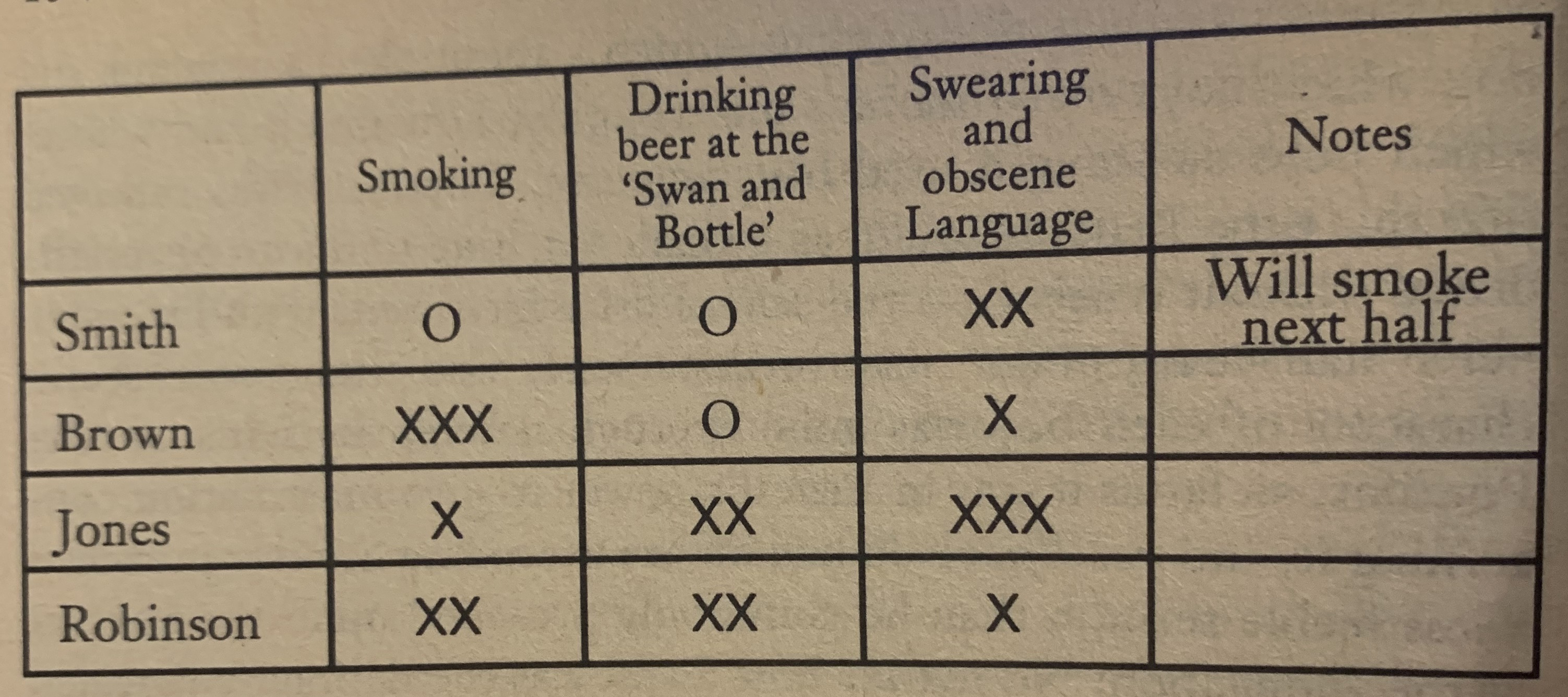
And thus through the whole school.
Of course, in justice to Ernest, Dr Skinner would be bound over to
secrecy before a word was said to him, but, Ernest being thus
protected, he could not be furnished with the facts too completely.
CHAPTER XLIII
So important did Theobald consider this matter that he made a special
journey to Roughborough before the half year began. It was a relief to
have him out of the house, but though his destination was not
mentioned, Ernest guessed where he had gone.
To this day he considers his conduct at this crisis to have been one of
the most serious laches of his life—one which he can never think of
without shame and indignation. He says he ought to have run away from
home. But what good could he have done if he had? He would have been
caught, brought back and examined two days later instead of two days
earlier. A boy of barely sixteen cannot stand against the moral pres-
sure of a father and mother who have always oppressed him any more
than he can cope physically with a powerful full-grown man. True, he
may allow himself to be killed rather than yield, but this is being so
morbidly heroic as to come close round again to cowardice; for it is
little else than suicide, which is universally condemned as cowardly.
On the re-assembling of the school it became apparent that something
had gone wrong. Dr Skinner called the boys together, and with much pomp
excommunicated Mrs Cross and Mrs Jones, by declaring their shops to be
out of bounds. The street in which the “Swan and Bottle” stood was also
forbidden. The vices of drinking and smoking, therefore, were clearly
aimed at, and before prayers Dr Skinner spoke a few impressive words
about the abominable sin of using bad language. Ernest’s feelings can
be imagined.
Next day at the hour when the daily punishments were read out, though
there had not yet been time for him to have offended, Ernest Pontifex
was declared to have incurred every punishment which the school
provided for evil-doers. He was placed on the idle list for the whole
half year, and on perpetual detentions; his bounds were curtailed; he
was to attend junior callings-over; in fact he was so hemmed in with
punishments upon every side that it was hardly possible for him to go
outside the school gates. This unparalleled list of punishments
inflicted on the first day of the half year, and intended to last till
the ensuing Christmas holidays, was not connected with any specified
offence. It required no great penetration therefore, on the part of the
boys to connect Ernest with the putting Mrs Cross’s and Mrs Jones’s
shops out of bounds.
Great indeed was the indignation about Mrs Cross who, it was known,
remembered Dr Skinner himself as a small boy only just got into
jackets, and had doubtless let him have many a sausage and mashed
potatoes upon deferred payment. The head boys assembled in conclave to
consider what steps should be taken, but hardly had they done so before
Ernest knocked timidly at the head-room door and took the bull by the
horns by explaining the facts as far as he could bring himself to do
so. He made a clean breast of everything except about the school list
and the remarks he had made about each boy’s character. This infamy
was more than he could own to, and he kept his counsel concerning it.
Fortunately he was safe in doing so, for Dr Skinner, pedant and more
than pedant though he was, had still just sense enough to turn on
Theobald in the matter of the school list. Whether he resented being
told that he did not know the characters of his own boys, or whether he
dreaded a scandal about the school I know not, but when Theobald had
handed him the list, over which he had expended so much pains, Dr
Skinner had cut him uncommonly short, and had then and there, with
more suavity than was usual with him, committed it to the flames before
Theobald’s own eyes.
Ernest got off with the head boys easier than he expected. It was
admitted that the offence, heinous though it was, had been committed
under extenuating circumstances; the frankness with which the culprit
had confessed all, his evidently unfeigned remorse, and the fury with
which Dr Skinner was pursuing him tended to bring about a reaction in
his favour, as though he had been more sinned against than sinning.
As the half year wore on his spirits gradually revived, and when
attacked by one of his fits of self-abasement he was in some degree
consoled by having found out that even his father and mother, whom he
had supposed so immaculate, were no better than they should be. About
the fifth of November it was a school custom to meet on a certain
common not far from Roughborough and burn somebody in effigy, this
being the compromise arrived at in the matter of fireworks and Guy
Fawkes festivities. This year it was decided that Pontifex’s governor
should be the victim, and Ernest though a good deal exercised in mind
as to what he ought to do, in the end saw no sufficient reason for
holding aloof from proceedings which, as he justly remarked, could not
do his father any harm.
It so happened that the bishop had held a confirmation at the school on
the fifth of November. Dr Skinner had not quite liked the selection of
this day, but the bishop was pressed by many engagements, and had been
compelled to make the arrangement as it then stood. Ernest was among
those who had to be confirmed, and was deeply impressed with the solemn
importance of the ceremony. When he felt the huge old bishop drawing
down upon him as he knelt in chapel he could hardly breathe, and when
the apparition paused before him and laid its hands upon his head he
was frightened almost out of his wits. He felt that he had arrived at
one of the great turning points of his life, and that the Ernest of the
future could resemble only very faintly the Ernest of the past.
This happened at about noon, but by the one o’clock dinner-hour the
effect of the confirmation had worn off, and he saw no reason why he
should forego his annual amusement with the bonfire; so he went with
the others and was very valiant till the image was actually produced
and was about to be burnt; then he felt a little frightened. It was a
poor thing enough, made of paper, calico and straw, but they had
christened it The Rev. Theobald Pontifex, and he had a revulsion of
feeling as he saw it being carried towards the bonfire. Still he held
his ground, and in a few minutes when all was over felt none the worse
for having assisted at a ceremony which, after all, was prompted by a
boyish love of mischief rather than by rancour.
I should say that Ernest had written to his father, and told him of the
unprecedented way in which he was being treated; he even ventured to
suggest that Theobald should interfere for his protection and reminded
him how the story had been got out of him, but Theobald had had enough
of Dr Skinner for the present; the burning of the school list had been
a rebuff which did not encourage him to meddle a second time in the
internal economics of Roughborough. He therefore replied that he must
either remove Ernest from Roughborough altogether, which would for many
reasons be undesirable, or trust to the discretion of the head master
as regards the treatment he might think best for any of his pupils.
Ernest said no more; he still felt that it was so discreditable to him
to have allowed any confession to be wrung from him, that he could not
press the promised amnesty for himself.
It was during the “Mother Cross row,” as it was long styled among the
boys, that a remarkable phenomenon was witnessed at Roughborough. I
mean that of the head boys under certain conditions doing errands for
their juniors. The head boys had no bounds and could go to Mrs Cross’s
whenever they liked; they actually, therefore, made themselves
go-betweens, and would get anything from either Mrs Cross’s or Mrs
Jones’s for any boy, no matter how low in the school, between the hours
of a quarter to nine and nine in the morning, and a quarter to six and
six in the afternoon. By degrees, however, the boys grew bolder, and
the shops, though not openly declared in bounds again, were tacitly
allowed to be so.
CHAPTER XLIV
I may spare the reader more details about my hero’s school days. He
rose, always in spite of himself, into the Doctor’s form, and for the
last two years or so of his time was among the præpostors, though he
never rose into the upper half of them. He did little, and I think the
Doctor rather gave him up as a boy whom he had better leave to himself,
for he rarely made him construe, and he used to send in his exercises
or not, pretty much as he liked. His tacit, unconscious obstinacy had
in time effected more even than a few bold sallies in the first
instance would have done. To the end of his career his position inter
pares was what it had been at the beginning, namely, among the upper
part of the less reputable class—whether of seniors or juniors—rather
than among the lower part of the more respectable.
Only once in the whole course of his school life did he get praise from
Dr Skinner for any exercise, and this he has treasured as the best
example of guarded approval which he has ever seen. He had had to write
a copy of Alcaics on “The dogs of the monks of St Bernard,” and when
the exercise was returned to him he found the Doctor had written on it:
“In this copy of Alcaics—which is still excessively bad—I fancy that I
can discern some faint symptoms of improvement.” Ernest says that if
the exercise was any better than usual it must have been by a fluke,
for he is sure that he always liked dogs, especially St Bernard dogs,
far too much to take any pleasure in writing Alcaics about them.
“As I look back upon it,” he said to me but the other day, with a
hearty laugh, “I respect myself more for having never once got the
best mark for an exercise than I should do if I had got it every time
it could be got. I am glad nothing could make me do Latin and Greek
verses; I am glad Skinner could never get any moral influence over me;
I am glad I was idle at school, and I am glad my father overtasked me
as a boy—otherwise, likely enough I should have acquiesced in the
swindle, and might have written as good a copy of Alcaics about the
dogs of the monks of St Bernard as my neighbours, and yet I don’t know,
for I remember there was another boy, who sent in a Latin copy of some
sort, but for his own pleasure he wrote the following—
The dogs of the monks of St Bernard go
To pick little children out of the snow,
And around their necks is the cordial gin
Tied with a little bit of bob-bin.
I should like to have written that, and I did try, but I couldn’t. I
didn’t quite like the last line, and tried to mend it, but I couldn’t.”
I fancied I could see traces of bitterness against the instructors of
his youth in Ernest’s manner, and said something to this effect.
“Oh, no,” he replied, still laughing, “no more than St Anthony felt
towards the devils who had tempted him, when he met some of them
casually a hundred or a couple of hundred years afterwards. Of course
he knew they were devils, but that was all right enough; there must be
devils. St Anthony probably liked these devils better than most others,
and for old acquaintance sake showed them as much indulgence as was
compatible with decorum.
“Besides, you know,” he added, “St Anthony tempted the devils quite as
much as they tempted him; for his peculiar sanctity was a greater
temptation to tempt him than they could stand. Strictly speaking, it
was the devils who were the more to be pitied, for they were led up by
St Anthony to be tempted and fell, whereas St Anthony did not fall. I
believe I was a disagreeable and unintelligible boy, and if ever I meet
Skinner there is no one whom I would shake hands with, or do a good
turn to more readily.”
At home things went on rather better; the Ellen and Mother Cross rows
sank slowly down upon the horizon, and even at home he had quieter
times now that he had become a præpostor. Nevertheless the watchful
eye and protecting hand were still ever over him to guard his comings in
and his goings out, and to spy out all his ways. Is it wonderful that
the boy, though always trying to keep up appearances as though he were
cheerful and contented—and at times actually being so—wore often an
anxious, jaded look when he thought none were looking, which told of an
almost incessant conflict within?
Doubtless Theobald saw these looks and knew how to interpret them, but
it was his profession to know how to shut his eyes to things that were
inconvenient—no clergyman could keep his benefice for a month if he
could not do this; besides he had allowed himself for so many years to
say things he ought not to have said, and not to say the things he
ought to have said, that he was little likely to see anything that he
thought it more convenient not to see unless he was made to do so.
It was not much that was wanted. To make no mysteries where Nature
has made none, to bring his conscience under something like reasonable
control, to give Ernest his head a little more, to ask fewer questions,
and to give him pocket money with a desire that it should be spent upon
menus plaisirs . . .
“Call that not much indeed,” laughed Ernest, as I read him what I have
just written. “Why it is the whole duty of a father, but it is the
mystery-making which is the worst evil. If people would dare to speak
to one another unreservedly, there would be a good deal less sorrow in
the world a hundred years hence.”
To return, however, to Roughborough. On the day of his leaving, when he
was sent for into the library to be shaken hands with, he was surprised
to feel that, though assuredly glad to leave, he did not do so with any
especial grudge against the Doctor rankling in his breast. He had come
to the end of it all, and was still alive, nor, take it all round, more
seriously amiss than other people. Dr Skinner received him graciously,
and was even frolicsome after his own heavy fashion. Young people are
almost always placable, and Ernest felt as he went away that another
such interview would not only have wiped off all old scores, but have
brought him round into the ranks of the Doctor’s admirers and sup-
porters—among whom it is only fair to say that the greater number of
the more promising boys were found.
Just before saying good-bye the Doctor actually took down a volume from
those shelves which had seemed so awful six years previously, and gave
it to him after having written his name in it, and the words φιλιας και
ευνοιας χαριν, which I believe means “with all kind wishes from
the donor.” The book was one written in Latin by a German—Schömann:
“De comitiis Atheniensibus”—not exactly light and cheerful reading, but
Ernest felt it was high time he got to understand the Athenian
constitution and manner of voting; he had got them up a great many
times already, but had forgotten them as fast as he had learned them;
now, however, that the Doctor had given him this book, he would master
the subject once for all. How strange it was! He wanted to remember
these things very badly; he knew he did, but he could never retain
them; in spite of himself they no sooner fell upon his mind than they
fell off it again, he had such a dreadful memory; whereas, if anyone
played him a piece of music and told him where it came from, he never
forgot that, though he made no effort to retain it, and was not even
conscious of trying to remember it at all. His mind must be badly
formed and he was no good.
Having still a short time to spare, he got the keys of St Michael’s
church and went to have a farewell practice upon the organ, which he
could now play fairly well. He walked up and down the aisle for a while
in a meditative mood, and then, settling down to the organ, played
“They loathed to drink of the river” about six times over, after which
he felt more composed and happier; then, tearing himself away from the
instrument he loved so well, he hurried to the station.
As the train drew out he looked down from a high embankment on to
the little house his aunt had taken, and where it might be said she had
died through her desire to do him a kindness. There were the two
well-known bow windows, out of which he had often stepped to run
across the lawn into the workshop. He reproached himself with the little
gratitude he had shown towards this kind lady—the only one of his
relations whom he had ever felt as though he could have taken into his
confidence. Dearly as he loved her memory, he was glad she had not
known the scrapes he had got into since she died; perhaps she might not
have forgiven them—and how awful that would have been! But then, if she
had lived, perhaps many of his ills would have been spared him. As he
mused thus he grew sad again. Where, where, he asked himself, was it
all to end? Was it to be always sin, shame and sorrow in the future, as
it had been in the past, and the ever-watchful eye and protecting hand
of his father laying burdens on him greater than he could bear—or was
he, too, some day or another to come to feel that he was fairly well
and happy?
There was a gray mist across the sun, so that the eye could bear its
light, and Ernest, while musing as above, was looking right into the
middle of the sun himself, as into the face of one whom he knew and
was fond of. At first his face was grave, but kindly, as of a tired man
who feels that a long task is over; but in a few seconds the more hu-
morous side of his misfortunes presented itself to him, and he smiled
half reproachfully, half merrily, as thinking how little all that had
happened to him really mattered, and how small were his hardships as
compared with those of most people. Still looking into the eye of the
sun and smiling dreamily, he thought how he had helped to burn his
father in effigy, and his look grew merrier, till at last he broke out
into a laugh. Exactly at this moment the light veil of cloud parted
from the sun, and he was brought to terra firma by the breaking forth
of the sunshine. On this he became aware that he was being watched
attentively by a fellow-traveller opposite to him, an elderly gentleman
with a large head and iron-grey hair.
“My young friend,” said he, good-naturedly, “you really must not carry
on conversations with people in the sun, while you are in a public
railway carriage.”
The old gentleman said not another word, but unfolded his Times and
began to read it. As for Ernest, he blushed crimson. The pair did not
speak during the rest of the time they were in the carriage, but they
eyed each other from time to time, so that the face of each was
impressed on the recollection of the other.
CHAPTER XLV
Some people say that their school days were the happiest of their
lives. They may be right, but I always look with suspicion upon those
whom I hear saying this. It is hard enough to know whether one is happy
or unhappy now, and still harder to compare the relative happiness or
unhappiness of different times of one’s life; the utmost that can be
said is that we are fairly happy so long as we are not distinctly aware
of being miserable. As I was talking with Ernest one day not so long
since about this, he said he was so happy now that he was sure he had
never been happier, and did not wish to be so, but that Cambridge was
the first place where he had ever been consciously and continuously
happy.
How can any boy fail to feel an ecstasy of pleasure on first finding
himself in rooms which he knows for the next few years are to be his
castle? Here he will not be compelled to turn out of the most
comfortable place as soon as he has ensconced himself in it because
papa or mamma happens to come into the room, and he should give it up
to them. The most cosy chair here is for himself, there is no one even
to share the room with him, or to interfere with his doing as he likes
in it—smoking included. Why, if such a room looked out both back and
front on to a blank dead wall it would still be a paradise, how much
more then when the view is of some quiet grassy court or cloister or
garden, as from the windows of the greater number of rooms at Oxford
and Cambridge.
Theobald, as an old fellow and tutor of Emmanuel—at which college he
had entered Ernest—was able to obtain from the present tutor a certain
preference in the choice of rooms; Ernest’s, therefore, were very
pleasant ones, looking out upon the grassy court that is bounded by the
Fellows’ gardens.
Theobald accompanied him to Cambridge, and was at his best while doing
so. He liked the jaunt, and even he was not without a certain feeling
of pride in having a full-blown son at the University. Some of the
reflected rays of this splendour were allowed to fall upon Ernest
himself. Theobald said he was “willing to hope”—this was one of his
tags—that his son would turn over a new leaf now that he had left
school, and for his own part he was “only too ready”—this was another
tag—to let bygones be bygones.
Ernest, not yet having his name on the books, was able to dine with his
father at the Fellows’ table of one of the other colleges on the
invitation of an old friend of Theobald’s; he there made acquaintance
with sundry of the good things of this life, the very names of which
were new to him, and felt as he ate them that he was now indeed
receiving a liberal education. When at length the time came for him to
go to Emmanuel, where he was to sleep in his new rooms, his father came
with him to the gates and saw him safe into college; a few minutes more
and he found himself alone in a room for which he had a latch-key.
From this time he dated many days which, if not quite unclouded, were
upon the whole very happy ones. I need not however describe them, as
the life of a quiet steady-going undergraduate has been told in a score
of novels better than I can tell it. Some of Ernest’s schoolfellows
came up to Cambridge at the same time as himself, and with these he
continued on friendly terms during the whole of his college career.
Other schoolfellows were only a year or two his seniors; these called
on him, and he thus made a sufficiently favourable entrée into
college life. A straightforwardness of character that was stamped upon
his face, a love of humour, and a temper which was more easily appeased
than ruffled made up for some awkwardness and want of savoir faire.
He soon became a not unpopular member of the best set of his year, and
though neither capable of becoming, nor aspiring to become, a leader,
was admitted by the leaders as among their nearer hangers-on.
Of ambition he had at that time not one particle; greatness, or indeed
superiority of any kind, seemed so far off and incomprehensible to him
that the idea of connecting it with himself never crossed his mind. If
he could escape the notice of all those with whom he did not feel
himself en rapport, he conceived that he had triumphed sufficiently.
He did not care about taking a good degree, except that it must be good
enough to keep his father and mother quiet. He did not dream of being
able to get a fellowship; if he had, he would have tried hard to do so,
for he became so fond of Cambridge that he could not bear the thought
of having to leave it; the briefness indeed of the season during which
his present happiness was to last was almost the only thing that now
seriously troubled him.
Having less to attend to in the matter of growing, and having got his
head more free, he took to reading fairly well—not because he liked it,
but because he was told he ought to do so, and his natural instinct,
like that of all very young men who are good for anything, was to do as
those in authority told him. The intention at Battersby was (for Dr
Skinner had said that Ernest could never get a fellowship) that he
should take a sufficiently good degree to be able to get a tutorship or
mastership in some school preparatory to taking orders. When he was
twenty-one years old his money was to come into his own hands, and the
best thing he could do with it would be to buy the next presentation to
a living, the rector of which was now old, and live on his mastership
or tutorship till the living fell in. He could buy a very good living
for the sum which his grandfather’s legacy now amounted to, for
Theobald had never had any serious intention of making deductions for
his son’s maintenance and education, and the money had accumulated till
it was now about five thousand pounds; he had only talked about making
deductions in order to stimulate the boy to exertion as far as
possible, by making him think that this was his only chance of escaping
starvation—or perhaps from pure love of teasing.
When Ernest had a living of £600 or £700 a year with a house, and not
too many parishioners—why, he might add to his income by taking pupils,
or even keeping a school, and then, say at thirty, he might marry. It
was not easy for Theobald to hit on any much more sensible plan. He
could not get Ernest into business, for he had no business
connections—besides he did not know what business meant; he had no
interest, again, at the Bar; medicine was a profession which subjected
its students to ordeals and temptations which these fond parents shrank
from on behalf of their boy; he would be thrown among companions and
familiarised with details which might sully him, and though he might
stand, it was “only too possible” that he would fall. Besides,
ordination was the road which Theobald knew and understood, and indeed
the only road about which he knew anything at all, so not unnaturally
it was the one he chose for Ernest.
The foregoing had been instilled into my hero from earliest boyhood,
much as it had been instilled into Theobald himself, and with the same
result—the conviction, namely, that he was certainly to be a clergyman,
but that it was a long way off yet, and he supposed it was all right.
As for the duty of reading hard, and taking as good a degree as he
could, this was plain enough, so he set himself to work, as I have
said, steadily, and to the surprise of everyone as well as himself got
a college scholarship, of no great value, but still a scholarship, in
his freshman’s term. It is hardly necessary to say that Theobald stuck
to the whole of this money, believing the pocket-money he allowed
Ernest to be sufficient for him, and knowing how dangerous it was for
young men to have money at command. I do not suppose it even occurred
to him to try and remember what he had felt when his father took a like
course in regard to himself.
Ernest’s position in this respect was much what it had been at school
except that things were on a larger scale. His tutor’s and cook’s bills
were paid for him; his father sent him his wine; over and above this he
had £50 a year with which to keep himself in clothes and all other
expenses; this was about the usual thing at Emmanuel in Ernest’s day,
though many had much less than this. Ernest did as he had done at
school—he spent what he could, soon after he received his money; he
then incurred a few modest liabilities, and then lived penuriously till
next term, when he would immediately pay his debts, and start new ones
to much the same extent as those which he had just got rid of. When he
came into his £5000 and became independent of his father, £15 or £20
served to cover the whole of his unauthorised expenditure.
He joined the boat club, and was constant in his attendance at the
boats. He still smoked, but never took more wine or beer than was good
for him, except perhaps on the occasion of a boating supper, but even
then he found the consequences unpleasant, and soon learned how to keep
within safe limits. He attended chapel as often as he was compelled to
do so; he communicated two or three times a year, because his tutor
told him he ought to; in fact he set himself to live soberly and
cleanly, as I imagine all his instincts prompted him to do, and when he
fell—as who that is born of woman can help sometimes doing?—it was not
till after a sharp tussle with a temptation that was more than his
flesh and blood could stand; then he was very penitent and would go a
fairly long while without sinning again; and this was how it had always
been with him since he had arrived at years of indiscretion.
Even to the end of his career at Cambridge he was not aware that he
had it in him to do anything, but others had begun to see that he was
not wanting in ability and sometimes told him so. He did not believe it;
indeed he knew very well that if they thought him clever they were
being taken in, but it pleased him to have been able to take them in,
and he tried to do so still further; he was therefore a good deal on
the look-out for cants that he could catch and apply in season, and
might have done himself some mischief thus if he had not been ready to
throw over any cant as soon as he had come across another more nearly
to his fancy; his friends used to say that when he rose he flew like a
snipe, darting several times in various directions before he settled
down to a steady straight flight, but when he had once got into this he
would keep to it.
(Continue Reading)