CHAPTER XXVI.
MRS. HURTLE.
Paul Montague at this time lived in comfortable lodgings in Sackville
Street, and ostensibly the world was going well with him. But he had
many troubles. His troubles in reference to Fisker, Montague, and
Montague,--and also their consolation,--are already known to the
reader. He was troubled too about his love, though when he allowed
his mind to expatiate on the success of the great railway he would
venture to hope that on that side his life might perhaps be blessed.
Henrietta had at any rate as yet showed no disposition to accept her
cousin's offer. He was troubled too about the gambling, which he
disliked, knowing that in that direction there might be speedy
ruin, and yet returning to it from day to day in spite of his own
conscience. But there was yet another trouble which culminated just
at this time. One morning, not long after that Sunday night which
had been so wretchedly spent at the Beargarden, he got into a cab in
Piccadilly and had himself taken to a certain address in Islington.
Here he knocked at a decent, modest door,--at such a house as
men live in with two or three hundred a year,--and asked for Mrs.
Hurtle. Yes;--Mrs. Hurtle lodged there, and he was shown into the
drawing-room. There he stood by the round table for a quarter of
an hour turning over the lodging-house books which lay there, and
then Mrs. Hurtle entered the room. Mrs. Hurtle was a widow whom
he had once promised to marry. "Paul," she said, with a quick,
sharp voice, but with a voice which could be very pleasant when she
pleased,--taking him by the hand as she spoke, "Paul, say that that
letter of yours must go for nothing. Say that it shall be so, and I
will forgive everything."
"I cannot say that," he replied, laying his hand in hers.
"You cannot say it! What do you mean? Will you dare to tell me that
your promises to me are to go for nothing?"
"Things are changed," said Paul hoarsely. He had come thither at her
bidding because he had felt that to remain away would be cowardly,
but the meeting was inexpressibly painful to him. He did think that
he had sufficient excuse for breaking his troth to this woman, but
the justification of his conduct was founded on reasons which he
hardly knew how to plead to her. He had heard that of her past life
which, had he heard it before, would have saved him from his present
difficulty. But he had loved her,--did love her in a certain fashion;
and her offences, such as they were, did not debar her from his
sympathies.
"How are they changed? I am two years older, if you mean that." As
she said this she looked round at the glass, as though to see whether
she was become so haggard with age as to be unfit to become this
man's wife. She was very lovely, with a kind of beauty which we
seldom see now. In these days men regard the form and outward lines
of a woman's face and figure more than either the colour or the
expression, and women fit themselves to men's eyes. With padding
and false hair without limit a figure may be constructed of almost
any dimensions. The sculptors who construct them, male and female,
hairdressers and milliners, are very skilful, and figures are construct-
ed of noble dimensions, sometimes with voluptuous expansion,
sometimes with classic reticence, sometimes with dishevelled neg-
ligence which becomes very dishevelled indeed when long out of the
sculptors' hands. Colours indeed are added, but not the colours which
we used to love. The taste for flesh and blood has for the day given
place to an appetite for horsehair and pearl powder. But Mrs. Hurtle
was not a beauty after the present fashion. She was very dark,--a
dark brunette,--with large round blue eyes, that could indeed be
soft, but could also be very severe. Her silken hair, almost black,
hung in a thousand curls all round her head and neck. Her cheeks and
lips and neck were full, and the blood would come and go, giving a
varying expression to her face with almost every word she spoke. Her
nose also was full, and had something of the pug. But nevertheless
it was a nose which any man who loved her would swear to be perfect.
Her mouth was large, and she rarely showed her teeth. Her chin was
full, marked by a large dimple, and as it ran down to her neck was
beginning to form a second. Her bust was full and beautifully shaped;
but she invariably dressed as though she were oblivious, or at any
rate neglectful, of her own charms. Her dress, as Montague had seen
her, was always black,--not a sad weeping widow's garment, but silk
or woollen or cotton as the case might be, always new, always nice,
always well-fitting, and most especially always simple. She was
certainly a most beautiful woman, and she knew it. She looked as
though she knew it,--but only after that fashion in which a woman
ought to know it. Of her age she had never spoken to Montague. She
was in truth over thirty,--perhaps almost as near thirty-five as
thirty. But she was one of those whom years hardly seem to touch.
"You are beautiful as ever you were," he said.
"Psha! Do not tell me of that. I care nothing for my beauty unless it
can bind me to your love. Sit down there and tell me what it means."
Then she let go his hand, and seated herself opposite to the chair
which she gave him.
"I told you in my letter."
"You told me nothing in your letter,--except that it was to be--off.
Why is it to be--off? Do you not love me?" Then she threw herself
upon her knees, and leaned upon his, and looked up in his face.
"Paul," she said, "I have come again across the Atlantic on purpose
to see you,--after so many months,--and will you not give me one
kiss? Even though you should leave me for ever, give me one kiss."
Of
course he kissed her, not once, but with a long, warm embrace. How
could it have been otherwise? With all his heart he wished that she
would have remained away, but while she knelt there at his feet what
could he do but embrace her? "Now tell me everything," she said,
seating herself on a footstool at his feet.
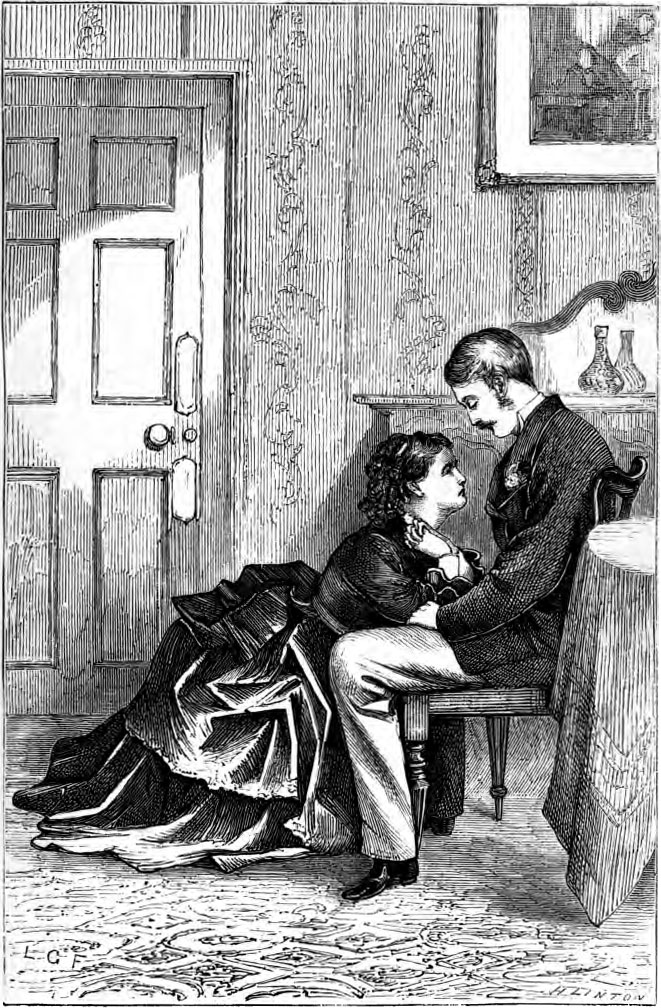
She certainly did not look like a woman whom a man might ill treat
or scorn with impunity. Paul felt, even while she was lavishing her
caresses upon him, that she might too probably turn and rend him
before he left her. He had known something of her temper before,
though he had also known the truth and warmth of her love. He had
travelled with her from San Francisco to England, and she had been
very good to him in illness, in distress of mind and in poverty,--for
he had been almost penniless in New York. When they landed at
Liverpool they were engaged as man and wife. He had told her all his
affairs, had given her the whole history of his life. This was before
his second journey to America, when Hamilton K. Fisker was unknown
to him. But she had told him little or nothing of her own life,--but
that she was a widow, and that she was travelling to Paris on
business. When he left her at the London railway station, from which
she started for Dover, he was full of all a lover's ardour. He had
offered to go with her, but that she had declined. But when he
remembered that he must certainly tell his friend Roger of his
engagement, and remembered also how little he knew of the lady to
whom he was engaged, he became embarrassed. What were her means he
did not know. He did know that she was some years older than himself,
and that she had spoken hardly a word to him of her own family.
She had indeed said that her husband had been one of the greatest
miscreants ever created, and had spoken of her release from him as
the one blessing she had known before she had met Paul Montague. But
it was only when he thought of all this after she had left him,--only
when he reflected how bald was the story which he must tell Roger
Carbury,--that he became dismayed. Such had been the woman's
cleverness, such her charm, so great her power of adaptation, that
he had passed weeks in her daily company, with still progressing
intimacy and affection, without feeling that anything had been
missing.
He had told his friend, and his friend had declared to him that it
was impossible that he should marry a woman whom he had met in a
railway train without knowing something about her. Roger did all
he could to persuade the lover to forget his love,--and partially
succeeded. It is so pleasant and so natural that a young man should
enjoy the company of a clever, beautiful woman on a long journey,--so
natural that during the journey he should allow himself to think that
she may during her whole life be all in all to him as she is at that
moment;--and so natural again that he should see his mistake when he
has parted from her! But Montague, though he was half false to his
widow, was half true to her. He had pledged his word, and that he
said ought to bind him. Then he returned to California, and learned
through the instrumentality of Hamilton K. Fisker, that in San
Francisco Mrs. Hurtle was regarded as a mystery. Some people did not
quite believe that there ever had been a Mr. Hurtle. Others said that
there certainly had been a Mr. Hurtle, and that to the best of their
belief he still existed. The fact, however, best known of her was,
that she had shot a man through the head somewhere in Oregon. She had
not been tried for it, as the world of Oregon had considered that the
circumstances justified the deed. Everybody knew that she was very
clever and very beautiful,--but everybody also thought that she was
very dangerous. "She always had money when she was here," Hamilton
Fisker said, "but no one knew where it came from." Then he wanted to
know why Paul inquired. "I don't think, you know, that I should like
to go in for a life partnership, if you mean that," said Hamilton K.
Fisker.
Montague had seen her in New York as he passed through on his second
journey to San Francisco, and had then renewed his promises in spite
of his cousin's caution. He told her that he was going to see what he
could make of his broken fortunes,--for at this time, as the reader
will remember, there was no great railway in existence,--and she had
promised to follow him. Since that they had never met till this day.
She had not made the promised journey to San Francisco, at any rate
before he had left it. Letters from her had reached him in England,
and these he had answered by explaining to her, or endeavouring to
explain, that their engagement must be at an end. And now she had
followed him to London! "Tell me everything," she said, leaning upon
him and looking up into his face.
"But you,--when did you arrive here?"
"Here, at this house, I arrived the night before last. On Tuesday
I reached Liverpool. There I found that you were probably in London,
and so I came on. I have come only to see you. I can understand that
you should have been estranged from me. That journey home is now so
long ago! Our meeting in New York was so short and wretched. I would
not tell you because you then were poor yourself, but at that moment
I was penniless. I have got my own now out from the very teeth of
robbers." As she said this, she looked as though she could be very
persistent in claiming her own,--or what she might think to be her
own. "I could not get across to San Francisco as I said I would, and
when I was there you had quarrelled with your uncle and returned. And
now I am here. I at any rate have been faithful." As she said this
his arm was again thrown over her, so as to press her head to his
knee. "And now," she said, "tell me about yourself?"
His position was embarrassing and very odious to himself. Had he done
his duty properly, he would gently have pushed her from him, have
sprung to his legs, and have declared that, however faulty might have
been his previous conduct, he now found himself bound to make her
understand that he did not intend to become her husband. But he was
either too much of a man or too little of a man for conduct such as
that. He did make the avowal to himself, even at that moment as she
sat there. Let the matter go as it would, she should never be his
wife. He would marry no one unless it was Hetta Carbury. But he did
not at all know how to get this said with proper emphasis, and yet
with properly apologetic courtesy. "I am engaged here about this
railway," he said. "You have heard, I suppose, of our projected
scheme?"
"Heard of it! San Francisco is full of it. Hamilton Fisker is the
great man of the day there, and, when I left, your uncle was buying
a villa for seventy-four thousand dollars. And yet they say that the
best of it all has been transferred to you Londoners. Many there are
very hard upon Fisker for coming here and doing as he did."
"It's doing very well, I believe," said Paul, with some feeling of
shame, as he thought how very little he knew about it.
"You are the manager here in England?"
"No,--I am a member of the firm that manages it at San Francisco; but
the real manager here is our chairman, Mr. Melmotte."
"Ah,--I have heard of him. He is a great man;--a Frenchman, is he
not? There was a talk of inviting him to California. You know him of
course?"
"Yes;--I know him. I see him once a week."
"I would sooner see that man than your Queen, or any of your dukes or
lords. They tell me that he holds the world of commerce in his right
hand. What power;--what grandeur!"
"Grand enough," said Paul, "if it all came honestly."
"Such a man rises above honesty," said Mrs. Hurtle, "as a great
general rises above humanity when he sacrifices an army to conquer
a nation. Such greatness is incompatible with small scruples. A
pigmy man is stopped by a little ditch, but a giant stalks over the
rivers."
"I prefer to be stopped by the ditches," said Montague.
"Ah, Paul, you were not born for commerce. And I will grant you this,
that commerce is not noble unless it rises to great heights. To live
in plenty by sticking to your counter from nine in the morning to
nine at night, is not a fine life. But this man with a scratch of his
pen can send out or call in millions of dollars. Do they say here
that he is not honest?"
"As he is my partner in this affair perhaps I had better say nothing
against him."
"Of course such a man will be abused. People have said that Napoleon
was a coward, and Washington a traitor. You must take me where I
shall see Melmotte. He is a man whose hand I would kiss; but I would
not condescend to speak even a word of reverence to any of your
Emperors."
"I fear you will find that your idol has feet of clay."
"Ah,--you mean that he is bold in breaking those precepts of
yours about coveting worldly wealth. All men and women break that
commandment, but they do so in a stealthy fashion, half drawing back
the grasping hand, praying to be delivered from temptation while they
filch only a little, pretending to despise the only thing that is
dear to them in the world. Here is a man who boldly says that he
recognises no such law; that wealth is power, and that power is good,
and that the more a man has of wealth the greater and the stronger
and the nobler he can be. I love a man who can turn the hobgoblins
inside out and burn the wooden bogies that he meets."
Montague had formed his own opinions about Melmotte. Though con-
nected with the man, he believed their Grand Director to be as vile a
scoundrel as ever lived. Mrs. Hurtle's enthusiasm was very pretty,
and there was something of feminine eloquence in her words. But it
was shocking to see them lavished on such a subject. "Personally, I
do not like him," said Paul.
"I had thought to find that you and he were hand and glove."
"Oh no."
"But you are prospering in this business?"
"Yes,--I suppose we are prospering. It is one of those hazardous
things in which a man can never tell whether he be really prosperous
till he is out of it. I fell into it altogether against my will. I
had no alternative."
"It seems to me to have been a golden chance."
"As far as immediate results go it has been golden."
"That at any rate is well, Paul. And now,--now that we have got back
into our old way of talking, tell me what all this means. I have
talked to no one after this fashion since we parted. Why should our
engagement be over? You used to love me, did you not?"
He would willingly have left her question unanswered, but she waited
for an answer. "You know I did," he said.
"I thought so. This I know, that you were sure and are sure of my
love to you. Is it not so? Come, speak openly like a man. Do you
doubt me?"
He did not doubt her, and was forced to say so. "No, indeed."
"Oh, with what bated, half-mouthed words you speak,--fit for a girl
from a nursery! Out with it if you have anything to say against me!
You owe me so much at any rate. I have never ill-treated you. I have
never lied to you. I have taken nothing from you,--if I have not
taken your heart. I have given you all that I have to give." Then she
leaped to her feet and stood a little apart from him. "If you hate
me, say so."
"Winifrid," he said, calling her by her name.
"Winifrid! Yes, now for the first time, though I have called you
Paul from the moment you entered the room. Well, speak out. Is there
another woman that you love?"
At this moment Paul Montague proved that at any rate he was no
coward. Knowing the nature of the woman, how ardent, how impetuous
she could be, and how full of wrath, he had come at her call
intending to tell her the truth which he now spoke. "There is
another," he said.
She stood silent, looking into his face, thinking how she would
commence her attack upon him. She fixed her eyes upon him, standing
quite upright, squeezing her own right hand with the fingers of the
left. "Oh," she said, in a whisper;--"that is the reason why I am
told that I am to be--off."
"That was not the reason."
"What;--can there be more reason than that,--better reason than that?
Unless, indeed, it be that as you have learned to love another so
also you have learned to--hate me."
"Listen to me, Winifrid."
"No, sir; no Winifrid now! How did you dare to kiss me, knowing that
it was on your tongue to tell me I was to be cast aside? And so you
love--some other woman! I am too old to please you, too rough,--too
little like the dolls of your own country! What were your--other
reasons? Let me hear your--other reasons, that I may tell you that
they are lies."
The reasons were very difficult to tell, though when put forward by
Roger Carbury they had been easily pleaded. Paul knew but little
about Winifrid Hurtle, and nothing at all about the late Mr. Hurtle.
His reasons curtly put forward might have been so stated. "We know
too little of each other," he said.
"What more do you want to know? You can know all for the asking.
Did I ever refuse to answer you? As to my knowledge of you and your
affairs, if I think it sufficient, need you complain? What is it that
you want to know? Ask anything and I will tell you. Is it about my
money? You knew when you gave me your word that I had next to none.
Now I have ample means of my own. You knew that I was a widow. What
more? If you wish to hear of the wretch that was my husband, I will
deluge you with stories. I should have thought that a man who loved
would not have cared to hear much of one--who perhaps was loved
once."
He knew that his position was perfectly indefensible. It would have
been better for him not to have alluded to any reasons, but to have
remained firm to his assertion that he loved another woman. He must
have acknowledged himself to be false, perjured, inconstant, and
very base. A fault that may be venial to those who do not suffer, is
damnable, deserving of an eternity of tortures, in the eyes of the
sufferer. He must have submitted to be told that he was a fiend, and
might have had to endure whatever of punishment a lady in her wrath
could inflict upon him. But he would have been called upon for no
further mental effort. His position would have been plain. But now he
was all at sea. "I wish to hear nothing," he said.
"Then why tell me that we know so little of each other? That, surely,
is a poor excuse to make to a woman,--after you have been false to
her. Why did you not say that when we were in New York together?
Think of it, Paul. Is not that mean?"
"I do not think that I am mean."
"No;--a man will lie to a woman, and justify it always. Who is--this
lady?"
He knew that he could not at any rate be warranted in mentioning
Hetta Carbury's name. He had never even asked her for her love, and
certainly had received no assurance that he was loved. "I can not
name her."
"And I, who have come hither from California to see you, am to return
satisfied because you tell me that you have--changed your affections?
That is to be all, and you think that fair? That suits your own mind,
and leaves no sore spot in your heart? You can do that, and shake
hands with me, and go away,--without a pang, without a scruple?"
"I did not say so."
"And you are the man who cannot bear to hear me praise Augustus
Melmotte because you think him dishonest! Are you a liar?"
"I hope not."
"Did you say you would be my husband? Answer me, sir."
"I did say so."
"Do you now refuse to keep your promise? You shall answer me."
"I cannot marry you."
"Then, sir, are you not a liar?" It would have taken him long to
explain to her, even had he been able, that a man may break a
promise and yet not tell a lie. He had made up his mind to break his
engagement before he had seen Hetta Carbury, and therefore he could
not accuse himself of falseness on her account. He had been brought
to his resolution by the rumours he had heard of her past life, and
as to his uncertainty about her husband. If Mr. Hurtle were alive,
certainly then he would not be a liar because he did not marry Mrs.
Hurtle. He did not think himself to be a liar, but he was not at once
ready with his defence. "Oh, Paul," she said, changing at once into
softness,--"I am pleading to you for my life. Oh, that I could make
you feel that I am pleading for my life. Have you given a promise to
this lady also?"
"No," said he. "I have given no promise."
"But she loves you?"
"She has never said so."
"You have told her of your love?"
"Never."
"There is nothing, then, between you? And you would put her against
me,--some woman who has nothing to suffer, no cause of complaint,
who, for aught you know, cares nothing for you. Is that so?"
"I suppose it is," said Paul.
"Then you may still be mine. Oh, Paul, come back to me. Will any
woman love you as I do;--live for you as I do? Think what I have done
in coming here, where I have no friend,--not a single friend,--unless
you are a friend. Listen to me. I have told the woman here that I am
engaged to marry you."
"You have told the woman of the house?"
"Certainly I have. Was I not justified? Were you not engaged to me?
Am I to have you to visit me here, and to risk her insults, perhaps
to be told to take myself off and to find accommodation elsewhere,
because I am too mealy-mouthed to tell the truth as to the cause of
my being here? I am here because you have promised to make me your
wife, and, as far as I am concerned, I am not ashamed to have the
fact advertised in every newspaper in the town. I told her that I
was the promised wife of one Paul Montague, who was joined with Mr.
Melmotte in managing the new great American railway, and that Mr.
Paul Montague would be with me this morning. She was too far-seeing
to doubt me, but had she doubted, I could have shown her your
letters. Now go and tell her that what I have said is false,--if
you dare." The woman was not there, and it did not seem to be his
immediate duty to leave the room in order that he might denounce
a lady whom he certainly had ill-used. The position was one which
required thought. After a while he took up his hat to go. "Do you
mean to tell her that my statement is untrue?"
"No,--" he said; "not to-day."
"And you will come back to me?"
"Yes;--I will come back."
"I have no friend here, but you, Paul. Remember that. Remember all
your promises. Remember all our love,--and be good to me." Then she
let him go without another word.
CHAPTER XXVII.
MRS. HURTLE GOES TO THE PLAY.
On the day after the visit just recorded, Paul Montague received the
following letter from Mrs. Hurtle:--
MY DEAR PAUL,--
I think that perhaps we hardly made ourselves understood
to each other yesterday, and I am sure that you do not
understand how absolutely my whole life is now at stake.
I need only refer you to our journey from San Francisco to
London to make you conscious that I really love you. To a
woman such love is all important. She cannot throw it from
her as a man may do amidst the affairs of the world. Nor,
if it has to be thrown from her, can she bear the loss
as a man bears it. Her thoughts have dwelt on it with
more constancy than his;--and then too her devotion has
separated her from other things. My devotion to you has
separated me from everything.
But I scorn to come to you as a suppliant. If you choose
to say after hearing me that you will put me away from you
because you have seen some one fairer than I am, whatever
course I may take in my indignation, I shall not throw
myself at your feet to tell you of my wrongs. I wish,
however, that you should hear me. You say that there is
some one you love better than you love me, but that you
have not committed yourself to her. Alas, I know too much
of the world to be surprised that a man's constancy should
not stand out two years in the absence of his mistress.
A man cannot wrap himself up and keep himself warm with
an absent love as a woman does. But I think that some
remembrance of the past must come back upon you now that
you have seen me again. I think that you must have owned
to yourself that you did love me, and that you could love
me again. You sin against me to my utter destruction if
you leave me. I have given up every friend I have to
follow you. As regards the other--nameless lady, there can
be no fault; for, as you tell me, she knows nothing of
your passion.
You hinted that there were other reasons,--that we know
too little of each other. You meant no doubt that you
knew too little of me. Is it not the case that you were
content when you knew only what was to be learned in those
days of our sweet intimacy, but that you have been made
discontented by stories told you by your partners at San
Francisco? If this be so, trouble yourself at any rate to
find out the truth before you allow yourself to treat a
woman as you propose to treat me. I think you are too good
a man to cast aside a woman you have loved,--like a soiled
glove,--because ill-natured words have been spoken of her
by men, or perhaps by women, who know nothing of her life.
My late husband, Caradoc Hurtle, was Attorney-General in
the State of Kansas when I married him, I being then in
possession of a considerable fortune left to me by my
mother. There his life was infamously bad. He spent what
money he could get of mine, and then left me and the
State, and took himself to Texas;--where he drank himself
to death. I did not follow him, and in his absence I was
divorced from him in accordance with the laws of Kansas
State. I then went to San Francisco about property of my
mother's, which my husband had fraudulently sold to a
countryman of ours now resident in Paris,--having forged
my name. There I met you, and in that short story I tell
you all that there is to be told. It may be that you do
not believe me now; but if so, are you not bound to go
where you can verify your own doubts or my word?
I try to write dispassionately, but I am in truth
overborne by passion. I also have heard in California
rumours about myself, and after much delay I received your
letter. I resolved to follow you to England as soon as
circumstances would permit me. I have been forced to fight
a battle about my property, and I have won it. I had two
reasons for carrying this through by my personal efforts
before I saw you. I had begun it and had determined that
I would not be beaten by fraud. And I was also determined
that I would not plead to you as a pauper. We have talked
too freely together in past days of our mutual money
matters for me to feel any delicacy in alluding to them.
When a man and woman have agreed to be husband and wife
there should be no delicacy of that kind. When we came
here together we were both embarrassed. We both had some
property, but neither of us could enjoy it. Since that I
have made my way through my difficulties. From what I have
heard at San Francisco I suppose that you have done the
same. I at any rate shall be perfectly contented if from
this time our affairs can be made one.
And now about myself,--immediately. I have come here all
alone. Since I last saw you in New York I have not had
altogether a good time. I have had a great struggle and
have been thrown on my own resources and have been all
alone. Very cruel things have been said of me. You heard
cruel things said, but I presume them to have been said
to you with reference to my late husband. Since that they
have been said to others with reference to you. I have not
now come, as my countrymen do generally, backed with a
trunk full of introductions and with scores of friends
ready to receive me. It was necessary to me that I should
see you and hear my fate,--and here I am. I appeal to
you to release me in some degree from the misery of my
solitude. You know,--no one so well,--that my nature is
social and that I am not given to be melancholy. Let us be
cheerful together, as we once were, if it be only for a
day. Let me see you as I used to see you, and let me be
seen as I used to be seen.
Come to me and take me out with you, and let us dine
together, and take me to one of your theatres. If you wish
it I will promise you not to allude to that revelation you
made to me just now, though of course it is nearer to my
heart than any other matter. Perhaps some woman's vanity
makes me think that if you would only see me again, and
talk to me as you used to talk, you would think of me as
you used to think.
You need not fear but you will find me at home. I have no
whither to go,--and shall hardly stir from the house till
you come to me. Send me a line, however, that I may have
my hat on if you are minded to do as I ask you.
Yours with all my heart,
WINIFRID HURTLE.
This letter took her much time to write, though she was very careful
so to write as to make it seem that it had flown easily from her pen.
She copied it from the first draught, but she copied it rapidly, with
one or two premeditated erasures, so that it should look to have
been done hurriedly. There had been much art in it. She had at any
rate suppressed any show of anger. In calling him to her she had so
written as to make him feel that if he would come he need not fear
the claws of an offended lioness:--and yet she was angry as a
lioness who had lost her cub. She had almost ignored that other lady
whose name she had not yet heard. She had spoken of her lover's
entanglement with that other lady as a light thing which might easily
be put aside. She had said much of her own wrongs, but had not said
much of the wickedness of the wrong doer. Invited as she had invited
him, surely he could not but come to her! And then, in her reference
to money, not descending to the details of dollars and cents, she
had studied how to make him feel that he might marry her without
imprudence. As she read it over to herself she thought that there
was a tone through it of natural feminine uncautious eagerness. She
put her letter up in an envelope, stuck a stamp on it and addressed
it,--and then threw herself back in her chair to think of her
position.
He should marry her,--or there should be something done which should
make the name of Winifrid Hurtle known to the world! She had no plan
of revenge yet formed. She would not talk of revenge,--she told
herself that she would not even think of revenge,--till she was
quite sure that revenge would be necessary. But she did think of it,
and could not keep her thoughts from it for a moment. Could it be
possible that she, with all her intellectual gifts as well as those
of her outward person, should be thrown over by a man whom well
as she loved him,--and she did love him with all her heart,--she
regarded as greatly inferior to herself! He had promised to marry
her; and he should marry her, or the world should hear the story of
his perjury!
Paul Montague felt that he was surrounded by difficulties as soon as
he read the letter. That his heart was all the other way he was quite
sure; but yet it did seem to him that there was no escape from his
troubles open to him. There was not a single word in this woman's
letter that he could contradict. He had loved her and had promised
to make her his wife,--and had determined to break his word to her
because he found that she was enveloped in dangerous mystery. He
had so resolved before he had ever seen Hetta Carbury, having been
made to believe by Roger Carbury that a marriage with an unknown
American woman,--of whom he only did know that she was handsome and
clever,--would be a step to ruin. The woman, as Roger said, was an
adventuress,--might never have had a husband,--might at this moment
have two or three,--might be overwhelmed with debt,--might be
anything bad, dangerous, and abominable. All that he had heard at San
Francisco had substantiated Roger's views. "Any scrape is better than
that scrape," Roger had said to him. Paul had believed his Mentor,
and had believed with a double faith as soon as he had seen Hetta
Carbury.
But what should he do now? It was impossible, after what had passed
between them, that he should leave Mrs. Hurtle at her lodgings at
Islington without any notice. It was clear enough to him that she
would not consent to be so left. Then her present proposal,--though
it seemed to be absurd and almost comical in the tragical condition
of their present circumstances,--had in it some immediate comfort.
To take her out and give her a dinner, and then go with her to some
theatre, would be easy and perhaps pleasant. It would be easier,
and certainly much pleasanter, because she had pledged herself to
abstain from talking of her grievances. Then he remembered some happy
evenings, delicious hours, which he had so passed with her, when they
were first together at New York. There could be no better companion
for such a festival. She could talk,--and she could listen as well as
talk. And she could sit silent, conveying to her neighbour the sense
of her feminine charms by her simple proximity. He had been very
happy when so placed. Had it been possible he would have escaped
the danger now, but the reminiscence of past delights in some sort
reconciled him to the performance of this perilous duty.
But when the evening should be over, how would he part with her? When
the pleasant hour should have passed away and he had brought her
back to her door, what should he say to her then? He must make some
arrangement as to a future meeting. He knew that he was in a great
peril, and he did not know how he might best escape it. He could not
now go to Roger Carbury for advice; for was not Roger Carbury his
rival? It would be for his friend's interest that he should marry the
widow. Roger Carbury, as he knew well, was too honest a man to allow
himself to be guided in any advice he might give by such a feeling,
but, still, on this matter, he could no longer tell everything to
Roger Carbury. He could not say all that he would have to say without
speaking of Hetta;--and of his love for Hetta he could not speak to
his rival.
He had no other friend in whom he could confide. There was no other
human being he could trust, unless it was Hetta herself. He thought
for a moment that he would write a stern and true letter to the
woman, telling her that as it was impossible that there should ever
be marriage between them, he felt himself bound to abstain from
her society. But then he remembered her solitude, her picture of
herself in London without even an acquaintance except himself, and he
convinced himself that it would be impossible that he should leave
her without seeing her. So he wrote to her thus;--
DEAR WINIFRID,
I will come for you to-morrow at half-past five. We will
dine together at the Thespian;--and then I will have a
box at the Haymarket. The Thespian is a good sort of
place, and lots of ladies dine there. You can dine in your
bonnet.
Yours affectionately,
P. M.
Some half-formed idea ran through his brain that P. M. was a safer
signature than Paul Montague. Then came a long train of thoughts as
to the perils of the whole proceeding. She had told him that she had
announced herself to the keeper of the lodging-house as engaged to
him, and he had in a manner authorised the statement by declining
to contradict it at once. And now, after that announcement, he
was assenting to her proposal that they should go out and amuse
themselves together. Hitherto she had always seemed to him to
be open, candid, and free from intrigue. He had known her to be
impulsive, capricious, at times violent, but never deceitful. Perhaps
he was unable to read correctly the inner character of a woman whose
experience of the world had been much wider than his own. His mind
misgave him that it might be so; but still he thought that he knew
that she was not treacherous. And yet did not her present acts
justify him in thinking that she was carrying on a plot against him?
The note, however, was sent, and he prepared for the evening of the
play, leaving the dangers of the occasion to adjust themselves. He
ordered the dinner and he took the box, and at the hour fixed he was
again at her lodgings.
The woman of the house with a smile showed him into Mrs. Hurtle's
sitting-room, and he at once perceived that the smile was intend-
ed to welcome him as an accepted lover. It was a smile half of
congratulation to the lover, half of congratulation to herself as
a woman that another man had been caught by the leg and made fast.
Who does not know the smile? What man, who has been caught and
made sure, has not felt a certain dissatisfaction at being so treated,
understanding that the smile is intended to convey to him a sense of
his own captivity? It has, however, generally mattered but little to
us. If we have felt that something of ridicule was intended, because
we have been regarded as cocks with their spurs cut away, then we
also have a pride when we have declared to ourselves that upon the
whole we have gained more than we have lost. But with Paul Montague
at the present moment there was no satisfaction, no pride,--only
a feeling of danger which every hour became deeper, and stronger,
with less chance of escape. He was almost tempted at this moment to
detain the woman, and tell her the truth,--and bear the immediate
consequences. But there would be treason in doing so, and he would
not, could not do it.
He was left hardly a moment to think of this. Almost before the woman
had shut the door, Mrs. Hurtle came to him out of her bedroom, with
her hat on her head. Nothing could be more simple than her dress, and
nothing prettier. It was now June, and the weather was warm, and the
lady wore a light gauzy black dress,--there is a fabric which the
milliners I think call grenadine,--coming close up round her throat.
It was very pretty, and she was prettier even than her dress. And she
had on a hat, black also, small and simple, but very pretty. There
are times at which a man going to a theatre with a lady wishes her to
be bright in her apparel,--almost gorgeous; in which he will hardly
be contented unless her cloak be scarlet, and her dress white, and
her gloves of some bright hue,--unless she wear roses or jewels in
her hair. It is thus our girls go to the theatre now, when they go
intending that all the world shall know who they are. But there are
times again in which a man would prefer that his companion should be
very quiet in her dress,--but still pretty; in which he would choose
that she should dress herself for him only. All this Mrs. Hurtle had
understood accurately; and Paul Montague, who understood nothing of
it, was gratified. "You told me to have a hat, and here I am,--hat
and all." She gave him her hand, and laughed, and looked pleasantly
at him, as though there was no cause of unhappiness between them. The
lodging-house woman saw them enter the cab, and muttered some little
word as they went off. Paul did not hear the word, but was sure that
it bore some indistinct reference to his expected marriage.
Neither during the drive, nor at the dinner, nor during the
performance at the theatre, did she say a word in allusion to her
engagement. It was with them, as in former days it had been at New
York. She whispered pleasant words to him, touching his arm now and
again with her finger as she spoke, seeming ever better inclined
to listen than to speak. Now and again she referred, after some
slightest fashion, to little circumstances that had occurred between
them, to some joke, some hour of tedium, some moment of delight; but
it was done as one man might do it to another,--if any man could have
done it so pleasantly. There was a scent which he had once approved,
and now she bore it on her handkerchief. There was a ring which he
had once given her, and she wore it on the finger with which she
touched his sleeve. With his own hands he had once adjusted her
curls, and each curl was as he had placed it. She had a way of
shaking her head, that was very pretty,--a way that might, one would
think, have been dangerous at her age, as likely to betray those
first grey hairs which will come to disturb the last days of youth.
He had once told her in sport to be more careful. She now shook her
head again, and, as he smiled, she told him that she could still dare
to be careless. There are a thousand little silly softnesses which
are pretty and endearing between acknowledged lovers, with which
no woman would like to dispense, to which even men who are in love
submit sometimes with delight; but which in other circumstances would
be vulgar,--and to the woman distasteful. There are closenesses and
sweet approaches, smiles and nods and pleasant winkings, whispers,
innuendoes and hints, little mutual admirations and assurances that
there are things known to those two happy ones of which the world
beyond is altogether ignorant. Much of this comes of nature, but
something of it sometimes comes by art. Of such art as there may
be in it Mrs. Hurtle was a perfect master. No allusion was made to
their engagement,--not an unpleasant word was spoken; but the art
was practised with all its pleasant adjuncts. Paul was flattered to the
top of his bent; and, though the sword was hanging over his head,
though he knew that the sword must fall,--must partly fall that very
night,--still he enjoyed it.
There are men who, of their natures, do not like women, even though
they may have wives and legions of daughters, and be surrounded by
things feminine in all the affairs of their lives. Others again have
their strongest affinities and sympathies with women, and are rarely
altogether happy when removed from their influence. Paul Montague was
of the latter sort. At this time he was thoroughly in love with Hetta
Carbury, and was not in love with Mrs. Hurtle. He would have given
much of his golden prospects in the American railway to have had Mrs.
Hurtle reconveyed suddenly to San Francisco. And yet he had a delight
in her presence. "The acting isn't very good," he said when the piece
was nearly over.
"What does it signify? What we enjoy or what we suffer depends upon
the humour. The acting is not first-rate, but I have listened and
laughed and cried, because I have been happy."
He was bound to tell her that he also had enjoyed the evening, and
was bound to say it in no voice of hypocritical constraint. "It has
been very jolly," he said.
"And one has so little that is really jolly, as you call it. I wonder
whether any girl ever did sit and cry like that because her lover
talked to another woman. What I find fault with is that the writers
and actors are so ignorant of men and women as we see them every day.
It's all right that she should cry, but she shouldn't cry there."
The
position described was so nearly her own, that he could say nothing
to this. She had so spoken on purpose,--fighting her own battle after
her own fashion, knowing well that her words would confuse him. "A
woman hides such tears. She may be found crying because she is un-
able to hide them;--but she does not willingly let the other woman see
them. Does she?"
"I suppose not."
"Medea did not weep when she was introduced to Creusa."
"Women are not all Medeas," he replied.
"There's a dash of the savage princess about most of them. I am quite
ready if you like. I never want to see the curtain fall. And I have
had no nosegay brought in a wheelbarrow to throw on to the stage. Are
you going to see me home?"
"Certainly."
"You need not. I'm not a bit afraid of a London cab by myself." But
of course he accompanied her to Islington. He owed her at any rate as
much as that. She continued to talk during the whole journey. What a
wonderful place London was,--so immense, but so dirty! New York of
course was not so big, but was, she thought, pleasanter. But Paris
was the gem of gems among towns. She did not like Frenchmen, and she
liked Englishmen even better than Americans; but she fancied that she
could never like English women. "I do so hate all kinds of buckram. I
like good conduct, and law, and religion too if it be not forced down
one's throat; but I hate what your women call propriety. I suppose
what we have been doing to-night is very improper; but I am quite
sure that it has not been in the least wicked."
"I don't think it has," said Paul Montague very tamely.
It is a long way from the Haymarket to Islington, but at last the
cab reached the lodging-house door. "Yes, this is it," she said.
"Even about the houses there is an air of stiff-necked propriety
which frightens me." She was getting out as she spoke, and he had
already knocked at the door. "Come in for one moment," she said
as he paid the cabman. The woman the while was standing with the
door in her hand. It was near midnight,--but, when people are
engaged, hours do not matter. The woman of the house, who was
respectability herself,--a nice kind widow, with five children, named
Pipkin,--understood that and smiled again as he followed the lady
into the sitting-room. She had already taken off her hat and was
flinging it on to the sofa as he entered. "Shut the door for one
moment," she said; and he shut it. Then she threw herself into his
arms, not kissing him but looking up into his face. "Oh Paul," she
exclaimed, "my darling! Oh Paul, my love! I will not bear to be
separated from you. No, no;--never. I swear it, and you may believe
me. There is nothing I cannot do for love of you,--but to lose you."
Then she pushed him from her and looked away from him, clasping her
hands together. "But Paul, I mean to keep my pledge to you to-night.
It was to be an island in our troubles, a little holiday in our hard
school-time, and I will not destroy it at its close. You will see me
again soon,--will you not?" He nodded assent, then took her in his
arms and kissed her, and left her without a word.
CHAPTER XXVIII.
DOLLY LONGESTAFFE GOES INTO THE CITY.
It has been told how the gambling at the Beargarden went on one
Sunday night. On the following Monday Sir Felix did not go to the
club. He had watched Miles Grendall at play, and was sure that on
more than one or two occasions the man had cheated. Sir Felix did not
quite know what in such circumstances it would be best for him to do.
Reprobate as he was himself, this work of villainy was new to him and
seemed to be very terrible. What steps ought he to take? He was quite
sure of his facts, and yet he feared that Nidderdale and Grasslough
and Longestaffe would not believe him. He would have told Montague,
but Montague had, he thought, hardly enough authority at the club to
be of any use to him. On the Tuesday again he did not go to the club.
He felt severely the loss of the excitement to which he had been
accustomed, but the thing was too important to him to be slurred
over. He did not dare to sit down and play with the man who had
cheated him without saying anything about it. On the Wednesday
afternoon life was becoming unbearable to him and he sauntered into
the building at about five in the afternoon. There, as a matter of
course, he found Dolly Longestaffe drinking sherry and bitters.
"Where the blessed angels have you been?" said Dolly. Dolly was at
that moment alert with the sense of a duty performed. He had just
called on his sister and written a sharp letter to his father, and
felt himself to be almost a man of business.
"I've had fish of my own to fry," said Felix, who had passed the last
two days in unendurable idleness. Then he referred again to the money
which Dolly owed him, not making any complaint, not indeed asking for
immediate payment, but explaining with an air of importance that if
a commercial arrangement could be made, it might, at this moment, be
very serviceable to him. "I'm particularly anxious to take up those
shares," said Felix.
"Of course you ought to have your money."
"I don't say that at all, old fellow. I know very well that you're
all right. You're not like that fellow, Miles Grendall."
"Well; no. Poor Miles has got nothing to bless himself with. I
suppose I could get it, and so I ought to pay."
"That's no excuse for Grendall," said Sir Felix, shaking his head.
"A chap can't pay if he hasn't got it, Carbury. A chap ought to pay
of course. I've had a letter from our lawyer within the last half
hour--here it is." And Dolly pulled a letter out of his pocket
which he had opened and read indeed within the last hour, but which
had been duly delivered at his lodgings early in the morning. "My
governor wants to sell Pickering, and Melmotte wants to buy the
place. My governor can't sell without me, and I've asked for half the
plunder. I know what's what. My interest in the property is greater
than his. It isn't much of a place, and they are talking of £50,000,
over and above the debt upon it. £25,000 would pay off what I owe on
my own property, and make me very square. From what this fellow says
I suppose they're going to give in to my terms."
"By George, that'll be a grand thing for you, Dolly."
"Oh yes. Of course I want it. But I don't like the place going. I'm
not much of a fellow, I know. I'm awfully lazy and can't get myself
to go in for things as I ought to do; but I've a sort of feeling that
I don't like the family property going to pieces. A fellow oughtn't
to let his family property go to pieces."
"You never lived at Pickering."
"No;--and I don't know that it is any good. It gives us 3 per cent.
on the money it's worth, while the governor is paying 6 per cent.,
and I'm paying 25, for the money we've borrowed. I know more about it
than you'd think. It ought to be sold, and now I suppose it will be
sold. Old Melmotte knows all about it, and if you like I'll go with
you to the city to-morrow and make it straight about what I owe you.
He'll advance me £1,000, and then you can get the shares. Are you
going to dine here?"
Sir Felix said that he would dine at the club, but declared, with
considerable mystery in his manner, that he could not stay and play
whist afterwards. He acceded willingly to Dolly's plan of visiting
Abchurch Lane on the following day, but had some difficulty in
inducing his friend to consent to fix on an hour early enough for
city purposes. Dolly suggested that they should meet at the club at
4 P.M. Sir Felix had named noon, and promised to call at Dolly's
lodgings. They split the difference at last and agreed to start
at two. They then dined together, Miles Grendall dining alone at
the next table to them. Dolly and Grendall spoke to each other
frequently, but in that conversation the young baronet would not
join. Nor did Grendall ever address himself to Sir Felix. "Is there
anything up between you and Miles?" said Dolly, when they had
adjourned to the smoking-room.
"I can't bear him."
"There never was any love between you two, I know. But you used to
speak, and you've played with him all through."
"Played with him! I should think I have. Though he did get such a
haul last Sunday he owes me more than you do now."
"Is that the reason you haven't played the last two nights?"
Sir Felix paused a moment. "No;--that is not the reason. I'll tell
you all about it in the cab to-morrow." Then he left the club,
declaring that he would go up to Grosvenor Square and see Marie
Melmotte. He did go up to the Square, and when he came to the house
he would not go in. What was the good? He could do nothing further
till he got old Melmotte's consent, and in no way could he so
probably do that as by showing that he had got money wherewith to buy
shares in the railway. What he did with himself during the remainder
of the evening the reader need not know, but on his return home at
some comparatively early hour, he found this note from Marie.
Wednesday Afternoon.
DEAREST FELIX,
Why don't we see you? Mamma would say nothing if you
came. Papa is never in the drawing-room. Miss Longestaffe
is here of course, and people always come in in the
evening. We are just going to dine out at the Duchess of
Stevenage's. Papa, and mamma and I. Mamma told me that
Lord Nidderdale is to be there, but you need not be a bit
afraid. I don't like Lord Nidderdale, and I will never
take any one but the man I love. You know who that is.
Miss Longestaffe is so angry because she can't go with
us. What do you think of her telling me that she did not
understand being left alone? We are to go afterwards to a
musical party at Lady Gamut's. Miss Longestaffe is going
with us, but she says that she hates music. She is such a
set-up thing! I wonder why papa has her here. We don't go
anywhere to-morrow evening, so pray come.
And why haven't you written me something and sent it to
Didon? She won't betray us. And if she did, what matters?
I mean to be true. If papa were to beat me into a mummy
I would stick to you. He told me once to take Lord
Nidderdale, and then he told me to refuse him. And now he
wants me to take him again. But I won't. I'll take no one
but my own darling.
Yours for ever and ever,
MARIE.
Now that the young lady had begun to have an interest of her own
in life, she was determined to make the most of it. All this was
delightful to her, but to Sir Felix it was simply "a bother." Sir
Felix was quite willing to marry the girl to-morrow,--on condition
of course that the money was properly arranged; but he was not
willing to go through much work in the way of love-making with Marie
Melmotte. In such business he preferred Ruby Ruggles as a companion.
On the following day Felix was with his friend at the appointed time,
and was only kept an hour waiting while Dolly ate his breakfast and
struggled into his coat and boots. On their way to the city Felix
told his dreadful story about Miles Grendall. "By George!" said
Dolly. "And you think you saw him do it!"
"It's not thinking at all. I'm sure I saw him do it three times. I
believe he always had an ace somewhere about him." Dolly sat quite
silent thinking of it. "What had I better do?" asked Sir Felix.
"By George;--I don't know."
"What should you do?"
"Nothing at all. I shouldn't believe my own eyes. Or if I did, should
take care not to look at him."
"You wouldn't go on playing with him?"
"Yes I should. It'd be such a bore breaking up."
"But Dolly,--if you think of it!"
"That's all very fine, my dear fellow, but I shouldn't think of it."
"And you won't give me your advice."
"Well;--no; I think I'd rather not. I wish you hadn't told me. Why
did you pick me out to tell me? Why didn't you tell Nidderdale?"
"He might have said, why didn't you tell Longestaffe?"
"No, he wouldn't. Nobody would suppose that anybody would pick me out
for this kind of thing. If I'd known that you were going to tell me
such a story as this I wouldn't have come with you."
"That's nonsense, Dolly."
"Very well. I can't bear these kind of things. I feel all in a
twitter already."
"You mean to go on playing just the same?"
"Of course I do. If he won anything very heavy I should begin to
think about it, I suppose. Oh; this is Abchurch Lane, is it? Now for
the man of money."
The man of money received them much more graciously than Sir Felix
had expected. Of course nothing was said about Marie and no further
allusion was made to the painful subject of the baronet's "property."
Both Dolly and Sir Felix were astonished by the quick way in which
the great financier understood their views and the readiness with
which he undertook to comply with them. No disagreeable questions
were asked as to the nature of the debt between the young men. Dolly
was called upon to sign a couple of documents, and Sir Felix to
sign one,--and then they were assured that the thing was done. Mr.
Adolphus Longestaffe had paid Sir Felix Carbury a thousand pounds,
and Sir Felix Carbury's commission had been accepted by Mr. Melmotte
for the purchase of railway stock to that amount. Sir Felix attempted
to say a word. He endeavoured to explain that his object in this
commercial transaction was to make money immediately by reselling
the shares,--and to go on continually making money by buying at a
low price and selling at a high price. He no doubt did believe that,
being a Director, if he could once raise the means of beginning this
game, he could go on with it for an unlimited period;--buy and sell,
buy and sell;--so that he would have an almost regular income. This,
as far as he could understand, was what Paul Montague was allowed
to do,--simply because he had become a Director with a little money.
Mr. Melmotte was cordiality itself, but he could not be got to go
into particulars. It was all right. "You will wish to sell again, of
course;--of course. I'll watch the market for you." When the young
men left the room all they knew, or thought that they knew, was, that
Dolly Longestaffe had authorised Melmotte to pay a thousand pounds on
his behalf to Sir Felix, and that Sir Felix had instructed the same
great man to buy shares with the amount. "But why didn't he give you
the scrip?" said Dolly on his way westwards.
"I suppose it's all right with him," said Sir Felix.
"Oh yes;--it's all right. Thousands of pounds to him are only like
half-crowns to us fellows. I should say it's all right. All the same,
he's the biggest rogue out, you know." Sir Felix already began to be
unhappy about his thousand pounds.
CHAPTER XXIX.
MISS MELMOTTE'S COURAGE.
Lady Carbury continued to ask frequent questions as to the
prosecution of her son's suit, and Sir Felix began to think that he
was persecuted. "I have spoken to her father," he said crossly.
"And what did Mr. Melmotte say?"
"Say;--what should he say? He wanted to know what income I had got.
After all he's an old screw."
"Did he forbid you to come there any more?"
"Now, mother, it's no use your cross-examining me. If you'll let me
alone I'll do the best I can."
"She has accepted you, herself?"
"Of course she has. I told you that at Carbury."
"Then, Felix, if I were you I'd run off with her. I would indeed.
It's done every day, and nobody thinks any harm of it when you
marry the girl. You could do it now because I know you've got money.
From all I can hear she's just the sort of girl that would go with
you." The son sat silent, listening to these maternal councils. He
did believe that Marie would go off with him, were he to propose
the scheme to her. Her own father had almost alluded to such a
proceeding,--had certainly hinted that it was feasible,--but at the
same time had very clearly stated that in such case the ardent lover
would have to content himself with the lady alone. In any such event
as that there would be no fortune. But then, might not that only be a
threat? Rich fathers generally do forgive their daughters, and a rich
father with only one child would surely forgive her when she returned
to him, as she would do in this instance, graced with a title. Sir
Felix thought of all this as he sat there silent. His mother read his
thoughts as she continued. "Of course, Felix, there must be some
risk."
"Fancy what it would be to be thrown over at last!" he exclaimed. "I
couldn't bear it. I think I should kill her."
"Oh no, Felix; you wouldn't do that. But when I say there would be
some risk I mean that there would be very little. There would be
nothing in it that ought to make him really angry. He has nobody
else to give his money to, and it would be much nicer to have his
daughter, Lady Carbury, with him, than to be left all alone in the
world."
"I couldn't live with him, you know. I couldn't do it."
"You needn't live with him, Felix. Of course she would visit her
parents. When the money was once settled you need see as little of
them as you pleased. Pray do not allow trifles to interfere with you.
If this should not succeed, what are you to do? We shall all starve
unless something be done. If I were you, Felix, I would take her away
at once. They say she is of age."
"I shouldn't know where to take her," said Sir Felix, almost stunned
into thoughtfulness by the magnitude of the proposition made to him.
"All that about Scotland is done with now."
"Of course you would marry her at once."
"I suppose so,--unless it were better to stay as we were, till the
money was settled."
"Oh, no; no! Everybody would be against you. If you take her off in a
spirited sort of way and then marry her, everybody will be with you.
That's what you want. The father and mother will be sure to come
round, if--"
"The mother is nothing."
"He will come round if people speak up in your favour. I could get
Mr. Alf and Mr. Broune to help. I'd try it, Felix; indeed I would.
Ten thousand a year is not to be had every year."
Sir Felix gave no assent to his mother's views. He felt no desire to
relieve her anxiety by an assurance of activity in the matter. But
the prospect was so grand that it had excited even him. He had money
sufficient for carrying out the scheme, and if he delayed the matter
now, it might well be that he would never again find himself so cir-
cumstanced. He thought that he would ask somebody whither he ought
to take her, and what he ought to do with her;--and that he would
then make the proposition to herself. Miles Grendall would be the
man to tell him, because, with all his faults, Miles did understand
things. But he could not ask Miles. He and Nidderdale were good
friends; but Nidderdale wanted the girl for himself. Grasslough would
be sure to tell Nidderdale. Dolly would be altogether useless. He
thought that, perhaps, Herr Vossner would be the man to help him.
There would be no difficulty out of which Herr Vossner would not
extricate "a fellow,"--if "the fellow" paid him.
On Thursday evening he went to Grosvenor Square, as desired by
Marie,--but unfortunately found Melmotte in the drawing-room. Lord
Nidderdale was there also, and his lordship's old father, the Marquis
of Auld Reekie, whom Felix, when he entered the room, did not know.
He was a fierce-looking, gouty old man, with watery eyes, and very
stiff grey hair,--almost white. He was standing up supporting himself
on two sticks when Sir Felix entered the room. There were also
present Madame Melmotte, Miss Longestaffe, and Marie. As Felix had
entered the hall one huge footman had said that the ladies were not
at home; then there had been for a moment a whispering behind a
door,--in which he afterwards conceived that Madame Didon had taken a
part;--and upon that a second tall footman had contradicted the first
and had ushered him up to the drawing-room. He felt considerably
embarrassed, but shook hands with the ladies, bowed to Melmotte, who
seemed to take no notice of him, and nodded to Lord Nidderdale. He
had not had time to place himself, when the Marquis arranged things.
"Suppose we go down-stairs," said the Marquis.
"Certainly, my lord," said Melmotte. "I'll show your lordship the
way." The Marquis did not speak to his son, but poked at him with his
stick, as though poking him out of the door. So instigated Nidderdale
followed the financier, and the gouty old Marquis toddled after them.
Madame Melmotte was beside herself with trepidation. "You should not
have been made to come up at all," she said. "Il faut que vous vous
retirez."
"I am very sorry," said Sir Felix, looking quite aghast.
"I think that I had at any rate better retire," said Miss
Longestaffe, raising herself to her full height and stalking out of
the room.
"Qu'elle est méchante," said Madame Melmotte. "Oh, she is so bad. Sir
Felix, you had better go too. Yes,--indeed."
"No," said Marie, running to him, and taking hold of his arm. "Why
should he go? I want papa to know."
"Il vous tuera," said Madame Melmotte. "My God, yes."
"Then he shall," said Marie, clinging to her lover. "I will never
marry Lord Nidderdale. If he were to cut me into bits I wouldn't do
it. Felix, you love me;--do you not?"
"Certainly," said Sir Felix, slipping his arm round her waist.
"Mamma," said Marie, "I will never have any other man but
him;--never, never, never. Oh, Felix, tell her that you love me."
"You know that, don't you, ma'am?" Sir Felix was a little troubled in
his mind as to what he should say, or what he should do.
"Oh, love! It is a beastliness," said Madame Melmotte. "Sir Felix,
you had better go. Yes, indeed. Will you be so obliging?"
"Don't go," said Marie. "No, mamma, he shan't go. What has he to be
afraid of? I will walk down among them into papa's room, and say that
I will never marry that man, and that this is my lover. Felix, will
you come?"
Sir Felix did not quite like the proposition. There had been a
savage ferocity in that Marquis's eye, and there was habitually a
heavy sternness about Melmotte, which together made him resist
the invitation. "I don't think I have a right to do that," he
said,
"because it is Mr. Melmotte's own house."
"I wouldn't mind," said Marie. "I told papa to-day that I wouldn't
marry Lord Nidderdale."
"Was he angry with you?"
"He laughed at me. He manages people till he thinks that everybody
must do exactly what he tells them. He may kill me, but I will not do
it. I have quite made up my mind. Felix, if you will be true to me,
nothing shall separate us. I will not be ashamed to tell everybody
that I love you."
Madame Melmotte had now thrown herself into a chair and was sigh-
ing. Sir Felix stood on the rug with his arm round Marie's waist,
listening to her protestations, but saying little in answer to them,
--when, suddenly, a heavy step was heard ascending the stairs.
"C'est lui," screamed Madame Melmotte, bustling up from her seat and
hurrying out of the room by a side door. The two lovers were alone
for one moment, during which Marie lifted up her face, and Sir Felix
kissed her lips. "Now be brave," she said, escaping from his arm,
"and I'll be brave." Mr. Melmotte looked round the room as he
entered. "Where are the others?" he asked.
"Mamma has gone away, and Miss Longestaffe went before mamma."
"Sir Felix, it is well that I should tell you that my daughter is
engaged to marry Lord Nidderdale."
"Sir Felix, I am not engaged--to--marry Lord Nidderdale," said Marie.
"It's no good, papa. I won't do it. If you chop me to pieces, I won't
do it."
"She will marry Lord Nidderdale," continued Mr. Melmotte, addressing
himself to Sir Felix. "As that is arranged, you will perhaps think it
better to leave us. I shall be happy to renew my acquaintance with
you as soon as the fact is recognised;--or happy to see you in the
city at any time."
"Papa, he is my lover," said Marie.
"Pooh!"
"It is not pooh. He is. I will never have any other. I hate Lord
Nidderdale; and as for that dreadful old man, I could not bear to
look at him. Sir Felix is as good a gentleman as he is. If you loved
me, papa, you would not want to make me unhappy all my life."
Her father walked up to her rapidly with his hand raised, and she
clung only the closer to her lover's arm. At this moment Sir Felix
did not know what he might best do, but he thoroughly wished himself
out in the square. "Jade!" said Melmotte, "get to your room."
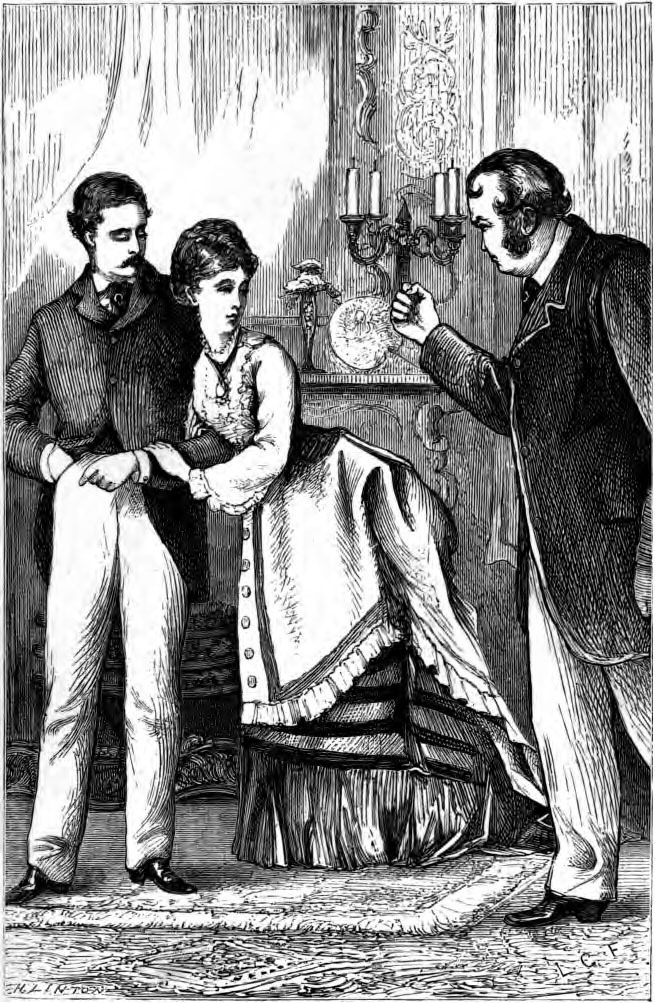
"Of course I will go to bed, if you tell me, papa."
"I do tell you. How dare you take hold of him in that way before me!
Have you no idea of disgrace?"
"I am not disgraced. It is not more disgraceful to love him than that
other man. Oh, papa, don't. You hurt me. I am going." He took her by
the arm and dragged her to the door, and then thrust her out.
"I am very sorry, Mr. Melmotte," said Sir Felix, "to have had a hand
in causing this disturbance."
"Go away, and don't come back any more;--that's all. You can't both
marry her. All you have got to understand is this. I'm not the man to
give my daughter a single shilling if she marries against my consent.
By the God that hears me, Sir Felix, she shall not have one shilling.
But look you,--if you'll give this up, I shall be proud to co-operate
with you in anything you may wish to have done in the city."
After this Sir Felix left the room, went down the stairs, had the
door opened for him, and was ushered into the square. But as he
went through the hall a woman managed to shove a note into his
hand,--which he read as soon as he found himself under a gas lamp. It
was dated that morning, and had therefore no reference to the fray
which had just taken place. It ran as follows:--
I hope you will come to-night. There is something I cannot
tell you then, but you ought to know it. When we were in
France papa thought it wise to settle a lot of money on
me. I don't know how much, but I suppose it was enough to
live on if other things went wrong. He never talked to
me about it, but I know it was done. And it hasn't been
undone, and can't be without my leave. He is very angry
about you this morning, for I told him I would never give
you up. He says he won't give me anything if I marry
without his leave. But I am sure he cannot take it away. I
tell you, because I think I ought to tell you everything.
M.
Sir Felix as he read this could not but think that he had become
engaged to a very enterprising young lady. It was evident that she
did not care to what extent she braved her father on behalf of her
lover, and now she coolly proposed to rob him. But Sir Felix saw no
reason why he should not take advantage of the money made over to the
girl's name, if he could lay his hands on it. He did not know much of
such transactions, but he knew more than Marie Melmotte, and could
understand that a man in Melmotte's position should want to secure
a portion of his fortune against accidents, by settling it on his
daughter. Whether having so settled it, he could again resume it
without the daughter's assent, Sir Felix did not know. Marie, who
had no doubt been regarded as an absolutely passive instrument when
the thing was done, was now quite alive to the benefit which she
might possibly derive from it. Her proposition, put into plain
English, amounted to this: "Take me and marry me without my father's
consent,--and then you and I together can rob my father of the money
which, for his own purposes, he has settled upon me." He had looked
upon the lady of his choice as a poor weak thing, without any special
character of her own, who was made worthy of consideration only by
the fact that she was a rich man's daughter; but now she began to
loom before his eyes as something bigger than that. She had had a
will of her own when the mother had none. She had not been afraid of
her brutal father when he, Sir Felix, had trembled before him. She
had offered to be beaten, and killed, and chopped to pieces on behalf
of her lover. There could be no doubt about her running away if she
were asked.
It seemed to him that within the last month he had gained a great
deal of experience, and that things which heretofore had been
troublesome to him, or difficult, or perhaps impossible, were now
coming easily within his reach. He had won two or three thousand
pounds at cards, whereas invariable loss had been the result of
the small play in which he had before indulged. He had been set to
marry this heiress, having at first no great liking for the attempt,
because of its difficulties and the small amount of hope which it
offered him. The girl was already willing and anxious to jump into
his arms. Then he had detected a man cheating at cards,--an extent
of iniquity that was awful to him before he had seen it,--and was
already beginning to think that there was not very much in that. If
there was not much in it, if such a man as Miles Grendall could cheat
at cards and be brought to no punishment, why should not he try it?
It was a rapid way of winning, no doubt. He remembered that on one or
two occasions he had asked his adversary to cut the cards a second
time at whist, because he had observed that there was no honour at
the bottom. No feeling of honesty had interfered with him. The little
trick had hardly been premeditated, but when successful without
detection had not troubled his conscience. Now it seemed to him that
much more than that might be done without detection. But nothing
had opened his eyes to the ways of the world so widely as the sweet
little lover-like proposition made by Miss Melmotte for robbing her
father. It certainly recommended the girl to him. She had been able
at an early age, amidst the circumstances of a very secluded life,
to throw off from her altogether those scruples of honesty, those
bugbears of the world, which are apt to prevent great enterprises in
the minds of men.
What should he do next? This sum of money of which Marie wrote so
easily was probably large. It would not have been worth the while
of such a man as Mr. Melmotte to make a trifling provision of this
nature. It could hardly be less than £50,000,--might probably be
very much more. But this was certain to him,--that if he and Marie
were to claim this money as man and wife, there could then be no
hope of further liberality. It was not probable that such a man
as Mr. Melmotte would forgive even an only child such an offence
as that. Even if it were obtained, £50,000 would not be very much.
And Melmotte might probably have means, even if the robbery were
duly perpetrated, of making the possession of the money very
uncomfortable. These were deep waters into which Sir Felix was
preparing to plunge; and he did not feel himself to be altogether
comfortable, although he liked the deep waters.
CHAPTER XXX.
MR. MELMOTTE'S PROMISE.
On the following Saturday there appeared in Mr. Alf's paper, the
"Evening Pulpit," a very remarkable article on the South Central
Pacific and Mexican Railway. It was an article that attracted a great
deal of attention and was therefore remarkable, but it was in nothing
more remarkable than in this,--that it left on the mind of its reader
no impression of any decided opinion about the railway. The Editor
would at any future time be able to refer to his article with equal
pride whether the railway should become a great cosmopolitan fact,
or whether it should collapse amidst the foul struggles of a horde
of swindlers. In utrumque paratus, the article was mysterious,
suggestive, amusing, well-informed,--that in the "Evening Pulpit"
was a matter of course,--and, above all things, ironical. Next to
its omniscience its irony was the strongest weapon belonging to
the "Evening Pulpit." There was a little praise given, no doubt in
irony, to the duchesses who served Mr. Melmotte. There was a little
praise, given of course in irony, to Mr. Melmotte's Board of English
Directors. There was a good deal of praise, but still alloyed by a
dash of irony, bestowed on the idea of civilising Mexico by joining
it to California. Praise was bestowed upon England for taking up the
matter, but accompanied by some ironical touches at her incapacity
to believe thoroughly in any enterprise not originated by herself.
Then there was something said of the universality of Mr. Melmotte's
commercial genius, but whether said in a spirit prophetic of ultimate
failure and disgrace, or of heavenborn success and unequalled
commercial splendour, no one could tell.
It was generally said at the clubs that Mr. Alf had written this
article himself. Old Splinter, who was one of a body of men
possessing an excellent cellar of wine and calling themselves Paides
Pallados, and who had written for the heavy quarterlies any time this
last forty years, professed that he saw through the article. The
"Evening Pulpit" had been, he explained, desirous of going as far as
it could in denouncing Mr. Melmotte without incurring the danger of
an action for libel. Mr. Splinter thought that the thing was clever
but mean. These new publications generally were mean. Mr. Splinter
was constant in that opinion; but, putting the meanness aside,
he thought that the article was well done. According to his view
it was intended to expose Mr. Melmotte and the railway. But the
Paides Pallados generally did not agree with him. Under such an
interpretation, what had been the meaning of that paragraph in which
the writer had declared that the work of joining one ocean to another
was worthy of the nearest approach to divinity that had been granted
to men? Old Splinter chuckled and gabbled as he heard this, and
declared that there was not wit enough left now even among the Paides
Pallados to understand a shaft of irony. There could be no doubt,
however, at the time, that the world did not go with old Splinter,
and that the article served to enhance the value of shares in the
great railway enterprise.
Lady Carbury was sure that the article was intended to write up the
railway, and took great joy in it. She entertained in her brain a
somewhat confused notion that if she could only bestir herself in the
right direction and could induce her son to open his eyes to his own
advantage, very great things might be achieved, so that wealth might
become his handmaid and luxury the habit and the right of his life.
He was the beloved and the accepted suitor of Marie Melmotte. He was
a Director of this great company, sitting at the same board with the
great commercial hero. He was the handsomest young man in London.
And he was a baronet. Very wild ideas occurred to her. Should she take
Mr. Alf into her entire confidence? If Melmotte and Alf could be
brought together what might they not do? Alf could write up Melmotte,
and Melmotte could shower shares upon Alf. And if Melmotte would come
and be smiled upon by herself, be flattered as she thought that she
could flatter him, be told that he was a god, and have that passage
about the divinity of joining ocean to ocean construed to him as she
could construe it, would not the great man become plastic under her
hands? And if, while this was a-doing, Felix would run away with
Marie, could not forgiveness be made easy? And her creative mind
ranged still farther. Mr. Broune might help, and even Mr. Booker. To
such a one as Melmotte, a man doing great things through the force of
the confidence placed in him by the world at large, the freely-spoken
support of the Press would be everything. Who would not buy shares in
a railway as to which Mr. Broune and Mr. Alf would combine in saying
that it was managed by "divinity"? Her thoughts were rather hazy, but
from day to day she worked hard to make them clear to herself.
On the Sunday afternoon Mr. Booker called on her and talked to her
about the article. She did not say much to Mr. Booker as to her own
connection with Mr. Melmotte, telling herself that prudence was
essential in the present emergency. But she listened with all her
ears. It was Mr. Booker's idea that the man was going "to make a
spoon or spoil a horn." "You think him honest;--don't you?" asked
Lady Carbury. Mr. Booker smiled and hesitated. "Of course, I mean
honest as men can be in such very large transactions."
"Perhaps that is the best way of putting it," said Mr. Booker.
"If a thing can be made great and beneficent, a boon to humanity,
simply by creating a belief in it, does not a man become a benefactor
to his race by creating that belief?"
"At the expense of veracity?" suggested Mr. Booker.
"At the expense of anything?" rejoined Lady Carbury with energy. "One
cannot measure such men by the ordinary rule."
"You would do evil to produce good?" asked Mr. Booker.
"I do not call it doing evil. You have to destroy a thousand living
creatures every time you drink a glass of water, but you do not think
of that when you are athirst. You cannot send a ship to sea without
endangering lives. You do send ships to sea though men perish yearly.
You tell me this man may perhaps ruin hundreds, but then again he may
create a new world in which millions will be rich and happy."
"You are an excellent casuist, Lady Carbury."
"I am an enthusiastic lover of beneficent audacity," said Lady
Carbury, picking her words slowly, and showing herself to be quite
satisfied with herself as she picked them. "Did I hold your place,
Mr. Booker, in the literature of my country,--"
"I hold no place, Lady Carbury."
"Yes;--and a very distinguished place. Were I circumstanced as you
are I should have no hesitation in lending the whole weight of my
periodical, let it be what it might, to the assistance of so great
a man and so great an object as this."
"I should be dismissed to-morrow," said Mr. Booker, getting up
and laughing as he took his departure. Lady Carbury felt that, as
regarded Mr. Booker, she had only thrown out a chance word that
could not do any harm. She had not expected to effect much through
Mr. Booker's instrumentality. On the Tuesday evening,--her regular
Tuesday as she called it,--all her three editors came to her
drawing-room; but there came also a greater man than either of them.
She had taken the bull by the horns, and without saying anything to
anybody had written to Mr. Melmotte himself, asking him to honour her
poor house with his presence. She had written a very pretty note to
him, reminding him of their meeting at Caversham, telling him that
on a former occasion Madame Melmotte and his daughter had been so
kind as to come to her, and giving him to understand that of all the
potentates now on earth he was the one to whom she could bow the
knee with the purest satisfaction. He wrote back,--or Miles Grendall did
for him,--a very plain note, accepting the honour of Lady Carbury's
invitation.
The great man came, and Lady Carbury took him under her immediate
wing with a grace that was all her own. She said a word about their
dear friends at Caversham, expressed her sorrow that her son's
engagements did not admit of his being there, and then with the
utmost audacity rushed off to the article in the "Pulpit." Her
friend, Mr. Alf, the editor, had thoroughly appreciated the greatness
of Mr. Melmotte's character, and the magnificence of Mr. Melmotte's
undertakings. Mr. Melmotte bowed and muttered something that was
inaudible. "Now I must introduce you to Mr. Alf," said the lady.
The introduction was effected, and Mr. Alf explained that it was
hardly necessary, as he had already been entertained as one of Mr.
Melmotte's guests.
"There were a great many there I never saw, and probably never shall
see," said Mr. Melmotte.
"I was one of the unfortunates," said Mr. Alf.
"I'm sorry you were unfortunate. If you had come into the whist-room
you would have found me."
"Ah,--if I had but known!" said Mr. Alf. The editor, as was proper,
carried about with him samples of the irony which his paper used so
effectively, but it was altogether thrown away upon Melmotte.
Lady Carbury finding that no immediate good results could be expected
from this last introduction, tried another. "Mr. Melmotte," she said,
whispering to him, "I do so want to make you known to Mr. Broune. Mr.
Broune I know you have never met before. A morning paper is a much
heavier burden to an editor than one published in the afternoon. Mr.
Broune, as of course you know, manages the 'Breakfast Table.' There
is hardly a more influential man in London than Mr. Broune. And
they declare, you know," she said, lowering the tone of her whisper
as she communicated the fact, "that his commercial articles are
gospel,--absolutely gospel." Then the two men were named to each
other, and Lady Carbury retreated;--but not out of hearing.
"Getting very hot," said Mr. Melmotte.
"Very hot indeed," said Mr. Broune.
"It was over 70 in the city to-day. I call that very hot for June."
"Very hot indeed," said Mr. Broune again. Then the conversation was
over. Mr. Broune sidled away, and Mr. Melmotte was left standing in
the middle of the room. Lady Carbury told herself at the moment that
Rome was not built in a day. She would have been better satisfied
certainly if she could have laid a few more bricks on this day.
Perseverance, however, was the thing wanted.
But Mr. Melmotte himself had a word to say, and before he left
the house he said it. "It was very good of you to ask me, Lady
Carbury;--very good." Lady Carbury intimated her opinion that the
goodness was all on the other side. "And I came," continued Mr.
Melmotte, "because I had something particular to say. Otherwise
I don't go out much to evening parties. Your son has proposed to
my daughter." Lady Carbury looked up into his face with all her
eyes;--clasped both her hands together; and then, having unclasped
them, put one upon his sleeve. "My daughter, ma'am, is engaged to
another man."
"You would not enslave her affections, Mr. Melmotte?"
"I won't give her a shilling if she marries any one else; that's all.
You reminded me down at Caversham that your son is a Director at our
Board."
"I did;--I did."
"I have a great respect for your son, ma'am. I don't want to hurt him
in any way. If he'll signify to my daughter that he withdraws from
this offer of his, because I'm against it, I'll see that he does
uncommon well in the city. I'll be the making of him. Good night,
ma'am." Then Mr. Melmotte took his departure without another word.
Here at any rate was an undertaking on the part of the great man
that he would be the "making of Felix," if Felix would only obey
him--accompanied, or rather preceded, by a most positive assurance
that if Felix were to succeed in marrying his daughter he would not
give his son-in-law a shilling! There was very much to be considered
in this. She did not doubt that Felix might be "made" by Mr.
Melmotte's city influences, but then any perpetuity of such making
must depend on qualifications in her son which she feared that he did
not possess. The wife without the money would be terrible! That would
be absolute ruin! There could be no escape then; no hope. There was
an appreciation of real tragedy in her heart while she contemplated
the position of Sir Felix married to such a girl as she supposed
Marie Melmotte to be, without any means of support for either of
them but what she could supply. It would kill her. And for those
young people there would be nothing before them, but beggary and the
workhouse. As she thought of this she trembled with true maternal
instincts. Her beautiful boy,--so glorious with his outward gifts,
so fit, as she thought him, for all the graces of the grand world!
Though the ambition was vilely ignoble, the mother's love was noble
and disinterested.
But the girl was an only child. The future honours of the house
of Melmotte could be made to settle on no other head. No doubt
the father would prefer a lord for a son-in-law; and, having that
preference, would of course do as he was now doing. That he should
threaten to disinherit his daughter if she married contrary to his
wishes was to be expected. But would it not be equally a matter of
course that he should make the best of the marriage if it were once
effected? His daughter would return to him with a title, though
with one of a lower degree than his ambition desired. To herself
personally, Lady Carbury felt that the great financier had been very
rude. He had taken advantage of her invitation that he might come to
her house and threaten her. But she would forgive that. She could
pass that over altogether if only anything were to be gained by
passing it over.
She looked round the room, longing for a friend, whom she might
consult with a true feeling of genuine womanly dependence. Her most
natural friend was Roger Carbury. But even had he been there she
could not have consulted him on any matter touching the Melmottes.
His advice would have been very clear. He would have told her to have
nothing at all to do with such adventurers. But then dear Roger was
old fashioned, and knew nothing of people as they are now. He lived
in a world which, though slow, had been good in its way; but which,
whether bad or good, had now passed away. Then her eye settled on
Mr. Broune. She was afraid of Mr. Alf. She had almost begun to think
that Mr. Alf was too difficult of management to be of use to her. But
Mr. Broune was softer. Mr. Booker was serviceable for an article,
but would not be sympathetic as a friend. Mr. Broune had been very
courteous to her lately;--so much so that on one occasion she had
almost feared that the "susceptible old goose" was going to be a
goose again. That would be a bore; but still she might make use
of the friendly condition of mind which such susceptibility would
produce. When her guests began to leave her, she spoke a word aside
to him. She wanted his advice. Would he stay for a few minutes after
the rest of the company? He did stay, and when all the others were
gone she asked her daughter to leave them. "Hetta," she said, "I have
something of business to communicate to Mr. Broune." And so they were
left alone.
"I'm afraid you didn't make much of Mr. Melmotte," she said smiling.
He had seated himself on the end of a sofa, close to the arm-chair
which she occupied. In reply, he only shook his head and laughed.
"I saw how it was, and I was sorry for it; for he certainly is a
wonderful man."
"I suppose he is, but he is one of those men whose powers do not lie,
I should say, chiefly in conversation. Though, indeed, there is no
reason why he should not say the same of me;--for if he said little,
I said less."
"It didn't just come off," Lady Carbury suggested with her sweetest
smile. "But now I want to tell you something. I think I am justified
in regarding you as a real friend."
"Certainly," he said, putting out his hand for hers.
She gave it to him for a moment, and then took it back
again,--finding that he did not relinquish it of his own accord.
"Stupid old goose!" she said to herself. "And now to my story. You
know my boy, Felix?" The editor nodded his head. "He is engaged to
marry that man's daughter."
"Engaged to marry Miss Melmotte?" Then Lady Carbury nodded her head.
"Why, she is said to be the greatest heiress that the world has ever
produced. I thought she was to marry Lord Nidderdale."
"She has engaged herself to Felix. She is desperately in love with
him,--as is he with her." She tried to tell her story truly, knowing
that no advice can be worth anything that is not based on a true
story;--but lying had become her nature. "Melmotte naturally wants
her to marry the lord. He came here to tell me that if his daughter
married Felix she should not have a penny."
"Do you mean that he volunteered that,--as a threat?"
"Just so;--and he told me that he had come here simply with the
object of saying so. It was more candid than civil, but we must take
it as we get it."
"He would be sure to make some such threat."
"Exactly. That is just what I feel. And in these days young people
are not often kept from marrying simply by a father's fantasy. But I
must tell you something else. He told me that if Felix would desist,
he would enable him to make a fortune in the city."
"That's bosh," said Broune with decision.
"Do you think it must be so;--certainly?"
"Yes, I do. Such an undertaking, if intended by Melmotte, would give
me a worse opinion of him than I have ever held."
"He did make it."
"Then he did very wrong. He must have spoken with the purpose of
deceiving."
"You know my son is one of the Directors of that great American
Railway. It was not just as though the promise were made to a young
man who was altogether unconnected with him."
"Sir Felix's name was put there, in a hurry, merely because he has a
title, and because Melmotte thought he, as a young man, would not be
likely to interfere with him. It may be that he will be able to sell
a few shares at a profit; but, if I understand the matter rightly, he
has no capital to go into such a business."
"No;--he has no capital."
"Dear Lady Carbury, I would place no dependence at all on such a
promise as that."
"You think he should marry the girl then in spite of the father?"
Mr. Broune hesitated before he replied to this question. But it was
to this question that Lady Carbury especially wished for a reply.
She wanted some one to support her under the circumstances of an
elopement. She rose from her chair, and he rose at the same time.
"Perhaps I should have begun by saying that Felix is all but prepared
to take her off. She is quite ready to go. She is devoted to him. Do
you think he would be wrong?"
"That is a question very hard to answer."
"People do it every day. Lionel Goldsheiner ran away the other day
with Lady Julia Start, and everybody visits them."
"Oh yes, people do run away, and it all comes right. It was the
gentleman had the money then, and it is said you know that old Lady
Catchboy, Lady Julia's mother, had arranged the elopement herself as
offering the safest way of securing the rich prize. The young lord
didn't like it, so the mother had it done in that fashion."
"There would be nothing disgraceful."
"I didn't say there would;--but nevertheless it is one of those
things a man hardly ventures to advise. If you ask me whether I
think that Melmotte would forgive her, and make her an allowance
afterwards,--I think he would."
"I am so glad to hear you say that."
"And I feel quite certain that no dependence whatever should be
placed on that promise of assistance."
"I quite agree with you. I am so much obliged to you," said Lady
Carbury, who was now determined that Felix should run off with the
girl. "You have been so very kind." Then again she gave him her hand,
as though to bid him farewell for the night.
"And now," he said, "I also have something to say to you."
CHAPTER XXXI.
MR. BROUNE HAS MADE UP HIS MIND.
"And now I have something to say to you." Mr. Broune as he thus spoke
to Lady Carbury rose up to his feet and then sat down again. There
was an air of perturbation about him which was very manifest to the
lady, and the cause and coming result of which she thought that she
understood. "The susceptible old goose is going to do something
highly ridiculous and very disagreeable." It was thus that she spoke
to herself of the scene that she saw was prepared for her, but she
did not foresee accurately the shape in which the susceptibility
of the "old goose" would declare itself. "Lady Carbury," said Mr.
Broune, standing up a second time, "we are neither of us so young as
we used to be."
"No, indeed;--and therefore it is that we can afford to ourselves the
luxury of being friends. Nothing but age enables men and women to
know each other intimately."
This speech was a great impediment to Mr. Broune's progress. It was
evidently intended to imply that he at least had reached a time of
life at which any allusion to love would be absurd. And yet, as a
fact, he was nearer fifty than sixty, was young of his age, could
walk his four or five miles pleasantly, could ride his cob in the
park with as free an air as any man of forty, and could afterwards
work through four or five hours of the night with an easy steadiness
which nothing but sound health could produce. Mr. Broune, thinking of
himself and his own circumstances, could see no reason why he should
not be in love. "I hope we know each other intimately at any rate,"
he said somewhat lamely.
"Oh, yes;--and it is for that reason that I have come to you for
advice. Had I been a young woman I should not have dared to ask you."
"I don't see that. I don't quite understand that. But it has nothing
to do with my present purpose. When I said that we were neither of us
so young as we once were, I uttered what was a stupid platitude,--a
foolish truism."
"I did not think so," said Lady Carbury smiling.
"Or would have been, only that I intended something further."
Mr.
Broune had got himself into a difficulty and hardly knew how to get
out of it. "I was going on to say that I hoped we were not too old
to--love."
Foolish old darling! What did he mean by making such an ass of
himself? This was worse even than the kiss, as being more troublesome
and less easily pushed on one side and forgotten. It may serve to
explain the condition of Lady Carbury's mind at the time if it be
stated that she did not even at this moment suppose that the editor
of the "Morning Breakfast Table" intended to make her an offer of
marriage. She knew, or thought she knew, that middle-aged men are
fond of prating about love, and getting up sensational scenes. The
falseness of the thing, and the injury which may come of it, did
not shock her at all. Had she known that the editor professed to
be in love with some lady in the next street, she would have been
quite ready to enlist the lady in the next street among her friends
that she might thus strengthen her own influence with Mr. Broune.
For herself such make-belief of an improper passion would be
inconvenient, and therefore to be avoided. But that any man, placed
as Mr. Broune was in the world,--blessed with power, with a large
income, with influence throughout all the world around him, courted,
fêted, feared and almost worshipped,--that he should desire to
share her fortunes, her misfortunes, her struggles, her poverty and
her obscurity, was not within the scope of her imagination. There
was a homage in it, of which she did not believe any man to be
capable,--and which to her would be the more wonderful as being paid
to herself. She thought so badly of men and women generally, and of
Mr. Broune and herself as a man and a woman individually, that she
was unable to conceive the possibility of such a sacrifice. "Mr.
Broune," she said, "I did not think that you would take advantage of
the confidence I have placed in you to annoy me in this way."
"To annoy you, Lady Carbury! The phrase at any rate is singular.
After much thought I have determined to ask you to be my wife. That
I should be--annoyed, and more than annoyed by your refusal, is a
matter of course. That I ought to expect such annoyance is perhaps
too true. But you can extricate yourself from the dilemma only too
easily."
The word "wife" came upon her like a thunder-clap. It at once chang-
ed all her feelings towards him. She did not dream of loving him.
She felt sure that she never could love him. Had it been on the
cards with her to love any man as a lover, it would have been some
handsome spendthrift who would have hung from her neck like a nether
millstone. This man was a friend to be used,--to be used because he
knew the world. And now he gave her this clear testimony that he knew
as little of the world as any other man. Mr. Broune of the "Daily
Breakfast Table" asking her to be his wife! But mixed with her other
feelings there was a tenderness which brought back some memory of
her distant youth, and almost made her weep. That a man,--such a
man,--should offer to take half her burdens, and to confer upon her
half his blessings! What an idiot! But what a God! She had looked
upon the man as all intellect, alloyed perhaps by some passionless
remnants of the vices of his youth; and now she found that he not
only had a human heart in his bosom, but a heart that she could
touch. How wonderfully sweet! How infinitely small!
It was necessary that she should answer him--and to her it was only
natural that she should at first think what answer would best assist
her own views without reference to his. It did not occur to her that
she could love him; but it did occur to her that he might lift her
out of her difficulties. What a benefit it would be to her to have a
father, and such a father, for Felix! How easy would be a literary
career to the wife of the editor of the "Morning Breakfast Table!"
And then it passed through her mind that somebody had told her that
the man was paid £3,000 a year for his work. Would not the world, or
any part of it that was desirable, come to her drawing-room if she
were the wife of Mr. Broune? It all passed through her brain at once
during that minute of silence which she allowed herself after the
declaration was made to her. But other ideas and other feelings were
present to her also. Perhaps the truest aspiration of her heart had
been the love of freedom which the tyranny of her late husband had
engendered. Once she had fled from that tyranny and had been almost
crushed by the censure to which she had been subjected. Then her
husband's protection and his tyranny had been restored to her. After
that the freedom had come. It had been accompanied by many hopes
never as yet fulfilled, and embittered by many sorrows which had
been always present to her; but still the hopes were alive and the
remembrance of the tyranny was very clear to her. At last the minute
was over and she was bound to speak. "Mr. Broune," she said, "you
have quite taken away my breath. I never expected anything of this
kind."
And now Mr. Broune's mouth was opened, and his voice was free. "Lady
Carbury," he said, "I have lived a long time without marrying, and I
have sometimes thought that it would be better for me to go on in the
same way to the end. I have worked so hard all my life that when I
was young I had no time to think of love. And, as I have gone on,
my mind has been so fully employed, that I have hardly realised the
want which nevertheless I have felt. And so it has been with me till
I fancied, not that I was too old for love, but that others would
think me so. Then I met you. As I said at first, perhaps with scant
gallantry, you also are not as young as you once were. But you keep
the beauty of your youth, and the energy, and something of the
freshness of a young heart. And I have come to love you. I speak with
absolute frankness, risking your anger. I have doubted much before
I resolved upon this. It is so hard to know the nature of another
person. But I think I understand yours;--and if you can confide your
happiness with me, I am prepared to intrust mine to your keeping."
Poor Mr. Broune! Though endowed with gifts peculiarly adapted for the
editing of a daily newspaper, he could have had but little capacity
for reading a woman's character when he talked of the freshness of
Lady Carbury's young mind! And he must have surely been much blinded
by love, before convincing himself that he could trust his happiness
to such keeping.
"You do me infinite honour. You pay me a great compliment,"
ejaculated Lady Carbury.
"Well?"
"How am I to answer you at a moment? I expected nothing of this. As
God is to be my judge it has come upon me like a dream. I look upon
your position as almost the highest in England,--on your prosperity
as the uttermost that can be achieved."
"That prosperity, such as it is, I desire most anxiously to share
with you."
"You tell me so;--but I can hardly yet believe it. And then how am I
to know my own feelings so suddenly? Marriage as I have found it, Mr.
Broune, has not been happy. I have suffered much. I have been wounded
in every joint, hurt in every nerve,--tortured till I could hardly
endure my punishment. At last I got my liberty, and to that I have
looked for happiness."
"Has it made you happy?"
"It has made me less wretched. And there is so much to be considered!
I have a son and a daughter, Mr. Broune."
"Your daughter I can love as my own. I think I prove my devotion
to you when I say that I am willing for your sake to encounter the
troubles which may attend your son's future career."
"Mr. Broune, I love him better,--always shall love him better,--than
anything in the world." This was calculated to damp the lover's
ardour, but he probably reflected that should he now be successful,
time might probably change the feeling which had just been expressed.
"Mr. Broune," she said, "I am now so agitated that you had better
leave me. And it is very late. The servant is sitting up, and will
wonder that you should remain. It is near two o'clock."
"When may I hope for an answer?"
"You shall not be kept waiting. I will write to you, almost at once.
I will write to you,--to-morrow; say the day after to-morrow, on
Thursday. I feel that I ought to have been prepared with an answer;
but I am so surprised that I have none ready." He took her hand in
his, and kissing it, left her without another word.
As he was about to open the front door to let himself out, a key
from the other side raised the latch, and Sir Felix, returning from
his club, entered his mother's house. The young man looked up into
Mr. Broune's face with mingled impudence and surprise. "Halloo, old
fellow," he said, "you've been keeping it up late here; haven't
you?" He was nearly drunk, and Mr. Broune, perceiving his condition,
passed him without a word. Lady Carbury was still standing in the
drawing-room, struck with amazement at the scene which had just
passed, full of doubt as to her future conduct, when she heard her
son stumbling up the stairs. It was impossible for her not to go out
to him. "Felix," she said, "why do you make so much noise as you come
in?"
"Noish! I'm not making any noish. I think I'm very early. Your
people's only just gone. I shaw shat editor fellow at the door that
won't call himself Brown. He'sh great ass'h, that fellow. All right,
mother. Oh, ye'sh I'm all right." And so he stumbled up to bed, and
his mother followed him to see that the candle was at any rate placed
squarely on the table, beyond the reach of the bed curtains.
Mr. Broune as he walked to his newspaper office experienced all those
pangs of doubts which a man feels when he has just done that which
for days and weeks past he has almost resolved that he had better
leave undone. That last apparition which he had encountered at his
lady love's door certainly had not tended to reassure him. What curse
can be much greater than that inflicted by a drunken, reprobate son?
The evil, when in the course of things it comes upon a man, has to
be borne; but why should a man in middle life unnecessarily afflict
himself with so terrible a misfortune? The woman, too, was devoted to
the cub! Then thousands of other thoughts crowded upon him. How would
this new life suit him? He must have a new house, and new ways; must
live under a new dominion, and fit himself to new pleasures. And what
was he to gain by it? Lady Carbury was a handsome woman, and he liked
her beauty. He regarded her too as a clever woman; and, because she
had flattered him, he had liked her conversation. He had been long
enough about town to have known better,--and as he now walked along
the streets, he almost felt that he ought to have known better. Every
now and again he warmed himself a little with the remembrance of
her beauty, and told himself that his new home would be pleasanter,
though it might perhaps be less free, than the old one. He tried to
make the best of it; but as he did so was always repressed by the
memory of the appearance of that drunken young baronet.
Whether for good or for evil, the step had been taken and the thing
was done. It did not occur to him that the lady would refuse him.
All his experience of the world was against such refusal. Towns
which consider, always render themselves. Ladies who doubt always
solve their doubts in the one direction. Of course she would accept
him;--and of course he would stand to his guns. As he went to his
work he endeavoured to bathe himself in self-complacency; but, at the
bottom of it, there was a substratum of melancholy which leavened his
prospects.
Lady Carbury went from the door of her son's room to her own chamber,
and there sat thinking through the greater part of the night.
During these hours she perhaps became a better woman, as being more
oblivious of herself, than she had been for many a year. It could not
be for the good of this man that he should marry her,--and she did in
the midst of her many troubles try to think of the man's condition.
Although in the moments of her triumph,--and such moments were
many,--she would buoy herself up with assurances that her Felix
would become a rich man, brilliant with wealth and rank, an honour
to her, a personage whose society would be desired by many, still
in her heart of hearts she knew how great was the peril, and in her
imagination she could foresee the nature of the catastrophe which
might come. He would go utterly to the dogs and would take her with
him. And whithersoever he might go, to what lowest canine regions he
might descend, she knew herself well enough to be sure that whether
married or single she would go with him. Though her reason might be
ever so strong in bidding her to desert him, her heart, she knew,
would be stronger than her reason. He was the one thing in the world
that overpowered her. In all other matters she could scheme, and
contrive, and pretend; could get the better of her feelings and fight
the world with a double face, laughing at illusions and telling
herself that passions and preferences were simply weapons to be used.
But her love for her son mastered her,--and she knew it. As it was
so, could it be fit that she should marry another man?
And then her liberty! Even though Felix should bring her to utter
ruin, nevertheless she would be and might remain a free woman. Should
the worse come to the worst she thought that she could endure a
Bohemian life in which, should all her means have been taken from
her, she could live on what she earned. Though Felix was a tyrant
after a kind, he was not a tyrant who could bid her do this or that.
A repetition of marriage vows did not of itself recommend itself to
her. As to loving the man, liking his caresses, and being specially
happy because he was near her,--no romance of that kind ever
presented itself to her imagination. How would it affect Felix and
her together,--and Mr. Broune as connected with her and Felix? If
Felix should go to the dogs, then would Mr. Broune not want her.
Should Felix go to the stars instead of the dogs, and become one of
the gilded ornaments of the metropolis, then would not he and she
want Mr. Broune. It was thus that she regarded the matter.
She thought very little of her daughter as she considered all this.
There was a home for Hetta, with every comfort, if Hetta would only
condescend to accept it. Why did not Hetta marry her cousin Roger
Carbury and let there be an end of that trouble? Of course Hetta
must live wherever her mother lived till she should marry; but
Hetta's life was so much at her own disposal that her mother did
not feel herself bound to be guided in the great matter by Hetta's
predispositions.
But she must tell Hetta should she ultimately make up her mind to
marry the man, and in that case the sooner this was done the better.
On that night she did not make up her mind. Ever and again as she
declared to herself that she would not marry him, the picture of a
comfortable assured home over her head, and the conviction that the
editor of the "Morning Breakfast Table" would be powerful for all
things, brought new doubts to her mind. But she could not convince
herself, and when at last she went to her bed her mind was still
vacillating. The next morning she met Hetta at breakfast, and with
assumed nonchalance asked a question about the man who was perhaps
about to be her husband. "Do you like Mr. Broune, Hetta?"
"Yes;--pretty well. I don't care very much about him. What makes you
ask, mamma?"
"Because among my acquaintances in London there is no one so truly
kind to me as he is."
"He always seems to me to like to have his own way."
"Why shouldn't he like it?"
"He has to me that air of selfishness which is so very common with
people in London;--as though what he said were all said out of
surface politeness."
"I wonder what you expect, Hetta, when you talk of--London people?
Why should not London people be as kind as other people? I think Mr.
Broune is as obliging a man as any one I know. But if I like anybody,
you always make little of him. The only person you seem to think well
of is Mr. Montague."
"Mamma, that is unfair and unkind. I never mention Mr. Montague's
name if I can help it,--and I should not have spoken of Mr. Broune,
had you not asked me."
CHAPTER XXXII.
LADY MONOGRAM.
Georgiana Longestaffe had now been staying with the Melmottes for
a fortnight, and her prospects in regard to the London season had
not much improved. Her brother had troubled her no further, and her
family at Caversham had not, as far as she was aware, taken any
notice of Dolly's interference. Twice a week she received a cold,
dull letter from her mother,--such letters as she had been accustomed
to receive when away from home; and these she had answered, always
endeavouring to fill her sheet with some customary description of
fashionable doings, with some bit of scandal such as she would have
repeated for her mother's amusement,--and her own delectation in the
telling of it,--had there been nothing painful in the nature of her
sojourn in London. Of the Melmottes she hardly spoke. She did not
say that she was taken to the houses in which it was her ambition to
be seen. She would have lied directly in saying so. But she did not
announce her own disappointment. She had chosen to come up to the
Melmottes in preference to remaining at Caversham, and she would not
declare her own failure. "I hope they are kind to you," Lady Pomona
always said. But Georgiana did not tell her mother whether the
Melmottes were kind or unkind.
In truth, her "season" was a very unpleasant season. Her mode of
living was altogether different to anything she had already known.
The house in Bruton Street had never been very bright, but the
appendages of life there had been of a sort which was not known in
the gorgeous mansion in Grosvenor Square. It had been full of books
and little toys and those thousand trifling household gods which are
accumulated in years, and which in their accumulation suit themselves
to the taste of their owners. In Grosvenor Square there were no
Lares;--no toys, no books, nothing but gold and grandeur, pomatum,
powder and pride. The Longestaffe life had not been an easy, natural,
or intellectual life; but the Melmotte life was hardly endurable even
by a Longestaffe. She had, however, come prepared to suffer much,
and was endowed with considerable power of endurance in pursuit of
her own objects. Having willed to come, even to the Melmottes, in
preference to remaining at Caversham, she fortified herself to suffer
much. Could she have ridden in the park at mid-day in desirable
company, and found herself in proper houses at midnight, she would
have borne the rest, bad as it might have been. But it was not
so. She had her horse, but could with difficulty get any proper
companion. She had been in the habit of riding with one of the
Primero girls,--and old Primero would accompany them, or perhaps a
brother Primero, or occasionally her own father. And then, when once
out, she would be surrounded by a cloud of young men,--and though
there was but little in it, a walking round and round the same bit
of ground with the same companions and with the smallest attempt at
conversation, still it had been the proper thing and had satisfied
her. Now it was with difficulty that she could get any cavalier
such as the laws of society demand. Even Penelope Primero snubbed
her,--whom she, Georgiana Longestaffe, had hitherto endured and
snubbed. She was just allowed to join them when old Primero rode, and
was obliged even to ask for that assistance.
But the nights were still worse. She could only go where Madame
Melmotte went, and Madame Melmotte was more prone to receive
people at home than to go out. And the people she did receive were
antipathetic to Miss Longestaffe. She did not even know who they
were, whence they came, or what was their nature. They seemed to
be as little akin to her as would have been the shopkeepers in the
small town near Caversham. She would sit through long evenings al-
most speechless, trying to fathom the depth of the vulgarity of her
associates. Occasionally she was taken out, and was then, probably,
taken to very grand houses. The two duchesses and the Marchioness
of Auld Reekie received Madame Melmotte, and the garden parties of
royalty were open to her. And some of the most elaborate fêtes of
the season,--which indeed were very elaborate on behalf of this and
that travelling potentate,--were attained. On these occasions Miss
Longestaffe was fully aware of the struggle that was always made for
invitations, often unsuccessfully, but sometimes with triumph. Even
the bargains, conducted by the hands of Lord Alfred and his mighty
sister, were not altogether hidden from her. The Emperor of China was
to be in London and it was thought proper that some private person,
some untitled individual, should give the Emperor a dinner, so that
the Emperor might see how an English merchant lives. Mr. Melmotte was
chosen on condition that he would spend £10,000 on the banquet;--
and, as a part of his payment for this expenditure, was to be admitted
with his family, to a grand entertainment given to the Emperor at
Windsor Park. Of these good things Georgiana Longestaffe would
receive her share. But she went to them as a Melmotte and not as a
Longestaffe,--and when amidst these gaieties, though she could see
her old friends, she was not with them. She was ever behind Madame
Melmotte, till she hated the make of that lady's garments and the
shape of that lady's back.
She had told both her father and mother very plainly that it behoved
her to be in London at this time of the year that she might--look for
a husband. She had not hesitated in declaring her purpose; and that
purpose, together with the means of carrying it out, had not appeared
to them to be unreasonable. She wanted to be settled in life. She had
meant, when she first started on her career, to have a lord;--but
lords are scarce. She was herself not very highly born, not very
highly gifted, not very lovely, not very pleasant, and she had no
fortune. She had long made up her mind that she could do without a
lord, but that she must get a commoner of the proper sort. He must
be a man with a place in the country and sufficient means to bring
him annually to London. He must be a gentleman,--and, probably,
in parliament. And above all things he must be in the right set.
She would rather go on for ever struggling than take some country
Whitstable as her sister was about to do. But now the men of the
right sort never came near her. The one object for which she had
subjected herself to all this ignominy seemed to have vanished
altogether in the distance. When by chance she danced or exchanged a
few words with the Nidderdales and Grassloughs whom she used to know,
they spoke to her with a want of respect which she felt and tasted
but could hardly analyse. Even Miles Grendall, who had hitherto
been below her notice, attempted to patronise her in a manner that
bewildered her. All this nearly broke her heart.
And then from time to time little rumours reached her ears which made
her aware that, in the teeth of all Mr. Melmotte's social successes,
a general opinion that he was a gigantic swindler was rather gaining
ground than otherwise. "Your host is a wonderful fellow, by George!"
said Lord Nidderdale. "No one seems to know which way he'll turn up
at last." "There's nothing like being a robber, if you can only rob
enough," said Lord Grasslough,--not exactly naming Melmotte, but
very clearly alluding to him. There was a vacancy for a member of
parliament at Westminster, and Melmotte was about to come forward
as a candidate. "If he can manage that I think he'll pull through,"
she heard one man say. "If money'll do it, it will be done," said
another. She could understand it all. Mr. Melmotte was admitted into
society, because of some enormous power which was supposed to lie in
his hands; but even by those who thus admitted him he was regarded
as a thief and a scoundrel. This was the man whose house had been
selected by her father in order that she might make her search for a
husband from beneath his wing!
In her agony she wrote to her old friend Julia Triplex, now the wife
of Sir Damask Monogram. She had been really intimate with Julia
Triplex, and had been sympathetic when a brilliant marriage had been
achieved. Julia had been without fortune, but very pretty. Sir Damask
was a man of great wealth, whose father had been a contractor. But
Sir Damask himself was a sportsman, keeping many horses on which
other men often rode, a yacht in which other men sunned themselves, a
deer forest, a moor, a large machinery for making pheasants. He shot
pigeons at Hurlingham, drove four-in-hand in the park, had a box at
every race-course, and was the most good-natured fellow known. He had
really conquered the world, had got over the difficulty of being the
grandson of a butcher, and was now as good as though the Monograms
had gone to the crusades. Julia Triplex was equal to her position,
and made the very most of it. She dispensed champagne and smiles, and
made everybody, including herself, believe that she was in love with
her husband. Lady Monogram had climbed to the top of the tree, and
in that position had been, of course, invaluable to her old friend.
We must give her her due and say that she had been fairly true
to friendship while Georgiana--behaved herself. She thought that
Georgiana in going to the Melmottes had--not behaved herself, and
therefore she had determined to drop Georgiana. "Heartless, false,
purse-proud creature," Georgiana said to herself as she wrote the
following letter in humiliating agony.
DEAR LADY MONOGRAM,
I think you hardly understand my position. Of course you
have cut me. Haven't you? And of course I must feel it
very much. You did not use to be ill-natured, and I hardly
think you can have become so now when you have everything
pleasant around you. I do not think that I have done
anything that should make an old friend treat me in this
way, and therefore I write to ask you to let me see you.
Of course it is because I am staying here. You know me
well enough to be sure that it can't be my own choice.
Papa arranged it all. If there is anything against these
people, I suppose papa does not know it. Of course they
are not nice. Of course they are not like anything that
I have been used to. But when papa told me that the house
in Bruton Street was to be shut up and that I was to come
here, of course I did as I was bid. I don't think an
old friend like you, whom I have always liked more than
anybody else, ought to cut me for it. It's not about the
parties, but about yourself that I mind. I don't ask
you to come here, but if you will see me I can have the
carriage and will go to you.
Yours, as ever,
GEORGIANA LONGESTAFFE.
It was a troublesome letter to get written. Lady Monogram was
her junior in age and had once been lower than herself in social
position. In the early days of their friendship she had sometimes
domineered over Julia Triplex, and had been entreated by Julia, in
reference to balls here and routes there. The great Monogram marriage
had been accomplished very suddenly, and had taken place,--exalting
Julia very high,--just as Georgiana was beginning to allow her
aspirations to descend. It was in that very season that she moved
her castle in the air from the Upper to the Lower House. And now she
was absolutely begging for notice, and praying that she might not be
cut! She sent her letter by post and on the following day received a
reply, which was left by a footman.
DEAR GEORGIANA,
Of course I shall be delighted to see you. I don't know
what you mean by cutting. I never cut anybody. We happen
to have got into different sets, but that is not my fault.
Sir Damask won't let me call on the Melmottes. I can't
help that. You wouldn't have me go where he tells me not.
I don't know anything about them myself, except that I did
go to their ball. But everybody knows that's different.
I shall be at home all to-morrow till three,--that is
to-day I mean, for I'm writing after coming home from Lady
Killarney's ball; but if you wish to see me alone you had
better come before lunch.
Yours affectionately,
J. MONOGRAM.
Georgiana condescended to borrow the carriage and reached her
friend's house a little after noon. The two ladies kissed each other
when they met--of course, and then Miss Longestaffe at once began.
"Julia, I did think that you would at any rate have asked me to your
second ball."
"Of course you would have been asked if you had been up in Bruton
Street. You know that as well as I do. It would have been a matter of
course."
"What difference does a house make?"
"But the people in a house make a great deal of difference, my dear.
I don't want to quarrel with you, my dear; but I can't know the
Melmottes."
"Who asks you?"
"You are with them."
"Do you mean to say that you can't ask anybody to your house without
asking everybody that lives with that person? It's done every day."
"Somebody must have brought you."
"I would have come with the Primeros, Julia."
"I couldn't do it. I asked Damask and he wouldn't have it. When that
great affair was going on in February, we didn't know much about the
people. I was told that everybody was going and therefore I got Sir
Damask to let me go. He says now that he won't let me know them; and
after having been at their house I can't ask you out of it, without
asking them too."
"I don't see it at all, Julia."
"I'm very sorry, my dear, but I can't go against my husband."
"Everybody goes to their house," said Georgiana, pleading her cause
to the best of her ability. "The Duchess of Stevenage has dined in
Grosvenor Square since I have been there."
"We all know what that means," replied Lady Monogram.
"And people are giving their eyes to be asked to the dinner party
which he is to give to the Emperor in July;--and even to the
reception afterwards."
"To hear you talk, Georgiana, one would think that you didn't
understand anything," said Lady Monogram. "People are going to see
the Emperor, not to see the Melmottes. I dare say we might have
gone,--only I suppose we shan't now because of this row."
"I don't know what you mean by a row, Julia."
"Well;--it is a row, and I hate rows. Going there when the Emperor
of China is there, or anything of that kind, is no more than going
to the play. Somebody chooses to get all London into his house, and
all London chooses to go. But it isn't understood that that means
acquaintance. I should meet Madame Melmotte in the park afterwards
and not think of bowing to her."
"I should call that rude."
"Very well. Then we differ. But really it does seem to me that you
ought to understand these things as well as anybody. I don't find any
fault with you for going to the Melmottes,--though I was very sorry
to hear it; but when you have done it, I don't think you should com-
plain of people because they won't have the Melmottes crammed down
their throats."
"Nobody has wanted it," said Georgiana sobbing. At this moment
the door was opened, and Sir Damask came in. "I'm talking to your
wife about the Melmottes," she continued, determined to take the
bull by the horns. "I'm staying there, and--I think it--unkind that
Julia--hasn't been--to see me. That's all."
"How'd you do, Miss Longestaffe? She doesn't know them." And Sir
Damask, folding his hands together, raising his eyebrows, and
standing on the rug, looked as though he had solved the whole
difficulty.
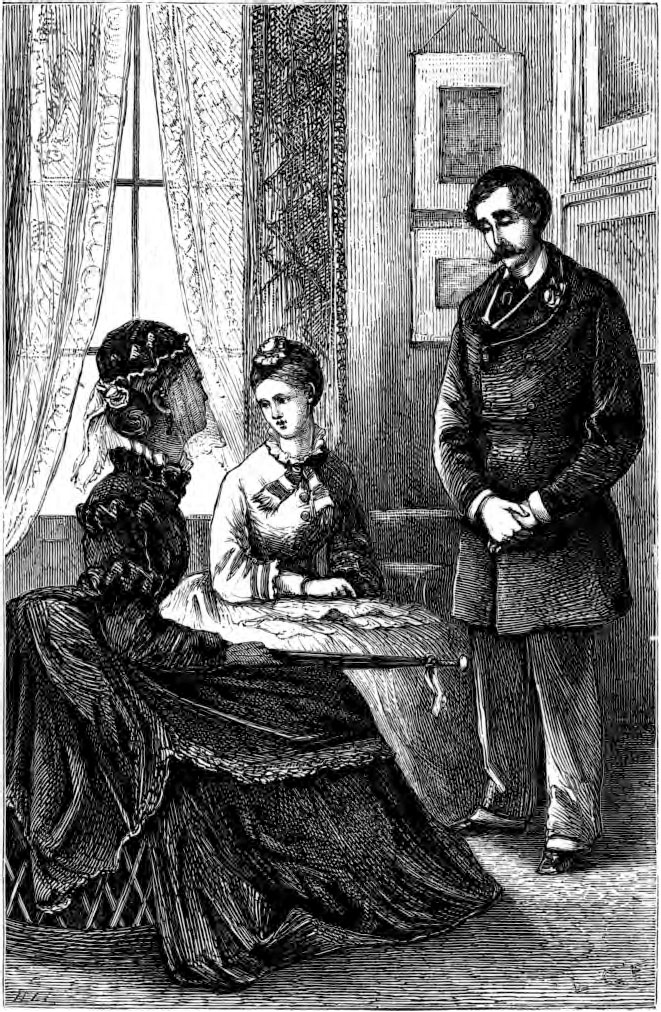
"She knows me, Sir Damask."
"Oh yes;--she knows you. That's a matter of course. We're delighted
to see you, Miss Longestaffe--I am, always. Wish we could have had
you at Ascot. But--." Then he looked as though he had again explained
everything.
"I've told her that you don't want me to go to the Melmottes," said
Lady Monogram.
"Well, no;--not just to go there. Stay and have lunch, Miss
Longestaffe."
"No, thank you."
"Now you're here, you'd better," said Lady Monogram.
"No, thank you. I'm sorry that I have not been able to make you
understand me. I could not allow our very long friendship to be
dropped without a word."
"Don't say--dropped," exclaimed the baronet.
"I do say dropped, Sir Damask. I thought we should have understood
each other;--your wife and I. But we haven't. Wherever she might have
gone, I should have made it my business to see her; but she feels
differently. Good-bye."
"Good-bye, my dear. If you will quarrel, it isn't my doing." Then Sir
Damask led Miss Longestaffe out, and put her into Madame Melmotte's
carriage. "It's the most absurd thing I ever knew in my life," said
the wife as soon as her husband had returned to her. "She hasn't
been able to bear to remain down in the country for one season, when
all the world knows that her father can't afford to have a house
for them in town. Then she condescends to come and stay with these
abominations and pretends to feel surprised that her old friends
don't run after her. She is old enough to have known better."
"I suppose she likes parties," said Sir Damask.
"Likes parties! She'd like to get somebody to take her. It's twelve
years now since Georgiana Longestaffe came out. I remember being told
of the time when I was first entered myself. Yes, my dear, you know
all about it, I dare say. And there she is still. I can feel for her,
and do feel for her. But if she will let herself down in that way she
can't expect not to be dropped. You remember the woman;--don't you?"
"What woman?"
"Madame Melmotte?"
"Never saw her in my life."
"Oh yes, you did. You took me there that night when Prince ----
danced with the girl. Don't you remember the blowsy fat woman at the
top of the stairs;--a regular horror?"
"Didn't look at her. I was only thinking what a lot of money it all
cost."
"I remember her, and if Georgiana Longestaffe thinks I'm going
there to make an acquaintance with Madame Melmotte she is very much
mistaken. And if she thinks that that is the way to get married, I
think she is mistaken again." Nothing perhaps is so efficacious in
preventing men from marrying as the tone in which married women speak
of the struggles made in that direction by their unmarried friends.
CHAPTER XXXIII.
JOHN CRUMB.
Sir Felix Carbury made an appointment for meeting Ruby Ruggles a
second time at the bottom of the kitchen-garden belonging to Sheep's
Acre farm, which appointment he neglected, and had, indeed, made
without any intention of keeping it. But Ruby was there, and remained
hanging about among the cabbages till her grandfather returned from
Harlestone market. An early hour had been named; but hours may be
mistaken, and Ruby had thought that a fine gentleman, such as was
her lover, used to live among fine people up in London, might well
mistake the afternoon for the morning. If he would come at all she
could easily forgive such a mistake. But he did not come, and late in
the afternoon she was obliged to obey her grandfather's summons as he
called her into the house.
After that for three weeks she heard nothing of her London lover,
but she was always thinking of him;--and though she could not
altogether avoid her country lover, she was in his company as little
as possible. One afternoon her grandfather returned from Bungay and
told her that her country lover was coming to see her. "John Crumb
be a coming over by-and-by," said the old man. "See and have a bit o'
supper ready for him."
"John Crumb coming here, grandfather? He's welcome to stay away then,
for me."
"That be dommed." The old man thrust his old hat on to his head and
seated himself in a wooden arm-chair that stood by the kitchen-fire.
Whenever he was angry he put on his hat, and the custom was well
understood by Ruby. "Why not welcome, and he all one as your husband?
Look ye here, Ruby, I'm going to have an eend o' this. John Crumb is
to marry you next month, and the banns is to be said."
"The parson may say what he pleases, grandfather. I can't stop his
saying of 'em. It isn't likely I shall try, neither. But no parson
among 'em all can marry me without I'm willing."
"And why should you no be willing, you contrairy young jade, you?"
"You've been a' drinking, grandfather."
He turned round at her sharp, and threw his old hat at her
head;--nothing to Ruby's consternation, as it was a practice to which
she was well accustomed. She picked it up, and returned it to him
with a cool indifference which was intended to exasperate him. "Look
ye here, Ruby," he said, "out o' this place you go. If you go as John
Crumb's wife you'll go with five hun'erd pound, and we'll have a
dinner here, and a dance, and all Bungay."
"Who cares for all Bungay,--a set of beery chaps as knows nothing
but swilling and smoking;--and John Crumb the main of 'em all? There
never was a chap for beer like John Crumb."
"Never saw him the worse o' liquor in all my life." And the old
farmer, as he gave this grand assurance, rattled his fist down upon
the table.
"It ony just makes him stoopider and stoopider the more he swills.
You can't tell me, grandfather, about John Crumb. I knows him."
"Didn't ye say as how ye'd have him? Didn't ye give him a promise?"
"If I did, I ain't the first girl as has gone back of her word,--and
I shan't be the last."
"You means you won't have him?"
"That's about it, grandfather."
"Then you'll have to have somebody to fend for ye, and that pretty
sharp,--for you won't have me."
"There ain't no difficulty about that, grandfather."
"Very well. He's a coming here to-night, and you may settle it along
wi' him. Out o' this ye shall go. I know of your doings."
"What doings! You don't know of no doings. There ain't no doings. You
don't know nothing ag'in me."
"He's a coming here to-night, and if you can make it up wi' him, well
and good. There's five hun'erd pound, and ye shall have the dinner
and the dance and all Bungay. He ain't a going to be put off no
longer;--he ain't."
"Whoever wanted him to be put on? Let him go his own gait."
"If you can't make it up wi' him--"
"Well, grandfather, I shan't anyways."
"Let me have my say, will ye, yer jade, you? There's five hun'erd
pound! and there ain't ere a farmer in Suffolk or Norfolk paying
rent for a bit of land like this can do as well for his darter as
that,--let alone only a granddarter. You never thinks o' that;--you
don't. If you don't like to take it,--leave it. But you'll leave
Sheep's Acre too."
"Bother Sheep's Acre. Who wants to stop at Sheep's Acre? It's the
stoopidest place in all England."
"Then find another. Then find another. That's all aboot it. John
Crumb's a coming up for a bit o' supper. You tell him your own mind.
I'm dommed if I trouble aboot it. On'y you don't stay here. Sheep's
Acre ain't good enough for you, and you'd best find another home.
Stoopid, is it? You'll have to put up wi' places stoopider nor
Sheep's Acre, afore you've done."
In regard to the hospitality promised to Mr. Crumb, Miss Ruggles went
about her work with sufficient alacrity. She was quite willing that
the young man should have a supper, and she did understand that,
so far as the preparation of the supper went, she owed her service
to her grandfather. She therefore went to work herself, and gave
directions to the servant girl who assisted her in keeping her
grandfather's house. But as she did this, she determined that she
would make John Crumb understand that she would never be his wife.
Upon that she was now fully resolved. As she went about the kitchen,
taking down the ham and cutting the slices that were to be broiled,
and as she trussed the fowl that was to be boiled for John Crumb, she
made mental comparisons between him and Sir Felix Carbury. She could
see, as though present to her at the moment, the mealy, floury head
of the one, with hair stiff with perennial dust from his sacks, and
the sweet glossy dark well-combed locks of the other, so bright,
so seductive, that she was ever longing to twine her fingers among
them. And she remembered the heavy, flat, broad honest face of the
meal-man, with his mouth slow in motion, and his broad nose looking
like a huge white promontory, and his great staring eyes, from the
corners of which he was always extracting meal and grit;--and then
also she remembered the white teeth, the beautiful soft lips, the
perfect eyebrows, and the rich complexion of her London lover. Surely
a lease of Paradise with the one, though but for one short year,
would be well purchased at the price of a life with the other! "It's
no good going against love," she said to herself, "and I won't try.
He shall have his supper, and be told all about it, and then go home.
He cares more for his supper than he do for me." And then, with this
final resolution firmly made, she popped the fowl into the pot. Her
grandfather wanted her to leave Sheep's Acre. Very well. She had a
little money of her own, and would take herself off to London. She
knew what people would say, but she cared nothing for old women's
tales. She would know how to take care of herself, and could always
say in her own defence that her grandfather had turned her out of
Sheep's Acre.
Seven had been the hour named, and punctually at that hour John
Crumb knocked at the back door of Sheep's Acre farm-house. Nor did
he come alone. He was accompanied by his friend Joe Mixet, the
baker of Bungay, who, as all Bungay knew, was to be his best man
at his marriage. John Crumb's character was not without many fine
attributes. He could earn money,--and having earned it could spend
and keep it in fair proportion. He was afraid of no work, and,--to
give him his due,--was afraid of no man. He was honest, and ashamed
of nothing that he did. And after his fashion he had chivalrous ideas
about women. He was willing to thrash any man that ill-used a woman,
and would certainly be a most dangerous antagonist to any man who
would misuse a woman belonging to him. But Ruby had told the truth of
him in saying that he was slow of speech, and what the world calls
stupid in regard to all forms of expression. He knew good meal from
bad as well as any man, and the price at which he could buy it so
as to leave himself a fair profit at the selling. He knew the value
of a clear conscience, and without much argument had discovered for
himself that honesty is in truth the best policy. Joe Mixet, who was
dapper of person and glib of tongue, had often declared that any one
buying John Crumb for a fool would lose his money. Joe Mixet was
probably right; but there had been a want of prudence, a lack of
worldly sagacity, in the way in which Crumb had allowed his proposed
marriage with Ruby Ruggles to become a source of gossip to all
Bungay. His love was now an old affair; and, though he never talked
much, whenever he did talk, he talked about that. He was proud of
Ruby's beauty, and of her fortune, and of his own status as her
acknowledged lover,--and he did not hide his light under a bushel.
Perhaps the publicity so produced had some effect in prejudicing Ruby
against the man whose offer she had certainly once accepted. Now when
he came to settle the day,--having heard more than once or twice
that there was a difficulty with Ruby,--he brought his friend Mixet
with him as though to be present at his triumph. "If here isn't Joe
Mixet," said Ruby to herself. "Was there ever such a stoopid as John
Crumb? There's no end to his being stoopid."
The old man had slept off his anger and his beer while Ruby had been
preparing the feast, and now roused himself to entertain his guests.
"What, Joe Mixet; is that thou? Thou'rt welcome. Come in, man. Well,
John, how is it wi' you? Ruby's a stewing o' something for us to
eat a bit. Don't 'e smell it?"--John Crumb lifted up his great nose,
sniffed and grinned.
"John didn't like going home in the dark like," said the baker, with
his little joke. "So I just come along to drive away the bogies."
"The more the merrier;--the more the merrier. Ruby 'll have enough
for the two o' you, I'll go bail. So John Crumb's afraid of
bogies;--is he? The more need he to have some 'un in his house to
scart 'em away."
The lover had seated himself without speaking a word; but now he was
instigated to ask a question. "Where be she, Muster Ruggles?"
They
were seated in the outside or front kitchen, in which the old man
and his granddaughter always lived; while Ruby was at work in the
back kitchen. As John Crumb asked this question she could be heard
distinctly among the pots and the plates. She now came out, and
wiping her hands on her apron, shook hands with the two young men.
She had enveloped herself in a big household apron when the cooking
was in hand, and had not cared to take it off for the greeting of
this lover. "Grandfather said as how you was a coming out for your
supper, so I've been a seeing to it. You'll excuse the apron, Mr.
Mixet."
"You couldn't look nicer, miss, if you was to try it ever so. My
mother says as it's housifery as recommends a girl to the young men.
What do you say, John?"
"I loiks to see her loik o' that," said John rubbing his hands down
the back of his trowsers, and stooping till he had brought his eyes
down to a level with those of his sweetheart.
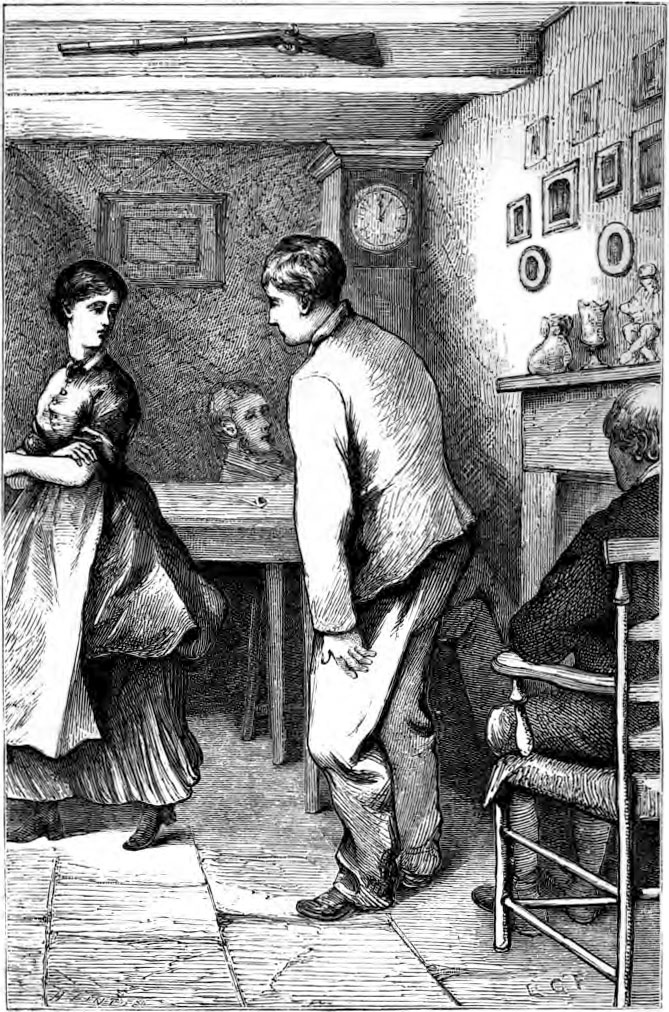
"It looks homely; don't it, John?" said Mixet.
"Bother!" said Ruby, turning round sharp, and going back to the other
kitchen. John Crumb turned round also, and grinned at his friend, and
then grinned at the old man.
"You've got it all afore you," said the farmer,--leaving the lover to
draw what lesson he might from this oracular proposition.
"And I don't care how soon I ha'e it in hond;--that I don't," said
John.
"That's the chat," said Joe Mixet. "There ain't nothing wanting in
his house;--is there, John? It's all there,--cradle, caudle-cup, and
the rest of it. A young woman going to John knows what she'll have to
eat when she gets up, and what she'll lie down upon when she goes to
bed." This he declared in a loud voice for the benefit of Ruby in the
back kitchen.
"That she do," said John, grinning again. "There's a hun'erd and
fifty poond o' things in my house forbye what mother left behind
her."
After this there was no more conversation till Ruby reappeared with
the boiled fowl, and without her apron. She was followed by the girl
with a dish of broiled ham and an enormous pyramid of cabbage. Then
the old man got up slowly and opening some private little door of
which he kept the key in his breeches pocket, drew a jug of ale and
placed it on the table. And from a cupboard of which he also kept the
key, he brought out a bottle of gin. Everything being thus prepared,
the three men sat round the table, John Crumb looking at his chair
again and again before he ventured to occupy it. "If you'll sit
yourself down, I'll give you a bit of something to eat," said Ruby
at last. Then he sank at once into his chair. Ruby cut up the fowl
standing, and dispensed the other good things, not even placing a
chair for herself at the table,--and apparently not expected to do
so, for no one invited her. "Is it to be spirits or ale, Mr. Crumb?"
she said, when the other two men had helped themselves. He turned
round and gave her a look of love that might have softened the heart
of an Amazon; but instead of speaking he held up his tumbler, and
bobbed his head at the beer jug. Then she filled it to the brim,
frothing it in the manner in which he loved to have it frothed. He
raised it to his mouth slowly, and poured the liquor in as though to
a vat. Then she filled it again. He had been her lover, and she would
be as kind to him as she knew how,--short of love.
There was a good deal of eating done, for more ham came in, and
another mountain of cabbage; but very little or nothing was said.
John Crumb ate whatever was given to him of the fowl, sedulously
picking the bones, and almost swallowing them; and then finished
the second dish of ham, and after that the second instalment of
cabbage. He did not ask for more beer, but took it as often as
Ruby replenished his glass. When the eating was done, Ruby retired
into the back kitchen, and there regaled herself with some bone or
merry-thought of the fowl, which she had with prudence reserved,
sharing her spoils however with the other maiden. This she did
standing, and then went to work, cleaning the dishes. The men lit
their pipes and smoked in silence, while Ruby went through her
domestic duties. So matters went on for half an hour; during which
Ruby escaped by the back door, went round into the house, got into
her own room, and formed the grand resolution of going to bed. She
began her operations in fear and trembling, not being sure but that
her grandfather would bring the man up-stairs to her. As she thought
of this she stayed her hand, and looked to the door. She knew well
that there was no bolt there. It would be terrible to her to be
invaded by John Crumb after his fifth or sixth glass of beer. And,
she declared to herself, that should he come he would be sure to
bring Joe Mixet with him to speak his mind for him. So she paused and
listened.
When they had smoked for some half hour the old man called for his
granddaughter, but called of course in vain. "Where the mischief is
the jade gone?" he said, slowly making his way into the back kitchen.
The maid as soon as she heard her master moving, escaped into the
yard and made no response, while the old man stood bawling at the
back door. "The devil's in them. They're off some gates," he said
aloud. "She'll make the place hot for her, if she goes on this way."
Then he returned to the two young men. "She's playing off her games
somwheres," he said. "Take a glass of sperrits and water, Mr. Crumb,
and I'll see after her."
"I'll just take a drop of y'ell," said John Crumb, apparently quite
unmoved by the absence of his sweetheart.
It was sad work for the old man. He went down the yard and into the
garden, hobbling among the cabbages, not daring to call very loud, as
he did not wish to have it supposed that the girl was lost; but still
anxious, and sore at heart as to the ingratitude shown to him. He was
not bound to give the girl a home at all. She was not his own child.
And he had offered her £500! "Domm her," he said aloud as he made his
way back to the house. After much search and considerable loss of
time he returned to the kitchen in which the two men were sitting,
leading Ruby in his hand. She was not smart in her apparel, for
she had half undressed herself, and been then compelled by her
grandfather to make herself fit to appear in public. She had
acknowledged to herself that she had better go down and tell John
Crumb the truth. For she was still determined that she would never be
John Crumb's wife. "You can answer him as well as I, grandfather,"
she had said. Then the farmer had cuffed her, and told her that she
was an idiot. "Oh, if it comes to that," said Ruby, "I'm not afraid
of John Crumb, nor yet of nobody else. Only I didn't think you'd go
to strike me, grandfather." "I'll knock the life out of thee, if thou
goest on this gate," he had said. But she had consented to come down,
and they entered the room together.
"We're a disturbing you a'most too late, miss," said Mr. Mixet.
"It ain't that at all, Mr. Mixet. If grandfather chooses to have
a few friends, I ain't nothing against it. I wish he'd have a few
friends a deal oftener than he do. I likes nothing better than to do
for 'em;--only when I've done for 'em and they're smoking their pipes
and that like, I don't see why I ain't to leave 'em to 'emselves."
"But we've come here on a hauspicious occasion, Miss Ruby."
"I don't know nothing about auspicious, Mr. Mixet. If you and Mr.
Crumb've come out to Sheep's Acre farm for a bit of supper--"
"Which we ain't," said John Crumb very loudly;--"nor yet for
beer;--not by no means."
"We've come for the smiles of beauty," said Joe Mixet.
Ruby chucked up her head. "Mr. Mixet, if you'll be so good as to stow
that! There ain't no beauty here as I knows of, and if there was it
isn't nothing to you."
"Except in the way of friendship," said Mixet.
"I'm just as sick of all this as a man can be," said Mr. Ruggles,
who was sitting low in his chair, with his back bent, and his head
forward. "I won't put up with it no more."
"Who wants you to put up with it?" said Ruby. "Who wants 'em to come
here with their trash? Who brought 'em to-night? I don't know what
business Mr. Mixet has interfering along o' me. I never interfere
along o' him."
"John Crumb, have you anything to say?" asked the old man.
Then John Crumb slowly arose from his chair, and stood up at his full
height. "I hove," said he, swinging his head to one side.
"Then say it."
"I will," said he. He was still standing bolt upright with his hands
down by his side. Then he stretched out his left to his glass which
was half full of beer, and strengthened himself as far as that would
strengthen him. Having done this he slowly deposited the pipe which
he still held in his right hand.
"Now speak your mind, like a man," said Mixet.
"I intends it," said John. But he still stood dumb, looking down upon
old Ruggles, who from his crouched position was looking up at him.
Ruby was standing with both her hands upon the table and her eyes
intent upon the wall over the fire-place.
"You've asked Miss Ruby to be your wife a dozen times;--haven't you,
John?" suggested Mixet.
"I hove."
"And you mean to be as good as your word?"
"I do."
"And she has promised to have you?"
"She hove."
"More nor once or twice?" To this proposition Crumb found it only
necessary to bob his head. "You're ready,--and willing?"
"I om."
"You're wishing to have the banns said without any more delay?"
"There ain't no delay 'bout me;--never was."
"Everything is ready in your own house?"
"They is."
"And you will expect Miss Ruby to come to the scratch?"
"I sholl."
"That's about it, I think," said Joe Mixet, turning to the
grandfather. "I don't think there was ever anything much more
straightforward than that. You know, I know, Miss Ruby knows all
about John Crumb. John Crumb didn't come to Bungay yesterday,--nor
yet the day before. There's been a talk of five hundred pounds, Mr.
Ruggles." Mr. Ruggles made a slight gesture of assent with his head.
"Five hundred pounds is very comfortable; and added to what John has
will make things that snug that things never was snugger. But John
Crumb isn't after Miss Ruby along of her fortune."
"Nohow's," said the lover, shaking his head and still standing
upright with his hands by his side.
"Not he;--it isn't his ways, and them as knows him'll never say it of
him. John has a heart in his buzsom."
"I has," said John, raising his hand a little above his stomach.
"And feelings as a man. It's true love as has brought John Crumb to
Sheep's Acre farm this night;--love of that young lady, if she'll let
me make so free. He's a proposed to her, and she's a haccepted him,
and now it's about time as they was married. That's what John Crumb
has to say."
"That's what I has to say," repeated John Crumb, "and I means it."
"And now, miss," continued Mixet, addressing himself to Ruby, "you've
heard what John has to say."
"I've heard you, Mr. Mixet, and I've heard quite enough."
"You can't have anything to say against it, miss; can you? There's
your grandfather as is willing, and the money as one may say counted
out,--and John Crumb is willing, with his house so ready that there
isn't a ha'porth to do. All we want is for you to name the day."
"Say to-morrow, Ruby, and I'll not be agon it," said John Crumb,
slapping his thigh.
"I won't say to-morrow, Mr. Crumb, nor yet the day after to-morrow,
nor yet no day at all. I'm not going to have you. I've told you as
much before."
"That was only in fun, loike."
"Then now I tell you in earnest. There's some folk wants such a deal
of telling."
"You don't mean,--never?"
"I do mean never, Mr. Crumb."
"Didn't you say as you would, Ruby? Didn't you say so as plain as
the nose on my face?" John as he asked these questions could hardly
refrain from tears.
"Young women is allowed to change their minds," said Ruby.
"Brute!" exclaimed old Ruggles. "Pig! Jade! I'll tell'ee what, John.
She'll go out o' this into the streets;--that's what she wull. I
won't keep her here, no longer;--nasty, ungrateful, lying slut."
"She ain't that;--she ain't that," said John. "She ain't that at all.
She's no slut. I won't hear her called so;--not by her grandfather.
But, oh, she has a mind to put me so abouts, that I'll have to go
home and hang myself."
"Dash it, Miss Ruby, you ain't a going to serve a young man that
way," said the baker.
"If you'll jist keep yourself to yourself, I'll be obliged to you,
Mr. Mixet," said Ruby. "If you hadn't come here at all things might
have been different."
"Hark at that now," said John, looking at his friend almost with
indignation.
Mr. Mixet, who was fully aware of his rare eloquence and of the
absolute necessity there had been for its exercise if any arrangement
were to be made at all, could not trust himself to words after this.
He put on his hat and walked out through the back kitchen into the
yard declaring that his friend would find him there, round by the
pig-stye wall, whenever he was ready to return to Bungay. As soon as
Mixet was gone John looked at his sweetheart out of the corners of
his eyes and made a slow motion towards her, putting out his right
hand as a feeler. "He's aff now, Ruby," said John.
"And you'd better be aff after him," said the cruel girl.
"And when'll I come back again?"
"Never. It ain't no use. What's the good of more words, Mr. Crumb?"
"Domm her; domm her," said old Ruggles. "I'll even it to her. She'll
have to be out on the roads this night."
"She shall have the best bed in my house if she'll come for it," said
John, "and the old woman to look arter her; and I won't come nigh her
till she sends for me."
"I can find a place for myself, thank ye, Mr. Crumb." Old Ruggles
sat grinding his teeth, and swearing to himself, taking his hat off
and putting it on again, and meditating vengeance. "And now if you
please, Mr. Crumb, I'll go up-stairs to my own room."
"You don't go up to any room here, you jade you." The old man as he
said this got up from his chair as though to fly at her. And he would
have struck her with his stick but that he was stopped by John Crumb.
"Don't hit the girl, no gate, Mr. Ruggles."
"Domm her, John; she breaks my heart." While her lover held her
grandfather Ruby escaped, and seated herself on the bedside, again
afraid to undress, lest she should be disturbed by her grandfather.
"Ain't it more nor a man ought to have to bear;--ain't it, Mr.
Crumb?" said the grandfather appealing to the young man.
"It's the ways on 'em, Mr. Ruggles."
"Ways on 'em! A whipping at the cart-tail ought to be the ways on
her. She's been and seen some young buck."
Then John Crumb turned red all over, through the flour, and sparks of
anger flashed from his eyes. "You ain't a meaning of it, master?"
"I'm told there's been the squoire's cousin aboot,--him as they call
the baronite."
"Been along wi' Ruby?" The old man nodded at him. "By the mortials
I'll baronite him;--I wull," said John seizing his hat and stalking
off through the back kitchen after his friend.
CHAPTER XXXIV.
RUBY RUGGLES OBEYS HER GRANDFATHER.
The next day there was great surprise at Sheep's Acre farm, which
communicated itself to the towns of Bungay and Beccles, and even
affected the ordinary quiet life of Carbury Manor. Ruby Ruggles had
gone away, and at about twelve o'clock in the day the old farmer
became aware of the fact. She had started early, at about seven in
the morning; but Ruggles himself had been out long before that, and
had not condescended to ask for her when he returned to the house
for his breakfast. There had been a bad scene up in the bedroom
overnight, after John Crumb had left the farm. The old man in his
anger had tried to expel the girl; but she had hung on to the
bed-post and would not go; and he had been frightened, when the maid
came up crying and screaming murder. "You'll be out o' this to-morrow
as sure as my name's Dannel Ruggles," said the farmer panting for
breath. But for the gin which he had taken he would hardly have
struck her;--but he had struck her, and pulled her by the hair, and
knocked her about;--and in the morning she took him at his word and
was away. About twelve he heard from the servant girl that she had
gone. She had packed a box and had started up the road carrying the
box herself. "Grandfather says I'm to go, and I'm gone," she had said
to the girl. At the first cottage she had got a boy to carry her
box into Beccles, and to Beccles she had walked. For an hour or two
Ruggles sat, quiet, within the house, telling himself that she might
do as she pleased with herself,--that he was well rid of her, and
that from henceforth he would trouble himself no more about her. But
by degrees there came upon him a feeling half of compassion and half
of fear, with perhaps some mixture of love, instigating him to make
search for her. She had been the same to him as a child, and what
would people say of him if he allowed her to depart from him after
this fashion? Then he remembered his violence the night before, and
the fact that the servant girl had heard if she had not seen it.
He could not drop his responsibility in regard to Ruby, even if he
would. So, as a first step, he sent in a message to John Crumb, at
Bungay, to tell him that Ruby Ruggles had gone off with a box to
Beccles. John Crumb went open-mouthed with the news to Joe Mix-
et, and all Bungay soon knew that Ruby Ruggles had run away.
After sending his message to Crumb the old man still sat thinking,
and at last made up his mind that he would go to his landlord. He
held a part of his farm under Roger Carbury, and Roger Carbury would
tell him what he ought to do. A great trouble had come upon him. He
would fain have been quiet, but his conscience and his heart and his
terrors all were at work together,--and he found that he could not
eat his dinner. So he had out his cart and horse and drove himself
off to Carbury Hall.
It was past four when he started, and he found the squire seated on
the terrace after an early dinner, and with him was Father Barham,
the priest. The old man was shown at once round into the garden, and
was not long in telling his story. There had been words between him
and his granddaughter about her lover. Her lover had been accepted
and had come to the farm to claim his bride. Ruby had behaved very
badly. The old man made the most of Ruby's bad behaviour, and of
course as little as possible of his own violence. But he did explain
that there had been threats used when Ruby refused to take the man,
and that Ruby had, this day, taken herself off.
"I always thought it was settled they were to be man and wife," said
Roger.
"It was settled, squoire;--and he war to have five hun'erd pound
down;--money as I'd saved myself. Drat the jade."
"Didn't she like him, Daniel?"
"She liked him well enough till she'd seed somebody else." Then old
Daniel paused, and shook his head, and was evidently the owner of a
secret. The squire got up and walked round the garden with him,--and
then the secret was told. The farmer was of opinion that there was
something between the girl and Sir Felix. Sir Felix some weeks since
had been seen near the farm and on the same occasion Ruby had been
observed at some little distance from the house with her best clothes
on.
"He's been so little here, Daniel," said the squire.
"It goes as tinder and a spark o' fire, that does," said the farmer.
"Girls like Ruby don't want no time to be wooed by one such as that,
though they'll fall-lall with a man like John Crumb for years."
"I suppose she's gone to London."
"Don't know nothing of where she's gone, squoire;--only she have
gone some'eres. May be it's Lowestoffe. There's lots of quality at
Lowestoffe a' washing theyselves in the sea."
Then they returned to the priest, who might be supposed to be
cognisant of the guiles of the world and competent to give advice on
such an occasion as this. "If she was one of our people," said Father
Barham, "we should have her back quick enough."
"Would ye now?" said Ruggles, wishing at the moment that he and all
his family had been brought up as Roman Catholics.
"I don't see how you would have more chance of catching her than we
have," said Carbury.
"She'd catch herself. Wherever she might be she'd go to the priest,
and he wouldn't leave her till he'd seen her put on the way back to
her friends."
"With a flea in her lug," suggested the farmer.
"Your people never go to a clergyman in their distress. It's the last
thing they'd think of. Any one might more probably be regarded as a
friend than the parson. But with us the poor know where to look for
sympathy."
"She ain't that poor, neither," said the grandfather.
"She had money with her?"
"I don't know just what she had; but she ain't been brought up poor.
And I don't think as our Ruby'd go of herself to any clergyman. It
never was her way."
"It never is the way with a Protestant," said the priest.
"We'll say no more about that for the present," said Roger, who was
waxing wroth with the priest. That a man should be fond of his own
religion is right; but Roger Carbury was beginning to think that
Father Barham was too fond of his religion. "What had we better do?
I suppose we shall hear something of her at the railway. There are
not so many people leaving Beccles but that she may be remembered."
So the waggonette was ordered, and they all prepared to go off to the
station together.
But before they started John Crumb rode up to the door. He had gone
at once to the farm on hearing of Ruby's departure, and had followed
the farmer from thence to Carbury. Now he found the squire and the
priest and the old man standing around as the horses were being put
to the carriage. "Ye ain't a' found her, Mr. Ruggles, ha' ye?" he
asked as he wiped the sweat from his brow.
"Noa;--we ain't a' found no one yet."
"If it was as she was to come to harm, Mr. Carbury, I'd never forgive
myself,--never," said Crumb.
"As far as I can understand it is no doing of yours, my friend," said
the squire.
"In one way, it ain't; and in one way it is. I was over there last
night a bothering of her. She'd a' come round may be, if she'd a'
been left alone. She wouldn't a' been off now, only for our going
over to Sheep's Acre. But,--oh!"
"What is it, Mr. Crumb?"
"He's a coosin o' yours, squoire; and long as I've known Suffolk,
I've never known nothing but good o' you and yourn. But if your
baronite has been and done this! Oh, Mr. Carbury! If I was to wring
his neck round, you wouldn't say as how I was wrong; would ye, now?"
Roger could hardly answer the question. On general grounds the
wringing of Sir Felix's neck, let the immediate cause for such a
performance have been what it might, would have seemed to him to
be a good deed. The world would be better, according to his thinking,
with Sir Felix out of it than in it. But still the young man was his
cousin and a Carbury, and to such a one as John Crumb he was bound
to defend any member of his family as far as he might be defensible.
"They says as how he was groping about Sheep's Acre when he was
last here, a hiding himself and skulking behind hedges. Drat 'em all.
They've gals enough of their own,--them fellows. Why can't they let
a fellow alone? I'll do him a mischief, Master Roger; I wull;--if he's
had a hand in this." Poor John Crumb! When he had his mistress to
win he could find no words for himself; but was obliged to take an
eloquent baker with him to talk for him. Now in his anger he could
talk freely enough.
"But you must first learn that Sir Felix has had anything to do with
this, Mr. Crumb."
"In coorse; in coorse. That's right. That's right. Must l'arn as he
did it, afore I does it. But when I have l'arned!"-- And John Crumb
clenched his fist as though a very short lesson would suffice for him
upon this occasion.
They all went to the Beccles Station, and from thence to the Beccles
post office,--so that Beccles soon knew as much about it as Bungay.
At the railway station Ruby was distinctly remembered. She had taken
a second-class ticket by the morning train for London, and had gone
off without any appearance of secrecy. She had been decently dressed,
with a hat and cloak, and her luggage had been such as she might have
been expected to carry, had all her friends known that she was going.
So much was made clear at the railway station, but nothing more could
be learned there. Then a message was sent by telegraph to the station
in London, and they all waited, loitering about the post office, for
a reply. One of the porters in London remembered seeing such a girl
as was described, but the man who was supposed to have carried her
box for her to a cab had gone away for the day. It was believed that
she had left the station in a four-wheel cab. "I'll be arter her.
I'll be arter her at once," said John Crumb. But there was no train
till night, and Roger Carbury was doubtful whether his going would do
any good. It was evidently fixed on Crumb's mind that the first step
towards finding Ruby would be the breaking of every bone in the body
of Sir Felix Carbury. Now it was not at all apparent to the squire
that his cousin had had anything to do with this affair. It had been
made quite clear to him that the old man had quarrelled with his
granddaughter and had threatened to turn her out of his house, not
because she had misbehaved with Sir Felix, but on account of her
refusing to marry John Crumb. John Crumb had gone over to the farm
expecting to arrange it all, and up to that time there had been no
fear about Felix Carbury. Nor was it possible that there should have
been communication between Ruby and Felix since the quarrel at the
farm. Even if the old man were right in supposing that Ruby and the
baronet had been acquainted,--and such acquaintance could not but be
prejudicial to the girl,--not on that account would the baronet be
responsible for her abduction. John Crumb was thirsting for blood and
was not very capable in his present mood of arguing the matter out
coolly, and Roger, little as he loved his cousin, was not desirous
that all Suffolk should know that Sir Felix Carbury had been thrashed
within an inch of his life by John Crumb of Bungay. "I'll tell you
what I'll do," said he, putting his hand kindly on the old man's
shoulder. "I'll go up myself by the first train to-morrow. I can
trace her better than Mr. Crumb can do, and you will both trust me."
"There's not one in the two counties I'd trust so soon," said the old
man.
"But you'll let us know the very truth," said John Crumb. Roger
Carbury made him an indiscreet promise that he would let him know
the truth. So the matter was settled, and the grandfather and lover
returned together to Bungay.
CHAPTER XXXV.
MELMOTTE'S GLORY.
Augustus Melmotte was becoming greater and greater in every
direction,--mightier and mightier every day. He was learning to
despise mere lords, and to feel that he might almost domineer over
a duke. In truth he did recognise it as a fact that he must either
domineer over dukes, or else go to the wall. It can hardly be said of
him that he had intended to play so high a game, but the game that he
had intended to play had become thus high of its own accord. A man
cannot always restrain his own doings and keep them within the limits
which he had himself planned for them. They will very often fall
short of the magnitude to which his ambition has aspired. They will
sometimes soar higher than his own imagination. So it had now been
with Mr. Melmotte. He had contemplated great things; but the things
which he was achieving were beyond his contemplation.
The reader will not have thought much of Fisker on his arrival in
England. Fisker was, perhaps, not a man worthy of much thought. He
had never read a book. He had never written a line worth reading.
He had never said a prayer. He cared nothing for humanity. He had
sprung out of some Californian gully, was perhaps ignorant of his own
father and mother, and had tumbled up in the world on the strength
of his own audacity. But, such as he was, he had sufficed to give
the necessary impetus for rolling Augustus Melmotte onwards into
almost unprecedented commercial greatness. When Mr. Melmotte took his
offices in Abchurch Lane, he was undoubtedly a great man, but nothing
so great as when the South Central Pacific and Mexican Railway had
become not only an established fact, but a fact established in
Abchurch Lane. The great company indeed had an office of its own,
where the Board was held; but everything was really managed in
Mr. Melmotte's own commercial sanctum. Obeying, no doubt, some
inscrutable law of commerce, the grand enterprise,--"perhaps the
grandest when you consider the amount of territory manipulated, which
has ever opened itself before the eyes of a great commercial people,"
as Mr. Fisker with his peculiar eloquence observed through his nose,
about this time to a meeting of shareholders at San Francisco,--had
swung itself across from California to London, turning itself to the
centre of the commercial world as the needle turns to the pole, till
Mr. Fisker almost regretted the deed which himself had done. And
Melmotte was not only the head, but the body also, and the feet of
it all. The shares seemed to be all in Melmotte's pocket, so that
he could distribute them as he would; and it seemed also that when
distributed and sold, and when bought again and sold again, they came
back to Melmotte's pocket. Men were contented to buy their shares and
to pay their money, simply on Melmotte's word. Sir Felix had realised
a large portion of his winnings at cards,--with commendable prudence
for one so young and extravagant,--and had brought his savings to the
great man. The great man had swept the earnings of the Beargarden
into his till, and had told Sir Felix that the shares were his. Sir
Felix had been not only contented, but supremely happy. He could now
do as Paul Montague was doing,--and Lord Alfred Grendall. He could
realize a perennial income, buying and selling. It was only after
the reflection of a day or two that he found that he had as yet got
nothing to sell. It was not only Sir Felix that was admitted into
these good things after this fashion. Sir Felix was but one among
hundreds. In the meantime the bills in Grosvenor Square were no doubt
paid with punctuality,--and these bills must have been stupendous.
The very servants were as tall, as gorgeous, almost as numerous, as
the servants of royalty,--and remunerated by much higher wages. There
were four coachmen with egregious wigs, and eight footmen, not one
with a circumference of calf less than eighteen inches.
And now there appeared a paragraph in the "Morning Breakfast Table,"
and another appeared in the "Evening Pulpit," telling the world
that Mr. Melmotte had bought Pickering Park, the magnificent Sussex
property of Adolphus Longestaffe, Esq., of Caversham. And it was so.
The father and son who never had agreed before, and who now had come
to no agreement in the presence of each other, had each considered
that their affairs would be safe in the hands of so great a man as
Mr. Melmotte, and had been brought to terms. The purchase-money,
which was large, was to be divided between them. The thing was done
with the greatest ease,--there being no longer any delay as is the
case when small people are at work. The magnificence of Mr. Melmotte
affected even the Longestaffe lawyers. Were I to buy a little
property, some humble cottage with a garden,--or you, O reader,
unless you be magnificent,--the money to the last farthing would be
wanted, or security for the money more than sufficient, before we
should be able to enter in upon our new home. But money was the very
breath of Melmotte's nostrils, and therefore his breath was taken for
money. Pickering was his, and before a week was over a London builder
had collected masons and carpenters by the dozen down at Chichester,
and was at work upon the house to make it fit to be a residence for
Madame Melmotte. There were rumours that it was to be made ready for
the Goodwood week, and that the Melmotte entertainment during that
festival would rival the duke's.
But there was still much to be done in London before the Goodwood
week should come round in all of which Mr. Melmotte was concerned,
and of much of which Mr. Melmotte was the very centre. A member for
Westminster had succeeded to a peerage, and thus a seat was vacated.
It was considered to be indispensable to the country that Mr. Mel-
motte should go into Parliament, and what constituency could such
a man as Melmotte so fitly represent as one combining as Westminster
does all the essences of the metropolis? There was the popular
element, the fashionable element, the legislative element, the legal
element, and the commercial element. Melmotte undoubtedly was the
man for Westminster. His thorough popularity was evinced by testimony
which perhaps was never before given in favour of any candidate for
any county or borough. In Westminster there must of course be a
contest. A seat for Westminster is a thing not to be abandoned by
either political party without a struggle. But, at the beginning of
the affair, when each party had to seek the most suitable candidate
which the country could supply, each party put its hand upon
Melmotte. And when the seat, and the battle for the seat, were
suggested to Melmotte, then for the first time was that great man
forced to descend from the altitudes on which his mind generally
dwelt, and to decide whether he would enter Parliament as a
Conservative or a Liberal. He was not long in convincing himself that
the Conservative element in British Society stood the most in need
of that fiscal assistance which it would be in his province to give;
and on the next day every hoarding in London declared to the world
that Melmotte was the Conservative candidate for Westminster. It is
needless to say that his committee was made up of peers, bankers, and
publicans, with all that absence of class prejudice for which the
party has become famous since the ballot was introduced among us.
Some unfortunate Liberal was to be made to run against him, for the
sake of the party; but the odds were ten to one on Melmotte.
This no doubt was a great matter,--this affair of the seat; but the
dinner to be given to the Emperor of China was much greater. It was
the middle of June, and the dinner was to be given on Monday, 8th
July, now three weeks hence;--but all London was already talking of
it. The great purport proposed was to show to the Emperor by this
banquet what an English merchant-citizen of London could do. Of
course there was a great amount of scolding and a loud clamour on the
occasion. Some men said that Melmotte was not a citizen of London,
others that he was not a merchant, others again that he was not an
Englishman. But no man could deny that he was both able and willing
to spend the necessary money; and as this combination of ability and
will was the chief thing necessary, they who opposed the arrangement
could only storm and scold. On the 20th of June the tradesmen were
at work, throwing up a building behind, knocking down walls, and
generally transmuting the house in Grosvenor Square in such a fashion
that two hundred guests might be able to sit down to dinner in the
dining-room of a British merchant.
But who were to be the two hundred? It used to be the case that when
a gentleman gave a dinner he asked his own guests;--but when affairs
become great, society can hardly be carried on after that simple
fashion. The Emperor of China could not be made to sit at table
without English royalty, and English royalty must know whom it has to
meet,--must select at any rate some of its comrades. The minister of
the day also had his candidates for the dinner,--in which arrangement
there was however no private patronage, as the list was confined to
the cabinet and their wives. The Prime Minister took some credit to
himself in that he would not ask for a single ticket for a private
friend. But the Opposition as a body desired their share of seats.
Melmotte had elected to stand for Westminster on the Conservative
interest, and was advised that he must insist on having as it were
a Conservative cabinet present, with its Conservative wives. He was
told that he owed it to his party, and that his party exacted payment
of the debt. But the great difficulty lay with the city merchants.
This was to be a city merchant's private feast, and it was essential
that the Emperor should meet this great merchant's brother merchants
at the merchant's board. No doubt the Emperor would see all the
merchants at the Guildhall; but that would be a semi-public affair,
paid for out of the funds of a corporation. This was to be a private
dinner. Now the Lord Mayor had set his face against it, and what was
to be done? Meetings were held; a committee was appointed; merchant
guests were selected, to the number of fifteen with their fifteen
wives;--and subsequently the Lord Mayor was made a baronet on the
occasion of receiving the Emperor in the city. The Emperor with his
suite was twenty. Royalty had twenty tickets, each ticket for guest
and wife. The existing Cabinet was fourteen; but the coming was
numbered at about eleven only;--each one for self and wife. Five
ambassadors and five ambassadresses were to be asked. There were to
be fifteen real merchants out of the city. Ten great peers,--with
their peeresses,--were selected by the general committee of
management. There were to be three wise men, two poets, three
independent members of the House of Commons, two Royal Academicians,
three editors of papers, an African traveller who had just come home,
and a novelist;--but all these latter gentlemen were expected to come
as bachelors. Three tickets were to be kept over for presentation
to bores endowed with a power of making themselves absolutely
unendurable if not admitted at the last moment,--and ten were left
for the giver of the feast and his own family and friends. It is
often difficult to make things go smooth,--but almost all roughnesses
may be smoothed at last with patience and care, and money and
patronage.
But the dinner was not to be all. Eight hundred additional tickets
were to be issued for Madame Melmotte's evening entertainment, and
the fight for these was more internecine than for seats at the
dinner. The dinner-seats, indeed, were handled in so statesmanlike a
fashion that there was not much visible fighting about them. Royalty
manages its affairs quietly. The existing Cabinet was existing, and
though there were two or three members of it who could not have got
themselves elected at a single unpolitical club in London, they had a
right to their seats at Melmotte's table. What disappointed ambition
there might be among Conservative candidates was never known to the
public. Those gentlemen do not wash their dirty linen in public.
The ambassadors of course were quiet, but we may be sure that the
Minister from the United States was among the favoured five. The
city bankers and bigwigs, as has been already said, were at first
unwilling to be present, and therefore they who were not chosen could
not afterwards express their displeasure. No grumbling was heard
among the peers, and that which came from the peeresses floated down
into the current of the great fight about the evening entertainment.
The poet laureate was of course asked, and the second poet was as
much a matter of course. Only two Academicians had in this year
painted royalty, so that there was no ground for jealousy there.
There were three, and only three, specially insolent and specially
disagreeable independent members of Parliament at that time in the
House, and there was no difficulty in selecting them. The wise men
were chosen by their age. Among editors of newspapers there was some
ill-blood. That Mr. Alf and Mr. Broune should be selected was almost
a matter of course. They were hated accordingly, but still this was
expected. But why was Mr. Booker there? Was it because he had praised
the Prime Minister's translation of Catullus? The African traveller
chose himself by living through all his perils and coming home. A
novelist was selected; but as royalty wanted another ticket at the
last moment, the gentleman was only asked to come in after dinner.
His proud heart, however, resented the treatment, and he joined
amicably with his literary brethren in decrying the festival
altogether.
We should be advancing too rapidly into this portion of our story
were we to concern ourselves deeply at the present moment with the
feud as it raged before the evening came round, but it may be right
to indicate that the desire for tickets at last became a burning
passion, and a passion which in the great majority of cases could
not be indulged. The value of the privilege was so great that Madame
Melmotte thought that she was doing almost more than friendship
called for when she informed her guest, Miss Longestaffe, that
unfortunately there would be no seat for her at the dinner-table;
but that, as payment for her loss, she should receive an evening
ticket for herself and a joint ticket for a gentleman and his wife.
Georgiana was at first indignant, but she accepted the compromise.
What she did with her tickets shall be hereafter told.
From all this I trust it will be understood that the Mr. Melmotte of
the present hour was a very different man from that Mr. Melmotte who
was introduced to the reader in the early chapters of this chronicle.
Royalty was not to be smuggled in and out of his house now without
his being allowed to see it. No manoeuvres now were necessary to
catch a simple duchess. Duchesses were willing enough to come. Lord
Alfred when he was called by his Christian name felt no aristocratic
twinges. He was only too anxious to make himself more and more
necessary to the great man. It is true that all this came as it were
by jumps, so that very often a part of the world did not know on what
ledge in the world the great man was perched at that moment. Miss
Longestaffe who was staying in the house did not at all know how
great a man her host was. Lady Monogram when she refused to go to
Grosvenor Square, or even to allow any one to come out of the house
in Grosvenor Square to her parties, was groping in outer darkness.
Madame Melmotte did not know. Marie Melmotte did not know. The
great man did not quite know himself where, from time to time, he
was standing. But the world at large knew. The world knew that Mr.
Melmotte was to be Member for Westminster, that Mr. Melmotte was to
entertain the Emperor of China, that Mr. Melmotte carried the South
Central Pacific and Mexican Railway in his pocket;--and the world
worshipped Mr. Melmotte.
In the meantime Mr. Melmotte was much troubled about his private
affairs. He had promised his daughter to Lord Nidderdale, and as he
rose in the world had lowered the price which he offered for this
marriage,--not so much in the absolute amount of fortune to be
ultimately given, as in the manner of giving it. Fifteen thousand a
year was to be settled on Marie and on her eldest son, and twenty
thousand pounds were to be paid into Nidderdale's hands six months
after the marriage. Melmotte gave his reasons for not paying this sum
at once. Nidderdale would be more likely to be quiet, if he were kept
waiting for that short time. Melmotte was to purchase and furnish for
them a house in town. It was, too, almost understood that the young
people were to have Pickering Park for themselves, except for a week
or so at the end of July. It was absolutely given out in the papers
that Pickering was to be theirs. It was said on all sides that
Nidderdale was doing very well for himself. The absolute money
was not perhaps so great as had been at first asked; but then,
at that time, Melmotte was not the strong rock, the impregnable
tower of commerce, the very navel of the commercial enterprise of
the world,--as all men now regarded him. Nidderdale's father, and
Nidderdale himself, were, in the present condition of things, content
with a very much less stringent bargain than that which they had
endeavoured at first to exact.
But, in the midst of all this, Marie, who had at one time consented
at her father's instance to accept the young lord, and who in some
speechless fashion had accepted him, told both the young lord and
her father, very roundly, that she had changed her mind. Her father
scowled at her and told her that her mind in the matter was of no
concern. He intended that she should marry Lord Nidderdale, and
himself fixed some day in August for the wedding. "It is no use,
father, for I will never have him," said Marie.
"Is it about that other scamp?" he asked angrily.
"If you mean Sir Felix Carbury, it is about him. He has been to you
and told you, and therefore I don't know why I need hold my tongue."
"You'll both starve, my lady; that's all." Marie however was not so
wedded to the grandeur which she encountered in Grosvenor Square as
to be afraid of the starvation which she thought she might have to
suffer if married to Sir Felix Carbury. Melmotte had not time for any
long discussion. As he left her he took hold of her and shook her.
"By ----," he said, "if you run rusty after all I've done for you,
I'll make you suffer. You little fool; that man's a beggar. He hasn't
the price of a petticoat or a pair of stockings. He's looking only
for what you haven't got, and shan't have if you marry him. He wants
money, not you, you little fool!"
But after that she was quite settled in her purpose when Nidderdale
spoke to her. They had been engaged and then it had been off;--and
now the young nobleman, having settled everything with the father,
expected no great difficulty in resettling everything with the girl.
He was not very skilful at making love,--but he was thoroughly
good-humoured, from his nature anxious to please, and averse to give
pain. There was hardly any injury which he could not forgive, and
hardly any kindness which he would not do,--so that the labour upon
himself was not too great. "Well, Miss Melmotte," he said; "governors
are stern beings: are they not?"
"Is yours stern, my lord?"
"What I mean is that sons and daughters have to obey them. I think
you understand what I mean. I was awfully spoony on you that time
before; I was indeed."
"I hope it didn't hurt you much, Lord Nidderdale."
"That's so like a woman; that is. You know well enough that you and I
can't marry without leave from the governors."
"Nor with it," said Marie, nodding her head.
"I don't know how that may be. There was some hitch somewhere,--I
don't quite know where."--The hitch had been with himself, as he
demanded ready money. "But it's all right now. The old fellows are
agreed. Can't we make a match of it, Miss Melmotte?"
"No, Lord Nidderdale; I don't think we can."
"Do you mean that?"
"I do mean it. When that was going on before I knew nothing about it.
I have seen more of things since then."
"And you've seen somebody you like better than me?"
"I say nothing about that, Lord Nidderdale. I don't think you ought
to blame me, my lord."
"Oh dear no."
"There was something before, but it was you that was off first.
Wasn't it now?"
"The governors were off, I think."
"The governors have a right to be off, I suppose. But I don't think
any governor has a right to make anybody marry any one."
"I agree with you there;--I do indeed," said Lord Nidderdale.
"And no governor shall make me marry. I've thought a great deal about
it since that other time, and that's what I've come to determine."
"But I don't know why you shouldn't--just marry me--because you--like
me."
"Only,--just because I don't. Well; I do like you, Lord Nidderdale."
"Thanks;--so much!"
"I like you ever so,--only marrying a person is different."
"There's something in that to be sure."
"And I don't mind telling you," said Marie with an almost solemn
expression on her countenance, "because you are good-natured
and won't get me into a scrape if you can help it, that I do like
somebody else;--oh, so much."
"I supposed that was it."
"That is it."
"It's a deuced pity. The governors had settled everything, and we
should have been awfully jolly. I'd have gone in for all the things
you go in for; and though your governor was screwing us up a bit,
there would have been plenty of tin to go on with. You couldn't think
of it again?"
"I tell you, my lord, I'm--in love."
"Oh, ah;--yes. So you were saying. It's an awful bore. That's all. I
shall come to the party all the same if you send me a ticket." And so
Nidderdale took his dismissal, and went away,--not however without an
idea that the marriage would still come off. There was always,--so he
thought,--such a bother about things before they would get themselves
fixed. This happened some days after Mr. Broune's proposal to Lady
Carbury, more than a week since Marie had seen Sir Felix. As soon as
Lord Nidderdale was gone she wrote again to Sir Felix begging that
she might hear from him,--and entrusted her letter to Didon.
CHAPTER XXXVI.
MR. BROUNE'S PERILS.
Lady Carbury had allowed herself two days for answering Mr. Broune's
proposition. It was made on Tuesday night and she was bound by her
promise to send a reply some time on Thursday. But early on the
Wednesday morning she had made up her mind; and at noon on that day
her letter was written. She had spoken to Hetta about the man, and
she had seen that Hetta had disliked him. She was not disposed to
be much guided by Hetta's opinion. In regard to her daughter she
was always influenced by a vague idea that Hetta was an unnecessary
trouble. There was an excellent match ready for her if she would
only accept it. There was no reason why Hetta should continue
to add herself to the family burden. She never said this even
to herself,--but she felt it, and was not therefore inclined to
consult Hetta's comfort on this occasion. But nevertheless, what her
daughter said had its effect. She had encountered the troubles of
one marriage, and they had been very bad. She did not look upon that
marriage as a mistake,--having even up to this day a consciousness
that it had been the business of her life, as a portionless girl,
to obtain maintenance and position at the expense of suffering and
servility. But that had been done. The maintenance was, indeed, again
doubtful, because of her son's vices; but it might so probably be
again secured,--by means of her son's beauty! Hetta had said that
Mr. Broune liked his own way. Had not she herself found that all men
liked their own way? And she liked her own way. She liked the comfort
of a home to herself. Personally she did not want the companionship
of a husband. And what scenes would there be between Felix and the
man! And added to all this there was something within her, almost
amounting to conscience, which told her that it was not right that
she should burden any one with the responsibility and inevitable
troubles of such a son as her son Felix. What would she do were her
husband to command her to separate herself from her son? In such
circumstances she would certainly separate herself from her husband.
Having considered these things deeply, she wrote as follows to Mr.
Broune:--
DEAREST FRIEND,
I need not tell you that I have thought much of your
generous and affectionate offer. How could I refuse such
a prospect as you offer me without much thought? I regard
your career as the most noble which a man's ambition can
achieve. And in that career no one is your superior. I
cannot but be proud that such a one as you should have
asked me to be his wife. But, my friend, life is subject
to wounds which are incurable, and my life has been so
wounded. I have not strength left me to make my heart
whole enough to be worthy of your acceptance. I have been
so cut and scotched and lopped by the sufferings which
I have endured that I am best alone. It cannot all be
described;--and yet with you I would have no reticence.
I would put the whole history before you to read, with all
my troubles past and still present, all my hopes, and all
my fears,--with every circumstance as it has passed by and
every expectation that remains, were it not that the poor
tale would be too long for your patience. The result of it
would be to make you feel that I am no longer fit to enter
in upon a new home. I should bring showers instead of
sunshine, melancholy in lieu of mirth.
I will, however, be bold enough to assure you that could
I bring myself to be the wife of any man I would now
become your wife. But I shall never marry again.
Nevertheless, I am your most affectionate friend,
MATILDA CARBURY.
About six o'clock in the afternoon she sent this letter to
Mr. Broune's rooms in Pall Mall East, and then sat for awhile
alone,--full of regrets. She had thrown away from her a firm footing
which would certainly have served her for her whole life. Even at
this moment she was in debt,--and did not know how to pay her debts
without mortgaging her life income. She longed for some staff on
which she could lean. She was afraid of the future. When she would
sit with her paper before her, preparing her future work for the
press, copying a bit here and a bit there, inventing historical
details, dovetailing her chronicle, her head would sometimes seem
to be going round as she remembered the unpaid baker, and her son's
horses, and his unmeaning dissipation, and all her doubts about
the marriage. As regarded herself, Mr. Broune would have made her
secure,--but that now was all over. Poor woman! This at any rate may
be said for her,--that had she accepted the man her regrets would
have been as deep.
Mr. Broune's feelings were more decided in their tone than those of
the lady. He had not made his offer without consideration, and yet
from the very moment in which it had been made he repented it. That
gently sarcastic appellation by which Lady Carbury had described
him to herself when he had kissed her best explained that side of
Mr. Broune's character which showed itself in this matter. He was
a susceptible old goose. Had she allowed him to kiss her without
objection, the kissing might probably have gone on; and, whatever
might have come of it, there would have been no offer of marriage.
He had believed that her little manoeuvres had indicated love on her
part, and he had felt himself constrained to reciprocate the passion.
She was beautiful in his eyes. She was bright. She wore her clothes
like a lady; and,--if it was written in the Book of the Fates that
some lady was to sit at the top of his table,--Lady Carbury would
look as well there as any other. She had repudiated the kiss, and
therefore he had felt himself bound to obtain for himself the right
to kiss her.
The offer had no sooner been made than he met her son reeling in,
drunk, at the front door. As he made his escape the lad had insulted
him. This, perhaps, helped to open his eyes. When he woke the next
morning, or rather late in the next day, after his night's work, he
was no longer able to tell himself that the world was all right with
him. Who does not know that sudden thoughtfulness at waking, that
first matutinal retrospection, and pro-spection, into things as they
have been and are to be; and the lowness of heart, the blankness of
hope which follows the first remembrance of some folly lately done,
some word ill-spoken, some money misspent,--or perhaps a cigar too
much, or a glass of brandy and soda-water which he should have left
untasted? And when things have gone well, how the waker comforts
himself among the bedclothes as he claims for himself to be whole all
over, teres atque rotundus,--so to have managed his little affairs
that he has to fear no harm, and to blush inwardly at no error! Mr.
Broune, the way of whose life took him among many perils, who in the
course of his work had to steer his bark among many rocks, was in the
habit of thus auditing his daily account as he shook off sleep about
noon,--for such was his lot, that he seldom was in bed before four
or five in the morning. On this Wednesday he found that he could not
balance his sheet comfortably. He had taken a very great step and he
feared that he had not taken it with wisdom. As he drank the cup of
tea with which his servant supplied him while he was yet in bed, he
could not say of himself, teres atque rotundus, as he was wont to do
when things were well with him. Everything was to be changed. As he
lit a cigarette he bethought himself that Lady Carbury would not like
him to smoke in her bedroom. Then he remembered other things. "I'll
be d---- if he shall live in my house," he said to himself.
And there was no way out of it. It did not occur to the man that his
offer could be refused. During the whole of that day he went about
among his friends in a melancholy fashion, saying little snappish
uncivil things at the club, and at last dining by himself with about
fifteen newspapers around him. After dinner he did not speak a
word to any man, but went early to the office of the newspaper in
Trafalgar Square at which he did his nightly work. Here he was lapped
in comforts,--if the best of chairs, of sofas, of writing tables, and
of reading lamps can make a man comfortable who has to read nightly
thirty columns of a newspaper, or at any rate to make himself
responsible for their contents.
He seated himself to his work like a man, but immediately saw Lady
Carbury's letter on the table before him. It was his custom when he
did not dine at home to have such documents brought to him at his
office as had reached his home during his absence;--and here was
Lady Carbury's letter. He knew her writing well, and was aware that
here was the confirmation of his fate. It had not been expected, as
she had given herself another day for her answer,--but here it was,
beneath his hand. Surely this was almost unfeminine haste. He chucked
the letter, unopened, a little from him, and endeavoured to fix his
attention on some printed slip that was ready for him. For some ten
minutes his eyes went rapidly down the lines, but he found that his
mind did not follow what he was reading. He struggled again, but
still his thoughts were on the letter. He did not wish to open it,
having some vague idea that, till the letter should have been read,
there was a chance of escape. The letter would not become due to be
read till the next day. It should not have been there now to tempt
his thoughts on this night. But he could do nothing while it lay
there. "It shall be a part of the bargain that I shall never have to
see him," he said to himself, as he opened it. The second line told
him that the danger was over.
When he had read so far he stood up with his back to the fire-place,
leaving the letter on the table. Then, after all, the woman wasn't in
love with him! But that was a reading of the affair which he could
hardly bring himself to look upon as correct. The woman had shown
her love by a thousand signs. There was no doubt, however, that she
now had her triumph. A woman always has a triumph when she rejects a
man,--and more especially when she does so at a certain time of life.
Would she publish her triumph? Mr. Broune would not like to have it
known about among brother editors, or by the world at large, that he
had offered to marry Lady Carbury and that Lady Carbury had refused
him. He had escaped; but the sweetness of his present safety was not
in proportion to the bitterness of his late fears.
He could not understand why Lady Carbury should have refused him! As
he reflected upon it, all memory of her son for the moment passed
away from him. Full ten minutes had passed, during which he had still
stood upon the rug, before he read the entire letter. "'Cut and
scotched and lopped!' I suppose she has been," he said to himself. He
had heard much of Sir Patrick, and knew well that the old general had
been no lamb. "I shouldn't have cut her, or scotched her, or lopped
her." When he had read the whole letter patiently there crept upon
him gradually a feeling of admiration for her, greater than he had
ever yet felt,--and, for awhile, he almost thought that he would
renew his offer to her. "'Showers instead of sunshine; melancholy
instead of mirth,'" he repeated to himself. "I should have done the
best for her, taking the showers and the melancholy if they were
necessary."
He went to his work in a mixed frame of mind, but certainly without
that dragging weight which had oppressed him when he entered the
room. Gradually, through the night, he realised the conviction that
he had escaped, and threw from him altogether the idea of repeating
his offer. Before he left he wrote her a line--
Be it so. It need not break our friendship.
N. B.
This he sent by a special messenger, who returned with a note to his
lodgings long before he was up on the following morning.
No;--no; certainly not. No word of this will ever pass my
mouth.
M. C.
Mr. Broune thought that he was very well out of the danger, and
resolved that Lady Carbury should never want anything that his
friendship could do for her.
CHAPTER XXXVII.
THE BOARD-ROOM.
On Friday, the 21st June, the Board of the South Central Pacific
and Mexican Railway sat in its own room behind the Exchange, as was
the Board's custom every Friday. On this occasion all the members
were there, as it had been understood that the chairman was to make
a special statement. There was the great chairman as a matter of
course. In the midst of his numerous and immense concerns he never
threw over the railway, or delegated to other less experienced hands
those cares which the commercial world had intrusted to his own. Lord
Alfred was there, with Mr. Cohenlupe, the Hebrew gentleman, and Paul
Montague, and Lord Nidderdale,--and even Sir Felix Carbury. Sir Felix
had come, being very anxious to buy and sell, and not as yet having
had an opportunity of realising his golden hopes, although he had
actually paid a thousand pounds in hard money into Mr. Melmotte's
hands. The secretary, Mr. Miles Grendall, was also present as a
matter of course. The Board always met at three, and had generally
been dissolved at a quarter past three. Lord Alfred and Mr. Cohenlupe
sat at the chairman's right and left hand. Paul Montague generally
sat immediately below, with Miles Grendall opposite to him;--but on
this occasion the young lord and the young baronet took the next
places. It was a nice little family party, the great chairman with
his two aspiring sons-in-law, his two particular friends,--the social
friend, Lord Alfred, and the commercial friend Mr. Cohenlupe,--and
Miles, who was Lord Alfred's son. It would have been complete
in its friendliness, but for Paul Montague, who had lately made
himself disagreeable to Mr. Melmotte;--and most ungratefully so, for
certainly no one had been allowed so free a use of the shares as the
younger member of the house of Fisker, Montague, and Montague.
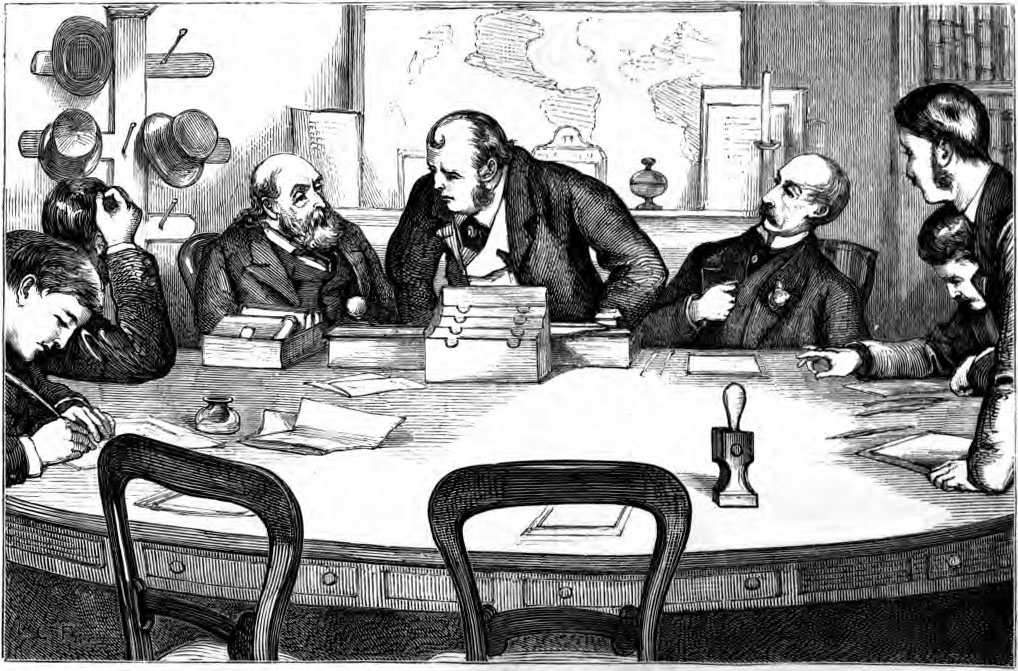
It was understood that Mr. Melmotte was to make a statement. Lord
Nidderdale and Sir Felix had conceived that this was to be done as
it were out of the great man's own heart, of his own wish, so that
something of the condition of the company might be made known to the
directors of the company. But this was not perhaps exactly the truth.
Paul Montague had insisted on giving vent to certain doubts at the
last meeting but one, and, having made himself very disagreeable
indeed, had forced this trouble on the great chairman. On the
intermediate Friday the chairman had made himself very unpleasant
to Paul, and this had seemed to be an effort on his part to frighten
the inimical director out of his opposition, so that the promise of
a statement need not be fulfilled. What nuisance can be so great to
a man busied with immense affairs, as to have to explain,--or to
attempt to explain,--small details to men incapable of understanding
them? But Montague had stood to his guns. He had not intended, he
said, to dispute the commercial success of the company. But he felt
very strongly, and he thought that his brother directors should feel
as strongly, that it was necessary that they should know more than
they did know. Lord Alfred had declared that he did not in the least
agree with his brother director. "If anybody don't understand, it's
his own fault," said Mr. Cohenlupe. But Paul would not give way, and
it was understood that Mr. Melmotte would make a statement.
The "Boards" were always commenced by the reading of a certain re-
cord of the last meeting out of a book. This was always done by Miles
Grendall; and the record was supposed to have been written by him.
But Montague had discovered that this statement in the book was
always prepared and written by a satellite of Melmotte's from
Abchurch Lane who was never present at the meeting. The adverse
director had spoken to the secretary,--it will be remembered that
they were both members of the Beargarden,--and Miles had given a
somewhat evasive reply. "A cussed deal of trouble and all that, you
know! He's used to it, and it's what he's meant for. I'm not going
to flurry myself about stuff of that kind." Montague after this had
spoken on the subject both to Nidderdale and Felix Carbury. "He
couldn't do it, if it was ever so," Nidderdale had said. "I don't
think I'd bully him if I were you. He gets £500 a-year, and if you
knew all he owes, and all he hasn't got, you wouldn't try to rob him
of it." With Felix Carbury Montague had as little success. Sir Felix
hated the secretary, had detected him cheating at cards, had resolved
to expose him,--and had then been afraid to do so. He had told Dolly
Longestaffe, and the reader will perhaps remember with what effect.
He had not mentioned the affair again, and had gradually fallen back
into the habit of playing at the club. Loo, however, had given way to
whist, and Sir Felix had satisfied himself with the change. He still
meditated some dreadful punishment for Miles Grendall, but, in the
meantime, felt himself unable to oppose him at the Board. Since the
day at which the aces had been manipulated at the club he had not
spoken to Miles Grendall except in reference to the affairs of the
whist-table. The "Board" was now commenced as usual. Miles read the
short record out of the book,--stumbling over every other word, and
going through the performance so badly that had there been anything
to understand no one could have understood it. "Gentlemen," said
Mr. Melmotte, in his usual hurried way, "is it your pleasure that I
shall sign the record?" Paul Montague rose to say that it was not his
pleasure that the record should be signed. But Melmotte had made his
scrawl, and was deep in conversation with Mr. Cohenlupe before Paul
could get upon his legs.
Melmotte, however, had watched the little struggle. Melmotte,
whatever might be his faults, had eyes to see and ears to hear. He
perceived that Montague had made a little struggle and had been
cowed; and he knew how hard it is for one man to persevere against
five or six, and for a young man to persevere against his elders.
Nidderdale was filliping bits of paper across the table at Carbury.
Miles Grendall was poring over the book which was in his charge.
Lord Alfred sat back in his chair, the picture of a model director,
with his right hand within his waistcoat. He looked aristocratic,
respectable, and almost commercial. In that room he never by any
chance opened his mouth, except when called on to say that Mr.
Melmotte was right, and was considered by the chairman really to
earn his money. Melmotte for a minute or two went on conversing with
Cohenlupe, having perceived that Montague for the moment was cowed.
Then Paul put both his hands upon the table, intending to rise and
ask some perplexing question. Melmotte saw this also and was upon
his legs before Montague had risen from his chair. "Gentlemen," said
Mr. Melmotte, "it may perhaps be as well if I take this occasion of
saying a few words to you about the affairs of the company." Then,
instead of going on with his statement, he sat down again, and began
to turn over sundry voluminous papers very slowly, whispering a word
or two every now and then to Mr. Cohenlupe. Lord Alfred never changed
his posture and never took his hand from his breast. Nidderdale and
Carbury filliped their paper pellets backwards and forwards. Montague
sat profoundly listening,--or ready to listen when anything should
be said. As the chairman had risen from his chair to commence his
statement, Paul felt that he was bound to be silent. When a speaker
is in possession of the floor, he is in possession even though he be
somewhat dilatory in looking to his references, and whispering to
his neighbour. And, when that speaker is a chairman, of course some
additional latitude must be allowed to him. Montague understood this,
and sat silent. It seemed that Melmotte had much to say to Cohenlupe,
and Cohenlupe much to say to Melmotte. Since Cohenlupe had sat at the
Board he had never before developed such powers of conversation.
Nidderdale didn't quite understand it. He had been there twenty
minutes, was tired of his present amusement, having been unable to
hit Carbury on the nose, and suddenly remembered that the Beargarden
would now be open. He was no respecter of persons, and had got over
any little feeling of awe with which the big table and the solemnity
of the room may have first inspired him. "I suppose that's about
all," he said, looking up at Melmotte.
"Well;--perhaps as your lordship is in a hurry, and as my lord here
is engaged elsewhere,"--turning round to Lord Alfred, who had not
uttered a syllable or made a sign since he had been in his seat,--"we
had better adjourn this meeting for another week."
"I cannot allow that," said Paul Montague.
"I suppose then we must take the sense of the Board," said the
Chairman.
"I have been discussing certain circumstances with our friend and
Chairman," said Cohenlupe, "and I must say that it is not expedient
just at present to go into matters too freely."
"My lords and gentlemen," said Melmotte. "I hope that you trust me."
Lord Alfred bowed down to the table and muttered something which was
intended to convey most absolute confidence. "Hear, hear," said Mr.
Cohenlupe. "All right," said Lord Nidderdale; "go on;" and he fired
another pellet with improved success.
"I trust," said the Chairman, "that my young friend, Sir Felix,
doubts neither my discretion nor my ability."
"Oh dear, no;--not at all," said the baronet, much flattered at being
addressed in this kindly tone. He had come there with objects of his
own, and was quite prepared to support the Chairman on any matter
whatever.
"My Lords and Gentlemen," continued Melmotte, "I am delighted to
receive this expression of your confidence. If I know anything in the
world I know something of commercial matters. I am able to tell you
that we are prospering. I do not know that greater prosperity has
ever been achieved in a shorter time by a commercial company. I think
our friend here, Mr. Montague, should be as feelingly aware of that
as any gentleman."
"What do you mean by that, Mr. Melmotte?" asked Paul.
"What do I mean?--Certainly nothing adverse to your character, sir.
Your firm in San Francisco, sir, know very well how the affairs of
the Company are being transacted on this side of the water. No doubt
you are in correspondence with Mr. Fisker. Ask him. The telegraph
wires are open to you, sir. But, my Lords and Gentlemen, I am able
to inform you that in affairs of this nature great discretion is
necessary. On behalf of the shareholders at large whose interests
are in our hands, I think it expedient that any general statement
should be postponed for a short time, and I flatter myself that in
that opinion I shall carry the majority of this Board with me." Mr.
Melmotte did not make his speech very fluently; but, being accustomed
to the place which he occupied, he did manage to get the words spoken
in such a way as to make them intelligible to the company. "I now
move that this meeting be adjourned to this day week," he added.
"I second that motion," said Lord Alfred, without moving his hand
from his breast.
"I understood that we were to have a statement," said Montague.
"You've had a statement," said Mr. Cohenlupe.
"I will put my motion to the vote," said the Chairman.
"I shall move an amendment," said Paul, determined that he would not
be altogether silenced.
"There is nobody to second it," said Mr. Cohenlupe.
"How do you know till I've made it?" asked the rebel. "I shall ask
Lord Nidderdale to second it, and when he has heard it I think that
he will not refuse."
"Oh, gracious me! why me? No;--don't ask me. I've got to go away. I
have indeed."
"At any rate I claim the right of saying a few words. I do not say
whether every affair of this Company should or should not be
published to the world."
"You'd break up everything if you did," said Cohenlupe.
"Perhaps everything ought to be broken up. But I say nothing about
that. What I do say is this. That as we sit here as directors and
will be held to be responsible as such by the public, we ought to
know what is being done. We ought to know where the shares really
are. I for one do not even know what scrip has been issued."
"You've bought and sold enough to know something about it," said
Melmotte.
Paul Montague became very red in the face. "I, at any rate, began,"
he said, "by putting what was to me a large sum of money into the
affair."
"That's more than I know," said Melmotte. "Whatever shares you have,
were issued at San Francisco, and not here."
"I have taken nothing that I haven't paid for," said Montague. "Nor
have I yet had allotted to me anything like the number of shares
which my capital would represent. But I did not intend to speak of my
own concerns."
"It looks very like it," said Cohenlupe.
"So far from it that I am prepared to risk the not improbable loss of
everything I have in the world. I am determined to know what is being
done with the shares, or to make it public to the world at large
that I, one of the directors of the Company, do not in truth know
anything about it. I cannot, I suppose, absolve myself from further
responsibility; but I can at any rate do what is right from this time
forward,--and that course I intend to take."
"The gentleman had better resign his seat at this Board," said
Melmotte. "There will be no difficulty about that."
"Bound up as I am with Fisker and Montague in California I fear that
there will be difficulty."
"Not in the least," continued the Chairman. "You need only gazette
your resignation and the thing is done. I had intended, gentlemen, to
propose an addition to our number. When I name to you a gentleman,
personally known to many of you, and generally esteemed throughout
England as a man of business, as a man of probity, and as a man of
fortune, a man standing deservedly high in all British circles, I
mean Mr. Longestaffe of Caversham--"
"Young Dolly, or old?" asked Lord Nidderdale.
"I mean Mr. Adolphus Longestaffe, senior, of Caversham. I am sure
that you will all be glad to welcome him among you. I had thought
to strengthen our number by this addition. But if Mr. Montague
is determined to leave us,--and no one will regret the loss of
his services so much as I shall,--it will be my pleasing duty to
move that Adolphus Longestaffe, senior, Esquire, of Caversham, be
requested to take his place. If on reconsideration Mr. Montague shall
determine to remain with us,--and I for one most sincerely hope that
such reconsideration may lead to such determination,--then I shall
move that an additional director be added to our number, and that
Mr. Longestaffe be requested to take the chair of that additional
director." The latter speech Mr. Melmotte got through very glibly,
and then immediately left the chair, so as to show that the business
of the Board was closed for that day without any possibility of
reopening it.
Paul went up to him and took him by the sleeve, signifying that he
wished to speak to him before they parted. "Certainly," said the
great man bowing. "Carbury," he said, looking round on the young
baronet with his blandest smile, "if you are not in a hurry, wait a
moment for me. I have a word or two to say before you go. Now, Mr.
Montague, what can I do for you?" Paul began his story, expressing
again the opinion which he had already very plainly expressed at the
table. But Melmotte stopped him very shortly, and with much less
courtesy than he had shown in the speech which he had made from the
chair. "The thing is about this way, I take it, Mr. Montague;--you
think you know more of this matter than I do."
"Not at all, Mr. Melmotte."
"And I think that I know more of it than you do. Either of us may
be right. But as I don't intend to give way to you, perhaps the
less we speak together about it the better. You can't be in earnest
in the threat you made, because you would be making public things
communicated to you under the seal of privacy,--and no gentleman
would do that. But as long as you are hostile to me, I can't help
you;--and so good afternoon." Then, without giving Montague the
possibility of a reply, he escaped into an inner room which had the
word "Private" painted on the door, and which was supposed to belong
to the chairman individually. He shut the door behind him, and then,
after a few moments, put out his head and beckoned to Sir Felix
Carbury. Nidderdale was gone. Lord Alfred with his son were already
on the stairs. Cohenlupe was engaged with Melmotte's clerk on the
record-book. Paul Montague finding himself without support and alone,
slowly made his way out into the court.
Sir Felix had come into the city intending to suggest to the Chairman
that having paid his thousand pounds he should like to have a few
shares to go on with. He was, indeed, at the present moment very
nearly penniless, and had negotiated, or lost at cards, all the
I.O.U.'s which were in any degree serviceable. He still had a
pocket-book full of those issued by Miles Grendall; but it was now an
understood thing at the Beargarden that no one was to be called upon
to take them except Miles Grendall himself;--an arrangement which
robbed the card-table of much of its delight. Beyond this, also, he
had lately been forced to issue a little paper himself,--in doing
which he had talked largely of his shares in the railway. His case
certainly was hard. He had actually paid a thousand pounds down in
hard cash, a commercial transaction which, as performed by himself,
he regarded as stupendous. It was almost incredible to himself that
he should have paid any one a thousand pounds, but he had done it
with much difficulty,--having carried Dolly junior with him all the
way into the city,--in the belief that he would thus put himself in
the way of making a continual and unfailing income. He understood
that as a director he would be always entitled to buy shares at par,
and, as a matter of course, always able to sell them at the market
price. This he understood to range from ten to fifteen and twenty per
cent. profit. He would have nothing to do but to buy and sell daily.
He was told that Lord Alfred was allowed to do it to a small extent;
and that Melmotte was doing it to an enormous extent. But before he
could do it he must get something,--he hardly knew what,--out of
Melmotte's hands. Melmotte certainly did not seem disposed to shun
him, and therefore there could be no difficulty about the shares. As
to danger;--who could think of danger in reference to money intrusted
to the hands of Augustus Melmotte?
"I am delighted to see you here," said Melmotte, shaking him
cordially by the hand. "You come regularly, and you'll find that it
will be worth your while. There's nothing like attending to business.
You should be here every Friday."
"I will," said the baronet.
"And let me see you sometimes up at my place in Abchurch Lane. I can
put you more in the way of understanding things there than I can
here. This is all a mere formal sort of thing. You can see that."
"Oh yes, I see that."
"We are obliged to have this kind of thing for men like that fellow
Montague. By-the-bye, is he a friend of yours?"
"Not particularly. He is a friend of a cousin of mine; and the women
know him at home. He isn't a pal of mine if you mean that."
"If he makes himself disagreeable, he'll have to go to the
wall;--that's all. But never mind him at present. Was your mother
speaking to you of what I said to her?"
"No, Mr. Melmotte," said Sir Felix, staring with all his eyes.
"I was talking to her about you, and I thought that perhaps she might
have told you. This is all nonsense, you know, about you and Marie."
Sir Felix looked into the man's face. It was not savage, as he had
seen it. But there had suddenly come upon his brow that heavy look
of a determined purpose which all who knew the man were wont to mark.
Sir Felix had observed it a few minutes since in the Board-room,
when the chairman was putting down the rebellious director. "You
understand that; don't you?" Sir Felix still looked at him, but made
no reply. "It's all d---- nonsense. You haven't got a brass farthing,
you know. You've no income at all; you're just living on your mother,
and I'm afraid she's not very well off. How can you suppose that I
shall give my girl to you?" Felix still looked at him but did not
dare to contradict a single statement made. Yet when the man told
him that he had not a brass farthing he thought of his own thousand
pounds which were now in the man's pocket. "You're a baronet, and
that's about all, you know," continued Melmotte. "The Carbury
property, which is a very small thing, belongs to a distant cousin
who may leave it to me if he pleases;--and who isn't very much older
than you are yourself."
"Oh, come, Mr. Melmotte; he's a great deal older than me."
"It wouldn't matter if he were as old as Adam. The thing is out of
the question, and you must drop it." Then the look on his brow became
a little heavier. "You hear what I say. She is going to marry Lord
Nidderdale. She was engaged to him before you ever saw her. What do
you expect to get by it?"
Sir Felix had not the courage to say that he expected to get the girl
he loved. But as the man waited for an answer he was obliged to say
something. "I suppose it's the old story," he said.
"Just so;--the old story. You want my money, and she wants you, just
because she has been told to take somebody else. You want something
to live on;--that's what you want. Come;--out with it. Is not that
it? When we understand each other I'll put you in the way of making
money."
"Of course I'm not very well off," said Felix.
"About as badly as any young man that I can hear of. You give me your
written promise that you'll drop this affair with Marie, and you
shan't want for money."
"A written promise!"
"Yes;--a written promise. I give nothing for nothing. I'll put you in
the way of doing so well with these shares that you shall be able to
marry any other girl you please;--or to live without marrying, which
you'll find to be better."
There was something worthy of consideration in Mr. Melmotte's
proposition. Marriage of itself, simply as a domestic institution,
had not specially recommended itself to Sir Felix Carbury. A few
horses at Leighton, Ruby Ruggles or any other beauty, and life at the
Beargarden were much more to his taste. And then he was quite alive
to the fact that it was possible that he might find himself possessed
of the wife without the money. Marie, indeed, had a grand plan of her
own, with reference to that settled income; but then Marie might be
mistaken,--or she might be lying. If he were sure of making money in
the way Melmotte now suggested, the loss of Marie would not break
his heart. But then also Melmotte might be--lying. "By-the-bye, Mr.
Melmotte," said he, "could you let me have those shares?"
"What shares?" And the heavy brow became still heavier.
"Don't you know?--I gave you a thousand pounds, and I was to have ten
shares."
"You must come about that on the proper day, to the proper place."
"When is the proper day?"
"It is the twentieth of each month I think." Sir Felix looked very
blank at hearing this, knowing that this present was the twenty-first
of the month. "But what does that signify? Do you want a little
money?"
"Well, I do," said Sir Felix. "A lot of fellows owe me money, but
it's so hard to get it."
"That tells a story of gambling," said Mr. Melmotte. "You think I'd
give my girl to a gambler?"
"Nidderdale's in it quite as thick as I am."
"Nidderdale has a settled property which neither he nor his father
can destroy. But don't you be such a fool as to argue with me. You
won't get anything by it. If you'll write that letter here now--"
"What;--to Marie?"
"No;--not to Marie at all; but to me. It need never be shown to her.
If you'll do that I'll stick to you and make a man of you. And if you
want a couple of hundred pounds I'll give you a cheque for it before
you leave the room. Mind, I can tell you this. On my word of honour
as a gentleman, if my daughter were to marry you, she'd never have a
single shilling. I should immediately make a will and leave all my
property to St. George's Hospital. I have quite made up my mind about
that."
"And couldn't you manage that I should have the shares before the
twentieth of next month?"
"I'll see about it. Perhaps I could let you have a few of my own. At
any rate I won't see you short of money."
The terms were enticing and the letter was of course written.
Melmotte himself dictated the words, which were not romantic in their
nature. The reader shall see the letter.
DEAR SIR,
In consideration of the offers made by you to me, and
on a clear understanding that such a marriage would be
disagreeable to you and to the lady's mother, and would
bring down a father's curse upon your daughter, I hereby
declare and promise that I will not renew my suit to the
young lady, which I hereby altogether renounce.
I am, Dear Sir,
Your obedient Servant,
FELIX CARBURY.
AUGUSTUS MELMOTTE, Esq.,
--, Grosvenor Square.
The letter was dated 21st July, and bore the printed address of the
offices of the South Central Pacific and Mexican Railway.
"You'll give me that cheque for £200, Mr. Melmotte?" The financier
hesitated for a moment, but did give the baronet the cheque as
promised. "And you'll see about letting me have those shares?"
"You can come to me in Abchurch Lane, you know." Sir Felix said that
he would call in Abchurch Lane.
As he went westward towards the Beargarden, the baronet was not
happy in his mind. Ignorant as he was as to the duties of a gentle-
man, indifferent as he was to the feelings of others, still he felt
ashamed of himself. He was treating the girl very badly. Even he knew
that he was behaving badly. He was so conscious of it that he tried
to console himself by reflecting that his writing such a letter as
that would not prevent his running away with the girl, should he, on
consideration, find it to be worth his while to do so.
That night he was again playing at the Beargarden, and he lost a
great part of Mr. Melmotte's money. He did in fact lose much more
than the £200; but when he found his ready money going from him he
issued paper.
CHAPTER XXXVIII.
PAUL MONTAGUE'S TROUBLES.
Paul Montague had other troubles on his mind beyond this trouble of
the Mexican Railway. It was now more than a fortnight since he had
taken Mrs. Hurtle to the play, and she was still living in lodgings
at Islington. He had seen her twice, once on the following day,
when he was allowed to come and go without any special reference to
their engagement, and again, three or four days afterwards, when the
meeting was by no means so pleasant. She had wept, and after weeping
had stormed. She had stood upon what she called her rights, and
had dared him to be false to her. Did he mean to deny that he had
promised to marry her? Was not his conduct to her, ever since she had
now been in London, a repetition of that promise? And then again she
became soft, and pleaded with him. But for the storm he might have
given way. At that moment he had felt that any fate in life would be
better than a marriage on compulsion. Her tears and her pleadings,
nevertheless, touched him very nearly. He had promised her most
distinctly. He had loved her and had won her love. And she was
lovely. The very violence of the storm made the sunshine more sweet.
She would sit down on a stool at his feet, and it was impossible to
drive her away from him. She would look up in his face and he could
not but embrace her. Then there had come a passionate flood of tears
and she was in his arms. How he had escaped he hardly knew, but he
did know that he had promised to be with her again before two days
should have passed.
On the day named he wrote to her a letter excusing himself, which
was at any rate true in words. He had been summoned, he said, to
Liverpool on business, and must postpone seeing her till his return.
And he explained that the business on which he was called was
connected with the great American railway, and, being important,
demanded his attention. In words this was true. He had been
corresponding with a gentleman at Liverpool with whom he had become
acquainted on his return home after having involuntarily become a
partner in the house of Fisker, Montague, and Montague. This man he
trusted and had consulted, and the gentleman, Mr. Ramsbottom by name,
had suggested that he should come to him at Liverpool. He had gone,
and his conduct at the Board had been the result of the advice which
he had received; but it may be doubted whether some dread of the
coming interview with Mrs. Hurtle had not added strength to Mr.
Ramsbottom's invitation.
In Liverpool he had heard tidings of Mrs. Hurtle, though it can
hardly be said that he obtained any trustworthy information. The lady
after landing from an American steamer had been at Mr. Ramsbottom's
office, inquiring for him, Paul; and Mr. Ramsbottom had thought
that the inquiries were made in a manner indicating danger. He
therefore had spoken to a fellow-traveller with Mrs. Hurtle, and the
fellow-traveller had opined that Mrs. Hurtle was "a queer card." "On
board ship we all gave it up to her that she was about the handsomest
woman we had ever seen, but we all said that there was a bit of the
wild cat in her breeding." Then Mr. Ramsbottom had asked whether the
lady was a widow. "There was a man on board from Kansas," said the
fellow-traveller, "who knew a man named Hurtle at Leavenworth, who
was separated from his wife and is still alive. There was, according
to him, a queer story about the man and his wife having fought a duel
with pistols, and then having separated." This Mr. Ramsbottom, who in
an earlier stage of the affair had heard something of Paul and Mrs.
Hurtle together, managed to communicate to the young man. His advice
about the railway company was very clear and general, and such as
an honest man would certainly give; but it might have been conveyed
by letter. The information, such as it was, respecting Mrs. Hurtle,
could only be given vivâ voce, and perhaps the invitation to
Liverpool had originated in Mr. Ramsbottom's appreciation of this
fact. "As she was asking after you here, perhaps it is as well that
you should know," his friend said to him. Paul had only thanked
him, not daring on the spur of the moment to speak of his own
difficulties.
In all this there had been increased dismay, but there had also
been some comfort. It had only been at moments in which he had
been subject to her softer influences that Paul had doubted as to his
adherence to the letter which he had written to her, breaking off his
engagement. When she told him of her wrongs and of her love; of his
promise and his former devotion to her; when she assured him that
she had given up everything in life for him, and threw her arms
round him, looking into his eyes;--then he would almost yield. But
when, what the traveller called the breeding of the wild cat, showed
itself;--and when, having escaped from her, he thought of Hetta
Carbury and of her breeding,--he was fully determined that, let his
fate be what it might, it should not be that of being the husband of
Mrs. Hurtle. That he was in a mass of troubles from which it would be
very difficult for him to extricate himself he was well aware;--but
if it were true that Mr. Hurtle was alive, that fact might help
him. She certainly had declared him to be,--not separated, or even
divorced,--but dead. And if it were true also that she had fought a
duel with one husband, that also ought to be a reason why a gentleman
should object to become her second husband. These facts would at any
rate justify himself to himself, and would enable himself to break
from his engagement without thinking himself to be a false traitor.
But he must make up his mind as to some line of conduct. She must
be made to know the truth. If he meant to reject the lady finally on
the score of her being a wild cat, he must tell her so. He felt very
strongly that he must not flinch from the wild cat's claws. That he
would have to undergo some severe handling, an amount of clawing
which might perhaps go near his life, he could perceive. Having done
what he had done he would have no right to shrink from such usage.
He must tell her to her face that he was not satisfied with her
past life, and that therefore he would not marry her. Of course he
might write to her;--but when summoned to her presence he would be
unable to excuse himself, even to himself, for not going. It was his
misfortune,--and also his fault,--that he had submitted to be loved
by a wild cat.
But it might be well that before he saw her he should get hold of
information that might have the appearance of real evidence. He
returned from Liverpool to London on the morning of the Friday on
which the Board was held, and thought even more of all this than he
did of the attack which he was prepared to make on Mr. Melmotte. If
he could come across that traveller he might learn something. The
husband's name had been Caradoc Carson Hurtle. If Caradoc Carson
Hurtle had been seen in the State of Kansas within the last two
years, that certainly would be sufficient evidence. As to the duel he
felt that it might be very hard to prove that, and that if proved, it
might be hard to found upon the fact any absolute right on his part
to withdraw from the engagement. But there was a rumour also, though
not corroborated during his last visit to Liverpool, that she had
shot a gentleman in Oregon. Could he get at the truth of that story?
If they were all true, surely he could justify himself to himself.
But this detective's work was very distasteful to him. After having
had the woman in his arms how could he undertake such inquiries as
these? And it would be almost necessary that he should take her in
his arms again while he was making them,--unless indeed he made them
with her knowledge. Was it not his duty, as a man, to tell everything
to herself? To speak to her thus;--"I am told that your life with
your last husband was, to say the least of it, eccentric; that you
even fought a duel with him. I could not marry a woman who had fought
a duel,--certainly not a woman who had fought with her own husband.
I am told also that you shot another gentleman in Oregon. It may well
be that the gentleman deserved to be shot; but there is something
in the deed so repulsive to me,--no doubt irrationally,--that, on
that score also, I must decline to marry you. I am told also that
Mr. Hurtle has been seen alive quite lately. I had understood from
you that he is dead. No doubt you may have been deceived. But as I
should not have engaged myself to you had I known the truth, so now
I consider myself justified in absolving myself from an engagement
which was based on a misconception." It would no doubt be difficult
to get through all these details; but it might be accomplished
gradually,--unless in the process of doing so he should incur the
fate of the gentleman in Oregon. At any rate he would declare to
her as well as he could the ground on which he claimed a right to
consider himself free, and would bear the consequences. Such was the
resolve which he made on his journey up from Liverpool, and that
trouble was also on his mind when he rose up to attack Mr. Melmotte
single-handed at the Board.
When the Board was over, he also went down to the Beargarden.
Perhaps, with reference to the Board, the feeling which hurt him most
was the conviction that he was spending money which he would never
have had to spend had there been no Board. He had been twitted with
this at the Board-meeting, and had justified himself by referring to
the money which had been invested in the Company of Fisker, Montague,
and Montague, which money was now supposed to have been made over
to the railway. But the money which he was spending had come to
him after a loose fashion, and he knew that if called upon for an
account, he could hardly make out one which would be square and
intelligible to all parties. Nevertheless he spent much of his time
at the Beargarden, dining there when no engagement carried him
elsewhere. On this evening he joined his table with Nidderdale's,
at the young lord's instigation. "What made you so savage at old
Melmotte to-day?" said the young lord.
"I didn't mean to be savage, but I think that as we call ourselves
Directors we ought to know something about it."
"I suppose we ought. I don't know, you know. I'll tell you what I've
been thinking. I can't make out why the mischief they made me a
Director."
"Because you're a lord," said Paul bluntly.
"I suppose there's something in that. But what good can I do them?
Nobody thinks that I know anything about business. Of course I'm in
Parliament, but I don't often go there unless they want me to vote.
Everybody knows that I'm hard up. I can't understand it. The Governor
said that I was to do it, and so I've done it."
"They say, you know,--there's something between you and Melmotte's
daughter."
"But if there is, what has that to do with a railway in the city?
And
why should Carbury be there? And, heaven and earth, why should old
Grendall be a Director? I'm impecunious; but if you were to pick out
the two most hopeless men in London in regard to money, they would be
old Grendall and young Carbury. I've been thinking a good deal about
it, and I can't make it out."
"I have been thinking about it too," said Paul.
"I suppose old Melmotte is all right?" asked Nidderdale. This was a
question which Montague found it difficult to answer. How could he be
justified in whispering suspicions to the man who was known to be at
any rate one of the competitors for Marie Melmotte's hand? "You can
speak out to me, you know," said Nidderdale, nodding his head.
"I've got nothing to speak. People say that he is about the richest
man alive."
"He lives as though he were."
"I don't see why it shouldn't be all true. Nobody, I take it, knows
very much about him." When his companion had left him, Nidderdale sat
down, thinking of it all. It occurred to him that he would "be coming
a cropper rather," were he to marry Melmotte's daughter for her
money, and then find that she had got none.
A little later in the evening he invited Montague to go up to the
card-room. "Carbury, and Grasslough, and Dolly Longestaffe are there
waiting," he said. But Paul declined. He was too full of his troubles
for play. "Poor Miles isn't there, if you're afraid of that," said
Nidderdale.
"Miles Grendall wouldn't hinder me," said Montague.
"Nor me either. Of course it's a confounded shame. I know that
as well as any body. But, God bless me, I owe a fellow down in
Leicestershire heaven knows how much for keeping horses, and that's
a shame."
"You'll pay him some day."
"I suppose I shall,--if I don't die first. But I should have gone on
with the horses just the same if there had never been anything to
come;--only they wouldn't have given me tick, you know. As far as I'm
concerned it's just the same. I like to live whether I've got money
or not. And I fear I don't have many scruples about paying. But then
I like to let live too. There's Carbury always saying nasty things
about poor Miles. He's playing himself without a rap to back him. If
he were to lose, Vossner wouldn't stand him a £10 note. But because
he has won, he goes on as though he were old Melmotte himself. You'd
better come up."
But Montague wouldn't go up. Without any fixed purpose he left the
club, and slowly sauntered northwards through the streets till he
found himself in Welbeck Street. He hardly knew why he went there,
and certainly had not determined to call on Lady Carbury when he left
the Beargarden. His mind was full of Mrs. Hurtle. As long as she was
present in London,--as long at any rate as he was unable to tell
himself that he had finally broken away from her,--he knew himself
to be an unfit companion for Henrietta Carbury. And, indeed, he
was still under some promise made to Roger Carbury, not that he
would avoid Hetta's company, but that for a certain period, as yet
unexpired, he would not ask her to be his wife. It had been a foolish
promise, made and then repented without much attention to words;--but
still it was existing, and Paul knew well that Roger trusted that it
would be kept. Nevertheless Paul made his way up to Welbeck Street
and almost unconsciously knocked at the door. No;--Lady Carbury was
not at home. She was out somewhere with Mr. Roger Carbury. Up to that
moment Paul had not heard that Roger was in town; but the reader may
remember that he had come up in search of Ruby Ruggles. Miss Carbury
was at home, the page went on to say. Would Mr. Montague go up and
see Miss Carbury? Without much consideration Mr. Montague said that
he would go up and see Miss Carbury. "Mamma is out with Roger," said
Hetta endeavouring to save herself from confusion. "There is a soirée
of learned people somewhere, and she made poor Roger take her. The
ticket was only for her and her friend, and therefore I could not
go."
"I am so glad to see you. What an age it is since we met."
"Hardly since the Melmottes' ball," said Hetta.
"Hardly indeed. I have been here once since that. What has brought
Roger up to town?"
"I don't know what it is. Some mystery, I think. Whenever there is a
mystery I am always afraid that there is something wrong about Felix.
I do get so unhappy about Felix, Mr. Montague."
"I saw him to-day in the city, at the Railway Board."
"But Roger says the Railway Board is all a sham,"--Paul could
not
keep himself from blushing as he heard this,--"and that Felix should
not be there. And then there is something going on about that horrid
man's daughter."
"She is to marry Lord Nidderdale, I think."
"Is she? They are talking of her marrying Felix, and of course it is
for her money. And I believe that man is determined to quarrel with
them."
"What man, Miss Carbury?"
"Mr. Melmotte himself. It's all horrid from beginning to end."
"But I saw them in the city to-day and they seemed to be the greatest
friends. When I wanted to see Mr. Melmotte he bolted himself into an
inner room, but he took your brother with him. He would not have done
that if they had not been friends. When I saw it I almost thought
that he had consented to the marriage."
"Roger has the greatest dislike to Mr. Melmotte."
"I know he has," said Paul.
"And Roger is always right. It is always safe to trust him. Don't
you think so, Mr. Montague?" Paul did think so, and was by no means
disposed to deny to his rival the praise which rightly belonged to
him; but still he found the subject difficult. "Of course I will
never go against mamma," continued Hetta, "but I always feel that my
Cousin Roger is a rock of strength, so that if one did whatever he
said one would never get wrong. I never found any one else that I
thought that of, but I do think it of him."
"No one has more reason to praise him than I have."
"I think everybody has reason to praise him that has to do with him.
And I'll tell you why I think it is. Whenever he thinks anything he
says it;--or, at least, he never says anything that he doesn't think.
If he spent a thousand pounds, everybody would know that he'd got it
to spend; but other people are not like that."
"You're thinking of Melmotte."
"I'm thinking of everybody, Mr. Montague;--of everybody except
Roger."
"Is he the only man you can trust? But it is abominable to me to seem
even to contradict you. Roger Carbury has been to me the best friend
that any man ever had. I think as much of him as you do."
"I didn't say he was the only person;--or I didn't mean to say so.
But of all my friends--"
"Am I among the number, Miss Carbury?"
"Yes;--I suppose so. Of course you are. Why not? Of course you are a
friend,--because you are his friend."
"Look here, Hetta," he said. "It is no good going on like this. I
love Roger Carbury,--as well as one man can love another. He is all
that you say,--and more. You hardly know how he denies himself, and
how he thinks of everybody near him. He is a gentleman all round and
every inch. He never lies. He never takes what is not his own. I
believe he does love his neighbour as himself."
"Oh, Mr. Montague! I am so glad to hear you speak of him like that."
"I love him better than any man,--as well as a man can love a man. If
you will say that you love him as well as a woman can love a man,--I
will leave England at once, and never return to it."
"There's mamma," said Henrietta;--for at that moment there was a
double knock at the door.
CHAPTER XXXIX.
"I DO LOVE HIM."
So it was. Lady Carbury had returned home from the soirée of learned
people, and had brought Roger Carbury with her. They both came up
to the drawing-room and found Paul and Henrietta together. It need
hardly be said that they were both surprised. Roger supposed that
Montague was still at Liverpool, and, knowing that he was not a
frequent visitor in Welbeck Street, could hardly avoid a feeling
that a meeting between the two had now been planned in the mother's
absence. The reader knows that it was not so. Roger certainly was a
man not liable to suspicion, but the circumstances in this case were
suspicious. There would have been nothing to suspect,--no reason why
Paul should not have been there,--but from the promise which had been
given. There was, indeed, no breach of that promise proved by Paul's
presence in Welbeck Street; but Roger felt rather than thought that
the two could hardly have spent the evening together without such
breach. Whether Paul had broken the promise by what he had already
said the reader must be left to decide.
Lady Carbury was the first to speak. "This is quite an unexpected
pleasure, Mr. Montague." Whether Roger suspected anything or not,
she did. The moment she saw Paul the idea occurred to her that the
meeting between Hetta and him had been preconcerted.
"Yes," he said,--making a lame excuse, where no excuse should have
been made,--"I had nothing to do, and was lonely, and thought that I
would come up and see you." Lady Carbury disbelieved him altogether,
but Roger felt assured that his coming in Lady Carbury's absence had
been an accident. The man had said so, and that was enough.
"I thought you were at Liverpool," said Roger.
"I came back to-day,--to be present at that Board in the city. I have
had a good deal to trouble me. I will tell you all about it just now.
What has brought you to London?"
"A little business," said Roger.
Then there was an awkward silence. Lady Carbury was angry, and hardly
knew whether she ought or ought not to show her anger. For Henrietta
it was very awkward. She, too, could not but feel that she had been
caught, though no innocence could be whiter than hers. She knew well
her mother's mind, and the way in which her mother's thoughts would
run. Silence was frightful to her, and she found herself forced to
speak. "Have you had a pleasant evening, mamma?"
"Have you had a pleasant evening, my dear?" said Lady Carbury,
forgetting herself in her desire to punish her daughter.
"Indeed, no," said Hetta, attempting to laugh, "I have been trying to
work hard at Dante, but one never does any good when one has to try
to work. I was just going to bed when Mr. Montague came in. What did
you think of the wise men and the wise women, Roger?"
"I was out of my element, of course; but I think your mother liked
it."
"I was very glad indeed to meet Dr. Palmoil. It seems that if we
can only open the interior of Africa a little further, we can get
everything that is wanted to complete the chemical combination
necessary for feeding the human race. Isn't that a grand idea,
Roger?"
"A little more elbow grease is the combination that I look to."
"Surely, Roger, if the Bible is to go for anything, we are to believe
that labour is a curse and not a blessing. Adam was not born to
labour."
"But he fell; and I doubt whether Dr. Palmoil will be able to put his
descendants back into Eden."
"Roger, for a religious man, you do say the strangest things! I have
quite made up my mind to this;--if ever I can see things so settled
here as to enable me to move, I will visit the interior of Africa. It
is the garden of the world."
This scrap of enthusiasm so carried them through their immediate
difficulties that the two men were able to take their leave and to
get out of the room with fair comfort. As soon as the door was closed
behind them Lady Carbury attacked her daughter. "What brought him
here?"
"He brought himself, mamma."
"Don't answer me in that way, Hetta. Of course he brought himself.
That is insolent."
"Insolent, mamma! How can you say such hard words? I meant that he
came of his own accord."
"How long was he here?"
"Two minutes before you came in. Why do you cross-question me like
this? I could not help his coming. I did not desire that he might be
shown up."
"You did not know that he was to come?"
"Mamma, if I am to be suspected, all is over between us."
"What do you mean by that?"
"If you can think that I would deceive you, you will think so always.
If you will not trust me, how am I to live with you as though you
did? I knew nothing of his coming."
"Tell me this, Hetta; are you engaged to marry him?"
"No;--I am not."
"Has he asked you to marry him?"
Hetta paused a moment, considering, before she answered this
question. "I do not think he ever has."
"You do not think?"
"I was going on to explain. He never has asked me. But he has said
that which makes me know that he wishes me to be his wife."
"What has he said? When did he say it?"
Again she paused. But again she answered with straightforward
simplicity. "Just before you came in, he said--; I don't know what he
said; but it meant that."
"You told me he had been here but a minute."
"It was but very little more. If you take me at my word in that way,
of course you can make me out to be wrong, mamma. It was almost no
time, and yet he said it."
"He had come prepared to say it."
"How could he,--expecting to find you?"
"Psha! He expected nothing of the kind."
"I think you do him wrong, mamma. I am sure you are doing me wrong.
I think his coming was an accident, and that what he said was--an
accident."
"An accident!"
"It was not intended,--not then, mamma. I have known it ever so
long;--and so have you. It was natural that he should say so when we
were alone together."
"And you;--what did you say?"
"Nothing. You came."
"I am sorry that my coming should have been so inopportune. But I
must ask one other question, Hetta. What do you intend to say?" Hetta
was again silent, and now for a longer space. She put her hand up to
her brow and pushed back her hair as she thought whether her mother
had a right to continue this cross-examination. She had told her
mother everything as it had happened. She had kept back no deed done,
no word spoken, either now or at any time. But she was not sure that
her mother had a right to know her thoughts, feeling as she did that
she had so little sympathy from her mother. "How do you intend to
answer him?" demanded Lady Carbury.
"I do not know that he will ask again."
"That is prevaricating."
"No, mamma;--I do not prevaricate. It is unfair to say that to me.
I do love him. There. I think it ought to have been enough for you to
know that I should never give him encouragement without telling you
about it. I do love him, and I shall never love any one else."
"He is a ruined man. Your cousin says that all this Company in which
he is involved will go to pieces."
Hetta was too clever to allow this argument to pass. She did not
doubt that Roger had so spoken of the Railway to her mother, but she
did doubt that her mother had believed the story. "If so," said she,
"Mr. Melmotte will be a ruined man too, and yet you want Felix to
marry Marie Melmotte."
"It makes me ill to hear you talk,--as if you understood these
things. And you think you will marry this man because he is to make a
fortune out of the Railway!" Lady Carbury was able to speak with an
extremity of scorn in reference to the assumed pursuit by one of her
children of an advantageous position which she was doing all in her
power to recommend to the other child.
"I have not thought of his fortune. I have not thought of marrying
him, mamma. I think you are very cruel to me. You say things so hard,
that I cannot bear them."
"Why will you not marry your cousin?"
"I am not good enough for him."
"Nonsense!"
"Very well; you say so. But that is what I think. He is so much above
me, that, though I do love him, I cannot think of him in that way.
And I have told you that I do love some one else. I have no secret
from you now. Good night, mamma," she said, coming up to her mother
and kissing her. "Do be kind to me; and pray,--pray,--do believe me."
Lady Carbury then allowed herself to be kissed, and allowed her
daughter to leave the room.
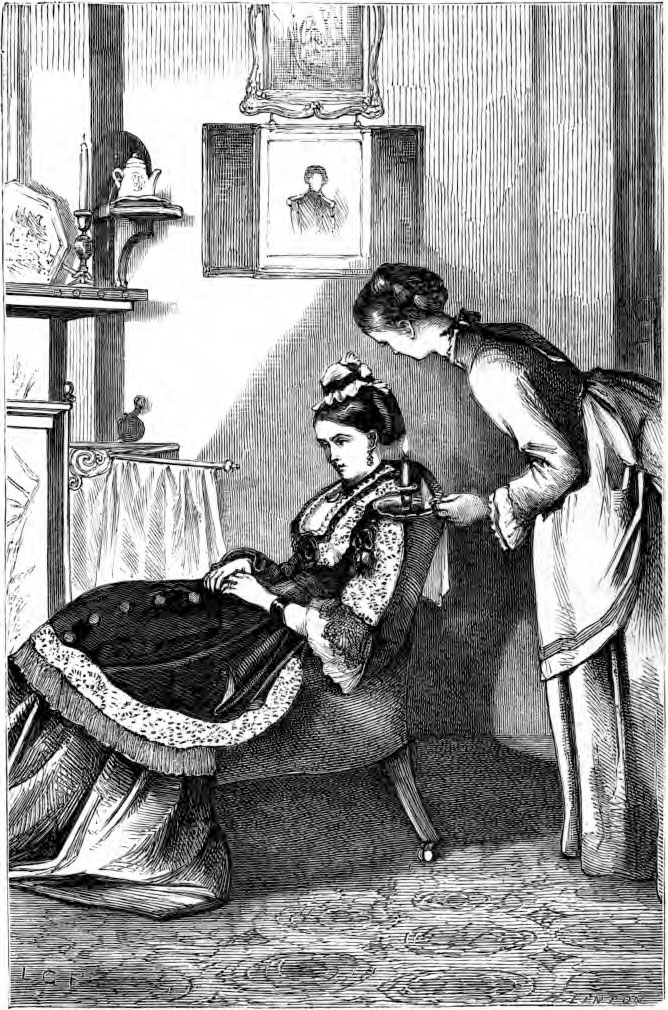
There was a great deal said that night between Roger Carbury and
Paul Montague before they parted. As they walked together to Roger's
hotel he said not a word as to Paul's presence in Welbeck Street.
Paul had declared his visit in Lady Carbury's absence to have
been accidental,--and therefore there was nothing more to be said.
Montague then asked as to the cause of Carbury's journey to London.
"I do not wish it to be talked of," said Roger after a pause,--"and
of course I could not speak of it before Hetta. A girl has gone away
from our neighbourhood. You remember old Ruggles?"
"You do not mean that Ruby has levanted? She was to have married John
Crumb."
"Just so,--but she has gone off, leaving John Crumb in an unhappy
frame of mind. John Crumb is an honest man and almost too good for
her."
"Ruby is very pretty. Has she gone with any one?"
"No;--she went alone. But the horror of it is this. They think down
there that Felix has,--well, made love to her, and that she has been
taken to London by him."
"That would be very bad."
"He certainly has known her. Though he lied, as he always lies, when
I first spoke to him, I brought him to admit that he and she had
been friends down in Suffolk. Of course we know what such friendship
means. But I do not think that she came to London at his instance. Of
course he would lie about that. He would lie about anything. If his
horse cost him a hundred pounds, he would tell one man that he gave
fifty, and another two hundred. But he has not lived long enough yet
to be able to lie and tell the truth with the same eye. When he is as
old as I am he'll be perfect."
"He knows nothing about her coming to town?"
"He did not when I first asked him. I am not sure, but I fancy that
I was too quick after her. She started last Saturday morning. I
followed on the Sunday, and made him out at his club. I think that he
knew nothing then of her being in town. He is very clever if he did.
Since that he has avoided me. I caught him once but only for half a
minute, and then he swore that he had not seen her."
"You still believed him?"
"No;--he did it very well, but I knew that he was prepared for me.
I cannot say how it may have been. To make matters worse old Ruggles
has now quarrelled with Crumb, and is no longer anxious to get back
his granddaughter. He was frightened at first; but that has gone off,
and he is now reconciled to the loss of the girl and the saving of
his money."
After that Paul told all his own story,--the double story, both in
regard to Melmotte and to Mrs. Hurtle. As regarded the Railway, Roger
could only tell him to follow explicitly the advice of his Liverpool
friend. "I never believed in the thing, you know."
"Nor did I. But what could I do?"
"I'm not going to blame you. Indeed, knowing you as I do, feeling
sure that you intend to be honest, I would not for a moment insist on
my own opinion, if it did not seem that Mr. Ramsbottom thinks as I
do. In such a matter, when a man does not see his own way clearly,
it behoves him to be able to show that he has followed the advice
of some man whom the world esteems and recognises. You have to bind
your character to another man's character; and that other man's
character, if it be good, will carry you through. From what I hear
Mr. Ramsbottom's character is sufficiently good;--but then you must
do exactly what he tells you."
But the Railway business, though it comprised all that Montague had
in the world, was not the heaviest of his troubles. What was he to
do about Mrs. Hurtle? He had now, for the first time, to tell his
friend that Mrs. Hurtle had come to London, and that he had been with
her three or four times. There was this difficulty in the matter,
too,--that it was very hard to speak of his engagement with Mrs.
Hurtle without in some sort alluding to his love for Henrietta
Carbury. Roger knew of both loves;--had been very urgent with his
friend to abandon the widow, and at any rate equally urgent with him
to give up the other passion. Were he to marry the widow, all danger
on the other side would be at an end. And yet, in discussing the
question of Mrs. Hurtle, he was to do so as though there were no such
person existing as Henrietta Carbury. The discussion did take place
exactly as though there were no such person as Henrietta Carbury.
Paul told it all,--the rumoured duel, the rumoured murder, and the
rumour of the existing husband.
"It may be necessary that you should go out to Kansas,--and to
Oregon," said Roger.
"But even if the rumours be untrue I will not marry her," said Paul.
Roger shrugged his shoulders. He was doubtless thinking of Hetta
Carbury, but he said nothing. "And what would she do, remaining
here?" continued Paul. Roger admitted that it would be awkward. "I
am determined that under no circumstances will I marry her. I know
I have been a fool. I know I have been wrong. But of course, if there
be a fair cause for my broken word, I will use it if I can."
"You will get out of it, honestly if you can; but you will get out of
it honestly or--any other way."
"Did you not advise me to get out of it, Roger;--before we knew as
much as we do now?"
"I did,--and I do. If you make a bargain with the Devil, it may be
dishonest to cheat him,--and yet I would have you cheat him if you
could. As to this woman, I do believe she has deceived you. If I were
you, nothing should induce me to marry her;--not though her claws
were strong enough to tear me utterly in pieces. I'll tell you what
I'll do. I'll go and see her if you like it."
But Paul would not submit to this. He felt that he was bound himself
to incur the risk of those claws, and that no substitute could take
his place. They sat long into the night, and it was at last resolved
between them that on the next morning Paul should go to Islington,
should tell Mrs. Hurtle all the stories which he had heard, and
should end by declaring his resolution that under no circumstances
would he marry her. They both felt how improbable it was that he
should ever be allowed to get to the end of such a story,--how almost
certain it was that the breeding of the wild cat would show itself
before that time should come. But, still, that was the course to be
pursued as far as circumstances would admit; and Paul was at any rate
to declare, claws or no claws, husband or no husband,--whether the
duel or the murder was admitted or denied,--that he would never make
Mrs. Hurtle his wife. "I wish it were over, old fellow," said Roger.
"So do I," said Paul, as he took his leave.
He went to bed like a man condemned to die on the next morning, and
he awoke in the same condition. He had slept well, but as he shook
from him his happy dream, the wretched reality at once overwhelmed
him. But the man who is to be hung has no choice. He cannot, when he
wakes, declare that he has changed his mind, and postpone the hour.
It was quite open to Paul Montague to give himself such instant
relief. He put his hand up to his brow, and almost made himself
believe that his head was aching. This was Saturday. Would it not be
well that he should think of it further, and put off his execution
till Monday? Monday was so far distant that he felt that he could go
to Islington quite comfortably on Monday. Was there not some hitherto
forgotten point which it would be well that he should discuss with
his friend Roger before he saw the lady? Should he not rush down to
Liverpool, and ask a few more questions of Mr. Ramsbottom? Why should
he go forth to execution, seeing that the matter was in his own
hands?
At last he jumped out of bed and into his tub, and dressed himself
as quickly as he could. He worked himself up into a fit of fortitude,
and resolved that the thing should be done before the fit was over.
He ate his breakfast about nine, and then asked himself whether he
might not be too early were he to go at once to Islington. But he
remembered that she was always early. In every respect she was an
energetic woman, using her time for some purpose, either good or bad,
not sleeping it away in bed. If one has to be hung on a given day,
would it not be well to be hung as soon after waking as possible?
I can fancy that the hangman would hardly come early enough. And if
one had to be hung in a given week, would not one wish to be hung on
the first day of the week, even at the risk of breaking one's last
Sabbath day in this world? Whatever be the misery to be endured, get
it over. The horror of every agony is in its anticipation. Paul had
realised something of this when he threw himself into a Hansom cab,
and ordered the man to drive him to Islington.
How quick that cab went! Nothing ever goes so quick as a Hansom
cab when a man starts for a dinner-party a little too early;--no-
thing so slow when he starts too late. Of all cabs this, surely, was
the quickest. Paul was lodging in Suffolk Street, close to Pall
Mall,--whence the way to Islington, across Oxford Street, across
Tottenham Court Road, across numerous squares north-east of the
Museum, seems to be long. The end of Goswell Road is the outside
of the world in that direction, and Islington is beyond the end of
Goswell Road. And yet that Hansom cab was there before Paul Montague
had been able to arrange the words with which he would begin the
interview. He had given the street and the number of the street. It
was not till after he had started that it occurred to him that it
might be well that he should get out at the end of the street, and
walk to the house,--so that he might, as it were, fetch his breath
before the interview was commenced. But the cabman dashed up to the
door in a manner purposely devised to make every inmate of the house
aware that a cab had just arrived before it. There was a little
garden before the house. We all know the garden;--twenty-four feet
long, by twelve broad;--and an iron-grated door, with the landlady's
name on a brass plate. Paul, when he had paid the cabman,--giving the
man half-a-crown, and asking for no change in his agony,--pushed in
the iron gate and walked very quickly up to the door, rang rather
furiously, and before the door was well opened asked for Mrs. Hurtle.
"Mrs. Hurtle is out for the day," said the girl who opened the door.
"Leastways, she went out yesterday and won't be back till to-night."
Providence had sent him a reprieve! But he almost forgot the
reprieve, as he looked at the girl and saw that she was Ruby Ruggles.
"Oh laws, Mr. Montague, is that you?" Ruby Ruggles had often seen
Paul down in Suffolk, and recognised him as quickly as he did her. It
occurred to her at once that he had come in search of herself. She
knew that Roger Carbury was up in town looking for her. So much she
had of course learned from Sir Felix,--for at this time she had seen
the baronet more than once since her arrival. Montague, she knew,
was Roger Carbury's intimate friend, and now she felt that she was
caught. In her terror she did not at first remember that the visitor
had asked for Mrs. Hurtle.
"Yes, it is I. I was sorry to hear, Miss Ruggles, that you had left
your home."
"I'm all right, Mr. Montague;--I am. Mrs. Pipkin is my aunt, or,
leastways, my mother's brother's widow, though grandfather never
would speak to her. She's quite respectable, and has five children,
and lets lodgings. There's a lady here now, and has gone away with
her just for one night down to Southend. They'll be back this
evening, and I've the children to mind, with the servant girl. I'm
quite respectable here, Mr. Montague, and nobody need be a bit afraid
about me."
"Mrs. Hurtle has gone down to Southend?"
"Yes, Mr. Montague; she wasn't quite well, and wanted a breath of
air, she said. And aunt didn't like she should go alone, as Mrs.
Hurtle is such a stranger. And Mrs. Hurtle said as she didn't
mind paying for two, and so they've gone, and the baby with them.
Mrs. Pipkin said as the baby shouldn't be no trouble. And Mrs.
Hurtle,--she's most as fond of the baby as aunt. Do you know Mrs.
Hurtle, sir?"
"Yes; she's a friend of mine."
"Oh; I didn't know. I did know as there was some friend as was
expected and as didn't come. Be I to say, sir, as you was here?"
Paul thought it might be as well to shift the subject and to ask Ruby
a few questions about herself while he made up his mind what message
he would leave for Mrs. Hurtle. "I'm afraid they are very unhappy
about you down at Bungay, Miss Ruggles."
"Then they've got to be unhappy; that's all about it, Mr. Montague.
Grandfather is that provoking as a young woman can't live with him,
nor yet I won't try never again. He lugged me all about the room by
my hair, Mr. Montague. How is a young woman to put up with that?
And I did everything for him,--that careful that no one won't do it
again;--did his linen, and his victuals, and even cleaned his boots
of a Sunday, 'cause he was that mean he wouldn't have anybody about
the place only me and the girl who had to milk the cows. There wasn't
nobody to do anything, only me. And then he went to drag me about
by the hairs of my head. You won't see me again at Sheep's Acre, Mr.
Montague;--nor yet won't the Squire."
"But I thought there was somebody else was to give you a home."
"John Crumb! Oh, yes, there's John Crumb. There's plenty of people to
give me a home, Mr. Montague."
"You were to have been married to John Crumb, I thought."
"Ladies is to change their minds if they like it, Mr. Montague. I'm
sure you've heard that before. Grandfather made me say I'd have
him,--but I never cared that for him."
"I'm afraid, Miss Ruggles, you won't find a better man up here in
London."
"I didn't come here to look for a man, Mr. Montague; I can tell you
that. They has to look for me, if they want me. But I am looked
after; and that by one as John Crumb ain't fit to touch." That told
the whole story. Paul when he heard the little boast was quite sure
that Roger's fear about Felix was well founded. And as for John
Crumb's fitness to touch Sir Felix, Paul felt that the Bungay mealman
might have an opinion of his own on that matter. "But there's Betsy a
crying up-stairs, and I promised not to leave them children for one
minute."
"I will tell the Squire that I saw you, Miss Ruggles."
"What does the Squire want o' me? I ain't nothing to the Squire,
--except that I respects him. You can tell if you please, Mr.
Montague, of course. I'm a coming, my darling."
Paul made his way into Mrs. Hurtle's sitting-room and wrote a note
for her in pencil. He had come, he said, immediately on his return
from Liverpool, and was sorry to find that she was away for the day.
When should he call again? If she would make an appointment he would
attend to it. He felt as he wrote this that he might very safely have
himself made an appointment for the morrow; but he cheated himself
into half believing that the suggestion he now made was the more
gracious and civil. At any rate it would certainly give him another
day. Mrs. Hurtle would not return till late in the evening, and as
the following day was Sunday there would be no delivery by post.
When the note was finished he left it on the table, and called to
Ruby to tell her that he was going. "Mr. Montague," she said in a
confidential whisper, as she tripped down the stairs, "I don't see
why you need be saying anything about me, you know."
"Mr. Carbury is up in town looking after you."
"What 'm I to Mr. Carbury?"
"Your grandfather is very anxious about you."
"Not a bit of it, Mr. Montague. Grandfather knows very well where
I am. There! Grandfather doesn't want me back, and I ain't a going.
Why should the Squire bother himself about me? I don't bother myself
about him."
"He's afraid, Miss Ruggles, that you are trusting yourself to a young
man who is not trustworthy."
"I can mind myself very well, Mr. Montague."
"Tell me this. Have you seen Sir Felix Carbury since you've been in
town?" Ruby, whose blushes came very easily, now flushed up to her
forehead. "You may be sure that he means no good to you. What can
come of an intimacy between you and such a one as he?"
"I don't see why I shouldn't have my friend, Mr. Montague, as well as
you. Howsomever, if you'll not tell, I'll be ever so much obliged."
"But I must tell Mr. Carbury."
"Then I ain't obliged to you one bit," said Ruby, shutting the door.
Paul as he walked away could not help thinking of the justice of
Ruby's reproach to him. What business had he to take upon himself to
be a Mentor to any one in regard to an affair of love;--he, who had
engaged himself to marry Mrs. Hurtle, and who the evening before had
for the first time declared his love to Hetta Carbury?
In regard to Mrs. Hurtle he had got a reprieve, as he thought, for
two days;--but it did not make him happy or even comfortable. As he
walked back to his lodgings he knew it would have been better for him
to have had the interview over. But, at any rate, he could now think
of Hetta Carbury, and the words he had spoken to her. Had he heard
that declaration which she had made to her mother, he would have been
able for the hour to have forgotten Mrs. Hurtle.
CHAPTER XL.
"UNANIMITY IS THE VERY SOUL OF THESE THINGS."
That evening Montague was surprised to receive at the Beargarden a
note from Mr. Melmotte, which had been brought thither by a messenger
from the city,--who had expected to have an immediate answer, as
though Montague lived at the club.
"Dear Sir," said the letter,
If not inconvenient would you call on me in Grosvenor
Square to-morrow, Sunday, at half past eleven. If you are
going to church, perhaps you will make an appointment in
the afternoon; if not, the morning will suit best. I want
to have a few words with you in private about the Company.
My messenger will wait for answer if you are at the club.
Yours truly,
AUGUSTUS MELMOTTE.
PAUL MONTAGUE, Esq.,
The Beargarden.
Paul immediately wrote to say that he would call at Grosvenor Square
at the hour appointed,--abandoning any intentions which he might have
had in reference to Sunday morning service. But this was not the only
letter he received that evening. On his return to his lodgings he
found a note, containing only one line, which Mrs. Hurtle had found
the means of sending to him after her return from Southend. "I am so
sorry to have been away. I will expect you all to-morrow. W. H." The
period of the reprieve was thus curtailed to less than a day.
On the Sunday morning he breakfasted late and then walked up to
Grosvenor Square, much pondering what the great man could have to
say to him. The great man had declared himself very plainly in the
Board-room,--especially plainly after the Board had risen. Paul had
understood that war was declared, and had understood also that he was
to fight the battle single-handed, knowing nothing of such strategy
as would be required, while his antagonist was a great master of
financial tactics. He was prepared to go to the wall in reference to
his money, only hoping that in doing so he might save his character
and keep the reputation of an honest man. He was quite resolved
to be guided altogether by Mr. Ramsbottom, and intended to ask Mr.
Ramsbottom to draw up for him such a statement as would be fitting
for him to publish. But it was manifest now that Mr. Melmotte would
make some proposition, and it was impossible that he should have Mr.
Ramsbottom at his elbow to help him.
He had been in Melmotte's house on the night of the ball, but had
contented himself after that with leaving a card. He had heard much
of the splendour of the place, but remembered simply the crush and
the crowd, and that he had danced there more than once or twice with
Hetta Carbury. When he was shown into the hall he was astonished to
find that it was not only stripped, but was full of planks, and
ladders, and trussels, and mortar. The preparations for the great
dinner had been already commenced. Through all this he made his way
to the stairs, and was taken up to a small room on the second floor,
where the servant told him that Mr. Melmotte would come to him. Here
he waited a quarter of an hour looking out into the yard at the
back. There was not a book in the room, or even a picture with which
he could amuse himself. He was beginning to think whether his own
personal dignity would not be best consulted by taking his departure,
when Melmotte himself, with slippers on his feet and enveloped in a
magnificent dressing-gown, bustled into the room. "My dear sir, I am
so sorry. You are a punctual man I see. So am I. A man of business
should be punctual. But they ain't always. Brehgert,--from the house
of Todd, Brehgert, and Goldsheiner, you know,--has just been with
me. We had to settle something about the Moldavian loan. He came a
quarter late, and of course he went a quarter late. And how is a man
to catch a quarter of an hour? I never could do it." Montague assured
the great man that the delay was of no consequence. "And I am so
sorry to ask you into such a place as this. I had Brehgert in my
room down-stairs, and then the house is so knocked about! We get
into a furnished house a little way off in Bruton Street to-morrow.
Longestaffe lets me his house for a month till this affair of the
dinner is over. By-the-bye, Montague, if you'd like to come to the
dinner, I've got a ticket I can let you have. You know how they're
run after." Montague had heard of the dinner, but had perhaps heard
as little of it as any man frequenting a club at the west end of
London. He did not in the least want to be at the dinner, and
certainly did not wish to receive any extraordinary civility from
Mr. Melmotte's hands. But he was very anxious to know why Mr.
Melmotte should offer it. He excused himself saying that he was not
particularly fond of big dinners, and that he did not like standing
in the way of other people. "Ah, indeed," said Melmotte. "There are
ever so many people of title would give anything for a ticket. You'd
be astonished at the persons who have asked. We've had to squeeze in
a chair on one side for the Master of the Buckhounds, and on another
for the Bishop of--; I forget what bishop it is, but we had the two
archbishops before. They say he must come because he has something
to do with getting up the missionaries for Thibet. But I've got the
ticket, if you'll have it." This was the ticket which was to have
taken in Georgiana Longestaffe as one of the Melmotte family, had not
Melmotte perceived that it might be useful to him as a bribe. But
Paul would not take the bribe. "You're the only man in London then,"
said Melmotte, somewhat offended. "But at any rate you'll come in
the evening, and I'll have one of Madame Melmotte's tickets sent to
you." Paul, not knowing how to escape, said that he would come in the
evening. "I am particularly anxious," continued he, "to be civil to
those who are connected with our great Railway, and of course, in
this country, your name stands first,--next to my own."
Then the great man paused, and Paul began to wonder whether it could
be possible that he had been sent for to Grosvenor Square on a Sunday
morning in order that he might be asked to dine in the same house a
fortnight later. But that was impossible. "Have you anything special
to say about the Railway?" he asked.
"Well, yes. It is so hard to get things said at the Board. Of course
there are some there who do not understand matters."
"I doubt if there be any one there who does understand this matter,"
said Paul.
Melmotte affected to laugh. "Well, well; I am not prepared to go
quite so far as that. My friend Cohenlupe has had great experience in
these affairs, and of course you are aware that he is in Parliament.
And Lord Alfred sees farther into them than perhaps you give him
credit for."
"He may easily do that."
"Well, well. Perhaps you don't know him quite as well as I do." The
scowl began to appear on Mr. Melmotte's brow. Hitherto it had been
banished as well as he knew how to banish it. "What I wanted to say
to you was this. We didn't quite agree at the last meeting."
"No; we did not."
"I was very sorry for it. Unanimity is everything in the direction
of
such an undertaking as this. With unanimity we can do--everything."
Mr. Melmotte in the ecstasy of his enthusiasm lifted up both his
hands over his head. "Without unanimity we can do--nothing." And
the two hands fell. "Unanimity should be printed everywhere about a
Board-room. It should, indeed, Mr. Montague."
"But suppose the directors are not unanimous."
"They should be unanimous. They should make themselves unanimous. God
bless my soul! You don't want to see the thing fall to pieces!"
"Not if it can be carried on honestly."
"Honestly! Who says that anything is dishonest?" Again the brow
became very heavy. "Look here, Mr. Montague. If you and I quarrel
in that Board-room, there is no knowing the amount of evil we may
do to every individual shareholder in the Company. I find the
responsibility on my own shoulders so great that I say the thing must
be stopped. Damme, Mr. Montague, it must be stopped. We mustn't ruin
widows and children, Mr. Montague. We mustn't let those shares run
down 20 below par for a mere chimera. I've known a fine property
blasted, Mr. Montague, sent straight to the dogs,--annihilated,
sir;--so that it all vanished into thin air, and widows and children
past counting were sent out to starve about the streets,--just
because one director sat in another director's chair. I did, by
G----! What do you think of that, Mr. Montague? Gentlemen who don't
know the nature of credit, how strong it is,--as the air,--to buoy
you up; how slight it is,--as a mere vapour,--when roughly touched,
can do an amount of mischief of which they themselves don't in the
least understand the extent! What is it you want, Mr. Montague?"
"What do I want?" Melmotte's description of the peculiar
susceptibility of great mercantile speculations had not been given
without some effect on Montague, but this direct appeal to himself
almost drove that effect out of his mind. "I only want justice."
"But you should know what justice is before you demand it at the
expense of other people. Look here, Mr. Montague. I suppose you are
like the rest of us, in this matter. You want to make money out of
it."
"For myself, I want interest for my capital; that is all. But I am
not thinking of myself."
"You are getting very good interest. If I understand the
matter,"--and here Melmotte pulled out a little book, showing thereby
how careful he was in mastering details,--"you had about £6,000
embarked in the business when Fisker joined your firm. You imagine
yourself to have that still."
"I don't know what I've got."
"I can tell you then. You have that, and you've drawn nearly a
thousand pounds since Fisker came over, in one shape or another.
That's not bad interest on your money."
"There was back interest due to me."
"If so, it's due still. I've nothing to do with that. Look here, Mr.
Montague. I am most anxious that you should remain with us. I was
about to propose, only for that little rumpus the other day, that,
as you're an unmarried man, and have time on your hands, you should
go out to California and probably across to Mexico, in order to get
necessary information for the Company. Were I of your age, unmarried,
and without impediment, it is just the thing I should like. Of course
you'd go at the Company's expense. I would see to your own personal
interests while you were away;--or you could appoint any one by power
of attorney. Your seat at the Board would be kept for you; but,
should anything occur amiss,--which it won't, for the thing is as
sound as anything I know,--of course you, as absent, would not
share the responsibility. That's what I was thinking. It would be a
delightful trip;--but if you don't like it, you can of course remain
at the Board, and be of the greatest use to me. Indeed, after a bit
I could devolve nearly the whole management on you;--and I must do
something of the kind, as I really haven't the time for it. But,--if
it is to be that way,--do be unanimous. Unanimity is the very soul of
these things;--the very soul, Mr. Montague."
"But if I can't be unanimous?"
"Well;--if you can't, and if you won't take my advice about going
out;--which, pray, think about, for you would be most useful. It
might be the very making of the railway;--then I can only suggest
that you should take your £6,000 and leave us. I, myself, should be
greatly distressed; but if you are determined that way I will see
that you have your money. I will make myself personally responsible
for the payment of it,--some time before the end of the year."
Paul Montague told the great man that he would consider the whole
matter, and see him in Abchurch Lane before the next Board day. "And
now, good-bye," said Mr. Melmotte, as he bade his young friend adieu
in a hurry. "I'm afraid that I'm keeping Sir Gregory Gribe, the Bank
Director, waiting down-stairs."
CHAPTER XLI.
ALL PREPARED.
During all these days Miss Melmotte was by no means contented with
her lover's prowess, though she would not allow herself to doubt his
sincerity. She had not only assured him of her undying affection in
the presence of her father and mother, had not only offered to be
chopped in pieces on his behalf, but had also written to him, telling
how she had a large sum of her father's money within her power, and
how willing she was to make it her own, to throw over her father and
mother, and give herself and her fortune to her lover. She felt that
she had been very gracious to her lover, and that her lover was a
little slow in acknowledging the favours conferred upon him. But,
nevertheless, she was true to her lover, and believed that he was
true to her. Didon had been hitherto faithful. Marie had written
various letters to Sir Felix, and had received two or three very
short notes in reply, containing hardly more than a word or two each.
But now she was told that a day was absolutely fixed for her marriage
with Lord Nidderdale, and that her things were to be got ready.
She was to be married in the middle of August, and here they were,
approaching the end of June. "You may buy what you like, mamma,"
she said; "and if papa agrees about Felix, why then I suppose they'll
do.
But they'll never be of any use about Lord Nidderdale. If you were to
sew me up in the things by main force, I wouldn't have him." Madame
Melmotte groaned, and scolded in English, French, and German, and
wished that she were dead; she told Marie that she was a pig, and
ass, and a toad, and a dog. And ended, as she always did end, by
swearing that Melmotte must manage the matter himself. "Nobody shall
manage this matter for me," said Marie. "I know what I'm about now,
and I won't marry anybody just because it will suit papa." "Que
nous étions encore à Francfort, ou New York," said the elder lady,
remembering the humbler but less troubled times of her earlier life.
Marie did not care for Francfort or New York; for Paris or for
London;--but she did care for Sir Felix Carbury.
While her father on Sunday morning was transacting business in his
own house with Paul Montague and the great commercial magnates of
the city,--though it may be doubted whether that very respectable
gentleman Sir Gregory Gribe was really in Grosvenor Square when his
name was mentioned,--Marie was walking inside the gardens; Didon was
also there at some distance from her; and Sir Felix Carbury was there
also close along side of her. Marie had the key of the gardens for
her own use; and had already learned that her neighbours in the
square did not much frequent the place during church time on Sunday
morning. Her lover's letter to her father had of course been shown to
her, and she had taxed him with it immediately. Sir Felix, who had
thought much of the letter as he came from Welbeck Street to keep his
appointment,--having been assured by Didon that the gate should be
left unlocked, and that she would be there to close it after he had
come in,--was of course ready with a lie. "It was the only thing to
do, Marie;--it was indeed."
"But you said you had accepted some offer."
"You don't suppose I wrote the letter?"
"It was your handwriting, Felix."
"Of course it was. I copied just what he put down. He'd have sent you
clean away where I couldn't have got near you if I hadn't written
it."
"And you have accepted nothing?"
"Not at all. As it is, he owes me money. Is not that odd? I gave him
a thousand pounds to buy shares, and I haven't got anything from him
yet." Sir Felix, no doubt, forgot the cheque for £200.
"Nobody ever does who gives papa money," said the observant daughter.
"Don't they? Dear me! But I just wrote it because I thought anything
better than a downright quarrel."
"I wouldn't have written it, if it had been ever so."
"It's no good scolding, Marie. I did it for the best. What do you
think we'd best do now?" Marie looked at him, almost with scorn.
Surely it was for him to propose and for her to yield. "I wonder
whether you're sure you're right about that money which you say is
settled."
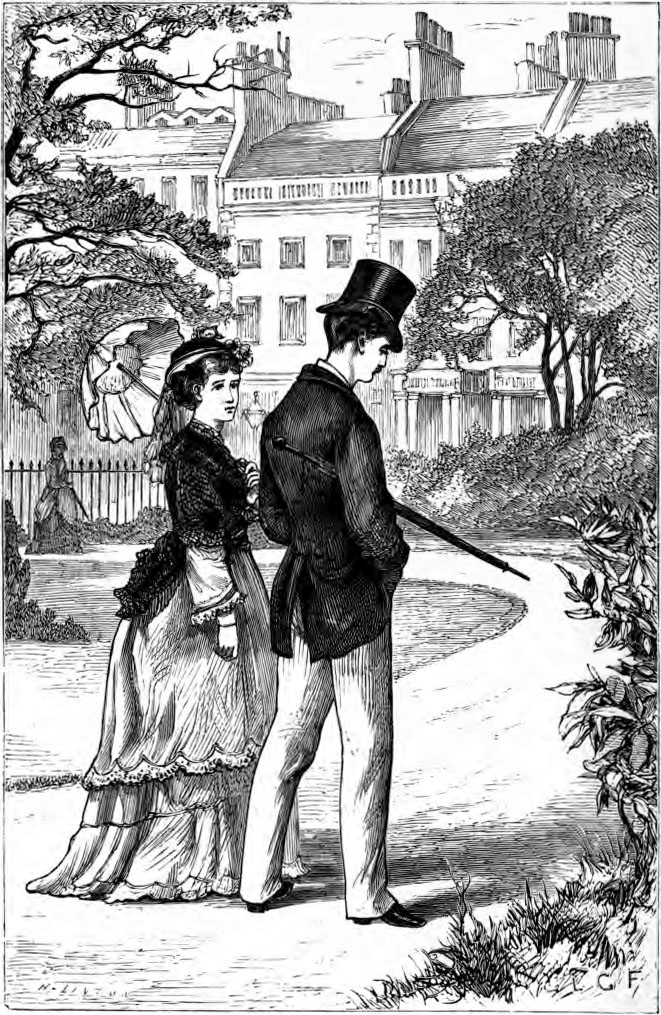
"I'm quite sure. Mamma told me in Paris,--just when we were coming
away,--that it was done so that there might be something if things
went wrong. And papa told me that he should want me to sign something
from time to time; and of course I said I would. But of course I
won't,--if I should have a husband of my own." Felix walked along,
pondering the matter, with his hands in his trowsers pockets. He
entertained those very fears which had latterly fallen upon Lord
Nidderdale. There would be no "cropper" which a man could "come"
so bad as would be his cropper were he to marry Marie Melmotte, and
then find that he was not to have a shilling! And, were he now to
run off with Marie, after having written that letter, the father
would certainly not forgive him. This assurance of Marie's as to the
settled money was too doubtful! The game to be played was too full of
danger! And in that case he would certainly get neither his £800, nor
the shares. And if he were true to Melmotte, Melmotte would probably
supply him with ready money. But then here was the girl at his elbow,
and he no more dared to tell her to her face that he meant to give
her up, than he dared to tell Melmotte that he intended to stick to
his engagement. Some half promise would be the only escape for the
present. "What are you thinking of, Felix?" she asked.
"It's d---- difficult to know what to do."
"But you do love me?"
"Of course I do. If I didn't love you why should I be here walking
round this stupid place? They talk of your being married to
Nidderdale about the end of August."
"Some day in August. But that's all nonsense, you know. They can't
take me up and marry me, as they used to do the girls ever so long
ago. I won't marry him. He don't care a bit for me, and never did.
I don't think you care much, Felix."
"Yes, I do. A fellow can't go on saying so over and over again in a
beastly place like this. If we were anywhere jolly together, then I
could say it often enough."
"I wish we were, Felix. I wonder whether we ever shall be."
"Upon my word I hardly see my way as yet."
"You're not going to give it up!"
"Oh no;--not give it up; certainly not. But the bother is a fellow
doesn't know what to do."
"You've heard of young Mr. Goldsheiner, haven't you?" suggested
Marie.
"He's one of those city chaps."
"And Lady Julia Start?"
"She's old Lady Catchboy's daughter. Yes; I've heard of them. They
got spliced last winter."
"Yes,--somewhere in Switzerland, I think. At any rate they went to
Switzerland, and now they've got a house close to Albert Gate."
"How jolly for them! He is awfully rich, isn't he?"
"I don't suppose he's half so rich as papa. They did all they could
to prevent her going, but she met him down at Folkestone just as the
tidal boat was starting. Didon says that nothing was easier."
"Oh;--ah. Didon knows all about it."
"That she does."
"But she'd lose her place."
"There are plenty of places. She could come and live with us, and
be my maid. If you would give her £50 for herself, she'd arrange it
all."
"And would you come to Folkestone?"
"I think that would be stupid, because Lady Julia did that. We should
make it a little different. If you liked I wouldn't mind going
to--New York. And then, perhaps, we might--get--married, you know, on
board. That's what Didon thinks."
"And would Didon go too?"
"That's what she proposes. She could go as my aunt, and I'd call
myself by her name;--any French name you know. I should go as a
French girl. And you could call yourself Smith, and be an American.
We wouldn't go together, but we'd get on board just at the last
moment. If they wouldn't--marry us on board, they would at New York,
instantly."
"That's Didon's plan?"
"That's what she thinks best,--and she'll do it, if you'll give her
£50 for herself, you know. The 'Adriatic,'--that's a White Star boat,
goes on Thursday week at noon. There's an early train that would take
us down that morning. You had better go and sleep at Liverpool, and
take no notice of us at all till we meet on board. We could be back
in a month,--and then papa would be obliged to make the best of it."
Sir Felix at once felt that it would be quite unnecessary for him to
go to Herr Vossner or to any other male counsellor for advice as to
the best means of carrying off his love. The young lady had it all
at her fingers' ends,--even to the amount of the fee required by the
female counsellor. But Thursday week was very near, and the whole
thing was taking uncomfortably defined proportions. Where was he to
get funds if he were to resolve that he would do this thing? He had
been fool enough to intrust his ready money to Melmotte, and now he
was told that when Melmotte got hold of ready money he was not apt to
release it. And he had nothing to show;--no security that he could
offer to Vossner. And then,--this idea of starting to New York with
Melmotte's daughter immediately after he had written to Melmotte
renouncing the girl, frightened him.
"There is a tide in the affairs of men,
Which taken at the flood leads on to fortune."
Sir Felix did not know these lines, but the lesson taught by them
came home to him at this moment. Now was the tide in his affairs at
which he might make himself, or utterly mar himself. "It's deuced
important," he said at last with a groan.
"It's not more important for you than me," said Marie.
"If you're wrong about the money, and he shouldn't come round, where
should we be then?"
"Nothing venture, nothing have," said the heiress.
"That's all very well; but one might venture everything and get
nothing after all."
"You'd get me," said Marie with a pout.
"Yes;--and I'm awfully fond of you. Of course I should get you!
But--"
"Very well then;--if that's your love," said Marie, turning back from
him.
Sir Felix gave a great sigh, and then announced his resolution. "I'll
venture it."
"Oh, Felix, how grand it will be!"
"There's a great deal to do, you know. I don't know whether it can be
Thursday week." He was putting in the coward's plea for a reprieve.
"I shall be afraid of Didon if it's delayed long."
"There's the money to get, and all that."
"I can get some money. Mamma has money in the house."
"How much?" asked the baronet eagerly.
"A hundred pounds, perhaps;--perhaps two hundred."
"That would help certainly. I must go to your father for money. Won't
that be a sell? To get it from him, to take you away!"
It was decided that they were to go to New York, on a Thursday,--on
Thursday week if possible, but as to that he was to let her know in a
day or two. Didon was to pack up the clothes and get it sent out of
the house. Didon was to have £50 before she went on board; and as one
of the men must know about it, and must assist in having the trunks
smuggled out of the house, he was to have £10. All had been settled
beforehand, so that Sir Felix really had no need to think about
anything. "And now," said Marie, "there's Didon. Nobody's looking
and she can open that gate for you. When we're gone, do you creep
out. The gate can be left, you know. Then we'll get out on the other
side." Marie Melmotte was certainly a clever girl.
CHAPTER XLII.
"CAN YOU BE READY IN TEN MINUTES?"
After leaving Melmotte's house on Sunday morning Paul Montague went
to Roger Carbury's hotel and found his friend just returning from
church. He was bound to go to Islington on that day, but had made up
his mind that he would defer his visit till the evening. He would
dine early and be with Mrs. Hurtle about seven o'clock. But it was
necessary that Roger should hear the news about Ruby Ruggles. "It's
not so bad as you thought," said he, "as she is living with her
aunt."
"I never heard of such an aunt."
"She says her grandfather knows where she is, and that he doesn't
want her back again."
"Does she see Felix Carbury?"
"I think she does," said Paul.
"Then it doesn't matter whether the woman's her aunt or not. I'll go
and see her and try to get her back to Bungay."
"Why not send for John Crumb?"
Roger hesitated for a moment, and then answered, "He'd give Felix
such a thrashing as no man ever had before. My cousin deserves it as
well as any man ever deserved a thrashing; but there are reasons why
I should not like it. And he could not force her back with him. I
don't suppose the girl is all bad,--if she could see the truth."
"I don't think she's bad at all."
"At any rate I'll go and see her," said Roger. "Perhaps I shall see
your widow at the same time." Paul sighed, but said nothing more
about his widow at that moment. "I'll walk up to Welbeck Street now,"
said Roger, taking his hat. "Perhaps I shall see you to-morrow." Paul
felt that he could not go to Welbeck Street with his friend.
He dined in solitude at the Beargarden, and then again made that
journey to Islington in a cab. As he went he thought of the proposal
that had been made to him by Melmotte. If he could do it with a clear
conscience, if he could really make himself believe in the railway,
such an expedition would not be displeasing to him. He had said
already more than he had intended to say to Hetta Carbury; and though
he was by no means disposed to flatter himself, yet he almost thought
that what he had said had been well received. At the moment they had
been disturbed, but she, as she heard the sound of her mother coming,
had at any rate expressed no anger. He had almost been betrayed into
breaking a promise. Were he to start now on this journey, the period
of the promise would have passed by before his return. Of course
he would take care that she should know that he had gone in the
performance of a duty. And then he would escape from Mrs. Hurtle,
and would be able to make those inquiries which had been suggested
to him. It was possible that Mrs. Hurtle should offer to go with
him,--an arrangement which would not at all suit him. That at any
rate must be avoided. But then how could he do this without a belief
in the railway generally? And how was it possible that he should have
such belief? Mr. Ramsbottom did not believe in it, nor did Roger
Carbury. He himself did not in the least believe in Fisker, and
Fisker had originated the railway. Then, would it not be best that he
should take the Chairman's offer as to his own money? If he could get
his £6,000 back and have done with the railway, he would certainly
think himself a lucky man. But he did not know how far he could with
honesty lay aside his responsibility; and then he doubted whether he
could put implicit trust in Melmotte's personal guarantee for the
amount. This at any rate was clear to him,--that Melmotte was very
anxious to secure his absence from the meetings of the Board.
Now he was again at Mrs. Pipkin's door, and again it was opened
by Ruby Ruggles. His heart was in his mouth as he thought of the
things he had to say. "The ladies have come back from Southend, Miss
Ruggles?"
"Oh yes, sir, and Mrs. Hurtle is expecting you all the day." Then she
put in a whisper on her own account. "You didn't tell him as you'd
seen me, Mr. Montague?"
"Indeed I did, Miss Ruggles."
"Then you might as well have left it alone, and not have been
ill-natured,--that's all," said Ruby as she opened the door of Mrs.
Hurtle's room.
Mrs. Hurtle got up to receive him with her sweetest smile,--and her
smile could be very sweet. She was a witch of a woman, and, as like
most witches she could be terrible, so like most witches she could
charm. "Only fancy," she said, "that you should have come the only
day I have been two hundred yards from the house, except that evening
when you took me to the play. I was so sorry."
"Why should you be sorry? It is easy to come again."
"Because I don't like to miss you, even for a day. But I wasn't well,
and I fancied that the house was stuffy, and Mrs. Pipkin took a
bright idea and proposed to carry me off to Southend. She was dying
to go herself. She declared that Southend was Paradise."
"A cockney Paradise."
"Oh, what a place it is! Do your people really go to Southend and
fancy that that is the sea?"
"I believe they do. I never went to Southend myself,--so that you
know more about it than I do."
"How very English it is,--a little yellow river,--and you call it the
sea! Ah;--you never were at Newport!"
"But I've been at San Francisco."
"Yes; you've been at San Francisco, and heard the seals howling.
Well; that's better than Southend."
"I suppose we do have the sea here in England. It's generally
supposed we're an island."
"Of course;--but things are so small. If you choose to go to the west
of Ireland, I suppose you'd find the Atlantic. But nobody ever does
go there for fear of being murdered." Paul thought of the gentleman
in Oregon, but said nothing;--thought, perhaps, of his own condition,
and remembered that a man might be murdered without going either to
Oregon or the west of Ireland. "But we went to Southend, I, and Mrs.
Pipkin and the baby, and upon my word I enjoyed it. She was so afraid
that the baby would annoy me, and I thought the baby was so much the
best of it. And then we ate shrimps, and she was so humble. You must
acknowledge that with us nobody would be so humble. Of course I paid.
She has got all her children, and nothing but what she can make out
of these lodgings. People are just as poor with us;--and other people
who happen to be a little better off, pay for them. But nobody is
humble to another, as you are here. Of course we like to have money
as well as you do, but it doesn't make so much difference."
"He who wants to receive, all the world over, will make himself as
agreeable as he can to him who can give."
"But Mrs. Pipkin was so humble. However we got back all right
yesterday evening, and then I found that you had been here,--at
last."
"You knew that I had to go to Liverpool."
"I'm not going to scold. Did you get your business done at
Liverpool?"
"Yes;--one generally gets something done, but never anything very
satisfactorily. Of course it's about this railway."
"I should have thought that that was satisfactory. Everybody talks
of it as being the greatest thing ever invented. I wish I was a man
that I might be concerned with a really great thing like that. I hate
little peddling things. I should like to manage the greatest bank
in the world, or to be Captain of the biggest fleet, or to make the
largest railway. It would be better even than being President of a
Republic, because one would have more of one's own way. What is it
that you do in it, Paul?"
"They want me now to go out to Mexico about it," said he slowly.
"Shall you go?" said she, throwing herself forward and asking the
question with manifest anxiety.
"I think not."
"Why not? Do go. Oh, Paul, I would go with you. Why should you not
go? It is just the thing for such a one as you to do. The railway
will make Mexico a new country, and then you would be the man who
had done it. Why should you throw away such a chance as that? It will
never come again. Emperors and kings have tried their hands at Mexico
and have been able to do nothing. Emperors and kings never can do
anything. Think what it would be to be the regenerator of Mexico!"
"Think what it would be to find one's self there without the means of
doing anything, and to feel that one had been sent there merely that
one might be out of the way."
"I would make the means of doing something."
"Means are money. How can I make that?"
"There is money going. There must be money where there is all this
buying and selling of shares. Where does your uncle get the money
with which he is living like a prince at San Francisco? Where does
Fisker get the money with which he is speculating in New York? Where
does Melmotte get the money which makes him the richest man in the
world? Why should not you get it as well as the others?"
"If I were anxious to rob on my own account perhaps I might do it."
"Why should it be robbery? I do not want you to live in a palace
and spend millions of dollars on yourself. But I want you to have
ambition. Go to Mexico, and chance it. Take San Francisco in your
way, and get across the country. I will go every yard with you. Make
people there believe that you are in earnest, and there will be no
difficulty about the money."
He felt that he was taking no steps to approach the subject which he
should have to discuss before he left her,--or rather the statement
which he had resolved that he would make. Indeed every word which
he allowed her to say respecting this Mexican project carried him
farther away from it. He was giving reasons why the journey should
not be made; but was tacitly admitting that if it were to be made she
might be one of the travellers. The very offer on her part implied
an understanding that his former abnegation of his engagement had
been withdrawn, and yet he shrunk from the cruelty of telling her,
in a side-way fashion, that he would not submit to her companionship
either for the purpose of such a journey or for any other purpose.
The thing must be said in a solemn manner, and must be introduced on
its own basis. But such preliminary conversation as this made the
introduction of it infinitely more difficult.
"You are not in a hurry?" she said.
"Oh no."
"You're going to spend the evening with me like a good man? Then I'll
ask them to let us have tea." She rang the bell and Ruby came in, and
the tea was ordered. "That young lady tells me that you are an old
friend of hers."
"I've known about her down in the country, and was astonished to find
her here yesterday."
"There's some lover, isn't there;--some would-be husband whom she
does not like?"
"And some won't-be husband, I fear, whom she does like."
"That's quite of course, if the other is true. Miss Ruby isn't
the girl to have come to her time of life without a preference.
The natural liking of a young woman for a man in a station above
her, because he is softer and cleaner and has better parts of
speech,--just as we keep a pretty dog if we keep a dog at all,--is
one of the evils of the inequality of mankind. The girl is content
with the love without having the love justified, because the object
is more desirable. She can only have her love justified with an
object less desirable. If all men wore coats of the same fabric, and
had to share the soil of the work of the world equally between them,
that evil would come to an end. A woman here and there might go wrong
from fantasy and diseased passions, but the ever-existing temptation
to go wrong would be at an end."
"If men were equal to-morrow and all wore the same coats, they would
wear different coats the next day."
"Slightly different. But there would be no more purple and fine
linen, and no more blue woad. It isn't to be done in a day of course,
nor yet in a century,--nor in a decade of centuries; but every human
being who looks into it honestly will see that his efforts should be
made in that direction. I remember; you never take sugar; give me
that."
Neither had he come here to discuss the deeply interesting questions
of women's difficulties and immediate or progressive equality. But
having got on to these rocks,--having, as the reader may perceive,
been taken on to them wilfully by the skill of the woman,--he did not
know how to get his bark out again into clear waters. But having his
own subject before him, with all its dangers, the wild-cat's claws,
and the possible fate of the gentleman in Oregon, he could not talk
freely on the subjects which she introduced, as had been his wont
in former years. "Thanks," he said, changing his cup. "How well you
remember!"
"Do you think I shall ever forget your preferences and dislikings?
Do
you recollect telling me about that blue scarf of mine, that I should
never wear blue?"
She stretched herself out towards him, waiting for an answer,
so that he was obliged to speak. "Of course I do. Black is your
colour;--black and grey; or white,--and perhaps yellow when you
choose to be gorgeous; crimson possibly. But not blue or green."
"I never thought much of it before, but I have taken your word for
gospel. It is very good to have an eye for such things,--as you have,
Paul. But I fancy that taste comes with, or at any rate forbodes, an
effete civilisation."
"I am sorry that mine should be effete," he said smiling.
"You know what I mean, Paul. I speak of nations, not individuals.
Civilisation was becoming effete, or at any rate men were, in
the time of the great painters; but Savanarola and Galileo were
individuals. You should throw your lot in with a new people. This
railway to Mexico gives you the chance."
"Are the Mexicans a new people?"
"They who will rule the Mexicans are. All American women I dare say
have bad taste in gowns,--and so the vain ones and rich ones send to
Paris for their finery; but I think our taste in men is generally
good. We like our philosophers; we like our poets; we like our
genuine workmen;--but we love our heroes. I would have you a hero,
Paul." He got up from his chair and walked about the room in an
agony of despair. To be told that he was expected to be a hero
at the very moment in his life in which he felt more devoid of
heroism, more thoroughly given up to cowardice than he had ever been
before, was not to be endured! And yet, with what utmost stretch of
courage,--even though he were willing to devote himself certainly and
instantly to the worst fate that he had pictured to himself,--could
he immediately rush away from these abstract speculations, encumbered
as they were with personal flattery, into his own most unpleasant,
most tragic matter! It was the unfitness that deterred him and
not the possible tragedy. Nevertheless, through it all, he was
sure,--nearly sure,--that she was playing her game, and playing it
in direct antagonism to the game which she knew that he wanted to
play. Would it not be better that he should go away and write another
letter? In a letter he could at any rate say what he had to say;--and
having said it he would then strengthen himself to adhere to it.
"What makes you so uneasy?" she asked; still speaking in her most
winning way, caressing him with the tones of her voice. "Do you not
like me to say that I would have you be a hero?"
"Winifrid," he said, "I came here with a purpose, and I had better
carry it out."
"What purpose?" She still leaned forward, but now supported her face
on her two hands with her elbows resting on her knees, looking at him
intently. But one would have said that there was only love in her
eyes;--love which might be disappointed, but still love. The wild
cat, if there, was all within, still hidden from sight. Paul stood
with his hands on the back of a chair, propping himself up and trying
to find fitting words for the occasion. "Stop, my dear," she said.
"Must the purpose be told to-night?"
"Why not to-night?"
"Paul, I am not well;--I am weak now. I am a coward. You do not know
the delight to me of having a few words of pleasant talk to an old
friend after the desolation of the last weeks. Mrs. Pipkin is not
very charming. Even her baby cannot supply all the social wants of my
life. I had intended that everything should be sweet to-night. Oh,
Paul, if it was your purpose to tell me of your love, to assure me
that you are still my dear, dear friend, to speak with hope of future
days, or with pleasure of those that are past,--then carry out your
purpose. But if it be cruel, or harsh, or painful; if you had come to
speak daggers;--then drop your purpose for to-night. Try and think
what my solitude must have been to me, and let me have one hour of
comfort."
Of course he was conquered for that night, and could only have that
solace which a most injurious reprieve could give him. "I will not
harass you, if you are ill," he said.
"I am ill. It was because I was afraid that I should be really ill
that I went to Southend. The weather is hot, though of course the sun
here is not as we have it. But the air is heavy,--what Mrs. Pipkin
calls muggy. I was thinking if I were to go somewhere for a week, it
would do me good. Where had I better go?" Paul suggested Brighton.
"That is full of people; is it not?--a fashionable place?"
"Not at this time of the year."
"But it is a big place. I want some little place that would be
pretty. You could take me down; could you not? Not very far, you
know;--not that any place can be very far from here." Paul, in his
John Bull displeasure, suggested Penzance, telling her, untruly, that
it would take twenty-four hours. "Not Penzance then, which I know is
your very Ultima Thule;--not Penzance, nor yet Orkney. Is there no
other place,--except Southend?"
"There is Cromer in Norfolk,--perhaps ten hours."
"Is Cromer by the sea?"
"Yes;--what we call the sea."
"I mean really the sea, Paul?"
"If you start from Cromer right away, a hundred miles would perhaps
take you across to Holland. A ditch of that kind wouldn't do
perhaps."
"Ah,--now I see you are laughing at me. Is Cromer pretty?"
"Well, yes;--I think it is. I was there once, but I don't remember
much. There's Ramsgate."
"Mrs. Pipkin told me of Ramsgate. I don't think I should like
Ramsgate."
"There's the Isle of Wight. The Isle of Wight is very pretty."
"That's the Queen's place. There would not be room for her and me
too."
"Or Lowestoft. Lowestoft is not so far as Cromer, and there is a
railway all the distance."
"And sea?"
"Sea enough for anything. If you can't see across it, and if there
are waves, and wind enough to knock you down, and shipwrecks every
other day, I don't see why a hundred miles isn't as good as a
thousand."
"A hundred miles is just as good as a thousand. But, Paul, at
Southend it isn't a hundred miles across to the other side of the
river. You must admit that. But you will be a better guide than Mrs.
Pipkin. You would not have taken me to Southend when I expressed a
wish for the ocean;--would you? Let it be Lowestoft. Is there an
hotel?"
"A small little place."
"Very small? uncomfortably small? But almost any place would do for
me."
"They make up, I believe, about a hundred beds; but in the States it
would be very small."
"Paul," said she, delighted to have brought him back to this humour,
"if I were to throw the tea things at you, it would serve you right.
This is all because I did not lose myself in awe at the sight of the
Southend ocean. It shall be Lowestoft." Then she rose up and came
to him, and took his arm. "You will take me down, will you not? It
is
desolate for a woman to go into such a place all alone. I will not
ask you to stay. And I can return by myself." She had put both hands
on one arm, and turned herself round, and looked into his face. "You
will do that for old acquaintance sake?" For a moment or two he made
no answer, and his face was troubled, and his brow was black. He was
endeavouring to think;--but he was only aware of his danger, and
could see no way through it. "I don't think you will let me ask in
vain for such a favour as that," she said.
"No;" he replied. "I will take you down. When will you go?" He had
cockered himself up with some vain idea that the railway carriage
would be a good place for the declaration of his purpose, or perhaps
the sands at Lowestoft.
"When will I go? when will you take me? You have Boards to attend,
and shares to look to, and Mexico to regenerate. I am a poor woman
with nothing on hand but Mrs. Pipkin's baby. Can you be ready in ten
minutes?--because I could." Paul shook his head and laughed. "I've
named a time and that doesn't suit. Now, sir, you name another, and
I'll promise it shall suit." Paul suggested Saturday, the 29th. He
must attend the next Board, and had promised to see Melmotte before
the Board day. Saturday of course would do for Mrs. Hurtle. Should
she meet him at the railway station? Of course he undertook to come
and fetch her.
Then, as he took his leave, she stood close against him, and put her
cheek up for him to kiss. There are moments in which a man finds it
utterly impossible that he should be prudent,--as to which, when
he thought of them afterwards, he could never forgive himself for
prudence, let the danger have been what it may. Of course he took her
in his arms, and kissed her lips as well as her cheeks.
CHAPTER XLIII.
THE CITY ROAD.
The statement made by Ruby as to her connection with Mrs. Pipkin was
quite true. Ruby's father had married a Pipkin whose brother had died
leaving a widow behind him at Islington. The old man at Sheep's Acre
farm had greatly resented this marriage, had never spoken to his
daughter-in-law,--or to his son after the marriage, and had steeled
himself against the whole Pipkin race. When he undertook the charge
of Ruby he had made it matter of agreement that she should have
no intercourse with the Pipkins. This agreement Ruby had broken,
corresponding on the sly with her uncle's widow at Islington. When
therefore she ran away from Suffolk she did the best she could
with herself in going to her aunt's house. Mrs. Pipkin was a poor
woman, and could not offer a permanent home to Ruby; but she was
good-natured, and came to terms. Ruby was to be allowed to stay at
any rate for a month, and was to work in the house for her bread. But
she made it a part of her bargain that she should be allowed to go
out occasionally. Mrs. Pipkin immediately asked after a lover. "I'm
all right," said Ruby. If the lover was what he ought to be, had he
not better come and see her? This was Mrs. Pipkin's suggestion. Mrs.
Pipkin thought that scandal might in this way be avoided. "That's as
it may be, by-and-by," said Ruby. Then she told all the story of John
Crumb:--how she hated John Crumb; how resolved she was that nothing
should make her marry John Crumb. And she gave her own account of
that night on which John Crumb and Mr. Mixet ate their supper at the
farm, and of the manner in which her grandfather had treated her
because she would not have John Crumb. Mrs. Pipkin was a respectable
woman in her way, always preferring respectable lodgers if she could
get them;--but bound to live. She gave Ruby very good advice. Of
course if she was "dead-set" against John Crumb, that was one thing!
But then there was nothing a young woman should look to so much as
a decent house over her head,--and victuals. "What's all the love
in the world, Ruby, if a man can't do for you?" Ruby declared that
she knew somebody who could do for her, and could do very well for
her. She knew what she was about, and wasn't going to be put off
it. Mrs. Pipkin's morals were good wearing morals, but she was not
strait-laced. If Ruby chose to manage in her own way about her lover
she must. Mrs. Pipkin had an idea that young women in these days did
have, and would have, and must have more liberty than was allowed
when she was young. The world was being changed very fast. Mrs.
Pipkin knew that as well as others. And therefore when Ruby went to
the theatre once and again,--by herself as far as Mrs. Pipkin knew,
but probably in company with her lover,--and did not get home till
past midnight, Mrs. Pipkin said very little about it, attributing
such novel circumstances to the altered condition of her country.
She had not been allowed to go to the theatre with a young man when
she had been a girl,--but that had been in the earlier days of Queen
Victoria, fifteen years ago, before the new dispensation had come.
Ruby had never yet told the name of her lover to Mrs. Pipkin, having
answered all inquiries by saying that she was all right. Sir Felix's
name had never even been mentioned in Islington till Paul Montague
had mentioned it. She had been managing her own affairs after her
own fashion,--not altogether with satisfaction, but still without
interruption; but now she knew that interference would come. Mr.
Montague had found her out, and had told her grandfather's landlord.
The Squire would be after her, and then John Crumb would come,
accompanied of course by Mr. Mixet,--and after that, as she said to
herself on retiring to the couch which she shared with two little
Pipkins, "the fat would be in the fire."
"Who do you think was at our place yesterday?" said Ruby one
eve-
ning to her lover. They were sitting together at a music-hall,--half
music-hall, half theatre, which pleasantly combined the allurements
of the gin-palace, the theatre, and the ball-room, trenching hard on
those of other places. Sir Felix was smoking, dressed, as he himself
called it, "incognito," with a Tom-and-Jerry hat, and a blue silk
cravat, and a green coat. Ruby thought it was charming. Felix
entertained an idea that were his West End friends to see him in this
attire they would not know him. He was smoking, and had before him a
glass of hot brandy and water, which was common to himself and Ruby.
He was enjoying life. Poor Ruby! She was half-ashamed of herself,
half-frightened, and yet supported by a feeling that it was a grand
thing to have got rid of restraints, and be able to be with her young
man. Why not? The Miss Longestaffes were allowed to sit and dance and
walk about with their young men,--when they had any. Why was she to
be given up to a great mass of stupid dust like John Crumb, without
seeing anything of the world? But yet as she sat sipping her lover's
brandy and water between eleven and twelve at the music-hall in
the City Road, she was not altogether comfortable. She saw things
which she did not like to see. And she heard things which she did
not like to hear. And her lover, though he was beautiful,--oh, so
beautiful!--was not all that a lover should be. She was still a
little afraid of him, and did not dare as yet to ask him for the
promise which she expected him to make to her. Her mind was set
upon--marriage, but the word had hardly passed between them. To have
his arm round her waist was heaven to her! Could it be possible that
he and John Crumb were of the same order of human beings? But how
was this to go on? Even Mrs. Pipkin made disagreeable allusions, and she
could not live always with Mrs. Pipkin, coming out at nights to drink
brandy and water and hear music with Sir Felix Carbury. She was glad
therefore to take the first opportunity of telling her lover that
something was going to happen. "Who do you suppose was at our place
yesterday?"
Sir Felix changed colour, thinking of Marie Melmotte, thinking that
perhaps some emissary from Marie Melmotte had been there; perhaps
Didon herself. He was amusing himself during these last evenings of
his in London; but the business of his life was about to take him
to New York. That project was still being elaborated. He had had an
interview with Didon, and nothing was wanting but the money. Didon
had heard of the funds which had been intrusted by him to Melmotte,
and had been very urgent with him to recover them. Therefore, though
his body was not unfrequently present, late in the night, at the City
Road Music-Hall, his mind was ever in Grosvenor Square. "Who was it,
Ruby?"
"A friend of the Squire's, a Mr. Montague. I used to see him about in
Bungay and Beccles."
"Paul Montague!"
"Do you know him, Felix?"
"Well;--rather. He's a member of our club, and I see him constantly
in the city--and I know him at home."
"Is he nice?"
"Well;--that depends on what you call nice. He's a prig of a fellow."
"He's got a lady friend where I live."
"The devil he has!" Sir Felix of course had heard of Roger Carbury's
suit to his sister, and of the opposition to this suit on the part of
Hetta, which was supposed to have been occasioned by her preference
for Paul Montague. "Who is she, Ruby?"
"Well;--she's a Mrs. Hurtle. Such a stunning woman! Aunt says she's
an American. She's got lots of money."
"Is Montague going to marry her?"
"Oh dear yes. It's all arranged. Mr. Montague comes quite regular
to see her;--not so regular as he ought, though. When gentlemen are
fixed as they're to be married, they never are regular afterwards.
I wonder whether it'll be the same with you?"
"Wasn't John Crumb regular, Ruby?"
"Bother John Crumb! That wasn't none of my doings. Oh, he'd been
regular enough, if I'd let him; he'd been like clockwork,--only the
slowest clock out. But Mr. Montague has been and told the Squire as
he saw me. He told me so himself. The Squire's coming about John
Crumb. I know that. What am I to tell him, Felix?"
"Tell him to mind his own business. He can't do anything to you."
"No;--he can't do nothing. I ain't done nothing wrong, and he can't
send for the police to have me took back to Sheep's Acre. But he can
talk,--and he can look. I ain't one of those, Felix, as don't mind
about their characters,--so don't you think it. Shall I tell him as
I'm with you?"
"Gracious goodness, no! What would you say that for?"
"I didn't know. I must say something."
"Tell him you're nothing to him."
"But aunt will be letting on about my being out late o'nights; I know
she will. And who am I with? He'll be asking that."
"Your aunt does not know?"
"No;--I've told nobody yet. But it won't do to go on like that, you
know,--will it? You don't want it to go on always like that;--do
you?"
"It's very jolly, I think."
"It ain't jolly for me. Of course, Felix, I like to be with you.
That's jolly. But I have to mind them brats all the day, and to be
doing the bedrooms. And that's not the worst of it."
"What is the worst of it?"
"I'm pretty nigh ashamed of myself. Yes, I am." And now Ruby burst
out into tears. "Because I wouldn't have John Crumb, I didn't mean to
be a bad girl. Nor yet I won't. But what'll I do, if everybody turns
again me? Aunt won't go on for ever in this way. She said last night
that--"
"Bother what she says!" Felix was not at all anxious to hear what
aunt Pipkin might have to say upon such an occasion.
"She's right too. Of course she knows there's somebody. She ain't
such a fool as to think that I'm out at these hours to sing psalms
with a lot of young women. She says that whoever it is ought to speak
out his mind. There;--that's what she says. And she's right. A girl
has to mind herself, though she's ever so fond of a young man."
Sir Felix sucked his cigar and then took a long drink of brandy and
water. Having emptied the beaker before him, he rapped for the waiter
and called for another. He intended to avoid the necessity of making
any direct reply to Ruby's importunities. He was going to New York
very shortly, and looked on his journey thither as an horizon in his
future beyond which it was unnecessary to speculate as to any farther
distance. He had not troubled himself to think how it might be with
Ruby when he was gone. He had not even considered whether he would
or would not tell her that he was going, before he started. It was not
his fault that she had come up to London. She was an "awfully jolly
girl," and he liked the feeling of the intrigue better perhaps than
the girl herself. But he assured himself that he wasn't going to give
himself any "d----d trouble." The idea of John Crumb coming up to
London in his wrath had never occurred to him,--or he would probably
have hurried on his journey to New York instead of delaying it, as he
was doing now. "Let's go in and have a dance," he said.
Ruby was very fond of dancing,--perhaps liked it better than anything
in the world. It was heaven to her to be spinning round the big room
with her lover's arm tight round her waist, with one hand in his and
her other hanging over his back. She loved the music, and loved the
motion. Her ear was good, and her strength was great, and she never
lacked breath. She could spin along and dance a whole room down, and
feel at the time that the world could have nothing to give better
worth having than that;--and such moments were too precious to be
lost. She went and danced, resolving as she did so that she would
have some answer to her question before she left her lover on that
night.
"And now I must go," she said at last. "You'll see me as far as the
Angel, won't you?" Of course he was ready to see her as far as the
Angel. "What am I to say to the Squire?"
"Say nothing."
"And what am I to say to aunt?"
"Say to her? Just say what you have said all along."
"I've said nothing all along,--just to oblige you, Felix. I must say
something. A girl has got herself to mind. What have you got to say
to me, Felix?"
He was silent for about a minute, meditating his answer. "If you
bother me I shall cut it, you know."
"Cut it!"
"Yes;--cut it. Can't you wait till I am ready to say something?"
"Waiting will be the ruin o' me, if I wait much longer. Where am I to
go, if Mrs. Pipkin won't have me no more?"
"I'll find a place for you."
"You find a place! No; that won't do. I've told you all that before.
I'd sooner go into service, or--"
"Go back to John Crumb."
"John Crumb has more respect for me nor you. He'd make me his wife
to-morrow, and only be too happy."
"I didn't tell you to come away from him," said Sir Felix.
"Yes, you did. You told me as I was to come up to London when I saw
you at Sheepstone Beeches;--didn't you? And you told me you loved
me;--didn't you? And that if I wanted anything you'd get it done for
me;--didn't you?"
"So I will. What do you want? I can give you a couple of sovereigns,
if that's what it is."
"No it isn't;--and I won't have your money. I'd sooner work my
fingers off. I want you to say whether you mean to marry me. There!"
As to the additional lie which Sir Felix might now have told, that
would have been nothing to him. He was going to New York, and would
be out of the way of any trouble; and he thought that lies of that
kind to young women never went for anything. Young women, he
thought, didn't believe them, but liked to be able to believe afterwards
that they had been deceived. It wasn't the lie that stuck in his
throat, but the fact that he was a baronet. It was in his estimation
"confounded impudence" on the part of Ruby Ruggles to ask to
be
his wife. He did not care for the lie, but he did not like to seem to
lower himself by telling such a lie as that at her dictation. "Marry,
Ruby! No, I don't ever mean to marry. It's the greatest bore out. I
know a trick worth two of that."
She stopped in the street and looked at him. This was a state of
things of which she had never dreamed. She could imagine that a
man should wish to put it off, but that he should have the face to
declare to his young woman that he never meant to marry at all, was a
thing that she could not understand. What business had such a man to
go after any young woman? "And what do you mean that I'm to do, Sir
Felix?" she said.
"Just go easy, and not make yourself a bother."
"Not make myself a bother! Oh, but I will; I will. I'm to be carrying
on with you, and nothing to come of it; but for you to tell me that
you don't mean to marry, never at all! Never?"
"Don't you see lots of old bachelors about, Ruby?"
"Of course I does. There's the Squire. But he don't come asking girls
to keep him company."
"That's more than you know, Ruby."
"If he did he'd marry her out of hand,--because he's a gentleman.
That's what he is, every inch of him. He never said a word to a
girl,--not to do her any harm, I'm sure," and Ruby began to cry. "You
mustn't come no further now, and I'll never see you again--never!
I think you're the falsest young man, and the basest, and the
lowest-minded that I ever heard tell of. I know there are them as
don't keep their words. Things turn up, and they can't. Or they gets
to like others better; or there ain't nothing to live on. But for a
young man to come after a young woman, and then say, right out, as
he never means to marry at all, is the lowest-spirited fellow that ever
was. I never read of such a one in none of the books. No, I won't.
You go your way, and I'll go mine." In her passion she was as good
as her word, and escaped from him, running all the way to her aunt's
door. There was in her mind a feeling of anger against the man, which
she did not herself understand, in that he would incur no risk on her
behalf. He would not even make a lover's easy promise, in order that
the present hour might be made pleasant. Ruby let herself into her
aunt's house, and cried herself to sleep with a child on each side of
her.
On the next day Roger called. She had begged Mrs. Pipkin to attend
the door, and had asked her to declare, should any gentleman ask for
Ruby Ruggles, that Ruby Ruggles was out. Mrs. Pipkin had not refused
to do so; but, having heard sufficient of Roger Carbury to imagine
the cause which might possibly bring him to the house, and having
made up her mind that Ruby's present condition of independence was
equally unfavourable to the lodging-house and to Ruby herself, she
determined that the Squire, if he did come, should see the young
lady. When therefore Ruby was called into the little back parlour and
found Roger Carbury there, she thought that she had been caught in a
trap. She had been very cross all the morning. Though in her rage she
had been able on the previous evening to dismiss her titled lover,
and to imply that she never meant to see him again, now, when the
remembrance of the loss came upon her amidst her daily work,--when
she could no longer console herself in her drudgery by thinking of
the beautiful things that were in store for her, and by flattering
herself that though at this moment she was little better than a maid
of all work in a lodging-house, the time was soon coming in which
she would bloom forth as a baronet's bride,--now in her solitude she
almost regretted the precipitancy of her own conduct. Could it be
that she would never see him again;--that she would dance no more
in that gilded bright saloon? And might it not be possible that she
had pressed him too hard? A baronet of course would not like to be
brought to book, as she could bring to book such a one as John Crumb.
But yet,--that he should have said never;--that he would never marry!
Looking at it in any light, she was very unhappy, and this coming of
the Squire did not serve to cure her misery.
Roger was very kind to her, taking her by the hand, and bidding
her sit down, and telling her how glad he was to find that she was
comfortably settled with her aunt. "We were all alarmed, of course,
when you went away without telling anybody where you were going."
"Grandfather 'd been that cruel to me that I couldn't tell him."
"He wanted you to keep your word to an old friend of yours."
"To pull me all about by the hairs of my head wasn't the way to
make a girl keep her word;--was it, Mr. Carbury? That's what he did,
then;--and Sally Hockett, who is there, heard it. I've been good to
grandfather, whatever I may have been to John Crumb; and he shouldn't
have treated me like that. No girl 'd like to be pulled about the
room by the hairs of her head, and she with her things all off, just
getting into bed."
The Squire had no answer to make to this. That old Ruggles should be
a violent brute under the influence of gin and water did not surprise
him. And the girl, when driven away from her home by such usage, had
not done amiss in coming to her aunt. But Roger had already heard
a few words from Mrs. Pipkin as to Ruby's late hours, had heard
also that there was a lover, and knew very well who that lover was.
He also was quite familiar with John Crumb's state of mind. John
Crumb was a gallant, loving fellow who might be induced to forgive
everything, if Ruby would only go back to him; but would certainly
persevere, after some slow fashion of his own, and "see the matter
out," as he would say himself, if she did not go back. "As you found
yourself obliged to run away," said Roger, "I'm glad that you should
be here; but you don't mean to stay here always?"
"I don't know," said Ruby.
"You must think of your future life. You don't want to be always your
aunt's maid."
"Oh dear, no."
"It would be very odd if you did, when you may be the wife of such a
man as Mr. Crumb."
"Oh, Mr. Crumb! Everybody is going on about Mr. Crumb. I don't like
Mr. Crumb, and I never will like him."
"Now look here, Ruby; I have come to speak to you very seriously, and
I expect you to hear me. Nobody can make you marry Mr. Crumb, unless
you please."
"Nobody can't, of course, sir."
"But I fear you have given him up for somebody else, who certainly
won't marry you, and who can only mean to ruin you."
"Nobody won't ruin me," said Ruby. "A girl has to look to herself,
and I mean to look to myself."
"I'm glad to hear you say so, but being out at night with such a one
as Sir Felix Carbury is not looking to yourself. That means going to
the devil head foremost."
"I ain't a going to the devil," said Ruby, sobbing and blushing.
"But you will, if you put yourself into the hands of that young man.
He's as bad as bad can be. He's my own cousin, and yet I'm obliged
to tell you so. He has no more idea of marrying you than I have; but
were he to marry you, he could not support you. He is ruined himself,
and would ruin any young woman who trusted him. I'm almost old enough
to be your father, and in all my experience I never came across so
vile a young man as he is. He would ruin you and cast you from him
without a pang of remorse. He has no heart in his bosom;--none." Ruby
had now given way altogether, and was sobbing with her apron to her
eyes in one corner of the room. "That's what Sir Felix Carbury is,"
said the Squire, standing up so that he might speak with the more
energy, and talk her down more thoroughly. "And if I understand it
rightly," he continued, "it is for a vile thing such as he, that you
have left a man who is as much above him in character, as the sun is
above the earth. You think little of John Crumb because he does not
wear a fine coat."
"I don't care about any man's coat," said Ruby; "but John hasn't ever
a word to say, was it ever so."
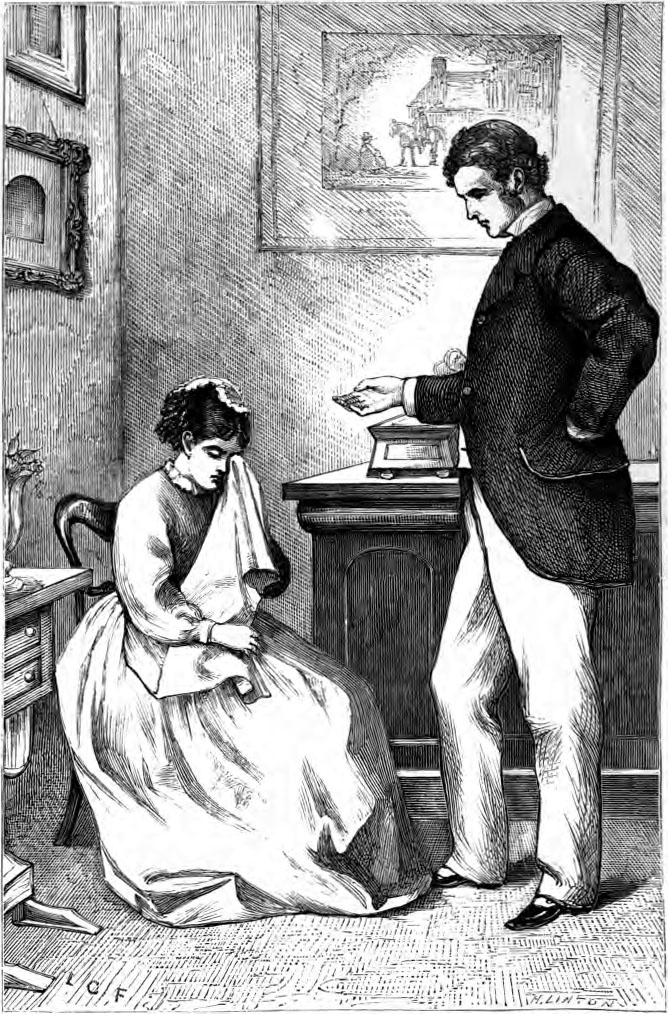
"Words to say! what do words matter? He loves you. He loves you after
that fashion that he wants to make you happy and respectable, not to
make you a bye-word and a disgrace." Ruby struggled hard to make some
opposition to the suggestion, but found herself to be incapable of
speech at the moment. "He thinks more of you than of himself, and
would give you all that he has. What would that other man give you?
If you were once married to John Crumb, would any one then pull you
by the hairs of your head? Would there be any want then, or any
disgrace?"
"There ain't no disgrace, Mr. Carbury."
"No disgrace in going about at midnight with such a one as Felix
Carbury? You are not a fool, and you know that it is disgraceful. If
you are not unfit to be an honest man's wife, go back and beg that
man's pardon."
"John Crumb's pardon! No!"
"Oh, Ruby, if you knew how highly I respect that man, and how lowly
I think of the other; how I look on the one as a noble fellow, and
regard the other as dust beneath my feet, you would perhaps change
your mind a little."
Her mind was being changed. His words did have their effect, though
the poor girl struggled against the conviction that was borne in upon
her. She had never expected to hear any one call John Crumb noble.
But she had never respected any one more highly than Squire Carbury,
and he said that John Crumb was noble. Amidst all her misery and
trouble she still told herself that it was but a dusty, mealy,--and
also a dumb nobility.
"I'll tell you what will take place," continued Roger. "Mr. Crumb
won't put up with this you know."
"He can't do nothing to me, sir."
"That's true enough. Unless it be to take you in his arms and press
you to his heart, he wants to do nothing to you. Do you think he'd
injure you if he could? You don't know what a man's love really
means, Ruby. But he could do something to somebody else. How do you
think it would be with Felix Carbury, if they two were in a room
together and nobody else by?"
"John's mortial strong, Mr. Carbury."
"If two men have equal pluck, strength isn't much needed. One is a
brave man, and the other--a coward. Which do you think is which?"
"He's your own cousin, and I don't know why you should say everything
again him."
"You know I'm telling you the truth. You know it as well as I do
myself;--and you're throwing yourself away, and throwing the man who
loves you over,--for such a fellow as that! Go back to him, Ruby, and
beg his pardon."
"I never will;--never."
"I've spoken to Mrs. Pipkin, and while you're here she will see that
you don't keep such hours any longer. You tell me that you're not
disgraced, and yet you are out at midnight with a young blackguard
like that! I've said what I've got to say, and I'm going away. But
I'll let your grandfather know."
"Grandfather don't want me no more."
"And I'll come again. If you want money to go home, I will let you
have it. Take my advice at least in this;--do not see Sir Felix
Carbury any more." Then he took his leave. If he had failed to
impress her with admiration for John Crumb, he had certainly been
efficacious in lessening that which she had entertained for Sir
Felix.
CHAPTER XLIV.
THE COMING ELECTION.
The very greatness of Mr. Melmotte's popularity, the extent of
the admiration which was accorded by the public at large to his
commercial enterprise and financial sagacity, created a peculiar
bitterness in the opposition that was organised against him at
Westminster. As the high mountains are intersected by deep valleys,
as puritanism in one age begets infidelity in the next, as in many
countries the thickness of the winter's ice will be in proportion
to the number of the summer musquitoes, so was the keenness of the
hostility displayed on this occasion in proportion to the warmth of
the support which was manifested. As the great man was praised, so
also was he abused. As he was a demi-god to some, so was he a fiend
to others. And indeed there was hardly any other way in which it
was possible to carry on the contest against him. From the moment
in which Mr. Melmotte had declared his purpose of standing for
Westminster in the Conservative interest, an attempt was made to
drive him down the throats of the electors by clamorous assertions of
his unprecedented commercial greatness. It seemed that there was but
one virtue in the world, commercial enterprise,--and that Melmotte
was its prophet. It seemed, too, that the orators and writers of the
day intended all Westminster to believe that Melmotte treated his
great affairs in a spirit very different from that which animates the
bosoms of merchants in general. He had risen above any feeling of
personal profit. His wealth was so immense that there was no longer
place for anxiety on that score. He already possessed,--so it was
said,--enough to found a dozen families, and he had but one daughter!
But by carrying on the enormous affairs which he held in his hands,
he would be able to open up new worlds, to afford relief to the
oppressed nationalities of the over-populated old countries. He had
seen how small was the good done by the Peabodys and the Bairds,
and, resolving to lend no ear to charities and religions, was intent on
projects for enabling young nations to earn plentiful bread by the
moderate sweat of their brows. He was the head and front of the
railway which was to regenerate Mexico. It was presumed that the
contemplated line from ocean to ocean across British America would
become a fact in his hands. It was he who was to enter into terms
with the Emperor of China for farming the tea-fields of that vast
country. He was already in treaty with Russia for a railway from
Moscow to Khiva. He had a fleet,--or soon would have a fleet of
emigrant ships,--ready to carry every discontented Irishman out of
Ireland to whatever quarter of the globe the Milesian might choose
for the exercise of his political principles. It was known that he
had already floated a company for laying down a submarine wire from
Penzance to Point de Galle, round the Cape of Good Hope,--so that,
in the event of general wars, England need be dependent on no other
country for its communications with India. And then there was the
philanthropic scheme for buying the liberty of the Arabian fellahs
from the Khedive of Egypt for thirty millions sterling,--the
compensation to consist of the concession of a territory about four
times as big as Great Britain in the lately annexed country on the
great African lakes. It may have been the case that some of these
things were as yet only matters of conversation,--speculations as to
which Mr. Melmotte's mind and imagination had been at work, rather
than his pocket or even his credit; but they were all sufficiently
matured to find their way into the public press, and to be used as
strong arguments why Melmotte should become member of Parliament
for Westminster.
All this praise was of course gall to those who found themselves
called upon by the demands of their political position to oppose Mr.
Melmotte. You can run down a demi-god only by making him out to be
a demi-devil. These very persons, the leading Liberals of the leading
borough in England as they called themselves, would perhaps have
cared little about Melmotte's antecedents had it not become their
duty to fight him as a Conservative. Had the great man found at the
last moment that his own British politics had been liberal in their
nature, these very enemies would have been on his committee. It was
their business to secure the seat. And as Melmotte's supporters began
the battle with an attempt at what the Liberals called "bounce,"--to
carry the borough with a rush by an overwhelming assertion of
their candidate's virtues,--the other party was driven to make
some enquiries as to that candidate's antecedents. They quickly
warmed to the work, and were not less loud in exposing the Satan
of speculation, than had been the Conservatives in declaring the
commercial Jove. Emissaries were sent to Paris and Francfort, and
the wires were used to Vienna and New York. It was not difficult
to collect stories,--true or false; and some quiet men, who merely
looked on at the game, expressed an opinion that Melmotte might have
wisely abstained from the glories of Parliament.
Nevertheless there was at first some difficulty in finding a proper
Liberal candidate to run against him. The nobleman who had been
elevated out of his seat by the death of his father had been a great
Whig magnate, whose family was possessed of immense wealth and
of popularity equal to its possessions. One of that family might
have contested the borough at a much less expense than any other
person,--and to them the expense would have mattered but little.
But there was no such member of it forthcoming. Lord This and Lord
That,--and the Honourable This and the Honourable That, sons of other
cognate Lords,--already had seats which they were unwilling to vacate
in the present state of affairs. There was but one other session for
the existing Parliament; and the odds were held to be very greatly in
Melmotte's favour. Many an outsider was tried, but the outsiders were
either afraid of Melmotte's purse or his influence. Lord Buntingford
was asked, and he and his family were good old Whigs. But he was
nephew to Lord Alfred Grendall, first cousin to Miles Grendall, and
abstained on behalf of his relatives. An overture was made to Sir
Damask Monogram, who certainly could afford the contest. But Sir
Damask did not see his way. Melmotte was a working bee, while he was
a drone,--and he did not wish to have the difference pointed out by
Mr. Melmotte's supporters. Moreover, he preferred his yacht and his
four-in-hand.
At last a candidate was selected, whose nomination and whose consent
to occupy the position created very great surprise in the London
world. The press had of course taken up the matter very strongly. The
"Morning Breakfast Table" supported Mr. Melmotte with all its weight.
There were people who said that this support was given by Mr. Broune
under the influence of Lady Carbury, and that Lady Carbury in this
way endeavoured to reconcile the great man to a marriage between
his daughter and Sir Felix. But it is more probable that Mr. Broune
saw,--or thought that he saw,--which way the wind sat, and that he
supported the commercial hero because he felt that the hero would
be supported by the country at large. In praising a book, or putting
foremost the merits of some official or military claimant, or writing
up a charity,--in some small matter of merely personal interest,--the
Editor of the "Morning Breakfast Table" might perhaps allow himself
to listen to a lady whom he loved. But he knew his work too well to
jeopardize his paper by such influences in any matter which might
probably become interesting to the world of his readers. There was
a strong belief in Melmotte. The clubs thought that he would be
returned for Westminster. The dukes and duchesses fêted him. The
city,--even the city was showing a wavering disposition to come
round. Bishops begged for his name on the list of promoters of their
pet schemes. Royalty without stint was to dine at his table. Melmotte
himself was to sit at the right hand of the brother of the Sun and
of the uncle of the Moon, and British Royalty was to be arranged
opposite, so that every one might seem to have the place of most
honour. How could a conscientious Editor of a "Morning Breakfast
Table," seeing how things were going, do other than support Mr.
Melmotte? In fair justice it may be well doubted whether Lady Carbury
had exercised any influence in the matter.
But the "Evening Pulpit" took the other side. Now this was the
more remarkable, the more sure to attract attention, inasmuch as
the "Evening Pulpit" had never supported the Liberal interest.
As was said in the first chapter of this work, the motto of that
newspaper implied that it was to be conducted on principles of
absolute independence. Had the "Evening Pulpit," like some of its
contemporaries, lived by declaring from day to day that all Liberal
elements were godlike, and all their opposites satanic, as a matter
of course the same line of argument would have prevailed as to the
Westminster election. But as it had not been so, the vigour of the
"Evening Pulpit" on this occasion was the more alarming and the
more noticeable,--so that the short articles which appeared almost
daily in reference to Mr. Melmotte were read by everybody. Now they
who are concerned in the manufacture of newspapers are well aware
that censure is infinitely more attractive than eulogy,--but they
are quite as well aware that it is more dangerous. No proprietor
or editor was ever brought before the courts at the cost of ever
so many hundred pounds,--which if things go badly may rise to
thousands,--because he had attributed all but divinity to some very
poor specimen of mortality. No man was ever called upon for dam-
ages because he had attributed grand motives. It might be well for
politics and literature and art,--and for truth in general, if it
was possible to do so. But a new law of libel must be enacted before
such salutary proceedings can take place. Censure on the other hand
is open to very grave perils. Let the Editor have been ever so
conscientious, ever so beneficent,--even ever so true,--let it be
ever so clear that what he has written has been written on behalf
of virtue, and that he has misstated no fact, exaggerated no fault,
never for a moment been allured from public to private matters,--
and he may still be in danger of ruin. A very long purse, or else a
very high courage is needed for the exposure of such conduct as the
"Evening Pulpit" attributed to Mr. Melmotte. The paper took up this
line suddenly. After the second article Mr. Alf sent back to Mr.
Miles Grendall, who in the matter was acting as Mr. Melmotte's
secretary, the ticket of invitation for the dinner, with a note from
Mr. Alf stating that circumstances connected with the forthcoming
election for Westminster could not permit him to have the great
honour of dining at Mr. Melmotte's table in the presence of the
Emperor of China. Miles Grendall showed the note to the dinner
committee, and, without consultation with Mr. Melmotte, it
was decided that the ticket should be sent to the Editor of a
thorough-going Conservative journal. This conduct on the part of the
"Evening Pulpit" astonished the world considerably; but the world was
more astonished when it was declared that Mr. Ferdinand Alf himself
was going to stand for Westminster on the Liberal interest.
Various suggestions were made. Some said that as Mr. Alf had a large
share in the newspaper, and as its success was now an established
fact, he himself intended to retire from the laborious position which
he filled, and was therefore free to go into Parliament. Others were
of opinion that this was the beginning of a new era in literature,
of a new order of things, and that from this time forward editors
would frequently be found in Parliament, if editors were employed of
sufficient influence in the world to find constituencies. Mr. Broune
whispered confidentially to Lady Carbury that the man was a fool for
his pains, and that he was carried away by pride. "Very clever,--and
dashing," said Mr. Broune, "but he never had ballast." Lady Carbury
shook her head. She did not want to give up Mr. Alf if she could help
it. He had never said a civil word of her in his paper;--but still
she had an idea that it was well to be on good terms with so great a
power. She entertained a mysterious awe for Mr. Alf,--much in excess
of any similar feeling excited by Mr. Broune, in regard to whom
her awe had been much diminished since he had made her an offer of
marriage. Her sympathies as to the election of course were with Mr.
Melmotte. She believed in him thoroughly. She still thought that his
nod might be the means of making Felix,--or if not his nod, then his
money without the nod.
"I suppose he is very rich," she said, speaking to Mr. Broune
respecting Mr. Alf.
"I dare say he has put by something. But this election will cost him
£10,000;--and if he goes on as he is doing now, he had better allow
another £10,000 for action for libel. They've already declared that
they will indict the paper."
"Do you believe about the Austrian Insurance Company?" This was a
matter as to which Mr. Melmotte was supposed to have retired from
Paris not with clean hands.
"I don't believe the 'Evening Pulpit' can prove it,--and I'm sure
that they can't attempt to prove it without an expense of three or
four thousand pounds. That's a game in which nobody wins but the
lawyers. I wonder at Alf. I should have thought that he would have
known how to get all said that he wanted to have said without running
with his head into the lion's mouth. He has been so clever up to
this! God knows he has been bitter enough, but he has always sailed
within the wind."
Mr. Alf had a powerful committee. By this time an animus in regard to
the election had been created strong enough to bring out the men on
both sides, and to produce heat, when otherwise there might only have
been a warmth or possibly frigidity. The Whig Marquises and the Whig
Barons came forward, and with them the liberal professional men,
and the tradesmen who had found that party to answer best, and the
democratical mechanics. If Melmotte's money did not, at last, utterly
demoralise the lower class of voters, there would still be a good
fight. And there was a strong hope that, under the ballot, Melmotte's
money might be taken without a corresponding effect upon the voting.
It was found upon trial that Mr. Alf was a good speaker. And though
he still conducted the "Evening Pulpit," he made time for addressing
meetings of the constituency almost daily. And in his speeches he
never spared Melmotte. No one, he said, had a greater reverence for
mercantile grandeur than himself. But let them take care that the
grandeur was grand. How great would be the disgrace to such a borough
as that of Westminster if it should find that it had been taken in
by a false spirit of speculation and that it had surrendered itself
to gambling when it had thought to do honour to honest commerce.
This, connected as of course it was, with the articles in the paper,
was regarded as very open speaking. And it had its effect. Some men
began to say that Melmotte had not been known long enough to deserve
confidence in his riches, and the Lord Mayor was already beginning to
think that it might be wise to escape the dinner by some excuse.
Melmotte's committee was also very grand. If Alf was supported by
Marquises and Barons, he was supported by Dukes and Earls. But his
speaking in public did not of itself inspire much confidence. He
had very little to say when he attempted to explain the political
principles on which he intended to act. After a little he confined
himself to remarks on the personal attacks made on him by the other
side, and even in doing that was reiterative rather than diffusive.
Let them prove it. He defied them to prove it. Englishmen were too
great, too generous, too honest, too noble,--the men of Westminster
especially were a great deal too high-minded to pay any attention to
such charges as these till they were proved. Then he began again. Let
them prove it. Such accusations as these were mere lies till they
were proved. He did not say much himself in public as to actions
for libel,--but assurances were made on his behalf to the electors,
especially by Lord Alfred Grendall and his son, that as soon as the
election was over all speakers and writers would be indicted for
libel, who should be declared by proper legal advice to have made
themselves liable to such action. The "Evening Pulpit" and Mr. Alf
would of course be the first victims.
The dinner was fixed for Monday, July the 8th. The election for the
borough was to be held on Tuesday the 9th. It was generally thought
that the proximity of the two days had been arranged with the view of
enhancing Melmotte's expected triumph. But such in truth was not the
case. It had been an accident, and an accident that was distressing
to some of the Melmottites. There was much to be done about the
dinner,--which could not be omitted; and much also as to the
election,--which was imperative. The two Grendalls, father and son,
found themselves to be so driven that the world seemed for them to be
turned topsey-turvey. The elder had in old days been accustomed to
electioneering in the interest of his own family, and had declared
himself willing to make himself useful on behalf of Mr. Melmotte. But
he found Westminster to be almost too much for him. He was called
here and sent there, till he was very near rebellion. "If this goes
on much longer I shall cut it," he said to his son.
"Think of me, governor," said the son. "I have to be in the city four
or five times a week."
"You've a regular salary."
"Come, governor; you've done pretty well for that. What's my salary
to the shares you've had? The thing is;--will it last?"
"How last?"
"There are a good many who say that Melmotte will burst up."
"I don't believe it," said Lord Alfred. "They don't know what they're
talking about. There are too many in the same boat to let him burst
up. It would be the bursting up of half London. But I shall tell him
after this that he must make it easier. He wants to know who's to
have every ticket for the dinner, and there's nobody to tell him
except me. And I've got to arrange all the places, and nobody to help
me except that fellow from the Herald's office. I don't know about
people's rank. Which ought to come first: a director of the bank or
a fellow who writes books?" Miles suggested that the fellow from the
Herald's office would know all about that, and that his father need
not trouble himself with petty details.
"And you shall come to us for three days,--after it's over," said
Lady Monogram to Miss Longestaffe; a proposition to which Miss
Longestaffe acceded, willingly indeed, but not by any means as
though a favour had been conferred upon her. Now the reason why Lady
Monogram had changed her mind as to inviting her old friend, and thus
threw open her hospitality for three whole days to the poor young
lady who had disgraced herself by staying with the Melmottes, was as
follows. Miss Longestaffe had the disposal of two evening tickets for
Madame Melmotte's grand reception; and so greatly had the Melmottes
risen in general appreciation, that Lady Monogram had found that she
was bound, on behalf of her own position in society, to be present
on that occasion. It would not do that her name should not be in the
printed list of the guests. Therefore she had made a serviceable
bargain with her old friend Miss Longestaffe. She was to have her two
tickets for the reception, and Miss Longestaffe was to be received
for three days as a guest by Lady Monogram. It had also been conceded
that at any rate on one of these nights Lady Monogram should take
Miss Longestaffe out with her, and that she should herself receive
company on another. There was perhaps something slightly painful at
the commencement of the negotiation; but such feelings soon fade
away, and Lady Monogram was quite a woman of the world.
CHAPTER XLV.
MR. MELMOTTE IS PRESSED FOR TIME.
About this time, a fortnight or nearly so before the election, Mr.
Longestaffe came up to town and saw Mr. Melmotte very frequently. He
could not go into his own house, as he had let that for a month to
the great financier, nor had he any establishment in town; but he
slept at an hotel and lived at the Carlton. He was quite delighted to
find that his new friend was an honest Conservative, and he himself
proposed the honest Conservative at the club. There was some idea of
electing Mr. Melmotte out of hand, but it was decided that the club
could not go beyond its rule, and could only admit Mr. Melmotte
out of his regular turn as soon as he should occupy a seat in the
House of Commons. Mr. Melmotte, who was becoming somewhat arro-
gant, was heard to declare that if the club did not take him when he
was willing to be taken, it might do without him. If not elected at once,
he should withdraw his name. So great was his prestige at this moment
with his own party that there were some, Mr. Longestaffe among the
number, who pressed the thing on the committee. Mr. Melmotte was not
like other men. It was a great thing to have Mr. Melmotte in the
party. Mr. Melmotte's financial capabilities would in themselves be
a tower of strength. Rules were not made to control the club in a
matter of such importance as this. A noble lord, one among seven who
had been named as a fit leader of the Upper House on the Conservative
side in the next session, was asked to take the matter up; and men
thought that the thing might have been done had he complied. But he
was old-fashioned, perhaps pig-headed; and the club for the time lost
the honour of entertaining Mr. Melmotte.
It may be remembered that Mr. Longestaffe had been anxious to become
one of the directors of the Mexican Railway, and that he was rather
snubbed than encouraged when he expressed his wish to Mr. Melmotte.
Like other great men, Mr. Melmotte liked to choose his own time for
bestowing favours. Since that request was made the proper time had
come, and he had now intimated to Mr. Longestaffe that in a somewhat
altered condition of things there would be a place for him at the
Board, and that he and his brother directors would be delighted to
avail themselves of his assistance. The alliance between Mr. Melmotte
and Mr. Longestaffe had become very close. The Melmottes had visited
the Longestaffes at Caversham. Georgiana Longestaffe was staying
with Madame Melmotte in London. The Melmottes were living in Mr.
Longestaffe's town house, having taken it for a month at a very
high rent. Mr. Longestaffe now had a seat at Mr. Melmotte's board.
And Mr. Melmotte had bought Mr. Longestaffe's estate at Pickering
on terms very favourable to the Longestaffes. It had been suggested
to Mr. Longestaffe by Mr. Melmotte that he had better qualify for
his seat at the Board by taking shares in the Company to the amount
of--perhaps two or three thousand pounds, and Mr. Longestaffe had
of course consented. There would be no need of any transaction in
absolute cash. The shares could of course be paid for out of Mr.
Longestaffe's half of the purchase money for Pickering Park, and
could remain for the present in Mr. Melmotte's hands. To this also
Mr. Longestaffe had consented, not quite understanding why the scrip
should not be made over to him at once.
It was a part of the charm of all dealings with this great man that
no ready money seemed ever to be necessary for anything. Great
purchases were made and great transactions apparently completed
without the signing even of a cheque. Mr. Longestaffe found himself
to be afraid even to give a hint to Mr. Melmotte about ready money.
In speaking of all such matters Melmotte seemed to imply that
everything necessary had been done, when he had said that it was
done. Pickering had been purchased and the title-deeds made over
to Mr. Melmotte; but the £80,000 had not been paid,--had not been
absolutely paid, though of course Mr. Melmotte's note assenting
to the terms was security sufficient for any reasonable man. The
property had been mortgaged, though not heavily, and Mr. Melmotte
had no doubt satisfied the mortgagee; but there was still a sum of
£50,000 to come, of which Dolly was to have one half and the other
was to be employed in paying off Mr. Longestaffe's debts to tradesmen
and debts to the bank. It would have been very pleasant to have had
this at once,--but Mr. Longestaffe felt the absurdity of pressing
such a man as Mr. Melmotte, and was partly conscious of the gradual
consummation of a new æra in money matters. "If your banker is
pressing you, refer him to me," Mr. Melmotte had said. As for many
years past we have exchanged paper instead of actual money for our
commodities, so now it seemed that, under the new Melmotte régime, an
exchange of words was to suffice.
But Dolly wanted his money. Dolly, idle as he was, foolish as he was,
dissipated as he was and generally indifferent to his debts, liked to
have what belonged to him. It had all been arranged. £5,000 would pay
off all his tradesmen's debts and leave him comfortably possessed of
money in hand, while the other £20,000 would make his own property
free. There was a charm in this which awakened even Dolly, and for
the time almost reconciled him to his father's society. But now a
shade of impatience was coming over him. He had actually gone down
to Caversham to arrange the terms with his father,--and had in fact
made his own terms. His father had been unable to move him, and
had consequently suffered much in spirit. Dolly had been almost
triumphant,--thinking that the money would come on the next day, or
at any rate during the next week. Now he came to his father early in
the morning,--at about two o'clock,--to enquire what was being done.
He had not as yet been made blessed with a single ten-pound note in
his hand, as the result of the sale.
"Are you going to see Melmotte, sir?" he asked somewhat abruptly.
"Yes;--I'm to be with him to-morrow, and he is to introduce me to the
Board."
"You're going in for that, are you, sir? Do they pay anything?"
"I believe not."
"Nidderdale and young Carbury belong to it. It's a sort of Beargarden
affair."
"A bear-garden affair, Adolphus. How so?"
"I mean the club. We had them all there for dinner one day, and a
jolly dinner we gave them. Miles Grendall and old Alfred belong to
it. I don't think they'd go in for it, if there was no money going.
I'd make them fork out something if I took the trouble of going all
that way."
"I think that perhaps, Adolphus, you hardly understand these things."
"No, I don't. I don't understand much about business, I know. What I
want to understand is, when Melmotte is going to pay up this money."
"I suppose he'll arrange it with the banks," said the father.
"I beg that he won't arrange my money with the banks, sir. You'd
better tell him not. A cheque upon his bank which I can pay in to
mine is about the best thing going. You'll be in the city to-morrow,
and you'd better tell him. If you don't like, you know, I'll get Squer-
cum to do it." Mr. Squercum was a lawyer whom Dolly had employed
of late years much to the annoyance of his parent. Mr. Squercum's
name was odious to Mr. Longestaffe.
"I beg you'll do nothing of the kind. It will be very foolish if you
do;--perhaps ruinous."
"Then he'd better pay up, like anybody else," said Dolly as he left
the room. The father knew the son, and was quite sure that Squercum
would have his finger in the pie unless the money were paid quickly.
When Dolly had taken an idea into his head, no power on earth,--no
power at least of which the father could avail himself,--would turn
him.
On that same day Melmotte received two visits in the city from two
of his fellow directors. At the time he was very busy. Though his
electioneering speeches were neither long nor pithy, still he had to
think of them beforehand. Members of his Committee were always trying
to see him. Orders as to the dinner and the preparation of the house
could not be given by Lord Alfred without some reference to him.
And then those gigantic commercial affairs which were enumerated in
the last chapter could not be adjusted without much labour on his
part. His hands were not empty, but still he saw each of these young
men,--for a few minutes. "My dear young friend, what can I do for
you?" he said to Sir Felix, not sitting down, so that Sir Felix also
should remain standing.
"About that money, Mr. Melmotte?"
"What money, my dear fellow? You see that a good many money matters
pass through my hands."
"The thousand pounds I gave you for shares. If you don't mind, and as
the shares seem to be a bother, I'll take the money back."
"It was only the other day you had £200," said Melmotte, showing that
he could apply his memory to small transactions when he pleased.
"Exactly;--and you might as well let me have the £800."
"I've ordered the shares;--gave the order to my broker the other
day."
"Then I'd better take the shares," said Sir Felix, feeling that it
might very probably be that day fortnight before he could start for
New York. "Could I get them, Mr. Melmotte?"
"My dear fellow, I really think you hardly calculate the value of my
time when you come to me about such an affair as this."
"I'd like to have the money or the shares," said Sir Felix, who was
not specially averse to quarrelling with Mr. Melmotte now that he
had resolved upon taking that gentleman's daughter to New York in
direct opposition to his written promise. Their quarrel would be so
thoroughly internecine when the departure should be discovered, that
any present anger could hardly increase its bitterness. What Felix
thought of now was simply his money, and the best means of getting it
out of Melmotte's hands.
"You're a spendthrift," said Melmotte, apparently relenting, "and I'm
afraid a gambler. I suppose I must give you £200 more on account."
Sir Felix could not resist the touch of ready money, and consented to
take the sum offered. As he pocketed the cheque he asked for the name
of the brokers who were employed to buy the shares. But here Melmotte
demurred. "No, my friend," said Melmotte; "you are only entitled to
shares for £600 pounds now. I will see that the thing is put right."
So Sir Felix departed with £200 only. Marie had said that she could
get £200. Perhaps if he bestirred himself and wrote to some of
Miles's big relations he could obtain payment of a part of that
gentleman's debt to him.
Sir Felix going down the stairs in Abchurch Lane met Paul Montague
coming up. Carbury, on the spur of the moment, thought that he would
"take a rise" as he called it out of Montague. "What's this I hear
about a lady at Islington?" he asked.
"Who has told you anything about a lady at Islington?"
"A little bird. There are always little birds about telling of
ladies. I'm told that I'm to congratulate you on your coming
marriage."
"Then you've been told an infernal falsehood," said Montague passing
on. He paused a moment and added, "I don't know who can have told
you, but if you hear it again, I'll trouble you to contradict it."
As he was waiting in Melmotte's outer room while the Duke's nephew
went in to see whether it was the great man's pleasure to see him, he
remembered whence Carbury must have heard tidings of Mrs. Hurtle. Of
course the rumour had come through Ruby Ruggles.
Miles Grendall brought out word that the great man would see Mr.
Montague; but he added a caution. "He's awfully full of work just
now,--you won't forget that;--will you?" Montague assured the duke's
nephew that he would be concise, and was shown in.
"I should not have troubled you," said Paul, "only that I understood
that I was to see you before the Board met."
"Exactly;--of course. It was quite necessary,--only you see I am a
little busy. If this d----d dinner were over I shouldn't mind. It's
a deal easier to make a treaty with an Emperor, than to give him a
dinner; I can tell you that. Well;--let me see. Oh;--I was proposing
that you should go out to Pekin?"
"To Mexico."
"Yes, yes;--to Mexico. I've so many things running in my head!
Well;--if you'll say when you're ready to start, we'll draw up
something of instructions. You'd know better, however, than we can
tell you what to do. You'll see Fisker, of course. You and Fisker
will manage it. The chief thing will be a cheque for the expenses;
eh? We must get that passed at the next Board."
Mr. Melmotte had been so quick that Montague had been unable to
interrupt him. "There need be no trouble about that, Mr. Melmotte, as
I have made up my mind that it would not be fit that I should go."
"Oh, indeed!"
There had been a shade of doubt on Montague's mind, till the tone
in which Melmotte had spoken of the embassy grated on his ears. The
reference to the expenses disgusted him altogether. "No;--even did
I see my way to do any good in America my duties here would not be
compatible with the undertaking."
"I don't see that at all. What duties have you got here? What
good are you doing the Company? If you do stay, I hope you'll be
unanimous; that's all;--or perhaps you intend to go out. If that's
it, I'll look to your money. I think I told you that before."
"That, Mr. Melmotte, is what I should prefer."
"Very well,--very well. I'll arrange it. Sorry to lose you,--that's
all. Miles, isn't Mr. Goldsheiner waiting to see me?"
"You're a little too quick, Mr. Melmotte," said Paul.
"A man with my business on his hands is bound to be quick, sir."
"But I must be precise. I cannot tell you as a fact that I shall
withdraw from the Board till I receive the advice of a friend with
whom I am consulting. I hardly yet know what my duty may be."
"I'll tell you, sir, what can not be your duty. It cannot be your
duty to make known out of that Board-room any of the affairs of the
Company which you have learned in that Board-room. It cannot be your
duty to divulge the circumstances of the Company or any differences
which may exist between Directors of the Company, to any gentleman
who is a stranger to the Company. It cannot be your duty--."
"Thank you, Mr. Melmotte. On matters such as that I think that I
can see my own way. I have been in fault in coming in to the Board
without understanding what duties I should have to perform--."
"Very much in fault, I should say," replied Melmotte, whose arrogance
in the midst of his inflated glory was overcoming him.
"But in reference to what I may or may not say to any friend, or how
far I should be restricted by the scruples of a gentleman, I do not
want advice from you."
"Very well;--very well. I can't ask you to stay, because a partner
from the house of Todd, Brehgert, and Goldsheiner is waiting to
see me, about matters which are rather more important than this of
yours." Montague had said what he had to say, and departed.
On the following day, three-quarters of an hour before the meeting of
the Board of Directors, old Mr. Longestaffe called in Abchurch Lane.
He was received very civilly by Miles Grendall, and asked to sit
down. Mr. Melmotte quite expected him, and would walk with him over
to the offices of the railway, and introduce him to the Board. Mr.
Longestaffe, with some shyness, intimated his desire to have a few
moments conversation with the chairman before the Board met. Fearing
his son, especially fearing Squercum, he had made up his mind to
suggest that the little matter about Pickering Park should be
settled. Miles assured him that the opportunity should be given him,
but that at the present moment the chief secretary of the Russian
Legation was with Mr. Melmotte. Either the chief secretary was very
tedious with his business, or else other big men must have come in,
for Mr. Longestaffe was not relieved till he was summoned to walk off
to the Board five minutes after the hour at which the Board should
have met. He thought that he could explain his views in the street;
but on the stairs they were joined by Mr. Cohenlupe, and in three
minutes they were in the Board-room. Mr. Longestaffe was then
presented, and took the chair opposite to Miles Grendall. Montague
was not there, but had sent a letter to the secretary explaining that
for reasons with which the chairman was acquainted he should absent
himself from the present meeting. "All right," said Melmotte. "I know
all about it. Go on. I'm not sure but that Mr. Montague's retirement
from among us may be an advantage. He could not be made to under-
stand that unanimity in such an enterprise as this is essential. I am
confident that the new director whom I have had the pleasure of
introducing to you to-day will not sin in the same direction." Then
Mr. Melmotte bowed and smiled very sweetly on Mr. Longestaffe.
Mr. Longestaffe was astonished to find how soon the business was
done, and how very little he had been called on to do. Miles Grendall
had read something out of a book which he had been unable to follow.
Then the chairman had read some figures. Mr. Cohenlupe had declared
that their prosperity was unprecedented;--and the Board was over.
When Mr. Longestaffe explained to Miles Grendall that he still wished
to speak to Mr. Melmotte, Miles explained to him that the chairman
had been obliged to run off to a meeting of gentlemen connected with
the interior of Africa, which was now being held at the Cannon Street
Hotel.
CHAPTER XLVI.
ROGER CARBURY AND HIS TWO FRIENDS.
Roger Carbury having found Ruby Ruggles, and having ascertained that
she was at any rate living in a respectable house with her aunt,
returned to Carbury. He had given the girl his advice, and had done
so in a manner that was not altogether ineffectual. He had frightened
her, and had also frightened Mrs. Pipkin. He had taught Mrs. Pipkin
to believe that the new dispensation was not yet so completely
established as to clear her from all responsibility as to her niece's
conduct. Having done so much, and feeling that there was no more to
be done, he returned home. It was out of the question that he should
take Ruby with him. In the first place she would not have gone. And
then,--had she gone,--he would not have known where to bestow her.
For it was now understood throughout Bungay,--and the news had spread
to Beccles,--that old Farmer Ruggles had sworn that his granddaughter
should never again be received at Sheep's Acre Farm. The squire on
his return home heard all the news from his own housekeeper. John
Crumb had been at the farm and there had been a fierce quarrel
between him and the old man. The old man had called Ruby by every
name that is most distasteful to a woman, and John had stormed and
had sworn that he would have punched the old man's head but for his
age. He wouldn't believe any harm of Ruby,--or if he did he was
ready to forgive that harm. But as for the Baro-nite;--the Baro-nite
had better look to himself! Old Ruggles had declared that Ruby
should never have a shilling of his money;--whereupon Crumb had
anathematised old Ruggles and his money too, telling him that he was
an old hunx, and that he had driven the girl away by his cruelty.
Roger at once sent over to Bungay for the dealer in meal, who was
with him early on the following morning.
"Did ye find her, squoire?"
"Oh, yes, Mr. Crumb, I found her. She's living with her aunt, Mrs.
Pipkin, at Islington."
"Eh, now;--look at that."
"You knew she had an aunt of that name up in London."
"Ye-es; I knew'd it, squoire. I a' heard tell of Mrs. Pipkin, but I
never see'd her."
"I wonder it did not occur to you that Ruby would go there." John
Crumb scratched his head, as though acknowledging the shortcoming of
his own intellect. "Of course if she was to go to London it was the
proper thing for her to do."
"I knew she'd do the thing as was right. I said that all along.
Darned if I didn't. You ask Mixet, squoire,--him as is baker down
Bardsey Lane. I allays guv' it her that she'd do the thing as was
right. But how about she and the Baro-nite?"
Roger did not wish to speak of the Baronet just at present. "I
suppose the old man down here did ill use her?"
"Oh, dreadful;--there ain't no manner of doubt o' that. Dragged her
about awful;--as he ought to be took up, only for the rumpus like.
D'ye think she's see'd the Baro-nite since she's been in Lon'on,
Muster Carbury?"
"I think she's a good girl, if you mean that."
"I'm sure she be. I don't want none to tell me that, squoire. Tho',
squoire, it's better to me nor a ten pun' note to hear you say so. I
allays had a leaning to you, squoire; but I'll more nor lean to you,
now. I've said all through she was good, and if e'er a man in Bungay
said she warn't--; well, I was there, and ready."
"I hope nobody has said so."
"You can't stop them women, squoire. There ain't no dropping into
them. But, Lord love 'ee, she shall come and be missus of my house
to-morrow, and what 'll it matter her then what they say? But,
squoire,--did ye hear if the Baro-nite had been a' hanging about that
place?"
"About Islington, you mean."
"He goes a hanging about; he do. He don't come out straight forrard,
and tell a girl as he loves her afore all the parish. There ain't
one in Bungay, nor yet in Mettingham, nor yet in all the Ilketsals
and all the Elmhams, as don't know as I'm set on Ruby Ruggles.
Huggery-Muggery is pi'son to me, squoire."
"We all know that when you've made up your mind, you have made up
your mind."
"I hove. It's made up ever so as to Ruby. What sort of a one is her
aunt now, squoire?"
"She keeps lodgings;--a very decent sort of a woman I should say."
"She won't let the Baro-nite come there?"
"Certainly not," said Roger, who felt that he was hardly dealing
sincerely with this most sincere of mealmen. Hitherto he had shuffled
off every question that had been asked him about Felix, though he
knew that Ruby had spent many hours with her fashionable lover. "Mrs.
Pipkin won't let him come there."
"If I was to give her a ge'own now,--or a blue cloak;--them
lodging-house women is mostly hard put to it;--or a chest of drawers
like, for her best bedroom, wouldn't that make her more o' my side,
squoire?"
"I think she'll try to do her duty without that."
"They do like things the like o' that; any ways I'll go up, squoire,
arter Sax'nam market, and see how things is lying."
"I wouldn't go just yet, Mr. Crumb, if I were you. She hasn't
forgotten the scene at the farm yet."
"I said nothing as warn't as kind as kind."
"But her own perversity runs in her own head. If you had been unkind
she could have forgiven that; but as you were good-natured and she
was cross, she can't forgive that." John Crumb again scratched his
head, and felt that the depths of a woman's character required more
gauging than he had yet given to it. "And to tell you the truth, my
friend, I think that a little hardship up at Mrs. Pipkin's will do
her good."
"Don't she have a bellyful o' vittels?" asked John Crumb, with
intense anxiety.
"I don't quite mean that. I dare say she has enough to eat. But of
course she has to work for it with her aunt. She has three or four
children to look after."
"That moight come in handy by-and-by;--moightn't it, squoire?" said
John Crumb grinning.
"As you say, she'll be learning something that may be useful to her
in another sphere. Of course there is a good deal to do, and I should
not be surprised if she were to think after a bit that your house in
Bungay was more comfortable than Mrs. Pipkin's kitchen in London."
"My little back parlour;--eh, squoire! And I've got a four-poster,
most as big as any in Bungay."
"I am sure you have everything comfortable for her, and she knows it
herself. Let her think about all that,--and do you go and tell her
again in a month's time. She'll be more willing to settle matters
then than she is now."
"But,--the Baro-nite!"
"Mrs. Pipkin will allow nothing of that."
"Girls is so 'cute. Ruby is awful 'cute. It makes me feel as though
I had two hun'erd weight o' meal on my stomach, lying awake o'
nights and thinking as how he is, may be,--pulling of her about! If I
thought that she'd let him--; oh! I'd swing for it, Muster Carbury.
They'd have to make an eend o' me at Bury, if it was that way. They
would then."
Roger assured him again and again that he believed Ruby to be a good
girl, and promised that further steps should be taken to induce
Mrs. Pipkin to keep a close watch upon her niece. John Crumb made
no promise that he would abstain from his journey to London after
Saxmundham fair; but left the squire with a conviction that his
purpose of doing so was shaken. He was still however resolved to send
Mrs. Pipkin the price of a new blue cloak, and declared his purpose
of getting Mixet to write the letter and enclose the money order.
John Crumb had no delicacy as to declaring his own deficiency in
literary acquirements. He was able to make out a bill for meal or
pollards, but did little beyond that in the way of writing letters.
This happened on a Saturday morning, and on that afternoon Roger
Carbury rode over to Lowestoft, to a meeting there on church matters
at which his friend the bishop presided. After the meeting was over
he dined at the inn with half a dozen clergymen and two or three
neighbouring gentlemen, and then walked down by himself on to the
long strand which has made Lowestoft what it is. It was now just the
end of June, and the weather was delightful;--but people were not
as yet flocking to the sea-shore. Every shopkeeper in every little
town through the country now follows the fashion set by Parliament
and abstains from his annual holiday till August or September. The
place therefore was by no means full. Here and there a few of the
townspeople, who at a bathing place are generally indifferent to the
sea, were strolling about; and another few, indifferent to fashion,
had come out from the lodging-houses and from the hotel, which had
been described as being small and insignificant,--and making up only
a hundred beds. Roger Carbury, whose house was not many miles distant
from Lowestoft, was fond of the sea-shore, and always came to loiter
there for a while when any cause brought him into the town. Now he
was walking close down upon the marge of the tide,--so that the last
little roll of the rising water should touch his feet,--with his
hands joined behind his back, and his face turned down towards the
shore, when he came upon a couple who were standing with their backs
to the land, looking forth together upon the waves. He was close
to them before he saw them, and before they had seen him. Then he
perceived that the man was his friend Paul Montague. Leaning on
Paul's arm a lady stood, dressed very simply in black, with a dark
straw hat on her head;--very simple in her attire, but yet a woman
whom it would be impossible to pass without notice. The lady of
course was Mrs. Hurtle.
Paul Montague had been a fool to suggest Lowestoft, but his folly had
been natural. It was not the first place he had named; but when fault
had been found with others, he had fallen back upon the sea sands
which were best known to himself. Lowestoft was just the spot which
Mrs. Hurtle required. When she had been shown her room, and taken
down out of the hotel on to the strand, she had declared herself to
be charmed. She acknowledged with many smiles that of course she had
had no right to expect that Mrs. Pipkin should understand what sort
of place she needed. But Paul would understand,--and had understood.
"I think the hotel charming," she said. "I don't know what you
mean by your fun about the American hotels, but I think this quite
gorgeous, and the people so civil!" Hotel people always are civil
before the crowds come. Of course it was impossible that Paul should
return to London by the mail train which started about an hour after
his arrival. He would have reached London at four or five in the
morning, and have been very uncomfortable. The following day was
Sunday, and of course he promised to stay till Monday. Of course he
had said nothing in the train of those stern things which he had
resolved to say. Of course he was not saying them when Roger Carbury
came upon him; but was indulging in some poetical nonsense, some
probably very trite raptures as to the expanse of the ocean, and the
endless ripples which connected shore with shore. Mrs. Hurtle, too,
as she leaned with friendly weight upon his arm, indulged also in
moonshine and romance. Though at the back of the heart of each of
them there was a devouring care, still they enjoyed the hour. We
know that the man who is to be hung likes to have his breakfast well
cooked. And so did Paul like the companionship of Mrs. Hurtle because
her attire, though simple, was becoming; because the colour glowed in
her dark face; because of the brightness of her eyes, and the happy
sharpness of her words, and the dangerous smile which played upon her
lips. He liked the warmth of her close vicinity, and the softness of
her arm, and the perfume from her hair,--though he would have given
all that he possessed that she had been removed from him by some
impassable gulf. As he had to be hanged,--and this woman's continued
presence would be as bad as death to him,--he liked to have his meal
well dressed.
He certainly had been foolish to bring her to Lowestoft, and the
close neighbourhood of Carbury Manor;--and now he felt his folly. As
soon as he saw Roger Carbury he blushed up to his forehead, and then
leaving Mrs. Hurtle's arm he came forward, and shook hands with his
friend. "It is Mrs. Hurtle," he said, "I must introduce you," and the
introduction was made. Roger took off his hat and bowed, but he did
so with the coldest ceremony. Mrs. Hurtle, who was quick enough at
gathering the minds of people from their looks, was just as cold in
her acknowledgment of the courtesy. In former days she had heard much
of Roger Carbury, and surmised that he was no friend to her. "I did
not know that you were thinking of coming to Lowestoft," said Roger
in a voice that was needlessly severe. But his mind at the present
moment was severe, and he could not hide his mind.
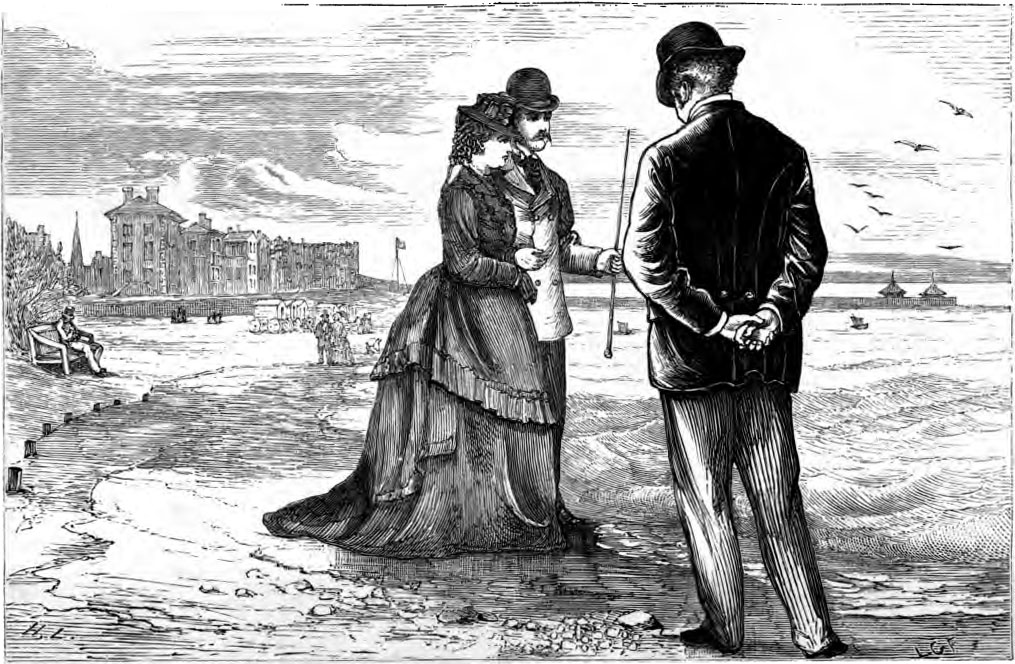
"I was not thinking of it. Mrs. Hurtle wished to get to the sea, and
as she knew no one else here in England, I brought her."
"Mr. Montague and I have travelled so many miles together before
now," she said, "that a few additional will not make much
difference."
"Do you stay long?" asked Roger in the same voice.
"I go back probably on Monday," said Montague.
"As I shall be here a whole week, and shall not speak a word to any
one after he has left me, he has consented to bestow his company
on me for two days. Will you join us at dinner, Mr. Carbury, this
evening?"
"Thank you, madam;--I have dined."
"Then, Mr. Montague, I will leave you with your friend. My toilet,
though it will be very slight, will take longer than yours. We dine
you know in twenty minutes. I wish you could get your friend to join
us." So saying, Mrs. Hurtle tripped back across the sand towards the
hotel.
"Is this wise?" demanded Roger in a voice that was almost sepulchral,
as soon as the lady was out of hearing.
"You may well ask that, Carbury. Nobody knows the folly of it so
thoroughly as I do."
"Then why do you do it? Do you mean to marry her?"
"No; certainly not."
"Is it honest then, or like a gentleman, that you should be with her
in this way? Does she think that you intend to marry her?"
"I have told her that I would not. I have told her--." Then he
stopped. He was going on to declare that he had told her that he
loved another woman, but he felt that he could hardly touch that
matter in speaking to Roger Carbury.
"What does she mean then? Has she no regard for her own character?"
"I would explain it to you all, Carbury, if I could. But you would
never have the patience to hear me."
"I am not naturally impatient."
"But this would drive you mad. I wrote to her assuring her that it
must be all over. Then she came here and sent for me. Was I not bound
to go to her?"
"Yes;--to go to her and repeat what you had said in your letter."
"I did do so. I went with that very purpose, and did repeat it."
"Then you should have left her."
"Ah; but you do not understand. She begged that I would not desert
her in her loneliness. We have been so much together that I could not
desert her."
"I certainly do not understand that, Paul. You have allowed yourself
to be entrapped into a promise of marriage; and then, for reasons
which we will not go into now but which we both thought to be
adequate, you resolved to break your promise, thinking that you would
be justified in doing so. But nothing can justify you in living with
the lady afterwards on such terms as to induce her to suppose that
your old promise holds good."
"She does not think so. She cannot think so."
"Then what must she be, to be here with you? And what must you be,
to be here, in public, with such a one as she is? I don't know why I
should trouble you or myself about it. People live now in a way that
I don't comprehend. If this be your way of living, I have no right to
complain."
"For God's sake, Carbury, do not speak in that way. It sounds as
though you meant to throw me over."
"I should have said that you had thrown me over. You come down here
to this hotel, where we are both known, with this lady whom you are
not going to marry;--and I meet you, just by chance. Had I known it,
of course I could have turned the other way. But coming on you by
accident, as I did, how am I not to speak to you? And if I speak,
what am I to say? Of course I think that the lady will succeed in
marrying you."
"Never."
"And that such a marriage will be your destruction. Doubtless she is
good-looking."
"Yes, and clever. And you must remember that the manners of her
country are not as the manners of this country."
"Then if I marry at all," said Roger, with all his prejudice
expressed strongly in his voice, "I trust I may not marry a lady of
her country. She does not think that she is to marry you, and yet
she comes down here and stays with you. Paul, I don't believe it.
I believe you, but I don't believe her. She is here with you in
order that she may marry you. She is cunning and strong. You are
foolish and weak. Believing as I do that marriage with her would
be destruction, I should tell her my mind,--and leave her." Paul
at the moment thought of the gentleman in Oregon, and of certain
difficulties in leaving. "That's what I should do. You must go in
now, I suppose, and eat your dinner."
"I may come to the hall as I go back home?"
"Certainly you may come if you please," said Roger. Then he bethought
himself that his welcome had not been cordial. "I mean that I shall
be delighted to see you," he added, marching away along the strand.
Paul did go into the hotel, and did eat his dinner. In the meantime
Roger Carbury marched far away along the strand. In all that he had
said to Montague he had spoken the truth, or that which appeared to
him to be the truth. He had not been influenced for a moment by any
reference to his own affairs. And yet he feared, he almost knew, that
this man,--who had promised to marry a strange American woman and
who was at this very moment living in close intercourse with the woman
after he had told her that he would not keep his promise,--was the
chief barrier between himself and the girl that he loved. As he
had listened to John Crumb while John spoke of Ruby Ruggles, he
had told himself that he and John Crumb were alike. With an honest,
true, heart-felt desire they both panted for the companionship of a
fellow-creature whom each had chosen. And each was to be thwarted
by the make-believe regard of unworthy youth and fatuous good looks!
Crumb, by dogged perseverance and indifference to many things, would
probably be successful at last. But what chance was there of success
for him? Ruby, as soon as want or hardship told upon her, would
return to the strong arm that could be trusted to provide her with
plenty and comparative ease. But Hetta Carbury, if once her heart
had passed from her own dominion into the possession of another,
would never change her love. It was possible, no doubt,--nay, how
probable,--that her heart was still vacillating. Roger thought that
he knew that at any rate she had not as yet declared her love. If she
were now to know,--if she could now learn,--of what nature was the
love of this other man; if she could be instructed that he was living
alone with a lady whom not long since he had promised to marry,--if
she could be made to understand this whole story of Mrs. Hurtle,
would not that open her eyes? Would she not then see where she
could trust her happiness, and where, by so trusting it, she would
certainly be shipwrecked!
"Never," said Roger to himself, hitting at the stones on the beach
with his stick. "Never." Then he got his horse and rode back to
Carbury Manor.
CHAPTER XLVII.
MRS. HURTLE AT LOWESTOFT.
When Paul got down into the dining-room Mrs. Hurtle was already
there, and the waiter was standing by the side of the table ready to
take the cover off the soup. She was radiant with smiles and made
herself especially pleasant during dinner, but Paul felt sure that
everything was not well with her. Though she smiled, and talked and
laughed, there was something forced in her manner. He almost knew
that she was only waiting till the man should have left the room
to speak in a different strain. And so it was. As soon as the last
lingering dish had been removed, and when the door was finally shut
behind the retreating waiter, she asked the question which no doubt
had been on her mind since she had walked across the strand to the
hotel. "Your friend was hardly civil; was he, Paul?"
"Do you mean that he should have come in? I have no doubt it was true
that he had dined."
"I am quite indifferent about his dinner,--but there are two ways of
declining as there are of accepting. I suppose he is on very intimate
terms with you?"
"Oh, yes."
"Then his want of courtesy was the more evidently intended for me. In
point of fact he disapproves of me. Is not that it?" To this question
Montague did not feel himself called upon to make any immediate
answer. "I can well understand that it should be so. An intimate
friend may like or dislike the friend of his friend, without offence.
But unless there be strong reason he is bound to be civil to his
friend's friend, when accident brings them together. You have told me
that Mr. Carbury was your beau ideal of an English gentleman."
"So he is."
"Then why didn't he behave as such?" and Mrs. Hurtle again smiled.
"Did not you yourself feel that you were rebuked for coming here with
me, when he expressed surprise at your journey? Has he authority over
you?"
"Of course he has not. What authority could he have?"
"Nay, I do not know. He may be your guardian. In this safe-going
country young men perhaps are not their own masters till they are
past thirty. I should have said that he was your guardian, and that
he intended to rebuke you for being in bad company. I dare say he did
after I had gone."
This was so true that Montague did not know how to deny it. Nor was
he sure that it would be well that he should deny it. The time must
come, and why not now as well as at any future moment? He had to
make her understand that he could not join his lot with her,--chiefly
indeed because his heart was elsewhere, a reason on which he could
hardly insist because she could allege that she had a prior right
to his heart;--but also because her antecedents had been such as to
cause all his friends to warn him against such a marriage. So he
plucked up courage for the battle. "It was nearly that," he said.
There are many,--and probably the greater portion of my readers
will be among the number,--who will declare to themselves that Paul
Montague was a poor creature, in that he felt so great a repugnance
to face this woman with the truth. His folly in falling at first
under the battery of her charms will be forgiven him. His engagement,
unwise as it was, and his subsequent determination to break his
engagement, will be pardoned. Women, and perhaps some men also, will
feel that it was natural that he should have been charmed, natural
that he should have expressed his admiration in the form which
unmarried ladies expect from unmarried men when any such expression
is to be made at all;--natural also that he should endeavour to
escape from the dilemma when he found the manifold dangers of the
step which he had proposed to take. No woman, I think, will be hard
upon him because of his breach of faith to Mrs. Hurtle. But they
will be very hard on him on the score of his cowardice,--as, I think,
unjustly. In social life we hardly stop to consider how much of that
daring spirit which gives mastery comes from hardness of heart rather
than from high purpose, or true courage. The man who succumbs to
his wife, the mother who succumbs to her daughter, the master who
succumbs to his servant, is as often brought to servility by a
continual aversion to the giving of pain, by a softness which
causes the fretfulness of others to be an agony to himself,--as by
any actual fear which the firmness of the imperious one may have
produced. There is an inner softness, a thinness of the mind's skin,
an incapability of seeing or even thinking of the troubles of others
with equanimity, which produces a feeling akin to fear; but which
is compatible not only with courage, but with absolute firmness of
purpose, when the demand for firmness arises so strongly as to
assert itself. With this man it was not really that. He feared the
woman;--or at least such fears did not prevail upon him to be silent;
but he shrank from subjecting her to the blank misery of utter
desertion. After what had passed between them he could hardly bring
himself to tell her that he wanted her no further and to bid her go.
But that was what he had to do. And for that his answer to her last
question prepared the way. "It was nearly that," he said.
"Mr. Carbury did take it upon himself to rebuke you for showing
yourself on the sands at Lowestoft with such a one as I am?"
"He knew of the letter which I wrote to you."
"You have canvassed me between you?"
"Of course we have. Is that unnatural? Would you have had me be
silent about you to the oldest and the best friend I have in the
world?"
"No, I would not have had you be silent to your oldest and best
friend. I presume you would declare your purpose. But I should not
have supposed you would have asked his leave. When I was travelling
with you, I thought you were a man capable of managing your own
actions. I had heard that in your country girls sometimes hold
themselves at the disposal of their friends,--but I did not dream
that such could be the case with a man who had gone out into the
world to make his fortune."
Paul Montague did not like it. The punishment to be endured was being
commenced. "Of course you can say bitter things," he replied.
"Is it my nature to say bitter things? Have I usually said bitter
things to you? When I have hung round your neck and have sworn that
you should be my God upon earth, was that bitter? I am alone and I
have to fight my own battles. A woman's weapon is her tongue. Say but
one word to me, Paul, as you know how to say it, and there will be
soon an end to that bitterness. What shall I care for Mr. Carbury,
except to make him the cause of some innocent joke, if you will speak
but that one word? And think what it is I am asking. Do you remember
how urgent were once your own prayers to me;--how you swore that
your happiness could only be secured by one word of mine? Though
I loved you, I doubted. There were considerations of money, which
have now vanished. But I spoke it,--because I loved you, and because
I believed you. Give me that which you swore you had given before
I made my gift to you."
"I cannot say that word."
"Do you mean that, after all, I am to be thrown off like an old
glove? I have had many dealings with men and have found them to be
false, cruel, unworthy, and selfish. But I have met nothing like
that. No man has ever dared to treat me like that. No man shall
dare."
"I wrote to you."
"Wrote to me;--yes! And I was to take that as sufficient! No. I
think but little of my life and have but little for which to live. But
while I do live I will travel over the world's surface to face
injustice and to expose it, before I will put up with it. You wrote
to me! Heaven and earth;--I can hardly control myself when I hear
such impudence!" She clenched her fist upon the knife that lay on the
table as she looked at him, and raising it, dropped it again at a
further distance. "Wrote to me! Could any mere letter of your writing
break the bond by which we were bound together? Had not the distance
between us seemed to have made you safe would you have dared to
write that letter? The letter must be unwritten. It has already
been contradicted by your conduct to me since I have been in this
country."
"I am sorry to hear you say that."
"Am I not justified in saying it?"
"I hope not. When I first saw you I told you everything. If I have
been wrong in attending to your wishes since, I regret it."
"This comes from your seeing your master for two minutes on the
beach. You are acting now under his orders. No doubt he came with the
purpose. Had you told him you were to be here?"
"His coming was an accident."
"It was very opportune at any rate. Well;--what have you to say to
me? Or am I to understand that you suppose yourself to have said all
that is required of you? Perhaps you would prefer that I should argue
the matter out with your--friend, Mr. Carbury."
"What has to be said, I believe I can say myself."
"Say it then. Or are you so ashamed of it, that the words stick in
your throat?"
"There is some truth in that. I am ashamed of it. I must say that
which will be painful, and which would not have been to be said, had
I been fairly careful."
Then he paused. "Don't spare me," she said. "I know what it all is
as well as though it were already told. I know the lies with which
they have crammed you at San Francisco. You have heard that up in
Oregon--I shot a man. That is no lie. I did. I brought him down dead
at my feet." Then she paused, and rose from her chair, and looked at
him. "Do you wonder that that is a story that a woman should hesitate
to tell? But not from shame. Do you suppose that the sight of that
dying wretch does not haunt me? that I do not daily hear his drunken
screech, and see him bound from the earth, and then fall in a heap
just below my hand? But did they tell you also that it was thus
alone that I could save myself,--and that had I spared him, I must
afterwards have destroyed myself? If I were wrong, why did they not
try me for his murder? Why did the women flock around me and kiss the
very hems of my garments? In this soft civilization of yours you know
nothing of such necessity. A woman here is protected,--unless it be
from lies."
"It was not that only," he whispered.
"No; they told you other things," she continued, still standing over
him. "They told you of quarrels with my husband. I know the lies,
and who made them, and why. Did I conceal from you the character of
my former husband? Did I not tell you that he was a drunkard and a
scoundrel? How should I not quarrel with such a one? Ah, Paul; you
can hardly know what my life has been."
"They told me that--you fought him."
"Psha;--fought him! Yes;--I was always fighting him. What are you to
do but to fight cruelty, and fight falsehood, and fight fraud and
treachery,--when they come upon you and would overwhelm you but for
fighting? You have not been fool enough to believe that fable about a
duel? I did stand once, armed, and guarded my bedroom door from him,
and told him that he should only enter it over my body. He went away
to the tavern and I did not see him for a week afterwards. That was
the duel. And they have told you that he is not dead."
"Yes;--they have told me that."
"Who has seen him alive? I never said to you that I had seen him
dead. How should I?"
"There would be a certificate."
"Certificate;--in the back of Texas;--five hundred miles from
Galveston! And what would it matter to you? I was divorced from him
according to the law of the State of Kansas. Does not the law make
a woman free here to marry again,--and why not with us? I sued
for a divorce on the score of cruelty and drunkenness. He made no
appearance, and the Court granted it me. Am I disgraced by that?"
"I heard nothing of the divorce."
"I do not remember. When we were talking of these old days before,
you did not care how short I was in telling my story. You wanted to
hear little or nothing then of Caradoc Hurtle. Now you have become
more particular. I told you that he was dead,--as I believed myself,
and do believe. Whether the other story was told or not I do not
know."
"It was not told."
"Then it was your own fault,--because you would not listen. And they
have made you believe I suppose that I have failed in getting back my
property?"
"I have heard nothing about your property but what you yourself have
said unasked. I have asked no question about your property."
"You are welcome. At last I have made it again my own. And now, sir,
what else is there? I think I have been open with you. Is it because
I protected myself from drunken violence that I am to be rejected? Am
I to be cast aside because I saved my life while in the hands of a
reprobate husband, and escaped from him by means provided by law;--or
because by my own energy I have secured my own property? If I am not
to be condemned for these things, then say why am I condemned."
She had at any rate saved him the trouble of telling the story, but
in doing so had left him without a word to say. She had owned to
shooting the man. Well; it certainly may be necessary that a woman
should shoot a man--especially in Oregon. As to the duel with her
husband,--she had half denied and half confessed it. He presumed
that she had been armed with a pistol when she refused Mr. Hurtle
admittance into the nuptial chamber. As to the question of Hurtle's
death,--she had confessed that perhaps he was not dead. But then,--as
she had asked,--why should not a divorce for the purpose in hand
be considered as good as a death? He could not say that she had
not washed herself clean;--and yet, from the story as told by
herself, what man would wish to marry her? She had seen so much of
drunkenness, had become so handy with pistols, and had done so much
of a man's work, that any ordinary man might well hesitate before he
assumed to be her master. "I do not condemn you," he replied.
"At any rate, Paul, do not lie," she answered. "If you tell me that
you will not be my husband, you do condemn me. Is it not so?"
"I will not lie if I can help it. I did ask you to be my wife--"
"Well;--rather. How often before I consented?"
"It matters little; at any rate, till you did consent. I have since
satisfied myself that such a marriage would be miserable for both of
us."
"You have?"
"I have. Of course, you can speak of me as you please and think of me
as you please. I can hardly defend myself."
"Hardly, I think."
"But, with whatever result, I know that I shall now be acting for the
best in declaring that I will not become--your husband."
"You will not?" She was still standing, and stretched out her right
hand as though again to grasp something.
He also now rose from his chair. "If I speak with abruptness it is
only to avoid a show of indecision. I will not."
"Oh, God! what have I done that it should be my lot to meet man after
man false and cruel as this! You tell me to my face that I am to bear
it! Who is the jade that has done it? Has she money?--or rank? Or is
it that you are afraid to have by your side a woman who can speak
for herself,--and even act for herself if some action be necessary?
Perhaps you think that I am--old." He was looking at her intently as
she spoke, and it did seem to him that many years had been added to
her face. It was full of lines round the mouth, and the light play
of drollery was gone, and the colour was fixed,--and her eyes seemed
to be deep in her head. "Speak, man,--is it that you want a younger
wife?"
"You know it is not."
"Know! How should any one know anything from a liar? From what
you tell me I know nothing. I have to gather what I can from your
character. I see that you are a coward. It is that man that came to
you, and who is your master, that has forced you to this. Between me
and him you tremble, and are a thing to be pitied. As for knowing
what you would be at, from anything that you would say,--that
is impossible. Once again I have come across a mean wretch. Oh,
fool!--that men should be so vile, and think themselves masters of
the world! My last word to you is, that you are--a liar. Now for the
present you can go. Ten minutes since, had I had a weapon in my hand
I should have shot another man."
Paul Montague, as he looked round the room for his hat, could not but
think that perhaps Mrs. Hurtle might have had some excuse. It seemed
at any rate to be her custom to have a pistol with her,--though
luckily, for his comfort, she had left it in her bedroom on the
present occasion. "I will say good-bye to you," he said, when he had
found his hat.
"Say no such thing. Tell me that you have triumphed and got rid of
me. Pluck up your spirits, if you have any, and show me your joy.
Tell me that an Englishman has dared to ill-treat an American woman.
You would,--were you not afraid to indulge yourself." He was now
standing in the doorway, and before he escaped she gave him an
imperative command. "I shall not stay here now," she said--"I shall
return on Monday. I must think of what you have said, and must
resolve what I myself will do. I shall not bear this without seeking
a means of punishing you for your treachery. I shall expect you to
come to me on Monday."
He closed the door as he answered her. "I do not see that it will
serve any purpose."
"It is for me, sir, to judge of that. I suppose you are not so much a
coward that you are afraid to come to me. If so, I shall come to you;
and you may be assured that I shall not be too timid to show myself
and to tell my story." He ended by saying that if she desired it he
would wait upon her, but that he would not at present fix a day. On
his return to town he would write to her.
When he was gone she went to the door and listened awhile. Then she
closed it, and turning the lock, stood with her back against the door
and with her hands clasped. After a few moments she ran forward, and
falling on her knees, buried her face in her hands upon the table.
Then she gave way to a flood of tears, and at last lay rolling upon
the floor.
Was this to be the end of it? Should she never know rest;--never have
one draught of cool water between her lips? Was there to be no end to
the storms and turmoils and misery of her life? In almost all that
she had said she had spoken the truth, though doubtless not all the
truth,--as which among us would in giving the story of his life? She
had endured violence, and had been violent. She had been schemed
against, and had schemed. She had fitted herself to the life which
had befallen her. But in regard to money, she had been honest and she
had been loving of heart. With her heart of hearts she had loved this
young Englishman;--and now, after all her scheming, all her daring,
with all her charms, this was to be the end of it! Oh, what a journey
would this be which she must now make back to her own country, all
alone!
But the strongest feeling which raged within her bosom was that of
disappointed love. Full as had been the vials of wrath which she had
poured forth over Montague's head, violent as had been the storm
of abuse with which she had assailed him, there had been after all
something counterfeited in her indignation. But her love was no
counterfeit. At any moment if he would have returned to her and
taken her in his arms, she would not only have forgiven him but have
blessed him also for his kindness. She was in truth sick at heart of
violence and rough living and unfeminine words. When driven by wrongs
the old habit came back upon her. But if she could only escape the
wrongs, if she could find some niche in the world which would be
bearable to her, in which, free from harsh treatment, she could pour
forth all the genuine kindness of her woman's nature,--then, she
thought she could put away violence and be gentle as a young girl.
When she first met this Englishman and found that he took delight in
being near her, she had ventured to hope that a haven would at last
be open to her. But the reek of the gunpowder from that first pistol
shot still clung to her, and she now told herself again, as she had
often told herself before, that it would have been better for her to
have turned the muzzle against her own bosom.
After receiving his letter she had run over on what she had told
herself was a vain chance. Though angry enough when that letter first
reached her, she had, with that force of character which marked her,
declared to herself that such a resolution on his part was natural.
In marrying her he must give up all his old allies, all his old haunts.
The whole world must be changed to him. She knew enough of
herself, and enough of Englishwomen, to be sure that when her past
life should be known, as it would be known, she would be avoided in
England. With all the little ridicule she was wont to exercise in
speaking of the old country there was ever mixed, as is so often
the case in the minds of American men and women, an almost envious
admiration of English excellence. To have been allowed to forget the
past and to live the life of an English lady would have been heaven
to her. But she, who was sometimes scorned and sometimes feared in
the eastern cities of her own country, whose name had become almost a
proverb for violence out in the far West,--how could she dare to hope
that her lot should be so changed for her?
She had reminded Paul that she had required to be asked often before
she had consented to be his wife; but she did not tell him that that
hesitation had arisen from her own conviction of her own unfitness.
But it had been so. Circumstances had made her what she was.
Circumstances had been cruel to her. But she could not now alter
them. Then gradually, as she came to believe in his love, as she lost
herself in love for him, she told herself that she would be changed.
She had, however, almost known that it could not be so. But this man
had relatives, had business, had property in her own country. Though
she could not be made happy in England, might not a prosperous life
be opened for him in the far West? Then had risen the offer of that
journey to Mexico with much probability that work of no ordinary
kind might detain him there for years. With what joy would she have
accompanied him as his wife! For that at any rate she would have been
fit.
She was conscious,--perhaps too conscious, of her own beauty. That
at any rate, she felt, had not deserted her. She was hardly aware that
time was touching it. And she knew herself to be clever, capable of
causing happiness, and mirth and comfort. She had the qualities of
a good comrade--which are so much in a woman. She knew all this of
herself. If he and she could be together in some country in which
those stories of her past life would be matter of indifference, could
she not make him happy? But what was she that a man should give up
everything and go away and spend his days in some half-barbarous
country for her alone? She knew it all and was hardly angry with
him in that he had decided against her. But treated as she had been
she must play her game with such weapons as she possessed. It was
consonant with her old character, it was consonant with her present
plans that she should at any rate seem to be angry.
Sitting there alone late into the night she made many plans, but the
plan that seemed best to suit the present frame of her mind was
the writing of a letter to Paul bidding him adieu, sending him her
fondest love, and telling him that he was right. She did write the
letter, but wrote it with a conviction that she would not have the
strength to send it to him. The reader may judge with what feeling
she wrote the following words:--
DEAR PAUL,--
You are right and I am wrong. Our marriage would not have
been fitting. I do not blame you. I attracted you when
we were together; but you have learned and have learned
truly that you should not give up your life for such
attractions. If I have been violent with you, forgive me.
You will acknowledge that I have suffered.
Always know that there is one woman who will love you
better than any one else. I think too that you will love
me even when some other woman is by your side. God bless
you, and make you happy. Write me the shortest, shortest
word of adieu. Not to do so would make you think yourself
heartless. But do not come to me.
For ever,
W. H.
This she wrote on a small slip of paper, and then having read it
twice, she put it into her pocket-book. She told herself that she
ought to send it; but told herself as plainly that she could not
bring herself to do so. It was early in the morning before she went
to bed but she had admitted no one into the room after Montague had
left her.
Paul, when he escaped from her presence, roamed out on to the
sea-shore, and then took himself to bed, having ordered a conveyance
to take him to Carbury Manor early in the morning. At breakfast
he presented himself to the squire. "I have come earlier than you
expected," he said.
"Yes, indeed;--much earlier. Are you going back to Lowestoft?"
Then he told the whole story. Roger expressed his satisfaction,
recalling however the pledge which he had given as to his return.
"Let her follow you, and bear it," he said. "Of course you must
suffer the effects of your own imprudence." On that evening Paul
Montague returned to London by the mail train, being sure that he
would thus avoid a meeting with Mrs. Hurtle in the railway-carriage.
CHAPTER XLVIII.
RUBY A PRISONER.
Ruby had run away from her lover in great dudgeon after the dance at
the Music Hall, and had declared that she never wanted to see him
again. But when reflection came with the morning her misery was
stronger than her wrath. What would life be to her now without her
lover? When she escaped from her grandfather's house she certainly
had not intended to become nurse and assistant maid-of-all-work at a
London lodging-house. The daily toil she could endure, and the hard
life, as long as she was supported by the prospect of some coming
delight. A dance with Felix at the Music Hall, though it were three
days distant from her, would so occupy her mind that she could wash
and dress all the children without complaint. Mrs. Pipkin was forced
to own to herself that Ruby did earn her bread. But when she had
parted with her lover almost on an understanding that they were never
to meet again, things were very different with her. And perhaps she
had been wrong. A gentleman like Sir Felix did not of course like to
be told about marriage. If she gave him another chance, perhaps he
would speak. At any rate she could not live without another dance.
And so she wrote him a letter.
Ruby was glib enough with her pen, though what she wrote will hardly
bear repeating. She underscored all her loves to him. She underscored
the expression of her regret if she had vexed him. She did not want
to hurry a gentleman. But she did want to have another dance at the
Music Hall. Would he be there next Saturday? Sir Felix sent her a
very short reply to say that he would be at the Music Hall on the Tues-
day. As at this time he proposed to leave London on the Wednesday
on his way to New York, he was proposing to devote his very last
night to the companionship of Ruby Ruggles.
Mrs. Pipkin had never interfered with her niece's letters. It is
certainly a part of the new dispensation that young women shall send
and receive letters without inspection. But since Roger Carbury's
visit Mrs. Pipkin had watched the postman, and had also watched her
niece. For nearly a week Ruby said not a word of going out at night.
She took the children for an airing in a broken perambulator, nearly
as far as Holloway, with exemplary care, and washed up the cups and
saucers as though her mind was intent upon them. But Mrs. Pipkin's
mind was intent on obeying Mr. Carbury's behests. She had already
hinted something as to which Ruby had made no answer. It was her
purpose to tell her and to swear to her most solemnly,--should she
find her preparing herself to leave the house after six in the
evening,--that she should be kept out the whole night, having a
purpose equally clear in her own mind that she would break her oath
should she be unsuccessful in her effort to keep Ruby at home. But on
the Tuesday, when Ruby went up to her room to deck herself, a bright
idea as to a better precaution struck Mrs. Pipkin's mind. Ruby had
been careless,--had left her lover's scrap of a note in an old pocket
when she went out with the children, and Mrs. Pipkin knew all about
it. It was nine o'clock when Ruby went up-stairs,--and then Mrs.
Pipkin locked both the front door and the area gate. Mrs. Hurtle
had come home on the previous day. "You won't be wanting to go out
to-night;--will you, Mrs. Hurtle?" said Mrs. Pipkin, knocking at her
lodger's door. Mrs. Hurtle declared her purpose of remaining at home
all the evening. "If you should hear words between me and my niece,
don't you mind, ma'am."
"I hope there's nothing wrong, Mrs. Pipkin?"
"She'll be wanting to go out, and I won't have it. It isn't right;
is it, ma'am? She's a good girl; but they've got such a way nowadays
of doing just as they pleases, that one doesn't know what's going to
come next." Mrs. Pipkin must have feared downright rebellion when she
thus took her lodger into her confidence.
Ruby came down in her silk frock, as she had done before, and made
her usual little speech. "I'm just going to step out, aunt, for a
little time to-night. I've got the key, and I'll let myself in quite
quiet."
"Indeed, Ruby, you won't," said Mrs. Pipkin.
"Won't what, aunt?"
"Won't let yourself in, if you go out. If you go out to-night you'll
stay out. That's all about it. If you go out to-night you won't
come back here any more. I won't have it, and it isn't right that
I should. You're going after that young man that they tell me is the
greatest scamp in all England."
"They tell you lies then, Aunt Pipkin."
"Very well. No girl is going out any more at nights out of my house;
so that's all about it. If you had told me you was going before, you
needn't have gone up and bedizened yourself. For now it's all to take
off again."
Ruby could hardly believe it. She had expected some opposition,--what
she would have called a few words; but she had never imagined that
her aunt would threaten to keep her in the streets all night. It
seemed to her that she had bought the privilege of amusing herself by
hard work. Nor did she believe now that her aunt would be as hard as
her threat. "I've a right to go if I like," she said.
"That's as you think. You haven't a right to come back again, any
way."
"Yes, I have. I've worked for you a deal harder than the girl
down-stairs, and I don't want no wages. I've a right to go out, and a
right to come back;--and go I shall."
"You'll be no better than you should be, if you do."
"Am I to work my very nails off, and push that perambulator about all
day till my legs won't carry me,--and then I ain't to go out, not
once in a week?"
"Not unless I know more about it, Ruby. I won't have you go and throw
yourself into the gutter;--not while you're with me."
"Who's throwing themselves into the gutter? I've thrown myself into
no gutter. I know what I'm about."
"There's two of us that way, Ruby;--for I know what I'm about."
"I shall just go then." And Ruby walked off towards the door.
"You won't get out that way, any way, for the door's locked;--and
the area gate. You'd better be said, Ruby, and just take your things
off."
Poor Ruby for the moment was struck dumb with mortification. Mrs.
Pipkin had given her credit for more outrageous perseverance than she
possessed, and had feared that she would rattle at the front door,
or attempt to climb over the area gate. She was a little afraid of
Ruby, not feeling herself justified in holding absolute dominion
over her as over a servant. And though she was now determined in
her conduct,--being fully resolved to surrender neither of the keys
which she held in her pocket,--still she feared that she might so
far collapse as to fall away into tears, should Ruby be violent.
But Ruby was crushed. Her lover would be there to meet her, and the
appointment would be broken by her! "Aunt Pipkin," she said, "let me
go just this once."
"No, Ruby;--it ain't proper."
"You don't know what you're a' doing of, aunt; you don't. You'll ruin
me,--you will. Dear Aunt Pipkin, do, do! I'll never ask again, if you
don't like."
Mrs. Pipkin had not expected this, and was almost willing to yield.
But Mr. Carbury had spoken so very plainly! "It ain't the thing,
Ruby; and I won't do it."
"And I'm to be--a prisoner! What have I done to be--a prisoner? I
don't believe as you've any right to lock me up."
"I've a right to lock my own doors."
"Then I shall go away to-morrow."
"I can't help that, my dear. The door will be open to-morrow, if you
choose to go out."
"Then why not open it to-night? Where's the difference?" But Mrs.
Pipkin was stern, and Ruby, in a flood of tears, took herself up to
her garret.
Mrs. Pipkin knocked at Mrs. Hurtle's door again. "She's gone to bed,"
she said.
"I'm glad to hear it. There wasn't any noise about it;--was there?"
"Not as I expected, Mrs. Hurtle, certainly. But she was put out a
bit. Poor girl! I've been a girl too, and used to like a bit of
outing as well as any one,--and a dance too; only it was always when
mother knew. She ain't got a mother, poor dear! and as good as no
father. And she's got it into her head that she's that pretty that a
great gentleman will marry her."
"She is pretty!"
"But what's beauty, Mrs. Hurtle? It's no more nor skin deep, as the
scriptures tell us. And what'd a grand gentleman see in Ruby to marry
her? She says she'll leave to-morrow."
"And where will she go?"
"Just nowhere. After this gentleman,--and you know what that means!
You're going to be married yourself, Mrs. Hurtle."
"We won't mind about that now, Mrs. Pipkin."
"And this 'll be your second, and you know how these things are
managed. No gentleman 'll marry her because she runs after him. Girls
as knows what they're about should let the gentlemen run after them.
That's my way of looking at it."
"Don't you think they should be equal in that respect?"
"Anyways the girls shouldn't let on as they are running after the
gentlemen. A gentleman goes here and he goes there, and he speaks
up free, of course. In my time, girls usen't to do that. But then,
maybe, I'm old-fashioned," added Mrs. Pipkin, thinking of the new
dispensation.
"I suppose girls do speak for themselves more than they did
formerly."
"A deal more, Mrs. Hurtle; quite different. You hear them talk of
spooning with this fellow, and spooning with that fellow,--and that
before their very fathers and mothers! When I was young we used to do
it, I suppose,--only not like that."
"You did it on the sly."
"I think we got married quicker than they do, any way. When the
gentlemen had to take more trouble they thought more about it. But
if you wouldn't mind speaking to Ruby to-morrow, Mrs. Hurtle, she'd
listen to you when she wouldn't mind a word I said to her. I don't
want her to go away from this, out into the street, till she knows
where she's to go to, decent. As for going to her young man,--that's
just walking the streets."
Mrs. Hurtle promised that she would speak to Ruby, though when mak-
ing the promise she could not but think of her unfitness for the task.
She knew nothing of the country. She had not a single friend in
it, but Paul Montague;--and she had run after him with as little
discretion as Ruby Ruggles was showing in running after her lover.
Who was she that she should take upon herself to give advice to any
female?
She had not sent her letter to Paul, but she still kept it in her
pocket-book. At some moments she thought that she would send it; and
at others she told herself that she would never surrender this last
hope till every stone had been turned. It might still be possible
to shame him into a marriage. She had returned from Lowestoft on
the Monday, and had made some trivial excuse to Mrs. Pipkin in her
mildest voice. The place had been windy, and too cold for her;--and
she had not liked the hotel. Mrs. Pipkin was very glad to see her
back again.
CHAPTER XLIX.
SIR FELIX MAKES HIMSELF READY.
Sir Felix, when he promised to meet Ruby at the Music Hall on the
Tuesday, was under an engagement to start with Marie Melmotte for New
York on the Thursday following, and to go down to Liverpool on the
Wednesday. There was no reason, he thought, why he should not enjoy
himself to the last, and he would say a parting word to poor little
Ruby. The details of his journey were settled between him and Marie,
with no inconsiderable assistance from Didon, in the garden of
Grosvenor Square, on the previous Sunday,--where the lovers had
again met during the hours of morning service. Sir Felix had been
astonished at the completion of the preparations which had been made.
"Mind you go by the 5 P.M. train," Marie said. "That will take you
into Liverpool at 10.15. There's an hotel at the railway-station.
Didon has got our tickets under the names of Madame and Mademoiselle
Racine. We are to have one cabin between us. You must get yours
to-morrow. She has found out that there is plenty of room."
"I'll be all right."
"Pray don't miss the train that afternoon. Somebody would be sure
to suspect something if we were seen together in the same train. We
leave at 7 A.M. I shan't go to bed all night, so as to be sure to be
in time. Robert,--he's the man,--will start a little earlier in the
cab with my heavy box. What do you think is in it?"
"Clothes," suggested Felix.
"Yes, but what clothes?--my wedding dresses. Think of that! What a
job to get them and nobody to know anything about it except Didon and
Madame Craik at the shop in Mount Street! They haven't come yet, but
I shall be there whether they come or not. And I shall have all my
jewels. I'm not going to leave them behind. They'll go off in our
cab. We can get the things out behind the house into the mews. Then
Didon and I follow in another cab. Nobody ever is up before near
nine, and I don't think we shall be interrupted."
"If the servants were to hear."
"I don't think they'd tell. But if I was to be brought back again,
I should only tell papa that it was no good. He can't prevent me
marrying."
"Won't your mother find out?"
"She never looks after anything. I don't think she'd tell if she
knew. Papa leads her such a life! Felix! I hope you won't be like
that."--And she looked up into his face, and thought that it would be
impossible that he should be.
"I'm all right," said Felix, feeling very uncomfortable at the time.
This great effort of his life was drawing very near. There had been
a pleasurable excitement in talking of running away with the great
heiress of the day, but now that the deed had to be executed,--and
executed after so novel and stupendous a fashion, he almost wished
that he had not undertaken it. It must have been much nicer when men
ran away with their heiresses only as far as Gretna Green. And even
Goldsheiner with Lady Julia had nothing of a job in comparison with
this which he was expected to perform. And then if they should be
wrong about the girl's fortune! He almost repented. He did repent,
but he had not the courage to recede. "How about money though?"
he said hoarsely.
"You have got some?"
"I have just the two hundred pounds which your father paid me, and
not a shilling more. I don't see why he should keep my money, and not
let me have it back."
"Look here," said Marie, and she put her hand into her pocket.
"I told you I thought I could get some. There is a cheque for two
hundred and fifty pounds. I had money of my own enough for the
tickets."
"And whose is this?" said Felix, taking the bit of paper with much
trepidation.
"It is papa's cheque. Mamma gets ever so many of them to carry on the
house and pay for things. But she gets so muddled about it that she
doesn't know what she pays and what she doesn't." Felix looked at the
cheque and saw that it was payable to House or Bearer, and that it
was signed by Augustus Melmotte. "If you take it to the bank you'll
get the money," said Marie. "Or shall I send Didon, and give you the
money on board the ship?"
Felix thought over the matter very anxiously. If he did go on the
journey he would much prefer to have the money in his own pocket.
He liked the feeling of having money in his pocket. Perhaps if Didon
were entrusted with the cheque she also would like the feeling. But
then might it not be possible that if he presented the cheque himself
he might be arrested for stealing Melmotte's money? "I think Didon
had better get the money," he said, "and bring it to me to-morrow,
at four o'clock in the afternoon, to the club." If the money did
not come he would not go down to Liverpool, nor would he be at the
expense of his ticket for New York. "You see," he said, "I'm so much
in the City that they might know me at the bank." To this arrangement
Marie assented and took back the cheque. "And then I'll come on board
on Thursday morning," he said, "without looking for you."
"Oh dear, yes;--without looking for us. And don't know us even till
we are out at sea. Won't it be fun when we shall be walking about on
the deck and not speaking to one another! And, Felix;--what do you
think? Didon has found out that there is to be an American clergyman
on board. I wonder whether he'd marry us."
"Of course he will."
"Won't that be jolly? I wish it was all done. Then, directly it's
done, and when we get to New York, we'll telegraph and write to papa,
and we'll be ever so penitent and good; won't we? Of course he'll
make the best of it."
"But he's so savage; isn't he?"
"When there's anything to get;--or just at the moment. But I don't
think he minds afterwards. He's always for making the best of
everything;--misfortunes and all. Things go wrong so often that if he
was to go on thinking of them always they'd be too many for anybody.
It'll be all right in a month's time. I wonder how Lord Nidderdale
will look when he hears that we've gone off. I should so like to see
him. He never can say that I've behaved bad to him. We were engaged,
but it was he broke it. Do you know, Felix, that though we were
engaged to be married, and everybody knew it, he never once kissed
me!" Felix at this moment almost wished that he had never done so. As
to what the other man had done, he cared nothing at all.
Then they parted with the understanding that they were not to see
each other again till they met on board the boat. All arrangements
were made. But Felix was determined that he would not stir in the
matter unless Didon brought him the full sum of £250; and he almost
thought, and indeed hoped, that she would not. Either she would be
suspected at the bank and apprehended, or she would run off with the
money on her own account when she got it;--or the cheque would have
been missed and the payment stopped. Some accident would occur, and
then he would be able to recede from his undertaking. He would do
nothing till after Monday afternoon.
Should he tell his mother that he was going? His mother had clearly
recommended him to run away with the girl, and must therefore approve
of the measure. His mother would understand how great would be the
expense of such a trip, and might perhaps add something to his stock
of money. He determined that he would tell his mother;--that is, if
Didon should bring him full change for the cheque.
He walked into the Beargarden exactly at four o'clock on the Monday,
and there he found Didon standing in the hall. His heart sank within
him as he saw her. Now must he certainly go to New York. She made him
a little curtsey, and without a word handed him an envelope, soft and
fat with rich enclosures. He bade her wait a moment, and going into a
little waiting-room counted the notes. The money was all there;--the
full sum of £250. He must certainly go to New York. "C'est tout en
règle?" said Didon in a whisper as he returned to the hall. Sir Felix
nodded his head, and Didon took her departure.
Yes; he must go now. He had Melmotte's money in his pocket, and was
therefore bound to run away with Melmotte's daughter. It was a great
trouble to him as he reflected that Melmotte had more of his money
than he had of Melmotte's. And now how should he dispose of his time
before he went? Gambling was too dangerous. Even he felt that. Where
would he be were he to lose his ready money? He would dine that night
at the club, and in the evening go up to his mother. On the Tuesday
he would take his place for New York in the City, and would spend the
evening with Ruby at the Music Hall. On the Wednesday, he would start
for Liverpool,--according to his instructions. He felt annoyed that
he had been so fully instructed. But should the affair turn out well
nobody would know that. All the fellows would give him credit for the
audacity with which he had carried off the heiress to America.
At ten o'clock he found his mother and Hetta in Welbeck Street--
"What; Felix?" exclaimed Lady Carbury.
"You're surprised; are you not?" Then he threw himself into a chair.
"Mother," he said, "would you mind coming into the other room?" Lady
Carbury of course went with him. "I've got something to tell you," he
said.
"Good news?" she asked, clasping her hands together. From his manner
she thought that it was good news. Money had in some way come into
his hands,--or at any rate a prospect of money.
"That's as may be," he said, and then he paused.
"Don't keep me in suspense, Felix."
"The long and the short of it is that I'm going to take Marie off."
"Oh, Felix."
"You said you thought it was the right thing to do;--and therefore
I'm going to do it. The worst of it is that one wants such a lot of
money for this kind of thing."
"But when?"
"Immediately. I wouldn't tell you till I had arranged everything.
I've had it in my mind for the last fortnight."
"And how is it to be? Oh, Felix, I hope it may succeed."
"It was your own idea, you know. We're going to;--where do you
think?"
"How can I think?--Boulogne."
"You say that just because Goldsheiner went there. That wouldn't have
done at all for us. We're going to--New York."
"To New York! But when will you be married?"
"There will be a clergyman on board. It's all fixed. I wouldn't go
without telling you."
"Oh; I wish you hadn't told me."
"Come now;--that's kind. You don't mean to say it wasn't you that put
me up to it. I've got to get my things ready."
"Of course, if you tell me that you are going on a journey, I will
have your clothes got ready for you. When do you start?"
"Wednesday afternoon."
"For New York! We must get some things ready-made. Oh, Felix, how
will it be if he does not forgive her?" He attempted to laugh. "When
I spoke of such a thing as possible he had not sworn then that he
would never give her a shilling."
"They always say that."
"You are going to risk it?"
"I am going to take your advice." This was dreadful to the poor
mother. "There is money settled on her."
"Settled on whom?"
"On Marie;--money which he can't get back again."
"How much?"
"She doesn't know;--but a great deal; enough for them all to live
upon if things went amiss with them."
"But that's only a form, Felix. That money can't be her own, to give
to her husband."
"Melmotte will find that it is, unless he comes to terms. That's the
pull we've got over him. Marie knows what she's about. She's a great
deal sharper than any one would take her to be. What can you do for
me about money, mother?"
"I have none, Felix."
"I thought you'd be sure to help me, as you wanted me so much to do
it."
"That's not true, Felix. I didn't want you to do it. Oh, I am so
sorry that that word ever passed my mouth! I have no money. There
isn't £20 at the bank altogether."
"They would let you overdraw for £50 or £60."
"I will not do it. I will not starve myself and Hetta. You had
ever so much money only lately. I will get some things for you,
and pay for them as I can if you cannot pay for them after your
marriage;--but I have not money to give you."
"That's a blue look out," said he, turning himself in his chair,--
"just when £60 or £70 might make a fellow for life! You could
borrow it from your friend Broune."
"I will do no such thing, Felix. £50 or £60 would make very little
difference in the expense of such a trip as this. I suppose you have
some money?"
"Some;--yes, some. But I'm so short that any little thing would help
me." Before the evening was over she absolutely did give him a cheque
for £30, although she had spoken the truth in saying that she had not
so much at her banker's.
After this he went back to his club, although he himself understood
the danger. He could not bear the idea of going to bed quietly at
home at half-past ten. He got into a cab, and was very soon up in the
card-room. He found nobody there, and went to the smoking-room, where
Dolly Longestaffe and Miles Grendall were sitting silently together,
with pipes in their mouths. "Here's Carbury," said Dolly, waking
suddenly into life. "Now we can have a game at three-handed loo."
"Thank ye; not for me," said Sir Felix. "I hate three-handed loo."
"Dummy," suggested Dolly.
"I don't think I'll play to-night, old fellow. I hate three fellows
sticking down together." Miles sat silent, smoking his pipe,
conscious of the baronet's dislike to play with him. "By-the-bye,
Grendall,--look here." And Sir Felix in his most friendly tone
whispered into his enemy's ear a petition that some of the I. O. U.'s
might be converted into cash.
"'Pon my word, I must ask you to wait till next week," said Miles.
"It's always waiting till next week with you," said Sir Felix,
getting up and standing with his back to the fire-place. There were
other men in the room, and this was said so that every one should
hear it. "I wonder whether any fellow would buy these for five
shillings in the pound?" And he held up the scraps of paper in his
hand. He had been drinking freely before he went up to Welbeck
Street, and had taken a glass of brandy on re-entering the club.
"Don't let's have any of that kind of thing down here," said Dolly.
"If there is to be a row about cards, let it be in the card-room."
"Of course," said Miles. "I won't say a word about the matter down
here. It isn't the proper thing."
"Come up into the card-room, then," said Sir Felix, getting up from
his chair. "It seems to me that it makes no difference to you, what
room you're in. Come up, now; and Dolly Longestaffe shall come and
hear what you say." But Miles Grendall objected to this arrangement.
He was not going up into the card-room that night, as no one was
going to play. He would be there to-morrow, and then if Sir Felix
Carbury had anything to say, he could say it.
"How I do hate a row!" said Dolly. "One has to have rows with one's
own people, but there ought not to be rows at a club."
"He likes a row,--Carbury does," said Miles.
"I should like my money, if I could get it," said Sir Felix, walking
out of the room.
On the next day he went into the City, and changed his mother's
cheque. This was done after a little hesitation. The money was given
to him, but a gentleman from behind the desks begged him to remind
Lady Carbury that she was overdrawing her account. "Dear, dear;" said
Sir Felix, as he pocketed the notes, "I'm sure she was unaware of
it." Then he paid for his passage from Liverpool to New York under
the name of Walter Jones, and felt as he did so that the intrigue was
becoming very deep. This was on Tuesday. He dined again at the club,
alone, and in the evening went to the Music Hall. There he remained
from ten till nearly twelve, very angry at the non-appearance of Ruby
Ruggles. As he smoked and drank in solitude, he almost made up his
mind that he had intended to tell her of his departure for New York.
Of course he would have done no such thing. But now, should she ever
complain on that head he would have his answer ready. He had devoted
his last night in England to the purpose of telling her, and she had
broken her appointment. Everything would now be her fault. Whatever
might happen to her she could not blame him.
Having waited till he was sick of the Music Hall,--for a music hall
without ladies' society must be somewhat dull,--he went back to his
club. He was very cross, as brave as brandy could make him, and well
inclined to expose Miles Grendall if he could find an opportunity. Up
in the card-room he found all the accustomed men,--with the exception
of Miles Grendall. Nidderdale, Grasslough, Dolly, Paul Montague, and
one or two others were there. There was, at any rate, comfort in
the idea of playing without having to encounter the dead weight of
Miles Grendall. Ready money was on the table,--and there was none
of the peculiar Beargarden paper flying about. Indeed the men at the
Beargarden had become sick of paper, and there had been formed a
half-expressed resolution that the play should be somewhat lower, but
the payments punctual. The I. O. U.'s had been nearly all converted
into money,--with the assistance of Herr Vossner,--excepting those
of Miles Grendall. The resolution mentioned did not refer back to
Grendall's former indebtedness, but was intended to include a clause
that he must in future pay ready money. Nidderdale had communicated
to him the determination of the committee. "Bygones are bygones, old
fellow; but you really must stump up, you know, after this." Miles
had declared that he would "stump up." But on this occasion Miles was
absent.
At three o'clock in the morning, Sir Felix had lost over a hundred
pounds in ready money. On the following night about one he had lost a
further sum of two hundred pounds. The reader will remember that he
should at that time have been in the hotel at Liverpool.
But Sir Felix, as he played on in the almost desperate hope of
recovering the money which he so greatly needed, remembered how
Fisker had played all night, and how he had gone off from the club to
catch the early train for Liverpool, and how he had gone on to New
York without delay.
(Continue Reading)