| Characters | |
| Lady Matilda Carbury | An ambitious writer striving to curate favorable reviews for her book Criminal Queens. Following the death of her abusive husband, she seeks literary fame and
friendships. Her deep concern is reserved for her son, Felix, the one person
to whom she is truly devoted, though she is distressed by what she perceives
as his squandered life. Lady Carbury is also frustrated by her daughter
Hetta's determination to choose her own path in marriage. |
| Augustus Melmotte |
A notorious financier, whose perceived financial genius makes him the talk of upper-class London. His reputation hinges on maintaining the illusion of his prosperity, which is vital to his continued success. Despite the disdain of the English aristocracy for his abrasive demeanor, their financial needs compel them to overlook these flaws, seeking invitations to his lavish events. Melmotte aspires to ascend further into society by securing a seat in Parliament and marrying off his daughter, Marie, to a nobleman. However, his ambitions lead him to excessive risk-taking. |
| Sir Felix Carbury |
Trollope’s most perfect picture of a cad. After spending his own fortune, he beggared his mother and sister, and as a last resort planned to elope with Marie Melmotte. Melmotte recognizes him as a weak, profligate and dissipated character and opposes the match. |
| Roger Carbury |
Head of the Carbury family, and Squire of Carbury Hall, Suffolk. A second cousin of Felix and of Henrietta, whom he wished to marry. Trollope used him as a mouthpiece for his own denunciation of the hollowness and evil practices of certain phases of English society life. |
| Henrietta "Hetta" Carbury |
The daughter of Lady Carbury, is courted by Roger Carbury. Though she admires Roger's wisdom and integrity, her heart belongs to Paul Montague. Their prospects for a future together face jeopardy due to Paul's past connection with Mrs. Hurtle. |
| Paul Montague |
A friend and distant relative of Roger Carbury. He invested his small fortune in a venture in San Francisco, but, not liking the country, returned to England. He won the love of Henrietta Carbury, whom Roger wished to marry. Becoming involved with Augustus Melmotte in his promotion schemes, he vainly tried to warn his fellow directors of the unsoundness of the business, and extricated himself before the crash. |
| Winifred Hurtle |
An independent, spirited American woman once engaged to Paul Montague.
Though she believes rekindling their engagement is her last chance at happiness,
her history is marked by survival against an abusive husband and a dramatic
episode in Oregon, where she resorted to self-defense. Ambivalent towards
the rigid English social norms that thwart her aspirations, she both dreams
of a secure life in England and rejects the societal constraints that dictate
propriety and lineage, clashing with characters like Roger Carbury who
disapprove of her past. |
| Marie Melmotte |
The illegitimate daughter of Augustus Melmotte is initially seen as a pawn
in her father's plans to cement his social standing by marrying her to
an English lord. Initially compliant in marrying Lord Nidderdale, she grows
disillusioned upon realizing his interest is purely financial. Aspiring
for genuine affection, she turns to Sir Felix Carbury, only to discover
he, too, desires her wealth over her. Accepting this harsh reality, she
reconsiders Lord Nidderdale's proposal, appreciating his honest intentions
as they develop mutual admiration. |
| Lord Nidderdale | The eldest son of the Marquis of Auld Reekie, and a cousin of the Duchess of Omnium. He became one of the directors of the South Central Pacific and Mexican Railroad, and offered to marry Marie Melmotte for half a million down. He refused the match when Marie’s father tried to tie up the money, but later renewed his suit, having become attracted to Marie. |
| Adolphus "Dolly" Longestaffe, Jr. |
A good-natured but moronic member of the Beargarden Club. Often at variance with his father on business matters, his refusal to consent to the sale of Pickering unless half the produce of the sale is given to him at once prompts Melmotte to forge his signiature on the deed of sale, a major factor in Melmotte's ultimate downfall. |
| Georgiana Longestaffe |
A shopworn beauty, ill-tempered over her failure to find a rich husband,
she is so desperate to find one in London that when her father announces
he will forgo the annual London visit as a way to economize, she agrees
to live with the Melmotte family, only to find herself shunned for the
connection by her London social circle. |
| Ruby Ruggles | A pretty country girl, engaged to John Crumb, the local miller. Sir Felix Carbury made love to her and she followed him to London. Refusing to marry John Crumb whose flour-covered skin and simpleness she compares unfavorably to Felix's "beautiful" looks, she is thrashed by her grandfather and flees to London to live with her Aunt, Mrs. Pipkin where she earns her keep minding the children. |
| John Crumb | The inarticulate miller in Bungay who is in love with Ruby Ruggles, to whom he offers a comfortable home with a big bed. When she ran away to London in search of Sir Felix Carbury, John followed her, intent on thrashing Sir Felix soundly. His patience and loyalty fascinates Mrs. Hurtle who has never met anyone like him. |
| Nicholas Broune | The editor of the “Morning Breakfast Table.” He became a friend of Lady Carbury through his publication of her writings, and, despite his clear understanding of her nature, he comes to admire her and becomes her trusted friend and adviser. |
| Sophia Longestaffe |
The elder daughter of the family, who, failing in the London marriage market, settled for a stodgy, brainless country squire, George Whitstable. Having always lived in the shadow of her stronger-willed sister, she avails herself of every opportunity to torment her once the tables are turned.. |
| Madame Melmotte | A Bohemian Jewess, who strove valiantly, but with no success, to assist in her husband’s ambitious social plans, and to aid in securing an advantageous marriage for his daughter Marie. She feared and hated her husband. |
| Hamilton K Fisker | Brash San Francisco promoter of the South Central Pacific and Mexican Railway, and senior partner in the firm of Fisker, Montague and Montague who entices Melmotte to lend his name and financial savvy to the enterprise. |
| Lord Alfred Grendall | One of the dummy directors in the railroad company promoted by Augustus Melmotte, for whom he acted as private secretary. A brother of the Duchess of Stevenage. Playing whist was Lord Alfred's only accomplishment, and almost the only occupation of his life. |
CONTENTS
I. THREE EDITORS.
II. THE CARBURY FAMILY.
III. THE BEARGARDEN.
IV. MADAME MELMOTTE'S BALL.
V. AFTER THE BALL.
VI. ROGER CARBURY AND PAUL MONTAGUE.
VII. MENTOR.
VIII. LOVE-SICK.
IX. THE GREAT RAILWAY TO VERA CRUZ.
X. MR. FISKER'S SUCCESS.
XI. LADY CARBURY AT HOME.
XII. SIR FELIX IN HIS MOTHER'S HOUSE.
XIII. THE LONGESTAFFES.
XIV. CARBURY MANOR.
XV. "YOU SHOULD REMEMBER THAT I AM HIS MOTHER."
XVI. THE BISHOP AND THE PRIEST.
XVII. MARIE MELMOTTE HEARS A LOVE TALE.
XVIII. RUBY RUGGLES HEARS A LOVE TALE.
XIX. HETTA CARBURY HEARS A LOVE TALE.
XX. LADY POMONA'S DINNER PARTY.
XXI. EVERYBODY GOES TO THEM.
XXII. LORD NIDDERDALE'S MORALITY.
XXIII. "YES;--I'M A BARONET."
XXIV. MILES GRENDALL'S TRIUMPH.
XXV. IN GROSVENOR SQUARE.
XXVI. MRS. HURTLE.
XXVII. MRS. HURTLE GOES TO THE PLAY.
XXVIII. DOLLY LONGESTAFFE GOES INTO THE CITY.
XXIX. MISS MELMOTTE'S COURAGE.
XXX. MR. MELMOTTE'S PROMISE.
XXXI. MR. BROUNE HAS MADE UP HIS MIND.
XXXII. LADY MONOGRAM.
XXXIII. JOHN CRUMB.
XXXIV. RUBY RUGGLES OBEYS HER GRANDFATHER.
XXXV. MELMOTTE'S GLORY.
XXXVI. MR. BROUNE'S PERILS.
XXXVII. THE BOARD-ROOM.
XXXVIII. PAUL MONTAGUE'S TROUBLES.
XXXIX. "I DO LOVE HIM."
XL. "UNANIMITY IS THE VERY SOUL OF THESE THINGS."
XLI. ALL PREPARED.
XLII. "CAN YOU BE READY IN TEN MINUTES?"
XLIII. THE CITY ROAD.
XLIV. THE COMING ELECTION.
XLV. MR. MELMOTTE IS PRESSED FOR TIME.
XLVI. ROGER CARBURY AND HIS TWO FRIENDS.
XLVII. MRS. HURTLE AT LOWESTOFT.
XLVIII. RUBY A PRISONER.
XLIX. SIR FELIX MAKES HIMSELF READY.
L. THE JOURNEY TO LIVERPOOL.
LI. WHICH SHALL IT BE?
LII. THE RESULTS OF LOVE AND WINE.
LIII. A DAY IN THE CITY.
LIV. THE INDIA OFFICE.
LV. CLERICAL CHARITIES.
LVI. FATHER BARHAM VISITS LONDON.
LVII. LORD NIDDERDALE TRIES HIS HAND AGAIN.
LVIII. MR. SQUERCUM IS EMPLOYED.
LIX. THE DINNER.
LX. MISS LONGESTAFFE'S LOVER.
LXI. LADY MONOGRAM PREPARES FOR THE PARTY.
LXII. THE PARTY.
LXIII. MR. MELMOTTE ON THE DAY OF THE ELECTION.
LXIV. THE ELECTION.
LXV. MISS LONGESTAFFE WRITES HOME.
LXVI. "SO SHALL BE MY ENMITY."
LXVII. SIR FELIX PROTECTS HIS SISTER.
LXVIII. MISS MELMOTTE DECLARES HER PURPOSE.
LXIX. MELMOTTE IN PARLIAMENT.
LXX. SIR FELIX MEDDLES WITH MANY MATTERS.
LXXI. JOHN CRUMB FALLS INTO TROUBLE.
LXXII. "ASK HIMSELF."
LXXIII. MARIE'S FORTUNE.
LXXIV. MELMOTTE MAKES A FRIEND.
LXXV. IN BRUTON STREET.
LXXVI. HETTA AND HER LOVER.
LXXVII. ANOTHER SCENE IN BRUTON STREET.
LXXVIII. MISS LONGESTAFFE AGAIN AT CAVERSHAM.
LXXIX. THE BREHGERT CORRESPONDENCE.
LXXX. RUBY PREPARES FOR SERVICE.
LXXXI. MR. COHENLUPE LEAVES LONDON.
LXXXII. MARIE'S PERSEVERANCE.
LXXXIII. MELMOTTE AGAIN AT THE HOUSE.
LXXXIV. PAUL MONTAGUE'S VINDICATION.
LXXXV. BREAKFAST IN BERKELEY SQUARE.
LXXXVI. THE MEETING IN BRUTON STREET.
LXXXVII. DOWN AT CARBURY.
LXXXVIII. THE INQUEST.
LXXXIX. "THE WHEEL OF FORTUNE."
XC. HETTA'S SORROW.
XCI. THE RIVALS.
XCII. HAMILTON K. FISKER AGAIN.
XCIII. A TRUE LOVER.
XCIV. JOHN CRUMB'S VICTORY.
XCV. THE LONGESTAFFE MARRIAGES.
XCVI. WHERE "THE WILD ASSES QUENCH THEIR THIRST."
XCVII. MRS. HURTLE'S FATE.
XCVIII. MARIE MELMOTTE'S FATE.
XCIX. LADY CARBURY AND MR. BROUNE.
C. DOWN IN SUFFOLK.
CHAPTER I.
THREE EDITORS.
Let the reader be introduced to Lady Carbury, upon whose character
and doings much will depend of whatever interest these pages may
have, as she sits at her writing-table in her own room in her own
house in Welbeck Street. Lady Carbury spent many hours at her desk,
and wrote many letters,--wrote also very much beside letters. She
spoke of herself in these days as a woman devoted to Literature,
always spelling the word with a big L. Something of the nature of her
devotion may be learned by the perusal of three letters which on this
morning she had written with a quickly running hand. Lady Carbury was
rapid in everything, and in nothing more rapid than in the writing of
letters. Here is Letter No. 1;--
Thursday,
Welbeck Street.
DEAR FRIEND,--
I have taken care that you shall have the early sheets of
my two new volumes to-morrow, or Saturday at latest, so
that you may, if so minded, give a poor struggler like
myself a lift in your next week's paper. Do give a poor
struggler a lift. You and I have so much in common, and
I have ventured to flatter myself that we are really
friends! I do not flatter you when I say, that not only
would aid from you help me more than from any other
quarter, but also that praise from you would gratify my
vanity more than any other praise. I almost think you will
like my "Criminal Queens." The sketch of Semiramis is at
any rate spirited, though I had to twist it about a little
to bring her in guilty. Cleopatra, of course, I have taken
from Shakespeare. What a wench she was! I could not quite
make Julia a queen; but it was impossible to pass over
so piquant a character. You will recognise in the two or
three ladies of the empire how faithfully I have studied
my Gibbon. Poor dear old Belisarius! I have done the best
I could with Joanna, but I could not bring myself to
care for her. In our days she would simply have gone to
Broadmore. I hope you will not think that I have been too
strong in my delineations of Henry VIII. and his sinful
but unfortunate Howard. I don't care a bit about Anne
Boleyne. I am afraid that I have been tempted into too
great length about the Italian Catherine; but in truth she
has been my favourite. What a woman! What a devil! Pity
that a second Dante could not have constructed for her a
special hell. How one traces the effect of her training
in the life of our Scotch Mary. I trust you will go with
me in my view as to the Queen of Scots. Guilty! guilty
always! Adultery, murder, treason, and all the rest of it.
But recommended to mercy because she was royal. A queen
bred, born and married, and with such other queens around
her, how could she have escaped to be guilty? Marie
Antoinette I have not quite acquitted. It would be
uninteresting;--perhaps untrue. I have accused her
lovingly, and have kissed when I scourged. I trust
the British public will not be angry because I do not
whitewash Caroline, especially as I go along with them
altogether in abusing her husband.
But I must not take up your time by sending you another
book, though it gratifies me to think that I am writing
what none but yourself will read. Do it yourself, like a
dear man, and, as you are great, be merciful. Or rather,
as you are a friend, be loving.
Yours gratefully and faithfully,
MATILDA CARBURY.
After all how few women there are who can raise them-
selves above the quagmire of what we call love, and make
themselves anything but playthings for men. Of almost all
these royal and luxurious sinners it was the chief sin
that in some phase of their lives they consented to be
playthings without being wives. I have striven so hard to
be proper; but when girls read everything, why should not
an old woman write anything?
This letter was addressed to Nicholas Broune, Esq., the editor of the
"Morning Breakfast Table," a daily newspaper of high character; and,
as it was the longest, so was it considered to be the most important
of the three. Mr. Broune was a man powerful in his profession,--and
he was fond of ladies. Lady Carbury in her letter had called herself
an old woman, but she was satisfied to do so by a conviction that no
one else regarded her in that light. Her age shall be no secret to
the reader, though to her most intimate friends, even to Mr. Broune,
it had never been divulged. She was forty-three, but carried her
years so well, and had received such gifts from nature, that it was
impossible to deny that she was still a beautiful woman. And she
used her beauty not only to increase her influence,--as is natural
to women who are well-favoured,--but also with a well-considered
calculation that she could obtain material assistance in the
procuring of bread and cheese, which was very necessary to her, by
a prudent adaptation to her purposes of the good things with which
providence had endowed her. She did not fall in love, she did not
wilfully flirt, she did not commit herself; but she smiled and whis-
pered, and made confidences, and looked out of her own eyes into
men's eyes as though there might be some mysterious bond between her
and them--if only mysterious circumstances would permit it. But the
end of all was to induce some one to do something which would cause
a publisher to give her good payment for indifferent writing, or an
editor to be lenient when, upon the merits of the case, he should
have been severe. Among all her literary friends, Mr. Broune was the
one in whom she most trusted; and Mr. Broune was fond of handsome
women. It may be as well to give a short record of a scene which had
taken place between Lady Carbury and her friend about a month before
the writing of this letter which has been produced. She had wanted
him to take a series of papers for the "Morning Breakfast Table," and
to have them paid for at rate No. 1, whereas she suspected that he
was rather doubtful as to their merit, and knew that, without special
favour, she could not hope for remuneration above rate No. 2, or
possibly even No. 3. So she had looked into his eyes, and had left
her soft, plump hand for a moment in his. A man in such circumstances
is so often awkward, not knowing with any accuracy when to do one
thing and when another! Mr. Broune, in a moment of enthusiasm, had
put his arm round Lady Carbury's waist and had kissed her. To say
that Lady Carbury was angry, as most women would be angry if so
treated, would be to give an unjust idea of her character. It was a
little accident which really carried with it no injury, unless it
should be the injury of leading to a rupture between herself and
a valuable ally. No feeling of delicacy was shocked. What did it
matter? No unpardonable insult had been offered; no harm had been
done, if only the dear susceptible old donkey could be made at once
to understand that that wasn't the way to go on!
Without a flutter, and without a blush, she escaped from his arm, and
then made him an excellent little speech. "Mr. Broune, how foolish,
how wrong, how mistaken! Is it not so? Surely you do not wish to put
an end to the friendship between us!"
"Put an end to our friendship, Lady Carbury! Oh, certainly not that."
"Then why risk it by such an act? Think of my son and of my
daughter,--both grown up. Think of the past troubles of my life;--so
much suffered and so little deserved. No one knows them so well as
you do. Think of my name, that has been so often slandered but never
disgraced! Say that you are sorry, and it shall be forgotten."
When a man has kissed a woman it goes against the grain with him to
say the very next moment that he is sorry for what he has done. It is
as much as to declare that the kiss had not answered his expectation.
Mr. Broune could not do this, and perhaps Lady Carbury did not quite
expect it. "You know that for worlds I would not offend you," he
said. This sufficed. Lady Carbury again looked into his eyes, and
a promise was given that the articles should be printed--and with
generous remuneration.
When the interview was over Lady Carbury regarded it as having been
quite successful. Of course when struggles have to be made and hard
work done, there will be little accidents. The lady who uses a street
cab must encounter mud and dust which her richer neighbour, who has a
private carriage, will escape. She would have preferred not to have
been kissed;--but what did it matter? With Mr. Broune the affair was
more serious. "Confound them all," he said to himself as he left the
house; "no amount of experience enables a man to know them." As he
went away he almost thought that Lady Carbury had intended him to
kiss her again, and he was almost angry with himself in that he had
not done so. He had seen her three or four times since, but had not
repeated the offence.
We will now go on to the other letters, both of which were addressed
to the editors of other newspapers. The second was written to Mr.
Booker, of the "Literary Chronicle." Mr. Booker was a hard-working
professor of literature, by no means without talent, by no means
without influence, and by no means without a conscience. But,
from the nature of the struggles in which he had been engaged,
by compromises which had gradually been driven upon him by the
encroachment of brother authors on the one side and by the demands
on the other of employers who looked only to their profits, he had
fallen into a routine of work in which it was very difficult to be
scrupulous, and almost impossible to maintain the delicacies of a
literary conscience. He was now a bald-headed old man of sixty, with
a large family of daughters, one of whom was a widow dependent on
him with two little children. He had five hundred a year for editing
the "Literary Chronicle," which, through his energy, had become
a valuable property. He wrote for magazines, and brought out some
book of his own almost annually. He kept his head above water, and
was regarded by those who knew about him, but did not know him, as
a successful man. He always kept up his spirits, and was able in
literary circles to show that he could hold his own. But he was
driven by the stress of circumstances to take such good things as
came in his way, and could hardly afford to be independent. It must
be confessed that literary scruple had long departed from his mind.
Letter No. 2 was as follows;--
Welbeck Street,
25th February, 187--.
DEAR MR. BOOKER,--
I have told Mr. Leadham--[Mr. Leadham was senior partner
in the enterprising firm of publishers known as Messrs.
Leadham and Loiter]--to send you an early copy of my
"Criminal Queens." I have already settled with my friend
Mr. Broune that I am to do your "New Tale of a Tub" in
the "Breakfast Table." Indeed, I am about it now, and
am taking great pains with it. If there is anything
you wish to have specially said as to your view of the
Protestantism of the time, let me know. I should like you
to say a word as to the accuracy of my historical details,
which I know you can safely do. Don't put it off, as the
sale does so much depend on early notices. I am only
getting a royalty, which does not commence till the first
four hundred are sold.
Yours sincerely,
MATILDA CARBURY.
ALFRED BOOKER, Esq.,
"Literary Chronicle," Office, Strand.
There was nothing in this which shocked Mr. Booker. He laughed
inwardly, with a pleasantly reticent chuckle, as he thought of Lady
Carbury dealing with his views of Protestantism,--as he thought also
of the numerous historical errors into which that clever lady must
inevitably fall in writing about matters of which he believed her to
know nothing. But he was quite alive to the fact that a favourable
notice in the "Breakfast Table" of his very thoughtful work, called
the "New Tale of a Tub," would serve him, even though written by the
hand of a female literary charlatan, and he would have no compunc-
tion as to repaying the service by fulsome praise in the "Literary
Chronicle." He would not probably say that the book was accurate,
but he would be able to declare that it was delightful reading, that
the feminine characteristics of the queens had been touched with a
masterly hand, and that the work was one which would certainly make
its way into all drawing-rooms. He was an adept at this sort of work,
and knew well how to review such a book as Lady Carbury's "Criminal
Queens," without bestowing much trouble on the reading. He could
almost do it without cutting the book, so that its value for purposes
of after sale might not be injured. And yet Mr. Booker was an
honest man, and had set his face persistently against many literary
malpractices. Stretched-out type, insufficient lines, and the French
habit of meandering with a few words over an entire page, had been
rebuked by him with conscientious strength. He was supposed to be
rather an Aristides among reviewers. But circumstanced as he was he
could not oppose himself altogether to the usages of the time. "Bad;
of course it is bad," he said to a young friend who was working with
him on his periodical. "Who doubts that? How many very bad things are
there that we do! But if we were to attempt to reform all our bad
ways at once, we should never do any good thing. I am not strong
enough to put the world straight, and I doubt if you are." Such was
Mr. Booker.
Then there was letter No. 3, to Mr. Ferdinand Alf. Mr. Alf managed,
and, as it was supposed, chiefly owned, the "Evening Pulpit," which
during the last two years had become "quite a property," as men
connected with the press were in the habit of saying. The "Evening
Pulpit" was supposed to give daily to its readers all that had been
said and done up to two o'clock in the day by all the leading people
in the metropolis, and to prophesy with wonderful accuracy what would
be the sayings and doings of the twelve following hours. This was
effected with an air of wonderful omniscience, and not unfrequently
with an ignorance hardly surpassed by its arrogance. But the
writing was clever. The facts, if not true, were well invented; the
arguments, if not logical, were seductive. The presiding spirit of
the paper had the gift, at any rate, of knowing what the people for
whom he catered would like to read, and how to get his subjects
handled, so that the reading should be pleasant. Mr. Booker's
"Literary Chronicle" did not presume to entertain any special
political opinions. The "Breakfast Table" was decidedly Liberal. The
"Evening Pulpit" was much given to politics, but held strictly to the
motto which it had assumed;--
"Nullius addictus jurare in verba magistri;"--
and consequently had at all times the invaluable privilege of abusing
what was being done, whether by one side or by the other. A newspaper
that wishes to make its fortune should never waste its columns and
weary its readers by praising anything. Eulogy is invariably dull,--a
fact that Mr. Alf had discovered and had utilized.
Mr. Alf had, moreover, discovered another fact. Abuse from those who
occasionally praise is considered to be personally offensive, and
they who give personal offence will sometimes make the world too
hot to hold them. But censure from those who are always finding
fault is regarded so much as a matter of course that it ceases to be
objectionable. The caricaturist, who draws only caricatures, is held
to be justifiable, let him take what liberties he may with a man's
face and person. It is his trade, and his business calls upon him to
vilify all that he touches. But were an artist to publish a series of
portraits, in which two out of a dozen were made to be hideous, he
would certainly make two enemies, if not more. Mr. Alf never made
enemies, for he praised no one, and, as far as the expression of his
newspaper went, was satisfied with nothing.
Personally, Mr. Alf was a remarkable man. No one knew whence he came
or what he had been. He was supposed to have been born a German Jew;
and certain ladies said that they could distinguish in his tongue the
slightest possible foreign accent. Nevertheless it was conceded to
him that he knew England as only an Englishman can know it. During
the last year or two he had "come up" as the phrase goes, and had
come up very thoroughly. He had been black-balled at three or four
clubs, but had effected an entrance at two or three others, and
had learned a manner of speaking of those which had rejected him
calculated to leave on the minds of hearers a conviction that the
societies in question were antiquated, imbecile, and moribund. He
was never weary of implying that not to know Mr. Alf, not to be on
good terms with Mr. Alf, not to understand that let Mr. Alf have been
born where he might and how he might he was always to be recognised
as a desirable acquaintance, was to be altogether out in the dark.
And that which he so constantly asserted, or implied, men and
women around him began at last to believe,--and Mr. Alf became an
acknowledged something in the different worlds of politics, letters,
and fashion.
He was a good-looking man, about forty years old, but carrying
himself as though he was much younger, spare, below the middle
height, with dark brown hair which would have shown a tinge of
grey but for the dyer's art, with well-cut features, with a smile
constantly on his mouth the pleasantness of which was always belied
by the sharp severity of his eyes. He dressed with the utmost
simplicity, but also with the utmost care. He was unmarried, had
a small house of his own close to Berkeley Square at which he
gave remarkable dinner parties, kept four or five hunters in
Northamptonshire, and was reputed to earn £6,000 a year out of the
"Evening Pulpit" and to spend about half of that income. He also was
intimate after his fashion with Lady Carbury, whose diligence in
making and fostering useful friendships had been unwearied. Her
letter to Mr. Alf was as follows;--
DEAR MR. ALF,--
Do tell me who wrote the review on Fitzgerald Barker's
last poem. Only I know you won't. I remember nothing done
so well. I should think the poor wretch will hardly hold
his head up again before the autumn. But it was fully
deserved. I have no patience with the pretensions of
would-be poets who contrive by toadying and underground
influences to get their volumes placed on every
drawing-room table. I know no one to whom the world has
been so good-natured in this way as to Fitzgerald Barker,
but I have heard of no one who has extended the good
nature to the length of reading his poetry.
Is it not singular how some men continue to obtain the
reputation of popular authorship without adding a word
to the literature of their country worthy of note? It is
accomplished by unflagging assiduity in the system of
puffing. To puff and to get one's self puffed have become
different branches of a new profession. Alas, me! I wish
I might find a class open in which lessons could be taken
by such a poor tyro as myself. Much as I hate the thing
from my very soul, and much as I admire the consistency
with which the "Pulpit" has opposed it, I myself am so
much in want of support for my own little efforts, and
am struggling so hard honestly to make for myself a
remunerative career, that I think, were the opportunity
offered to me, I should pocket my honour, lay aside the
high feeling which tells me that praise should be bought
neither by money nor friendship, and descend among the low
things, in order that I might one day have the pride of
feeling that I had succeeded by my own work in providing
for the needs of my children.
But I have not as yet commenced the descent downwards;
and therefore I am still bold enough to tell you that I
shall look, not with concern but with a deep interest,
to anything which may appear in the "Pulpit" respecting
my "Criminal Queens." I venture to think that the
book,--though I wrote it myself,--has an importance of
its own which will secure for it some notice. That my
inaccuracy will be laid bare and presumption scourged I do
not in the least doubt, but I think your reviewer will be
able to certify that the sketches are life-like and the
portraits well considered. You will not hear me told,
at any rate, that I had better sit at home and darn
my stockings, as you said the other day of that poor
unfortunate Mrs. Effington Stubbs.
I have not seen you for the last three weeks. I have a few
friends every Tuesday evening;--pray come next week or
the week following. And pray believe that no amount of
editorial or critical severity shall make me receive you
otherwise than with a smile.
Most sincerely yours,
MATILDA CARBURY.
Lady Carbury, having finished her third letter, threw herself back
in her chair, and for a moment or two closed her eyes, as though
about to rest. But she soon remembered that the activity of her life
did not admit of such rest. She therefore seized her pen and began
scribbling further notes.
CHAPTER II.
THE CARBURY FAMILY.
Something of herself and condition Lady Carbury has told the reader
in the letters given in the former chapter, but more must be added.
She has declared she had been cruelly slandered; but she has also
shown that she was not a woman whose words about herself could be
taken with much confidence. If the reader does not understand so much
from her letters to the three editors they have been written in vain.
She has been made to say that her object in work was to provide for
the need of her children, and that with that noble purpose before
her she was struggling to make for herself a career in literature.
Detestably false as had been her letters to the editors, absolutely
and abominably foul as was the entire system by which she was
endeavouring to achieve success, far away from honour and honesty as
she had been carried by her ready subserviency to the dirty things
among which she had lately fallen, nevertheless her statements about
herself were substantially true. She had been ill-treated. She had
been slandered. She was true to her children,--especially devoted to
one of them,--and was ready to work her nails off if by doing so she
could advance their interests.
She was the widow of one Sir Patrick Carbury, who many years since
had done great things as a soldier in India, and had been thereupon
created a baronet. He had married a young wife late in life and,
having found out when too late that he had made a mistake, had
occasionally spoilt his darling and occasionally ill used her. In
doing each he had done it abundantly. Among Lady Carbury's faults
had never been that of even incipient,--not even of sentimental
infidelity to her husband. When as a very lovely and penniless girl
of eighteen she had consented to marry a man of forty-four who had
the spending of a large income, she had made up her mind to abandon
all hope of that sort of love which poets describe and which young
people generally desire to experience. Sir Patrick at the time of
his marriage was red-faced, stout, bald, very choleric, generous in
money, suspicious in temper, and intelligent. He knew how to govern
men. He could read and understand a book. There was nothing mean
about him. He had his attractive qualities. He was a man who might
be loved;--but he was hardly a man for love. The young Lady Carbury
had understood her position and had determined to do her duty. She
had resolved before she went to the altar that she would never allow
herself to flirt and she had never flirted. For fifteen years things
had gone tolerably well with her,--by which it is intended that the
reader should understand that they had so gone that she had been able
to tolerate them. They had been home in England for three or four
years, and then Sir Patrick had returned with some new and higher
appointment. For fifteen years, though he had been passionate,
imperious, and often cruel, he had never been jealous. A boy and
a girl had been born to them, to whom both father and mother had
been over indulgent;--but the mother, according to her lights, had
endeavoured to do her duty by them. But from the commencement of her
life she had been educated in deceit, and her married life had seemed
to make the practice of deceit necessary to her. Her mother had run
away from her father, and she had been tossed to and fro between
this and that protector, sometimes being in danger of wanting any
one to care for her, till she had been made sharp, incredulous,
and untrustworthy by the difficulties of her position. But she was
clever, and had picked up an education and good manners amidst the
difficulties of her childhood,--and had been beautiful to look at.
To marry and have the command of money, to do her duty correctly, to
live in a big house and be respected, had been her ambition,--and
during the first fifteen years of her married life she was successful
amidst great difficulties. She would smile within five minutes of
violent ill-usage. Her husband would even strike her,--and the first
effort of her mind would be given to conceal the fact from all the
world. In latter years he drank too much, and she struggled hard
first to prevent the evil, and then to prevent and to hide the ill
effects of the evil. But in doing all this she schemed, and lied, and
lived a life of manoeuvres. Then, at last, when she felt that she
was no longer quite a young woman, she allowed herself to attempt to
form friendships for herself, and among her friends was one of the
other sex. If fidelity in a wife be compatible with such friendship,
if the married state does not exact from a woman the necessity of
debarring herself from all friendly intercourse with any man except
her lord, Lady Carbury was not faithless. But Sir Carbury became
jealous, spoke words which even she could not endure, did things
which drove even her beyond the calculations of her prudence,--and
she left him. But even this she did in so guarded a way that, as to
every step she took, she could prove her innocence. Her life at that
period is of little moment to our story, except that it is essential
that the reader should know in what she had been slandered. For
a month or two all hard words had been said against her by her
husband's friends, and even by Sir Patrick himself. But gradually
the truth was known, and after a year's separation they came again
together and she remained the mistress of his house till he died. She
brought him home to England, but during the short period left to him
of life in his old country he had been a worn-out, dying invalid.
But the scandal of her great misfortune had followed her, and some
people were never tired of reminding others that in the course of her
married life Lady Carbury had run away from her husband, and had been
taken back again by the kind-hearted old gentleman.
Sir Patrick had left behind him a moderate fortune, though by no
means great wealth. To his son, who was now Sir Felix Carbury, he had
left £1,000 a year; and to his widow as much, with a provision that
after her death the latter sum should be divided between his son
and daughter. It therefore came to pass that the young man, who had
already entered the army when his father died, and upon whom devolved
no necessity of keeping a house, and who in fact not unfrequently
lived in his mother's house, had an income equal to that with which
his mother and his sister were obliged to maintain a roof over their
head. Now Lady Carbury, when she was released from her thraldom
at the age of forty, had no idea at all of passing her future
life amidst the ordinary penances of widowhood. She had hitherto
endeavoured to do her duty, knowing that in accepting her position
she was bound to take the good and the bad together. She had
certainly encountered hitherto much that was bad. To be scolded,
watched, beaten, and sworn at by a choleric old man till she was at
last driven out of her house by the violence of his ill-usage; to be
taken back as a favour with the assurance that her name would for
the remainder of her life be unjustly tarnished; to have her flight
constantly thrown in her face; and then at last to become for a year
or two the nurse of a dying debauchee, was a high price to pay for
such good things as she had hitherto enjoyed. Now at length had come
to her a period of relaxation--her reward, her freedom, her chance of
happiness. She thought much about herself, and resolved on one or
two things. The time for love had gone by, and she would have nothing
to do with it. Nor would she marry again for convenience. But she
would have friends,--real friends; friends who could help her,--and
whom possibly she might help. She would, too, make some career for
herself, so that life might not be without an interest to her. She
would live in London, and would become somebody at any rate in some
circle. Accident at first rather than choice had thrown her among
literary people, but that accident had, during the last two years,
been supported and corroborated by the desire which had fallen upon
her of earning money. She had known from the first that economy
would be necessary to her,--not chiefly or perhaps not at all from a
feeling that she and her daughter could not live comfortably together
on a thousand a year,--but on behalf of her son. She wanted no luxury
but a house so placed that people might conceive of her that she
lived in a proper part of the town. Of her daughter's prudence she
was as well convinced as of her own. She could trust Henrietta in
everything. But her son, Sir Felix, was not very trustworthy. And yet
Sir Felix was the darling of her heart.
At the time of the writing of the three letters, at which our story
is supposed to begin, she was driven very hard for money. Sir Felix
was then twenty-five, had been in a fashionable regiment for four
years, had already sold out, and, to own the truth at once, had
altogether wasted the property which his father had left him. So much
the mother knew,--and knew, therefore, that with her limited income
she must maintain not only herself and daughter, but also the
baronet. She did not know, however, the amount of the baronet's
obligations;--nor, indeed, did he, or any one else. A baronet,
holding a commission in the Guards, and known to have had a fortune
left him by his father, may go very far in getting into debt; and Sir
Felix had made full use of all his privileges. His life had been in ev-
ery way bad. He had become a burden on his mother so heavy,--and
on his sister also,--that their life had become one of unavoidable
embarrassments. But not for a moment had either of them ever
quarrelled with him. Henrietta had been taught by the conduct of both
father and mother that every vice might be forgiven in a man and in
a son, though every virtue was expected from a woman, and especially
from a daughter. The lesson had come to her so early in life that she
had learned it without the feeling of any grievance. She lamented
her brother's evil conduct as it affected him, but she pardoned it
altogether as it affected herself. That all her interests in life
should be made subservient to him was natural to her; and when she
found that her little comforts were discontinued, and her moderate
expenses curtailed because he, having eaten up all that was his
own, was now eating up also all that was his mother's, she never
complained. Henrietta had been taught to think that men in that rank
of life in which she had been born always did eat up everything.
The mother's feeling was less noble,--or perhaps, it might better
be said, more open to censure. The boy, who had been beautiful as a
star, had ever been the cynosure of her eyes, the one thing on which
her heart had rivetted itself. Even during the career of his folly
she had hardly ventured to say a word to him with the purport of
stopping him on his road to ruin. In everything she had spoilt him
as a boy, and in everything she still spoilt him as a man. She was
almost proud of his vices, and had taken delight in hearing of doings
which if not vicious of themselves had been ruinous from their
extravagance. She had so indulged him that even in her own presence
he was never ashamed of his own selfishness or apparently conscious
of the injustice which he did to others.
From all this it had come to pass that that dabbling in literature
which had been commenced partly perhaps from a sense of pleasure in
the work, partly as a passport into society, had been converted into
hard work by which money if possible might be earned. So that Lady
Carbury when she wrote to her friends, the editors, of her struggles
was speaking the truth. Tidings had reached her of this and the other
man's success, and,--coming near to her still,--of this and that
other woman's earnings in literature. And it had seemed to her that,
within moderate limits, she might give a wide field to her hopes. Why
should she not add a thousand a year to her income, so that Felix
might again live like a gentleman and marry that heiress who, in Lady
Carbury's look-out into the future, was destined to make all things
straight! Who was so handsome as her son? Who could make himself
more agreeable? Who had more of that audacity which is the chief thing
necessary to the winning of heiresses? And then he could make his
wife Lady Carbury. If only enough money might be earned to tide over
the present evil day, all might be well.
The one most essential obstacle to the chance of success in all
this was probably Lady Carbury's conviction that her end was to
be obtained not by producing good books, but by inducing certain
people to say that her books were good. She did work hard at what
she wrote,--hard enough at any rate to cover her pages quickly;
and was, by nature, a clever woman. She could write after a glib,
common-place, sprightly fashion, and had already acquired the knack
of spreading all she knew very thin, so that it might cover a vast
surface. She had no ambition to write a good book, but was painfully
anxious to write a book that the critics should say was good. Had Mr.
Broune, in his closet, told her that her book was absolutely trash,
but had undertaken at the same time to have it violently praised in
the "Breakfast Table," it may be doubted whether the critic's own
opinion would have even wounded her vanity. The woman was false from
head to foot, but there was much of good in her, false though she
was.
Whether Sir Felix, her son, had become what he was solely by bad
training, or whether he had been born bad, who shall say? It is
hardly possible that he should not have been better had he been taken
away as an infant and subjected to moral training by moral teachers.
And yet again it is hardly possible that any training or want of
training should have produced a heart so utterly incapable of feeling
for others as was his. He could not even feel his own misfortunes
unless they touched the outward comforts of the moment. It seemed
that he lacked sufficient imagination to realise future misery though
the futurity to be considered was divided from the present but by
a single month, a single week,--but by a single night. He liked to
be kindly treated, to be praised and petted, to be well fed and
caressed; and they who so treated him were his chosen friends. He
had in this the instincts of a horse, not approaching the higher
sympathies of a dog. But it cannot be said of him that he had
ever loved any one to the extent of denying himself a moment's
gratification on that loved one's behalf. His heart was a stone. But
he was beautiful to look at, ready-witted, and intelligent. He was
very dark, with that soft olive complexion which so generally gives
to young men an appearance of aristocratic breeding. His hair, which
was never allowed to become long, was nearly black, and was soft
and silky without that taint of grease which is so common with
silken-headed darlings. His eyes were long, brown in colour, and
were made beautiful by the perfect arch of the perfect eyebrow. But
perhaps the glory of the face was due more to the finished moulding
and fine symmetry of the nose and mouth than to his other features.
On his short upper lip he had a moustache as well formed as his
eyebrows, but he wore no other beard. The form of his chin too was
perfect, but it lacked that sweetness and softness of expression,
indicative of softness of heart, which a dimple conveys. He was about
five feet nine in height, and was as excellent in figure as in face.
It was admitted by men and clamorously asserted by women that no man
had ever been more handsome than Felix Carbury, and it was admitted
also that he never showed consciousness of his beauty. He had given
himself airs on many scores;--on the score of his money, poor fool,
while it lasted; on the score of his title; on the score of his army
standing till he lost it; and especially on the score of superiority
in fashionable intellect. But he had been clever enough to dress
himself always with simplicity and to avoid the appearance of thought
about his outward man. As yet the little world of his associates had
hardly found out how callous were his affections,--or rather how
devoid he was of affection. His airs and his appearance, joined with
some cleverness, had carried him through even the viciousness of
his life. In one matter he had marred his name, and by a moment's
weakness had injured his character among his friends more than he had
done by the folly of three years. There had been a quarrel between
him and a brother officer, in which he had been the aggressor; and,
when the moment came in which a man's heart should have produced
manly conduct, he had first threatened and had then shown the white
feather. That was now a year since, and he had partly outlived the
evil;--but some men still remembered that Felix Carbury had been
cowed, and had cowered.
It was now his business to marry an heiress. He was well aware that
it was so, and was quite prepared to face his destiny. But he lacked
something in the art of making love. He was beautiful, had the
manners of a gentleman, could talk well, lacked nothing of audacity,
and had no feeling of repugnance at declaring a passion which he did
not feel. But he knew so little of the passion, that he could hardly
make even a young girl believe that he felt it. When he talked of
love, he not only thought that he was talking nonsense, but showed
that he thought so. From this fault he had already failed with one
young lady reputed to have £40,000, who had refused him because, as
she naively said, she knew "he did not really care." "How can I show
that I care more than by wishing to make you my wife?" he had asked.
"I don't know that you can, but all the same you don't care," she
said. And so that young lady escaped the pit-fall. Now there was
another young lady, to whom the reader shall be introduced in time,
whom Sir Felix was instigated to pursue with unremitting diligence.
Her wealth was not defined, as had been the £40,000 of her
predecessor, but was known to be very much greater than that. It was,
indeed, generally supposed to be fathomless, bottomless, endless.
It was said that in regard to money for ordinary expenditure, money
for houses, servants, horses, jewels, and the like, one sum was
the same as another to the father of this young lady. He had great
concerns;--concerns so great that the payment of ten or twenty
thousand pounds upon any trifle was the same thing to him,--as to men
who are comfortable in their circumstances it matters little whether
they pay sixpence or ninepence for their mutton chops. Such a man
may be ruined at any time; but there was no doubt that to any one
marrying his daughter during the present season of his outrageous
prosperity he could give a very large fortune indeed. Lady Carbury,
who had known the rock on which her son had been once wrecked, was
very anxious that Sir Felix should at once make a proper use of the
intimacy which he had effected in the house of this topping Croesus
of the day.
And now there must be a few words said about Henrietta Carbury. Of
course she was of infinitely less importance than her brother, who
was a baronet, the head of that branch of the Carburys, and her
mother's darling; and, therefore, a few words should suffice. She
also was very lovely, being like her brother; but somewhat less
dark and with features less absolutely regular. But she had in her
countenance a full measure of that sweetness of expression which
seems to imply that consideration of self is subordinated to
consideration for others. This sweetness was altogether lacking to
her brother. And her face was a true index of her character. Again,
who shall say why the brother and sister had become so opposite to
each other; whether they would have been thus different had both been
taken away as infants from their father's and mother's training, or
whether the girl's virtues were owing altogether to the lower place
which she had held in her parent's heart? She, at any rate, had
not been spoilt by a title, by the command of money, and by the
temptations of too early acquaintance with the world. At the present
time she was barely twenty-one years old, and had not seen much of
London society. Her mother did not frequent balls, and during the
last two years there had grown upon them a necessity for economy
which was inimical to many gloves and costly dresses. Sir Felix went
out of course, but Hetta Carbury spent most of her time at home with
her mother in Welbeck Street. Occasionally the world saw her, and
when the world did see her the world declared that she was a charming
girl. The world was so far right.
But for Henrietta Carbury the romance of life had already commenced
in real earnest. There was another branch of the Carburys, the head
branch, which was now represented by one Roger Carbury, of Carbury
Hall. Roger Carbury was a gentleman of whom much will have to be
said, but here, at this moment, it need only be told that he was
passionately in love with his cousin Henrietta. He was, however,
nearly forty years old, and there was one Paul Montague whom
Henrietta had seen.
CHAPTER III.
THE BEARGARDEN.
Lady Carbury's house in Welbeck Street was a modest house
enough,--with no pretensions to be a mansion, hardly assuming even
to be a residence; but, having some money in her hands when she
first took it, she had made it pretty and pleasant, and was still
proud to feel that in spite of the hardness of her position she had
comfortable belongings around her when her literary friends came to
see her on her Tuesday evenings. Here she was now living with her son
and daughter. The back drawing-room was divided from the front by
doors that were permanently closed, and in this she carried on her
great work. Here she wrote her books and contrived her system for the
inveigling of editors and critics. Here she was rarely disturbed by
her daughter, and admitted no visitors except editors and critics.
But her son was controlled by no household laws, and would break
in upon her privacy without remorse. She had hardly finished two
galloping notes after completing her letter to Mr. Ferdinand Alf,
when Felix entered the room with a cigar in his mouth and threw
himself upon the sofa.
"My dear boy," she said, "pray leave your tobacco below when you come
in here."
"What affectation it is, mother," he said, throwing, however, the
half-smoked cigar into the fire-place. "Some women swear they like
smoke, others say they hate it like the devil. It depends altogether
on whether they wish to flatter or snub a fellow."
"You don't suppose that I wish to snub you?"
"Upon my word I don't know. I wonder whether you can let me have
twenty pounds?"
"My dear Felix!"
"Just so, mother;--but how about the twenty pounds?"
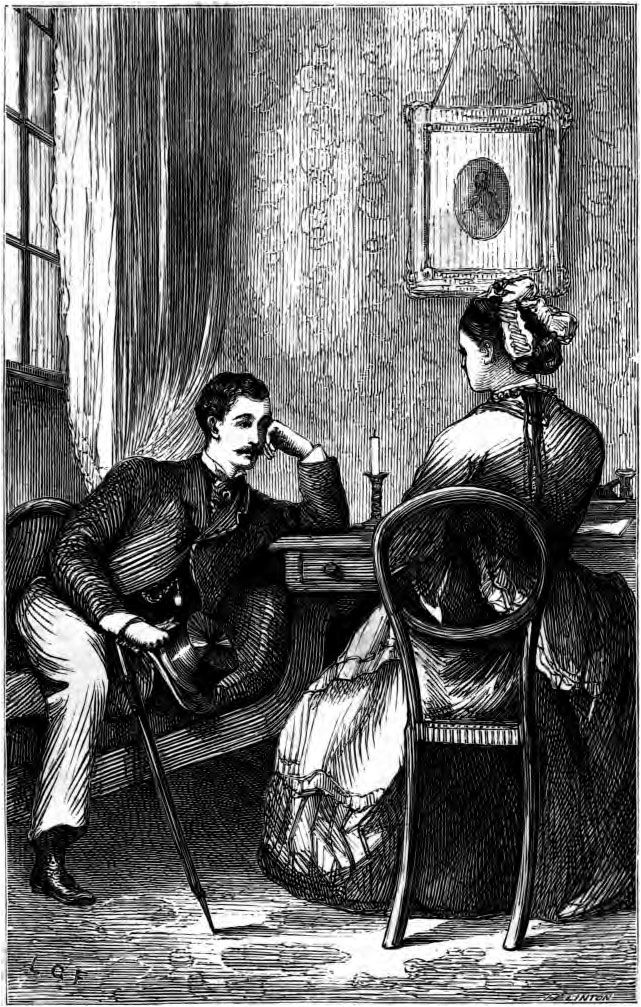
"What is it for, Felix?"
"Well;--to tell the truth, to carry on the game for the nonce till
something is settled. A fellow can't live without some money in his
pocket. I do with as little as most fellows. I pay for nothing that
I can help. I even get my hair cut on credit, and as long as it was
possible I had a brougham, to save cabs."
"What is to be the end of it, Felix?"
"I never could see the end of anything, mother. I never could nurse
a horse when the hounds were going well in order to be in at the
finish. I never could pass a dish that I liked in favour of those
that were to follow. What's the use?" The young man did not say
"carpe diem," but that was the philosophy which he intended to
preach.
"Have you been at the Melmottes' to-day?" It was now five o'clock
on a winter afternoon, the hour at which ladies are drinking tea, and
idle men playing whist at the clubs,--at which young idle men are
sometimes allowed to flirt, and at which, as Lady Carbury thought,
her son might have been paying his court to Marie Melmotte the great
heiress.
"I have just come away."
"And what do you think of her?"
"To tell the truth, mother, I have thought very little about her.
She is not pretty, she is not plain; she is not clever, she is not
stupid; she is neither saint nor sinner."
"The more likely to make a good wife."
"Perhaps so. I am at any rate quite willing to believe that as wife
she would be 'good enough for me.'"
"What does the mother say?"
"The mother is a caution. I cannot help speculating whether, if I
marry the daughter, I shall ever find out where the mother came from.
Dolly Longestaffe says that somebody says that she was a Bohemian
Jewess; but I think she's too fat for that."
"What does it matter, Felix?"
"Not in the least."
"Is she civil to you?"
"Yes, civil enough."
"And the father?"
"Well, he does not turn me out, or anything of that sort. Of course
there are half-a-dozen after her, and I think the old fellow is
bewildered among them all. He's thinking more of getting dukes to
dine with him than of his daughter's lovers. Any fellow might pick
her up who happened to hit her fancy."
"And why not you?"
"Why not, mother? I am doing my best, and it's no good flogging a
willing horse. Can you let me have the money?"
"Oh, Felix, I think you hardly know how poor we are. You have still
got your hunters down at the place!"
"I have got two horses, if you mean that; and I haven't paid a
shilling for their keep since the season began. Look here, mother;
this is a risky sort of game, I grant, but I am playing it by your
advice. If I can marry Miss Melmotte, I suppose all will be right.
But I don't think the way to get her would be to throw up everything
and let all the world know that I haven't got a copper. To do that
kind of thing a man must live a little up to the mark. I've brought
my hunting down to a minimum, but if I gave it up altogether there
would be lots of fellows to tell them in Grosvenor Square why I had
done so."
There was an apparent truth in this argument which the poor woman was
unable to answer. Before the interview was over the money demanded
was forthcoming, though at the time it could be but ill afforded, and
the youth went away apparently with a light heart, hardly listening
to his mother's entreaties that the affair with Marie Melmotte might,
if possible, be brought to a speedy conclusion.
Felix, when he left his mother, went down to the only club to which
he now belonged. Clubs are pleasant resorts in all respects but one.
They require ready money, or even worse than that in respect to
annual payments,--money in advance; and the young baronet had been
absolutely forced to restrict himself. He, as a matter of course, out
of those to which he had possessed the right of entrance, chose the
worst. It was called the Beargarden, and had been lately opened with
the express view of combining parsimony with profligacy. Clubs were
ruined, so said certain young parsimonious profligates, by providing
comforts for old fogies who paid little or nothing but their
subscriptions, and took out by their mere presence three times as
much as they gave. This club was not to be opened till three o'clock
in the afternoon, before which hour the promoters of the Beargarden
thought it improbable that they and their fellows would want a
club. There were to be no morning papers taken, no library, no
morning-room. Dining-rooms, billiard-rooms, and card-rooms would
suffice for the Beargarden. Everything was to be provided by a
purveyor, so that the club should be cheated only by one man.
Everything was to be luxurious, but the luxuries were to be achieved
at first cost. It had been a happy thought, and the club was said to
prosper. Herr Vossner, the purveyor, was a jewel, and so carried on
affairs that there was no trouble about anything. He would assist
even in smoothing little difficulties as to the settling of card ac-
counts, and had behaved with the greatest tenderness to the drawers
of cheques whose bankers had harshly declared them to have "no
effects." Herr Vossner was a jewel, and the Beargarden was a
success. Perhaps no young man about town enjoyed the Beargarden
more thoroughly than did Sir Felix Carbury. The club was in the close
vicinity of other clubs, in a small street turning out of St. James's
Street, and piqued itself on its outward quietness and sobriety. Why
pay for stone-work for other people to look at;--why lay out money
in marble pillars and cornices, seeing that you can neither eat such
things, nor drink them, nor gamble with them? But the Beargarden had
the best wines,--or thought that it had,--and the easiest chairs, and
two billiard-tables than which nothing more perfect had ever been
made to stand upon legs. Hither Sir Felix wended on that January
afternoon as soon as he had his mother's cheque for £20 in his
pocket.
He found his special friend, Dolly Longestaffe, standing on the steps
with a cigar in his mouth, and gazing vacantly at the dull brick
house opposite. "Going to dine here, Dolly?" said Sir Felix.
"I suppose I shall, because it's such a lot of trouble to go anywhere
else. I'm engaged somewhere, I know; but I'm not up to getting home
and dressing. By George! I don't know how fellows do that kind of
thing. I can't."
"Going to hunt to-morrow?"
"Well, yes; but I don't suppose I shall. I was going to hunt every
day last week, but my fellow never would get me up in time. I can't
tell why it is that things are done in such a beastly way. Why
shouldn't fellows begin to hunt at two or three, so that a fellow
needn't get up in the middle of the night?"
"Because one can't ride by moonlight, Dolly."
"It isn't moonlight at three. At any rate I can't get myself to
Euston Square by nine. I don't think that fellow of mine likes
getting up himself. He says he comes in and wakes me, but I never
remember it."
"How many horses have you got at Leighton, Dolly?"
"How many? There were five, but I think that fellow down there sold
one; but then I think he bought another. I know he did something."
"Who rides them?"
"He does, I suppose. That is, of course, I ride them myself, only I
so seldom get down. Somebody told me that Grasslough was riding two
of them last week. I don't think I ever told him he might. I think he
tipped that fellow of mine; and I call that a low kind of thing to
do. I'd ask him, only I know he'd say that I had lent them. Perhaps
I did when I was tight, you know."
"You and Grasslough were never pals."
"I don't like him a bit. He gives himself airs because he is a lord,
and is devilish ill-natured. I don't know why he should want to ride
my horses."
"To save his own."
"He isn't hard up. Why doesn't he have his own horses? I'll tell you
what, Carbury, I've made up my mind to one thing, and, by Jove, I'll
stick to it. I never will lend a horse again to anybody. If fellows
want horses let them buy them."
"But some fellows haven't got any money, Dolly."
"Then they ought to go tick. I don't think I've paid for any of mine
I've bought this season. There was somebody here yesterday--"
"What! here at the club?"
"Yes; followed me here to say he wanted to be paid for something! It
was horses, I think, because of the fellow's trousers."
"What did you say?"
"Me! Oh, I didn't say anything."
"And how did it end?"
"When he'd done talking I offered him a cigar, and while he was
biting off the end I went up-stairs. I suppose he went away when he
was tired of waiting."
"I'll tell you what, Dolly; I wish you'd let me ride two of yours
for a couple of days,--that is, of course, if you don't want them
yourself. You ain't tight now, at any rate."
"No; I ain't tight," said Dolly, with melancholy acquiescence.
"I mean that I wouldn't like to borrow your horses without your
remembering all about it. Nobody knows as well as you do how awfully
done up I am. I shall pull through at last, but it's an awful squeeze
in the meantime. There's nobody I'd ask such a favour of except you."
"Well, you may have them;--that is, for two days. I don't know
whether that fellow of mine will believe you. He wouldn't believe
Grasslough, and told him so. But Grasslough took them out of the
stables. That's what somebody told me."
"You could write a line to your groom."
"Oh, my dear fellow, that is such a bore; I don't think I could do
that. My fellow will believe you, because you and I have been pals.
I think I'll have a little drop of curaçoa before dinner. Come along
and try it. It'll give us an appetite."
It was then nearly seven o'clock. Nine hours afterwards the same
two men, with two others,--of whom young Lord Grasslough, Dolly
Longestaffe's peculiar aversion, was one,--were just rising from a
card-table in one of the up-stairs rooms of the club. For it was
understood that, though the Beargarden was not to be open before
three o'clock in the afternoon, the accommodation denied during
the day was to be given freely during the night. No man could get
a breakfast at the Beargarden, but suppers at three o'clock in
the morning were quite within the rule. Such a supper, or rather
succession of suppering, there had been to-night, various devils and
broils and hot toasts having been brought up from time to time first
for one and then for another. But there had been no cessation of
gambling since the cards had first been opened about ten o'clock. At
four in the morning Dolly Longestaffe was certainly in a condition
to lend his horses and to remember nothing about it. He was quite
affectionate with Lord Grasslough, as he was also with his other
companions,--affection being the normal state of his mind when
in that condition. He was by no means helplessly drunk, and was,
perhaps, hardly more silly than when he was sober; but he was willing
to play at any game whether he understood it or not, and for any
stakes. When Sir Felix got up and said he would play no more, Dolly
also got up, apparently quite contented. When Lord Grasslough, with
a dark scowl on his face, expressed his opinion that it was not
just the thing for men to break up like that when so much money had
been lost, Dolly as willingly sat down again. But Dolly's sitting
down was not sufficient. "I'm going to hunt to-morrow," said Sir
Felix,--meaning that day,--"and I shall play no more. A man must go
to bed at some time."
"I don't see it at all," said Lord Grasslough. "It's an understood
thing that when a man has won as much as you have he should stay."
"Stay how long?" said Sir Felix, with an angry look. "That's
non-
sense; there must be an end of everything, and there's an end of
this for me to-night."
"Oh, if you choose," said his lordship.
"I do choose. Good night, Dolly; we'll settle this next time we meet.
I've got it all entered."
The night had been one very serious in its results to Sir Felix. He
had sat down to the card-table with the proceeds of his mother's
cheque, a poor £20, and now he had,--he didn't at all know how much
in his pockets. He also had drunk, but not so as to obscure his mind.
He knew that Longestaffe owed him over £800, and he knew also that
he had received more than that in ready money and cheques from Lord
Grasslough and the other player. Dolly Longestaffe's money, too,
would certainly be paid, though Dolly did complain of the importunity
of his tradesmen. As he walked up St. James's Street, looking for a
cab, he presumed himself to be worth over £700. When begging for a
small sum from Lady Carbury, he had said that he could not carry
on the game without some ready money, and had considered himself
fortunate in fleecing his mother as he had done. Now he was in
the possession of wealth,--of wealth that might, at any rate, be
sufficient to aid him materially in the object he had in hand. He
never for a moment thought of paying his bills. Even the large sum of
which he had become so unexpectedly possessed would not have gone
far with him in such a quixotic object as that; but he could now look
bright, and buy presents, and be seen with money in his hands. It is
hard even to make love in these days without something in your purse.
He found no cab, but in his present frame of mind was indifferent to
the trouble of walking home. There was something so joyous in the
feeling of the possession of all this money that it made the night
air pleasant to him. Then, of a sudden, he remembered the low wail
with which his mother had spoken of her poverty when he demanded
assistance from her. Now he could give her back the £20. But it
occurred to him sharply, with an amount of carefulness quite new to
him, that it would be foolish to do so. How soon might he want it
again? And, moreover, he could not repay the money without explaining
to her how he had gotten it. It would be preferable to say nothing
about his money. As he let himself into the house and went up to his
room he resolved that he would not say anything about it.
On that morning he was at the station at nine, and hunted down in
Buckinghamshire, riding two of Dolly Longestaffe's horses,--for the
use of which he paid Dolly Longestaffe's "fellow" thirty shillings.
CHAPTER IV.
MADAME MELMOTTE'S BALL.
The next night but one after that of the gambling transaction at the
Beargarden, a great ball was given in Grosvenor Square. It was a
ball on a scale so magnificent that it had been talked about ever
since Parliament met, now about a fortnight since. Some people had
expressed an opinion that such a ball as this was intended to be
could not be given successfully in February. Others declared that the
money which was to be spent,--an amount which would make this affair
something quite new in the annals of ball-giving,--would give the
thing such a character that it would certainly be successful. And
much more than money had been expended. Almost incredible efforts
had been made to obtain the co-operation of great people, and these
efforts had at last been grandly successful. The Duchess of Stevenage
had come up from Castle Albury herself to be present at it and to
bring her daughters, though it has never been her Grace's wont to be
in London at this inclement season. No doubt the persuasion used with
the Duchess had been very strong. Her brother, Lord Alfred Grendall,
was known to be in great difficulties, which,--so people said,--had
been considerably modified by opportune pecuniary assistance. And
then it was certain that one of the young Grendalls, Lord Alfred's
second son, had been appointed to some mercantile position, for which
he received a salary which his most intimate friends thought that he
was hardly qualified to earn. It was certainly a fact that he went to
Abchurch Lane, in the City, four or five days a week, and that he did
not occupy his time in so unaccustomed a manner for nothing. Where
the Duchess of Stevenage went all the world would go. And it became
known at the last moment, that is to say only the day before the
party, that a prince of the blood royal was to be there. How this
had been achieved nobody quite understood; but there were rumours
that a certain lady's jewels had been rescued from the pawnbroker's.
Everything was done on the same scale. The Prime Minister had indeed
declined to allow his name to appear on the list; but one Cabinet
Minister and two or three under-secretaries had agreed to come
because it was felt that the giver of the ball might before long be
the master of considerable parliamentary interest. It was believed
that he had an eye to politics, and it is always wise to have great
wealth on one's own side. There had at one time been much solicitude
about the ball. Many anxious thoughts had been given. When great
attempts fail, the failure is disastrous, and may be ruinous. But
this ball had now been put beyond the chance of failure.
The giver of the ball was Augustus Melmotte, Esq., the father of the
girl whom Sir Felix Carbury desired to marry, and the husband of the
lady who was said to have been a Bohemian Jewess. It was thus that
the gentleman chose to have himself designated, though within the
last two years he had arrived in London from Paris, and had at first
been known as M. Melmotte. But he had declared of himself that he
had been born in England, and that he was an Englishman. He admitted
that his wife was a foreigner,--an admission that was necessary as
she spoke very little English. Melmotte himself spoke his "native"
language fluently, but with an accent which betrayed at least a long
expatriation. Miss Melmotte,--who a very short time since had been
known as Mademoiselle Marie,--spoke English well, but as a foreigner.
In regard to her it was acknowledged that she had been born out of
England,--some said in New York; but Madame Melmotte, who must have
known, had declared that the great event had taken place in Paris.
It was at any rate an established fact that Mr. Melmotte had made
his wealth in France. He no doubt had had enormous dealings in other
countries, as to which stories were told which must surely have been
exaggerated. It was said that he had made a railway across Russia,
that he provisioned the Southern army in the American civil war, that
he had supplied Austria with arms, and had at one time bought up all
the iron in England. He could make or mar any company by buying or
selling stock, and could make money dear or cheap as he pleased. All
this was said of him in his praise,--but it was also said that he
was regarded in Paris as the most gigantic swindler that had ever
lived; that he had made that City too hot to hold him; that he had
endeavoured to establish himself in Vienna, but had been warned away
by the police; and that he had at length found that British freedom
would alone allow him to enjoy, without persecution, the fruits of
his industry. He was now established privately in Grosvenor Square
and officially in Abchurch Lane; and it was known to all the world
that a Royal Prince, a Cabinet Minister, and the very cream of
duchesses were going to his wife's ball. All this had been done
within twelve months.
There was but one child in the family, one heiress for all this
wealth. Melmotte himself was a large man, with bushy whiskers and
rough thick hair, with heavy eyebrows, and a wonderful look of power
about his mouth and chin. This was so strong as to redeem his face
from vulgarity; but the countenance and appearance of the man were
on the whole unpleasant, and, I may say, untrustworthy. He looked as
though he were purse-proud and a bully. She was fat and fair,--unlike
in colour to our traditional Jewesses; but she had the Jewish nose
and the Jewish contraction of the eyes. There was certainly very
little in Madame Melmotte to recommend her, unless it was a readiness
to spend money on any object that might be suggested to her by her
new acquaintances. It sometimes seemed that she had a commission from
her husband to give away presents to any who would accept them. The
world had received the man as Augustus Melmotte, Esq. The world so
addressed him on the very numerous letters which reached him, and so
inscribed him among the directors of three dozen companies to which
he belonged. But his wife was still Madame Melmotte. The daughter had
been allowed to take her rank with an English title. She was now Miss
Melmotte on all occasions.
Marie Melmotte had been accurately described by Felix Carbury to his
mother. She was not beautiful, she was not clever, and she was not a
saint. But then neither was she plain, nor stupid, nor, especially, a
sinner. She was a little thing, hardly over twenty years of age, very
unlike her father or mother, having no trace of the Jewess in her
countenance, who seemed to be overwhelmed by the sense of her own
position. With such people as the Melmottes things go fast, and it
was very well known that Miss Melmotte had already had one lover
who had been nearly accepted. The affair, however, had gone off.
In this "going off" no one imputed to the young lady blame or even
misfortune. It was not supposed that she had either jilted or been
jilted. As in royal espousals interests of State regulate their
expedience with an acknowledged absence, with even a proclaimed
impossibility, of personal predilections, so in this case was money
allowed to have the same weight. Such a marriage would or would not
be sanctioned in accordance with great pecuniary arrangements. The
young Lord Nidderdale, the eldest son of the Marquis of Auld Reekie,
had offered to take the girl and make her Marchioness in the process
of time for half a million down. Melmotte had not objected to the
sum,--so it was said,--but had proposed to tie it up. Nidderdale had
desired to have it free in his own grasp, and would not move on any
other terms. Melmotte had been anxious to secure the Marquis,--very
anxious to secure the Marchioness; for at that time terms had not
been made with the Duchess; but at last he had lost his temper, and
had asked his lordship's lawyer whether it was likely that he would
entrust such a sum of money to such a man. "You are willing to trust
your only child to him," said the lawyer. Melmotte scowled at the man
for a few seconds from under his bushy eyebrows; then told him that
his answer had nothing in it, and marched out of the room. So that
affair was over. I doubt whether Lord Nidderdale had ever said a word
of love to Marie Melmotte,--or whether the poor girl had expected it.
Her destiny had no doubt been explained to her.
Others had tried and had broken down somewhat in the same fashion.
Each had treated the girl as an encumbrance he was to undertake,--at
a very great price. But as affairs prospered with the Melmottes, as
princes and duchesses were obtained by other means,--costly no doubt,
but not so ruinously costly,--the immediate disposition of Marie
became less necessary, and Melmotte reduced his offers. The girl
herself, too, began to have an opinion. It was said that she had
absolutely rejected Lord Grasslough, whose father indeed was in a
state of bankruptcy, who had no income of his own, who was ugly,
vicious, ill-tempered, and without any power of recommending himself
to a girl. She had had experience since Lord Nidderdale, with a half
laugh, had told her that he might just as well take her for his
wife, and was now tempted from time to time to contemplate her own
happiness and her own condition. People around were beginning to say
that if Sir Felix Carbury managed his affairs well he might be the
happy man.
There was considerable doubt whether Marie was the daughter of that
Jewish-looking woman. Enquiries had been made, but not successfully,
as to the date of the Melmotte marriage. There was an idea abroad
that Melmotte had got his first money with his wife, and had gotten
it not very long ago. Then other people said that Marie was not his
daughter at all. Altogether the mystery was rather pleasant as the
money was certain. Of the certainty of the money in daily use there
could be no doubt. There was the house. There was the furniture.
There were the carriages, the horses, the servants with the livery
coats and powdered heads, and the servants with the black coats and
unpowdered heads. There were the gems, and the presents, and all the
nice things that money can buy. There were two dinner parties every
day, one at two o'clock called lunch, and the other at eight. The
tradesmen had learned enough to be quite free of doubt, and in the
City Mr. Melmotte's name was worth any money,--though his character
was perhaps worth but little.
The large house on the south side of Grosvenor Square was all
ablaze by ten o'clock. The broad verandah had been turned into a
conservatory, had been covered in with boards contrived to look like
trellis-work, was heated with hot air and filled with exotics at some
fabulous price. A covered way had been made from the door, down
across the pathway, to the road, and the police had, I fear, been
bribed to frighten foot passengers into a belief that they were bound
to go round. The house had been so arranged that it was impossible to
know where you were, when once in it. The hall was a paradise. The
staircase was fairyland. The lobbies were grottoes rich with ferns.
Walls had been knocked away and arches had been constructed. The
leads behind had been supported and walled in, and covered and
carpeted. The ball had possession of the ground floor and first
floor, and the house seemed to be endless. "It's to cost sixty
thousand pounds," said the Marchioness of Auld Reekie to her old
friend the Countess of Mid-Lothian. The Marchioness had come in spite
of her son's misfortune when she heard that the Duchess of Stevenage
was to be there. "And worse spent money never was wasted," said
the Countess. "By all accounts it was as badly come by," said the
Marchioness. Then the two old noblewomen, one after the other, made
graciously flattering speeches to the much-worn Bohemian Jewess, who
was standing in fairyland to receive her guests, almost fainting
under the greatness of the occasion.
The three saloons on the first or drawing-room floor had been
prepared for dancing, and here Marie was stationed. The Duchess
had however undertaken to see that somebody should set the dancing
going, and she had commissioned her nephew Miles Grendall, the young
gentleman who now frequented the City, to give directions to the band
and to make himself generally useful. Indeed there had sprung up a
considerable intimacy between the Grendall family,--that is Lord
Alfred's branch of the Grendalls,--and the Melmottes; which was as
it should be, as each could give much and each receive much. It was
known that Lord Alfred had not a shilling; but his brother was a duke
and his sister was a duchess, and for the last thirty years there
had been one continual anxiety for poor dear Alfred, who had tumbled
into an unfortunate marriage without a shilling, had spent his own
moderate patrimony, had three sons and three daughters, and had lived
now for a very long time entirely on the unwilling contributions
of his noble relatives. Melmotte could support the whole family in
affluence without feeling the burden;--and why should he not? There
had once been an idea that Miles should attempt to win the heiress,
but it had soon been found expedient to abandon it. Miles had no
title, no position of his own, and was hardly big enough for the
place. It was in all respects better that the waters of the fountain
should be allowed to irrigate mildly the whole Grendall family;--and
so Miles went into the city.
The ball was opened by a quadrille in which Lord Buntingford, the
eldest son of the Duchess, stood up with Marie. Various arrangements
had been made, and this among them. We may say that it had been part
of a bargain. Lord Buntingford had objected mildly, being a young man
devoted to business, fond of his own order, rather shy, and not given
to dancing. But he had allowed his mother to prevail. "Of course they
are vulgar," the Duchess had said,--"so much so as to be no longer
distasteful because of the absurdity of the thing. I dare say he
hasn't been very honest. When men make so much money, I don't know
how they can have been honest. Of course it's done for a purpose.
It's all very well saying that it isn't right, but what are we to do
about Alfred's children? Miles is to have £500 a-year. And then he is
always about the house. And between you and me they have got up
those bills of Alfred's, and have said they can lie in their safe till
it
suits your uncle to pay them."
"They will lie there a long time," said Lord Buntingford.
"Of course they expect something in return; do dance with the girl
once." Lord Buntingford disapproved--mildly, and did as his mother
asked him.
The affair went off very well. There were three or four card-tables
in one of the lower rooms, and at one of them sat Lord Alfred
Grendall and Mr. Melmotte, with two or three other players, cutting
in and out at the end of each rubber. Playing whist was Lord Alfred's
only accomplishment, and almost the only occupation of his life. He
began it daily at his club at three o'clock, and continued playing
till two in the morning with an interval of a couple of hours for his
dinner. This he did during ten months of the year, and during the
other two he frequented some watering-place at which whist prevailed.
He did not gamble, never playing for more than the club stakes and
bets. He gave to the matter his whole mind, and must have excelled
those who were generally opposed to him. But so obdurate was fortune
to Lord Alfred that he could not make money even of whist. Melmotte
was very anxious to get into Lord Alfred's club,--The Peripatetics.
It was pleasant to see the grace with which he lost his money, and
the sweet intimacy with which he called his lordship Alfred. Lord
Alfred had a remnant of feeling left, and would have liked to kick
him. Though Melmotte was by far the bigger man, and was also the
younger, Lord Alfred would not have lacked the pluck to kick him.
Lord Alfred, in spite of his habitual idleness and vapid uselessness,
had still left about him a dash of vigour, and sometimes thought that
he would kick Melmotte and have done with it. But there were his poor
boys, and those bills in Melmotte's safe. And then Melmotte lost
his points so regularly, and paid his bets with such absolute good
humour! "Come and have a glass of champagne, Alfred," Melmotte
said, as the two cut out together. Lord Alfred liked champagne, and
followed his host; but as he went he almost made up his mind that on
some future day he would kick the man.
Late in the evening Marie Melmotte was waltzing with Felix Carbury,
and Henrietta Carbury was then standing by talking to one Mr. Paul
Montague. Lady Carbury was also there. She was not well inclined
either to balls or to such people as the Melmottes; nor was
Henrietta. But Felix had suggested that, bearing in mind his
prospects as to the heiress, they had better accept the invitation
which he would cause to have sent to them. They did so; and then
Paul Montague also got a card, not altogether to Lady Carbury's
satisfaction. Lady Carbury was very gracious to Madame Melmotte for
two minutes, and then slid into a chair expecting nothing but misery
for the evening. She, however, was a woman who could do her duty and
endure without complaint.
"It is the first great ball I ever was at in London," said Hetta
Carbury to Paul Montague.
"And how do you like it?"
"Not at all. How should I like it? I know nobody here. I don't
understand how it is that at these parties people do know each other,
or whether they all go dancing about without knowing."
"Just that; I suppose when they are used to it they get introduced
backwards and forwards, and then they can know each other as fast as
they like. If you would wish to dance why won't you dance with me?"
"I have danced with you,--twice already."
"Is there any law against dancing three times?"
"But I don't especially want to dance," said Henrietta. "I think
I'll go and console poor mamma, who has got nobody to speak to her."
Just at this moment, however, Lady Carbury was not in that wretched
condition, as an unexpected friend had come to her relief.
Sir Felix and Marie Melmotte had been spinning round and round
throughout a long waltz, thoroughly enjoying the excitement of the
music and the movement. To give Felix Carbury what little praise
might be his due, it is necessary to say that he did not lack
physical activity. He would dance, and ride, and shoot eagerly, with
an animation that made him happy for the moment. It was an affair not
of thought or calculation, but of physical organisation. And Marie
Melmotte had been thoroughly happy. She loved dancing with all her
heart if she could only dance in a manner pleasant to herself. She
had been warned especially as to some men,--that she should not dance
with them. She had been almost thrown into Lord Nidderdale's arms,
and had been prepared to take him at her father's bidding. But she
had never had the slightest pleasure in his society, and had only not
been wretched because she had not as yet recognised that she had an
identity of her own in the disposition of which she herself should
have a voice. She certainly had never cared to dance with Lord
Nidderdale. Lord Grasslough she had absolutely hated, though at first
she had hardly dared to say so. One or two others had been obnoxious
to her in different ways, but they had passed on, or were passing on,
out of her way. There was no one at the present moment whom she had
been commanded by her father to accept should an offer be made. But
she did like dancing with Sir Felix Carbury.
It was not only that the man was handsome but that he had a power of
changing the expression of his countenance, a play of face, which
belied altogether his real disposition. He could seem to be hearty
and true till the moment came in which he had really to expose his
heart,--or to try to expose it. Then he failed, knowing nothing
about it. But in the approaches to intimacy with a girl he could
be very successful. He had already nearly got beyond this with
Marie Melmotte; but Marie was by no means quick in discovering his
deficiencies. To her he had seemed like a god. If she might be
allowed to be wooed by Sir Felix Carbury, and to give herself to him,
she thought that she would be contented.
"How well you dance," said Sir Felix, as soon as he had breath for
speaking.
"Do I?" She spoke with a slightly foreign accent, which gave a little
prettiness to her speech. "I was never told so. But nobody ever told
me anything about myself."
"I should like to tell you everything about yourself, from the
beginning to the end."
"Ah,--but you don't know."
"I would find out. I think I could make some good guesses. I'll tell
you what you would like best in all the world."
"What is that?"
"Somebody that liked you best in all the world."
"Ah,--yes; if one knew who?"
"How can you know, Miss Melmotte, but by believing?"
"That is not the way to know. If a girl told me that she liked me
better than any other girl, I should not know it, just because she
said so. I should have to find it out."
"And if a gentleman told you so?"
"I shouldn't believe him a bit, and I should not care to find out.
But I should like to have some girl for a friend whom I could love,
oh, ten times better than myself."
"So should I."
"Have you no particular friend?"
"I mean a girl whom I could love,--oh, ten times better than myself."
"Now you are laughing at me, Sir Felix," said Miss Melmotte.
"I wonder whether that will come to anything?" said Paul Montague to
Miss Carbury. They had come back into the drawing-room, and had been
watching the approaches to love-making which the baronet was opening.
"You mean Felix and Miss Melmotte. I hate to think of such things,
Mr. Montague."
"It would be a magnificent chance for him."
"To marry a girl, the daughter of vulgar people, just because
she will have a great deal of money? He can't care for her
really,--because she is rich."
"But he wants money so dreadfully! It seems to me that there is no
other condition of things under which Felix can face the world, but
by being the husband of an heiress."
"What a dreadful thing to say!"
"But isn't it true? He has beggared himself."
"Oh, Mr. Montague."
"And he will beggar you and your mother."
"I don't care about myself."
"Others do though." As he said this he did not look at her, but spoke
through his teeth, as if he were angry both with himself and her.
"I did not think you would have spoken so harshly of Felix."
"I don't speak harshly of him, Miss Carbury. I haven't said that it
was his own fault. He seems to be one of those who have been born
to spend money; and as this girl will have plenty of money to spend, I
think it would be a good thing if he were to marry her. If Felix had
£20,000 a year, everybody would think him the finest fellow in the
world." In saying this, however, Mr. Paul Montague showed himself
unfit to gauge the opinion of the world. Whether Sir Felix be rich or
poor, the world, evil-hearted as it is, will never think him a fine
fellow.
Lady Carbury had been seated for nearly half an hour in uncomplaining
solitude under a bust, when she was delighted by the appearance of
Mr. Ferdinand Alf. "You here?" she said.
"Why not? Melmotte and I are brother adventurers."
"I should have thought you would find so little here to amuse you."
"I have found you; and, in addition to that, duchesses and their
daughters without number. They expect Prince George!"
"Do they?"
"And Legge Wilson from the India Office is here already. I spoke to
him in some jewelled bower as I made my way here, not five minutes
since. It's quite a success. Don't you think it very nice, Lady
Carbury?"
"I don't know whether you are joking or in earnest."
"I never joke. I say it is very nice. These people are spending
thousands upon thousands to gratify you and me and others, and all
they want in return is a little countenance."
"Do you mean to give it then?"
"I am giving it them."
"Ah;--but the countenance of the 'Evening Pulpit.' Do you mean to
give them that?"
"Well; it is not in our line exactly to give a catalogue of names
and to record ladies' dresses. Perhaps it may be better for our host
himself that he should be kept out of the newspapers."
"Are you going to be very severe upon poor me, Mr. Alf?" said the
lady after a pause.
"We are never severe upon anybody, Lady Carbury. Here's the Prince.
What will they do with him now they've caught him! Oh, they're going
to make him dance with the heiress. Poor heiress!"
"Poor Prince!" said Lady Carbury.
"Not at all. She's a nice little girl enough, and he'll have nothing
to trouble him. But how is she, poor thing, to talk to royal blood?"
Poor thing indeed! The Prince was brought into the big room where
Marie was still being talked to by Felix Carbury, and was at once
made to understand that she was to stand up and dance with royalty.
The introduction was managed in a very business-like manner. Miles
Grendall first came in and found the female victim; the Duchess
followed with the male victim. Madame Melmotte, who had been on her
legs till she was ready to sink, waddled behind, but was not allowed
to take any part in the affair. The band were playing a galop, but
that was stopped at once, to the great confusion of the dancers. In
two minutes Miles Grendall had made up a set. He stood up with his
aunt, the Duchess, as vis-a-vis to Marie and the Prince, till, about
the middle of the quadrille, Legge Wilson was found and made to take
his place. Lord Buntingford had gone away; but then there were still
present two daughters of the Duchess who were rapidly caught. Sir
Felix Carbury, being good-looking and having a name, was made to
dance with one of them, and Lord Grasslough with the other. There
were four other couples, all made up of titled people, as it was
intended that this special dance should be chronicled, if not in the
"Evening Pulpit," in some less serious daily journal. A paid reporter
was present in the house ready to rush off with the list as soon as
the dance should be a realized fact. The Prince himself did not quite
understand why he was there, but they who marshalled his life for
him had so marshalled it for the present moment. He himself probably
knew nothing about the lady's diamonds which had been rescued, or
the considerable subscription to St. George's Hospital which had been
extracted from Mr. Melmotte as a make-weight. Poor Marie felt as
though the burden of the hour would be greater than she could bear,
and looked as though she would have fled had flight been possible.
But the trouble passed quickly, and was not really severe. The Prince
said a word or two between each figure, and did not seem to expect a
reply. He made a few words go a long way, and was well trained in the
work of easing the burden of his own greatness for those who were for
the moment inflicted with it. When the dance was over he was allowed
to escape after the ceremony of a single glass of champagne drank in
the presence of the hostess. Considerable skill was shown in keeping
the presence of his royal guest a secret from the host himself
till the Prince was gone. Melmotte would have desired to pour out
that glass of wine with his own hands, to solace his tongue by
Royal Highnesses, and would probably have been troublesome and
disagreeable. Miles Grendall had understood all this and had managed
the affair very well. "Bless my soul;--his Royal Highness come and
gone!" exclaimed Melmotte. "You and my father were so fast at your
whist that it was impossible to get you away," said Miles. Melmotte
was not a fool, and understood it all;--understood not only that it
had been thought better that he should not speak to the Prince, but
also that it might be better that it should be so. He could not have
everything at once. Miles Grendall was very useful to him, and he
would not quarrel with Miles, at any rate as yet.
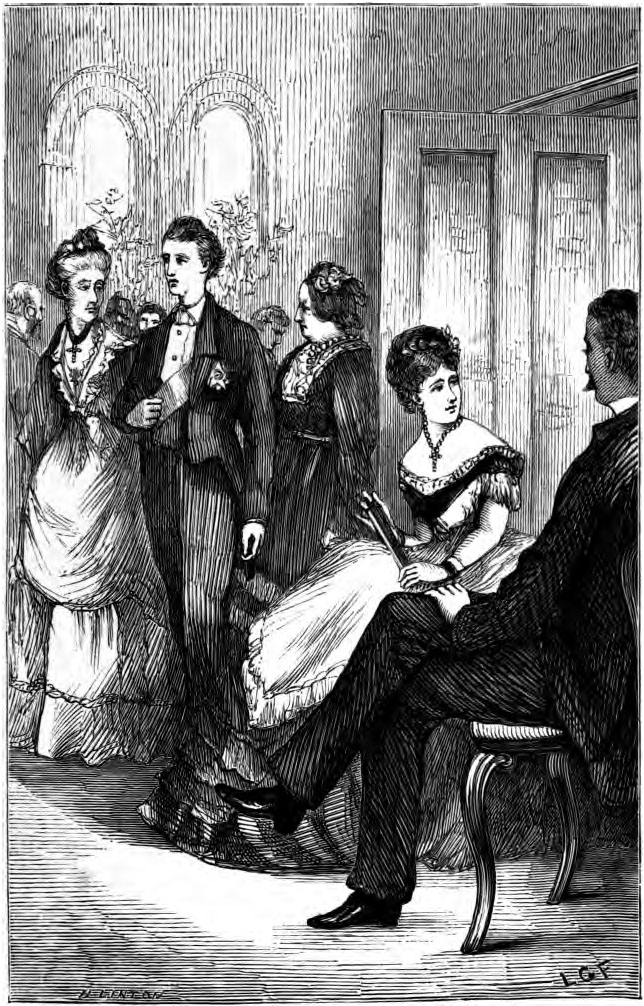
"Have another rubber, Alfred?" he said to Miles's father as the
carriages were taking away the guests.
Lord Alfred had taken sundry glasses of champagne, and for a moment
forgot the bills in the safe, and the good things which his boys were
receiving. "Damn that kind of nonsense," he said. "Call people by
their proper names." Then he left the house without a further word
to the master of it. That night before they went to sleep Melmotte
required from his weary wife an account of the ball, and especially
of Marie's conduct. "Marie," Madame Melmotte said, "had behaved well,
but had certainly preferred 'Sir Carbury' to any other of the young
men." Hitherto Mr. Melmotte had heard very little of "Sir Carbury,"
except that he was a baronet. Though his eyes and ears were always
open, though he attended to everything, and was a man of sharp
intelligence, he did not yet quite understand the bearing and
sequence of English titles. He knew that he must get for his daughter
either an eldest son, or one absolutely in possession himself.
Sir Felix, he had learned, was only a baronet; but then he was
in possession. He had discovered also that Sir Felix's son would
in course of time also become Sir Felix. He was not therefore at
the present moment disposed to give any positive orders as to
his daughter's conduct to the young baronet. He did not, however,
conceive that the young baronet had as yet addressed his girl in such
words as Felix had in truth used when they parted. "You know who it
is," he whispered, "likes you better than any one else in the world."
"Nobody does;--don't, Sir Felix."
"I do," he said as he held her hand for a minute. He looked into her
face and she thought it very sweet. He had studied the words as a
lesson, and, repeating them as a lesson, he did it fairly well. He
did it well enough at any rate to send the poor girl to bed with a
sweet conviction that at last a man had spoken to her whom she could
love.
CHAPTER V.
AFTER THE BALL.
"It's weary work," said Sir Felix as he got into the brougham with
his mother and sister.
"What must it have been to me then, who had nothing to do?" said his
mother.
"It's the having something to do that makes me call it weary work.
By-the-bye, now I think of it, I'll run down to the club before I go
home." So saying he put his head out of the brougham, and stopped the
driver.
"It is two o'clock, Felix," said his mother.
"I'm afraid it is, but you see I'm hungry. You had supper, perhaps;
I had none."
"Are you going down to the club for supper at this time in the
morning?"
"I must go to bed hungry if I don't. Good night." Then he jumped
out of the brougham, called a cab, and had himself driven to the
Beargarden. He declared to himself that the men there would think it
mean of him if he did not give them their revenge. He had renewed his
play on the preceding night, and had again won. Dolly Longestaffe
owed him now a considerable sum of money, and Lord Grasslough was
also in his debt. He was sure that Grasslough would go to the club
after the ball, and he was determined that they should not think that
he had submitted to be carried home by his mother and sister. So
he argued with himself; but in truth the devil of gambling was hot
within his bosom; and though he feared that in losing he might lose
real money, and that if he won it would be long before he was paid,
yet he could not keep himself from the card-table.
Neither mother or daughter said a word till they reached home and had
got up-stairs. Then the elder spoke of the trouble that was nearest
to her heart at the moment. "Do you think he gambles?"
"He has got no money, mamma."
"I fear that might not hinder him. And he has money with him, though,
for him and such friends as he has, it is not much. If he gambles
everything is lost."
"I suppose they all do play,--more or less."
"I have not known that he played. I am wearied too, out of all heart,
by his want of consideration to me. It is not that he will not obey
me. A mother perhaps should not expect obedience from a grown-up son.
But my word is nothing to him. He has no respect for me. He would as
soon do what is wrong before me as before the merest stranger."
"He has been so long his own master, mamma."
"Yes,--his own master! And yet I must provide for him as though he
were but a child. Hetta, you spent the whole evening talking to Paul
Montague."
"No, mamma;--that is unjust."
"He was always with you."
"I knew nobody else. I could not tell him not to speak to me. I
danced with him twice." Her mother was seated, with both her hands up
to her forehead, and shook her head. "If you did not want me to speak
to Paul you should not have taken me there."
"I don't wish to prevent your speaking to him. You know what I
want." Henrietta came up and kissed her, and bade her good night.
"I think I am the unhappiest woman in all London," she said, sobbing
hysterically.
"Is it my fault, mamma?"
"You could save me from much if you would. I work like a horse,
and I never spend a shilling that I can help. I want nothing for
myself,--nothing for myself. Nobody has suffered as I have. But Felix
never thinks of me for a moment."
"I think of you, mamma."
"If you did you would accept your cousin's offer. What right have you
to refuse him? I believe it is all because of that young man."
"No, mamma; it is not because of that young man. I like my cousin
very much;--but that is all. Good night, mamma." Lady Carbury just
allowed herself to be kissed, and then was left alone.
At eight o'clock the next morning daybreak found four young men who
had just risen from a card-table at the Beargarden. The Beargarden
was so pleasant a club that there was no rule whatsoever as to its
being closed,--the only law being that it should not be opened before
three in the afternoon. A sort of sanction had, however, been given
to the servants to demur to producing supper or drinks after six in
the morning, so that, about eight, unrelieved tobacco began to be too
heavy even for juvenile constitutions. The party consisted of Dolly
Longestaffe, Lord Grasslough, Miles Grendall, and Felix Carbury, and
the four had amused themselves during the last six hours with various
innocent games. They had commenced with whist, and had culminated
during the last half-hour with blind hookey. But during the whole
night Felix had won. Miles Grendall hated him, and there had been an
expressed opinion between Miles and the young lord that it would be
both profitable and proper to relieve Sir Felix of the winnings of
the last two nights. The two men had played with the same object, and
being young had shown their intention,--so that a certain feeling of
hostility had been engendered. The reader is not to understand that
either of them had cheated, or that the baronet had entertained
any suspicion of foul play. But Felix had felt that Grendall and
Grasslough were his enemies, and had thrown himself on Dolly for
sympathy and friendship. Dolly, however, was very tipsy.
At eight o'clock in the morning there came a sort of settling, though
no money then passed. The ready-money transactions had not lasted
long through the night. Grasslough was the chief loser, and the
figures and scraps of paper which had been passed over to Carbury,
when counted up, amounted to nearly £2,000. His lordship contested
the fact bitterly, but contested it in vain. There were his own
initials and his own figures, and even Miles Grendall, who was
supposed to be quite wide awake, could not reduce the amount. Then
Grendall had lost over £400 to Carbury,--an amount, indeed, that
mattered little, as Miles could, at present, as easily have raised
£40,000. However, he gave his I.O.U. to his opponent with an easy
air. Grasslough, also, was impecunious; but he had a father,--also
impecunious, indeed; but with them the matter would not be hopeless.
Dolly Longestaffe was so tipsy that he could not even assist in
making up his own account. That was to be left between him and
Carbury for some future occasion.
"I suppose you'll be here to-morrow,--that is to-night," said Miles.
"Certainly,--only one thing," answered Felix.
"What one thing?"
"I think these things should be squared before we play any more!"
"What do you mean by that?" said Grasslough angrily. "Do you mean to
hint anything?"
"I never hint anything, my Grassy," said Felix. "I believe when
people play cards, it's intended to be ready-money, that's all. But
I'm not going to stand on P's and Q's with you. I'll give you your
revenge to-night."
"That's all right," said Miles.
"I was speaking to Lord Grasslough," said Felix. "He is an old
friend, and we know each other. You have been rather rough to-night,
Mr. Grendall."
"Rough;--what the devil do you mean by that?"
"And I think it will be as well that our account should be settled
before we begin again."
"A settlement once a week is the kind of thing I'm used to," said
Grendall.
There was nothing more said; but the young men did not part on good
terms. Felix, as he got himself taken home, calculated that if he
could realize his spoil, he might begin the campaign again with
horses, servants, and all luxuries as before. If all were paid, he
would have over £3,000!
CHAPTER VI.
ROGER CARBURY AND PAUL MONTAGUE.
Roger Carbury, of Carbury Hall, the owner of a small property in
Suffolk, was the head of the Carbury family. The Carburys had been in
Suffolk a great many years,--certainly from the time of the War of
the Roses,--and had always held up their heads. But they had never
held them very high. It was not known that any had risen ever to
the honour of knighthood before Sir Patrick, going higher than that,
had been made a baronet. They had, however, been true to their
acres and their acres true to them through the perils of civil wars,
Reformation, Commonwealth, and Revolution, and the head Carbury of
the day had always owned, and had always lived at, Carbury Hall. At
the beginning of the present century the squire of Carbury had been
a considerable man, if not in his county, at any rate in his part of
the county. The income of the estate had sufficed to enable him to
live plenteously and hospitably, to drink port wine, to ride a stout
hunter, and to keep an old lumbering coach for his wife's use when
she went avisiting. He had an old butler who had never lived anywhere
else, and a boy from the village who was in a way apprenticed to the
butler. There was a cook, not too proud to wash up her own dishes,
and a couple of young women;--while the house was kept by Mrs.
Carbury herself, who marked and gave out her own linen, made her own
preserves, and looked to the curing of her own hams. In the year 1800
the Carbury property was sufficient for the Carbury house. Since that
time the Carbury property has considerably increased in value, and
the rents have been raised. Even the acreage has been extended by
the enclosure of commons. But the income is no longer comfortably
adequate to the wants of an English gentleman's household. If a
moderate estate in land be left to a man now, there arises the
question whether he is not damaged unless an income also be left to
him wherewith to keep up the estate. Land is a luxury, and of all
luxuries is the most costly. Now the Carburys never had anything but
land. Suffolk has not been made rich and great either by coal or
iron. No great town had sprung up on the confines of the Carbury
property. No eldest son had gone into trade or risen high in a
profession so as to add to the Carbury wealth. No great heiress had
been married. There had been no ruin,--no misfortune. But in the days
of which we write the Squire of Carbury Hall had become a poor man
simply through the wealth of others. His estate was supposed to bring
him in £2,000 a year. Had he been content to let the Manor House, to
live abroad, and to have an agent at home to deal with the tenants,
he would undoubtedly have had enough to live luxuriously. But he
lived on his own land among his own people, as all the Carburys
before him had done, and was poor because he was surrounded by rich
neighbours. The Longestaffes of Caversham,--of which family Dolly
Longestaffe was the eldest son and hope,--had the name of great
wealth, but the founder of the family had been a Lord Mayor of
London and a chandler as lately as in the reign of Queen Anne. The
Hepworths, who could boast good blood enough on their own side, had
married into new money. The Primeros,--though the good nature of the
country folk had accorded to the head of them the title of Squire
Primero,--had been trading Spaniards fifty years ago, and had bought
the Bundlesham property from a great duke. The estates of those three
gentlemen, with the domain of the Bishop of Elmham, lay all around
the Carbury property, and in regard to wealth enabled their owners
altogether to overshadow our squire. The superior wealth of a bishop
was nothing to him. He desired that bishops should be rich, and was
among those who thought that the country had been injured when the
territorial possessions of our prelates had been converted into
stipends by Act of Parliament. But the grandeur of the Longestaffes
and the too apparent wealth of the Primeros did oppress him, though
he was a man who would never breathe a word of such oppression into
the ear even of his dearest friend. It was his opinion,--which he
did not care to declare loudly, but which was fully understood to be
his opinion by those with whom he lived intimately,--that a man's
standing in the world should not depend at all upon his wealth. The
Primeros were undoubtedly beneath him in the social scale, although
the young Primeros had three horses apiece, and killed legions of
pheasants annually at about 10_s_. a head. Hepworth of Eardly was a
very good fellow, who gave himself no airs and understood his duties
as a country gentleman; but he could not be more than on a par with
Carbury of Carbury, though he was supposed to enjoy £7,000 a year.
The Longestaffes were altogether oppressive. Their footmen, even in
the country, had powdered hair. They had a house in town,--a house
of their own,--and lived altogether as magnates. The lady was Lady
Pomona Longestaffe. The daughters, who certainly were handsome, had
been destined to marry peers. The only son, Dolly, had, or had had,
a fortune of his own. They were an oppressive people in a country
neighbourhood. And to make the matter worse, rich as they were,
they never were able to pay anybody anything that they owed. They
continued to live with all the appurtenances of wealth. The girls
always had horses to ride, both in town and country. The acquaintance
of Dolly the reader has already made. Dolly, who certainly was a poor
creature though good natured, had energy in one direction. He would
quarrel perseveringly with his father, who only had a life interest
in the estate. The house at Caversham Park was during six or seven
months, of the year full of servants, if not of guests, and all
the tradesmen in the little towns around, Bungay, Beccles, and
Harlestone, were aware that the Longestaffes were the great people
of that country. Though occasionally much distressed for money,
they would always execute the Longestaffe orders with submissive
punctuality, because there was an idea that the Longestaffe property
was sound at the bottom. And, then, the owner of a property so
managed cannot scrutinise bills very closely.
Carbury of Carbury had never owed a shilling that he could not pay,
or his father before him. His orders to the tradesmen at Beccles were
not extensive, and care was used to see that the goods supplied were
neither overcharged nor unnecessary. The tradesmen, consequently, of
Beccles did not care much for Carbury of Carbury;--though perhaps one
or two of the elders among them entertained some ancient reverence
for the family. Roger Carbury, Esq., was Carbury of Carbury,--a
distinction of itself, which, from its nature, could not belong to
the Longestaffes and Primeros, which did not even belong to the
Hepworths of Eardly. The very parish in which Carbury Hall stood,--or
Carbury Manor House, as it was more properly called,--was Carbury
parish. And there was Carbury Chase, partly in Carbury parish and
partly in Bundlesham,--but belonging, unfortunately, in its entirety
to the Bundlesham estate.
Roger Carbury himself was all alone in the world. His nearest
relatives of the name were Sir Felix and Henrietta, but they were no
more than second cousins. He had sisters, but they had long since
been married and had gone away into the world with their husbands,
one to India, and another to the far west of the United States. At
present he was not much short of forty years of age, and was still
unmarried. He was a stout, good-looking man, with a firmly set square
face, with features finely cut, a small mouth, good teeth, and
well-formed chin. His hair was red, curling round his head, which
was now partly bald at the top. He wore no other beard than small,
almost unnoticeable whiskers. His eyes were small, but bright, and
very cheery when his humour was good. He was about five feet nine in
height, having the appearance of great strength and perfect health.
A more manly man to the eye was never seen. And he was one with
whom you would instinctively wish at first sight to be on good
terms,--partly because in looking at him there would come on you an
unconscious conviction that he would be very stout in holding his own
against his opponents; partly also from a conviction equally strong,
that he would be very pleasant to his friends.
When Sir Patrick had come home from India as an invalid, Roger
Carbury had hurried up to see him in London, and had proffered him
all kindness. Would Sir Patrick and his wife and children like to
go down to the old place in the country? Sir Patrick did not care
a straw for the old place in the country, and so told his cousin
in almost those very words. There had not, therefore, been much
friendship during Sir Patrick's life. But when the violent
ill-conditioned old man was dead, Roger paid a second visit, and
again offered hospitality to the widow and her daughter,--and to the
young baronet. The young baronet had just joined his regiment and
did not care to visit his cousin in Suffolk; but Lady Carbury and
Henrietta had spent a month there, and everything had been done to
make them happy. The effort as regarded Henrietta had been altogether
successful. As regarded the widow, it must be acknowledged that
Carbury Hall had not quite suited her tastes. She had already begun
to sigh for the glories of a literary career. A career of some
kind,--sufficient to repay her for the sufferings of her early
life,--she certainly desired. "Dear cousin Roger," as she called him,
had not seemed to her to have much power of assisting her in these
views. She was a woman who did not care much for country charms.
She had endeavoured to get up some mild excitement with the
bishop, but the bishop had been too plain spoken and sincere for
her. The Primeros had been odious; the Hepworths stupid; the
Longestaffes,--she had endeavoured to make up a little friendship
with Lady Pomona,--insufferably supercilious. She had declared to
Henrietta "that Carbury Hall was very dull."
But then there had come a circumstance which altogether changed
her opinions as to Carbury Hall, and its proprietor. The proprietor
after a few weeks followed them up to London, and made a most
matter-of-fact offer to the mother for the daughter's hand. He was at
that time thirty-six, and Henrietta was not yet twenty. He was very
cool;--some might have thought him phlegmatic in his love-making.
Henrietta declared to her mother that she had not in the least
expected it. But he was very urgent, and very persistent. Lady
Carbury was eager on his side. Though the Carbury Manor House did
not exactly suit her, it would do admirably for Henrietta. And as for
age, to her thinking, she being then over forty, a man of thirty-six
was young enough for any girl. But Henrietta had an opinion of her
own. She liked her cousin, but did not love him. She was amazed, and
even annoyed by the offer. She had praised him and praised the house
so loudly to her mother,--having in her innocence never dreamed of
such a proposition as this,--so that now she found it difficult to
give an adequate reason for her refusal. Yes;--she had undoubtedly
said that her cousin was charming, but she had not meant charming in
that way. She did refuse the offer very plainly, but still with some
apparent lack of persistency. When Roger suggested that she should
take a few months to think of it, and her mother supported Roger's
suggestion, she could say nothing stronger than that she was afraid
that thinking about it would not do any good. Their first visit to
Carbury had been made in September. In the following February she
went there again,--much against the grain as far as her own wishes
were concerned; and when there had been cold, constrained, almost
dumb in the presence of her cousin. Before they left the offer was
renewed, but Henrietta declared that she could not do as they would
have her. She could give no reason, only she did not love her cousin
in that way. But Roger declared that he by no means intended to
abandon his suit. In truth he verily loved the girl, and love with
him was a serious thing. All this happened a full year before the
beginning of our present story.
But something else happened also. While that second visit was being
made at Carbury there came to the hall a young man of whom Roger
Carbury had said much to his cousins,--one Paul Montague, of whom
some short account shall be given in this chapter. The squire,--Roger
Carbury was always called the squire about his own place,--had
anticipated no evil when he so timed this second visit of his cousins
to his house that they must of necessity meet Paul Montague there.
But great harm had come of it. Paul Montague had fallen into love
with his cousin's guest, and there had sprung up much unhappiness.
Lady Carbury and Henrietta had been nearly a month at Carbury, and
Paul Montague had been there barely a week, when Roger Carbury
thus spoke to the guest who had last arrived. "I've got to tell you
something, Paul."
"Anything serious?"
"Very serious to me. I may say so serious that nothing in my own
life can approach it in importance." He had unconsciously assumed
that look, which his friend so thoroughly understood, indicating his
resolve to hold to what he believed to be his own, and to fight if
fighting be necessary. Montague knew him well, and became half aware
that he had done something, he knew not what, militating against this
serious resolve of his friend. He looked up, but said nothing. "I
have offered my hand in marriage to my cousin Henrietta," said Roger
very gravely.
"Miss Carbury?"
"Yes; to Henrietta Carbury. She has not accepted it. She has refused
me twice. But I still have hopes of success. Perhaps I have no right
to hope, but I do. I tell it you just as it is. Everything in life to
me depends upon it. I think I may count upon your sympathy."
"Why did you not tell me before?" said Paul Montague in a hoarse
voice.
Then there had come a sudden and rapid interchange of quick speaking
between the men, each of them speaking the truth exactly, each of
them declaring himself to be in the right and to be ill-used by
the other, each of them equally hot, equally generous, and equally
unreasonable. Montague at once asserted that he also loved Henrietta
Carbury. He blurted out his assurance in the baldest and most
incomplete manner, but still in such words as to leave no doubt.
No;--he had not said a word to her. He had intended to consult Roger
Carbury himself,--should have done so in a day or two,--perhaps on
that very day had not Roger spoken to him. "You have neither of you
a shilling in the world," said Roger; "and now you know what my
feelings are you must abandon it." Then Montague declared that he
had a right to speak to Miss Carbury. He did not suppose that Miss
Carbury cared a straw about him. He had not the least reason to think
that she did. It was altogether impossible. But he had a right to his
chance. That chance was all the world to him. As to money,--he would
not admit that he was a pauper, and, moreover, he might earn an
income as well as other men. Had Carbury told him that the young
lady had shown the slightest intention to receive his, Carbury's,
addresses, he, Paul, would at once have disappeared from the scene.
But as it was not so, he would not say that he would abandon his
hope.
The scene lasted for above an hour. When it was ended, Paul Montague
packed up all his clothes and was driven away to the railway station
by Roger himself, without seeing either of the ladies. There had been
very hot words between the men, but the last words which Roger spoke
to the other on the railway platform were not quarrelsome in their
nature. "God bless you, old fellow," he said, pressing Paul's hands.
Paul's eyes were full of tears, and he replied only by returning the
pressure.
Paul Montague's father and mother had long been dead. The father had
been a barrister in London, having perhaps some small fortune of his
own. He had, at any rate, left to this son, who was one among others,
a sufficiency with which to begin the world. Paul when he had come
of age had found himself possessed of about £6,000. He was then at
Oxford, and was intended for the bar. An uncle of his, a younger
brother of his father, had married a Carbury, the younger sister
of two, though older than her brother Roger. This uncle many years
since had taken his wife out to California, and had there become an
American. He had a large tract of land, growing wool, and wheat, and
fruit; but whether he prospered or whether he did not, had not always
been plain to the Montagues and Carburys at home. The intercourse
between the two families had in the quite early days of Paul Mon-
tague's life, created an affection between him and Roger, who, as
will be understood by those who have carefully followed the above
family history, were not in any degree related to each other. Roger,
when quite a young man, had had the charge of the boy's education,
and had sent him to Oxford. But the Oxford scheme, to be followed by
the bar, and to end on some one of the many judicial benches of the
country, had not succeeded. Paul had got into a "row" at Balliol, and
had been rusticated,--had then got into another row, and was sent
down. Indeed he had a talent for rows,--though, as Roger Carbury
always declared, there was nothing really wrong about any of them.
Paul was then twenty-one, and he took himself and his money out to
California, and joined his uncle. He had perhaps an idea,--based on
very insufficient grounds,--that rows are popular in California. At
the end of three years he found that he did not like farming life in
California,--and he found also that he did not like his uncle. So he
returned to England, but on returning was altogether unable to get
his £6,000 out of the Californian farm. Indeed he had been compelled
to come away without any of it, with funds insufficient even to take
him home, accepting with much dissatisfaction an assurance from his
uncle that an income amounting to ten per cent. upon his capital
should be remitted to him with the regularity of clockwork. The
clock alluded to must have been one of Sam Slick's. It had gone
very badly. At the end of the first quarter there came the proper
remittance;--then half the amount;--then there was a long interval
without anything; then some dropping payments now and again;--and
then a twelvemonth without anything. At the end of that twelvemonth
he paid a second visit to California, having borrowed money from
Roger for his journey. He had now again returned, with some little
cash in hand, and with the additional security of a deed executed in
his favour by one Hamilton K. Fisker, who had gone into partnership
with his uncle, and who had added a vast flour-mill to his uncle's
concerns. In accordance with this deed he was to get twelve per cent.
on his capital, and had enjoyed the gratification of seeing his name
put up as one of the firm, which now stood as Fisker, Montague, and
Montague. A business declared by the two elder partners to be most
promising had been opened at Fiskerville, about two hundred and fifty
miles from San Francisco, and the hearts of Fisker and the elder
Montague were very high. Paul hated Fisker horribly, did not love his
uncle much, and would willingly have got back his £6,000 had he been
able. But he was not able, and returned as one of Fisker, Montague,
and Montague, not altogether unhappy, as he had succeeded in
obtaining enough of his back income to pay what he owed to Roger, and
to live for a few months. He was intent on considering how he should
bestow himself, consulting daily with Roger on the subject, when
suddenly Roger had perceived that the young man was becoming attached
to the girl whom he himself loved. What then occurred has been told.
Not a word was said to Lady Carbury or her daughter of the real
cause of Paul's sudden disappearance. It had been necessary that he
should go to London. Each of the ladies probably guessed something
of the truth, but neither spoke a word to the other on the subject.
Before they left the Manor the squire again pleaded his cause with
Henrietta, but he pleaded it in vain. Henrietta was colder than
ever,--but she made use of one unfortunate phrase which destroyed all
the effect which her coldness might have had. She said that she was
too young to think of marrying yet. She had meant to imply that the
difference in their ages was too great, but had not known how to
say it. It was easy to tell her that in a twelvemonth she would be
older;--but it was impossible to convince her that any number of
twelvemonths would alter the disparity between her and her cousin.
But even that disparity was not now her strongest reason for feeling
sure that she could not marry Roger Carbury.
Within a week of the departure of Lady Carbury from the Manor House,
Paul Montague returned, and returned as a still dear friend. He had
promised before he went that he would not see Henrietta again for
three months, but he would promise nothing further. "If she won't
take you, there is no reason why I shouldn't try." That had been
his argument. Roger would not accede to the justice even of this.
It seemed to him that Paul was bound to retire altogether, partly
because he had got no income, partly because of Roger's previous
claim,--partly no doubt in gratitude, but of this last reason Roger
never said a word. If Paul did not see this himself, Paul was not
such a man as his friend had taken him to be.
Paul did see it himself, and had many scruples. But why should his
friend be a dog in the manger? He would yield at once to Roger
Carbury's older claims if Roger could make anything of them. Indeed
he could have no chance if the girl were disposed to take Roger for
her husband. Roger had all the advantage of Carbury Manor at his
back, whereas he had nothing but his share in the doubtful business
of Fisker, Montague, and Montague, in a wretched little town 250
miles further off than San Francisco! But if, with all this, Roger
could not prevail, why should he not try? What Roger said about want
of money was mere nonsense. Paul was sure that his friend would have
created no such difficulty had not he himself been interested. Paul
declared to himself that he had money, though doubtful money, and
that he certainly would not give up Henrietta on that score.
He came up to London at various times in search of certain employment
which had been half promised him, and, after the expiration of the
three months, constantly saw Lady Carbury and her daughter. But from
time to time he had given renewed promises to Roger Carbury that
he would not declare his passion,--now for two months, then for
six weeks, then for a month. In the meantime the two men were fast
friends,--so fast that Montague spent by far the greater part of
his time as his friend's guest,--and all this was done with the
understanding that Roger Carbury was to blaze up into hostile wrath
should Paul ever receive the privilege to call himself Henrietta
Carbury's favoured lover, but that everything was to be smooth
between them should Henrietta be persuaded to become the mistress of
Carbury Hall. So things went on up to the night at which Montague
met Henrietta at Madame Melmotte's ball. The reader should also be
informed that there had been already a former love affair in the
young life of Paul Montague. There had been, and indeed there still
was, a widow, one Mrs. Hurtle, whom he had been desperately anxious
to marry before his second journey to California;--but the marriage
had been prevented by the interference of Roger Carbury.
CHAPTER VII.
MENTOR.
Lady Carbury's desire for a union between Roger and her daughter
was greatly increased by her solicitude in respect to her son. Since
Roger's offer had first been made, Felix had gone on from bad to
worse, till his condition had become one of hopeless embarrassment.
If her daughter could but be settled in the world, Lady Carbury said
to herself, she could then devote herself to the interests of her
son. She had no very clear idea of what that devotion would be. But
she did know that she had paid so much money for him, and would have
so much more extracted from her, that it might well come to pass that
she would be unable to keep a home for her daughter. In all these
troubles she constantly appealed to Roger Carbury for advice,--which,
however, she never followed. He recommended her to give up her
house in town, to find a home for her daughter elsewhere, and also
for Felix if he would consent to follow her. Should he not so
consent, then let the young man bear the brunt of his own misdoings.
Doubtless, when he could no longer get bread in London he would find
her out. Roger was always severe when he spoke of the baronet,--or
seemed to Lady Carbury to be severe.
But, in truth, she did not ask for advice in order that she might
follow it. She had plans in her head with which she knew that Roger
would not sympathise. She still thought that Sir Felix might bloom
and burst out into grandeur, wealth, and fashion, as the husband of a
great heiress, and in spite of her son's vices, was proud of him in
that anticipation. When he succeeded in obtaining from her money, as
in the case of that £20,--when, with brazen-faced indifference to her
remonstrances, he started off to his club at two in the morning, when
with impudent drollery he almost boasted of the hopelessness of his
debts, a sickness of heart would come upon her, and she would weep
hysterically, and lie the whole night without sleeping. But could he
marry Miss Melmotte, and thus conquer all his troubles by means of
his own personal beauty,--then she would be proud of all that had
passed. With such a condition of mind Roger Carbury could have no
sympathy. To him it seemed that a gentleman was disgraced who owed
money to a tradesman which he could not pay. And Lady Carbury's heart
was high with other hopes,--in spite of her hysterics and her fears.
The "Criminal Queens" might be a great literary success. She almost
thought that it would be a success. Messrs. Leadham and Loiter, the
publishers, were civil to her. Mr. Broune had promised. Mr. Booker
had said that he would see what could be done. She had gathered from
Mr. Alf's caustic and cautious words that the book would be noticed
in the "Evening Pulpit." No;--she would not take dear Roger's advice
as to leaving London. But she would continue to ask Roger's advice.
Men like to have their advice asked. And, if possible, she would
arrange the marriage. What country retirement could be so suitable
for a Lady Carbury when she wished to retire for awhile,--as Carbury
Manor, the seat of her own daughter? And then her mind would fly away
into regions of bliss. If only by the end of this season Henrietta
could be engaged to her cousin, Felix be the husband of the richest
bride in Europe, and she be the acknowledged author of the cleverest
book of the year, what a Paradise of triumph might still be open to
her after all her troubles! Then the sanguine nature of the woman
would bear her up almost to exultation, and for an hour she would be
happy, in spite of everything.
A few days after the ball Roger Carbury was up in town, and was
closeted with her in her back drawing-room. The declared cause
of his coming was the condition of the baronet's affairs and the
indispensable necessity,--so Roger thought,--of taking some steps by
which at any rate the young man's present expenses might be brought
to an end. It was horrible to him that a man who had not a shilling
in the world or any prospect of a shilling, who had nothing and never
thought of earning anything, should have hunters! He was very much in
earnest about it, and quite prepared to speak his mind to the young
man himself,--if he could get hold of him. "Where is he now, Lady
Carbury;--at this moment?"
"I think he's out with the Baron." Being "out with the Baron" meant
that the young man was hunting with the stag hounds some forty miles
away from London.
"How does he manage it? Whose horses does he ride? Who pays for
them?"
"Don't be angry with me, Roger. What can I do to prevent it?"
"I think you should refuse to have anything to do with him while he
continues in such courses."
"My own son!"
"Yes;--exactly. But what is to be the end of it? Is he to be allowed
to ruin you, and Hetta? It can't go on long."
"You wouldn't have me throw him over."
"I think he is throwing you over. And then it is so thoroughly
dishonest,--so ungentlemanlike! I don't understand how it goes on
from day to day. I suppose you don't supply him with ready money."
"He has had a little."
Roger frowned angrily. "I can understand that you should provide him
with bed and food, but not that you should pander to his vices by
giving him money." This was very plain speaking, and Lady Carbury
winced under it. "The kind of life that he is leading requires a
large income of itself. I understand the thing, and know that with
all I have in the world I could not do it myself."
"You are so different."
"I am older of course,--very much older. But he is not so young that
he should not begin to comprehend. Has he any money beyond what you
give him?"
Then Lady Carbury revealed certain suspicions which she had begun to
entertain during the last day or two. "I think he has been playing."
"That is the way to lose money,--not to get it," said Roger.
"I suppose somebody wins,--sometimes."
"They who win are the sharpers. They who lose are the dupes. I would
sooner that he were a fool than a knave."
"O Roger, you are so severe!"
"You say he plays. How would he pay, were he to lose?"
"I know nothing about it. I don't even know that he does play; but
I have reason to think that during the last week he has had money at
his command. Indeed I have seen it. He comes home at all manner of
hours and sleeps late. Yesterday I went into his room about ten and
did not wake him. There were notes and gold lying on his table;--ever
so much."
"Why did you not take them?"
"What; rob my own boy?"
"When you tell me that you are absolutely in want of money to pay
your own bills, and that he has not hesitated to take yours from you!
Why does he not repay you what he has borrowed?"
"Ah, indeed;--why not? He ought to if he has it. And there were
papers there;--I. O. U.'s, signed by other men."
"You looked at them."
"I saw as much as that. It is not that I am curious, but one does
feel about one's own son. I think he has bought another horse. A
groom came here and said something about it to the servants."
"Oh dear;--oh dear!"
"If you could only induce him to stop the gambling! Of course it is
very bad whether he wins or loses,--though I am sure that Felix would
do nothing unfair. Nobody ever said that of him. If he has won money,
it would be a great comfort if he would let me have some of it,--for,
to tell the truth, I hardly know how to turn. I am sure nobody can
say that I spend it on myself."
Then Roger again repeated his advice. There could be no use in
attempting to keep up the present kind of life in Welbeck Street.
Welbeck Street might be very well without a penniless spendthrift
such as Sir Felix, but must be ruinous under the present conditions.
If Lady Carbury felt, as no doubt she did feel, bound to afford a
home to her ruined son in spite of all his wickedness and folly, that
home should be found far away from London. If he chose to remain in
London, let him do so on his own resources. The young man should make
up his mind to do something for himself. A career might possibly be
opened for him in India. "If he be a man he would sooner break stones
than live on you," said Roger. Yes, he would see his cousin to-morrow
and speak to him;--that is if he could possibly find him. "Young men
who gamble all night, and hunt all day are not easily found." But
he would come at twelve as Felix generally breakfasted at that hour.
Then he gave an assurance to Lady Carbury which to her was not the
least comfortable part of the interview. In the event of her son not
giving her the money which she at once required he, Roger, would lend
her a hundred pounds till her half year's income should be due. After
that his voice changed altogether, as he asked a question on another
subject, "Can I see Henrietta to-morrow?"
"Certainly;--why not? She is at home now, I think."
"I will wait till to-morrow,--when I call to see Felix. I should like
her to know that I am coming. Paul Montague was in town the other
day. He was here, I suppose?"
"Yes;--he called."
"Was that all you saw of him?"
"He was at the Melmottes' ball. Felix got a card for him;--and we
were there. Has he gone down to Carbury?"
"No;--not to Carbury. I think he had some business about his partners
at Liverpool. There is another case of a young man without anything
to do. Not that Paul is at all like Sir Felix." This he was induced
to say by the spirit of honesty which was always strong within him.
"Don't be too hard upon poor Felix," said Lady Carbury. Roger, as he
took his leave, thought that it would be impossible to be too hard
upon Sir Felix Carbury.
The next morning Lady Carbury was in her son's bedroom before he was
up, and with incredible weakness told him that his cousin Roger was
coming to lecture him. "What the Devil's the use of it?" said Felix
from beneath the bedclothes.
"If you speak to me in that way, Felix, I must leave the room."
"But what is the use of his coming to me? I know what he has got
to say just as if it were said. It's all very well preaching sermons
to good people, but nothing ever was got by preaching to people who
ain't good."
"Why shouldn't you be good?"
"I shall do very well, mother, if that fellow will leave me alone. I
can play my hand better than he can play it for me. If you'll go now
I'll get up." She had intended to ask him for some of the money which
she believed he still possessed, but her courage failed her. If she
asked for his money, and took it, she would in some fashion recognise
and tacitly approve his gambling. It was not yet eleven, and it was
early for him to leave his bed; but he had resolved that he would get
out of the house before that horrible bore should be upon him with
his sermon. To do this he must be energetic. He was actually eating
his breakfast at half-past eleven, and had already contrived in
his mind how he would turn the wrong way as soon as he got into
the street,--towards Marylebone Road, by which route Roger would
certainly not come. He left the house at ten minutes before twelve,
cunningly turned away, dodging round by the first corner,--and just
as he had turned it encountered his cousin. Roger, anxious in regard
to his errand, with time at his command, had come before the hour
appointed and had strolled about, thinking not of Felix but of
Felix's sister. The baronet felt that he had been caught,--caught
unfairly, but by no means abandoned all hope of escape. "I was going
to your mother's house on purpose to see you," said Roger.
"Were you indeed? I am so sorry. I have an engagement out here with a
fellow which I must keep. I could meet you at any other time, you
know."
"You can come back for ten minutes," said Roger, taking him by the
arm.
"Well;--not conveniently at this moment."
"You must manage it. I am here at your mother's request, and can't
afford to remain in town day after day looking for you. I go down
to Carbury this afternoon. Your friend can wait. Come along." His
firmness was too much for Felix, who lacked the courage to shake
his cousin off violently, and to go his way. But as he returned
he fortified himself with the remembrance of all the money in his
pocket,--for he still had his winnings,--remembered too certain sweet
words which had passed between him and Marie Melmotte since the ball,
and resolved that he would not be "sat upon" by Roger Carbury. The
time was coming,--he might almost say that the time had come,--in
which he might defy Roger Carbury. Nevertheless, he dreaded the words
which were now to be spoken to him with a craven fear.
"Your mother tells me," said Roger, "that you still keep hunters."
"I don't know what she calls hunters. I have one that I didn't part
with when the others went."
"You have only one horse?"
"Well;--if you want to be exact, I have a hack as well as the horse
I ride."
"And another up here in town?"
"Who told you that? No; I haven't. At least there is one staying at
some stables which has been sent for me to look at."
"Who pays for all these horses?"
"At any rate I shall not ask you to pay for them."
"No;--you would be afraid to do that. But you have no scruple in
asking your mother, though you should force her to come to me or to
other friends for assistance. You have squandered every shilling of
your own, and now you are ruining her."
"That isn't true. I have money of my own."
"Where did you get it?"
"This is all very well, Roger; but I don't know that you have any
right to ask me these questions. I have money. If I buy a horse I can
pay for it. If I keep one or two I can pay for them. Of course I owe
a lot of money, but other people owe me money too. I'm all right, and
you needn't frighten yourself."
"Then why do you beg her last shilling from your mother, and when you
have money not pay it back to her?"
"She can have the twenty pounds, if you mean that."
"I mean that, and a good deal more than that. I suppose you have been
gambling."
"I don't know that I am bound to answer your questions, and I
won't do it. If you have nothing else to say, I'll go about my own
business."
"I have something else to say, and I mean to say it." Felix had walked
towards the door, but Roger was before him, and now leaned his
back against it.
"I am not going to be kept here against my will," said Felix.
"You have to listen to me, so you may as well sit still. Do you wish
to be looked upon as a blackguard by all the world?"
"Oh,--go on."
"That is what it will be. You have spent every shilling of your own,
--and because your mother is affectionate and weak, you are now
spending all that she has, and are bringing her and your sister to
beggary."
"I don't ask them to pay anything for me."
"Not when you borrow her money?"
"There is the £20. Take it and give it her," said Felix, counting the
notes out of the pocket-book. "When I asked her for it, I did not
think she would make such a row about such a trifle." Roger took up
the notes and thrust them into his pocket. "Now, have you done?" said
Felix.
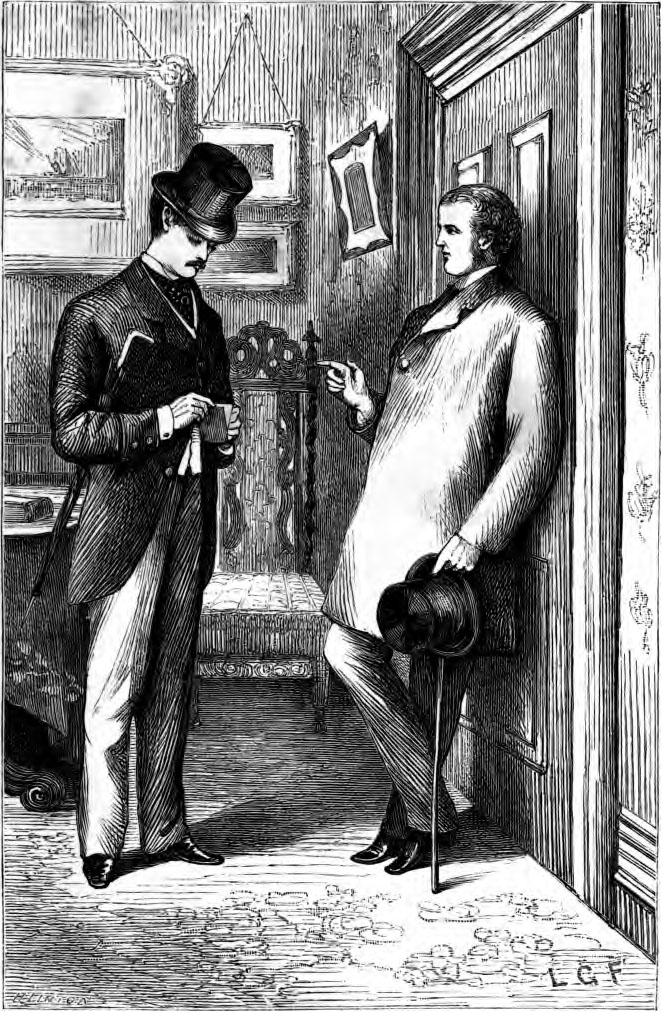
"Not quite. Do you purpose that your mother should keep you and
clothe you for the rest of your life?"
"I hope to be able to keep her before long, and to do it much better
than it has ever been done before. The truth is, Roger, you know
nothing about it. If you'll leave me to myself, you'll find that I
shall do very well."
"I don't know any young man who ever did worse, or one who had less
moral conception of what is right and wrong."
"Very well. That's your idea. I differ from you. People can't all
think alike, you know. Now, if you please, I'll go."
Roger felt that he hadn't half said what he had to say, but he hardly
knew how to get it said. And of what use could it be to talk to a
young man who was altogether callous and without feeling? The remedy
for the evil ought to be found in the mother's conduct rather than
the son's. She, were she not foolishly weak, would make up her mind
to divide herself utterly from her son, at any rate for a while, and
to leave him to suffer utter penury. That would bring him round. And
then when the agony of want had tamed him, he would be content to
take bread and meat from her hand and would be humble. At present he
had money in his pocket, and would eat and drink of the best, and
be free from inconvenience for the moment. While this prosperity
remained it would be impossible to touch him. "You will ruin your
sister, and break your mother's heart," said Roger, firing a last
harmless shot after the young reprobate.
When Lady Carbury came into the room, which she did as soon as the
front door was closed behind her son, she seemed to think that a
great success had been achieved because the £20 had been recovered.
"I knew he would give it me back, if he had it," she said.
"Why did he not bring it to you of his own accord?"
"I suppose he did not like to talk about it. Has he said that he got
it by--playing?"
"No,--he did not speak a word of truth while he was here. You may
take it for granted that he did get it by gambling. How else should
he have it? And you may take it for granted also that he will lose
all that he has got. He talked in the wildest way,--saying that he
would soon have a home for you and Hetta."
"Did he;--dear boy!"
"Had he any meaning?"
"Oh; yes. And it is quite on the cards that it should be so. You have
heard of Miss Melmotte."
"I have heard of the great French swindler who has come over here,
and who is buying his way into society."
"Everybody visits them now, Roger."
"More shame for everybody. Who knows anything about him,--except
that he left Paris with the reputation of a specially prosperous rogue?
But what of him?"
"Some people think that Felix will marry his only child. Felix is hand-
some; isn't he? What young man is there nearly so handsome? They
say she'll have half a million of money."
"That's his game;--is it?"
"Don't you think he is right?"
"No; I think he's wrong. But we shall hardly agree with each other
about that. Can I see Henrietta for a few minutes?"
CHAPTER VIII.
LOVE-SICK.
Roger Carbury said well that it was very improbable that he and
his cousin, the widow, should agree in their opinions as to the
expedience of fortune-hunting by marriage. It was impossible that
they should ever understand each other. To Lady Carbury the prospect
of a union between her son and Miss Melmotte was one of unmixed joy
and triumph. Could it have been possible that Marie Melmotte should
be rich and her father be a man doomed to a deserved sentence in a
penal settlement, there might perhaps be a doubt about it. The wealth
even in that case would certainly carry the day against the disgrace,
and Lady Carbury would find reasons why "poor Marie" should not be
punished for her father's sins, even while enjoying the money which
those sins had produced. But how different were the existing facts?
Mr. Melmotte was not at the galleys, but was entertaining duchesses
in Grosvenor Square. People said that Mr. Melmotte had a reputation
throughout Europe as a gigantic swindler,--as one who in the
dishonest and successful pursuit of wealth had stopped at nothing.
People said of him that he had framed and carried out long
premeditated and deeply laid schemes for the ruin of those who
had trusted him, that he had swallowed up the property of all who
had come in contact with him, that he was fed with the blood of
widows and children;--but what was all this to Lady Carbury? If the
duchesses condoned it all, did it become her to be prudish? People
also said that Melmotte would yet get a fall,--that a man who had
risen after such a fashion never could long keep his head up. But he
might keep his head up long enough to give Marie her fortune. And
then Felix wanted a fortune so badly;--was so exactly the young man
who ought to marry a fortune! To Lady Carbury there was no second way
of looking at the matter.
And to Roger Carbury also there was no second way of looking at it.
That condonation of antecedents which, in the hurry of the world,
is often vouchsafed to success, that growing feeling which induces
people to assert to themselves that they are not bound to go outside
the general verdict, and that they may shake hands with whomsoever
the world shakes hands with, had never reached him. The old-fashioned
idea that the touching of pitch will defile still prevailed with him.
He was a gentleman;--and would have felt himself disgraced to enter
the house of such a one as Augustus Melmotte. Not all the duchesses
in the peerage, or all the money in the city, could alter his notions
or induce him to modify his conduct. But he knew that it would be
useless for him to explain this to Lady Carbury. He trusted, however,
that one of the family might be taught to appreciate the difference
between honour and dishonour. Henrietta Carbury had, he thought, a
higher turn of mind than her mother, and had as yet been kept free
from soil. As for Felix,--he had so grovelled in the gutters as to be
dirt all over. Nothing short of the prolonged sufferings of half a
life could cleanse him.
He found Henrietta alone in the drawing-room. "Have you seen Felix?"
she said, as soon as they had greeted each other.
"Yes. I caught him in the street."
"We are so unhappy about him."
"I cannot say but that you have reason. I think, you know, that your
mother indulges him foolishly."
"Poor mamma! She worships the very ground he treads on."
"Even a mother should not throw her worship away like that. The fact
is that your brother will ruin you both if this goes on."
"What can mamma do?"
"Leave London, and then refuse to pay a shilling on his behalf."
"What would Felix do in the country?"
"If he did nothing, how much better would that be than what he does
in town? You would not like him to become a professional gambler."
"Oh, Mr. Carbury; you do not mean that he does that!"
"It seems cruel to say such things to you,--but in a matter of such
importance one is bound to speak the truth. I have no influence over
your mother; but you may have some. She asks my advice, but has not
the slightest idea of listening to it. I don't blame her for that;
but I am anxious for the sake of--, for the sake of the family."
"I am sure you are."
"Especially for your sake. You will never throw him over."
"You would not ask me to throw him over."
"But he may drag you into the mud. For his sake you have already been
taken into the house of that man Melmotte."
"I do not think that I shall be injured by anything of that kind,"
said Henrietta, drawing herself up.
"Pardon me if I seem to interfere."
"Oh, no;--it is no interference from you."
"Pardon me then if I am rough. To me it seems that an injury is done
to you if you are made to go to the house of such a one as this man.
Why does your mother seek his society? Not because she likes him;
not because she has any sympathy with him or his family;--but simply
because there is a rich daughter."
"Everybody goes there, Mr. Carbury."
"Yes,--that is the excuse which everybody makes. Is that sufficient
reason for you to go to a man's house? Is there not another place to
which we are told that a great many are going, simply because the
road has become thronged and fashionable? Have you no feeling that
you ought to choose your friends for certain reasons of your own?
I admit there is one reason here. They have a great deal of money,
and it is thought possible that he may get some of it by falsely
swearing to a girl that he loves her. After what you have heard, are
the Melmottes people with whom you would wish to be connected?"
"I don't know."
"I do. I know very well. They are absolutely disgraceful. A
social connection with the first crossing-sweeper would be less
objectionable." He spoke with a degree of energy of which he was
himself altogether unaware. He knit his brows, and his eyes flashed,
and his nostrils were extended. Of course she thought of his own
offer to herself. Of course her mind at once conceived,--not that the
Melmotte connection could ever really affect him, for she felt sure
that she would never accept his offer,--but that he might think that
he would be so affected. Of course she resented the feeling which she
thus attributed to him. But, in truth, he was much too simple-minded
for any such complex idea. "Felix," he continued, "has already
descended so far that I cannot pretend to be anxious as to what
houses he may frequent. But I should be sorry to think that you
should often be seen at Mr. Melmotte's."
"I think, Mr. Carbury, that mamma will take care that I am not taken
where I ought not to be taken."
"I wish you to have some opinion of your own as to what is proper for
you."
"I hope I have. I am sorry you should think that I have not."
"I am old-fashioned, Hetta."
"And we belong to a newer and worse sort of world. I dare say it is
so. You have been always very kind, but I almost doubt whether you
can change us now. I have sometimes thought that you and mamma were
hardly fit for each other."
"I have thought that you and I were,--or possibly might be fit for
each other."
"Oh,--as for me, I shall always take mamma's side. If mamma chooses
to go to the Melmottes I shall certainly go with her. If that is
contamination, I suppose I must be contaminated. I don't see why I'm
to consider myself better than any one else."
"I have always thought that you were better than any one else."
"That was before I went to the Melmottes. I am sure you have altered
your opinion now. Indeed, you have told me so. I am afraid, Mr.
Carbury, you must go your way, and we must go ours."
He looked into her face as she spoke, and gradually began to perceive
the working of her mind. He was so true himself that he did not
understand that there should be with her even that violet-coloured
tinge of prevarication which women assume as an additional charm.
Could she really have thought that he was attending to his own
possible future interests when he warned her as to the making of new
acquaintances?
"For myself," he said, putting out his hand and making a slight vain
effort to get hold of hers, "I have only one wish in the world; and
that is, to travel the same road with you. I do not say that you
ought to wish it too; but you ought to know that I am sincere. When
I spoke of the Melmottes, did you believe that I was thinking of
myself?"
"Oh no;--how should I?"
"I was speaking to you then as to a cousin who might regard me as an
elder brother. No contact with legions of Melmottes could make you
other to me than the woman on whom my heart has settled. Even were
you in truth disgraced,--could disgrace touch one so pure as you,--it
would be the same. I love you so well that I have already taken you
for better or for worse. I cannot change. My nature is too stubborn
for such changes. Have you a word to say to comfort me?" She turned
away her head, but did not answer him at once. "Do you understand how
much I am in need of comfort?"
"You can do very well without comfort from me."
"No, indeed. I shall live, no doubt; but I shall not do very well.
As it is, I am not doing at all well. I am becoming sour and moody,
and ill at ease with my friends. I would have you believe me, at any
rate, when I say I love you."
"I suppose you mean something."
"I mean a great deal, dear. I mean all that a man can mean. That is
it. You hardly understand that I am serious to the extent of ecstatic
joy on the one side, and utter indifference to the world on the
other. I shall never give it up till I learn that you are to be
married to some one else."
"What can I say, Mr. Carbury?"
"That you will love me."
"But if I don't?"
"Say that you will try."
"No; I will not say that. Love should come without a struggle. I
don't know how one person is to try to love another in that way. I
like you very much; but being married is such a terrible thing."
"It would not be terrible to me, dear."
"Yes;--when you found that I was too young for your tastes."
"I shall persevere, you know. Will you assure me of this,--that if
you promise your hand to another man, you will let me know at once?"
"I suppose I may promise that," she said, after pausing for a moment.
"There is no one as yet?"
"There is no one. But, Mr. Carbury, you have no right to question me.
I don't think it generous. I allow you to say things that nobody else
could say because you are a cousin and because mamma trusts you so
much. No one but mamma has a right to ask me whether I care for any
one."
"Are you angry with me?"
"No."
"If I have offended you it is because I love you so dearly."
"I am not offended, but I don't like to be questioned by a gentleman.
I don't think any girl would like it. I am not to tell everybody all
that happens."
"Perhaps when you reflect how much of my happiness depends upon it
you will forgive me. Good-bye now." She put out her hand to him and
allowed it to remain in his for a moment. "When I walk about the old
shrubberies at Carbury where we used to be together, I am always
asking myself what chance there is of your walking there as the
mistress."
"There is no chance."
"I am, of course, prepared to hear you say so. Well; good-bye, and
may God bless you."
The man had no poetry about him. He did not even care for romance.
All the outside belongings of love which are so pleasant to many men
and which to many women afford the one sweetness in life which they
really relish, were nothing to him. There are both men and women to
whom even the delays and disappointments of love are charming, even
when they exist to the detriment of hope. It is sweet to such persons
to be melancholy, sweet to pine, sweet to feel that they are now
wretched after a romantic fashion as have been those heroes and
heroines of whose sufferings they have read in poetry. But there was
nothing of this with Roger Carbury. He had, as he believed, found
the woman that he really wanted, who was worthy of his love, and now,
having fixed his heart upon her, he longed for her with an amazing
longing. He had spoken the simple truth when he declared that life
had become indifferent to him without her. No man in England could
be less likely to throw himself off the Monument or to blow out his
brains. But he felt numbed in all the joints of his mind by this
sorrow. He could not make one thing bear upon another, so as to
console himself after any fashion. There was but one thing for
him;--to persevere till he got her, or till he had finally lost her.
And should the latter be his fate, as he began to fear that it would
be, then, he would live, but live only, like a crippled man.
He felt almost sure in his heart of hearts that the girl loved that
other, younger man. That she had never owned to such love he was
quite sure. The man himself and Henrietta also had both assured him
on this point, and he was a man easily satisfied by words and prone
to believe. But he knew that Paul Montague was attached to her,
and that it was Paul's intention to cling to his love. Sorrowfully
looking forward through the vista of future years, he thought he saw
that Henrietta would become Paul's wife. Were it so, what should he
do? Annihilate himself as far as all personal happiness in the world
was concerned, and look solely to their happiness, their prosperity,
and their joys? Be as it were a beneficent old fairy to them, though
the agony of his own disappointment should never depart from him?
Should he do this, and be blessed by them,--or should he let Paul
Montague know what deep resentment such ingratitude could produce?
When had a father been kinder to a son, or a brother to a brother,
than he had been to Paul? His home had been the young man's home, and
his purse the young man's purse. What right could the young man have
to come upon him just as he was perfecting his bliss and rob him of
all that he had in the world? He was conscious all the while that
there was a something wrong in his argument,--that Paul when he
commenced to love the girl knew nothing of his friend's love,--that
the girl, though Paul had never come in the way, might probably have
been as obdurate as she was now to his entreaties. He knew all this
because his mind was clear. But yet the injustice,--at any rate, the
misery was so great, that to forgive it and to reward it would be
weak, womanly, and foolish. Roger Carbury did not quite believe in
the forgiveness of injuries. If you pardon all the evil done to you,
you encourage others to do you evil! If you give your cloak to him
who steals your coat, how long will it be before your shirt and
trousers will go also? Roger Carbury returned that afternoon to
Suffolk, and as he thought of it all throughout the journey, he
resolved that he would never forgive Paul Montague if Paul Montague
should become his cousin's husband.
CHAPTER IX.
THE GREAT RAILWAY TO VERA CRUZ.
"You have been a guest in his house. Then, I guess, the thing's about
as good as done." These words were spoken with a fine, sharp, nasal
twang by a brilliantly-dressed American gentleman in one of the
smartest private rooms of the great railway hotel at Liverpool, and
they were addressed to a young Englishman who was sitting opposite
to him. Between them there was a table covered with maps, schedules,
and printed programmes. The American was smoking a very large cigar,
which he kept constantly turning in his mouth, and half of which
was inside his teeth. The Englishman had a short pipe. Mr. Hamilton
K. Fisker, of the firm of Fisker, Montague, and Montague, was the
American, and the Englishman was our friend Paul, the junior member
of that firm.
"But I didn't even speak to him," said Paul.
"In commercial affairs that matters nothing. It quite justifies you
in introducing me. We are not going to ask your friend to do us a
favour. We don't want to borrow money."
"I thought you did."
"If he'll go in for the thing he'd be one of us, and there would
be no borrowing then. He'll join us if he's as clever as they say,
because he'll see his way to making a couple of million of dollars
out of it. If he'd take the trouble to run over and show himself in
San Francisco, he'd make double that. The moneyed men would go in
with him at once, because they know that he understands the game and
has got the pluck. A man who has done what he has by financing in
Europe,--by George! there's no limit to what he might do with us.
We're a bigger people than any of you and have more room. We go after
bigger things, and don't stand shilly-shally on the brink as you do.
But Melmotte pretty nigh beats the best among us. Anyway he should
come and try his luck, and he couldn't have a bigger thing or a safer
thing than this. He'd see it immediately if I could talk to him for
half an hour."
"Mr. Fisker," said Paul mysteriously, "as we are partners, I think
I ought to let you know that many people speak very badly of Mr.
Melmotte's honesty."
Mr. Fisker smiled gently, turned his cigar twice round in his mouth,
and then closed one eye. "There is always a want of charity," he
said, "when a man is successful."
The scheme in question was the grand proposal for a South Central
Pacific and Mexican railway, which was to run from the Salt Lake
City, thus branching off from the San Francisco and Chicago
line,--and pass down through the fertile lands of New Mexico and
Arizona, into the territory of the Mexican Republic, run by the city
of Mexico, and come out on the gulf at the port of Vera Cruz. Mr.
Fisker admitted at once that it was a great undertaking, acknowledged
that the distance might be perhaps something over 2,000 miles,
acknowledged that no computation had or perhaps could be made as to
the probable cost of the railway; but seemed to think that questions
such as these were beside the mark and childish. Melmotte, if he
would go into the matter at all, would ask no such questions.
But we must go back a little. Paul Montague had received a telegram
from his partner, Hamilton K. Fisker, sent on shore at Queenstown
from one of the New York liners, requesting him to meet Fisker at
Liverpool immediately. With this request he had felt himself bound to
comply. Personally he had disliked Fisker,--and perhaps not the less
so because when in California he had never found himself able to
resist the man's good humour, audacity, and cleverness combined. He
had found himself talked into agreeing with any project which Mr.
Fisker might have in hand. It was altogether against the grain with
him, and yet by his own consent, that the flour-mill had been opened
at Fiskerville. He trembled for his money and never wished to see
Fisker again; but still, when Fisker came to England, he was proud
to remember that Fisker was his partner, and he obeyed the order and
went down to Liverpool.
If the flour-mill had frightened him, what must the present project
have done! Fisker explained that he had come with two objects,--first
to ask the consent of the English partner to the proposed change in
their business, and secondly to obtain the co-operation of English
capitalists. The proposed change in the business meant simply the
entire sale of the establishment at Fiskerville, and the absorption
of the whole capital in the work of getting up the railway. "If you
could realise all the money it wouldn't make a mile of the railway,"
said Paul. Mr. Fisker laughed at him. The object of Fisker, Montague,
and Montague was not to make a railway to Vera Cruz, but to float
a company. Paul thought that Mr. Fisker seemed to be indifferent
whether the railway should ever be constructed or not. It was clearly
his idea that fortunes were to be made out of the concern before a
spadeful of earth had been moved. If brilliantly printed programmes
might avail anything, with gorgeous maps, and beautiful little
pictures of trains running into tunnels beneath snowy mountains and
coming out of them on the margin of sunlit lakes, Mr. Fisker had
certainly done much. But Paul, when he saw all these pretty things,
could not keep his mind from thinking whence had come the money to
pay for them. Mr. Fisker had declared that he had come over to obtain
his partner's consent, but it seemed to that partner that a great
deal had been done without any consent. And Paul's fears on this hand
were not allayed by finding that on all these beautiful papers he
himself was described as one of the agents and general managers of
the company. Each document was signed Fisker, Montague, and Montague.
References on all matters were to be made to Fisker, Montague, and
Montague,--and in one of the documents it was stated that a member
of the firm had proceeded to London with the view of attending to
British interests in the matter. Fisker had seemed to think that his
young partner would express unbounded satisfaction at the greatness
which was thus falling upon him. A certain feeling of importance,
not altogether unpleasant, was produced, but at the same time there
was another conviction forced upon Montague's mind, not altogether
pleasant, that his money was being made to disappear without any
consent given by him, and that it behoved him to be cautious lest
such consent should be extracted from him unawares.
"What has become of the mill?" he asked.
"We have put an agent into it."
"Is not that dangerous? What check have you on him?"
"He pays us a fixed sum, sir. But, my word! when there is such a
thing as this on hand a trumpery mill like that is not worth speaking
of."
"You haven't sold it?"
"Well;--no. But we've arranged a price for a sale."
"You haven't taken the money for it?"
"Well;--yes; we have. We've raised money on it, you know. You see you
weren't there, and so the two resident partners acted for the firm.
But Mr. Montague, you'd better go with us. You had indeed."
"And about my own income?"
"That's a flea-bite. When we've got a little ahead with this it won't
matter, sir, whether you spend twenty thousand or forty thousand
dollars a year. We've got the concession from the United States
Government through the territories, and we're in correspondence with
the President of the Mexican Republic. I've no doubt we've an office
open already in Mexico and another at Vera Cruz."
"Where's the money to come from?"
"Money to come from, sir? Where do you suppose the money comes from
in all these undertakings? If we can float the shares, the money'll
come in quick enough. We hold three million dollars of the stock
ourselves."
"Six hundred thousand pounds!" said Montague.
"We take them at par, of course,--and as we sell we shall pay for
them. But of course we shall only sell at a premium. If we can run
them up even to 110, there would be three hundred thousand dollars.
But we'll do better than that. I must try and see Melmotte at once.
You had better write a letter now."
"I don't know the man."
"Never mind. Look here--I'll write it, and you can sign it."
Whereupon Mr. Fisker did write the following letter:--
Langham Hotel, London.
March 4, 18--.
DEAR SIR,--I have the pleasure of informing you that my
partner, Mr. Fisker,--of Fisker, Montague, and Montague,
of San Francisco,--is now in London with the view of
allowing British capitalists to assist in carrying out
perhaps the greatest work of the age,--namely, the South
Central Pacific and Mexican Railway, which is to give
direct communication between San Francisco and the Gulf
of Mexico. He is very anxious to see you upon his arrival,
as he is aware that your co-operation would be desirable.
We feel assured that with your matured judgment in such
matters you would see at once the magnificence of the
enterprise. If you will name a day and an hour, Mr. Fisker
will call upon you.
I have to thank you and Madame Melmotte for a very
pleasant evening spent at your house last week.
Mr. Fisker proposes returning to New York. I shall remain
here, superintending the British interests which may be
involved.
I have the honour to be,
Dear Sir,
Most faithfully yours,
---- ----.
"But I have never said that I would superintend the interests," said
Montague.
"You can say so now. It binds you to nothing. You regular John Bull
Englishmen are so full of scruples that you lose as much of life as
should serve to make an additional fortune."
After some further conversation Paul Montague recopied the letter
and signed it. He did it with doubt,--almost with dismay. But he
told himself that he could do no good by refusing. If this wretched
American, with his hat on one side and rings on his fingers, had so
far got the upper hand of Paul's uncle as to have been allowed to do
what he liked with the funds of the partnership, Paul could not stop
it. On the following morning they went up to London together, and in
the course of the afternoon Mr. Fisker presented himself in Abchurch
Lane. The letter written at Liverpool, but dated from the Langham
Hotel, had been posted at the Euston Square Railway Station at the
moment of Fisker's arrival. Fisker sent in his card, and was asked to
wait. In the course of twenty minutes he was ushered into the great
man's presence by no less a person than Miles Grendall.
It has been already said that Mr. Melmotte was a big man with large
whiskers, rough hair, and with an expression of mental power on
a harsh vulgar face. He was certainly a man to repel you by his
presence unless attracted to him by some internal consideration.
He was magnificent in his expenditure, powerful in his doings,
successful in his business, and the world around him therefore
was not repelled. Fisker, on the other hand, was a shining little
man,--perhaps about forty years of age, with a well-twisted
moustache, greasy brown hair, which was becoming bald at the top,
good-looking if his features were analysed, but insignificant
in appearance. He was gorgeously dressed, with a silk waistcoat
and chains, and he carried a little stick. One would at first be
inclined to say that Fisker was not much of a man; but after a little
conversation most men would own that there was something in Fisker.
He was troubled by no shyness, by no scruples, and by no fears. His
mind was not capacious, but such as it was it was his own, and he
knew how to use it.
Abchurch Lane is not a grand site for the offices of a merchant
prince. Here, at a small corner house, there was a small brass plate
on a swing door, bearing the words "Melmotte & Co." Of whom the Co.
was composed no one knew. In one sense Mr. Melmotte might be said
to be in company with all the commercial world, for there was no
business to which he would refuse his co-operation on certain terms.
But he had never burthened himself with a partner in the usual sense
of the term. Here Fisker found three or four clerks seated at desks,
and was desired to walk up-stairs. The steps were narrow and crooked,
and the rooms were small and irregular. Here he stayed for a while in
a small dark apartment in which "The Daily Telegraph" was left for
the amusement of its occupant till Miles Grendall announced to him
that Mr. Melmotte would see him. The millionaire looked at him for a
moment or two, just condescending to touch with his fingers the hand
which Fisker had projected.
"I don't seem to remember," he said, "the gentleman who has done me
the honour of writing to me about you."
"I dare say not, Mr. Melmotte. When I'm at home in San Francisco,
I make acquaintance with a great many gents whom I don't remember
afterwards. My partner I think told me that he went to your house
with his friend, Sir Felix Carbury."
"I know a young man called Sir Felix Carbury."
"That's it. I could have got any amount of introductions to you if I
had thought this would not have sufficed." Mr. Melmotte bowed. "Our
account here in London is kept with the City and West End Joint
Stock. But I have only just arrived, and as my chief object in coming
to London is to see you, and as I met my partner, Mr. Montague, in
Liverpool, I took a note from him and came on straight."
"And what can I do for you, Mr. Fisker?"
Then Mr. Fisker began his account of the Great South Central Pacific
and Mexican Railway, and exhibited considerable skill by telling it
all in comparatively few words. And yet he was gorgeous and florid.
In two minutes he had displayed his programme, his maps, and his
pictures before Mr. Melmotte's eyes, taking care that Mr. Melmotte
should see how often the names of Fisker, Montague, and Montague,
reappeared upon them. As Mr. Melmotte read the documents, Fisker
from time to time put in a word. But the words had no reference at
all to the future profits of the railway, or to the benefit which
such means of communication would confer upon the world at large;
but applied solely to the appetite for such stock as theirs, which
might certainly be produced in the speculating world by a proper
manipulation of the affairs.
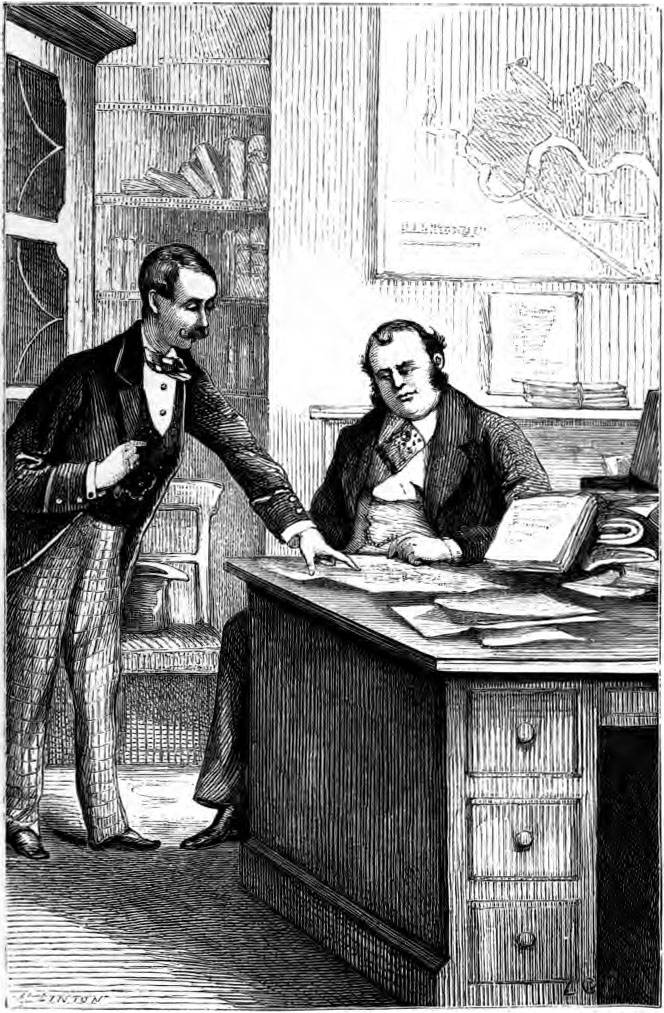
"You seem to think you couldn't get it taken up in your own country,"
said Melmotte.
"There's not a doubt about getting it all taken up there. Our folk,
sir, are quick enough at the game; but you don't want me to teach
you, Mr. Melmotte, that nothing encourages this kind of thing like
competition. When they hear at St. Louis and Chicago that the thing
is alive in London, they'll be alive there. And it's the same here,
sir. When they know that the stock is running like wildfire in
America, they'll make it run here too."
"How far have you got?"
"What we've gone to work upon is a concession for making the line
from the United States Congress. We're to have the land for nothing,
of course, and a grant of one thousand acres round every station, the
stations to be twenty-five miles apart."
"And the land is to be made over to you,--when?"
"When we have made the line up to the station." Fisker understood
perfectly that Mr. Melmotte did not ask the question in reference to
any value that he might attach to the possession of such lands, but
to the attractiveness of such a prospectus in the eyes of the outside
world of speculators.
"And what do you want me to do, Mr. Fisker?"
"I want to have your name there," he said. And he placed his finger
down on a spot on which it was indicated that there was, or was to
be, a chairman of an English Board of Directors, but with a space for
the name, hitherto blank.
"Who are to be your directors here, Mr. Fisker?"
"We should ask you to choose them, sir. Mr. Paul Montague should be
one, and perhaps his friend Sir Felix Carbury might be another. We
could get probably one of the Directors of the City and West End. But
we would leave it all to you,--as also the amount of stock you would
like to take yourself. If you gave yourself to it, heart and soul,
Mr. Melmotte, it would be the finest thing that there has been out
for a long time. There would be such a mass of stock!"
"You have to back that with a certain amount of paid-up capital?"
"We take care, sir, in the West not to cripple commerce too closely
by old-fashioned bandages. Look at what we've done already, sir, by
having our limbs pretty free. Look at our line, sir, right across the
continent, from San Francisco to New York. Look at--"
"Never mind that, Mr. Fisker. People wanted to go from New York to
San Francisco, and I don't know that they do want to go to Vera Cruz.
But I will look at it, and you shall hear from me." The interview
was over, and Mr. Fisker was contented with it. Had Mr. Melmotte not
intended at least to think of it he would not have given ten minutes
to the subject. After all, what was wanted from Mr. Melmotte was
little more than his name, for the use of which Mr. Fisker proposed
that he should receive from the speculative public two or three
hundred thousand pounds.
At the end of a fortnight from the date of Mr. Fisker's arrival
in London, the company was fully launched in England, with a body
of London directors, of whom Mr. Melmotte was the chairman. Among
the directors were Lord Alfred Grendall, Sir Felix Carbury, Samuel
Cohenlupe, Esq., Member of Parliament for Staines, a gentleman of
the Jewish persuasion, Lord Nidderdale, who was also in Parliament,
and Mr. Paul Montague. It may be thought that the directory was not
strong, and that but little help could be given to any commercial
enterprise by the assistance of Lord Alfred or Sir Felix;--but it was
felt that Mr. Melmotte was himself so great a tower of strength that
the fortune of the company,--as a company,--was made.
CHAPTER X.
MR. FISKER'S SUCCESS.
Mr. Fisker was fully satisfied with the progress he had made, but
he never quite succeeded in reconciling Paul Montague to the whole
transaction. Mr. Melmotte was indeed so great a reality, such a fact
in the commercial world of London, that it was no longer possible for
such a one as Montague to refuse to believe in the scheme. Melmotte
had the telegraph at his command, and had been able to make as close
inquiries as though San Francisco and Salt Lake City had been suburbs
of London. He was chairman of the British branch of the Company, and
had had shares allocated to him,--or as he said to the house,--to the
extent of two millions of dollars. But still there was a feeling of doubt,
and a consciousness that Melmotte, though a tower of strength, was
thought by many to have been built upon the sands.
Paul had now of course given his full authority to the work, much
in opposition to the advice of his old friend Roger Carbury,--and
had come up to live in town, that he might personally attend to
the affairs of the great railway. There was an office just behind
the Exchange, with two or three clerks and a secretary, the latter
position being held by Miles Grendall, Esq. Paul, who had a con-
science in the matter and was keenly alive to the fact that he was
not only a director but was also one of the firm of Fisker, Montague,
and Montague which was responsible for the whole affair, was
grievously anxious to be really at work, and would attend most
inopportunely at the Company's offices. Fisker, who still lingered in
London, did his best to put a stop to this folly, and on more than
one occasion somewhat snubbed his partner. "My dear fellow, what's
the use of your flurrying yourself? In a thing of this kind, when it
has once been set agoing, there is nothing else to do. You may have
to work your fingers off before you can make it move, and then fail.
But all that has been done for you. If you go there on the Thursdays
that's quite as much as you need do. You don't suppose that such
a man as Melmotte would put up with any real interference." Paul
endeavoured to assert himself, declaring that as one of the managers
he meant to take a part in the management;--that his fortune, such as
it was, had been embarked in the matter, and was as important to him
as was Mr. Melmotte's fortune to Mr. Melmotte. But Fisker got the
better of him and put him down. "Fortune! what fortune had either of
us? a few beggarly thousands of dollars not worth talking of, and
barely sufficient to enable a man to look at an enterprise. And now
where are you? Look here, sir;--there's more to be got out of the
smashing up of such an affair as this, if it should smash up, than
could be made by years of hard work out of such fortunes as yours
and mine in the regular way of trade."
Paul Montague certainly did not love Mr. Fisker personally, nor did
he relish his commercial doctrines; but he allowed himself to be
carried away by them. "When and how was I to have helped myself?" he
wrote to Roger Carbury. "The money had been raised and spent before
this man came here at all. It's all very well to say that he had no
right to do it; but he had done it. I couldn't even have gone to law
with him without going over to California, and then I should have
got no redress." Through it all he disliked Fisker, and yet Fisker
had one great merit which certainly recommended itself warmly to
Montague's appreciation. Though he denied the propriety of Paul's
interference in the business, he quite acknowledged Paul's right to a
share in the existing dash of prosperity. As to the real facts of the
money affairs of the firm he would tell Paul nothing. But he was well
provided with money himself, and took care that his partner should be
in the same position. He paid him all the arrears of his stipulated
income up to the present moment, and put him nominally into
possession of a large number of shares in the railway,--with,
however, an understanding that he was not to sell them till they had
reached ten per cent. above par, and that in any sale transacted he
was to touch no other money than the amount of profit which would
thus accrue. What Melmotte was to be allowed to do with his shares,
he never heard. As far as Montague could understand, Melmotte was in
truth to be powerful over everything. All this made the young man
unhappy, restless, and extravagant. He was living in London and had
money at command, but he never could rid himself of the fear that
the whole affair might tumble to pieces beneath his feet and that he
might be stigmatised as one among a gang of swindlers.
We all know how, in such circumstances, by far the greater proportion
of a man's life will be given up to the enjoyments that are offered
to him and the lesser proportion to the cares, sacrifices, and
sorrows. Had this young director been describing to his intimate
friend the condition in which he found himself, he would have
declared himself to be distracted by doubts, suspicions, and fears
till his life was a burden to him. And yet they who were living with
him at this time found him to be a very pleasant fellow, fond of a-
musement, and disposed to make the most of all the good things which
came in his way. Under the auspices of Sir Felix Carbury he had
become a member of the Beargarden, at which best of all possible
clubs the mode of entrance was as irregular as its other proceedings.
When any young man desired to come in who was thought to be unfit
for its style of living, it was shown to him that it would take
three years before his name could be brought up at the usual rate
of vacancies; but in regard to desirable companions the committee
had a power of putting them at the top of the list of candidates and
bringing them in at once. Paul Montague had suddenly become credited
with considerable commercial wealth and greater commercial influence.
He sat at the same Board with Melmotte and Melmotte's men; and was on
this account elected at the Beargarden without any of that harassing
delay to which other less fortunate candidates are subjected.
And,--let it be said with regret, for Paul Montague was at heart
honest and well-conditioned,--he took to living a good deal at the
Beargarden. A man must dine somewhere, and everybody knows that a
man dines cheaper at his club than elsewhere. It was thus he reasoned
with himself. But Paul's dinners at the Beargarden were not cheap. He
saw a good deal of his brother directors, Sir Felix Carbury and Lord
Nidderdale, entertained Lord Alfred more than once at the club, and
had twice dined with his great chairman amidst all the magnificence
of merchant-princely hospitality in Grosvenor Square. It had indeed
been suggested to him by Mr. Fisker that he also ought to enter
himself for the great Marie Melmotte plate. Lord Nidderdale had again
declared his intention of running, owing to considerable pressure put
upon him by certain interested tradesmen, and with this intention
had become one of the directors of the Mexican Railway Company. At
the time, however, of which we are now writing, Sir Felix was the
favourite for the race among fashionable circles generally.
The middle of April had come, and Fisker was still in London. When
millions of dollars are at stake,--belonging perhaps to widows
and orphans, as Fisker remarked,--a man was forced to set his own
convenience on one side. But this devotion was not left without
reward, for Mr. Fisker had "a good time" in London. He also was made
free of the Beargarden, as an honorary member, and he also spent
a good deal of money. But there is this comfort in great affairs,
that whatever you spend on yourself can be no more than a trifle.
Champagne and ginger-beer are all the same when you stand to win or
lose thousands,--with this only difference, that champagne may have
deteriorating results which the more innocent beverage will not
produce. The feeling that the greatness of these operations relieved
them from the necessity of looking to small expenses operated in the
champagne direction, both on Fisker and Montague, and the result was
deleterious. The Beargarden, no doubt, was a more lively place than
Carbury Manor, but Montague found that he could not wake up on these
London mornings with thoughts as satisfactory as those which attended
his pillow at the old Manor House.
On Saturday, the 19th of April, Fisker was to leave London on his
return to New York, and on the 18th a farewell dinner was to be given
to him at the club. Mr. Melmotte was asked to meet him, and on such
an occasion all the resources of the club were to be brought forth.
Lord Alfred Grendall was also to be a guest, and Mr. Cohenlupe, who
went about a good deal with Melmotte. Nidderdale, Carbury, Montague,
and Miles Grendall were members of the club, and gave the dinner. No
expense was spared. Herr Vossner purveyed the viands and wines,--and
paid for them. Lord Nidderdale took the chair, with Fisker on his
right hand, and Melmotte on his left, and, for a fast-going young
lord, was supposed to have done the thing well. There were only two
toasts drunk, to the healths of Mr. Melmotte and Mr. Fisker, and two
speeches were of course made by them. Mr. Melmotte may have been
held to have clearly proved the genuineness of that English birth which
he claimed by the awkwardness and incapacity which he showed on the
occasion. He stood with his hands on the table and with his face
turned to his plate blurted out his assurance that the floating of
this railway company would be one of the greatest and most successful
commercial operations ever conducted on either side of the Atlantic.
It was a great thing,--a very great thing;--he had no hesitation in
saying that it was one of the greatest things out. He didn't believe
a greater thing had ever come out. He was happy to give his humble
assistance to the furtherance of so great a thing,--and so on. These
assertions, not varying much one from the other, he jerked out like
so many separate interjections, endeavouring to look his friends in
the face at each, and then turning his countenance back to his plate
as though seeking for inspiration for the next attempt. He was not
eloquent; but the gentlemen who heard him remembered that he was the
great Augustus Melmotte, that he might probably make them all rich
men, and they cheered him to the echo. Lord Alfred had reconciled
himself to be called by his Christian name, since he had been put in
the way of raising two or three hundred pounds on the security of
shares which were to be allotted to him, but of which in the flesh
he had as yet seen nothing. Wonderful are the ways of trade! If
one can only get the tip of one's little finger into the right pie,
what noble morsels, what rich esculents, will stick to it as it is
extracted!
When Melmotte sat down Fisker made his speech, and it was fluent,
fast, and florid. Without giving it word for word, which would be
tedious, I could not adequately set before the reader's eye the
speaker's pleasing picture of world-wide commercial love and harmony
which was to be produced by a railway from Salt Lake City to Vera
Cruz, nor explain the extent of gratitude from the world at large
which might be claimed by, and would finally be accorded to, the
great firms of Melmotte & Co. of London, and Fisker, Montague, and
Montague of San Francisco. Mr. Fisker's arms were waved gracefully
about. His head was turned now this way and now that, but never
towards his plate. It was very well done. But there was more faith
in one ponderous word from Mr. Melmotte's mouth than in all the
American's oratory.
There was not one of them then present who had not after some fash-
ion been given to understand that his fortune was to be made, not by
the construction of the railway, but by the floating of the railway
shares. They had all whispered to each other their convictions on
this head. Even Montague did not beguile himself into an idea that he
was really a director in a company to be employed in the making and
working of a railway. People out of doors were to be advertised into
buying shares, and they who were so to say indoors were to have the
privilege of manufacturing the shares thus to be sold. That was to
be their work, and they all knew it. But now, as there were eight of
them collected together, they talked of humanity at large and of the
coming harmony of nations.
After the first cigar, Melmotte withdrew, and Lord Alfred went with
him. Lord Alfred would have liked to remain, being a man who enjoyed
tobacco and soda and brandy,--but momentous days had come upon him,
and he thought it well to cling to his Melmotte. Mr. Samuel Cohen-
lupe also went, not having taken a very distinguished part in the
entertainment. Then the young men were left alone, and it was soon
proposed that they should adjourn to the cardroom. It had been rather
hoped that Fisker would go with the elders. Nidderdale, who did not
understand much about the races of mankind, had his doubts whether
the American gentleman might not be a "Heathen Chinee," such as he
had read of in poetry. But Mr. Fisker liked to have his amusement
as well as did the others, and went up resolutely into the cardroom.
Here they were joined by Lord Grasslough, and were very quickly at
work, having chosen loo as their game. Mr. Fisker made an allusion to
poker as a desirable pastime, but Lord Nidderdale, remembering his
poetry, shook his head. "Oh! bother," he said, "let's have some game
that Christians play." Mr. Fisker declared himself ready for any
game,--irrespective of religious prejudices.
It must be explained that the gambling at the Beargarden had gone
on with very little interruption, and that on the whole Sir Felix
Carbury kept his luck. There had of course been vicissitudes, but
his star had been in the ascendant. For some nights together this
had been so continual that Mr. Miles Grendall had suggested to his
friend Lord Grasslough that there must be foul play. Lord Grasslough,
who had not many good gifts, was, at least, not suspicious, and
repudiated the idea. "We'll keep an eye on him," Miles Grendall had
said. "You may do as you like, but I'm not going to watch any one,"
Grasslough had replied. Miles had watched, and had watched in vain,
and it may as well be said at once that Sir Felix, with all his
faults, was not as yet a blackleg. Both of them now owed Sir Felix a
considerable sum of money, as did also Dolly Longestaffe, who was not
present on this occasion. Latterly very little ready money had passed
hands,--very little in proportion to the sums which had been written
down on paper,--though Sir Felix was still so well in funds as to
feel himself justified in repudiating any caution that his mother
might give him.
When I.O.U.'s have for some time passed freely in such a company as
that now assembled the sudden introduction of a stranger is very
disagreeable, particularly when that stranger intends to start for
San Francisco on the following morning. If it could be arranged
that the stranger should certainly lose, no doubt then he would be
regarded as a godsend. Such strangers have ready money in their
pockets, a portion of which would be felt to descend like a soft
shower in a time of drought. When these dealings in unsecured paper
have been going on for a considerable time real bank notes come to
have a loveliness which they never possessed before. But should the
stranger win, then there may arise complications incapable of any
comfortable solution. In such a state of things some Herr Vossner
must be called in, whose terms are apt to be ruinous. On this
occasion things did not arrange themselves comfortably. From the
very commencement Fisker won, and quite a budget of little papers
fell into his possession, many of which were passed to him from the
hands of Sir Felix,--bearing, however, a "G" intended to stand for
Grasslough, or an "N" for Nidderdale, or a wonderful hieroglyphic
which was known at the Beargarden to mean D. L----, or Dolly
Longestaffe, the fabricator of which was not present on the occasion.
Then there was the M. G. of Miles Grendall, which was a species of
paper peculiarly plentiful and very unattractive on these commercial
occasions. Paul Montague hitherto had never given an I.O.U. at
the Beargarden,--nor of late had our friend Sir Felix. On the
present occasion Montague won, though not heavily. Sir Felix lost
continually, and was almost the only loser. But Mr. Fisker won nearly
all that was lost. He was to start for Liverpool by train at 8.30
A.M., and at 6 A.M. he counted up his bits of paper and found himself
the winner of about £600. "I think that most of them came from you,
Sir Felix," he said,--handing the bundle across the table.
"I dare say they did, but they are all good against these other
fellows." Then Fisker, with most perfect good humour, extracted one
from the mass which indicated Dolly Longestaffe's indebtedness to the
amount of £50. "That's Longestaffe," said Felix, "and I'll change
that of course." Then out of his pocket-book he extracted other
minute documents bearing that M. G. which was so little esteemed
among them,--and so made up the sum. "You seem to have £150 from
Grasslough, £145 from Nidderdale, and £322 10_s._ from Grendall,"
said the baronet. Then Sir Felix got up as though he had paid his
score. Fisker, with smiling good humour, arranged the little bits of
paper before him and looked round upon the company.
"This won't do, you know," said Nidderdale. "Mr. Fisker must have his
money before he leaves. You've got it, Carbury."
"Of course he has," said Grasslough.
"As it happens I have not," said Sir Felix;--"but what if I had?"
"Mr. Fisker starts for New York immediately," said Lord Nidderdale.
"I suppose we can muster £600 among us. Ring the bell for Vossner.
I think Carbury ought to pay the money as he lost it, and we didn't
expect to have our I.O.U.'s brought up in this way."
"Lord Nidderdale," said Sir Felix, "I have already said that I have
not got the money about me. Why should I have it more than you,
especially as I knew I had I.O.U.'s more than sufficient to meet
anything I could lose when I sat down?"
"Mr. Fisker must have his money at any rate," said Lord Nidderdale,
ringing the bell again.
"It doesn't matter one straw, my lord," said the American. "Let it be
sent to me to Frisco, in a bill, my lord." And so he got up to take
his hat, greatly to the delight of Miles Grendall.
But the two young lords would not agree to this. "If you must go
this very minute I'll meet you at the train with the money," said
Nidderdale. Fisker begged that no such trouble should be taken. Of
course he would wait ten minutes if they wished. But the affair was
one of no consequence. Wasn't the post running every day? Then Herr
Vossner came from his bed, suddenly arrayed in a dressing-gown, and
there was a conference in a corner between him, the two lords, and
Mr. Grendall. In a very few minutes Herr Vossner wrote a cheque
for the amount due by the lords, but he was afraid that he had not
money at his banker's sufficient for the greater claim. It was well
understood that Herr Vossner would not advance money to Mr. Grendall
unless others would pledge themselves for the amount.
"I suppose I'd better send you a bill over to America," said Miles
Grendall, who had taken no part in the matter as long as he was in
the same boat with the lords.
"Just so. My partner, Montague, will tell you the address." Then
bustling off, taking an affectionate adieu of Paul, shaking hands
with them all round, and looking as though he cared nothing for the
money, he took his leave. "One cheer for the South Central Pacific
and Mexican Railway," he said as he went out of the room.
Not one there had liked Fisker. His manners were not as their
manners; his waistcoat not as their waistcoats. He smoked his cigar
after a fashion different from theirs, and spat upon the carpet. He
said "my lord" too often, and grated their prejudices equally whether
he treated them with familiarity or deference. But he had behaved
well about the money, and they felt that they were behaving badly.
Sir Felix was the immediate offender, as he should have understood
that he was not entitled to pay a stranger with documents which, by
tacit contract, were held to be good among themselves. But there was
no use now in going back to that. Something must be done.
"Vossner must get the money," said Nidderdale. "Let's have him up
again."
"I don't think it's my fault," said Miles. "Of course no one thought
he was to be called upon in this sort of way."
"Why shouldn't you be called upon?" said Carbury. "You acknowledge
that you owe the money."
"I think Carbury ought to have paid it," said Grasslough.
"Grassy, my boy," said the baronet, "your attempts at thinking are
never worth much. Why was I to suppose that a stranger would be
playing among us? Had you a lot of ready money with you to pay if you
had lost it? I don't always walk about with six hundred pounds in my
pocket;--nor do you!"
"It's no good jawing," said Nidderdale; "let's get the money." Then
Montague offered to undertake the debt himself, saying that there
were money transactions between him and his partner. But this could
not be allowed. He had only lately come among them, had as yet had no
dealing in I.O.U.'s, and was the last man in the company who ought
to be made responsible for the impecuniosity of Miles Grendall. He,
the impecunious one,--the one whose impecuniosity extended to the
absolute want of credit,--sat silent, stroking his heavy moustache.
There was a second conference between Herr Vossner and the two
lords in another room, which ended in the preparation of a document
by which Miles Grendall undertook to pay to Herr Vossner £450 at
the end of three months, and this was endorsed by the two lords,
by Sir Felix, and by Paul Montague; and in return for this the
German produced £322 10_s._ in notes and gold. This had taken some
considerable time. Then a cup of tea was prepared and swallowed;
after which Nidderdale, with Montague, started off to meet Fisker at
the railway station. "It'll only be a trifle over £100 each," said
Nidderdale, in the cab.
"Won't Mr. Grendall pay it?"
"Oh, dear no. How the devil should he?"
"Then he shouldn't play."
"That 'd be hard on him, poor fellow. If you went to his uncle the
duke, I suppose you could get it. Or Buntingford might put it right
for you. Perhaps he might win, you know, some day, and then he'd make
it square. He'd be fair enough if he had it. Poor Miles!"
They found Fisker wonderfully brilliant with bright rugs, and
greatcoats with silk linings. "We've brought you the tin," said
Nidderdale, accosting him on the platform.
"Upon my word, my lord, I'm sorry you have taken so much trouble
about such a trifle."
"A man should always have his money when he wins."
"We don't think anything about such little matters at Frisco, my
lord."
"You're fine fellows at Frisco, I dare say. Here we pay up,--when we
can. Sometimes we can't, and then it is not pleasant." Fresh adieus
were made between the two partners, and between the American and the
lord;--and then Fisker was taken off on his way towards Frisco. "He's
not half a bad fellow, but he's not a bit like an Englishman," said
Lord Nidderdale, as he walked out of the station.
CHAPTER XI.
LADY CARBURY AT HOME.
During the last six weeks Lady Carbury had lived a life of very mixed
depression and elevation. Her great work had come out,--the "Criminal
Queens,"--and had been very widely reviewed. In this matter it had
been by no means all pleasure, in as much as many very hard words had
been said of her. In spite of the dear friendship between herself and
Mr. Alf, one of Mr. Alf's most sharp-nailed subordinates had been
set upon her book, and had pulled it to pieces with almost rabid
malignity. One would have thought that so slight a thing could hardly
have been worthy of such protracted attention. Error after error
was laid bare with merciless prolixity. No doubt the writer of the
article must have had all history at his finger-ends, as in pointing
out the various mistakes made he always spoke of the historical facts
which had been misquoted, misdated, or misrepresented, as being
familiar in all their bearings to every schoolboy of twelve years
old. The writer of the criticism never suggested the idea that he
himself, having been fully provided with books of reference, and
having learned the art of finding in them what he wanted at a
moment's notice, had, as he went on with his work, checked off the
blunders without any more permanent knowledge of his own than a
housekeeper has of coals when she counts so many sacks into the
coal-cellar. He spoke of the parentage of one wicked ancient lady,
and the dates of the frailties of another, with an assurance intended
to show that an exact knowledge of all these details abided with him
always. He must have been a man of vast and varied erudition, and his
name was Jones. The world knew him not, but his erudition was always
there at the command of Mr. Alf,--and his cruelty. The greatness of
Mr. Alf consisted in this, that he always had a Mr. Jones or two
ready to do his work for him. It was a great business, this of Mr.
Alf's, for he had his Jones also for philology, for science, for
poetry, for politics, as well as for history, and one special Jones,
extraordinarily accurate and very well posted up in his references,
entirely devoted to the Elizabethan drama.
There is the review intended to sell a book,--which comes out
immediately after the appearance of the book, or sometimes before
it; the review which gives reputation, but does not affect the sale,
and which comes a little later; the review which snuffs a book out
quietly; the review which is to raise or lower the author a single
peg, or two pegs, as the case may be; the review which is suddenly to
make an author, and the review which is to crush him. An exuberant
Jones has been known before now to declare aloud that he would crush
a man, and a self-confident Jones has been known to declare that he
has accomplished the deed. Of all reviews, the crushing review is the
most popular, as being the most readable. When the rumour goes abroad
that some notable man has been actually crushed,--been positively
driven over by an entire Juggernaut's car of criticism till his literary
body be a mere amorphous mass,--then a real success has been
achieved, and the Alf of the day has done a great thing; but even
the crushing of a poor Lady Carbury, if it be absolute, is effective.
Such a review will not make all the world call for the "Evening
Pulpit," but it will cause those who do take the paper to be
satisfied with their bargain. Whenever the circulation of such a
paper begins to slacken, the proprietors should, as a matter of
course, admonish their Alf to add a little power to the crushing
department.
Lady Carbury had been crushed by the "Evening Pulpit." We may
fancy that it was easy work, and that Mr. Alf's historical Mr. Jones
was not forced to fatigue himself by the handling of many books
of reference. The errors did lie a little near the surface; and
the whole scheme of the work, with its pandering to bad tastes by
pretended revelations of frequently fabulous crime, was reprobated in
Mr. Jones's very best manner. But the poor authoress, though utterly
crushed, and reduced to little more than literary pulp for an hour
or two, was not destroyed. On the following morning she went to
her publishers, and was closeted for half an hour with the senior
partner, Mr. Leadham. "I've got it all in black and white," she said,
full of the wrong which had been done her, "and can prove him to
be wrong. It was in 1522 that the man first came to Paris, and he
couldn't have been her lover before that. I got it all out of the
'Biographie Universelle.' I'll write to Mr. Alf myself,--a letter to
be published, you know."
"Pray don't do anything of the kind, Lady Carbury."
"I can prove that I'm right."
"And they can prove that you're wrong."
"I've got all the facts,--and the figures."
Mr. Leadham did not care a straw for facts or figures,--had no
opinion of his own whether the lady or the reviewer were right; but
he knew very well that the "Evening Pulpit" would surely get the
better of any mere author in such a contention. "Never fight the
newspapers, Lady Carbury. Who ever yet got any satisfaction by that
kind of thing? It's their business, and you are not used to it."
"And Mr. Alf is my particular friend! It does seem so hard," said
Lady Carbury, wiping hot tears from her cheeks.
"It won't do us the least harm, Lady Carbury."
"It'll stop the sale?"
"Not much. A book of that sort couldn't hope to go on very long, you
know. The 'Breakfast Table' gave it an excellent lift, and came just
at the right time. I rather like the notice in the 'Pulpit,' myself."
"Like it!" said Lady Carbury, still suffering in every fibre of
her self-love from the soreness produced by those Juggernaut's
car-wheels.
"Anything is better than indifference, Lady Carbury. A great many
people remember simply that the book has been noticed, but carry
away nothing as to the purport of the review. It's a very good
advertisement."
"But to be told that I have got to learn the ABC of history,--after
working as I have worked!"
"That's a mere form of speech, Lady Carbury."
"You think the book has done pretty well?"
"Pretty well;--just about what we hoped, you know."
"There'll be something coming to me, Mr. Leadham?"
Mr. Leadham sent for a ledger, and turned over a few pages and ran up
a few figures, and then scratched his head. There would be something,
but Lady Carbury was not to imagine that it could be very much. It
did not often happen that a great deal could be made by a first book.
Nevertheless, Lady Carbury, when she left the publisher's shop, did
carry a cheque with her. She was smartly dressed and looked very
well, and had smiled on Mr. Leadham. Mr. Leadham, too, was no more
than man, and had written--a small cheque.
Mr. Alf certainly had behaved badly to her; but both Mr. Broune of
the "Breakfast Table," and Mr. Booker of the "Literary Chronicle,"
had been true to her interests. Lady Carbury had, as she promised,
"done" Mr. Booker's "New Tale of a Tub" in the "Breakfast Table."
That is, she had been allowed, as a reward for looking into Mr.
Broune's eyes, and laying her soft hand on Mr. Broune's sleeve,
and suggesting to Mr. Broune that no one understood her so well
as he did, to bedaub Mr. Booker's very thoughtful book in a very
thoughtless fashion,--and to be paid for her work. What had been said
about his work in the "Breakfast Table" had been very distasteful to
poor Mr. Booker. It grieved his inner contemplative intelligence that
such rubbish should be thrown upon him; but in his outside experience
of life he knew that even the rubbish was valuable, and that he
must pay for it in the manner to which he had unfortunately become
accustomed. So Mr. Booker himself wrote the article on the "Criminal
Queens" in the "Literary Chronicle," knowing that what he wrote
would also be rubbish. "Remarkable vivacity." "Power of delineating
character." "Excellent choice of subject." "Considerable intimacy
with the historical details of various periods." "The literary world
would be sure to hear of Lady Carbury again." The composition of the
review, together with the reading of the book, consumed altogether
perhaps an hour of Mr. Booker's time. He made no attempt to cut the
pages, but here and there read those that were open. He had done this
kind of thing so often, that he knew well what he was about. He could
have reviewed such a book when he was three parts asleep. When the
work was done he threw down his pen and uttered a deep sigh. He felt
it to be hard upon him that he should be compelled, by the exigencies
of his position, to descend so low in literature; but it did not
occur to him to reflect that in fact he was not compelled, and that
he was quite at liberty to break stones, or to starve honestly, if no
other honest mode of carrying on his career was open to him. "If I
didn't, somebody else would," he said to himself.
But the review in the "Morning Breakfast Table" was the making of
Lady Carbury's book, as far as it ever was made. Mr. Broune saw the
lady after the receipt of the letter given in the first chapter of
this Tale, and was induced to make valuable promises which had been
fully performed. Two whole columns had been devoted to the work,
and the world had been assured that no more delightful mixture of
amusement and instruction had ever been concocted than Lady Carbury's
"Criminal Queens." It was the very book that had been wanted for
years. It was a work of infinite research and brilliant imagination
combined. There had been no hesitation in the laying on of the paint.
At that last meeting Lady Carbury had been very soft, very handsome,
and very winning; Mr. Broune had given the order with good will, and
it had been obeyed in the same feeling.
Therefore, though the crushing had been very real, there had also
been some elation; and as a net result, Lady Carbury was disposed to
think that her literary career might yet be a success. Mr. Leadham's
cheque had been for a small amount, but it might probably lead the
way to something better. People at any rate were talking about
her, and her Tuesday evenings at home were generally full. But her
literary life, and her literary successes, her flirtations with Mr.
Broune, her business with Mr. Booker, and her crushing by Mr. Alf's
Mr. Jones, were after all but adjuncts to that real inner life of
hers of which the absorbing interest was her son. And with regard to
him too she was partly depressed, and partly elated, allowing her
hopes however to dominate her fears. There was very much to frighten
her. Even the moderate reform in the young man's expenses which had
been effected under dire necessity had been of late abandoned. Though
he never told her anything, she became aware that during the last
month of the hunting season he had hunted nearly every day. She knew,
too, that he had a horse up in town. She never saw him but once in
the day, when she visited him in his bed about noon, and was aware
that he was always at his club throughout the night. She knew that
he was gambling, and she hated gambling as being of all pastimes
the most dangerous. But she knew that he had ready money for his
immediate purposes, and that two or three tradesmen who were gifted
with a peculiar power of annoying their debtors, had ceased to
trouble her in Welbeck Street. For the present, therefore, she
consoled herself by reflecting that his gambling was successful. But
her elation sprung from a higher source than this. From all that she
could hear, she thought it likely that Felix would carry off the
great prize; and then,--should he do that,--what a blessed son would
he have been to her! How constantly in her triumph would she be able
to forget all his vices, his debts, his gambling, his late hours, and
his cruel treatment of herself! As she thought of it the bliss seemed
to be too great for the possibility of realisation. She was taught to
understand that £10,000 a year, to begin with, would be the least of
it; and that the ultimate wealth might probably be such as to make
Sir Felix Carbury the richest commoner in England. In her very heart
of hearts she worshipped wealth, but desired it for him rather than
for herself. Then her mind ran away to baronies and earldoms, and she
was lost in the coming glories of the boy whose faults had already
nearly engulfed her in his own ruin.
And she had another ground for elation, which comforted her much,
though elation from such a cause was altogether absurd. She had
discovered that her son had become a Director of the South Central
Pacific and Mexican Railway Company. She must have known,--she
certainly did know,--that Felix, such as he was, could not lend
assistance by his work to any company or commercial enterprise in the
world. She was aware that there was some reason for such a choice
hidden from the world, and which comprised and conveyed a falsehood.
A ruined baronet of five-and-twenty, every hour of whose life
since he had been left to go alone had been loaded with vice and
folly,--whose egregious misconduct warranted his friends in regarding
him as one incapable of knowing what principle is,--of what service
could he be, that he should be made a Director? But Lady Carbury,
though she knew that he could be of no service, was not at all
shocked. She was now able to speak up a little for her boy, and did
not forget to send the news by post to Roger Carbury. And her son sat
at the same Board with Mr. Melmotte! What an indication was this of
coming triumphs!
Fisker had started, as the reader will perhaps remember, on the
morning of Saturday, 19th April, leaving Sir Felix at the Club at
about seven in the morning. All that day his mother was unable to see
him. She found him asleep in his room at noon and again at two; and
when she sought him again he had flown. But on the Sunday she caught
him. "I hope," she said, "you'll stay at home on Tuesday evening."
Hitherto she had never succeeded in inducing him to grace her evening
parties by his presence.
"All your people are coming! You know, mother, it is such an awful
bore."
"Madame Melmotte and her daughter will be here."
"One looks such a fool carrying on that kind of thing in one's own
house. Everybody sees that it has been contrived. And it is such a
pokey, stuffy little place!"
Then Lady Carbury spoke out her mind. "Felix, I think you must be a
fool. I have given over ever expecting that you would do anything
to please me. I sacrifice everything for you and I do not even hope
for a return. But when I am doing everything to advance your own
interests, when I am working night and day to rescue you from ruin, I
think you might at any rate help a little,--not for me of course, but
for yourself."
"I don't know what you mean by working day and night. I don't want
you to work day and night."
"There is hardly a young man in London that is not thinking of this
girl, and you have chances that none of them have. I am told they
are going out of town at Whitsuntide, and that she's to meet Lord
Nidderdale down in the country."
"She can't endure Nidderdale. She says so herself."
"She will do as she is told,--unless she can be made to be downright
in love with some one like yourself. Why not ask her at once on
Tuesday?"
"If I'm to do it at all I must do it after my own fashion. I'm not
going to be driven."
"Of course if you will not take the trouble to be here to see her
when she comes to your own house, you cannot expect her to think that
you really love her."
"Love her! what a bother there is about loving! Well;--I'll look in.
What time do the animals come to feed?"
"There will be no feeding. Felix, you are so heartless and so cruel
that I sometimes think I will make up my mind to let you go your own
way and never to speak to you again. My friends will be here about
ten;--I should say from ten till twelve. I think you should be here
to receive her, not later than ten."
"If I can get my dinner out of my throat by that time, I will come."
When the Tuesday came, the over-driven young man did contrive to
get his dinner eaten, and his glass of brandy sipped, and his cigar
smoked, and perhaps his game of billiards played, so as to present
himself in his mother's drawing-room not long after half-past ten.
Madame Melmotte and her daughter were already there,--and many
others, of whom the majority were devoted to literature. Among them
Mr. Alf was in the room, and was at this very moment discussing
Lady Carbury's book with Mr. Booker. He had been quite graciously
received, as though he had not authorised the crushing. Lady Carbury
had given him her hand with that energy of affection with which she
was wont to welcome her literary friends, and had simply thrown one
glance of appeal into his eyes as she looked into his face,--as
though asking him how he had found it in his heart to be so cruel
to one so tender, so unprotected, so innocent as herself. "I cannot
stand this kind of thing," said Mr. Alf, to Mr. Booker. "There's a
regular system of touting got abroad, and I mean to trample it down."
"If you're strong enough," said Mr. Booker.
"Well, I think I am. I'm strong enough, at any rate, to show that I'm
not afraid to lead the way. I've the greatest possible regard for our
friend here;--but her book is a bad book, a thoroughly rotten book,
an unblushing compilation from half-a-dozen works of established
reputation, in pilfering from which she has almost always managed to
misapprehend her facts, and to muddle her dates. Then she writes to
me and asks me to do the best I can for her. I have done the best I
could."
Mr. Alf knew very well what Mr. Booker had done, and Mr. Booker was
aware of the extent of Mr. Alf's knowledge. "What you say is all very
right," said Mr. Booker; "only you want a different kind of world to
live in."
"Just so;--and therefore we must make it different. I wonder how our
friend Broune felt when he saw that his critic had declared that the
'Criminal Queens' was the greatest historical work of modern days."
"I didn't see the notice. There isn't much in the book, certainly, as
far as I have looked at it. I should have said that violent censure
or violent praise would be equally thrown away upon it. One doesn't
want to break a butterfly on the wheel;--especially a friendly
butterfly."
"As to the friendship, it should be kept separate. That's my idea,"
said Mr. Alf, moving away.
"I'll never forget what you've done for me,--never!" said Lady
Carbury, holding Mr. Broune's hand for a moment, as she whispered to
him.
"Nothing more than my duty," said he, smiling.
"I hope you'll learn to know that a woman can really be grateful,"
she replied. Then she let go his hand and moved away to some other
guest. There was a dash of true sincerity in what she had said. Of
enduring gratitude it may be doubtful whether she was capable: but
at this moment she did feel that Mr. Broune had done much for her,
and that she would willingly make him some return of friendship.
Of any feeling of another sort, of any turn at the moment towards
flirtation, of any idea of encouragement to a gentleman who had once
acted as though he were her lover, she was absolutely innocent. She
had forgotten that little absurd episode in their joint lives. She
was at any rate too much in earnest at the present moment to think
about it. But it was otherwise with Mr. Broune. He could not quite
make up his mind whether the lady was or was not in love with
him,--or whether, if she were, it was incumbent on him to indulge
her;--and if so, in what manner. Then as he looked after her,
he told himself that she was certainly very beautiful, that her
figure was distinguished, that her income was certain, and her rank
considerable. Nevertheless, Mr. Broune knew of himself that he was
not a marrying man. He had made up his mind that marriage would not
suit his business, and he smiled to himself as he reflected how
impossible it was that such a one as Lady Carbury should turn him
from his resolution.
"I am so glad that you have come to-night, Mr. Alf," Lady Carbury
said to the high-minded editor of the "Evening Pulpit."
"Am I not always glad to come, Lady Carbury?"
"You are very good. But I feared,--"
"Feared what, Lady Carbury?"
"That you might perhaps have felt that I should be unwilling to
welcome you after,--well, after the compliments of last Thursday."
"I never allow the two things to join themselves together. You see,
Lady Carbury, I don't write all these things myself."
"No indeed. What a bitter creature you would be if you did."
"To tell the truth, I never write any of them. Of course we endeavour
to get people whose judgments we can trust, and if, as in this case,
it should unfortunately happen that the judgment of our critic should
be hostile to the literary pretensions of a personal friend of my
own, I can only lament the accident, and trust that my friend may
have spirit enough to divide me as an individual from that Mr. Alf
who has the misfortune to edit a newspaper."
"It is because you have so trusted me that I am obliged to you," said
Lady Carbury with her sweetest smile. She did not believe a word that
Mr. Alf had said to her. She thought, and thought rightly, that Mr.
Alf's Mr. Jones had taken direct orders from his editor, as to his
treatment of the "Criminal Queens." But she remembered that she
intended to write another book, and that she might perhaps conquer
even Mr. Alf by spirit and courage under her present infliction.
It was Lady Carbury's duty on the occasion to say pretty things to
everybody. And she did her duty. But in the midst of it all she was
ever thinking of her son and Marie Melmotte, and she did at last
venture to separate the girl from her mother. Marie herself was not
unwilling to be talked to by Sir Felix. He had never bullied her, had
never seemed to scorn her; and then he was so beautiful! She, poor
girl, bewildered among various suitors, utterly confused by the life
to which she was introduced, troubled by fitful attacks of admonition
from her father, who would again, fitfully, leave her unnoticed for
a week at a time; with no trust in her pseudo-mother--for poor Marie
had in truth been born before her father had been a married man, and
had never known what was her own mother's fate,--with no enjoyment
in her present life, had come solely to this conclusion, that it would
be well for her to be taken away somewhere by somebody. Many a varied
phase of life had already come in her way. She could just remember
the dirty street in the German portion of New York in which she had
been born and had lived for the first four years of her life, and
could remember too the poor, hardly-treated woman who had been her
mother. She could remember being at sea, and her sickness,--but could
not quite remember whether that woman had been with her. Then she
had run about the streets of Hamburgh, and had sometimes been very
hungry, sometimes in rags,--and she had a dim memory of some trouble
into which her father had fallen, and that he was away from her for a
time. She had up to the present splendid moment her own convictions
about that absence, but she had never mentioned them to a human
being. Then her father had married her present mother in Francfort.
That she could remember distinctly, as also the rooms in which she
was then taken to live, and the fact that she was told that from
henceforth she was to be a Jewess. But there had soon come another
change. They went from Francfort to Paris, and there they were all
Christians. From that time they had lived in various apartments in
the French capital, but had always lived well. Sometimes there had
been a carriage, sometimes there had been none. And then there came
a time in which she was grown woman enough to understand that her
father was being much talked about. Her father to her had always been
alternately capricious and indifferent rather than cross or cruel,
but just at this period he was cruel both to her and to his wife.
And Madame Melmotte would weep at times and declare that they were
all ruined. Then, at a moment, they burst out into sudden splendour
at Paris. There was an hotel, with carriages and horses almost
unnumbered;--and then there came to their rooms a crowd of dark,
swarthy, greasy men, who were entertained sumptuously; but there were
few women. At this time Marie was hardly nineteen, and young enough
in manner and appearance to be taken for seventeen. Suddenly again
she was told that she was to be taken to London, and the migration
had been effected with magnificence. She was first taken to Brighton,
where the half of an hotel had been hired, and had then been brought
to Grosvenor Square, and at once thrown into the matrimonial
market. No part of her life had been more disagreeable to her, more
frightful, than the first months in which she had been trafficked for
by the Nidderdales and Grassloughs. She had been too frightened, too
much of a coward to object to anything proposed to her, but still
had been conscious of a desire to have some hand in her own future
destiny. Luckily for her, the first attempts at trafficking with the
Nidderdales and Grassloughs had come to nothing; and at length she
was picking up a little courage, and was beginning to feel that it
might be possible to prevent a disposition of herself which did not
suit her own tastes. She was also beginning to think that there might
be a disposition of herself which would suit her own tastes.
Felix Carbury was standing leaning against a wall, and she was seated
on a chair close to him. "I love you better than anyone in the
world," he said, speaking plainly enough for her to hear, perhaps
indifferent as to the hearing of others.
"Oh, Sir Felix, pray do not talk like that."
"You knew that before. Now I want you to say whether you will be my
wife."
"How can I answer that myself? Papa settles everything."
"May I go to papa?"
"You may if you like," she replied in a very low whisper. It was thus
that the greatest heiress of the day, the greatest heiress of any day
if people spoke truly, gave herself away to a man without a penny.
CHAPTER XII.
SIR FELIX IN HIS MOTHER'S HOUSE.
When all her friends were gone Lady Carbury looked about for her
son,--not expecting to find him, for she knew how punctual was his
nightly attendance at the Beargarden, but still with some faint hope
that he might have remained on this special occasion to tell her
of his fortune. She had watched the whispering, had noticed the
cool effrontery with which Felix had spoken,--for without hearing
the words she had almost known the very moment in which he was
asking,--and had seen the girl's timid face, and eyes turned to the
ground, and the nervous twitching of her hands as she replied. As a
woman, understanding such things, who had herself been wooed, who
had at least dreamed of love, she had greatly disapproved her son's
manner. But yet, if it might be successful, if the girl would put up
with love-making so slight as that, and if the great Melmotte would
accept in return for his money a title so modest as that of her son,
how glorious should her son be to her in spite of his indifference!
"I heard him leave the house before the Melmottes went," said
Henrietta, when the mother spoke of going up to her son's bedroom.
"He might have stayed to-night. Do you think he asked her?"
"How can I say, mamma?"
"I should have thought you would have been anxious about your
brother. I feel sure he did,--and that she accepted him."
"If so I hope he will be good to her. I hope he loves her."
"Why shouldn't he love her as well as any one else? A girl need not
be odious because she has money. There is nothing disagreeable about
her."
"No,--nothing disagreeable. I do not know that she is especially
attractive."
"Who is? I don't see anybody specially attractive. It seems to me you
are quite indifferent about Felix."
"Do not say that, mamma."
"Yes you are. You don't understand all that he might be with this
girl's fortune, and what he must be unless he gets money by marriage.
He is eating us both up."
"I would not let him do that, mamma."
"It's all very well to say that, but I have some heart. I love him.
I could not see him starve. Think what he might be with £20,000
a-year!"
"If he is to marry for that only, I cannot think that they will be
happy."
"You had better go to bed, Henrietta. You never say a word to comfort
me in all my troubles."
Then Henrietta went to bed, and Lady Carbury absolutely sat up the
whole night waiting for her son, in order that she might hear his
tidings. She went up to her room, disembarrassed herself of her
finery, and wrapped herself in a white dressing-gown. As she sat
opposite to her glass, relieving her head from its garniture of false
hair, she acknowledged to herself that age was coming on her. She
could hide the unwelcome approach by art,--hide it more completely
than can most women of her age; but, there it was, stealing on her
with short grey hairs over her ears and around her temples, with
little wrinkles round her eyes easily concealed by unobjectionable
cosmetics, and a look of weariness round the mouth which could only
be removed by that self-assertion of herself which practice had
made always possible to her in company, though it now so frequently
deserted her when she was alone.
But she was not a woman to be unhappy because she was growing
old. Her happiness, like that of most of us, was ever in the
future,--never reached but always coming. She, however, had not
looked for happiness to love and loveliness, and need not therefore
be disappointed on that score. She had never really determined what
it was that might make her happy,--having some hazy aspiration after
social distinction and literary fame, in which was ever commingled
solicitude respecting money. But at the present moment her great
fears and her great hopes were centred on her son. She would not
care how grey might be her hair, or how savage might be Mr. Alf, if
her Felix were to marry this heiress. On the other hand, nothing
that pearl-powder or the "Morning Breakfast Table" could do would
avail anything, unless he could be extricated from the ruin that
now surrounded him. So she went down into the dining-room, that she
might be sure to hear the key in the door, even should she sleep, and
waited for him with a volume of French memoirs in her hand.
Unfortunate woman! she might have gone to bed and have been duly
called about her usual time, for it was past eight and the full
staring daylight shone into her room when Felix's cab brought him to
the door. The night had been very wretched to her. She had slept, and
the fire had sunk nearly to nothing and had refused to become again
comfortable. She could not keep her mind to her book, and while she
was awake the time seemed to be everlasting. And then it was so
terrible to her that he should be gambling at such hours as these!
Why should he desire to gamble if this girl's fortune was ready to
fall into his hands? Fool, to risk his health, his character, his
beauty, the little money which at this moment of time might be
so indispensable to his great project, for the chance of winning
something which in comparison with Marie Melmotte's money must
be despicable! But at last he came! She waited patiently till he
had thrown aside his hat and coat, and then she appeared at the
dining-room door. She had studied her part for the occasion. She
would not say a harsh word, and now she endeavoured to meet him
with a smile. "Mother," he said, "you up at this hour!" His face was
flushed, and she thought that there was some unsteadiness in his
gait. She had never seen him tipsy, and it would be doubly terrible
to her if such should be his condition.
"I could not go to bed till I had seen you."
"Why not? why should you want to see me? I'll go to bed now. There'll
be plenty of time by-and-bye."
"Is anything the matter, Felix?"
"Matter;--what should be the matter? There's been a gentle row a-
mong the fellows at the club;--that's all. I had to tell Grasslough a bit
of my mind, and he didn't like it. I didn't mean that he should."
"There is not going to be any fighting, Felix?"
"What, duelling; oh no,--nothing so exciting as that. Whether
somebody may not have to kick somebody is more than I can say at
present. You must let me go to bed now, for I am about used up."
"What did Marie Melmotte say to you?"
"Nothing particular." And he stood with his hand on the door as he
answered her.
"And what did you say to her?"
"Nothing particular. Good heavens, mother, do you think that a man is
in a condition to talk about such stuff as that at eight o'clock in
the morning, when he has been up all night?"
"If you knew all that I suffer on your behalf you would speak a word
to me," she said, imploring him, holding him by the arm, and looking
into his purple face and bloodshot eyes. She was sure that he had
been drinking. She could smell it in his breath.
"I must go to the old fellow, of course."
"She told you to go to her father?"
"As far as I remember, that was about it. Of course, he means to
settle it as he likes. I should say that it's ten to one against me."
Pulling himself away with some little roughness from his mother's
hold, he made his way up to his own bedroom, occasionally stumbling
against the stairs.
Then the heiress herself had accepted her son! If so, surely the
thing might be done. Lady Carbury recalled to mind her old conviction
that a daughter may always succeed in beating a hard-hearted parent
in a contention about marriage, if she be well in earnest. But then
the girl must be really in earnest, and her earnestness will depend
on that of her lover. In this case, however, there was as yet no
reason for supposing that the great man would object. As far as
outward signs went, the great man had shown some partiality for her
son. No doubt it was Mr. Melmotte who had made Sir Felix a director
of the great American Company. Felix had also been kindly received
in Grosvenor Square. And then Sir Felix was Sir Felix,--a real
baronet. Mr. Melmotte had no doubt endeavoured to catch this and that
lord; but, failing a lord, why should he not content himself with a
baronet? Lady Carbury thought that her son wanted nothing but money
to make him an acceptable suitor to such a father-in-law as Mr.
Melmotte;--not money in the funds, not a real fortune, not so many
thousands a-year that could be settled;--the man's own enormous
wealth rendered this unnecessary;--but such a one as Mr. Melmotte
would not like outward palpable signs of immediate poverty. There
should be means enough for present sleekness and present luxury. He
must have a horse to ride, and rings and coats to wear, and bright
little canes to carry, and above all the means of making presents. He
must not be seen to be poor. Fortunately, most fortunately, Chance
had befriended him lately and had given him some ready money. But if
he went on gambling Chance would certainly take it all away again.
For aught that the poor mother knew, Chance might have done so
already. And then again, it was indispensable that he should abandon
the habit of play--at any rate for the present, while his prospects
depended on the good opinions of Mr. Melmotte. Of course such a one
as Mr. Melmotte could not like gambling at a club, however much he
might approve of it in the City. Why, with such a preceptor to help
him, should not Felix learn to do his gambling on the Exchange, or
among the brokers, or in the purlieus of the Bank? Lady Carbury would
at any rate instigate him to be diligent in his position as director
of the Great Mexican Railway,--which position ought to be the
beginning to him of a fortune to be made on his own account. But what
hope could there be for him if he should take to drink? Would not
all hopes be over with Mr. Melmotte should he ever learn that his
daughter's lover reached home and tumbled up-stairs to bed between
eight and nine o'clock in the morning?
She watched for his appearance on the following day, and began at
once on the subject.
"Do you know, Felix, I think I shall go down to your cousin Roger for
Whitsuntide."
"To Carbury Manor!" said he, as he eat some devilled kidneys which
the cook had been specially ordered to get for his breakfast. "I
thought you found it so dull that you didn't mean to go there any
more."
"I never said so, Felix. And now I have a great object."
"What will Hetta do?"
"Go too--why shouldn't she?"
"Oh; I didn't know. I thought that perhaps she mightn't like it."
"I don't see why she shouldn't like it. Besides, everything can't
give way to her."
"Has Roger asked you?"
"No; but I'm sure he'd be pleased to have us if I proposed that we
should all go."
"Not me, mother!"
"Yes; you especially."
"Not if I know it, mother. What on earth should I do at Carbury
Manor?"
"Madame Melmotte told me last night that they were all going down to
Caversham to stay three or four days with the Longestaffes. She spoke
of Lady Pomona as quite her particular friend."
"Oh--h! that explains it all."
"Explains what, Felix?" said Lady Carbury, who had heard of Dolly
Longestaffe, and was not without some fear that this projected visit
to Caversham might have some matrimonial purpose in reference to that
delightful young heir.
"They say at the club that Melmotte has taken up old Longestaffe's
affairs, and means to put them straight. There's an old property
in Sussex as well as Caversham, and they say that Melmotte is to
have that himself. There's some bother because Dolly, who would do
anything for anybody else, won't join his father in selling. So the
Melmottes are going to Caversham!"
"Madame Melmotte told me so."
"And the Longestaffes are the proudest people in England."
"Of course we ought to be at Carbury Manor while they are there. What
can be more natural? Everybody goes out of town at Whitsuntide; and
why shouldn't we run down to the family place?"
"All very natural if you can manage it, mother."
"And you'll come?"
"If Marie Melmotte goes, I'll be there at any rate for one day and
night," said Felix.
His mother thought that, for him, the promise had been graciously
made.
CHAPTER XIII.
THE LONGESTAFFES.
Mr. Adolphus Longestaffe, the squire of Caversham in Suffolk, and of
Pickering Park in Sussex, was closeted on a certain morning for the
best part of an hour with Mr. Melmotte in Abchurch Lane, had there
discussed all his private affairs, and was about to leave the room
with a very dissatisfied air. There are men,--and old men too, who
ought to know the world,--who think that if they can only find the
proper Medea to boil the cauldron for them, they can have their
ruined fortunes so cooked that they shall come out of the pot fresh
and new and unembarrassed. These great conjurors are generally sought
for in the City; and in truth the cauldrons are kept boiling though
the result of the process is seldom absolute rejuvenescence. No
greater Medea than Mr. Melmotte had ever been potent in money
matters, and Mr. Longestaffe had been taught to believe that if he
could get the necromancer even to look at his affairs everything
would be made right for him. But the necromancer had explained to
the squire that property could not be created by the waving of any
wand or the boiling of any cauldron. He, Mr. Melmotte, could put
Mr. Longestaffe in the way of realising property without delay,
of changing it from one shape into another, or could find out the
real market value of the property in question; but he could create
nothing. "You have only a life interest, Mr. Longestaffe."
"No; only a life interest. That is customary with family estates in
this country, Mr. Melmotte."
"Just so. And therefore you can dispose of nothing else. Your son, of
course, could join you, and then you could sell either one estate or
the other."
"There is no question of selling Caversham, sir. Lady Pomona and I
reside there."
"Your son will not join you in selling the other place?"
"I have not directly asked him; but he never does do anything that I
wish. I suppose you would not take Pickering Park on a lease for my
life."
"I think not, Mr. Longestaffe. My wife would not like the
uncertainty."
Then Mr. Longestaffe took his leave with a feeling of outraged
aristocratic pride. His own lawyer would almost have done as much
for him, and he need not have invited his own lawyer as a guest to
Caversham,--and certainly not his own lawyer's wife and daughter.
He had indeed succeeded in borrowing a few thousand pounds from the
great man at a rate of interest which the great man's head clerk was
to arrange, and this had been effected simply on the security of the
lease of a house in town. There had been an ease in this, an absence
of that delay which generally took place between the expression
of his desire for money and the acquisition of it,--and this had
gratified him. But he was already beginning to think that he might
pay too dearly for that gratification. At the present moment,
too, Mr. Melmotte was odious to him for another reason. He had
condescended to ask Mr. Melmotte to make him a director of the South
Central Pacific and Mexican Railway, and he,--Adolphus Longestaffe
of Caversham,--had had his request refused! Mr. Longestaffe had
condescended very low. "You have made Lord Alfred Grendall one!" he
had said in a complaining tone. Then Mr. Melmotte explained that Lord
Alfred possessed peculiar aptitudes for the position. "I'm sure I
could do anything that he does," said Mr. Longestaffe. Upon this
Mr. Melmotte, knitting his brows and speaking with some roughness,
replied that the number of directors required was completed. Since
he had had two duchesses at his house Mr. Melmotte was beginning to
feel that he was entitled to bully any mere commoner, especially a
commoner who could ask him for a seat at his board.
Mr. Longestaffe was a tall, heavy man, about fifty, with hair and
whiskers carefully dyed, whose clothes were made with great care,
though they always seemed to fit him too tightly, and who thought
very much of his personal appearance. It was not that he considered
himself handsome, but that he was specially proud of his aristocratic
bearing. He entertained an idea that all who understood the matter
would perceive at a single glance that he was a gentleman of the
first water, and a man of fashion. He was intensely proud of his
position in life, thinking himself to be immensely superior to all
those who earned their bread. There were no doubt gentlemen of
different degrees, but the English gentleman of gentlemen was he who
had land, and family title-deeds, and an old family place, and family
portraits, and family embarrassments, and a family absence of any
useful employment. He was beginning even to look down upon peers,
since so many men of much less consequence than himself had been
made lords; and, having stood and been beaten three or four times for
his county, he was of opinion that a seat in the House was rather a
mark of bad breeding. He was a silly man, who had no fixed idea that it
behoved him to be of use to any one; but, yet, he had compassed a
certain nobility of feeling. There was very little that his position
called upon him to do, but there was much that it forbad him to do.
It was not allowed to him to be close in money matters. He could
leave his tradesmen's bills unpaid till the men were clamorous,
but he could not question the items in their accounts. He could be
tyrannical to his servants, but he could not make inquiry as to the
consumption of his wines in the servants' hall. He had no pity for
his tenants in regard to game, but he hesitated much as to raising
their rent. He had his theory of life and endeavoured to live up to
it; but the attempt had hardly brought satisfaction to himself or to
his family.
At the present moment, it was the great desire of his heart to sell
the smaller of his two properties and disembarrass the other. The
debt had not been altogether of his own making, and the arrangement
would, he believed, serve his whole family as well as himself. It
would also serve his son, who was blessed with a third property of
his own which he had already managed to burden with debt. The father
could not bear to be refused; and he feared that his son would
decline. "But Adolphus wants money as much as any one," Lady Pomona
had said. He had shaken his head and pished and pshawed. Women never
could understand anything about money. Now he walked down sadly from
Mr. Melmotte's office and was taken in his brougham to his lawyer's
chambers in Lincoln's Inn. Even for the accommodation of those few
thousand pounds he was forced to condescend to tell his lawyers
that the title-deeds of his house in town must be given up. Mr.
Longestaffe felt that the world in general was very hard on him.
"What on earth are we to do with them?" said Sophia, the eldest Miss
Longestaffe, to her mother.
"I do think it's a shame of papa," said Georgiana, the second
daughter. "I certainly shan't trouble myself to entertain them."
"Of course you will leave them all on my hands," said Lady Pomona
wearily.
"But what's the use of having them?" urged Sophia. "I can understand
going to a crush at their house in town when everybody else goes. One
doesn't speak to them, and need not know them afterwards. As to the
girl, I'm sure I shouldn't remember her if I were to see her."
"It would be a fine thing if Adolphus would marry her," said Lady
Pomona.
"Dolly will never marry anybody," said Georgiana. "The idea of his
taking the trouble of asking a girl to have him! Besides, he won't
come down to Caversham; cart-ropes wouldn't bring him. If that is to
be the game, mamma, it is quite hopeless."
"Why should Dolly marry such a creature as that?" asked Sophia.
"Because everybody wants money," said Lady Pomona. "I'm sure I don't
know what your papa is to do, or how it is that there never is any
money for anything. I don't spend it."
"I don't think that we do anything out of the way," said Sophia. "I
haven't the slightest idea what papa's income is; but if we're to
live at all, I don't know how we are to make a change."
"It's always been like this ever since I can remember," said
Georgiana, "and I don't mean to worry about it any more. I suppose
it's just the same with other people, only one doesn't know it."
"But, my dears--when we are obliged to have such people as these
Melmottes!"
"As for that, if we didn't have them somebody else would. I shan't
trouble myself about them. I suppose it will only be for two days."
"My dear, they're coming for a week!"
"Then papa must take them about the country, that's all. I never did
hear of anything so absurd. What good can they do papa by being down
there?"
"He is wonderfully rich," said Lady Pomona.
"But I don't suppose he'll give papa his money," continued Georgiana.
"Of course I don't pretend to understand, but I think there is more
fuss about these things than they deserve. If papa hasn't got money
to live at home, why doesn't he go abroad for a year? The Sydney
Beauchamps did that, and the girls had quite a nice time of it in
Florence. It was there that Clara Beauchamp met young Lord Liffey.
I shouldn't at all mind that kind of thing, but I think it quite
horrible to have these sort of people brought down upon us at
Caversham. No one knows who they are, or where they came from, or
what they'll turn to." So spoke Georgiana, who among the Longestaffes
was supposed to have the strongest head, and certainly the sharpest
tongue.
This conversation took place in the drawing-room of the Longestaffes'
family town-house in Bruton Street. It was not by any means a
charming house, having but few of those luxuries and elegancies which
have been added of late years to newly-built London residences. It
was gloomy and inconvenient, with large drawing-rooms, bad bedrooms,
and very little accommodation for servants. But it was the old family
town-house, having been inhabited by three or four generations of
Longestaffes, and did not savour of that radical newness which
prevails, and which was peculiarly distasteful to Mr. Longestaffe.
Queen's Gate and the quarters around were, according to Mr.
Longestaffe, devoted to opulent tradesmen. Even Belgrave Square,
though its aristocratic properties must be admitted, still smelt
of the mortar. Many of those living there and thereabouts had
never possessed in their families real family town-houses. The old
streets lying between Piccadilly and Oxford Street, with one or two
well-known localities to the south and north of these boundaries,
were the proper sites for these habitations. When Lady Pomona,
instigated by some friend of high rank but questionable taste, had
once suggested a change to Eaton Square, Mr. Longestaffe had at once
snubbed his wife. If Bruton Street wasn't good enough for her and the
girls then they might remain at Caversham. The threat of remaining at
Caversham had been often made, for Mr. Longestaffe, proud as he was
of his town-house, was, from year to year, very anxious to save the
expense of the annual migration. The girls' dresses and the girls'
horses, his wife's carriage and his own brougham, his dull London
dinner-parties, and the one ball which it was always necessary that
Lady Pomona should give, made him look forward to the end of July,
with more dread than to any other period. It was then that he began
to know what that year's season would cost him. But he had never yet
been able to keep his family in the country during the entire year.
The girls, who as yet knew nothing of the Continent beyond Paris, had
signified their willingness to be taken about Germany and Italy for
twelve months, but had shown by every means in their power that they
would mutiny against any intention on their father's part to keep
them at Caversham during the London season.
Georgiana had just finished her strong-minded protest against the
Melmottes, when her brother strolled into the room. Dolly did not
often show himself in Bruton Street. He had rooms of his own,
and could seldom even be induced to dine with his family. His
mother wrote to him notes without end,--notes every day, pressing
invitations of all sorts upon him; would he come and dine; would he
take them to the theatre; would he go to this ball; would he go to
that evening-party? These Dolly barely read, and never answered. He
would open them, thrust them into some pocket, and then forget them.
Consequently his mother worshipped him; and even his sisters, who
were at any rate superior to him in intellect, treated him with a
certain deference. He could do as he liked, and they felt themselves
to be slaves, bound down by the dulness of the Longestaffe regime.
His freedom was grand to their eyes, and very enviable, although they
were aware that he had already so used it as to impoverish himself in
the midst of his wealth.
"My dear Adolphus," said the mother, "this is so nice of you."
"I think it is rather nice," said Dolly, submitting himself to be
kissed.
"Oh Dolly, whoever would have thought of seeing you?" said Sophia.
"Give him some tea," said his mother. Lady Pomona was always having
tea from four o'clock till she was taken away to dress for dinner.
"I'd sooner have soda and brandy," said Dolly.
"My darling boy!"
"I didn't ask for it, and I don't expect to get it; indeed I don't
want it. I only said I'd sooner have it than tea. Where's the
governor?" They all looked at him with wondering eyes. There must be
something going on more than they had dreamed of, when Dolly asked to
see his father.
"Papa went out in the brougham immediately after lunch," said Sophia
gravely.
"I'll wait a little for him," said Dolly, taking out his watch.
"Do stay and dine with us," said Lady Pomona.
"I could not do that, because I've got to go and dine with some
fellow."
"Some fellow! I believe you don't know where you're going," said
Georgiana.
"My fellow knows. At least he's a fool if he don't."
"Adolphus," began Lady Pomona very seriously, "I've got a plan and
I want you to help me."
"I hope there isn't very much to do in it, mother."
"We're all going to Caversham, just for Whitsuntide, and we
particularly want you to come."
"By George! no; I couldn't do that."
"You haven't heard half. Madame Melmotte and her daughter are
coming."
"The d---- they are!" ejaculated Dolly.
"Dolly!" said Sophia, "do remember where you are."
"Yes I will;--and I'll remember too where I won't be. I won't go to
Caversham to meet old mother Melmotte."
"My dear boy," continued the mother, "do you know that Miss Melmotte
will have twenty--thousand--a year the day she marries; and that
in all probability her husband will some day be the richest man in
Europe?"
"Half the fellows in London are after her," said Dolly.
"Why shouldn't you be one of them?"
"She isn't going to stay in the same house with half the fellows in
London," suggested Georgiana. "If you've a mind to try it you'll have
a chance which nobody else can have just at present."
"But I haven't any mind to try it. Good gracious me;--oh dear! it
isn't at all in my way, mother."
"I knew he wouldn't," said Georgiana.
"It would put everything so straight," said Lady Pomona.
"They'll have to remain crooked if nothing else will put them
straight. There's the governor. I heard his voice. Now for a row."
Then Mr. Longestaffe entered the room.
"My dear," said Lady Pomona, "here's Adolphus come to see us." The
father nodded his head at his son but said nothing. "We want him to
stay and dine, but he's engaged."
"Though he doesn't know where," said Sophia.
"My fellow knows;--he keeps a book. I've got a letter, sir, ever so
long, from those fellows in Lincoln's Inn. They want me to come and
see you about selling something; so I've come. It's an awful bore,
because I don't understand anything about it. Perhaps there isn't
anything to be sold. If so I can go away again, you know."
"You'd better come with me into the study," said the father. "We
needn't disturb your mother and sisters about business." Then the
squire led the way out of the room, and Dolly followed, making a
woful grimace at his sisters. The three ladies sat over their tea
for about half-an-hour, waiting,--not the result of the conference,
for with that they did not suppose that they would be made
acquainted,--but whatever signs of good or evil might be collected
from the manner and appearance of the squire when he should return to
them. Dolly they did not expect to see again,--probably for a month.
He and the squire never did come together without quarrelling, and
careless as was the young man in every other respect, he had hitherto
been obdurate as to his own rights in any dealings which he had with
his father. At the end of the half hour Mr. Longestaffe returned to
the drawing-room, and at once pronounced the doom of the family. "My
dear," he said, "we shall not return from Caversham to London this
year." He struggled hard to maintain a grand dignified tranquillity
as he spoke, but his voice quivered with emotion.
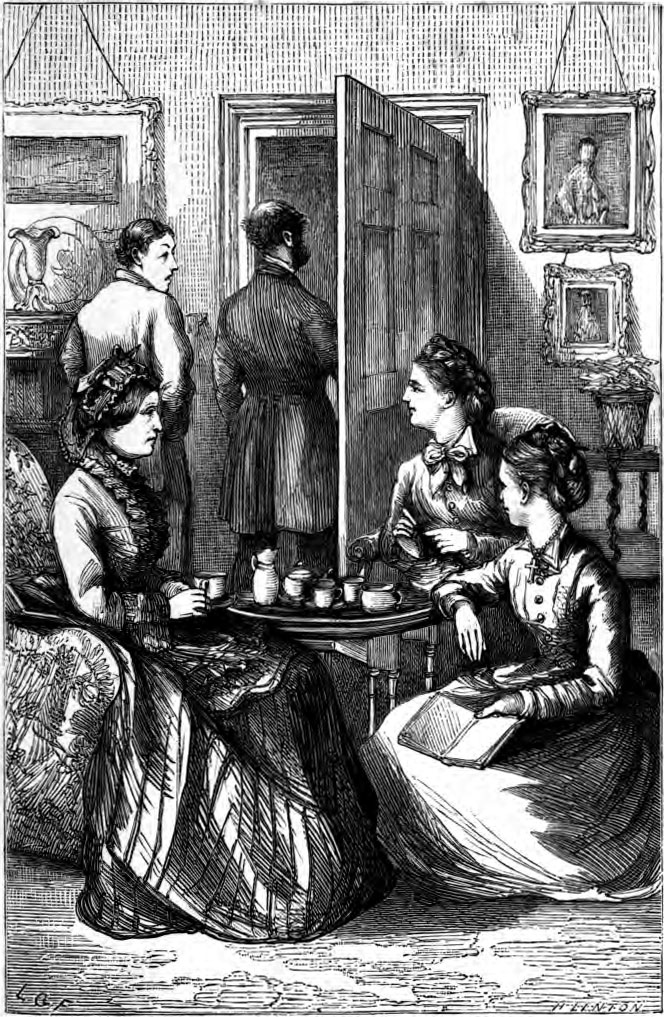
"Papa!" screamed Sophia.
"My dear, you don't mean it," said Lady Pomona.
"Of course papa doesn't mean it," said Georgiana rising to her feet.
"I mean it accurately and certainly," said Mr. Longestaffe. "We go to
Caversham in about ten days, and we shall not return from Caversham
to London this year."
"Our ball is fixed," said Lady Pomona.
"Then it must be unfixed." So saying, the master of the house left
the drawing-room and descended to his study.
The three ladies, when left to deplore their fate, expressed their
opinions as to the sentence which had been pronounced very strongly.
But the daughters were louder in their anger than was their mother.
"He can't really mean it," said Sophia.
"He does," said Lady Pomona, with tears in her eyes.
"He must unmean it again;--that's all," said Georgiana. "Dolly has
said something to him very rough, and he resents it upon us. Why did
he bring us up at all if he means to take us down before the season
has begun?"
"I wonder what Adolphus has said to him. Your papa is always hard
upon Adolphus."
"Dolly can take care of himself," said Georgiana, "and always does do
so. Dolly does not care for us."
"Not a bit," said Sophia.
"I'll tell you what you must do, mamma. You mustn't stir from this
at all. You must give up going to Caversham altogether, unless he
promises to bring us back. I won't stir,--unless he has me carried
out of the house."
"My dear, I couldn't say that to him."
"Then I will. To go and be buried down in that place for a whole year
with no one near us but the rusty old bishop and Mr. Carbury, who
is rustier still. I won't stand it. There are some sort of things
that one ought not to stand. If you go down I shall stay up with the
Primeros. Mrs. Primero would have me I know. It wouldn't be nice of
course. I don't like the Primeros. I hate the Primeros. Oh yes;--it's
quite true; I know that as well as you, Sophia; they are vulgar; but
not half so vulgar, mamma, as your friend Madame Melmotte."
"That's ill-natured, Georgiana. She is not a friend of mine."
"But you're going to have her down at Caversham. I can't think what
made you dream of going to Caversham just now, knowing as you do how
hard papa is to manage."
"Everybody has taken to going out of town at Whitsuntide, my dear."
"No, mamma; everybody has not. People understand too well the trouble
of getting up and down for that. The Primeros aren't going down. I
never heard of such a thing in all my life. What does he expect is to
become of us? If he wants to save money why doesn't he shut Caversham
up altogether and go abroad? Caversham costs a great deal more than
is spent in London, and it's the dullest house, I think, in all
England."
The family party in Bruton Street that evening was not very gay.
Nothing was being done, and they sat gloomily in each other's
company. Whatever mutinous resolutions might be formed and carried
out by the ladies of the family, they were not brought forward on
that occasion. The two girls were quite silent, and would not speak
to their father, and when he addressed them they answered simply by
monosyllables. Lady Pomona was ill, and sat in a corner of a sofa,
wiping her eyes. To her had been imparted up-stairs the purport of
the conversation between Dolly and his father. Dolly had refused to
consent to the sale of Pickering unless half the produce of the sale
were to be given to him at once. When it had been explained to him
that the sale would be desirable in order that the Caversham property
might be freed from debt, which Caversham property would eventually
be his, he replied that he also had an estate of his own which was a
little mortgaged and would be the better for money. The result seemed
to be that Pickering could not be sold,--and, as a consequence of
that, Mr. Longestaffe had determined that there should be no more
London expenses that year.
The girls, when they got up to go to bed, bent over him and kissed
his head, as was their custom. There was very little show of
affection in the kiss. "You had better remember that what you have
to do in town must be done this week," he said. They heard the words,
but marched in stately silence out of the room without deigning to
notice them.
CHAPTER XIV.
CARBURY MANOR.
"I don't think it quite nice, mamma; that's all. Of course if you
have made up your mind to go, I must go with you."
"What on earth can be more natural than that you should go to your
own cousin's house?"
"You know what I mean, mamma."
"It's done now, my dear, and I don't think there is anything at all
in what you say."
This little conversation arose from Lady Carbury's announcement
to her daughter of her intention of soliciting the hospitality of
Carbury Manor for the Whitsun week. It was very grievous to Henrietta
that she should be taken to the house of a man who was in love with
her, even though he was her cousin. But she had no escape. She could
not remain in town by herself, nor could she even allude to her
grievance to anyone but to her mother. Lady Carbury, in order that
she might be quite safe from opposition, had posted the following
letter to her cousin before she spoke to her daughter:--
Welbeck Street,
24th April, 18--.
MY DEAR ROGER,
We know how kind you are and how sincere, and that if what
I am going to propose doesn't suit you'll say so at once.
I have been working very hard,--too hard indeed, and I
feel that nothing will do me so much real good as getting
into the country for a day or two. Would you take us for a
part of Whitsun week? We would come down on the 20th May
and stay over the Sunday if you would keep us. Felix says
he would run down though he would not trouble you for so
long a time as we talk of staying.
I'm sure you must have been glad to hear of his being put
upon that Great American Railway Board as a Director. It
opens a new sphere of life to him, and will enable him to
prove that he can make himself useful. I think it was a
great confidence to place in one so young.
Of course you will say so at once if my little proposal
interferes with any of your plans, but you have been so
very very kind to us that I have no scruple in making it.
Henrietta joins with me in kind love.
Your affectionate cousin,
MATILDA CARBURY.
There was much in this letter that disturbed and even annoyed Roger
Carbury. In the first place he felt that Henrietta should not be
brought to his house. Much as he loved her, dear as her presence
to him always was, he hardly wished to have her at Carbury unless
she would come with a resolution to be its future mistress. In one
respect he did Lady Carbury an injustice. He knew that she was
anxious to forward his suit, and he thought that Henrietta was being
brought to his house with that object. He had not heard that the
great heiress was coming into his neighbourhood, and therefore knew
nothing of Lady Carbury's scheme in that direction. He was, too,
disgusted by the ill-founded pride which the mother expressed at her
son's position as a director. Roger Carbury did not believe in the
Railway. He did not believe in Fisker, nor in Melmotte, and certainly
not in the Board generally. Paul Montague had acted in opposition to
his advice in yielding to the seductions of Fisker. The whole thing
was to his mind false, fraudulent, and ruinous. Of what nature could
be a Company which should have itself directed by such men as Lord
Alfred Grendall and Sir Felix Carbury? And then as to their great
Chairman, did not everybody know, in spite of all the duchesses, that
Mr. Melmotte was a gigantic swindler? Although there was more than
one immediate cause for bitterness between them, Roger loved Paul
Montague well and could not bear with patience the appearance of
his friend's name on such a list. And now he was asked for warm
congratulations because Sir Felix Carbury was one of the Board! He
did not know which to despise most, Sir Felix for belonging to such a
Board, or the Board for having such a director. "New sphere of life!"
he said to himself. "The only proper sphere for them all would be
Newgate!"
And there was another trouble. He had asked Paul Montague to come
to Carbury for this special week, and Paul had accepted the invitation.
With the constancy, which was perhaps his strongest characteristic,
he clung to his old affection for the man. He could not bear the idea
of a permanent quarrel, though he knew that there must be a quarrel
if the man interfered with his dearest hopes. He had asked him down
to Carbury intending that the name of Henrietta Carbury should not
be mentioned between them;--and now it was proposed to him that
Henrietta Carbury should be at the Manor House at the very time of
Paul's visit! He made up his mind at once that he must tell Paul not
to come.
He wrote his two letters at once. That to Lady Carbury was very
short. He would be delighted to see her and Henrietta at the time
named,--and would be very glad should it suit Felix to come also.
He did not say a word about the Board, or the young man's probable
usefulness in his new sphere of life. To Montague his letter was
longer. "It is always best to be open and true," he said. "Since you
were kind enough to say that you would come to me, Lady Carbury has
proposed to visit me just at the same time and to bring her daughter.
After what has passed between us I need hardly say that I could not
make you both welcome here together. It is not pleasant to me to have
to ask you to postpone your visit, but I think you will not accuse me
of a want of hospitality towards you." Paul wrote back to say that
he was sure that there was no want of hospitality, and that he would
remain in town.
Suffolk is not especially a picturesque county, nor can it be said
that the scenery round Carbury was either grand or beautiful; but
there were little prettinesses attached to the house itself and the
grounds around it which gave it a charm of its own. The Carbury
River,--so called, though at no place is it so wide but that an
active schoolboy might jump across it,--runs, or rather creeps into
the Waveney, and in its course is robbed by a moat which surrounds
Carbury Manor House. The moat has been rather a trouble to the
proprietors, and especially so to Roger, as in these days of sanitary
considerations it has been felt necessary either to keep it clean
with at any rate moving water in it, or else to fill it up and
abolish it altogether. That plan of abolishing it had to be thought
of and was seriously discussed about ten years since; but then it was
decided that such a proceeding would altogether alter the character
of the house, would destroy the gardens, and would create a waste of
mud all round the place which it would take years to beautify, or
even to make endurable. And then an important question had been asked
by an intelligent farmer who had long been a tenant on the property;
"Fill un oop;--eh, eh; sooner said than doone, squoire. Where be the
stoof to come from?" The squire, therefore, had given up that idea,
and instead of abolishing his moat had made it prettier than ever.
The high road from Bungay to Beccles ran close to the house,--so
close that the gable ends of the building were separated from it
only by the breadth of the moat. A short, private road, not above
a hundred yards in length, led to the bridge which faced the front
door. The bridge was old, and high, with sundry architectural
pretensions, and guarded by iron gates in the centre, which, however,
were very rarely closed. Between the bridge and the front door there
was a sweep of ground just sufficient for the turning of a carriage,
and on either side of this the house was brought close to the water,
so that the entrance was in a recess, or irregular quadrangle, of
which the bridge and moat formed one side. At the back of the house
there were large gardens screened from the road by a wall ten feet
high, in which there were yew trees and cypresses said to be of
wonderful antiquity. The gardens were partly inside the moat, but
chiefly beyond them, and were joined by two bridges--a foot bridge
and one with a carriage way,--and there was another bridge at the end
of the house furthest from the road, leading from the back door to
the stables and farmyard.
The house itself had been built in the time of Charles II., when
that which we call Tudor architecture was giving way to a cheaper,
less picturesque, though perhaps more useful form. But Carbury Manor
House, through the whole county, had the reputation of being a Tudor
building. The windows were long, and for the most part low, made with
strong mullions, and still contained small, old-fashioned panes; for
the squire had not as yet gone to the expense of plate glass. There
was one high bow window, which belonged to the library, and which
looked out on to the gravel sweep, at the left of the front door as
you entered it. All the other chief rooms faced upon the garden. The
house itself was built of a stone that had become buff, or almost
yellow with years, and was very pretty. It was still covered with
tiles, as were all the attached buildings. It was only two stories
high, except at the end, where the kitchens were placed and the
offices, which thus rose above the other part of the edifice. The
rooms throughout were low, and for the most part long and narrow,
with large wide fire-places and deep wainscotings. Taking it
altogether, one would be inclined to say, that it was picturesque
rather than comfortable. Such as it was its owner was very proud
of it,--with a pride of which he never spoke to anyone, which he
endeavoured studiously to conceal, but which had made itself known
to all who knew him well. The houses of the gentry around him were
superior to his in material comfort and general accommodation, but to
none of them belonged that thoroughly established look of old county
position which belonged to Carbury. Bundlesham, where the Primeros
lived, was the finest house in that part of the county, but it
looked as if it had been built within the last twenty years. It
was surrounded by new shrubs and new lawns, by new walls and new
outhouses, and savoured of trade;--so at least thought Roger Carbury,
though he never said the words. Caversham was a very large mansion,
built in the early part of George III.'s reign, when men did care
that things about them should be comfortable, but did not care that
they should be picturesque. There was nothing at all to recommend
Caversham but its size. Eardly Park, the seat of the Hepworths, had,
as a park, some pretensions. Carbury possessed nothing that could be
called a park, the enclosures beyond the gardens being merely so many
home paddocks. But the house of Eardly was ugly and bad. The Bishop's
palace was an excellent gentleman's residence, but then that too was
comparatively modern, and had no peculiar features of its own. Now
Carbury Manor House was peculiar, and in the eyes of its owner was
pre-eminently beautiful.
It often troubled him to think what would come of the place when
he was gone. He was at present forty years old, and was perhaps as
healthy a man as you could find in the whole county. Those around
who had known him as he grew into manhood among them, especially the
farmers of the neighbourhood, still regarded him as a young man. They
spoke of him at the country fairs as the young squire. When in his
happiest moods he could be almost a boy, and he still had something
of old-fashioned boyish reverence for his elders. But of late there
had grown up a great care within his breast,--a care which does not
often, perhaps, in these days bear so heavily on men's hearts as it
used to do. He had asked his cousin to marry him,--having assured
himself with certainty that he did love her better than any other
woman,--and she had declined. She had refused him more than once,
and he believed her implicitly when she told him that she could
not love him. He had a way of believing people, especially when
such belief was opposed to his own interests, and had none of that
self-confidence which makes a man think that if opportunity be
allowed him he can win a woman even in spite of herself. But if it
were fated that he should not succeed with Henrietta, then,--so he
felt assured,--no marriage would now be possible to him. In that case
he must look out for an heir, and could regard himself simply as a
stop-gap among the Carburys. In that case he could never enjoy the
luxury of doing the best he could with the property in order that a
son of his own might enjoy it.
Now Sir Felix was the next heir. Roger was hampered by no entail,
and could leave every acre of the property as he pleased. In one
respect the natural succession to it by Sir Felix would generally be
considered fortunate. It had happened that a title had been won in a
lower branch of the family, and were this succession to take place
the family title and the family property would go together. No doubt
to Sir Felix himself such an arrangement would seem to be the most
proper thing in the world,--as it would also to Lady Carbury were it
not that she looked to Carbury Manor as the future home of another
child. But to all this the present owner of the property had very
strong objections. It was not only that he thought ill of the baronet
himself,--so ill as to feel thoroughly convinced that no good
could come from that quarter,--but he thought ill also of the
baronetcy itself. Sir Patrick, to his thinking, had been altogether
unjustifiable in accepting an enduring title, knowing that he would
leave behind him no property adequate for its support. A baronet, so
thought Roger Carbury, should be a rich man, rich enough to grace the
rank which he assumed to wear. A title, according to Roger's doctrine
on such subjects, could make no man a gentleman, but, if improperly
worn, might degrade a man who would otherwise be a gentleman. He
thought that a gentleman, born and bred, acknowledged as such without
doubt, could not be made more than a gentleman by all the titles
which the Queen could give. With these old-fashioned notions Roger
hated the title which had fallen upon a branch of his family. He
certainly would not leave his property to support the title which Sir
Felix unfortunately possessed. But Sir Felix was the natural heir,
and this man felt himself constrained, almost as by some divine law,
to see that his land went by natural descent. Though he was in no
degree fettered as to its disposition, he did not presume himself to
have more than a life interest in the estate. It was his duty to see
that it went from Carbury to Carbury as long as there was a Carbury
to hold it, and especially his duty to see that it should go from
his hands, at his death, unimpaired in extent or value. There was
no reason why he should himself die for the next twenty or thirty
years,--but were he to die Sir Felix would undoubtedly dissipate the
acres, and then there would be an end of Carbury. But in such case
he, Roger Carbury, would at any rate have done his duty. He knew that
no human arrangements can be fixed, let the care in making them be
ever so great. To his thinking it would be better that the estate
should be dissipated by a Carbury than held together by a stranger.
He would stick to the old name while there was one to bear it, and
to the old family while a member of it was left. So thinking he had
already made his will, leaving the entire property to the man whom of
all others he most despised, should he himself die without child.
In the afternoon of the day on which Lady Carbury was expected, he
wandered about the place thinking of all this. How infinitely better
it would be that he should have an heir of his own. How wonderfully
beautiful would the world be to him if at last his cousin would
consent to be his wife! How wearily insipid must it be if no such
consent could be obtained from her. And then he thought much of her
welfare too. In very truth he did not like Lady Carbury. He saw
through her character, judging her with almost absolute accuracy. The
woman was affectionate, seeking good things for others rather than
for herself; but she was essentially worldly, believing that good
could come out of evil, that falsehood might in certain conditions be
better than truth, that shams and pretences might do the work of true
service, that a strong house might be built upon the sand! It was
lamentable to him that the girl he loved should be subjected to this
teaching, and live in an atmosphere so burdened with falsehood. Would
not the touch of pitch at last defile her? In his heart of hearts he
believed that she loved Paul Montague; and of Paul himself he was
beginning to fear evil. What but a sham could be a man who consented
to pretend to sit as one of a Board of Directors to manage an
enormous enterprise with such colleagues as Lord Alfred Grendall and
Sir Felix Carbury, under the absolute control of such a one as Mr.
Augustus Melmotte? Was not this building a house upon the sand with
a vengeance? What a life it would be for Henrietta Carbury were she
to marry a man striving to become rich without labour and without
capital, and who might one day be wealthy and the next a beggar,--a
city adventurer, who of all men was to him the vilest and most
dishonest? He strove to think well of Paul Montague, but such was
the life which he feared the young man was preparing for himself.
Then he went into the house and wandered up through the rooms
which the two ladies were to occupy. As their host, a host without
a wife or mother or sister, it was his duty to see that things were
comfortable, but it may be doubted whether he would have been so
careful had the mother been coming alone. In the smaller room of the
two the hangings were all white, and the room was sweet with May
flowers; and he brought a white rose from the hot-house, and placed
it in a glass on the dressing table. Surely she would know who put it
there.
Then he stood at the open window, looking down upon the lawn, gazing
vacantly for half an hour, till he heard the wheels of the carriage
before the front door. During that half hour he resolved that he
would try again as though there had as yet been no repulse.
CHAPTER XV.
"YOU SHOULD REMEMBER THAT I AM HIS MOTHER."
"This is so kind of you," said Lady Carbury, grasping her cousin's
hand as she got out of the carriage.
"The kindness is on your part," said Roger.
"I felt so much before I dared to ask you to take us. But I did so
long to get into the country, and I do so love Carbury. And--and--"
"Where should a Carbury go to escape from London smoke, but to the
old house? I am afraid Henrietta will find it dull."
"Oh no," said Hetta smiling. "You ought to remember that I am never
dull in the country."
"The bishop and Mrs. Yeld are coming here to dine to-morrow,--and the
Hepworths."
"I shall be so glad to meet the bishop once more," said Lady Carbury.
"I think everybody must be glad to meet him, he is such a dear, good
fellow, and his wife is just as good. And there is another gentleman
coming whom you have never seen."
"A new neighbour?"
"Yes,--a new neighbour;--Father John Barham, who has come to Beccles
as priest. He has got a little cottage about a mile from here, in this parish,
and does duty both at Beccles and Bungay. I used to know something
of his family."
"He is a gentleman then?"
"Certainly he is a gentleman. He took his degree at Oxford, and
then became what we call a pervert, and what I suppose they call a
convert. He has not got a shilling in the world beyond what they
pay him as a priest, which I take it amounts to about as much as
the wages of a day labourer. He told me the other day that he was
absolutely forced to buy second-hand clothes."
"How shocking!" said Lady Carbury, holding up her hands.
"He didn't seem to be at all shocked at telling it. We have got to be
quite friends."
"Will the bishop like to meet him?"
"Why should not the bishop like to meet him? I've told the bishop all
about him, and the bishop particularly wishes to know him. He won't
hurt the bishop. But you and Hetta will find it very dull."
"I shan't find it dull, Mr. Carbury," said Henrietta.
"It was to escape from the eternal parties that we came down here,"
said Lady Carbury. She had nevertheless been anxious to hear what
guests were expected at the Manor House. Sir Felix had promised to
come down on Saturday, with the intention of returning on Monday, and
Lady Carbury had hoped that some visiting might be arranged between
Caversham and the Manor House, so that her son might have the full
advantage of his closeness to Marie Melmotte.
"I have asked the Longestaffes for Monday," said Roger.
"They are down here then?"
"I think they arrived yesterday. There is always a flustering breeze
in the air and a perturbation generally through the county when they
come or go, and I think I perceived the effects about four in the
afternoon. They won't come, I dare say."
"Why not?"
"They never do. They have probably a house full of guests, and they
know that my accommodation is limited. I've no doubt they'll ask us
on Tuesday or Wednesday, and if you like we will go."
"I know they are to have guests," said Lady Carbury.
"What guests?"
"The Melmottes are coming to them." Lady Carbury, as she made the
announcement, felt that her voice and countenance and self-possession
were failing her, and that she could not mention the thing as she
would any matter that was indifferent to her.
"The Melmottes coming to Caversham!" said Roger, looking at Henri-
etta, who blushed with shame as she remembered that she had been
brought into her lover's house solely in order that her brother might
have an opportunity of seeing Marie Melmotte in the country.
"Oh yes,--Madame Melmotte told me. I take it they are very intimate."
"Mr. Longestaffe ask the Melmottes to visit him at Caversham!"
"Why not?"
"I should almost as soon have believed that I myself might have been
induced to ask them here."
"I fancy, Roger, that Mr. Longestaffe does want a little pecuniary
assistance."
"And he condescends to get it in this way! I suppose it will make no
difference soon whom one knows, and whom one doesn't. Things aren't
as they were, of course, and never will be again. Perhaps it's all
for the better;--I won't say it isn't. But I should have thought that
such a man as Mr. Longestaffe might have kept such another man as Mr.
Melmotte out of his wife's drawing-room." Henrietta became redder
than ever. Even Lady Carbury flushed up, as she remembered that Roger
Carbury knew that she had taken her daughter to Madame Melmotte's
ball. He thought of this himself as soon as the words were spoken,
and then tried to make some half apology. "I don't approve of them
in London, you know; but I think they are very much worse in the
country."
Then there was a movement. The ladies were shown into their rooms,
and Roger again went out into the garden. He began to feel that he
understood it all. Lady Carbury had come down to his house in order
that she might be near the Melmottes! There was something in this
which he felt it difficult not to resent. It was for no love of him
that she was there. He had felt that Henrietta ought not to have been
brought to his house; but he could have forgiven that, because her
presence there was a charm to him. He could have forgiven that, even
while he was thinking that her mother had brought her there with
the object of disposing of her. If it were so, the mother's object
would be the same as his own, and such a manoeuvre he could pardon,
though he could not approve. His self-love had to some extent been
gratified. But now he saw that he and his house had been simply used
in order that a vile project of marrying two vile people to each
other might be furthered!
As he was thinking of all this, Lady Carbury came out to him in
the garden. She had changed her travelling dress, and made herself
pretty, as she well knew how to do. And now she dressed her face in
her sweetest smiles. Her mind, also, was full of the Melmottes, and
she wished to explain to her stern, unbending cousin all the good
that might come to her and hers by an alliance with the heiress. "I
can understand, Roger," she said, taking his arm, "that you should
not like those people."
"What people?"
"The Melmottes."
"I don't dislike them. How should I dislike people that I never saw?
I dislike those who seek their society simply because they have the
reputation of being rich."
"Meaning me."
"No; not meaning you. I don't dislike you, as you know very well,
though I do dislike the fact that you should run after these people.
I was thinking of the Longestaffes then."
"Do you suppose, my friend, that I run after them for my own
gratification? Do you think that I go to their house because I find
pleasure in their magnificence; or that I follow them down here for
any good that they will do me?"
"I would not follow them at all."
"I will go back if you bid me, but I must first explain what I mean.
You know my son's condition,--better, I fear, than he does himself."
Roger nodded assent to this, but said nothing. "What is he to do? The
only chance for a young man in his position is that he should marry a
girl with money. He is good-looking; you can't deny that."
"Nature has done enough for him."
"We must take him as he is. He was put into the army very young, and
was very young when he came into possession of his own small fortune.
He might have done better; but how many young men placed in such
temptations do well? As it is, he has nothing left."
"I fear not."
"And therefore is it not imperative that he should marry a girl with
money?"
"I call that stealing a girl's money, Lady Carbury."
"Oh, Roger, how hard you are!"
"A man must be hard or soft,--which is best?"
"With women I think that a little softness has the most effect. I
want to make you understand this about the Melmottes. It stands to
reason that the girl will not marry Felix unless she loves him."
"But does he love her?"
"Why should he not? Is a girl to be debarred from being loved because
she has money? Of course she looks to be married, and why should she
not have Felix if she likes him best? Cannot you sympathize with my
anxiety so to place him that he shall not be a disgrace to the name
and to the family?"
"We had better not talk about the family, Lady Carbury."
"But I think so much about it."
"You will never get me to say that I think the family will be
benefited by a marriage with the daughter of Mr. Melmotte. I look
upon him as dirt in the gutter. To me, in my old-fashioned way, all
his money, if he has it, can make no difference. When there is a
question of marriage people at any rate should know something of each
other. Who knows anything of this man? Who can be sure that she is
his daughter?"
"He would give her her fortune when she married."
"Yes; it all comes to that. Men say openly that he is an adventurer
and a swindler. No one pretends to think that he is a gentleman.
There is a consciousness among all who speak of him that he amasses
his money not by honest trade, but by unknown tricks,--as does a card
sharper. He is one whom we would not admit into our kitchens, much
less to our tables, on the score of his own merits. But because he
has learned the art of making money, we not only put up with him, but
settle upon his carcase as so many birds of prey."
"Do you mean that Felix should not marry the girl, even if they love
each other?"
He shook his head in disgust, feeling sure that any idea of love on
the part of the young man was a sham and a pretence, not only as
regarded him, but also his mother. He could not quite declare this,
and yet he desired that she should understand that he thought so.
"I have nothing more to say about it," he continued. "Had it gone on
in London I should have said nothing. It is no affair of mine. When
I am told that the girl is in the neighbourhood, at such a house as
Caversham, and that Felix is coming here in order that he may be near
to his prey, and when I am asked to be a party to the thing, I can
only say what I think. Your son would be welcome to my house, because
he is your son and my cousin, little as I approve his mode of life;
but I could have wished that he had chosen some other place for the
work that he has on hand."
"If you wish it, Roger, we will return to London. I shall find it
hard to explain to Hetta;--but we will go."
"No; I certainly do not wish that."
"But you have said such hard things! How are we to stay? You speak
of Felix as though he were all bad." She looked at him hoping to get
from him some contradiction of this, some retractation, some kindly
word; but it was what he did think, and he had nothing to say. She
could bear much. She was not delicate as to censure implied, or even
expressed. She had endured rough usage before, and was prepared to
endure more. Had he found fault with herself, or with Henrietta, she
would have put up with it, for the sake of benefits to come,--would
have forgiven it the more easily because perhaps it might not have
been deserved. But for her son she was prepared to fight. If she did
not defend him, who would? "I am grieved, Roger, that we should have
troubled you with our visit, but I think that we had better go. You
are very harsh, and it crushes me."
"I have not meant to be harsh."
"You say that Felix is seeking for his--prey, and that he is to be
brought here to be near--his prey. What can be more harsh than that?
At any rate, you should remember that I am his mother."
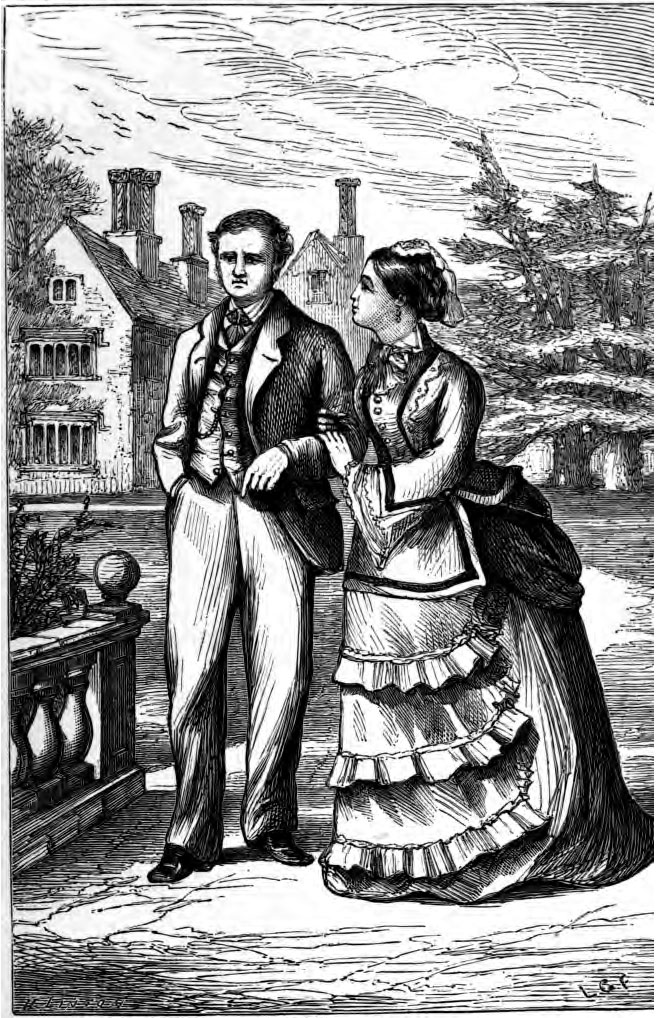
She expressed her sense of injury very well. Roger began to be
ashamed of himself, and to think that he had spoken unkind words. And
yet he did not know how to recall them. "If I have hurt you, I regret
it much."
"Of course you have hurt me. I think I will go in now. How very hard
the world is! I came here thinking to find peace and sunshine, and
there has come a storm at once."
"You asked me about the Melmottes, and I was obliged to speak. You
cannot think that I meant to offend you." They walked on in silence
till they had reached the door leading from the garden into the
house, and here he stopped her. "If I have been over hot with you,
let me beg your pardon." She smiled and bowed; but her smile was not
one of forgiveness; and then she essayed to pass on into the house.
"Pray do not speak of going, Lady Carbury."
"I think I will go to my room now. My head aches so that I can hardly
stand."
It was late in the afternoon,--about six,--and according to his daily
custom he should have gone round to the offices to see his men as
they came from their work, but he stood still for a few moments on
the spot where Lady Carbury had left him and went slowly across the
lawn to the bridge and there seated himself on the parapet. Could it
really be that she meant to leave his house in anger and to take her
daughter with her? Was it thus that he was to part with the one human
being in the world that he loved? He was a man who thought much of
the duties of hospitality, feeling that a man in his own house was
bound to exercise a courtesy towards his guests sweeter, softer, more
gracious than the world required elsewhere. And of all guests those
of his own name were the best entitled to such courtesy at Carbury.
He held the place in trust for the use of others. But if there were
one among all others to whom the house should be a house of refuge
from care, not an abode of trouble, on whose behalf were it possible
he would make the very air softer, and the flowers sweeter than their
wont, to whom he would declare, were such words possible to his
tongue, that of him and of his house, and of all things there she was
the mistress, whether she would condescend to love him or no,--that
one was his cousin Hetta. And now he had been told by his guest that
he had been so rough to her that she and her daughter must return to
London!
And he could not acquit himself. He knew that he had been rough.
He had said very hard words. It was true that he could not have
expressed his meaning without hard words, nor have repressed his
meaning without self-reproach. But in his present mood he could not
comfort himself by justifying himself. She had told him that he ought
to have remembered that Felix was her son; and as she spoke she had
acted well the part of an outraged mother. His heart was so soft that
though he knew the woman to be false and the son to be worthless, he
utterly condemned himself. Look where he would there was no comfort.
When he had sat half-an-hour upon the bridge he turned towards the
house to dress for dinner,--and to prepare himself for an apology, if
any apology might be accepted. At the door, standing in the doorway
as though waiting for him, he met his cousin Hetta. She had on her
bosom the rose he had placed in her room, and as he approached her he
thought that there was more in her eyes of graciousness towards him
than he had ever seen there before.
"Mr. Carbury," she said, "mamma is so unhappy!"
"I fear that I have offended her."
"It is not that, but that you should be so,--so angry about Felix."
"I am vexed with myself that I have vexed her,--more vexed than I can
tell you."
"She knows how good you are."
"No, I'm not. I was very bad just now. She was so offended with me
that she talked of going back to London." He paused for her to speak,
but Hetta had no words ready for the moment. "I should be wretched
indeed if you and she were to leave my house in anger."
"I do not think she will do that."
"And you?"
"I am not angry. I should never dare to be angry with you. I only
wish that Felix would be better. They say that young men have to be
bad, and that they do get to be better as they grow older. He is
something in the city now, a director they call him, and mamma thinks
that the work will be of service to him." Roger could express no
hope in this direction or even look as though he approved of the
directorship. "I don't see why he should not try at any rate."
"Dear Hetta, I only wish he were like you."
"Girls are so different, you know."
It was not till late in the evening, long after dinner, that he made
his apology in form to Lady Carbury; but he did make it, and at last
it was accepted. "I think I was rough to you, talking about Felix,"
he said,--"and I beg your pardon."
"You were energetic, that was all."
"A gentleman should never be rough to a lady, and a man should never
be rough to his own guests. I hope you will forgive me." She answered
him by putting out her hand and smiling on him; and so the quarrel
was over.
Lady Carbury understood the full extent of her triumph, and was
enabled by her disposition to use it thoroughly. Felix might now
come down to Carbury, and go over from thence to Caversham, and
prosecute his wooing, and the master of Carbury could make no further
objection. And Felix, if he would come, would not now be snubbed.
Roger would understand that he was constrained to courtesy by the
former severity of his language. Such points as these Lady Carbury
never missed. He understood it too, and though he was soft and
gracious in his bearing, endeavouring to make his house as pleasant
as he could to his two guests, he felt that he had been cheated out
of his undoubted right to disapprove of all connection with the
Melmottes. In the course of the evening there came a note,--or rather
a bundle of notes,--from Caversham. That addressed to Roger was
in the form of a letter. Lady Pomona was sorry to say that the
Longestaffe party were prevented from having the pleasure of dining
at Carbury Hall by the fact that they had a house full of guests.
Lady Pomona hoped that Mr. Carbury and his relatives, who, Lady
Pomona heard, were with him at the Hall, would do the Longestaffes
the pleasure of dining at Caversham either on the Monday or Tuesday
following, as might best suit the Carbury plans. That was the purport
of Lady Pomona's letter to Roger Carbury. Then there were cards of
invitation for Lady Carbury and her daughter, and also for Sir Felix.
Roger, as he read his own note, handed the others over to Lady
Carbury, and then asked her what she would wish to have done. The
tone of his voice, as he spoke, grated on her ear, as there was
something in it of his former harshness. But she knew how to use her
triumph. "I should like to go," she said.
"I certainly shall not go," he replied; "but there will be no
difficulty whatever in sending you over. You must answer at once,
because their servant is waiting."
"Monday will be best," she said; "--that is, if nobody is coming
here."
"There will be nobody here."
"I suppose I had better say that I, and Hetta,--and Felix will accept
their invitation."
"I can make no suggestion," said Roger, thinking how delightful it
would be if Henrietta could remain with him; how objectionable it was
that Henrietta should be taken to Caversham to meet the Melmottes.
Poor Hetta herself could say nothing. She certainly did not wish to
meet the Melmottes, nor did she wish to dine, alone, with her cousin
Roger.
"That will be best," said Lady Carbury after a moment's thought. "It
is very good of you to let us go, and to send us."
"Of course you will do here just as you please," he replied. But
there was still that tone in his voice which Lady Carbury feared. A
quarter of an hour later the Caversham servant was on his way home
with two letters,--the one from Roger expressing his regret that he
could not accept Lady Pomona's invitation, and the other from Lady
Carbury declaring that she and her son and daughter would have great
pleasure in dining at Caversham on the Monday.
CHAPTER XVI.
THE BISHOP AND THE PRIEST.
The afternoon on which Lady Carbury arrived at her cousin's house had
been very stormy. Roger Carbury had been severe, and Lady Carbury
had suffered under his severity,--or had at least so well pretended
to suffer as to leave on Roger's mind a strong impression that he
had been cruel to her. She had then talked of going back at once to
London, and when consenting to remain, had remained with a very bad
feminine headache. She had altogether carried her point, but had
done so in a storm. The next morning was very calm. That question of
meeting the Melmottes had been settled, and there was no need for
speaking of them again. Roger went out by himself about the farm,
immediately after breakfast, having told the ladies that they could
have the waggonnette when they pleased. "I'm afraid you'll find it
tiresome driving about our lanes," he said. Lady Carbury assured him
that she was never dull when left alone with books. Just as he was
starting he went into the garden and plucked a rose which he brought
to Henrietta. He only smiled as he gave it her, and then went his
way. He had resolved that he would say nothing to her of his suit
till Monday. If he could prevail with her then he would ask her to
remain with him when her mother and brother would be going out to
dine at Caversham. She looked up into his face as she took the rose
and thanked him in a whisper. She fully appreciated the truth, and
honour, and honesty of his character, and could have loved him so
dearly as her cousin if he would have contented himself with such
cousinly love! She was beginning, within her heart, to take his side
against her mother and brother, and to feel that he was the safest
guide that she could have. But how could she be guided by a lover
whom she did not love?
"I am afraid, my dear, we shall have a bad time of it here," said
Lady Carbury.
"Why so, mamma?"
"It will be so dull. Your cousin is the best friend in all the world,
and would make as good a husband as could be picked out of all the
gentlemen of England; but in his present mood with me he is not a
comfortable host. What nonsense he did talk about the Melmottes!"
"I don't suppose, mamma, that Mr. and Mrs. Melmotte can be nice
people."
"Why shouldn't they be as nice as anybody else? Pray, Henrietta,
don't let us have any of that nonsense from you. When it comes from
the superhuman virtue of poor dear Roger it has to be borne, but I
beg that you will not copy him."
"Mamma, I think that is unkind."
"And I shall think it very unkind if you take upon yourself to abuse
people who are able and willing to set poor Felix on his legs. A word
from you might undo all that we are doing."
"What word?"
"What word? Any word! If you have any influence with your brother you
should use it in inducing him to hurry this on. I am sure the girl is
willing enough. She did refer him to her father."
"Then why does he not go to Mr. Melmotte?"
"I suppose he is delicate about it on the score of money. If Roger
could only let it be understood that Felix is the heir to this place,
and that some day he will be Sir Felix Carbury of Carbury, I don't
think there would be any difficulty even with old Melmotte."
"How could he do that, mamma?"
"If your cousin were to die as he is now, it would be so. Your
brother would be his heir."
"You should not think of such a thing, mamma."
"Why do you dare to tell me what I am to think? Am I not to think
of my own son? Is he not to be dearer to me than any one? And what
I say, is so. If Roger were to die to-morrow he would be Sir Felix
Carbury of Carbury."
"But, mamma, he will live and have a family. Why should he not?"
"You say he is so old that you will not look at him."
"I never said so. When we were joking, I said he was old. You know
I did not mean that he was too old to get married. Men a great deal
older get married every day."
"If you don't accept him he will never marry. He is a man of that
kind,--so stiff and stubborn and old-fashioned that nothing will
change him. He will go on boodying over it, till he will become an
old misanthrope. If you would take him I would be quite contented.
You are my child as well as Felix. But if you mean to be obstinate
I do wish that the Melmottes should be made to understand that the
property and title and name of the place will all go together. It
will be so, and why should not Felix have the advantage?"
"Who is to say it?"
"Ah;--that's where it is. Roger is so violent and prejudiced that one
cannot get him to speak rationally."
"Oh, mamma;--you wouldn't suggest it to him;--that this place is to
go to--Felix, when he--is dead!"
"It would not kill him a day sooner."
"You would not dare to do it, mamma."
"I would dare to do anything for my children. But you need not look
like that, Henrietta. I am not going to say anything to him of the
kind. He is not quick enough to understand of what infinite service
he might be to us without in any way hurting himself." Henrietta
would fain have answered that their cousin was quick enough for
anything, but was by far too honest to take part in such a scheme
as that proposed. She refrained, however, and was silent. There
was no sympathy on the matter between her and her mother. She was
beginning to understand the tortuous mazes of manoeuvres in which
her mother's mind had learned to work, and to dislike and almost to
despise them. But she felt it to be her duty to abstain from rebukes.
In the afternoon Lady Carbury, alone, had herself driven into Beccles
that she might telegraph to her son. "You are to dine at Caversham
on Monday. Come on Saturday if you can. She is there." Lady Carbury
had many doubts as to the wording of this message. The female in
the office might too probably understand who was the "She," who
was spoken of as being at Caversham, and might understand also
the project, and speak of it publicly. But then it was essential
that Felix should know how great and certain was the opportunity
afforded to him. He had promised to come on Saturday and return on
Monday,--and, unless warned, would too probably stick to his plan and
throw over the Longestaffes and their dinner-party. Again if he were
told to come simply for the Monday, he would throw over the chance
of wooing her on the Sunday. It was Lady Carbury's desire to get him
down for as long a period as was possible, and nothing surely would
so tend to bring him and to keep him, as a knowledge that the heiress
was already in the neighbourhood. Then she returned, and shut herself
up in her bedroom, and worked for an hour or two at a paper which she
was writing for the "Breakfast Table." Nobody should ever accuse her
justly of idleness. And afterwards, as she walked by herself round
and round the garden, she revolved in her mind the scheme of a new
book. Whatever might happen she would persevere. If the Carburys
were unfortunate their misfortunes should come from no fault of hers.
Henrietta passed the whole day alone. She did not see her cousin from
breakfast till he appeared in the drawing-room before dinner. But she
was thinking of him during every minute of the day,--how good he was,
how honest, how thoroughly entitled to demand at any rate kindness
at her hand! Her mother had spoken of him as of one who might be
regarded as all but dead and buried, simply because of his love for
her. Could it be true that his constancy was such that he would never
marry unless she would take his hand? She came to think of him with
more tenderness than she had ever felt before, but, yet, she would
not tell herself she loved him. It might, perhaps, be her duty to
give herself to him without loving him,--because he was so good; but
she was sure that she did not love him.
In the evening the bishop came, and his wife, Mrs. Yeld, and the
Hepworths of Eardly, and Father John Barham, the Beccles priest. The
party consisted of eight, which is, perhaps, the best number for a
mixed gathering of men and women at a dinner-table,--especially if
there be no mistress whose prerogative and duty it is to sit opposite
to the master. In this case Mr. Hepworth faced the giver of the
feast, the bishop and the priest were opposite to each other, and the
ladies graced the four corners. Roger, though he spoke of such things
to no one, turned them over much in his mind, believing it to be the
duty of a host to administer in all things to the comfort of his
guests. In the drawing-room he had been especially courteous to the
young priest, introducing him first to the bishop and his wife, and
then to his cousins. Henrietta watched him through the whole evening,
and told herself that he was a very mirror of courtesy in his own
house. She had seen it all before, no doubt; but she had never
watched him as she now watched him since her mother had told her that
he would die wifeless and childless because she would not be his wife
and the mother of his children.
The bishop was a man sixty years of age, very healthy and hand-
some, with hair just becoming grey, clear eyes, a kindly mouth, and
something of a double chin. He was all but six feet high, with a broad
chest, large hands, and legs which seemed to have been made for
clerical breeches and clerical stockings. He was a man of fortune
outside his bishopric; and, as he never went up to London, and had
no children on whom to spend his money, he was able to live as a
nobleman in the country. He did live as a nobleman, and was very
popular. Among the poor around him he was idolized, and by such
clergy of his diocese as were not enthusiastic in their theology
either on the one side or on the other, he was regarded as a model
bishop. By the very high and the very low,--by those rather who
regarded ritualism as being either heavenly or devilish,--he was
looked upon as a time-server, because he would not put to sea in
either of those boats. He was an unselfish man, who loved his
neighbour as himself, and forgave all trespasses, and thanked God for
his daily bread from his heart, and prayed heartily to be delivered
from temptation. But I doubt whether he was competent to teach a
creed,--or even to hold one, if it be necessary that a man should
understand and define his creed before he can hold it. Whether he was
free from, or whether he was scared by, any inward misgivings, who
shall say? If there were such he never whispered a word of them even
to the wife of his bosom. From the tone of his voice and the look
of his eye, you would say that he was unscathed by that agony which
doubt on such a matter would surely bring to a man so placed. And yet
it was observed of him that he never spoke of his faith, or entered
into arguments with men as to the reasons on which he had based it.
He was diligent in preaching,--moral sermons that were short, pithy,
and useful. He was never weary in furthering the welfare of his
clergymen. His house was open to them and to their wives. The edifice
of every church in his diocese was a care to him. He laboured at
schools, and was zealous in improving the social comforts of the
poor; but he was never known to declare to man or woman that the
human soul must live or die for ever according to its faith. Perhaps
there was no bishop in England more loved or more useful in his
diocese than the Bishop of Elmham.
A man more antagonistic to the bishop than Father John Barham, the
lately appointed Roman Catholic priest at Beccles, it would be
impossible to conceive;--and yet they were both eminently good men.
Father John was not above five feet nine in height, but so thin, so
meagre, so wasted in appearance, that, unless when he stooped, he
was taken to be tall. He had thick dark brown hair, which was cut
short in accordance with the usage of his Church; but which he so
constantly ruffled by the action of his hands, that, though short, it
seemed to be wild and uncombed. In his younger days, when long locks
straggled over his forehead, he had acquired a habit, while talking
energetically, of rubbing them back with his finger, which he had not
since dropped. In discussions he would constantly push back his hair,
and then sit with his hand fixed on the top of his head. He had a
high, broad forehead, enormous blue eyes, a thin, long nose, cheeks
very thin and hollow, a handsome large mouth, and a strong square
chin. He was utterly without worldly means, except those which came
to him from the ministry of his church, and which did not suffice to
find him food and raiment; but no man ever lived more indifferent to
such matters than Father John Barham. He had been the younger son
of an English country gentleman of small fortune, had been sent to
Oxford that he might hold a family living, and on the eve of his
ordination had declared himself a Roman Catholic. His family had
resented this bitterly, but had not quarrelled with him till he had
drawn a sister with him. When banished from the house he had still
striven to achieve the conversion of other sisters by his letters,
and was now absolutely an alien from his father's heart and care.
But of this he never complained. It was a part of the plan of his
life that he should suffer for his faith. Had he been able to change
his creed without incurring persecution, worldly degradation, and
poverty, his own conversion would not have been to him comfortable
and satisfactory as it was. He considered that his father, as a
Protestant,--and in his mind Protestant and heathen were all the
same,--had been right to quarrel with him. But he loved his father,
and was endless in prayer, wearying his saints with supplications,
that his father might see the truth and be as he was.
To him it was everything that a man should believe and obey,--that
he should abandon his own reason to the care of another or of o-
thers, and allow himself to be guided in all things by authority. Faith
being sufficient and of itself all in all, moral conduct could be
nothing to a man, except as a testimony of faith; for to him, whose
belief was true enough to produce obedience, moral conduct would
certainly be added. The dogmas of his Church were to Father Barham
a real religion; and he would teach them in season and out of
season, always ready to commit himself to the task of proving their
truth, afraid of no enemy, not even fearing the hostility which his
perseverance would create. He had but one duty before him,--to do
his part towards bringing over the world to his faith. It might be that
with the toil of his whole life he should convert but one; that he
should but half convert one; that he should do no more than disturb
the thoughts of one so that future conversion might be possible. But
even that would be work done. He would sow the seed if it might be
so; but if it were not given to him to do that, he would at any rate
plough the ground.
He had come to Beccles lately, and Roger Carbury had found out that
he was a gentleman by birth and education. Roger had found out
also that he was very poor, and had consequently taken him by the
hand. The young priest had not hesitated to accept his neighbour's
hospitality, having on one occasion laughingly protested that he
should be delighted to dine at Carbury, as he was much in want of
a dinner. He had accepted presents from the garden and the poultry
yard, declaring that he was too poor to refuse anything. The apparent
frankness of the man about himself had charmed Roger, and the charm
had not been seriously disturbed when Father Barham, on one winter
evening in the parlour at Carbury, had tried his hand at converting
his host. "I have the most thorough respect for your religion," Roger
had said; "but it would not suit me." The priest had gone on with his
logic; if he could not sow the seed he might plough the ground. This
had been repeated two or three times, and Roger had begun to feel it
to be disagreeable. But the man was in earnest, and such earnestness
commanded respect. And Roger was quite sure that though he might be
bored, he could not be injured by such teaching. Then it occurred to
him one day that he had known the Bishop of Elmham intimately for a
dozen years, and had never heard from the bishop's mouth,--except
when in the pulpit,--a single word of religious teaching; whereas
this man, who was a stranger to him, divided from him by the very
fact of his creed, was always talking to him about his faith. Roger
Carbury was not a man given to much deep thinking, but he felt that
the bishop's manner was the pleasanter of the two.
Lady Carbury at dinner was all smiles and pleasantness. No one
looking at her, or listening to her, could think that her heart was
sore with many troubles. She sat between the bishop and her cousin,
and was skilful enough to talk to each without neglecting the other.
She had known the bishop before, and had on one occasion spoken to
him of her soul. The first tone of the good man's reply had convinced
her of her error, and she never repeated it. To Mr. Alf she commonly
talked of her mind; to Mr. Broune of her heart; to Mr. Booker of
her body--and its wants. She was quite ready to talk of her soul on
a proper occasion, but she was much too wise to thrust the subject
even on a bishop. Now she was full of the charms of Carbury and its
neighbourhood. "Yes, indeed," said the bishop, "I think Suffolk is a
very nice county; and as we are only a mile or two from Norfolk, I'll
say as much for Norfolk too. 'It's an ill bird that fouls its own
nest.'"
"I like a county in which there is something left of county feeling,"
said Lady Carbury. "Staffordshire and Warwickshire, Cheshire and
Lancashire have become great towns, and have lost all local
distinctions."
"We still keep our name and reputation," said the bishop; "Silly
Suffolk!"
"But that was never deserved."
"As much, perhaps, as other general epithets. I think we are a sleepy
people. We've got no coal, you see, and no iron. We have no beautiful
scenery, like the lake country,--no rivers great for fishing, like
Scotland,--no hunting grounds, like the shires."
"Partridges!" pleaded Lady Carbury, with pretty energy.
"Yes; we have partridges, fine churches, and the herring fishery.
We shall do very well if too much is not expected of us. We can't
increase and multiply as they do in the great cities."
"I like this part of England so much the best for that very reason.
What is the use of a crowded population?"
"The earth has to be peopled, Lady Carbury."
"Oh, yes," said her ladyship, with some little reverence added to her
voice, feeling that the bishop was probably adverting to a divine
arrangement. "The world must be peopled; but for myself I like the
country better than the town."
"So do I," said Roger; "and I like Suffolk. The people are hearty,
and radicalism is not quite so rampant as it is elsewhere. The poor
people touch their hats, and the rich people think of the poor. There
is something left among us of old English habits."
"That is so nice," said Lady Carbury.
"Something left of old English ignorance," said the bishop. "All the
same I dare say we're improving, like the rest of the world. What
beautiful flowers you have here, Mr. Carbury! At any rate, we can
grow flowers in Suffolk."
Mrs. Yeld, the bishop's wife, was sitting next to the priest, and
was in truth somewhat afraid of her neighbour. She was, perhaps, a
little stauncher than her husband in Protestantism; and though she
was willing to admit that Mr. Barham might not have ceased to be a
gentleman when he became a Roman Catholic priest, she was not quite
sure that it was expedient for her or her husband to have much to do
with him. Mr. Carbury had not taken them unawares. Notice had been
given that the priest was to be there, and the bishop had declared
that he would be very happy to meet the priest. But Mrs. Yeld had had
her misgivings. She never ventured to insist on her opinion after the
bishop had expressed his; but she had an idea that right was right,
and wrong wrong,--and that Roman Catholics were wrong, and therefore
ought to be put down. And she thought also that if there were no
priests there would be no Roman Catholics. Mr. Barham was, no doubt,
a man of good family, which did make a difference.
Mr. Barham always made his approaches very gradually. The taciturn
humility with which he commenced his operations was in exact
proportion to the enthusiastic volubility of his advanced intimacy.
Mrs. Yeld thought that it became her to address to him a few civil
words, and he replied to her with a shame-faced modesty that almost
overcame her dislike to his profession. She spoke of the poor
of Beccles, being very careful to allude only to their material
position. There was too much beer drunk, no doubt, and the young
women would have finery. Where did they get the money to buy those
wonderful bonnets which appeared every Sunday? Mr. Barham was very
meek, and agreed to everything that was said. No doubt he had a plan
ready formed for inducing Mrs. Yeld to have mass said regularly
within her husband's palace, but he did not even begin to bring it
about on this occasion. It was not till he made some apparently
chance allusion to the superior church-attending qualities of "our
people," that Mrs. Yeld drew herself up and changed the conversation
by observing that there had been a great deal of rain lately.
When the ladies were gone the bishop at once put himself in the
way of conversation with the priest, and asked questions as to the
morality of Beccles. It was evidently Mr. Barham's opinion that "his
people" were more moral than other people, though very much poorer.
"But the Irish always drink," said Mr. Hepworth.
"Not so much as the English, I think," said the priest. "And you
are not to suppose that we are all Irish. Of my flock the greater
proportion are English."
"It is astonishing how little we know of our neighbours," said the
bishop. "Of course I am aware that there are a certain number of
persons of your persuasion round about us. Indeed, I could give the
exact number in this diocese. But in my own immediate neighbourhood
I could not put my hand upon any families which I know to be Roman
Catholic."
"It is not, my lord, because there are none."
"Of course not. It is because, as I say, I do not know my
neighbours."
"I think, here in Suffolk, they must be chiefly the poor," said Mr.
Hepworth.
"They were chiefly the poor who at first put their faith in our
Saviour," said the priest.
"I think the analogy is hardly correctly drawn," said the bishop,
with a curious smile. "We were speaking of those who are still
attached to an old creed. Our Saviour was the teacher of a new
religion. That the poor in the simplicity of their hearts should be
the first to acknowledge the truth of a new religion is in accordance
with our idea of human nature. But that an old faith should remain
with the poor after it has been abandoned by the rich is not so
easily intelligible."
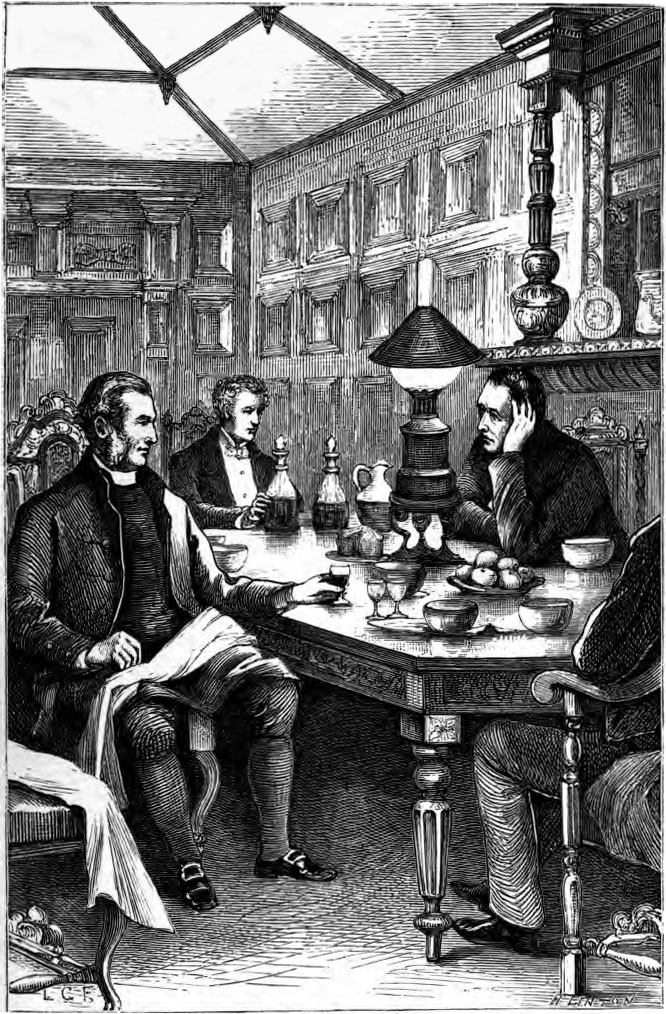
"The Roman population still believed," said Carbury, "when the
patricians had learned to regard their gods as simply useful
bugbears."
"The patricians had not ostensibly abandoned their religion. The
people clung to it thinking that their masters and rulers clung to it
also."
"The poor have ever been the salt of the earth, my lord," said the
priest.
"That begs the whole question," said the bishop, turning to his host,
and beginning to talk about a breed of pigs which had lately been
imported into the palace styes. Father Barham turned to Mr. Hepworth
and went on with his argument, or rather began another. It was a
mistake to suppose that the Catholics in the county were all poor.
There were the A----s and the B----s, and the C----s and the D----s.
He knew all their names and was proud of their fidelity. To him these
faithful ones were really the salt of the earth, who would some day
be enabled by their fidelity to restore England to her pristine
condition. The bishop had truly said that of many of his neighbours
he did not know to what Church they belonged; but Father Barham,
though he had not as yet been twelve months in the county, knew the
name of nearly every Roman Catholic within its borders.
"Your priest is a very zealous man," said the bishop afterwards
to Roger Carbury, "and I do not doubt but that he is an excellent
gentleman; but he is perhaps a little indiscreet."
"I like him because he is doing the best he can according to his
lights; without any reference to his own worldly welfare."
"That is all very grand, and I am perfectly willing to respect him.
But I do not know that I should care to talk very freely in his
company."
"I am sure he would repeat nothing."
"Perhaps not; but he would always be thinking that he was going to
get the best of me."
"I don't think it answers," said Mrs. Yeld to her husband as they
went home. "Of course I don't want to be prejudiced; but Protestants
are Protestants, and Roman Catholics are Roman Catholics."
"You may say the same of Liberals and Conservatives, but you wouldn't
have them decline to meet each other."
"It isn't quite the same, my dear. After all religion is religion."
"It ought to be," said the bishop.
"Of course I don't mean to put myself up against you, my dear; but I
don't know that I want to meet Mr. Barham again."
"I don't know that I do, either," said the bishop; "but if he comes
in my way I hope I shall treat him civilly."
CHAPTER XVII.
MARIE MELMOTTE HEARS A LOVE TALE.
On the following morning there came a telegram from Felix. He was
to be expected at Beccles on that afternoon by a certain train; and
Roger, at Lady Carbury's request, undertook to send a carriage to the
station for him. This was done, but Felix did not arrive. There was
still another train by which he might come so as to be just in time
for dinner if dinner were postponed for half an hour. Lady Carbury
with a tender look, almost without speaking a word, appealed to her
cousin on behalf of her son. He knit his brows, as he always did,
involuntarily, when displeased; but he assented. Then the carriage
had to be sent again. Now carriages and carriage-horses were not
numerous at Carbury. The squire kept a waggonnette and a pair of
horses which, when not wanted for house use, were employed about the
farm. He himself would walk home from the train, leaving the luggage
to be brought by some cheap conveyance. He had already sent the
carriage once on this day,--and now sent it again, Lady Carbury
having said a word which showed that she hoped that this would be
done. But he did it with deep displeasure. To the mother her son was
Sir Felix, the baronet, entitled to special consideration because of
his position and rank,--because also of his intention to marry the
great heiress of the day. To Roger Carbury, Felix was a vicious young
man, peculiarly antipathetic to himself, to whom no respect whatever
was due. Nevertheless the dinner was put off, and the waggonnette was
sent. But the waggonnette again came back empty. That evening was
spent by Roger, Lady Carbury, and Henrietta, in very much gloom.
About four in the morning the house was roused by the coming of
the baronet. Failing to leave town by either of the afternoon trains,
he had contrived to catch the evening mail, and had found himself
deposited at some distant town from which he had posted to Carbury.
Roger came down in his dressing-gown to admit him, and Lady Carbury
also left her room. Sir Felix evidently thought that he had been a
very fine fellow in going through so much trouble. Roger held a very
different opinion, and spoke little or nothing. "Oh, Felix," said the
mother, "you have so terrified us!"
"I can tell you I was terrified myself when I found that I had to
come fifteen miles across the country with a pair of old jades who
could hardly get up a trot."
"But why didn't you come by the train you named?"
"I couldn't get out of the city," said the baronet with a ready lie.
"I suppose you were at the Board?" To this Felix made no direct
answer. Roger knew that there had been no Board. Mr. Melmotte was in
the country and there could be no Board, nor could Sir Felix have had
business in the city. It was sheer impudence,--sheer indifference,
and, into the bargain, a downright lie. The young man, who was
of himself so unwelcome, who had come there on a project which
he, Roger, utterly disapproved,--who had now knocked him and his
household up at four o'clock in the morning,--had uttered no word of
apology. "Miserable cub!" Roger muttered between his teeth. Then he
spoke aloud, "You had better not keep your mother standing here. I
will show you your room."
"All right, old fellow," said Sir Felix. "I'm awfully sorry to
disturb you all in this way. I think I'll just take a drop of brandy
and soda before I go to bed, though." This was another blow to Roger.
"I doubt whether we have soda-water in the house, and if we have,
I don't know where to get it. I can give you some brandy if you
will come with me." He pronounced the word "brandy" in a tone which
implied that it was a wicked, dissipated beverage. It was a wretched
work to Roger. He was forced to go up-stairs and fetch a key in order
that he might wait upon this cub,--this cur! He did it, however, and
the cub drank his brandy-and-water, not in the least disturbed by his
host's ill-humour. As he went to bed he suggested the probability
of his not showing himself till lunch on the following day, and
expressed a wish that he might have breakfast sent to him in bed.
"He is born to be hung," said Roger to himself as he went to his
room,--"and he'll deserve it."
On the following morning, being Sunday, they all went to church,
--except Felix. Lady Carbury always went to church when she
was in the country, never when she was at home in London. It was
one of those moral habits, like early dinners and long walks, which
suited country life. And she fancied that were she not to do so, the
bishop would be sure to know it and would be displeased. She liked
the bishop. She liked bishops generally; and was aware that it was a
woman's duty to sacrifice herself for society. As to the purpose for
which people go to church, it had probably never in her life occurred
to Lady Carbury to think of it. On their return they found Sir Felix
smoking a cigar on the gravel path, close in front of the open
drawing-room window.
"Felix," said his cousin, "take your cigar a little farther. You are
filling the house with tobacco."
"Oh heavens,--what a prejudice!" said the baronet.
"Let it be so, but still do as I ask you." Sir Felix chucked the
cigar out of his mouth on to the gravel walk, whereupon Roger walked
up to the spot and kicked the offending weed away. This was the first
greeting of the day between the two men.
After lunch Lady Carbury strolled about with her son, instigating him
to go over at once to Caversham. "How the deuce am I to get there?"
"Your cousin will lend you a horse."
"He's as cross as a bear with a sore head. He's a deal older than
I am, and a cousin and all that, but I'm not going to put up with
insolence. If it were anywhere else I should just go into the yard
and ask if I could have a horse and saddle as a matter of course."
"Roger has not a great establishment."
"I suppose he has a horse and saddle, and a man to get it ready. I
don't want anything grand."
"He is vexed because he sent twice to the station for you yesterday."
"I hate the kind of fellow who is always thinking of little grievances.
Such a man expects you to go like clockwork, and because you
are not wound up just as he is, he insults you. I shall ask him
for a horse as I would any one else, and if he does not like it, he
may lump it." About half an hour after this he found his cousin. "Can
I have a horse to ride over to Caversham this afternoon?" he said.
"Our horses never go out on Sunday," said Roger. Then he added,
after a pause, "You can have it. I'll give the order." Sir Felix would
be gone on Tuesday, and it should be his own fault if that odious
cousin ever found his way into Carbury House again! So he declared
to himself as Felix rode out of the yard; but he soon remembered how
probable it was that Felix himself would be the owner of Carbury. And
should it ever come to pass,--as still was possible,--that Henrietta
should be the mistress of Carbury, he could hardly forbid her to
receive her brother. He stood for a while on the bridge watching his
cousin as he cantered away upon the road, listening to the horse's
feet. The young man was offensive in every possible way. Who does
not know that ladies only are allowed to canter their friends' horses
upon roads? A gentleman trots his horse, and his friend's horse.
Roger Carbury had but one saddle horse,--a favourite old hunter
that he loved as a friend. And now this dear old friend, whose legs
probably were not quite so good as they once were, was being galloped
along the hard road by that odious cub! "Soda and brandy!" Roger
exclaimed to himself almost aloud, thinking of the discomfiture of
that early morning. "He'll die some day of delirium tremens in a
hospital!"
Before the Longestaffes left London to receive their new friends
the Melmottes at Caversham, a treaty had been made between Mr.
Longestaffe, the father, and Georgiana, the strong-minded daughter.
The daughter on her side undertook that the guests should be treated
with feminine courtesy. This might be called the most-favoured-nation
clause. The Melmottes were to be treated exactly as though old
Melmotte had been a gentleman and Madame Melmotte a lady. In return
for this the Longestaffe family were to be allowed to return to town.
But here again the father had carried another clause. The prolonged
sojourn in town was to be only for six weeks. On the 10th of July the
Longestaffes were to be removed into the country for the remainder
of the year. When the question of a foreign tour was proposed, the
father became absolutely violent in his refusal. "In God's name where
do you expect the money is to come from?" When Georgiana urged that
other people had money to go abroad, her father told her that a time
was coming in which she might think it lucky if she had a house over
her head. This, however, she took as having been said with poetical
licence, the same threat having been made more than once before.
The treaty was very clear, and the parties to it were prepared to
carry it out with fair honesty. The Melmottes were being treated with
decent courtesy, and the house in town was not dismantled.
The idea, hardly ever in truth entertained but which had been barely
suggested from one to another among the ladies of the family, that
Dolly should marry Marie Melmotte, had been abandoned. Dolly, with
all his vapid folly, had a will of his own, which, among his own
family, was invincible. He was never persuaded to any course either
by his father or mother. Dolly certainly would not marry Marie
Melmotte. Therefore when the Longestaffes heard that Sir Felix was
coming to the country, they had no special objection to entertaining
him at Caversham. He had been lately talked of in London as the
favourite in regard to Marie Melmotte. Georgiana Longestaffe had a
grudge of her own against Lord Nidderdale, and was on that account
somewhat well inclined towards Sir Felix's prospects. Soon after the
Melmottes' arrival she contrived to say a word to Marie respecting
Sir Felix. "There is a friend of yours going to dine here on Monday,
Miss Melmotte." Marie, who was at the moment still abashed by the
grandeur and size and general fashionable haughtiness of her new
acquaintances, made hardly any answer. "I think you know Sir Felix
Carbury," continued Georgiana.
"Oh yes, we know Sir Felix Carbury."
"He is coming down to his cousin's. I suppose it is for your bright
eyes, as Carbury Manor would hardly be just what he would like."
"I don't think he is coming because of me," said Marie blushing. She
had once told him that he might go to her father, which according to
her idea had been tantamount to accepting his offer as far as her
power of acceptance went. Since that she had seen him, indeed, but
he had not said a word to press his suit, nor, as far as she knew, had
he said a word to Mr. Melmotte. But she had been very rigorous in
declining the attentions of other suitors. She had made up her mind
that she was in love with Felix Carbury, and she had resolved on
constancy. But she had begun to tremble, fearing his faithlessness.
"We had heard," said Georgiana, "that he was a particular friend of
yours." And she laughed aloud, with a vulgarity which Madame Melmotte
certainly could not have surpassed.
Sir Felix, on the Sunday afternoon, found all the ladies out on the
lawn, and he also found Mr. Melmotte there. At the last moment Lord
Alfred Grendall had been asked,--not because he was at all in favour
with any of the Longestaffes, but in order that he might be useful
in disposing of the great Director. Lord Alfred was used to him and
could talk to him, and might probably know what he liked to eat and
drink. Therefore Lord Alfred had been asked to Caversham, and Lord
Alfred had come, having all his expenses paid by the great Director.
When Sir Felix arrived, Lord Alfred was earning his entertainment by
talking to Mr. Melmotte in a summer-house. He had cool drink before
him and a box of cigars, but was probably thinking at the time how
hard the world had been to him. Lady Pomona was languid, but not
uncivil in her reception. She was doing her best to perform her
part of the treaty in reference to Madame Melmotte. Sophia was
walking apart with a certain Mr. Whitstable, a young squire in the
neighbourhood, who had been asked to Caversham because as Sophia was
now reputed to be twenty-eight,--they who decided the question might
have said thirty-one without falsehood,--it was considered that Mr.
Whitstable was good enough, or at least as good as could be expected.
Sophia was handsome, but with a big, cold, unalluring handsomeness,
and had not quite succeeded in London. Georgiana had been more
admired, and boasted among her friends of the offers which she had
rejected. Her friends on the other hand were apt to tell of her many
failures. Nevertheless she held her head up, and had not as yet come
down among the rural Whitstables. At the present moment her hands
were empty, and she was devoting herself to such a performance of the
treaty as should make it impossible for her father to leave his part
of it unfulfilled.
For a few minutes Sir Felix sat on a garden chair making conversation
to Lady Pomona and Madame Melmotte. "Beautiful garden," he said;
"for myself I don't much care for gardens; but if one is to live in the
country, this is the sort of thing that one would like."
"Delicious," said Madame Melmotte, repressing a yawn, and drawing her
shawl higher round her throat. It was the end of May, and the weather
was very warm for the time of the year; but, in her heart of hearts,
Madame Melmotte did not like sitting out in the garden.
"It isn't a pretty place; but the house is comfortable, and we make
the best of it," said Lady Pomona.
"Plenty of glass, I see," said Sir Felix. "If one is to live in the
country, I like that kind of thing. Carbury is a very poor place."
There was offence in this;--as though the Carbury property and the
Carbury position could be compared to the Longestaffe property and
the Longestaffe position. Though dreadfully hampered for money,
the Longestaffes were great people. "For a small place," said Lady
Pomona, "I think Carbury is one of the nicest in the county. Of
course it is not extensive."
"No, by Jove," said Sir Felix, "you may say that, Lady Pomona. It's
like a prison to me with that moat round it." Then he jumped up and
joined Marie Melmotte and Georgiana. Georgiana, glad to be released
for a time from performance of the treaty, was not long before she
left them together. She had understood that the two horses now in the
running were Lord Nidderdale and Sir Felix; and though she would not
probably have done much to aid Sir Felix, she was quite willing to
destroy Lord Nidderdale.
Sir Felix had his work to do, and was willing to do it,--as far as
such willingness could go with him. The prize was so great, and the
comfort of wealth was so sure, that even he was tempted to exert
himself. It was this feeling which had brought him into Suffolk, and
induced him to travel all night, across dirty roads, in an old cab.
For the girl herself he cared not the least. It was not in his power
really to care for anybody. He did not dislike her much. He was
not given to disliking people strongly, except at the moments in
which they offended him. He regarded her simply as the means by
which a portion of Mr. Melmotte's wealth might be conveyed to his
uses. In regard to feminine beauty he had his own ideas, and his own
inclinations. He was by no means indifferent to such attraction. But
Marie Melmotte, from that point of view, was nothing to him. Such
prettiness as belonged to her came from the brightness of her youth,
and from a modest shy demeanour joined to an incipient aspiration
for the enjoyment of something in the world which should be her own.
There was, too, arising within her bosom a struggle to be something
in the world, an idea that she, too, could say something, and have
thoughts of her own, if only she had some friend near her whom she
need not fear. Though still shy, she was always resolving that she
would abandon her shyness, and already had thoughts of her own as to
the perfectly open confidence which should exist between two lovers.
When alone,--and she was much alone,--she would build castles in
the air, which were bright with art and love, rather than with gems
and gold. The books she read, poor though they generally were, left
something bright on her imagination. She fancied to herself brilliant
conversations in which she bore a bright part, though in real life
she had hitherto hardly talked to any one since she was a child. Sir
Felix Carbury, she knew, had made her an offer. She knew also, or
thought that she knew, that she loved the man. And now she was with
him alone! Now surely had come the time in which some one of her
castles in the air might be found to be built of real materials.
"You know why I have come down here?" he said.
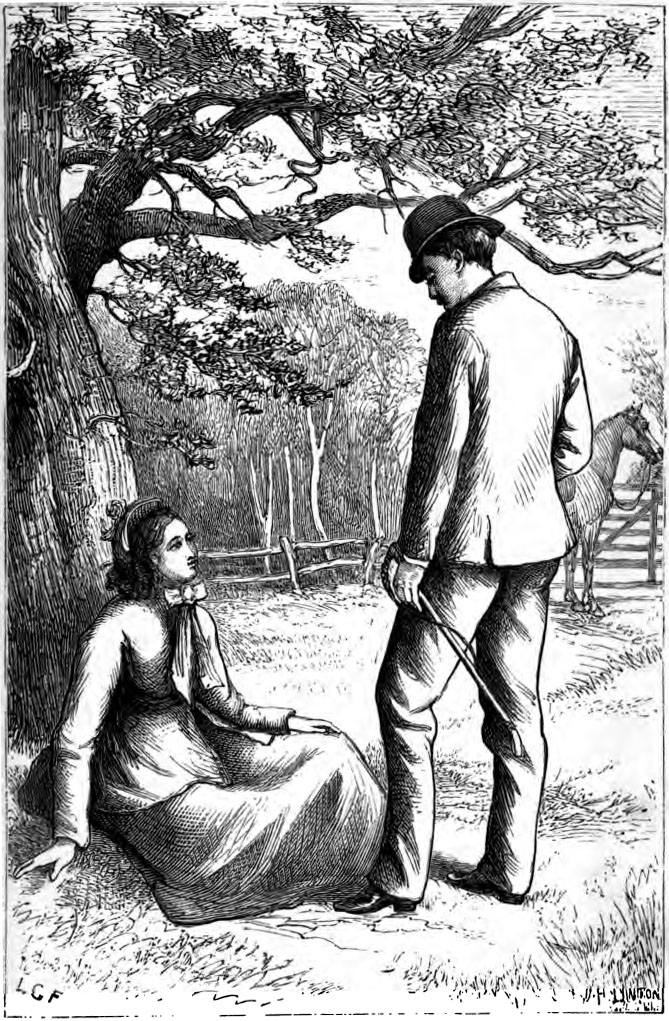 [Illustration: "You know why I have come down here?"]
"To see your cousin."
"No, indeed. I'm not particularly fond of my cousin, who is a
methodical stiff-necked old bachelor,--as cross as the mischief."
"How disagreeable!"
"Yes; he is disagreeable. I didn't come down to see him, I can
tell you. But when I heard that you were going to be here with the
Longestaffes, I determined to come at once. I wonder whether you are
glad to see me?"
"I don't know," said Marie, who could not at once find that
brilliancy of words with which her imagination supplied her readily
enough in her solitude.
"Do you remember what you said to me that evening at my mother's?"
"Did I say anything? I don't remember anything particular."
"Do you not? Then I fear you can't think very much of me." He paused
as though he supposed that she would drop into his mouth like a
cherry. "I thought you told me that you would love me."
"Did I?"
"Did you not?"
"I don't know what I said. Perhaps if I said that, I didn't mean it."
"Am I to believe that?"
"Perhaps you didn't mean it yourself."
"By George, I did. I was quite in earnest. There never was a fellow
more in earnest than I was. I've come down here on purpose to say it
again."
"To say what?"
"Whether you'll accept me?"
"I don't know whether you love me well enough." She longed to be told
by him that he loved her. He had no objection to tell her so, but,
without thinking much about it, felt it to be a bore. All that kind
of thing was trash and twaddle. He desired her to accept him; and he
would have wished, were it possible, that she should have gone to her
father for his consent. There was something in the big eyes and heavy
jaws of Mr. Melmotte which he almost feared. "Do you really love me
well enough?" she whispered.
"Of course I do. I'm bad at making pretty speeches, and all that, but
you know I love you."
"Do you?"
"By George, yes. I always liked you from the first moment I saw you.
I did indeed."
It was a poor declaration of love, but it sufficed. "Then I will love
you," she said. "I will with all my heart."
"There's a darling!"
"Shall I be your darling? Indeed I will. I may call you Felix
now;--mayn't I?"
"Rather."
"Oh, Felix, I hope you will love me. I will so dote upon you. You
know a great many men have asked me to love them."
"I suppose so."
"But I have never, never cared for one of them in the least;--not in
the least."
"You do care for me?"
"Oh yes." She looked up into his beautiful face as she spoke, and he
saw that her eyes were swimming with tears. He thought at the moment
that she was very common to look at. As regarded appearance only he
would have preferred even Sophia Longestaffe. There was indeed a
certain brightness of truth which another man might have read in
Marie's mingled smiles and tears, but it was thrown away altogether
upon him. They were walking in some shrubbery quite apart from the
house, where they were unseen; so, as in duty bound, he put his arm
round her waist and kissed her. "Oh, Felix," she said, giving her
face up to him; "no one ever did it before." He did not in the least
believe her, nor was the matter one of the slightest importance to
him. "Say that you will be good to me, Felix. I will be so good to
you."
"Of course I will be good to you."
"Men are not always good to their wives. Papa is often very cross to
mamma."
"I suppose he can be cross?"
"Yes, he can. He does not often scold me. I don't know what he'll say
when we tell him about this."
"But I suppose he intends that you shall be married?"
"He wanted me to marry Lord Nidderdale and Lord Grasslough, but
I hated them both. I think he wants me to marry Lord Nidderdale
again now. He hasn't said so, but mamma tells me. But I never
will;--never!"
"I hope not, Marie."
"You needn't be a bit afraid. I would not do it if they were to kill
me. I hate him,--and I do so love you." Then she leaned with all her
weight upon his arm and looked up again into his beautiful face. "You
will speak to papa; won't you?"
"Will that be the best way?"
"I suppose so. How else?"
"I don't know whether Madame Melmotte ought not--"
"Oh dear no. Nothing would induce her. She is more afraid of him
than anybody;--more afraid of him than I am. I thought the gentleman
always did that."
"Of course I'll do it," said Sir Felix. "I'm not afraid of him. Why
should I? He and I are very good friends, you know."
"I'm glad of that."
"He made me a Director of one of his companies the other day."
"Did he? Perhaps he'll like you for a son-in-law."
"There's no knowing;--is there?"
"I hope he will. I shall like you for papa's son-in-law. I hope it
isn't wrong to say that. Oh, Felix, say that you love me." Then she
put her face up towards his again.
"Of course I love you," he said, not thinking it worth his while to
kiss her. "It's no good speaking to him here. I suppose I had better
go and see him in the city."
"He is in a good humour now," said Marie.
"But I couldn't get him alone. It wouldn't be the thing to do down
here."
"Wouldn't it?"
"Not in the country,--in another person's house. Shall you tell
Madame Melmotte?"
"Yes, I shall tell mamma; but she won't say anything to him. Mamma
does not care much about me. But I'll tell you all that another time.
Of course I shall tell you everything now. I never yet had anybody to
tell anything to, but I shall never be tired of telling you." Then
he left her as soon as he could, and escaped to the other ladies. Mr.
Melmotte was still sitting in the summer-house, and Lord Alfred was
still with him, smoking and drinking brandy and seltzer. As Sir Felix
passed in front of the great man he told himself that it was much
better that the interview should be postponed till they were all in
London. Mr. Melmotte did not look as though he were in a good humour.
Sir Felix said a few words to Lady Pomona and Madame Melmotte. Yes;
he hoped to have the pleasure of seeing them with his mother and
sister on the following day. He was aware that his cousin was not
coming. He believed that his cousin Roger never did go any where like
any one else. No; he had not seen Mr. Longestaffe. He hoped to have
the pleasure of seeing him to-morrow. Then he escaped, and got on his
horse, and rode away.
"That's going to be the lucky man," said Georgiana to her mother,
that evening.
"In what way lucky?"
"He is going to get the heiress and all the money. What a fool Dolly
has been!"
"I don't think it would have suited Dolly," said Lady Pomona. "After
all, why should not Dolly marry a lady?"
CHAPTER XVIII.
RUBY RUGGLES HEARS A LOVE TALE.
Miss Ruby Ruggles, the granddaughter of old Daniel Ruggles, of
Sheep's Acre, in the parish of Sheepstone, close to Bungay, received
the following letter from the hands of the rural post letter-carrier
on that Sunday morning;--"A friend will be somewhere near Sheepstone
Birches between four and five o'clock on Sunday afternoon." There was
not another word in the letter, but Miss Ruby Ruggles knew well from
whom it came.
Daniel Ruggles was a farmer, who had the reputation of considerable
wealth, but who was not very well looked on in the neighbourhood as
being somewhat of a curmudgeon and a miser. His wife was dead;--he
had quarrelled with his only son, whose wife was also dead, and
had banished him from his home;--his daughters were married and
away; and the only member of his family who lived with him was his
granddaughter Ruby. And this granddaughter was a great trouble to the
old man. She was twenty-three years old, and had been engaged to a
prosperous young man at Bungay in the meal and pollard line, to whom
old Ruggles had promised to give £500 on their marriage. But Ruby had
taken it into her foolish young head that she did not like meal and
pollard, and now she had received the above very dangerous letter.
Though the writer had not dared to sign his name she knew well that
it came from Sir Felix Carbury,--the most beautiful gentleman she had
ever set her eyes upon. Poor Ruby Ruggles! Living down at Sheep's
Acre, on the Waveney, she had heard both too much and too little
of the great world beyond her ken. There were, she thought, many
glorious things to be seen which she would never see were she in
these her early years to become the wife of John Crumb, the dealer
in meal and pollard at Bungay. Therefore she was full of a wild
joy, half joy half fear, when she got her letter; and, therefore,
punctually at four o'clock on that Sunday she was ensconced among
the Sheepstone Birches, so that she might see without much danger of
being seen. Poor Ruby Ruggles, who was left to be so much mistress
of herself at the time of her life in which she most required the
kindness of a controlling hand!
Mr. Ruggles held his land, or the greater part of it, on what is
called a bishop's lease, Sheep's Acre Farm being a part of the
property which did belong to the bishopric of Elmham, and which was
still set apart for its sustentation;--but he also held a small
extent of outlying meadow which belonged to the Carbury estate, so
that he was one of the tenants of Roger Carbury. Those Sheepstone
Birches, at which Felix made his appointment, belonged to Roger. On a
former occasion, when the feeling between the two cousins was kinder
than that which now existed, Felix had ridden over with the landlord
to call on the old man, and had then first seen Ruby;--and had heard
from Roger something of Ruby's history up to that date. It had then
been just made known that she was to marry John Crumb. Since that
time not a word had been spoken between the men respecting the girl.
Mr. Carbury had heard, with sorrow, that the marriage was either
postponed or abandoned,--but his growing dislike to the baronet had
made it very improbable that there should be any conversation between
them on the subject. Sir Felix, however, had probably heard more of
Ruby Ruggles than her grandfather's landlord.
There is, perhaps, no condition of mind more difficult for the
ordinarily well-instructed inhabitant of a city to realise than that
of such a girl as Ruby Ruggles. The rural day labourer and his wife
live on a level surface which is comparatively open to the eye. Their
aspirations, whether for good or evil,--whether for food and drink to
be honestly earned for themselves and children, or for drink first,
to be come by either honestly or dishonestly,--are, if looked at at
all, fairly visible. And with the men of the Ruggles class one can
generally find out what they would be at, and in what direction
their minds are at work. But the Ruggles woman,--especially the
Ruggles young woman,--is better educated, has higher aspirations and
a brighter imagination, and is infinitely more cunning than the man.
If she be good-looking and relieved from the pressure of want, her
thoughts soar into a world which is as unknown to her as heaven is
to us, and in regard to which her longings are apt to be infinitely
stronger than are ours for heaven. Her education has been much better
than that of the man. She can read, whereas he can only spell words
from a book. She can write a letter after her fashion, whereas he can
barely spell words out on a paper. Her tongue is more glib, and her
intellect sharper. But her ignorance as to the reality of things
is much more gross than his. By such contact as he has with men in
markets, in the streets of the towns he frequents, and even in the
fields, he learns something unconsciously of the relative condition
of his countrymen,--and, as to that which he does not learn, his
imagination is obtuse. But the woman builds castles in the air, and
wonders, and longs. To the young farmer the squire's daughter is a
superior being very much out of his way. To the farmer's daughter the
young squire is an Apollo, whom to look at is a pleasure,--by whom to
be looked at is a delight. The danger for the most part is soon over.
The girl marries after her kind, and then husband and children put
the matter at rest for ever.
A mind more absolutely uninstructed than that of Ruby Ruggles as to
the world beyond Suffolk and Norfolk it would be impossible to find.
But her thoughts were as wide as they were vague, and as active as
they were erroneous. Why should she with all her prettiness, and all
her cleverness,--with all her fortune to boot,--marry that dustiest
of all men, John Crumb, before she had seen something of the beauties
of the things of which she had read in the books which came in her
way? John Crumb was not bad-looking. He was a sturdy, honest fellow,
too,--slow of speech but sure of his points when he had got them
within his grip,--fond of his beer but not often drunk, and the very
soul of industry at his work. But though she had known him all her
life she had never known him otherwise than dusty. The meal had so
gotten within his hair, and skin, and raiment, that it never came
out altogether even on Sundays. His normal complexion was a healthy
pallor, through which indeed some records of hidden ruddiness would
make themselves visible, but which was so judiciously assimilated to
his hat and coat and waistcoat, that he was more like a stout ghost
than a healthy young man. Nevertheless it was said of him that he
could thrash any man in Bungay, and carry two hundred weight of flour
upon his back. And Ruby also knew this of him,--that he worshipped
the very ground on which she trod.
But, alas, she thought there might be something better than such
worship; and, therefore, when Felix Carbury came in her way, with his
beautiful oval face, and his rich brown colour, and his bright hair
and lovely moustache, she was lost in a feeling which she mistook for
love; and when he sneaked over to her a second and a third time, she
thought more of his listless praise than ever she had thought of John
Crumb's honest promises. But, though she was an utter fool, she was
not a fool without a principle. She was miserably ignorant; but she
did understand that there was a degradation which it behoved her to
avoid. She thought, as the moths seem to think, that she might fly
into the flame and not burn her wings. After her fashion she was
pretty, with long glossy ringlets, which those about the farm on
week days would see confined in curl-papers, and large round dark
eyes, and a clear dark complexion, in which the blood showed itself
plainly beneath the soft brown skin. She was strong, and healthy, and
tall,--and had a will of her own which gave infinite trouble to old
Daniel Ruggles, her grandfather.
Felix Carbury took himself two miles out of his way in order that he
might return by Sheepstone Birches, which was a little copse distant
not above half a mile from Sheep's Acre farmhouse. A narrow angle
of the little wood came up to the road, by which there was a gate
leading into a grass meadow, which Sir Felix had remembered when
he made his appointment. The road was no more than a country lane,
unfrequented at all times, and almost sure to be deserted on Sundays.
He approached the gate in a walk, and then stood awhile looking into
the wood. He had not stood long before he saw the girl's bonnet
beneath a tree standing just outside the wood, in the meadow, but
on the bank of the ditch. Thinking for a moment what he would do
about his horse, he rode him into the field, and then, dismounting,
fastened him to a rail which ran down the side of the copse. Then he
sauntered on till he stood looking down upon Ruby Ruggles as she sat
beneath the tree. "I like your impudence," she said, "in calling
yourself a friend."
"Ain't I a friend, Ruby?"
"A pretty sort of friend, you! When you was going away, you was to be
back at Carbury in a fortnight; and that is,--oh, ever so long ago
now."
"But I wrote to you, Ruby."
"What's letters? And the postman to know all as in 'em for anything
anybody knows, and grandfather to be almost sure to see 'em. I don't
call letters no good at all, and I beg you won't write 'em any more."
"Did he see them?"
"No thanks to you if he didn't. I don't know why you are come here,
Sir Felix,--nor yet I don't know why I should come and meet you. It's
all just folly like."
"Because I love you;--that's why I come; eh, Ruby? And you have come
because you love me; eh, Ruby? Is not that about it?" Then he threw
himself on the ground beside her, and got his arm round her waist.
It would boot little to tell here all that they said to each other.
The happiness of Ruby Ruggles for that half hour was no doubt
complete. She had her London lover beside her; and though in every
word he spoke there was a tone of contempt, still he talked of love,
and made her promises, and told her that she was pretty. He probably
did not enjoy it much; he cared very little about her, and carried
on the liaison simply because it was the proper sort of thing for a
young man to do. He had begun to think that the odour of patchouli
was unpleasant, and that the flies were troublesome, and the ground
hard, before the half hour was over. She felt that she could be
content to sit there for ever and to listen to him. This was a
realisation of those delights of life of which she had read in the
thrice-thumbed old novels which she had gotten from the little
circulating library at Bungay.
But what was to come next? She had not dared to ask him to marry
her,--had not dared to say those very words; and he had not dared to
ask her to be his mistress. There was an animal courage about her,
and an amount of strength also, and a fire in her eye, of which he
had learned to be aware. Before the half hour was over I think that
he wished himself away;--but when he did go, he made a promise to
see her again on the Tuesday morning. Her grandfather would be at
Harlestone market, and she would meet him at about noon at the bottom
of the kitchen garden belonging to the farm. As he made the promise
he resolved that he would not keep it. He would write to her again,
and bid her come to him in London, and would send her money for the
journey.
"I suppose I am to be his wedded wife," said Ruby to herself, as she
crept away down from the road, away also from her own home;--so that
on her return her presence should not be associated with that of the
young man, should any one chance to see the young man on the road.
"I'll never be nothing unless I'm that," she said to herself. Then
she allowed her mind to lose itself in expatiating on the difference
between John Crumb and Sir Felix Carbury.
CHAPTER XIX.
HETTA CARBURY HEARS A LOVE TALE.
"I have half a mind to go back to-morrow morning," Felix said to his
mother that Sunday evening after dinner. At that moment Roger was
walking round the garden by himself, and Henrietta was in her own
room.
"To-morrow morning, Felix! You are engaged to dine with the
Longestaffes!"
"You could make any excuse you like about that."
"It would be the most uncourteous thing in the world. The
Longestaffes you know are the leading people in this part of the
country. No one knows what may happen. If you should ever be living
at Carbury, how sad it would be that you should have quarrelled with
them."
"You forget, mother, that Dolly Longestaffe is about the most
intimate friend I have in the world."
"That does not justify you in being uncivil to the father and mother.
And you should remember what you came here for."
"What did I come for?"
"That you might see Marie Melmotte more at your ease than you can in
their London house."
"That's all settled," said Sir Felix, in the most indifferent tone
that he could assume.
"Settled!"
"As far as the girl is concerned. I can't very well go to the old
fellow for his consent down here."
"Do you mean to say, Felix, that Marie Melmotte has accepted you?"
"I told you that before."
"My dear Felix. Oh, my boy!" In her joy the mother took her unwilling
son in her arms and caressed him. Here was the first step taken not
only to success, but to such magnificent splendour as should make
her son to be envied by all young men, and herself to be envied by
all mothers in England! "No, you didn't tell me before. But I am so
happy. Is she really fond of you? I don't wonder that any girl should
be fond of you."
"I can't say anything about that, but I think she means to stick to
it."
"If she is firm, of course her father will give way at last. Fathers
always do give way when the girl is firm. Why should he oppose it?"
"I don't know that he will."
"You are a man of rank, with a title of your own. I suppose what he
wants is a gentleman for his girl. I don't see why he should not be
perfectly satisfied. With all his enormous wealth a thousand a year
or so can't make any difference. And then he made you one of the
Directors at his Board. Oh Felix;--it is almost too good to be true."
"I ain't quite sure that I care very much about being married, you
know."
"Oh, Felix, pray don't say that. Why shouldn't you like being
married? She is a very nice girl, and we shall all be so fond of her!
Don't let any feeling of that kind come over you; pray don't. You
will be able to do just what you please when once the question of
her money is settled. Of course you can hunt as often as you like,
and you can have a house in any part of London you please. You must
understand by this time how very disagreeable it is to have to get on
without an established income."
"I quite understand that."
"If this were once done you would never have any more trouble of that
kind. There would be plenty of money for everything as long as you
live. It would be complete success. I don't know how to say enough to
you, or to tell you how dearly I love you, or to make you understand
how well I think you have done it all." Then she caressed him again,
and was almost beside herself in an agony of mingled anxiety and joy.
If, after all, her beautiful boy, who had lately been her disgrace
and her great trouble because of his poverty, should shine forth to
the world as a baronet with £20,000 a year, how glorious would it be!
She must have known,--she did know,--how poor, how selfish a crea-
ture he was. But her gratification at the prospect of his splendour
obliterated the sorrow with which the vileness of his character
sometimes oppressed her. Were he to win this girl with all her
father's money, neither she nor his sister would be the better for
it, except in this, that the burden of maintaining him would be taken
from her shoulders. But his magnificence would be established. He was
her son, and the prospect of his fortune and splendour was sufficient
to elate her into a very heaven of beautiful dreams. "But, Felix,"
she continued, "you really must stay and go to the Longestaffes'
to-morrow. It will only be one day.--And now were you to run away--"
"Run away! What nonsense you talk."
"If you were to start back to London at once I mean, it would be an
affront to her, and the very thing to set Melmotte against you. You
should lay yourself out to please him;--indeed you should."
"Oh, bother!" said Sir Felix. But nevertheless he allowed himself to
be persuaded to remain. The matter was important even to him, and
he consented to endure the almost unendurable nuisance of spending
another day at the Manor House. Lady Carbury, almost lost in delight,
did not know where to turn for sympathy. If her cousin were not so
stiff, so pig-headed, so wonderfully ignorant of the affairs of
the world, he would have at any rate consented to rejoice with her.
Though he might not like Felix,--who, as his mother admitted to
herself, had been rude to her cousin,--he would have rejoiced for the
sake of the family. But, as it was, she did not dare to tell him. He
would have received her tidings with silent scorn. And even Henrietta
would not be enthusiastic. She felt that though she would have
delighted to expatiate on this great triumph, she must be silent at
present. It should now be her great effort to ingratiate herself with
Mr. Melmotte at the dinner party at Caversham.
During the whole of that evening Roger Carbury hardly spoke to his
cousin Hetta. There was not much conversation between them till quite
late, when Father Barham came in for supper. He had been over at
Bungay among his people there, and had walked back, taking Carbury on
the way. "What did you think of our bishop?" Roger asked him, rather
imprudently.
"Not much of him as a bishop. I don't doubt that he makes a very nice
lord, and that he does more good among his neighbours than an average
lord. But you don't put power or responsibility into the hands of any
one sufficient to make him a bishop."
"Nine-tenths of the clergy in the diocese would be guided by him in
any matter of clerical conduct which might come before him."
"Because they know that he has no strong opinion of his own, and
would not therefore desire to dominate theirs. Take any of your
bishops that has an opinion,--if there be one left,--and see how far
your clergy consent to his teaching!" Roger turned round and took up
his book. He was already becoming tired of his pet priest. He himself
always abstained from saying a word derogatory to his new friend's
religion in the man's hearing; but his new friend did not by any
means return the compliment. Perhaps also Roger felt that were he
to take up the cudgels for an argument he might be worsted in the
combat, as in such combats success is won by practised skill rather
than by truth. Henrietta was also reading, and Felix was smoking
elsewhere,--wondering whether the hours would ever wear themselves
away in that castle of dulness, in which no cards were to be seen,
and where, except at meal-times, there was nothing to drink. But Lady
Carbury was quite willing to allow the priest to teach her that all
appliances for the dissemination of religion outside his own church
must be naught.
"I suppose our bishops are sincere in their beliefs," she said with
her sweetest smile.
"I'm sure I hope so. I have no possible reason to doubt it as to the
two or three whom I have seen,--nor indeed as to all the rest whom I
have not seen."
"They are so much respected everywhere as good and pious men!"
"I do not doubt it. Nothing tends so much to respect as a good
income. But they may be excellent men without being excellent
bishops. I find no fault with them, but much with the system by which
they are controlled. Is it probable that a man should be fitted to
select guides for other men's souls because he has succeeded by
infinite labour in his vocation in becoming the leader of a majority
in the House of Commons?"
"Indeed, no," said Lady Carbury, who did not in the least understand
the nature of the question put to her.
"And when you've got your bishop, is it likely that a man should be
able to do his duty in that capacity who has no power of his own to
decide whether a clergyman under him is or is not fit for his duty?"
"Hardly, indeed."
"The English people, or some of them,--that some being the richest,
and, at present, the most powerful,--like to play at having a Church,
though there is not sufficient faith in them to submit to the control
of a Church."
"Do you think men should be controlled by clergymen, Mr. Barham?"
"In matters of faith I do; and so, I suppose, do you; at least you
make that profession. You declare it to be your duty to submit
yourself to your spiritual pastors and masters."
"That, I thought, was for children," said Lady Carbury. "The
clergyman, in the catechism, says, 'My good child.'"
"It is what you were taught as a child before you had made profession
of your faith to a bishop, in order that you might know your duty
when you had ceased to be a child. I quite agree, however, that
the matter, as viewed by your Church, is childish altogether, and
intended only for children. As a rule, adults with you want no
religion."
"I am afraid that is true of a great many."
"It is marvellous to me that, when a man thinks of it, he should not
be driven by very fear to the comforts of a safer faith,--unless,
indeed, he enjoy the security of absolute infidelity."
"That is worse than anything," said Lady Carbury with a sigh and a
shudder.
"I don't know that it is worse than a belief which is no belief,"
said the priest with energy;--"than a creed which sits so easily
on a man that he does not even know what it contains, and never
asks himself as he repeats it, whether it be to him credible or
incredible."
"That is very bad," said Lady Carbury.
"We're getting too deep, I think," said Roger, putting down the book
which he had in vain been trying to read.
"I think it is so pleasant to have a little serious conversation on
Sunday evening," said Lady Carbury. The priest drew himself back into
his chair and smiled. He was quite clever enough to understand that
Lady Carbury had been talking nonsense, and clever enough also to be
aware of the cause of Roger's uneasiness. But Lady Carbury might be
all the easier converted because she understood nothing and was fond
of ambitious talking; and Roger Carbury might possibly be forced into
conviction by the very feeling which at present made him unwilling to
hear arguments.
"I don't like hearing my Church ill-spoken of," said Roger.
"You wouldn't like me if I thought ill of it and spoke well of it,"
said the priest.
"And, therefore, the less said the sooner mended," said Roger, rising
from his chair. Upon this Father Barham took his departure and walked
away to Beccles. It might be that he had sowed some seed. It might be
that he had, at any rate, ploughed some ground. Even the attempt to
plough the ground was a good work which would not be forgotten.
The following morning was the time on which Roger had fixed for
repeating his suit to Henrietta. He had determined that it should be
so, and though the words had been almost on his tongue during that
Sunday afternoon, he had repressed them because he would do as he
had determined. He was conscious, almost painfully conscious, of
a certain increase of tenderness in his cousin's manner towards
him. All that pride of independence, which had amounted almost to
roughness, when she was in London, seemed to have left her. When he
greeted her morning and night, she looked softly into his face. She
cherished the flowers which he gave her. He could perceive that if
he expressed the slightest wish in any matter about the house she
would attend to it. There had been a word said about punctuality,
and she had become punctual as the hand of the clock. There was not
a glance of her eye, nor a turn of her hand, that he did not watch,
and calculate its effect as regarded himself. But because she was
tender to him and observant, he did not by any means allow himself
to believe that her heart was growing into love for him. He thought
that he understood the working of her mind. She could see how great
was his disgust at her brother's doings; how fretted he was by her
mother's conduct. Her grace, and sweetness, and sense, took part with
him against those who were nearer to herself, and therefore,--in
pity,--she was kind to him. It was thus he read it, and he read it
almost with exact accuracy.
"Hetta," he said after breakfast, "come out into the garden awhile."
"Are not you going to the men?"
"Not yet, at any rate. I do not always go to the men as you call it."
She put on her hat and tripped out with him, knowing well that she
had been summoned to hear the old story. She had been sure, as soon
as she found the white rose in her room, that the old story would be
repeated again before she left Carbury;--and, up to this time, she
had hardly made up her mind what answer she would give to it. That
she could not take his offer, she thought she did know. She knew well
that she loved the other man. That other man had never asked her for
her love, but she thought that she knew that he desired it. But in
spite of all this there had in truth grown up in her bosom a feeling
of tenderness towards her cousin so strong that it almost tempted her
to declare to herself that he ought to have what he wanted, simply
because he wanted it. He was so good, so noble, so generous, so
devoted, that it almost seemed to her that she could not be justified
in refusing him. And she had gone entirely over to his side in regard
to the Melmottes. Her mother had talked to her of the charm of Mr.
Melmotte's money, till her very heart had been sickened. There was
nothing noble there; but, as contrasted with that, Roger's conduct
and bearing were those of a fine gentleman who knew neither fear
nor shame. Should such a one be doomed to pine for ever because a
girl could not love him,--a man born to be loved, if nobility and
tenderness and truth were lovely!
"Hetta," he said, "put your arm here." She gave him her arm. "I was
a little annoyed last night by that priest. I want to be civil to him,
and now he is always turning against me."
"He doesn't do any harm, I suppose?"
"He does do harm if he teaches you and me to think lightly of
those things which we have been brought up to revere." So, thought
Henrietta, it isn't about love this time; it's only about the Church.
"He ought not to say things before my guests as to our way of
believing, which I wouldn't under any circumstances say as to his.
I didn't quite like your hearing it."
"I don't think he'll do me any harm. I'm not at all that way given.
I suppose they all do it. It's their business."
"Poor fellow! I brought him here just because I thought it was a pity
that a man born and bred like a gentleman should never see the inside
of a comfortable house."
"I liked him;--only I didn't like his saying stupid things about the
bishop."
"And I like him." Then there was a pause. "I suppose your brother
does not talk to you much about his own affairs."
"His own affairs, Roger? Do you mean money? He never says a word to
me about money."
"I meant about the Melmottes."
"No; not to me. Felix hardly ever speaks to me about anything."
"I wonder whether she has accepted him."
"I think she very nearly did accept him in London."
"I can't quite sympathise with your mother in all her feelings about
this marriage, because I do not think that I recognise as she does
the necessity of money."
"Felix is so disposed to be extravagant."
"Well; yes. But I was going to say that though I cannot bring
myself to say anything to encourage her about this heiress, I quite
recognise her unselfish devotion to his interests."
"Mamma thinks more of him than of anything," said Hetta, not in the
least intending to accuse her mother of indifference to herself.
"I know it; and though I happen to think myself that her other child
would better repay her devotion,"--this he said, looking up to Hetta
and smiling,--"I quite feel how good a mother she is to Felix. You
know, when she first came the other day we almost had a quarrel."
"I felt that there was something unpleasant."
"And then Felix coming after his time put me out. I am getting old
and cross, or I should not mind such things."
"I think you are so good,--and so kind." As she said this she leaned
upon his arm almost as though she meant to tell him that she loved
him.
"I have been angry with myself," he said, "and so I am making you my
father confessor. Open confession is good for the soul sometimes, and
I think that you would understand me better than your mother."
"I do understand you; but don't think there is any fault to confess."
"You will not exact any penance?" She only looked at him and smiled.
"I am going to put a penance on myself all the same. I can't
congratulate your brother on his wooing over at Caversham, as I know
nothing about it, but I will express some civil wish to him about
things in general."
"Will that be a penance?"
"If you could look into my mind you'd find that it would. I'm full of
fretful anger against him for half-a-dozen little frivolous things.
Didn't he throw his cigar on the path? Didn't he lie in bed on Sunday
instead of going to church?"
"But then he was travelling all the Saturday night."
"Whose fault was that? But don't you see it is the triviality of the
offence which makes the penance necessary. Had he knocked me over
the head with a pickaxe, or burned the house down, I should have had
a right to be angry. But I was angry because he wanted a horse on
Sunday;--and therefore I must do penance."
There was nothing of love in all this. Hetta, however, did not
wish him to talk of love. He was certainly now treating her as a
friend,--as a most intimate friend. If he would only do that without
making love to her, how happy could she be! But his determination
still held good. "And now," said he, altering his tone altogether, "I
must speak about myself." Immediately the weight of her hand upon his
arm was lessened. Thereupon he put his left hand round and pressed
her arm to his. "No," he said; "do not make any change towards me
while I speak to you. Whatever comes of it we shall at any rate be
cousins and friends."
"Always friends!" she said.
"Yes;--always friends. And now listen to me for I have much to say.
I will not tell you again that I love you. You know it, or else you
must think me the vainest and falsest of men. It is not only that
I love you, but I am so accustomed to concern myself with one thing
only, so constrained by the habits and nature of my life to confine
myself to single interests, that I cannot as it were escape from my
love. I am thinking of it always, often despising myself because
I think of it so much. For, after all, let a woman be ever so
good,--and you to me are all that is good,--a man should not allow
his love to dominate his intellect."
"Oh, no!"
"I do. I calculate my chances within my own bosom almost as a man
might calculate his chances of heaven. I should like you to know me
just as I am, the weak and the strong together. I would not win you
by a lie if I could. I think of you more than I ought to do. I am
sure,--quite sure that you are the only possible mistress of this
house during my tenure of it. If I am ever to live as other men do,
and to care about the things which other men care for, it must be as
your husband."
"Pray,--pray do not say that."
"Yes; I think that I have a right to say it,--and a right to expect
that you should believe me. I will not ask you to be my wife if you
do not love me. Not that I should fear aught for myself, but that
you should not be pressed to make a sacrifice of yourself because
I am your friend and cousin. But I think it is quite possible you
might come to love me,--unless your heart be absolutely given away
elsewhere."
"What am I to say?"
"We each of us know of what the other is thinking. If Paul Montague
has robbed me of my love--?"
"Mr. Montague has never said a word."
"If he had, I think he would have wronged me. He met you in my house,
and I think must have known what my feelings were towards you."
"But he never has."
"We have been like brothers together,--one brother being very much
older than the other, indeed; or like father and son. I think he
should place his hopes elsewhere."
"What am I to say? If he have such hope he has not told me. I think
it almost cruel that a girl should be asked in that way."
"Hetta, I should not wish to be cruel to you. Of course I know the
way of the world in such matters. I have no right to ask you about
Paul Montague,--no right to expect an answer. But it is all the world
to me. You can understand that I should think you might learn to love
even me, if you loved no one else." The tone of his voice was manly,
and at the same time full of entreaty. His eyes as he looked at her
were bright with love and anxiety. She not only believed him as to
the tale which he now told her; but she believed in him altogether.
She knew that he was a staff on which a woman might safely lean,
trusting to it for comfort and protection in life. In that moment she
all but yielded to him. Had he seized her in his arms and kissed her
then, I think she would have yielded. She did all but love him. She
so regarded him that had it been some other woman that he craved,
she would have used every art she knew to have backed his suit, and
would have been ready to swear that any woman was a fool who refused
him. She almost hated herself because she was unkind to one who so
thoroughly deserved kindness. As it was she made him no answer, but
continued to walk beside him trembling. "I thought I would tell it
you all, because I wish you to know exactly the state of my mind.
I would show you if I could all my heart and all my thoughts about
yourself as in a glass case. Do not coy your love for me if you
can feel it. When you know, dear, that a man's heart is set upon a
woman as mine is set on you, so that it is for you to make his life
bright or dark, for you to open or to shut the gates of his earthly
Paradise, I think you will be above keeping him in darkness for the
sake of a girlish scruple."
"Oh, Roger!"
"If ever there should come a time in which you can say it truly,
remember my truth to you and say it boldly. I at least shall never
change. Of course if you love another man and give yourself to him,
it will be all over. Tell me that boldly also. I have said it all
now. God bless you, my own heart's darling. I hope,--I hope I may be
strong enough through it all to think more of your happiness than of
my own." Then he parted from her abruptly, taking his way over one of
the bridges, and leaving her to find her way into the house alone.
CHAPTER XX.
LADY POMONA'S DINNER PARTY.
Roger Carbury's half formed plan of keeping Henrietta at home while
Lady Carbury and Sir Felix went to dine at Caversham fell to the
ground. It was to be carried out only in the event of Hetta's
yielding to his prayer. But he had in fact not made a prayer, and
Hetta had certainly yielded nothing. When the evening came, Lady
Carbury started with her son and daughter, and Roger was left alone.
In the ordinary course of his life he was used to solitude. During
the greater part of the year he would eat and drink and live without
companionship; so that there was to him nothing peculiarly sad in
this desertion. But on the present occasion he could not prevent
himself from dwelling on the loneliness of his lot in life. These
cousins of his who were his guests cared nothing for him. Lady
Carbury had come to his house simply that it might be useful to her;
Sir Felix did not pretend to treat him with even ordinary courtesy;
and Hetta herself, though she was soft to him and gracious, was soft
and gracious through pity rather than love. On this day he had, in
truth, asked her for nothing; but he had almost brought himself to
think that she might give all that he wanted without asking. And yet,
when he told her of the greatness of his love, and of its endurance,
she was simply silent. When the carriage taking them to dinner went
away down the road, he sat on the parapet of the bridge in front of
the house listening to the sound of the horses' feet, and telling
himself that there was nothing left for him in life.
If ever one man had been good to another, he had been good to Paul
Montague, and now Paul Montague was robbing him of everything he
valued in the world. His thoughts were not logical, nor was his
mind exact. The more he considered it, the stronger was his inward
condemnation of his friend. He had never mentioned to anyone the
services he had rendered to Montague. In speaking of him to Hetta he
had alluded only to the affection which had existed between them. But
he felt that because of those services his friend Montague had owed
it to him not to fall in love with the girl he loved; and he thought
that if, unfortunately, this had happened unawares, Montague should
have retired as soon as he learned the truth. He could not bring
himself to forgive his friend, even though Hetta had assured him that
his friend had never spoken to her of love. He was sore all over, and
it was Paul Montague who made him sore. Had there been no such man at
Carbury when Hetta came there, Hetta might now have been mistress of
the house. He sat there till the servant came to tell him that his
dinner was on the table. Then he crept in and ate,--so that the man
might not see his sorrow; and, after dinner, he sat with a book in
his hand seeming to read. But he read not a word, for his mind was
fixed altogether on his cousin Hetta. "What a poor creature a man
is," he said to himself, "who is not sufficiently his own master to
get over a feeling like this."
At Caversham there was a very grand party,--as grand almost as a
dinner party can be in the country. There were the Earl and Countess
of Loddon and Lady Jane Pewet from Loddon Park, and the bishop
and his wife, and the Hepworths. These, with the Carburys and
the parson's family, and the people staying in the house, made
twenty-four at the dinner table. As there were fourteen ladies and
only ten men, the banquet can hardly be said to have been very well
arranged. But those things cannot be done in the country with the
exactness which the appliances of London make easy; and then the
Longestaffes, though they were decidedly people of fashion, were
not famous for their excellence in arranging such matters. If aught,
however, was lacking in exactness, it was made up in grandeur. There
were three powdered footmen, and in that part of the country Lady
Pomona alone was served after this fashion; and there was a very
heavy butler, whose appearance of itself was sufficient to give éclat
to a family. The grand saloon in which nobody ever lived was thrown
open, and sofas and chairs on which nobody ever sat were uncovered.
It was not above once in the year that this kind of thing was done
at Caversham; but when it was done, nothing was spared which could
contribute to the magnificence of the fête. Lady Pomona and her two
tall daughters standing up to receive the little Countess of Loddon
and Lady Jane Pewet, who was the image of her mother on a somewhat
smaller scale, while Madame Melmotte and Marie stood behind as though
ashamed of themselves, was a sight to see. Then the Carburys came,
and then Mrs. Yeld with the bishop. The grand room was soon fairly
full; but nobody had a word to say. The bishop was generally a man
of much conversation, and Lady Loddon, if she were well pleased
with her listeners, could talk by the hour without ceasing. But on
this occasion nobody could utter a word. Lord Loddon pottered about,
making a feeble attempt, in which he was seconded by no one. Lord
Alfred stood, stock-still, stroking his grey moustache with his hand.
That much greater man, Augustus Melmotte, put his thumbs into the
arm-holes of his waistcoat, and was impassible. The bishop saw at a
glance the hopelessness of the occasion, and made no attempt. The
master of the house shook hands with each guest as he entered, and
then devoted his mind to expectation of the next comer. Lady Pomona
and her two daughters were grand and handsome, but weary and dumb.
In accordance with the treaty, Madame Melmotte had been entertained
civilly for four entire days. It could not be expected that the
ladies of Caversham should come forth unwearied after such a
struggle.
When dinner was announced Felix was allowed to take in Marie
Melmotte. There can be no doubt but that the Caversham ladies did
execute their part of the treaty. They were led to suppose that this
arrangement would be desirable to the Melmottes, and they made it.
The great Augustus himself went in with Lady Carbury, much to her
satisfaction. She also had been dumb in the drawing-room; but now,
if ever, it would be her duty to exert herself. "I hope you like
Suffolk," she said.
"Pretty well, I thank you. Oh, yes;--very nice place for a little
fresh air."
"Yes;--that's just it, Mr. Melmotte. When the summer comes one does
long so to see the flowers."
"We have better flowers in our balconies than any I see down here,"
said Mr. Melmotte.
"No doubt;--because you can command the floral tribute of the world
at large. What is there that money will not do? It can turn a London
street into a bower of roses, and give you grottoes in Grosvenor
Square."
"It's a very nice place, is London."
"If you have got plenty of money, Mr. Melmotte."
"And if you have not, it's the best place I know to get it. Do you
live in London, ma'am?" He had quite forgotten Lady Carbury even if
he had seen her at his house, and with the dulness of hearing common
to men, had not picked up her name when told to take her out to
dinner.
"Oh, yes, I live in London. I have had the honour of being
entertained by you there." This she said with her sweetest smile.
"Oh, indeed. So many do come, that I don't always just remember."
"How should you,--with all the world flocking round you? I am Lady
Carbury, the mother of Sir Felix Carbury, whom I think you will
remember."
"Yes; I know Sir Felix. He's sitting there, next to my daughter."
"Happy fellow!"
"I don't know much about that. Young men don't get their happiness in
that way now. They've got other things to think of."
"He thinks so much of his business."
"Oh! I didn't know," said Mr. Melmotte.
"He sits at the same Board with you, I think, Mr. Melmotte."
"Oh;--that's his business!" said Mr. Melmotte, with a grim smile.
Lady Carbury was very clever as to many things, and was not
ill-informed on matters in general that were going on around her; but
she did not know much about the city, and was profoundly ignorant as
to the duties of those Directors of whom, from time to time, she saw
the names in a catalogue. "I trust that he is diligent, there," she
said; "and that he is aware of the great privilege which he enjoys in
having the advantage of your counsel and guidance."
"He don't trouble me much, ma'am, and I don't trouble him much."
After this Lady Carbury said no more as to her son's position in the
city. She endeavoured to open various other subjects of conversation;
but she found Mr. Melmotte to be heavy on her hands. After a while
she had to abandon him in despair, and give herself up to raptures in
favour of Protestantism at the bidding of the Caversham parson, who
sat on the other side of her, and who had been worked to enthusiasm
by some mention of Father Barham's name.
Opposite to her, or nearly so, sat Sir Felix and his love. "I have
told mamma," Marie had whispered, as she walked in to dinner
with him. She was now full of the idea so common to girls who are
engaged,--and as natural as it is common,--that she might tell
everything to her lover.
"Did she say anything?" he asked. Then Marie had to take her place
and arrange her dress before she could reply to him. "As to her, I
suppose it does not matter what she says, does it?"
"She said a great deal. She thinks that papa will think you are not
rich enough. Hush! Talk about something else, or people will hear."
So much she had been able to say during the bustle.
Felix was not at all anxious to talk about his love, and changed the
subject very willingly. "Have you been riding?" he asked.
"No; I don't think there are horses here,--not for visitors, that is.
How did you get home? Did you have any adventures?"
"None at all," said Felix, remembering Ruby Ruggles. "I just rode
home quietly. I go to town to-morrow."
"And we go on Wednesday. Mind you come and see us before long." This
she said bringing her voice down to a whisper.
"Of course I shall. I suppose I'd better go to your father in the
city. Does he go every day?"
"Oh yes, every day. He's back always about seven. Sometimes he's
good-natured enough when he comes back, but sometimes he's very
cross. He's best just after dinner. But it's so hard to get to him
then. Lord Alfred is almost always there; and then other people come,
and they play cards. I think the city will be best."
"You'll stick to it?" he asked.
"Oh, yes;--indeed I will. Now that I've once said it nothing will
ever turn me. I think papa knows that." Felix looked at her as
she said this, and thought that he saw more in her countenance
than he had ever read there before. Perhaps she would consent to
run away with him; and, if so, being the only child, she would
certainly,--almost certainly,--be forgiven. But if he were to
run away with her and marry her, and then find that she were not
forgiven, and that Melmotte allowed her to starve without a shilling
of fortune, where would he be then? Looking at the matter in all its
bearings, considering among other things the trouble and the expense
of such a measure, he thought that he could not afford to run away
with her.
After dinner he hardly spoke to her; indeed, the room itself,--the
same big room in which they had been assembled before the
feast,--seemed to be ill-adapted for conversation. Again nobody
talked to anybody, and the minutes went very heavily till at last the
carriages were there to take them all home. "They arranged that you
should sit next to her," said Lady Carbury to her son, as they were
in the carriage.
"Oh, I suppose that came naturally;--one young man and one young
woman, you know."
"Those things are always arranged, and they would not have done it
unless they had thought that it would please Mr. Melmotte. Oh, Felix!
if you can bring it about."
"I shall if I can, mother; you needn't make a fuss about it."
"No, I won't. You cannot wonder that I should be anxious. You behaved
beautifully to her at dinner; I was so happy to see you together.
Good night, Felix, and God bless you!" she said again, as they were
parting for the night. "I shall be the happiest and the proudest
mother in England if this comes about."
CHAPTER XXI.
EVERYBODY GOES TO THEM.
When the Melmottes went from Caversham the house was very desolate.
The task of entertaining these people was indeed over, and had the
return to London been fixed for a certain near day, there would have
been comfort at any rate among the ladies of the family. But this
was so far from being the case that the Thursday and Friday passed
without anything being settled, and dreadful fears began to fill
the minds of Lady Pomona and Sophia Longestaffe. Georgiana was also
impatient, but she asserted boldly that treachery, such as that which
her mother and sister contemplated, was impossible. Their father, she
thought, would not dare to propose it. On each of these days,--three
or four times daily,--hints were given and questions were asked, but
without avail. Mr. Longestaffe would not consent to have a day fixed
till he had received some particular letter, and would not even
listen to the suggestion of a day. "I suppose we can go at any rate
on Tuesday," Georgiana said on the Friday evening. "I don't know why
you should suppose anything of the kind," the father replied. Poor
Lady Pomona was urged by her daughters to compel him to name a day;
but Lady Pomona was less audacious in urging the request than her
younger child, and at the same time less anxious for its completion.
On the Sunday morning before they went to church there was a great
discussion up-stairs. The Bishop of Elmham was going to preach
at Caversham church, and the three ladies were dressed in their
best London bonnets. They were in their mother's room, having just
completed the arrangements of their church-going toilet. It was
supposed that the expected letter had arrived. Mr. Longestaffe had
certainly received a dispatch from his lawyer, but had not as yet
vouchsafed any reference to its contents. He had been more than
ordinarily silent at breakfast, and,--so Sophia asserted,--more
disagreeable than ever. The question had now arisen especially in
reference to their bonnets. "You might as well wear them," said Lady
Pomona, "for I am sure you will not be in London again this year."
"You don't mean it, mamma," said Sophia.
"I do, my dear. He looked like it when he put those papers back into
his pocket. I know what his face means so well."
"It is not possible," said Sophia. "He promised, and he got us to
have those horrid people because he promised."
"Well, my dear, if your father says that we can't go back, I suppose
we must take his word for it. It is he must decide of course. What he
meant I suppose was, that he would take us back if he could."
"Mamma!" shouted Georgiana. Was there to be treachery not only on
the part of their natural adversary, who, adversary though he was, had
bound himself to terms by a treaty, but treachery also in their own
camp!
"My dear, what can we do?" said Lady Pomona.
"Do!" Georgiana was now going to speak out plainly. "Make him
understand that we are not going to be sat upon like that. I'll do
something, if that's going to be the way of it. If he treats me like
that I'll run off with the first man that will take me, let him be
who it may."
"Don't talk like that, Georgiana, unless you wish to kill me."
"I'll break his heart for him. He does not care about us,--not the
least,--whether we are happy or miserable; but he cares very much
about the family name. I'll tell him that I'm not going to be a
slave. I'll marry a London tradesman before I'll stay down here." The
younger Miss Longestaffe was lost in passion at the prospect before
her.
"Oh, Georgey, don't say such horrid things as that," pleaded her
sister.
"It's all very well for you, Sophy. You've got George Whitstable."
"I haven't got George Whitstable."
"Yes, you have, and your fish is fried. Dolly does just what he
pleases, and spends money as fast as he likes. Of course it makes
no difference to you, mamma, where you are."
"You are very unjust," said Lady Pomona, wailing, "and you say horrid
things."
"I ain't unjust at all. It doesn't matter to you. And Sophy is the
same as settled. But I'm to be sacrificed! How am I to see anybody
down here in this horrid hole? Papa promised and he must keep his
word."
Then there came to them a loud voice calling to them from the hall.
"Are any of you coming to church, or are you going to keep the
carriage waiting all day?" Of course they were all going to church.
They always did go to church when they were at Caversham; and would
more especially do so to-day, because of the bishop and because of
the bonnets. They trooped down into the hall and into the carriage,
Lady Pomona leading the way. Georgiana stalked along, passing her
father at the front door without condescending to look at him. Not
a word was spoken on the way to church, or on the way home. During
the service Mr. Longestaffe stood up in the corner of his pew, and
repeated the responses in a loud voice. In performing this duty he
had been an example to the parish all his life. The three ladies
knelt on their hassocks in the most becoming fashion, and sat during
the sermon without the slightest sign either of weariness or of
attention. They did not collect the meaning of any one combination of
sentences. It was nothing to them whether the bishop had or had not
a meaning. Endurance of that kind was their strength. Had the bishop
preached for forty-five minutes instead of half an hour they would
not have complained. It was the same kind of endurance which enabled
Georgiana to go on from year to year waiting for a husband of the
proper sort. She could put up with any amount of tedium if only the
fair chance of obtaining ultimate relief were not denied to her. But
to be kept at Caversham all the summer would be as bad as hearing a
bishop preach for ever! After the service they came back to lunch,
and that meal also was eaten in silence. When it was over the head
of the family put himself into the dining-room arm-chair, evidently
meaning to be left alone there. In that case he would have meditated
upon his troubles till he went to sleep, and would have thus got
through the afternoon with comfort. But this was denied to him. The
two daughters remained steadfast while the things were being removed;
and Lady Pomona, though she made one attempt to leave the room,
returned when she found that her daughters would not follow her.
Georgiana had told her sister that she meant to "have it out"
with her father, and Sophia had of course remained in the room
in obedience to her sister's behest. When the last tray had been
taken out, Georgiana began. "Papa, don't you think you could settle
now when we are to go back to town? Of course we want to know
about engagements and all that. There is Lady Monogram's party on
Wednesday. We promised to be there ever so long ago."
"You had better write to Lady Monogram and say you can't keep your
engagement."
"But why not, papa? We could go up on Wednesday morning."
"You can't do anything of the kind."
"But, my dear, we should all like to have a day fixed," said Lady
Pomona. Then there was a pause. Even Georgiana, in her present state
of mind, would have accepted some distant, even some undefined time,
as a compromise.
"Then you can't have a day fixed," said Mr. Longestaffe.
"How long do you suppose that we shall be kept here?" said Sophia, in
a low constrained voice.
"I do not know what you mean by being kept here. This is your home,
and this is where you may make up your minds to live."
"But we are to go back?" demanded Sophia. Georgiana stood by in
silence, listening, resolving, and biding her time.
"You'll not return to London this season," said Mr. Longestaffe,
turning himself abruptly to a newspaper which he held in his hands.
"Do you mean that that is settled?" said Lady Pomona.
"I mean to say that that is settled," said Mr. Longestaffe.
Was there ever treachery like this! The indignation in Georgiana's
mind approached almost to virtue as she thought of her father's
falseness. She would not have left town at all but for that promise.
She would not have contaminated herself with the Melmottes but
for that promise. And now she was told that the promise was to be
absolutely broken, when it was no longer possible that she could get
back to London,--even to the house of the hated Primeros,--without
absolutely running away from her father's residence! "Then, papa,"
she said, with affected calmness, "you have simply and with
premeditation broken your word to us."
"How dare you speak to me in that way, you wicked child!"
"I am not a child, papa, as you know very well. I am my own
mistress,--by law."
"Then go and be your own mistress. You dare to tell me, your father,
that I have premeditated a falsehood! If you tell me that again, you
shall eat your meals in your own room or not eat them in this house."
"Did you not promise that we should go back if we would come down and
entertain these people?"
"I will not argue with a child, insolent and disobedient as you are.
If I have anything to say about it, I will say it to your mother. It
should be enough for you that I, your father, tell you that you have
to live here. Now go away, and if you choose to be sullen, go and be
sullen where I shan't see you." Georgiana looked round on her mother
and sister and then marched majestically out of the room. She still
meditated revenge, but she was partly cowed, and did not dare in her
father's presence to go on with her reproaches. She stalked off into
the room in which they generally lived, and there she stood panting
with anger, breathing indignation through her nostrils.
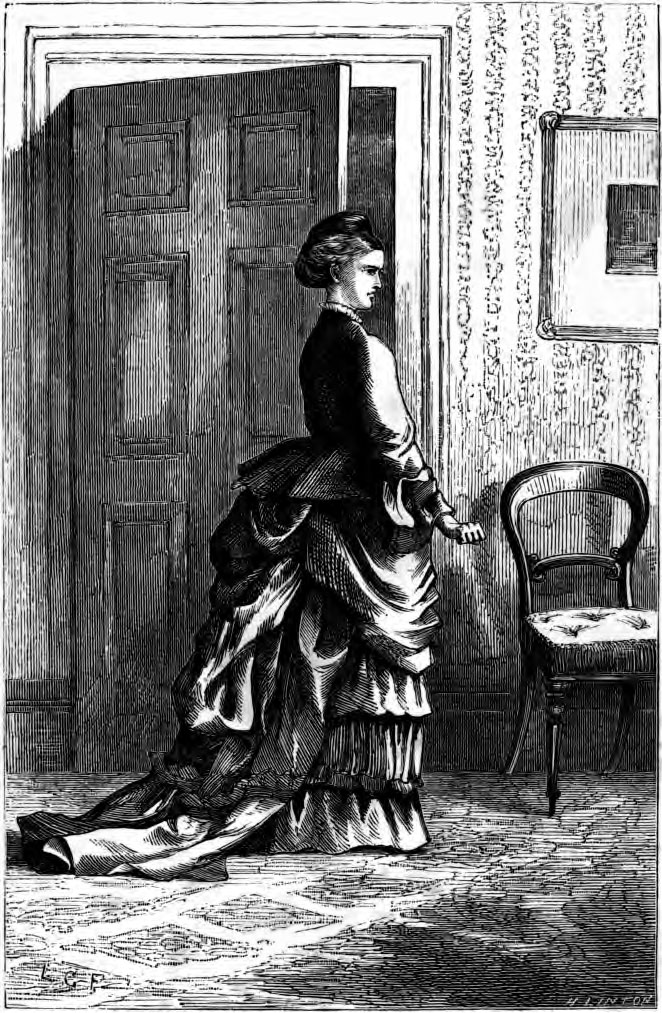
"And you mean to put up with it, mamma?" she said.
"What can we do, my dear?"
"I will do something. I'm not going to be cheated and swindled and
have my life thrown away into the bargain. I have always behaved
well to him. I have never run up bills without saying anything about
them." This was a cut at her elder sister, who had once got into some
little trouble of that kind. "I have never got myself talked about
with any body. If there is anything to be done I always do it. I have
written his letters for him till I have been sick, and when you were
ill I never asked him to stay out with us after two or half-past two
at the latest. And now he tells me that I am to eat my meals up in my
bedroom because I remind him that he distinctly promised to take us
back to London! Did he not promise, mamma?"
"I understood so, my dear."
"You know he promised, mamma. If I do anything now he must bear the
blame of it. I am not going to keep myself straight for the sake of
the family, and then be treated in that way."
"You do that for your own sake, I suppose," said her sister.
"It is more than you've been able to do for anybody's sake," said
Georgiana, alluding to a very old affair,--to an ancient flirtation,
in the course of which the elder daughter had made a foolish and a
futile attempt to run away with an officer of dragoons whose private
fortune was very moderate. Ten years had passed since that, and the
affair was never alluded to except in moments of great bitterness.
"I've kept myself as straight as you have," said Sophia. "It's easy
enough to be straight, when a person never cares for anybody, and
nobody cares for a person."
"My dears, if you quarrel what am I to do?" said their mother.
"It is I that have to suffer," continued Georgiana. "Does he expect
me to find anybody here that I could take? Poor George Whitstable is
not much; but there is nobody else at all."
"You may have him if you like," said Sophia, with a chuck of her
head.
"Thank you, my dear, but I shouldn't like it at all. I haven't come
to that quite yet."
"You were talking of running away with somebody."
"I shan't run away with George Whitstable; you may be sure of that.
I'll tell you what I shall do,--I will write papa a letter. I suppose
he'll condescend to read it. If he won't take me up to town himself,
he must send me up to the Primeros. What makes me most angry in the
whole thing is that we should have condescended to be civil to the
Melmottes down in the country. In London one does those things, but
to have them here was terrible!"
During that entire afternoon nothing more was said. Not a word passed
between them on any subject beyond those required by the necessities
of life. Georgiana had been as hard to her sister as to her father,
and Sophia in her quiet way resented the affront. She was now almost
reconciled to the sojourn in the country, because it inflicted a
fitting punishment on Georgiana, and the presence of Mr. Whitstable
at a distance of not more than ten miles did of course make a
difference to herself. Lady Pomona complained of a headache, which
was always an excuse with her for not speaking;--and Mr. Longestaffe
went to sleep. Georgiana during the whole afternoon remained apart,
and on the next morning the head of the family found the following
letter on his dressing-table;--
MY DEAR PAPA,--
I don't think you ought to be surprised because we feel
that our going up to town is so very important to us. If
we are not to be in London at this time of the year we can
never see anybody, and of course you know what that must
mean for me. If this goes on about Sophia, it does not
signify for her, and, though mamma likes London, it is not
of real importance. But it is very, very hard upon me. It
isn't for pleasure that I want to go up. There isn't so
very much pleasure in it. But if I'm to be buried down
here at Caversham, I might just as well be dead at once.
If you choose to give up both houses for a year, or for
two years, and take us all abroad, I should not grumble in
the least. There are very nice people to be met abroad,
and perhaps things go easier that way than in town. And
there would be nothing for horses, and we could dress very
cheap and wear our old things. I'm sure I don't want to
run up bills. But if you would only think what Caversham
must be to me, without any one worth thinking about within
twenty miles, you would hardly ask me to stay here.
You certainly did say that if we would come down here with
those Melmottes we should be taken back to town, and you
cannot be surprised that we should be disappointed when we
are told that we are to be kept here after that. It makes
me feel that life is so hard that I can't bear it. I see
other girls having such chances when I have none, that
sometimes I think I don't know what will happen to me.
(This was the nearest approach which she dared to make in writing to
that threat which she had uttered to her mother of running away with
somebody.)
I suppose that now it is useless for me to ask you to take
us all back this summer,--though it was promised; but I
hope you'll give me money to go up to the Primeros. It
would only be me and my maid. Julia Primero asked me to
stay with them when you first talked of not going up, and
I should not in the least object to reminding her, only
it should be done at once. Their house in Queen's Gate is
very large, and I know they've a room. They all ride, and
I should want a horse; but there would be nothing else,
as they have plenty of carriages, and the groom who rides
with Julia would do for both of us. Pray answer this at
once, papa.
Your affectionate daughter,
GEORGIANA LONGESTAFFE.
Mr. Longestaffe did condescend to read the letter. He, though he
had rebuked his mutinous daughter with stern severity, was also to
some extent afraid of her. At a sudden burst he could stand upon his
authority, and assume his position with parental dignity; but not the
less did he dread the wearing toil of continued domestic strife. He
thought that upon the whole his daughter liked a row in the house. If
not, there surely would not be so many rows. He himself thoroughly
hated them. He had not any very lively interest in life. He did not
read much; he did not talk much; he was not specially fond of eating
and drinking; he did not gamble, and he did not care for the farm. To
stand about the door and hall and public rooms of the clubs to which
he belonged and hear other men talk politics or scandal, was what
he liked better than anything else in the world. But he was quite
willing to give this up for the good of his family. He would be
contented to drag through long listless days at Caversham, and
endeavour to nurse his property, if only his daughter would allow it.
By assuming a certain pomp in his living, which had been altogether
unserviceable to himself and family, by besmearing his footmen's
heads, and bewigging his coachmen, by aping, though never achieving,
the grand ways of grander men than himself, he had run himself into
debt. His own ambition had been a peerage, and he had thought that
this was the way to get it. A separate property had come to his son
from his wife's mother,--some £2,000 or £3,000 a year, magnified by
the world into double its amount,--and the knowledge of this had
for a time reconciled him to increasing the burdens on the family
estates. He had been sure that Adolphus, when of age, would have
consented to sell the Sussex property in order that the Suffolk
property might be relieved. But Dolly was now in debt himself, and
though in other respects the most careless of men, was always on his
guard in any dealings with his father. He would not consent to the
sale of the Sussex property unless half of the proceeds were to be at
once handed to himself. The father could not bring himself to con-
sent o this, but, while refusing it, found the troubles of the world
very hard upon him. Melmotte had done something for him,--but in
doing this Melmotte was very hard and tyrannical. Melmotte, when at
Caversham, had looked into his affairs, and had told him very plainly
that with such an establishment in the country he was not entitled
to keep a house in town. Mr. Longestaffe had then said something
about his daughters,--something especially about Georgiana,--and Mr.
Melmotte had made a suggestion.
Mr. Longestaffe, when he read his daughter's appeal, did feel for
her, in spite of his anger. But if there was one man he hated more
than another, it was his neighbour Mr. Primero; and if one woman, it
was Mrs. Primero. Primero, whom Mr. Longestaffe regarded as quite
an upstart, and anything but a gentleman, owed no man anything. He
paid his tradesmen punctually, and never met the squire of Caversham
without seeming to make a parade of his virtue in that direction.
He had spent many thousands for his party in county elections and
borough elections, and was now himself member for a metropolitan
district. He was a radical, of course, or, according to Mr.
Longestaffe's view of his political conduct, acted and voted on the
radical side because there was nothing to be got by voting and acting
on the other. And now there had come into Suffolk a rumour that Mr.
Primero was to have a peerage. To others the rumour was incredible,
but Mr. Longestaffe believed it, and to Mr. Longestaffe that belief
was an agony. A Baron Bundlesham just at his door, and such a Baron
Bundlesham, would be more than Mr. Longestaffe could endure. It was
quite impossible that his daughter should be entertained in London by
the Primeros.
But another suggestion had been made. Georgiana's letter had been
laid on her father's table on the Monday morning. On the following
morning, when there could have been no intercourse with London by
letter, Lady Pomona called her younger daughter to her, and handed
her a note to read. "Your papa has this moment given it me. Of course
you must judge for yourself." This was the note;--
MY DEAR MR. LONGESTAFFE,
As you seem determined not to return to London this
season, perhaps one of your young ladies would like to
come to us. Mrs. Melmotte would be delighted to have Miss
Georgiana for June and July. If so, she need only give
Mrs. Melmotte a day's notice.
Yours truly,
AUGUSTUS MELMOTTE.
Georgiana, as soon as her eye had glanced down the one side of note
paper on which this invitation was written, looked up for the date.
It was without a date, and had, she felt sure, been left in her
father's hands to be used as he might think fit. She breathed very
hard. Both her father and mother had heard her speak of these Mel-
mottes, and knew what she thought of them. There was an insolence
in the very suggestion. But at the first moment she said nothing of
that. "Why shouldn't I go to the Primeros?" she asked.
"Your father will not hear of it. He dislikes them especially."
"And I dislike the Melmottes. I dislike the Primeros of course, but
they are not so bad as the Melmottes. That would be dreadful."
"You must judge for yourself, Georgiana."
"It is that,--or staying here?"
"I think so, my dear."
"If papa chooses I don't know why I am to mind. It will be awfully
disagreeable,--absolutely disgusting!"
"She seemed to be very quiet."
"Pooh, mamma! Quiet! She was quiet here because she was afraid of us.
She isn't yet used to be with people like us. She'll get over that
if I'm in the house with her. And then she is, oh! so frightfully
vulgar! She must have been the very sweeping of the gutters. Did
you not see it, mamma? She could not even open her mouth, she was
so ashamed of herself. I shouldn't wonder if they turned out to be
something quite horrid. They make me shudder. Was there ever anything
so dreadful to look at as he is?"
"Everybody goes to them," said Lady Pomona. "The Duchess of Stevenage
has been there over and over again, and so has Lady Auld Reekie.
Everybody goes to their house."
"But everybody doesn't go and live with them. Oh, mamma,--to have to
sit down to breakfast every day for ten weeks with that man and that
woman!"
"Perhaps they'll let you have your breakfast up-stairs."
"But to have to go out with them;--walking into the room after her!
Only think of it!"
"But you are so anxious to be in London, my dear."
"Of course I am anxious. What other chance have I, mamma? And, oh
dear, I am so tired of it! Pleasure, indeed! Papa talks of pleasure.
If papa had to work half as hard as I do, I wonder what he'd think
of it. I suppose I must do it. I know it will make me so ill that I
shall almost die under it. Horrid, horrid people! And papa to propose
it, who has always been so proud of everything,--who used to think so
much of being with the right set."
"Things are changed, Georgiana," said the anxious mother.
"Indeed they are when papa wants me to go and stay with people like
that. Why, mamma, the apothecary in Bungay is a fine gentleman
compared with Mr. Melmotte, and his wife is a fine lady compared with
Madame Melmotte. But I'll go. If papa chooses me to be seen with such
people it is not my fault. There will be no disgracing one's self
after that. I don't believe in the least that any decent man would
propose to a girl in such a house, and you and papa must not be
surprised if I take some horrid creature from the Stock Exchange.
Papa has altered his ideas; and so, I suppose, I had better alter
mine."
Georgiana did not speak to her father that night, but Lady Pomona
informed Mr. Longestaffe that Mr. Melmotte's invitation was to be
accepted. She herself would write a line to Madame Melmotte, and
Georgiana would go up on the Friday following. "I hope she'll like
it," said Mr. Longestaffe. The poor man had no intention of irony. It
was not in his nature to be severe after that fashion. But to poor
Lady Pomona the words sounded very cruel. How could any one like
to live in a house with Mr. and Madame Melmotte!
On the Friday morning there was a little conversation between the two
sisters, just before Georgiana's departure to the railway station,
which was almost touching. She had endeavoured to hold up her head as
usual, but had failed. The thing that she was going to do cowed her
even in the presence of her sister. "Sophy, I do so envy you staying
here."
"But it was you who were so determined to be in London."
"Yes; I was determined, and am determined. I've got to get myself
settled somehow, and that can't be done down here. But you are not
going to disgrace yourself."
"There's no disgrace in it, Georgey."
"Yes, there is. I believe the man to be a swindler and a thief; and
I believe her to be anything low that you can think of. As to their
pretensions to be gentlefolk, it is monstrous. The footmen and
housemaids would be much better."
"Then don't go, Georgey."
"I must go. It's the only chance that is left. If I were to remain
down here everybody would say that I was on the shelf. You are going
to marry Whitstable, and you'll do very well. It isn't a big place,
but there's no debt on it, and Whitstable himself isn't a bad sort of
fellow."
"Is he, now?"
"Of course he hasn't much to say for himself, for he's always at
home. But he is a gentleman."
"That he certainly is."
"As for me I shall give over caring about gentlemen now. The first
man that comes to me with four or five thousand a year, I'll take
him, though he'd come out of Newgate or Bedlam. And I shall always
say it has been papa's doing."
And so Georgiana Longestaffe went up to London and stayed with the
Melmottes.
CHAPTER XXII.
LORD NIDDERDALE'S MORALITY.
It was very generally said in the city about this time that the Great
South Central Pacific and Mexican Railway was the very best thing
out. It was known that Mr. Melmotte had gone into it with heart and
hand. There were many who declared,--with gross injustice to the
Great Fisker,--that the railway was Melmotte's own child, that he had
invented it, advertised it, agitated it, and floated it; but it was
not the less popular on that account. A railway from Salt Lake City
to Mexico no doubt had much of the flavour of a castle in Spain.
Our far-western American brethren are supposed to be imaginative.
Mexico has not a reputation among us for commercial security, or
that stability which produces its four, five, or six per cent. with
the regularity of clockwork. But there was the Panama railway, a
small affair which had paid twenty-five per cent.; and there was the
great line across the continent to San Francisco, in which enormous
fortunes had been made. It came to be believed that men with their
eyes open might do as well with the Great South Central as had ever
been done before with other speculations, and this belief was no
doubt founded on Mr. Melmotte's partiality for the enterprise. Mr.
Fisker had "struck 'ile" when he induced his partner, Montague, to
give him a note to the great man.
Paul Montague himself, who cannot be said to have been a man having
his eyes open, in the city sense of the word, could not learn how
the thing was progressing. At the regular meetings of the Board,
which never sat for above half an hour, two or three papers were read
by Miles Grendall. Melmotte himself would speak a few slow words,
intended to be cheery, and always indicative of triumph, and then
everybody would agree to everything, somebody would sign something,
and the "Board" for that day would be over. To Paul Montague this was
very unsatisfactory. More than once or twice he endeavoured to stay
the proceedings, not as disapproving, but "simply as desirous of
being made to understand;" but the silent scorn of his chairman put
him out of countenance, and the opposition of his colleagues was
a barrier which he was not strong enough to overcome. Lord Alfred
Grendall would declare that he "did not think all that was at all
necessary." Lord Nidderdale, with whom Montague had now become
intimate at the Beargarden, would nudge him in the ribs and bid him
hold his tongue. Mr. Cohenlupe would make a little speech in fluent
but broken English, assuring the Committee that everything was being
done after the approved city fashion. Sir Felix, after the first two
meetings, was never there. And thus Paul Montague, with a sorely
burdened conscience, was carried along as one of the Directors of the
Great South Central Pacific and Mexican Railway Company.
I do not know whether the burden was made lighter to him or heavier,
by the fact that the immediate pecuniary result was certainly very
comfortable. The Company had not yet been in existence quite six
weeks,--or at any rate Melmotte had not been connected with it above
that time,--and it had already been suggested to him twice that he
should sell fifty shares at £112 10_s_. He did not even yet know how
many shares he possessed, but on both occasions he consented to the
proposal, and on the following day received a cheque for £625,--that
sum representing the profit over and above the original nominal price
of £100 a share. The suggestion was made to him by Miles Grendall,
and when he asked some questions as to the manner in which the shares
had been allocated, he was told that all that would be arranged in
accordance with the capital invested and must depend on the final
disposition of the Californian property. "But from what we see, old
fellow," said Miles, "I don't think you have anything to fear. You
seem to be about the best in of them all. Melmotte wouldn't advise
you to sell out gradually, if he didn't look upon the thing as a
certain income as far as you are concerned."
Paul Montague understood nothing of all this, and felt that he was
standing on ground which might be blown from under his feet at any
moment. The uncertainty, and what he feared might be the dishonesty,
of the whole thing, made him often very miserable. In those wretched
moments his conscience was asserting itself. But again there were
times in which he also was almost triumphant, and in which he felt
the delight of his wealth. Though he was snubbed at the Board when
he wanted explanations, he received very great attention outside the
board-room from those connected with the enterprise. Melmotte had
asked him to dine two or three times. Mr. Cohenlupe had begged him to
go down to his little place at Rickmansworth,--an entreaty with which
Montague had not as yet complied. Lord Alfred was always gracious to
him, and Nidderdale and Carbury were evidently anxious to make him
one of their set at the club. Many other houses became open to him
from the same source. Though Melmotte was supposed to be the inventor
of the railway, it was known that Fisker, Montague, and Montague were
largely concerned in it, and it was known also that Paul Montague was
one of the Montagues named in that firm. People, both in the City and
the West End, seemed to think that he knew all about it, and treated
him as though some of the manna falling from that heaven were at his
disposition. There were results from this which were not unpleasing
to the young man. He only partially resisted the temptation; and
though determined at times to probe the affair to the bottom, was so
determined only at times. The money was very pleasant to him. The
period would now soon arrive before which he understood himself to be
pledged not to make a distinct offer to Henrietta Carbury; and when
that period should have been passed, it would be delightful to him to
know that he was possessed of property sufficient to enable him to
give a wife a comfortable home. In all his aspirations, and in all
his fears, he was true to Hetta Carbury, and made her the centre of
his hopes. Nevertheless, had Hetta known everything, it may be feared
that she would have at any rate endeavoured to dismiss him from her
heart.
There was considerable uneasiness in the bosoms of others of the
Directors, and a disposition to complain against the Grand Director,
arising from a grievance altogether different from that which
afflicted Montague. Neither had Sir Felix Carbury nor Lord Nidderdale
been invited to sell shares, and consequently neither of them
had received any remuneration for the use of their names. They
knew well that Montague had sold shares. He was quite open on the
subject, and had told Felix, whom he hoped some day to regard
as his brother-in-law, exactly what shares he had sold, and for
how much;--and the two men had endeavoured to make the matter
intelligible between themselves. The original price of the shares
being £100 each, and £12 10_s._ a share having been paid to Montague
as the premium, it was to be supposed that the original capital was
re-invested in other shares. But each owned to the other that the
matter was very complicated to him, and Montague could only write
to Hamilton K. Fisker at San Francisco asking for explanation. As
yet he had received no answer. But it was not the wealth flowing
into Montague's hands which embittered Nidderdale and Carbury. They
understood that he had really brought money into the concern, and was
therefore entitled to take money out of it. Nor did it occur to them
to grudge Melmotte his more noble pickings, for they knew how great
a man was Melmotte. Of Cohenlupe's doings they heard nothing; but he
was a regular city man, and had probably supplied funds. Cohenlupe
was too deep for their inquiry. But they knew that Lord Alfred had
sold shares, and had received the profit; and they knew also how
utterly impossible it was that Lord Alfred should have produced
capital. If Lord Alfred Grendall was entitled to plunder, why were
not they? And if their day for plunder had not yet come, why had
Lord Alfred's? And if there was so much cause to fear Lord Alfred
that it was necessary to throw him a bone, why should not they
also make themselves feared? Lord Alfred passed all his time with
Melmotte,--had, as these young men said, become Melmotte's head
valet,--and therefore had to be paid. But that reason did not satisfy
the young men.
"You haven't sold any shares;--have you?" This question Sir Felix
asked Lord Nidderdale at the club. Nidderdale was constant in his
attendance at the Board, and Felix was not a little afraid that he
might be jockied also by him.
"Not a share."
"Nor got any profits?"
"Not a shilling of any kind. As far as money is concerned my only
transaction has been my part of the expense of Fisker's dinner."
"What do you get then, by going into the city?" asked Sir Felix.
"I'm blessed if I know what I get. I suppose something will turn up
some day."
"In the meantime, you know, there are our names. And Grendall is
making a fortune out of it."
"Poor old duffer," said his lordship. "If he's doing so well, I think
Miles ought to be made to pay up something of what he owes. I think
we ought to tell him that we shall expect him to have the money ready
when that bill of Vossner's comes round."
"Yes, by George; let's tell him that. Will you do it?"
"Not that it will be the least good. It would be quite unnatural to
him to pay anything."
"Fellows used to pay their gambling debts," said Sir Felix, who was
still in funds, and who still held a considerable assortment of I. O.
U.'s.
"They don't now,--unless they like it. How did a fellow manage
before, if he hadn't got it?"
"He went smash," said Sir Felix, "and disappeared and was never heard
of any more. It was just the same as if he'd been found cheating. I
believe a fellow might cheat now and nobody'd say anything!"
"I shouldn't," said Lord Nidderdale. "What's the use of being beastly
ill-natured? I'm not very good at saying my prayers, but I do think
there's something in that bit about forgiving people. Of course
cheating isn't very nice: and it isn't very nice for a fellow to play
when he knows he can't pay; but I don't know that it's worse than
getting drunk like Dolly Longestaffe, or quarrelling with everybody
as Grasslough does,--or trying to marry some poor devil of a girl
merely because she's got money. I believe in living in glass houses,
but I don't believe in throwing stones. Do you ever read the Bible,
Carbury?"
"Read the Bible! Well;--yes;--no;--that is, I suppose, I used to do."
"I often think I shouldn't have been the first to pick up a stone and
pitch it at that woman. Live and let live;--that's my motto."
"But you agree that we ought to do something about these shares?"
said Sir Felix, thinking that this doctrine of forgiveness might be
carried too far.
"Oh, certainly. I'll let old Grendall live with all my heart; but
then he ought to let me live too. Only, who's to bell the cat?"
"What cat?"
"It's no good our going to old Grendall," said Lord Nidderdale, who
had some understanding in the matter, "nor yet to young Grendall. The
one would only grunt and say nothing, and the other would tell every
lie that came into his head. The cat in this matter I take to be our
great master, Augustus Melmotte."
This little meeting occurred on the day after Felix Carbury's return
from Suffolk, and at a time at which, as we know, it was the great
duty of his life to get the consent of old Melmotte to his marriage
with Marie Melmotte. In doing that he would have to put one bell on
the cat, and he thought that for the present that was sufficient. In
his heart of hearts he was afraid of Melmotte. But then, as he knew
very well, Nidderdale was intent on the same object. Nidderdale, he
thought, was a very queer fellow. That talking about the Bible, and
the forgiving of trespasses, was very queer; and that allusion to
the marrying of heiresses very queer indeed. He knew that Nidderdale
wanted to marry the heiress, and Nidderdale must also know that he
wanted to marry her. And yet Nidderdale was indelicate enough to talk
about it! And now the man asked who should bell the cat! "You go
there oftener than I do, and perhaps you could do it best," said Sir
Felix.
"Go where?"
"To the Board."
"But you're always at his house. He'd be civil to me, perhaps,
because I'm a lord: but then, for the same reason, he'd think I was
the bigger fool of the two."
"I don't see that at all," said Sir Felix.
"I ain't afraid of him, if you mean that," continued Lord Nidderdale.
"He's a wretched old reprobate, and I don't doubt but he'd skin you
and me if he could make money off our carcasses. But as he can't skin
me, I'll have a shy at him. On the whole I think he rather likes me,
because I've always been on the square with him. If it depended on
him, you know, I should have the girl to-morrow."
"Would you?" Sir Felix did not at all mean to doubt his friend's
assertion, but felt it hard to answer so very strange a statement.
"But then she don't want me, and I ain't quite sure that I want her.
Where the devil would a fellow find himself if the money wasn't all
there?" Lord Nidderdale then sauntered away, leaving the baronet in a
deep study of thought as to such a condition of things as that which
his lordship had suggested. Where the--mischief would he, Sir Felix
Carbury, be, if he were to marry the girl, and then to find that the
money was not all there?
On the following Friday, which was the Board day, Nidderdale went to
the great man's offices in Abchurch Lane, and so contrived that he
walked with the great man to the Board meeting. Melmotte was always
very gracious in his manner to Lord Nidderdale, but had never, up
to this moment, had any speech with his proposed son-in-law about
business. "I wanted just to ask you something," said the lord,
hanging on the chairman's arm.
"Anything you please, my lord."
"Don't you think that Carbury and I ought to have some shares to
sell?"
"No, I don't,--if you ask me."
"Oh;--I didn't know. But why shouldn't we as well as the others?"
"Have you and Sir Felix put any money into it?"
"Well, if you come to that, I don't suppose we have. How much has
Lord Alfred put into it?"
"_I_ have taken shares for Lord Alfred," said Melmotte, putting very
heavy emphasis on the personal pronoun. "If it suits me to advance
money to Lord Alfred Grendall, I suppose I may do so without asking
your lordship's consent, or that of Sir Felix Carbury."
"Oh, certainly. I don't want to make inquiry as to what you do with
your money."
"I'm sure you don't, and, therefore, we won't say anything more about
it. You wait awhile, Lord Nidderdale, and you'll find it will come
all right. If you've got a few thousand pounds loose, and will put
them into the concern, why, of course you can sell; and, if the
shares are up, can sell at a profit. It's presumed just at present
that, at some early day, you'll qualify for your directorship by
doing so, and till that is done, the shares are allocated to you, but
cannot be transferred to you."
"That's it, is it," said Lord Nidderdale, pretending to understand
all about it.
"If things go on as we hope they will between you and Marie, you can
have pretty nearly any number of shares that you please;--that is, if
your father consents to a proper settlement."
"I hope it'll all go smooth, I'm sure," said Nidderdale. "Thank you;
I'm ever so much obliged to you, and I'll explain it all to Carbury."
CHAPTER XXIII.
"YES;--I'M A BARONET."
How eager Lady Carbury was that her son should at once go in form to
Marie's father and make his proposition may be easily understood.
"My dear Felix," she said, standing over his bedside a little before
noon, "pray don't put it off; you don't know how many slips there may
be between the cup and the lip."
"It's everything to get him in a good humour," pleaded Sir Felix.
"But the young lady will feel that she is ill-used."
"There's no fear of that; she's all right. What am I to say to him
about money? That's the question."
"I shouldn't think of dictating anything, Felix."
"Nidderdale, when he was on before, stipulated for a certain sum
down; or his father did for him. So much cash was to be paid over
before the ceremony, and it only went off because Nidderdale wanted
the money to do what he liked with."
"You wouldn't mind having it settled?"
"No;--I'd consent to that on condition that the money was paid
down, and the income insured to me,--say £7,000 or £8,000 a year.
I wouldn't do it for less, mother; it wouldn't be worth while."
"But you have nothing left of your own."
"I've got a throat that I can cut, and brains that I can blow
out," said the son, using an argument which he conceived might be
efficacious with his mother; though, had she known him, she might
have been sure that no man lived less likely to cut his own throat or
blow out his own brains.
"Oh, Felix! how brutal it is to speak to me in that way."
"It may be brutal; but you know, mother, business is business. You
want me to marry this girl because of her money."
"You want to marry her yourself."
"I'm quite a philosopher about it. I want her money; and when one
wants money, one should make up one's mind how much or how little one
means to take,--and whether one is sure to get it."
"I don't think there can be any doubt."
"If I were to marry her, and if the money wasn't there, it would be
very like cutting my throat then, mother. If a man plays and loses,
he can play again and perhaps win; but when a fellow goes in for
an heiress, and gets the wife without the money, he feels a little
hampered you know."
"Of course he'd pay the money first."
"It's very well to say that. Of course he ought; but it would be
rather awkward to refuse to go into church after everything had been
arranged because the money hadn't been paid over. He's so clever,
that he'd contrive that a man shouldn't know whether the money had
been paid or not. You can't carry £10,000 a year about in your
pocket, you know. If you'll go, mother, perhaps I might think of
getting up."
Lady Carbury saw the danger, and turned over the affair on every side
in her own mind. But she could also see the house in Grosvenor
Square, the expenditure without limit, the congregating duchesses,
the general acceptation of the people, and the mercantile celebrity
of the man. And she could weigh against that the absolute
pennilessness of her baronet-son. As he was, his condition was
hopeless. Such a one must surely run some risk. The embarrassments
of such a man as Lord Nidderdale were only temporary. There were the
family estates, and the marquisate, and a golden future for him; but
there was nothing coming to Felix in the future. All the goods he
would ever have of his own, he had now;--position, a title, and a
handsome face. Surely he could afford to risk something! Even the
ruins and wreck of such wealth as that displayed in Grosvenor Square
would be better than the baronet's present condition. And then,
though it was possible that old Melmotte should be ruined some day,
there could be no doubt as to his present means; and would it not be
probable that he would make hay while the sun shone by securing his
daughter's position? She visited her son again on the next morning,
which was Sunday, and again tried to persuade him to the marriage. "I
think you should be content to run a little risk," she said.
Sir Felix had been unlucky at cards on Saturday night, and had taken,
perhaps, a little too much wine. He was at any rate sulky, and in
a humour to resent interference. "I wish you'd leave me alone," he
said, "to manage my own business."
"Is it not my business too?"
"No; you haven't got to marry her, and to put up with these people. I
shall make up my mind what to do myself, and I don't want anybody to
meddle with me."
"You ungrateful boy!"
"I understand all about that. Of course I'm ungrateful when I don't
do everything just as you wish it. You don't do any good. You only
set me against it all."
"How do you expect to live, then? Are you always to be a burden on
me and your sister? I wonder that you've no shame. Your cousin Roger
is right. I will quit London altogether, and leave you to your own
wretchedness."
"That's what Roger says; is it? I always thought Roger was a fellow
of that sort."
"He is the best friend I have." What would Roger have thought had he
heard this assertion from Lady Carbury?
"He's an ill-tempered, close-fisted, interfering cad, and if he
meddles with my affairs again, I shall tell him what I think of him.
Upon my word, mother, these little disputes up in my bedroom ain't
very pleasant. Of course it's your house; but if you do allow me a
room, I think you might let me have it to myself." It was impossible
for Lady Carbury, in her present mood, and in his present mood, to
explain to him that in no other way and at no other time could she
ever find him. If she waited till he came down to breakfast, he
escaped from her in five minutes, and then he returned no more till
some unholy hour in the morning. She was as good a pelican as ever
allowed the blood to be torn from her own breast to satisfy the greed
of her young, but she felt that she should have something back for
her blood,--some return for her sacrifices. This chick would take all
as long as there was a drop left, and then resent the fondling of
the mother-bird as interference. Again and again there came upon her
moments in which she thought that Roger Carbury was right. And yet
she knew that when the time came she would not be able to be severe.
She almost hated herself for the weakness of her own love,--but
she acknowledged it. If he should fall utterly, she must fall with
him. In spite of his cruelty, his callous hardness, his insolence to
herself, his wickedness and ruinous indifference to the future, she
must cling to him to the last. All that she had done, and all that
she had borne,--all that she was doing and bearing,--was it not for
his sake?
Sir Felix had been in Grosvenor Square since his return from Carbury,
and had seen Madame Melmotte and Marie; but he had seen them
together, and not a word had been said about the engagement. He could
not make much use of the elder woman. She was as gracious as was
usual with her; but then she was never very gracious. She had told
him that Miss Longestaffe was coming to her, which was a great bore,
as the young lady was "fatigante." Upon this Marie had declared that
she intended to like the young lady very much. "Pooh!" said Madame
Melmotte. "You never like no person at all." At this Marie had looked
over to her lover and smiled. "Ah, yes; that is all very well,--while
it lasts; but you care for no friend." From which Felix had judged
that Madame Melmotte at any rate knew of his offer, and did not
absolutely disapprove of it. On the Saturday he had received a note
at his club from Marie. "Come on Sunday at half-past two. You will
find papa after lunch." This was in his possession when his mother
visited him in his bedroom, and he had determined to obey the behest.
But he would not tell her of his intention, because he had drunk too
much wine, and was sulky.
At about three on Sunday he knocked at the door in Grosvenor Square
and asked for the ladies. Up to the moment of his knocking,--even
after he had knocked, and when the big porter was opening the
door,--he intended to ask for Mr. Melmotte; but at the last his
courage failed him, and he was shown up into the drawing-room. There
he found Madame Melmotte, Marie, Georgiana Longestaffe, and--Lord
Nidderdale. Marie looked anxiously into his face, thinking that he
had already been with her father. He slid into a chair close to
Madame Melmotte, and endeavoured to seem at his ease. Lord Nidderdale
continued his flirtation with Miss Longestaffe,--a flirtation which
she carried on in a half whisper, wholly indifferent to her hostess
or the young lady of the house. "We know what brings you here," she
said.
"I came on purpose to see you."
"I'm sure, Lord Nidderdale, you didn't expect to find me here."
"Lord bless you, I knew all about it, and came on purpose. It's a
great institution; isn't it?"
"It's an institution you mean to belong to,--permanently."
"No, indeed. I did have thoughts about it as fellows do when they
talk of going into the army or to the bar; but I couldn't pass. That
fellow there is the happy man. I shall go on coming here, because
you're here. I don't think you'll like it a bit, you know."
"I don't suppose I shall, Lord Nidderdale."
After a while Marie contrived to be alone with her lover near one
of the windows for a few seconds. "Papa is down-stairs in the
book-room," she said. "Lord Alfred was told when he came that he was
out." It was evident to Sir Felix that everything was prepared for
him. "You go down," she continued, "and ask the man to show you into
the book-room."
"Shall I come up again?"
"No; but leave a note for me here under cover to Madame Didon." Now
Sir Felix was sufficiently at home in the house to know that Madame
Didon was Madame Melmotte's own woman, commonly called Didon by the
ladies of the family. "Or send it by post,--under cover to her. That
will be better. Go at once, now." It certainly did seem to Sir Felix
that the very nature of the girl was altered. But he went, just
shaking hands with Madame Melmotte, and bowing to Miss Longestaffe.
In a few moments he found himself with Mr. Melmotte in the chamber
which had been dignified with the name of the book-room. The great
financier was accustomed to spend his Sunday afternoons here,
generally with the company of Lord Alfred Grendall. It may be
supposed that he was meditating on millions, and arranging the prices
of money and funds for the New York, Paris, and London Exchanges. But
on this occasion he was waked from slumber, which he seemed to have
been enjoying with a cigar in his mouth. "How do you do, Sir Felix?"
he said. "I suppose you want the ladies."
"I've just been in the drawing-room, but I thought I'd look in on you
as I came down." It immediately occurred to Melmotte that the baronet
had come about his share of the plunder out of the railway, and he at
once resolved to be stern in his manner, and perhaps rude also. He
believed that he should thrive best by resenting any interference
with him in his capacity as financier. He thought that he had risen
high enough to venture on such conduct, and experience had told him
that men who were themselves only half-plucked, might easily be cowed
by a savage assumption of superiority. And he, too, had generally the
advantage of understanding the game, while those with whom he was
concerned did not, at any rate, more than half understand it. He
could thus trade either on the timidity or on the ignorance of his
colleagues. When neither of these sufficed to give him undisputed
mastery, then he cultivated the cupidity of his friends. He liked
young associates because they were more timid and less greedy than
their elders. Lord Nidderdale's suggestions had soon been put at
rest, and Mr. Melmotte anticipated no greater difficulty with Sir
Felix. Lord Alfred he had been obliged to buy.
"I'm very glad to see you, and all that," said Melmotte, assuming a
certain exaltation of the eyebrows, which they who had many dealings
with him often found to be very disagreeable; "but this is hardly a
day for business, Sir Felix, nor,--yet a place for business."
Sir Felix wished himself at the Beargarden. He certainly had come
about business,--business of a particular sort; but Marie had told
him that of all days Sunday would be the best, and had also told him
that her father was more likely to be in a good humour on Sunday than
on any other day. Sir Felix felt that he had not been received with
good humour. "I didn't mean to intrude, Mr. Melmotte," he said.
"I dare say not. I only thought I'd tell you. You might have been
going to speak about that railway."
"Oh dear no."
"Your mother was saying to me down in the country that she hoped you
attended to the business. I told her that there was nothing to attend
to."
"My mother doesn't understand anything at all about it," said Sir
Felix.
"Women never do. Well;--what can I do for you, now that you are
here?"
"Mr. Melmotte, I'm come,--I'm come to;--in short, Mr. Melmotte, I
want to propose myself as a suitor for your daughter's hand."
"The d---- you do!"
"Well, yes; and we hope you'll give us your consent."
"She knows you're coming then?"
"Yes;--she knows."
"And my wife;--does she know?"
"I've never spoken to her about it. Perhaps Miss Melmotte has."
"And how long have you and she understood each other?"
"I've been attached to her ever since I saw her," said Sir Felix. "I
have indeed. I've spoken to her sometimes. You know how that kind of
thing goes on."
"I don't know about a promise."
"Do you consider that she's engaged to you?"
"Not if she's disposed to get out of it," said Sir Felix, hoping
that he might thus ingratiate himself with the father. "Of course, I
should be awfully disappointed."
"She has consented to your coming to me?"
"Well, yes;--in a sort of a way. Of course she knows that it all
depends on you."
"Not at all. She's of age. If she chooses to marry you, she can marry
you. If that's all you want, her consent is enough. You're a baronet,
I believe?"
"Oh, yes, I'm a baronet."
"And therefore you've come to your own property. You haven't to wait
for your father to die, and I dare say you are indifferent about
money."
This was a view of things which Sir Felix felt that he was bound
to dispel, even at the risk of offending the father. "Not exactly
that," he said. "I suppose you will give your daughter a fortune, of
course."
"Then I wonder you didn't come to me before you went to her. If my
daughter marries to please me, I shall give her money, no doubt. How
much is neither here nor there. If she marries to please herself,
without considering me, I shan't give her a farthing."
"I had hoped that you might consent, Mr. Melmotte."
"I've said nothing about that. It is possible. You're a man of
fashion and have a title of your own,--and no doubt a property. If
you'll show me that you've an income fit to maintain her, I'll think
about it at any rate. What is your property, Sir Felix?"
What could three or four thousand a year, or even five or six, matter
to a man like Melmotte? It was thus that Sir Felix looked at it. When
a man can hardly count his millions he ought not to ask questions
about trifling sums of money. But the question had been asked, and
the asking of such a question was no doubt within the prerogative of
a proposed father-in-law. At any rate, it must be answered. For a
moment it occurred to Sir Felix that he might conveniently tell the
truth. It would be nasty for the moment, but there would be nothing
to come after. Were he to do so he could not be dragged down lower
and lower into the mire by cross-examinings. There might be an end
of all his hopes, but there would at the same time be an end of all
his misery. But he lacked the necessary courage. "It isn't a large
property, you know," he said.
"Not like the Marquis of Westminster's, I suppose," said the horrid,
big, rich scoundrel.
"No;--not quite like that," said Sir Felix, with a sickly laugh.
"But you have got enough to support a baronet's title?"
"That depends on how you want to support it," said Sir Felix, putting
off the evil day.
"Where's your family seat?"
"Carbury Manor, down in Suffolk, near the Longestaffes, is the old
family place."
"That doesn't belong to you," said Melmotte, very sharply.
"No; not yet. But I'm the heir."
Perhaps if there is one thing in England more difficult than another
to be understood by men born and bred out of England, it is the
system under which titles and property descend together, or in
various lines. The jurisdiction of our Courts of Law is complex, and
so is the business of Parliament. But the rules regulating them,
though anomalous, are easy to the memory compared with the mixed
anomalies of the peerage and primogeniture. They who are brought up
among it, learn it as children do a language, but strangers who begin
the study in advanced life, seldom make themselves perfect in it. It
was everything to Melmotte that he should understand the ways of the
country which he had adopted; and when he did not understand, he was
clever at hiding his ignorance. Now he was puzzled. He knew that Sir
Felix was a baronet, and therefore presumed him to be the head of the
family. He knew that Carbury Manor belonged to Roger Carbury, and
he judged by the name it must be an old family property. And now
the baronet declared that he was heir to the man who was simply an
Esquire. "Oh, the heir are you? But how did he get it before you?
You're the head of the family?"
"Yes, I am the head of the family, of course," said Sir Felix, lying
directly. "But the place won't be mine till he dies. It would take a
long time to explain it all."
"He's a young man, isn't he?"
"No,--not what you'd call a young man. He isn't very old."
"If he were to marry and have children, how would it be then?"
Sir Felix was beginning to think that he might have told the truth
with discretion. "I don't quite know how it would be. I have always
understood that I am the heir. It's not very likely that he will
marry."
"And in the meantime what is your own property?"
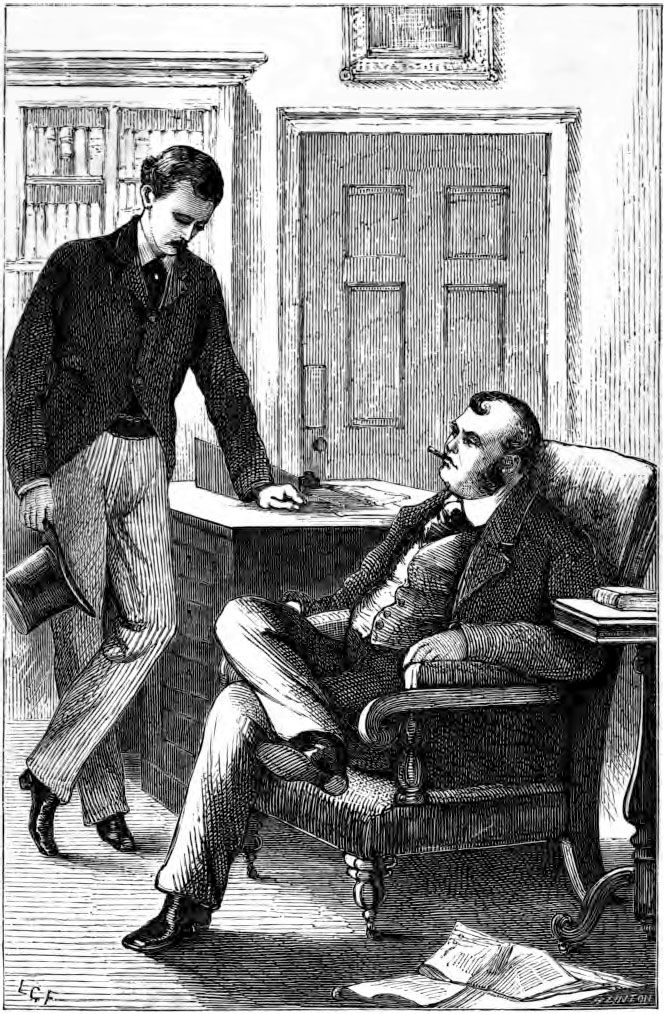
"My father left me money in the funds and in railway stock,--and then
I am my mother's heir."
"You have done me the honour of telling me that you wish to marry my
daughter."
"Certainly."
"Would you then object to inform me the amount and nature of the
income on which you intend to support your establishment as a married
man? I fancy that the position you assume justifies the question on
my part." The bloated swindler, the vile city ruffian, was certainly
taking a most ungenerous advantage of the young aspirant for wealth.
It was then that Sir Felix felt his own position. Was he not a
baronet, and a gentleman, and a very handsome fellow, and a man of
the world who had been in a crack regiment? If this surfeited sponge
of speculation, this crammed commercial cormorant, wanted more
than that for his daughter, why could he not say so without asking
disgusting questions such as these,--questions which it was quite
impossible that a gentleman should answer? Was it not sufficiently
plain that any gentleman proposing to marry the daughter of such
a man as Melmotte, must do so under the stress of pecuniary
embarrassment? Would it not be an understood bargain that as he
provided the rank and position, she would provide the money? And yet
the vulgar wretch took advantage of his assumed authority to ask
these dreadful questions! Sir Felix stood silent, trying to look the
man in the face, but failing;--wishing that he was well out of the
house, and at the Beargarden. "You don't seem to be very clear about
your own circumstances, Sir Felix. Perhaps you will get your lawyer
to write to me."
"Perhaps that will be best," said the lover.
"Either that, or to give it up. My daughter, no doubt, will have
money; but money expects money." At this moment Lord Alfred entered
the room. "You're very late to-day, Alfred. Why didn't you come as
you said you would?"
"I was here more than an hour ago, and they said you were out."
"I haven't been out of this room all day,--except to lunch. Good
morning, Sir Felix. Ring the bell, Alfred, and we'll have a little
soda and brandy." Sir Felix had gone through some greeting with
his fellow Director, Lord Alfred, and at last succeeded in getting
Melmotte to shake hands with him before he went. "Do you know
anything about that young fellow?" Melmotte asked as soon as the door
was closed.
"He's a baronet without a shilling;--was in the army and had to leave
it," said Lord Alfred as he buried his face in a big tumbler.
"Without a shilling! I supposed so. But he's heir to a place down in
Suffolk;--eh?"
"Not a bit of it. It's the same name, and that's about all. Mr.
Carbury has a small property there, and he might give it to me
to-morrow. I wish he would, though there isn't much of it. That young
fellow has nothing to do with it whatever."
"Hasn't he now?" Mr. Melmotte as he speculated upon it, almost
admired the young man's impudence.
CHAPTER XXIV.
MILES GRENDALL'S TRIUMPH.
Sir Felix as he walked down to his club felt that he had been
checkmated,--and was at the same time full of wrath at the insolence
of the man who had so easily beaten him out of the field. As far
as he could see, the game was over. No doubt he might marry Marie
Melmotte. The father had told him so much himself, and he perfectly
believed the truth of that oath which Marie had sworn. He did not
doubt but that she'd stick to him close enough. She was in love with
him, which was natural; and was a fool,--which was perhaps also
natural. But romance was not the game which he was playing. People
told him that when girls succeeded in marrying without their parents'
consent, fathers were always constrained to forgive them at last.
That might be the case with ordinary fathers. But Melmotte was
decidedly not an ordinary father. He was,--so Sir Felix declared to
himself,--perhaps the greatest brute ever created. Sir Felix could
not but remember that elevation of the eyebrows, and the brazen
forehead, and the hard mouth. He had found himself quite unable to
stand up against Melmotte, and now he cursed and swore at the man as
he was carried down to the Beargarden in a cab.
But what should he do? Should he abandon Marie Melmotte altogether,
never go to Grosvenor Square again, and drop the whole family,
including the Great Mexican Railway? Then an idea occurred to him.
Nidderdale had explained to him the result of his application for
shares. "You see we haven't bought any and therefore can't sell any.
There seems to be something in that. I shall explain it all to my
governor, and get him to go a thou' or two. If he sees his way to get
the money back, he'd do that and let me have the difference." On that
Sunday afternoon Sir Felix thought over all this. "Why shouldn't he
'go a thou,' and get the difference?" He made a mental calculation.
£12 10_s._ per £100! £125 for a thousand! and all paid in ready
money. As far as Sir Felix could understand, directly the one
operation had been perfected the thousand pounds would be available
for another. As he looked into it with all his intelligence he
thought that he began to perceive that that was the way in which the
Melmottes of the world made their money. There was but one objection.
He had not got the entire thousand pounds. But luck had been on the
whole very good to him. He had more than the half of it in real
money, lying at a bank in the city at which he had opened an account.
And he had very much more than the remainder in I. O. U.'s from
Dolly Longestaffe and Miles Grendall. In fact if every man had his
own,--and his bosom glowed with indignation as he reflected on the
injustice with which he was kept out of his own,--he could go into
the city and take up his shares to-morrow, and still have ready money
at his command. If he could do this, would not such conduct on his
part be the best refutation of that charge of not having any fortune
which Melmotte had brought against him? He would endeavour to work
the money out of Dolly Longestaffe;--and he entertained an idea that
though it would be impossible to get cash from Miles Grendall, he
might use his claim against Miles in the city. Miles was Secretary to
the Board, and might perhaps contrive that the money required for the
shares should not be all ready money. Sir Felix was not very clear
about it, but thought that he might possibly in this way use the
indebtedness of Miles Grendall. "How I do hate a fellow who does not
pay up," he said to himself as he sat alone in his club, waiting for
some friend to come in. And he formed in his head Draconic laws which
he would fain have executed upon men who lost money at play and did
not pay. "How the deuce fellows can look one in the face, is what I
can't understand," he said to himself.
He thought over this great stroke of exhibiting himself to Melmotte
as a capitalist till he gave up his idea of abandoning his suit.
So he wrote a note to Marie Melmotte in accordance with her
instructions.
DEAR M.,
Your father cut up very rough,--about money. Perhaps you
had better see him yourself; or would your mother?
Yours always,
F.
This, as directed, he put under cover to Madame Didon,--Grosvenor
Square, and posted at the club. He had put nothing at any rate in the
letter which could commit him.
There was generally on Sundays a house dinner, so called, at eight
o'clock. Five or six men would sit down, and would always gamble
afterwards. On this occasion Dolly Longestaffe sauntered in at about
seven in quest of sherry and bitters, and Felix found the opportunity
a good one to speak of his money. "You couldn't cash your I. O. U.'s
for me to-morrow;--could you?"
"To-morrow! oh, lord!"
"I'll tell you why. You know I'd tell you anything because I think we
are really friends. I'm after that daughter of Melmotte's."
"I'm told you're to have her."
"I don't know about that. I mean to try at any rate. I've gone in you
know for that Board in the city."
"I don't know anything about Boards, my boy."
"Yes, you do, Dolly. You remember that American fellow, Montague's
friend, that was here one night and won all our money."
"The chap that had the waistcoat, and went away in the morning to
California. Fancy starting to California after a hard night. I always
wondered whether he got there alive."
"Well;--I can't explain to you all about it, because you hate those
kinds of things."
"And because I am such a fool."
"I don't think you're a fool at all, but it would take a week. But
it's absolutely essential for me to take up a lot of shares in the
city to-morrow;--or perhaps Wednesday might do. I'm bound to pay
for them, and old Melmotte will think that I'm utterly hard up if
I don't. Indeed he said as much, and the only objection about me
and this girl of his is as to money. Can't you understand, now, how
important it may be?"
"It's always important to have a lot of money. I know that."
"I shouldn't have gone in for this kind of thing if I hadn't thought
I was sure. You know how much you owe me, don't you?"
"Not in the least."
"It's about eleven hundred pounds!"
"I shouldn't wonder."
"And Miles Grendall owes me two thousand. Grasslough and Nidderdale
when they lose always pay with Miles's I. O. U.'s."
"So should I, if I had them."
"It'll come to that soon that there won't be any other stuff going,
and they really ain't worth anything. I don't see what's the use of
playing when this rubbish is shoved about the table. As for Grendall
himself, he has no feeling about it."
"Not the least, I should say."
"You'll try and get me the money, won't you, Dolly?"
"Melmotte has been at me twice. He wants me to agree to sell
something. He's an old thief, and of course he means to rob me. You
may tell him that if he'll let me have the money in the way I've
proposed, you are to have a thousand pounds out of it. I don't know
any other way."
"You could write me that,--in a business sort of way."
"I couldn't do that, Carbury. What's the use? I never write any
letters. I can't do it. You tell him that; and if the sale comes off,
I'll make it straight."
Miles Grendall also dined there, and after dinner, in the
smoking-room, Sir Felix tried to do a little business with the
Secretary. He began his operations with unusual courtesy, believing
that the man must have some influence with the great distributor of
shares. "I'm going to take up my shares in that company," said Sir
Felix.
"Ah;--indeed." And Miles enveloped himself from head to foot in
smoke.
"I didn't quite understand about it, but Nidderdale saw Melmotte and
he has explained it. I think I shall go in for a couple of thousand
on Wednesday."
"Oh;--ah."
"It will be the proper thing to do;--won't it?"
"Very good--thing to do!" Miles Grendall smoked harder and harder as
the suggestions were made to him.
"Is it always ready money?"
"Always ready money," said Miles shaking his head, as though in
reprobation of so abominable an institution.
"I suppose they allow some time to their own Directors, if a deposit,
say 50 per cent., is made for the shares?"
"They'll give you half the number, which would come to the same
thing."
Sir Felix turned this over in his mind, but let him look at it as he
would, could not see the truth of his companion's remark. "You know
I should want to sell again,--for the rise."
"Oh; you'll want to sell again."
"And therefore I must have the full number."
"You could sell half the number, you know," said Miles.
"I'm determined to begin with ten shares;--that's £1,000. Well;--I
have got the money, but I don't want to draw out so much. Couldn't
you manage for me that I should get them on paying 50 per cent.
down?"
"Melmotte does all that himself."
"You could explain, you know, that you are a little short in your own
payments to me." This Sir Felix said, thinking it to be a delicate
mode of introducing his claim upon the Secretary.
"That's private," said Miles frowning.
"Of course it's private; but if you would pay me the money I could
buy the shares with it, though they are public."
"I don't think we could mix the two things together, Carbury."
"You can't help me?"
"Not in that way."
"Then, when the deuce will you pay me what you owe me?" Sir Felix
was driven to this plain expression of his demand by the impassibility of
his debtor. Here was a man who did not pay his debts of honour, who
did not even propose any arrangement for paying them, and who yet
had the impudence to talk of not mixing up private matters with
affairs of business! It made the young baronet very sick. Miles
Grendall smoked on in silence. There was a difficulty in answering the
question, and he therefore made no answer. "Do you know how much you
owe me?" continued the baronet, determined to persist now that he had
commenced the attack. There was a little crowd of other men in the
room, and the conversation about the shares had been commenced in
an under-tone. These two last questions Sir Felix had asked in a
whisper, but his countenance showed plainly that he was speaking in
anger.
"Of course I know," said Miles.
"Well?"
"I'm not going to talk about it here."
"Not going to talk about it here?"
"No. This is a public room."
"I am going to talk about it," said Sir Felix, raising his voice.
"Will any fellow come up-stairs and play a game of billiards?" said
Miles Grendall rising from his chair. Then he walked slowly out of
the room, leaving Sir Felix to take what revenge he pleased. For a
moment Sir Felix thought that he would expose the transaction to the
whole room; but he was afraid, thinking that Miles Grendall was a
more popular man than himself.
It was Sunday night; but not the less were the gamblers assembled in
the card-room at about eleven. Dolly Longestaffe was there, and with
him the two lords, and Sir Felix, and Miles Grendall of course, and,
I regret to say, a much better man than any of them, Paul Montague.
Sir Felix had doubted much as to the propriety of joining the party.
What was the use of playing with a man who seemed by general consent
to be liberated from any obligation to pay? But then if he did not
play with him, where should he find another gambling table? They
began with whist, but soon laid that aside and devoted themselves to
loo. The least respected man in that confraternity was Grendall, and
yet it was in compliance with the persistency of his suggestion that
they gave up the nobler game. "Let's stick to whist; I like cutting
out," said Grasslough. "It's much more jolly having nothing to do now
and then; one can always bet," said Dolly shortly afterwards. "I hate
loo," said Sir Felix in answer to a third application. "I like whist
best," said Nidderdale, "but I'll play anything anybody likes;--pitch
and toss if you please." But Miles Grendall had his way, and loo was
the game.
At about two o'clock Grendall was the only winner. The play had not
been very high, but nevertheless he had won largely. Whenever a
large pool had collected itself he swept it into his garners. The
men opposed to him hardly grudged him this stroke of luck. He had
hitherto been unlucky; and they were able to pay him with his own
paper, which was so valueless that they parted with it without a
pang. Even Dolly Longestaffe seemed to have a supply of it. The only
man there not so furnished was Montague, and while the sums won were
quite small he was allowed to pay with cash. But to Sir Felix it was
frightful to see ready money going over to Miles Grendall, as under
no circumstances could it be got back from him. "Montague," he said,
"just change these for the time. I'll take them back, if you still
have them when we've done." And he handed a lot of Miles's paper
across the table. The result of course would be that Felix would
receive so much real money, and that Miles would get back more of his
own worthless paper. To Montague it would make no difference, and he
did as he was asked;--or rather was preparing to do so, when Miles
interfered. On what principle of justice could Sir Felix come between
him and another man? "I don't understand this kind of thing," he
said. "When I win from you, Carbury, I'll take my I. O. U.'s, as long
as you have any."
"By George, that's kind."
"But I won't have them handed about the table to be changed."
"Pay them yourself, then," said Sir Felix, laying a handful down on
the table.
"Don't let's have a row," said Lord Nidderdale.
"Carbury is always making a row," said Grasslough.
"Of course he is," said Miles Grendall.
"I don't make more row than anybody else; but I do say that as we
have such a lot of these things, and as we all know that we don't get
cash for them as we want it, Grendall shouldn't take money and walk
off with it."
"Who is walking off?" said Miles.
"And why should you be entitled to Montague's money more than any of
us?" asked Grasslough.
The matter was debated, and was thus decided. It was not to be
allowed that Miles's paper should be negotiated at the table in
the manner that Sir Felix had attempted to adopt. But Mr. Grendall
pledged his honour that when they broke up the party he would apply
any money that he might have won to the redemption of his I. O. U.'s,
paying a regular percentage to the holders of them. The decision
made Sir Felix very cross. He knew that their condition at six or
seven in the morning would not be favourable to such commercial
accuracy,--which indeed would require an accountant to effect it; and
he felt sure that Miles, if still a winner, would in truth walk off
with the ready money.
For a considerable time he did not speak, and became very moderate
in his play, tossing his cards about, almost always losing, but losing
a minimum, and watching the board. He was sitting next to Grendall,
and he thought that he observed that his neighbour moved his chair
farther and farther away from him, and nearer to Dolly Longestaffe,
who was next to him on the other side. This went on for an hour,
during which Grendall still won,--and won heavily from Paul Montague.
"I never saw a fellow have such a run of luck in my life," said
Grasslough. "You've had two trumps dealt to you every hand almost
since we began!"
"Ever so many hands I haven't played at all," said Miles.
"You've always won when I've played," said Dolly. "I've been looed
every time."
"You oughtn't to begrudge me one run of luck, when I've lost
so much," said Miles, who, since he began, had destroyed paper
counters of his own making, supposed to represent considerably above
£1,000, and had also,--which was of infinitely greater concern to
him,--received an amount of ready money which was quite a godsend to
him.
"What's the good of talking about it?" said Nidderdale. "I hate all
this row about winning and losing. Let's go on, or go to bed." The
idea of going to bed was absurd. So they went on. Sir Felix, however,
hardly spoke at all, played very little, and watched Miles Grendall
without seeming to watch him. At last he felt certain that he saw
a card go into the man's sleeve, and remembered at the moment that
the winner had owed his success to a continued run of aces. He was
tempted to rush at once upon the player, and catch the card on his
person. But he feared. Grendall was a big man; and where would he be
if there should be no card there? And then, in the scramble, there
would certainly be at any rate a doubt. And he knew that the men
around him would be most unwilling to believe such an accusation.
Grasslough was Grendall's friend, and Nidderdale and Dolly
Longestaffe would infinitely rather be cheated than suspect any one
of their own set of cheating them. He feared both the violence of
the man he should accuse, and also the impassive good humour of the
others. He let that opportunity pass by, again watched, and again saw
the card abstracted. Thrice he saw it, till it was wonderful to him
that others also should not see it. As often as the deal came round,
the man did it. Felix watched more closely, and was certain that in
each round the man had an ace at least once. It seemed to him that
nothing could be easier. At last he pleaded a headache, got up, and
went away, leaving the others playing. He had lost nearly a thousand
pounds, but it had been all in paper. "There's something the matter
with that fellow," said Grasslough.
"There's always something the matter with him, I think," said Miles.
"He is so awfully greedy about his money." Miles had become somewhat
triumphant in his success.
"The less said about that, Grendall, the better," said Nidderdale.
"We have put up with a good deal, you know, and he has put up with
as much as anybody." Miles was cowed at once, and went on dealing
without manoeuvring a card on that hand.
CHAPTER XXV.
IN GROSVENOR SQUARE.
Marie Melmotte was hardly satisfied with the note which she received
from Didon early on the Monday morning. With a volubility of French
eloquence, Didon declared that she would be turned out of the house
if either Monsieur or Madame were to know what she was doing. Marie
told her that Madame would certainly never dismiss her. "Well,
perhaps not Madame," said Didon, who knew too much about Madame to
be dismissed; "but Monsieur!" Marie declared that by no possibility
could Monsieur know anything about it. In that house nobody ever told
anything to Monsieur. He was regarded as the general enemy, against
whom the whole household was always making ambushes, always firing
guns from behind rocks and trees. It is not a pleasant condition for
a master of a house; but in this house the master at any rate knew
how he was placed. It never occurred to him to trust any one. Of
course his daughter might run away. But who would run away with her
without money? And there could be no money except from him. He knew
himself and his own strength. He was not the man to forgive a girl,
and then bestow his wealth on the Lothario who had injured him.
His daughter was valuable to him because she might make him the
father-in-law of a Marquis or an Earl; but the higher that he rose
without such assistance, the less need had he of his daughter's
aid. Lord Alfred was certainly very useful to him. Lord Alfred had
whispered into his ear that by certain conduct and by certain uses of
his money, he himself might be made a baronet. "But if they should
say that I'm not an Englishman?" suggested Melmotte. Lord Alfred had
explained that it was not necessary that he should have been born in
England, or even that he should have an English name. No questions
would be asked. Let him first get into Parliament, and then spend
a little money on the proper side,--by which Lord Alfred meant the
Conservative side,--and be munificent in his entertainments, and the
baronetcy would be almost a matter of course. Indeed, there was no
knowing what honours might not be achieved in the present days by
money scattered with a liberal hand. In these conversations, Melmotte
would speak of his money and power of making money as though they
were unlimited,--and Lord Alfred believed him.
Marie was dissatisfied with her letter,--not because it described her
father as "cutting up very rough." To her who had known her father
all her life that was a matter of course. But there was no word of
love in the note. An impassioned correspondence carried on through
Didon would be delightful to her. She was quite capable of loving,
and she did love the young man. She had, no doubt, consented to
accept the addresses of others whom she did not love,--but this
she had done at the moment almost of her first introduction to the
marvellous world in which she was now living. As days went on she
ceased to be a child, and her courage grew within her. She became
conscious of an identity of her own, which feeling was produced
in great part by the contempt which accompanied her increasing
familiarity with grand people and grand names and grand things. She
was no longer afraid of saying No to the Nidderdales on account of
any awe of them personally. It might be that she should acknowledge
herself to be obliged to obey her father, though she was drifting
away even from the sense of that obligation. Had her mind been as it
was now when Lord Nidderdale first came to her, she might indeed have
loved him, who, as a man, was infinitely better than Sir Felix, and
who, had he thought it to be necessary, would have put some grace
into his love-making. But at that time she had been childish. He,
finding her to be a child, had hardly spoken to her. And she, child
though she was, had resented such usage. But a few months in London
had changed all this, and now she was a child no longer. She was in
love with Sir Felix, and had told her love. Whatever difficulties
there might be, she intended to be true. If necessary, she would
run away. Sir Felix was her idol, and she abandoned herself to its
worship. But she desired that her idol should be of flesh and blood,
and not of wood. She was at first half-inclined to be angry; but as
she sat with his letter in her hand, she remembered that he did not
know Didon as well as she did, and that he might be afraid to trust
his raptures to such custody. She could write to him at his club, and
having no such fear, she could write warmly.
--, Grosvenor Square.
Early Monday Morning.
DEAREST, DEAREST FELIX,
I have just got your note;--such a scrap! Of course papa
would talk about money because he never thinks of anything
else. I don't know anything about money, and I don't
care in the least how much you have got. Papa has got
plenty, and I think he would give us some if we were once
married. I have told mamma, but mamma is always afraid of
everything. Papa is very cross to her sometimes;--more so
than to me. I will try to tell him, though I can't always
get at him. I very often hardly see him all day long. But
I don't mean to be afraid of him, and will tell him that
on my word and honour I will never marry any one except
you. I don't think he will beat me, but if he does, I'll
bear it,--for your sake. He does beat mamma sometimes, I
know.
You can write to me quite safely through Didon. I think if
you would call some day and give her something, it would
help, as she is very fond of money. Do write and tell me
that you love me. I love you better than anything in the
world, and I will never,--never give you up. I suppose you
can come and call,--unless papa tells the man in the hall
not to let you in. I'll find that out from Didon, but I
can't do it before sending this letter. Papa dined out
yesterday somewhere with that Lord Alfred, so I haven't
seen him since you were here. I never see him before
he goes into the city in the morning. Now I am going
down-stairs to breakfast with mamma and that Miss
Longestaffe. She is a stuck-up thing. Didn't you think so
at Caversham?
Good-bye. You are my own, own, own darling Felix,
And I am your own, own affectionate ladylove,
MARIE.
Sir Felix when he read this letter at his club in the afternoon of
the Monday, turned up his nose and shook his head. He thought if
there were much of that kind of thing to be done, he could not go on
with it, even though the marriage were certain, and the money secure.
"What an infernal little ass!" he said to himself as he crumpled the
letter up.
Marie having intrusted her letter to Didon, together with a little
present of gloves and shoes, went down to breakfast. Her mother was
the first there, and Miss Longestaffe soon followed. That lady, when
she found that she was not expected to breakfast with the master of
the house, abandoned the idea of having her meal sent to her in her
own room. Madame Melmotte she must endure. With Madame Melmotte she
had to go out in the carriage every day. Indeed she could only go to
those parties to which Madame Melmotte accompanied her. If the London
season was to be of any use at all, she must accustom herself to
the companionship of Madame Melmotte. The man kept himself very
much apart from her. She met him only at dinner, and that not often.
Madame Melmotte was very bad; but she was silent, and seemed to
understand that her guest was only her guest as a matter of business.
But Miss Longestaffe already perceived that her old acquaintances
were changed in their manner to her. She had written to her dear
friend Lady Monogram, whom she had known intimately as Miss Triplex,
and whose marriage with Sir Damask Monogram had been splendid
preferment, telling how she had been kept down in Suffolk at the time
of her friend's last party, and how she had been driven to consent
to return to London as the guest of Madame Melmotte. She hoped
her friend would not throw her off on that account. She had been
very affectionate, with a poor attempt at fun, and rather humble.
Georgiana Longestaffe had never been humble before; but the Monograms
were people so much thought of and in such an excellent set! She
would do anything rather than lose the Monograms. But it was of no
use. She had been humble in vain, for Lady Monogram had not even
answered her note. "She never really cared for anybody but herself,"
Georgiana said in her wretched solitude. Then, too, she had found
that Lord Nidderdale's manner to her had been quite changed.
She was not a fool, and could read these signs with sufficient
accuracy. There had been little flirtations between her and
Nidderdale,--meaning nothing, as every one knew that Nidderdale must
marry money; but in none of them had he spoken to her as he spoke
when he met her in Madame Melmotte's drawing-room. She could see it
in the faces of people as they greeted her in the park,--especially
in the faces of the men. She had always carried herself with a
certain high demeanour, and had been able to maintain it. All that
was now gone from her, and she knew it. Though the thing was as yet
but a few days old she understood that others understood that she had
degraded herself. "What's all this about?" Lord Grasslough had said
to her, seeing her come into a room behind Madame Melmotte. She had
simpered, had tried to laugh, and had then turned away her face.
"Impudent scoundrel!" she said to herself, knowing that a fortnight
ago he would not have dared to address her in such a tone.
A day or two afterwards an occurrence took place worthy of
commemoration. Dolly Longestaffe called on his sister! His mind must
have been much stirred when he allowed himself to be moved to such
uncommon action. He came too at a very early hour, not much after
noon, when it was his custom to be eating his breakfast in bed. He
declared at once to the servant that he did not wish to see Madame
Melmotte or any of the family. He had called to see his sister. He
was therefore shown into a separate room where Georgiana joined him.
"What's all this about?"
She tried to laugh as she tossed her head. "What brings you here, I
wonder? This is quite an unexpected compliment."
"My being here doesn't matter. I can go anywhere without doing much
harm. Why are you staying with these people?"
"Ask papa."
"I don't suppose he sent you here?"
"That's just what he did do."
"You needn't have come, I suppose, unless you liked it. Is it because
they are none of them coming up?"
"Exactly that, Dolly. What a wonderful young man you are for
guessing!"
"Don't you feel ashamed of yourself?"
"No;--not a bit."
"Then I feel ashamed for you."
"Everybody comes here."
"No;--everybody does not come and stay here as you are doing.
Everybody doesn't make themselves a part of the family. I have heard
of nobody doing it except you. I thought you used to think so much of
yourself."
"I think as much of myself as ever I did," said Georgiana, hardly
able to restrain her tears.
"I can tell you nobody else will think much of you if you remain
here. I could hardly believe it when Nidderdale told me."
"What did he say, Dolly?"
"He didn't say much to me, but I could see what he thought. And
of course everybody thinks the same. How you can like the people
yourself is what I can't understand!"
"I don't like them,--I hate them."
"Then why do you come and live with them?"
"Oh, Dolly, it is impossible to make you understand. A man is so
different. You can go just where you please, and do what you like.
And if you're short of money, people will give you credit. And you
can live by yourself, and all that sort of thing. How should you like
to be shut up down at Caversham all the season?"
"I shouldn't mind it,--only for the governor."
"You have got a property of your own. Your fortune is made for you.
What is to become of me?"
"You mean about marrying?"
"I mean altogether," said the poor girl, unable to be quite as
explicit with her brother, as she had been with her father, and
mother, and sister. "Of course I have to think of myself."
"I don't see how the Melmottes are to help you. The long and the
short of it is, you oughtn't to be here. It's not often I interfere,
but when I heard it I thought I'd come and tell you. I shall write to
the governor, and tell him too. He should have known better."
"Don't write to papa, Dolly!"
"Yes, I shall. I am not going to see everything going to the devil
without saying a word. Good-bye."
As soon as he had left he hurried down to some club that was
open,--not the Beargarden, as it was long before the Beargarden
hours,--and actually did write a letter to his father.
MY DEAR FATHER,
I have seen Georgiana at Mr. Melmotte's house. She
ought not to be there. I suppose you don't know it, but
everybody says he's a swindler. For the sake of the family
I hope you will get her home again. It seems to me that
Bruton Street is the proper place for the girls at this
time of the year.
Your affectionate son,
ADOLPHUS LONGESTAFFE.
This letter fell upon old Mr. Longestaffe at Caversham like a
thunderbolt. It was marvellous to him that his son should have
been instigated to write a letter. The Melmottes must be very bad
indeed,--worse than he had thought,--or their iniquities would not
have brought about such energy as this. But the passage which angered
him most was that which told him that he ought to have taken his
family back to town. This had come from his son, who had refused to
do anything to help him in his difficulties.
(Continue Reading)


.jpg)